My mother’s text arrived at 7:47 in the evening, three days before Christmas. I was sitting in my home office, a glass of wine untouched beside my laptop, when my phone lit up with her name. For a moment, I let myself hope. Maybe she was calling to apologize.
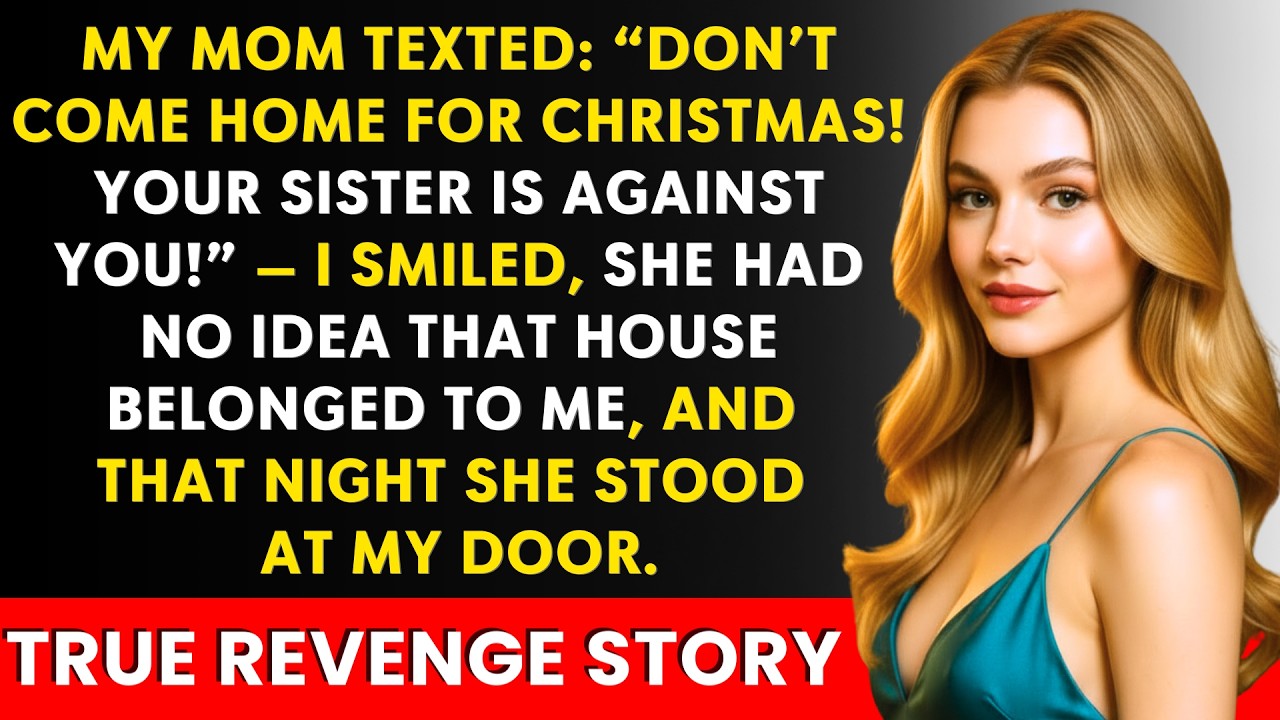
Maybe after 38 years, she was finally choosing me. I opened the message. Don’t come home for Christmas. Your sister is against you.
Nine words. Nine words that summarized everything I’d ever meant to my family. I didn’t cry. I didn’t call her back.
I didn’t throw my phone across the room. I smiled, because my mother had just told me not to come to my house for Christmas, and she had no idea the house she was banning me from had belonged to me for three years. I opened the bottom drawer of my desk. Inside sat a folder I hadn’t touched in months.
Legal documents. Property deeds. A purchase agreement signed by Carter Legacy Holdings LLC, a company I owned entirely, a company that held the title to 247 Maple Street. The house my father built.
The house my mother and sister had been living in rent-free while treating me like a ghost. My name is Emily Carter. I’m 38 years old. I built everything I have myself.
Scholarships, night classes, twelve-hour work days. While my sister Laura spent money like it grew on trees, I learned early that no one was coming to save me. So I saved myself. My family never noticed.
That was the point. I was the invisible daughter, the one who didn’t need attention, the one who showed up early, helped clean up, and never complained when her name was forgotten. Laura was different. Laura was the golden child.
At 16, she got a new car. I got a bus pass. Her college was paid in full. I worked three jobs and graduated with honors and debt.
Her wedding had 200 guests. I sat in the back row, and no one asked why I wasn’t a bridesmaid. I used to wonder what I’d done wrong. But somewhere along the way, I stopped wondering.
I stopped expecting my mother to show up for my life. I stopped inviting her to things, because the disappointment of her absence hurt more than never asking at all. Then my father died three years ago, and everything changed. I looked at the text again.
Your sister is against you. Not “we decided. ” Not “we need space. ” My mother couldn’t even pretend this was her choice.
She was hiding behind Laura the way she always had. But this time, I had something they didn’t know about. I called Diana Walsh, my attorney. She answered on the second ring.
“Emily. I was wondering when you’d call. ”
“You knew this was coming. I figured Christmas would be the breaking point.
What happened? ”
I told her about the text, about Laura pulling the strings, about the fact that they’d just told me not to come to a house I legally owned. “What do you want to do? ”
“I want them to know.
Not everything. Not yet. Just enough to shake the foundation. ”
“I can have a formal notice drafted by morning.
Certified mail or email. ”
“Email. I want to see how fast they panic. ”
For three years, I’d been paying the mortgage on that house.
The property taxes. The insurance. The repairs. I’d watched my mother and sister live in my father’s legacy while treating me like I didn’t exist.
I’d said nothing because I was waiting for them to see me. To change. But they weren’t going to change. That text proved it.
I opened my laptop and composed an email. Subject: Regarding property at 247 Maple Street, formal notice. The body was brief. A notification of ownership.
A request for a family meeting. A deadline of December 24th. I attached the deed. I pressed send at exactly 9:00.
Then I finished my wine, turned off my phone, and went to bed. Let them lose sleep for once. I’d been losing sleep over them for 38 years. I woke up to 17 missed calls.
Twelve from my mother, five from Laura, and one voicemail of my sister screaming into the phone. I let it ring. For 38 years, I’d been the one waiting by the phone. Let them wait for once.
I didn’t listen to Laura’s voicemail. I already knew what she sounded like when she was angry. She’d been perfecting that voice since childhood, weaponizing her emotions to get what she wanted. It worked on my mother every time.
It had never worked on me. By noon, the calls stopped. That’s when I knew something else was coming. Laura never gave up that easily.
She just changed tactics. I thought about how I’d ended up here, a woman who could send a legal notice to her own family and sleep soundly afterward. I’d been trained my whole life. I was ten the first time I understood I was different.
I came home to an empty house, made myself a peanut butter sandwich, did my homework alone. My mother came home at 9:00 with Laura in tow. Soccer game. Winning goal.
Ice cream to celebrate. No one asked about my day. No one noticed I’d been alone for five hours. That became the pattern.
Laura had soccer games and ballet recitals that required my mother’s full attention. I had an empty house and a key around my neck and the slowly forming understanding that I was on my own. At 17, I received a full scholarship to Boston University. I ran downstairs to tell my family at dinner.
My mother smiled and said, “That’s nice, honey. ” Then Laura announced she was trying out for cheerleading, and the conversation shifted. My scholarship was never mentioned again. That night, my father came to my room.
“I’m proud of you, Emily. That’s not luck. That’s you. ”
“Mom didn’t say anything.
”
He was quiet. “Your mother worries about Laura because Laura needs worrying about. She doesn’t worry about you because you’ve never given her a reason to. ” He paused.
“That’s not fair. I know it’s not fair. ”
At least someone saw me. At least someone knew.
My father was the only one who ever did. And then three years ago, he died, and I lost the only witness to my existence. One week after his funeral, I sat in a lawyer’s office and discovered the family home was 63 days from foreclosure. My mother had refinanced it three times to pay off Laura’s credit card debt, her car loan, her failed business ventures.
Over $200,000 extracted from my father’s life’s work. Every dollar had gone to Laura. I could have let the bank take it. But it wasn’t about them.
It was about my father. He’d built that house in 1982, the year I was born. I wasn’t going to let Laura’s spending erase 40 years of his work without a fight. I hired Diana Walsh.
She suggested an LLC so my family would never know who bought the house. It took two months. I liquidated a significant portion of my savings and took out a mortgage in the company’s name. Total cost: $243,000.
Nearly everything I had. On a Tuesday afternoon in February, I signed the final papers. No celebration. No fanfare.
Just the quiet satisfaction of saving something that mattered. For three years, I paid the mortgage, the taxes, the insurance. When the roof leaked, I paid for repairs without anyone knowing. My mother and Laura kept living there, oblivious.
They never checked the deed. They never asked questions. Laura kept spending. I watched from a distance, documenting everything.
Around 7:00 that evening, my doorbell rang. I checked the security camera. Laura was standing in my hallway, clutching her phone like a weapon, pacing and muttering. She’d driven 45 minutes to confront me in person.
I opened the door. She shoved past me into my living room, wearing her designer coat, her nails freshly manicured. She spun around, scanning my apartment with barely concealed judgment. “What the hell is wrong with you?
Do you have any idea what you’ve done? ”
I shut the door quietly and leaned against it. I didn’t say anything. Silence drew out more truth than questions ever could.
Laura kept talking, words tumbling over each other. She waved her phone at me. “This legal notice. Is this some kind of threat?
Are you trying to scare Mom? Because congratulations, Emily. She’s been crying all morning. ”
I still didn’t respond.
“You’ve always been jealous of me. But this is low, even for you. ”
I pushed myself off the door and walked toward her. “Did you actually read the email, Laura, or just the subject line?
”
Her eyes flickered. She hadn’t read it carefully. Laura never read anything carefully. She just reacted.
“Then you know it’s not a threat. It’s a notification of ownership. ”
“Ownership? That’s Mom’s house.
It’s been Mom’s house since Dad built it. ”
I opened the drawer, pulled out the folder, and spread the documents across the coffee table. The purchase agreement. The bank records.
The property deed. “This is the deed for 247 Maple Street. The house you’ve been living in for the past three years. Notice the owner’s name.
”
Laura grabbed the paper and scanned it. “This is fake. You forged this. ”
“I didn’t forge anything.
The house has been in my name for three years, two months, and fourteen days. I bought it from First National Bank after Dad died. You can do that when the bank is about to foreclose on it. ”
The word hung in the air.
Foreclose. “Mom hasn’t owned that house free and clear in over a decade. Someone took out loans against it. Multiple loans.
By the time Dad died, the house was 63 days from foreclosure. ”
Laura’s face went pale. “Who took out loans? ”
I didn’t answer.
Let her mind fill in the blanks. “So what? ” Her voice turned sharp again, defensive. “You bought the house.
That doesn’t give you the right to send legal notices like we’re strangers. ”
“I haven’t threatened anyone. I requested a family meeting. Tomorrow at 2:00, with Mom, Nathan, and Aunt Grace.
”
Laura froze. “Why would you invite her? ”
“Because someone in this family needs to witness the truth. ”
Her voice cracked.
“Does this mean you can kick us out? ”
“It means I have the legal right to decide who lives in that house. It means for three years I’ve paid the mortgage while you and Mom lived there rent-free. It means when you told me not to come home for Christmas, you were telling me not to come to my own property.
”
Laura threw the deed on the table. “This isn’t over. ”
“No, it’s not. That’s why we’re having a family meeting tomorrow.
”
She stormed out, slamming the door hard enough to rattle the frames. An hour later, my phone buzzed. Nathan, Laura’s husband. A man who’d barely spoken ten words to me in four years of marriage.
I don’t know what’s happening. Laura won’t stop crying. But I think we need to talk. I typed back: Tomorrow before the family meeting.
I’ll tell you everything. I met Nathan at a coffee shop at 8:00 the next morning. He looked like he hadn’t slept. His wedding ring was conspicuously absent.
“I need to tell you something about Laura,” he said. “Something I should have told someone a long time ago. ”
He told me about the secret bank account he’d discovered six months ago. The money she’d been siphoning from their joint accounts.
The loan application she’d forged his signature on last year. $35,000. When he confronted her, she cried, promised to change, blamed her difficult childhood. “I believed her every time.
Because that’s what she does. She makes you feel like the villain for noticing. ”
“That sounds familiar,” I said. I told him about the house.
The refinancing. The foreclosure. The money trail into Laura’s accounts. He put his head in his hands.
“I’m such an idiot. ”
“You’re not an idiot. You trusted your wife. ”
“You’re the first person in this family who’s told me the truth,” he said.
“Everyone else just protects her. ”
Nathan wasn’t my enemy. He was another casualty. Six hours later, I drove to 247 Maple Street.
I parked in the driveway instead of on the street. For 38 years, I’d parked like a visitor. Today, I parked like an owner. I used my key.
The door opened to the smell of my childhood. Cedar, old books, lavender sachets. Everyone was already in the living room. My mother sat in the armchair by the window, looking smaller than I’d ever seen her.
Laura was on the couch, arms crossed. Nathan stood by the far window, deliberately separate from his wife. In the corner chair sat Aunt Grace, holding a manila envelope. I walked to the fireplace and stood in my father’s spot.
“In 2018, our father was diagnosed with cancer. That same year, Mom refinanced this house. Between 2018 and 2021, it was refinanced three more times. Total debt: $217,000.
The money went to pay off Laura’s credit cards, her car loan, her failed business ventures. By the time Dad died, this house was 63 days from foreclosure. ”
I looked around the room. “None of you knew, because none of you were paying attention.
”
“So I bought it. Through an LLC. I paid off the bank, took over the mortgage, and have been maintaining this property for three years. You’ve been living rent-free in my house since 2021.
”
Laura stood up so fast she knocked over her coffee cup. “You’re lying. Mom, tell her she’s lying. ”
My mother didn’t move.
Didn’t speak. Her silence was its own confession. Laura turned on me. “You did this to control us.
This is your revenge because Mom asked you not to come for Christmas. ”
“If I wanted control, I would have evicted you the day I signed the deed. If I wanted revenge, I would have let the bank take the house. I did this because Dad built this house with his own hands.
And I wasn’t going to let your debt take it from our family. ”
Aunt Grace stood slowly. “Robert knew this day would come,” she said. “He came to me before he died.
He said Emily is the only one who can save this family. When the time comes, support her. ”
Laura exploded. “This is all a setup.
You and Dad and Grace—you’ve always hated me. ”
“No one hates you, Laura. But no one can keep protecting you from yourself either. ”
She grabbed her purse and stormed toward the door.
Then she turned to Nathan. “Aren’t you coming? ”
Nathan didn’t move. “No.
I think I need to hear the rest of this. ”
Laura slammed the door hard enough to rattle the windows. The silence after she left was deafening. Then Nathan walked to the couch and sat down heavily.
“There’s more. Things about Laura that none of you know. ”
He pulled out his phone. “She’s been transferring money to an account I’ve never seen before.
$15,000 in the past three months. The account holder is someone called David Mercer. ”
Aunt Grace’s face went pale. “Who is David Mercer?
” I asked. “Laura’s biological father,” Grace said. “The man your mother was married to before Robert. The man we all thought was dead.
”
I looked at my mother. Her face had gone white. “Mom. Who is David Mercer?
”
She couldn’t answer. Grace stepped forward. “Margaret married David Mercer when she was 19. David was charming at first.
Then controlling. Then violent. Laura was born in 1990. By then, the marriage was a nightmare.
David ran scams—insurance fraud, identity theft, forgery. When Laura was 2, he was arrested and sentenced to 15 years in federal prison. ”
I looked at my mother. She was crying silently.
“Margaret was humiliated. She told everyone David died in a car accident. Moved to Boston. Started over.
She met Robert three years later. He adopted Laura, raised her as his own. Robert knew the truth. He was the only one besides me.
”
“Did Laura know? ”
My mother finally spoke, barely above a whisper. “I told her when she turned 18. She was furious.
Said I’d lied to her whole life. ”
“David was released from prison 8 years ago,” Grace said. “He reached out to Laura about a year after that. ”
My mother’s head snapped up.
“What? She never told me. ”
“She didn’t tell anyone. I only know because I saw them together once.
She begged me not to tell Margaret. ”
Nathan scrolled through his phone. “The payments go back at least two years. Total estimate: over $80,000.
”
$80,000. Laura had drained our family home of $200,000. Now she was draining her husband, and all of it was flowing to a man who should have stayed a ghost. “Is he blackmailing her?
” I asked. “David Mercer is a con man. Whatever he’s doing, it’s not out of fatherly love. ”
Nathan stood and walked to the window.
“I’ve been married to her for four years. Four years of lies. ” He turned to face us. “I can’t do this anymore.
I’ve already talked to a divorce attorney. ”
My mother gasped. “Nathan, please give her a chance. ”
“I’ve given her dozens of chances.
Every time she cries, promises to change, and then does the same thing again. I’m done being her safety net. ”
My mother showed up at my door that evening. Christmas Eve.
She was holding a bottle of wine, her hands trembling, looking ten years older than she had that morning. “I know you’re waiting for Laura to make her next move. I am too. But I couldn’t sit in that house alone tonight.
”
I stepped aside and let her in. She sat on my couch, and for a moment, neither of us spoke. “I’ve never had both my daughters hate me at the same time,” she said finally. “I don’t hate you, Mom.
”
“You should. After everything I put you through. ”
“When Laura called me this afternoon, after I defended you, she called me a traitor. Said I was choosing you over her for the first time.
” She paused. “But it wasn’t the first time, was it? ”
“It was the first time for me, too. I don’t remember you ever taking my side before.
”
She flinched. “I know. And I’m so sorry. ”
“But sorry isn’t enough anymore.
I’ve been accepting apologies my whole life. Apologies that changed nothing. ”
“Why, Laura? ” I asked.
The question I’d carried for 38 years. “Why was she always the priority? ”
My mother took a long drink of wine. “When I left David, Laura was all I had.
She was 2 years old, and I was terrified I’d ruined her life. I swore I would protect her from everything. ”
“Then I met Robert, and we had you, and you were easy. ” She saw me flinch.
“I don’t mean that as an insult. You were self-sufficient from the moment you could walk. You solved your own problems. You never cried for help.
Laura cried constantly. She needed reassurance, attention, validation. I gave it to her because I thought that’s what protecting her meant. ”
She paused.
“I didn’t realize I was teaching her that she could take and take without consequences. And I didn’t realize I was teaching you that you didn’t matter enough to receive. ”
“You taught me that needing anything was a weakness,” I said quietly. “So I stopped needing.
”
“And I punished you for being strong by treating your strength as permission to ignore you. ”
I told her about my 16th birthday. The cake from a box mix. Eating it alone.
She’d come home at 11:00 and said she forgot. “I told myself it wasn’t a big deal because you didn’t seem upset. ”
“I was 16, Mom. I’d already learned not to show when I was upset.
”
She had no response. “I’ve spent 64 years thinking I was a good mother,” she said finally. “But looking at this place, at your career, at who you became, I realized I had nothing to do with any of it. You built all of this in spite of me, not because of me.
”
She started crying then. Real tears. “I lost you decades ago. I was just too blind to notice.
And now Laura is gone too, running to a man who will only use her. I failed both of you in completely different ways. ”
“Can we be fixed? ” she asked.
“I don’t know. But I know we can’t even start unless things actually change. Not just tonight. Permanently.
”
“Tell me what you need. Anything. ”
“I need you to see me. Not as the backup daughter.
Not as the one who doesn’t need attention. Me. ”
“I’m trying. ”
“Trying is a start.
But I’ve spent 38 years watching you try with Laura and fail. I need to see that this time is different. ”
She nodded slowly. “Then I’ll keep acknowledging.
For as long as it takes. ”
We’d been talking for two hours when my phone buzzed. A text from the building’s front desk. Two people asking to see me.
A woman named Laura Brennan and a man who says he’s family. My mother’s face went pale. “David. She brought David here.
”
“I can tell them to leave. ”
My mother stood. Something shifted in her posture. Her spine straightened.
“No. I’ve been running from David Mercer for 34 years. I’m done running. You wanted to see me change.
This is me changing. ”
I texted the front desk. Send them up. Two minutes later, I opened the door to find my sister standing next to a gray-haired man with sharp eyes and a smile that didn’t reach his face.
“Emily,” Laura said flatly. “This is David, my father. He has something to tell you about yours. ”
David extended his hand.
I didn’t take it. “Your father and I were business partners once,” he said, “before he stole everything from me and left me to rot in prison. I think it’s time the truth came out, don’t you? ”
Behind me, I heard my mother gasp.
“Robert and I were partners in the early ’90s,” David said, making himself comfortable on my armchair. “We pulled our resources—my capital, his connections. Then Robert discovered some irregularities in my accounting. ”
“You mean he discovered you were committing fraud?
”
His smile tightened. “He found something he could use against me. Instead of coming to me like a partner, he went to the FBI. And before he turned me in, he transferred our joint assets into his name.
He testified against me, kept the money, and built his perfect life with my wife. ”
“That’s a fascinating story,” I said. “Do you have any proof? ”
His smile flickered.
Con men rely on emotion, not documentation. My mother stepped forward. Her voice was shaking, but her words were clear. “You’re a liar, David.
You lost everything because you were a criminal. The FBI didn’t need Robert’s testimony. They had your own records. I was there.
I saw the fake invoices, the stolen identities, the clients you defrauded. Robert did the right thing. He reported you because you were hurting people. ”
“The only thing Robert took from you was me and Laura, and we weren’t yours to keep.
”
I stepped between them. “Here’s what’s going to happen. You’re going to leave my apartment tonight. If you don’t leave in the next two minutes, I will call the police.
Then I’ll file a restraining order. Then I’ll contact your parole officer and report that you’ve been harassing my family. ”
The mask finally slipped. Real anger surfaced on David’s face.
“You’re just like him. Cold, calculating. ”
“If protecting my family makes me like my father, I’ll take that as a compliment. ”
David stood, gathering his coat.
He turned to Laura. “Are you coming? ”
The room held its breath. Laura looked at David, then at me, then at our mother.
“Laura,” I said quietly. “He’s using you. Whatever he’s told you, whatever he’s promised, he’s using you to get money. That’s what he does.
”
Laura’s voice cracked. “You don’t know anything about him. ”
“I know he took $80,000 from you. I know your husband is filing for divorce.
I know you’re about to lose everything. And David Mercer is not going to save you. ”
My mother stepped forward. “Laura, please come home with me.
We can talk about this. ”
Laura looked at David one more time. He shrugged. “Your choice.
But when they turn on you again—and they will—you know where to find me. ”
He walked to the door, opened it, and paused. “This isn’t over, Emily. Your father wasn’t the saint you think he was.
”
Then he was gone. Laura didn’t follow. She stayed. She sank onto my couch and put her head in her hands.
“I didn’t know what else to do. I was so angry, and David made it sound like you were the enemy. ”
“Everyone has been protecting you for 38 years,” I said. “That’s the opposite of being against you.
”
Laura was quiet. Then she said, “He contacted me after Dad died. Said he wanted to reconnect. Said he’d changed.
”
“How much did you give him? ”
Her answer was barely audible. “Everything. Everything Nathan and I had saved.
And more. ”
Before anyone could respond, my phone rang. Nathan. His voice was calm, resolved.
“I filed the divorce papers this morning. It’s done. I wanted you to know first. And I wanted to thank you.
You’re the only honest person in that family. ”
He hung up. Laura was watching me, mascara streaked, shoulders hunched. “That was Nathan,” I said quietly.
“I know. He’s leaving me, isn’t he? ”
I didn’t answer. I didn’t have to.
Laura closed her eyes. The defiance was gone. In its place was something I hadn’t seen from my sister in decades. Real fear.
The kind that comes when you finally realize there’s no one left to catch you. My mother sat down next to Laura and put an arm around her. Laura didn’t pull away. We weren’t healed.
We weren’t fixed. But for the first time in 38 years, we were in the same room facing the same truth. It wasn’t enough. But it was a start.
I woke up on Christmas morning to a text from Aunt Grace. Merry Christmas, Emily. Come to my house when you’re ready. Your father has been waiting to talk to you.
I drove through the empty Christmas morning roads. Grace opened the door before I could knock. On her coffee table sat the manila envelope from the family meeting. But next to it was something else.
A sealed letter, yellowed with age. My name written across the front in my father’s handwriting. I stopped breathing. “Your father gave me two things before he died,” Grace said softly.
“The envelope was for the family. But this letter was only for you. ”
I opened it. Inside were three pages of my father’s handwriting, dated two months before his death.
“Would you read it aloud? ” Grace asked. “I’d like to hear his voice again through you. ”
I nodded and began reading.
“My dearest Emily. If you’re reading this, then the time has come. Let me start with what matters most. I am so proud of you.
Not for what you’ve accomplished, though that pride runs deep, but for who you are. You became extraordinary, not because anyone helped you, but because no one did. And I’m sorry for that. I’m sorry I didn’t fight harder for you to be seen.
”
My voice caught. Grace reached over and squeezed my hand. “Your mother loves you. Her love for Laura was never a replacement for love of you.
It was fear. Fear that Laura would break without constant attention. You, Emily, you never needed pouring into. You were a well that filled itself.
And I watched your mother mistake your strength for indifference to love. I should have corrected her. I didn’t. That failure is mine to carry.
”
I had to stop reading. The words blurred on the page. A well that filled itself. “By now, you may have learned about David Mercer.
Here is the truth. David was a con man. I discovered he’d been defrauding our clients—elderly people, families, people who trusted us with their savings. I had a choice: protect my partner or protect his victims.
I chose the victims. I went to the FBI. David went to prison blaming me for his choices. The only thing I took from him was your mother and Laura, and I took them to safety.
”
“Now, for the house. I discovered the debt six months before I died. I was too sick to fix it myself. But I knew you would fix it.
I knew you’d find a way to save the house, even if no one asked you to. That’s who you are, Emily. You protect things. You save things even when no one thanks you for it.
My daughter, my quiet, fierce, magnificent daughter. You did exactly what I hoped you would do. ”
I set the letter down. All the years of being invisible, being strong, being the one who didn’t need anything.
It all broke open at once. I cried then. Really cried. Deep shaking sobs that came from somewhere I’d locked away decades ago.
Grace didn’t try to comfort me with words. She just sat beside me, her hand on my back, letting me release what I’d been carrying for so long. When my sobs finally quieted, she spoke. “He talked about you constantly those last months.
About how proud he was. ”
“Why didn’t he tell me? ”
“Because he thought you knew. He thought actions spoke louder than words.
” She paused. “But some words need to be said out loud. ”
Grace retrieved a small velvet box. “This wasn’t in the instructions.
This is from me. But Robert would have wanted you to have it. ”
Inside was a simple gold band with a small sapphire. My grandmother’s ring.
Robert’s mother had worn it for 62 years. “He always said it would go to the daughter who deserved it. Laura got a lot of things. But this—Robert was clear.
This goes to Emily. ”
I slid the ring onto my finger. It fit perfectly. The doorbell rang.
Grace answered it. Then my mother and Laura appeared in the doorway. “We saw Emily’s car,” my mother said. Then she trailed off when she saw my face.
The tears still drying. The letter in my lap. The ring on my finger. Grace stepped aside.
“Come in. It’s Christmas. Family should be together. ”
Laura saw everything.
For once, she didn’t make it about herself. “Is that from Dad? ” she asked quietly. I nodded.
“What did he say? ”
“He said he loved us. Both of us, in different ways. ”
Laura’s eyes filled with tears.
“I never got a letter. He never wrote me anything. ”
“He didn’t write you a letter,” I said slowly, “because he said everything to you while he was alive. All those years of attention, of protection, of second chances.
That was his letter to you, written in real time. ”
Laura stared at me. Then, for the first time I could remember, she said two words I’d never heard from her before. “Thank you.
”
Six months later, I stood in the garden of my father’s house, my house, watching the first roses of summer bloom. The June sun was warm on my shoulders. Behind me, the house looked different than it had in December. Fresh paint on the shutters.
New flowers in the window boxes. My mother sat on the porch with iced tea, watching me work. In January, I’d gathered my mother and Laura for a different kind of meeting. Not a confrontation.
A conversation about the future. The house would remain in my name. That was non-negotiable. My mother could continue living there rent-free, but with a formal agreement.
Laura was never permitted to use the house as collateral for any loans. I would handle all financial decisions. My mother accepted immediately. Gratefully.
Laura was harder. But she was facing bankruptcy and divorce and the complete collapse of the life she’d built on credit cards and lies. She didn’t have the luxury of arguing. The house that almost divided us became the structure that held us together.
Not because I gave it away, but because I held on to it with clear terms and open hands. Laura’s life had been a slow, painful reckoning. Nathan’s divorce was finalized in March. She got the debt.
Over $120,000, between the credit cards, the forged loans, and the money she’d sent to David Mercer. David had disappeared after Christmas Eve, taking what Laura had given him. She’d tried calling for weeks. He never answered.
“I think I always knew he would,” she told me one afternoon. She filed for bankruptcy in April. Moved back into her childhood bedroom. Started therapy.
In May, she got a job as an administrative assistant. Entry level. Minimum wage. A humbling step down from the lifestyle she’d pretended to afford.
But she showed up every day. She started paying me $50 a month toward the debt she owed. “I know $50 doesn’t fix anything,” she’d said when she handed me the first payment. “But I wanted you to know I’m trying.
”
I didn’t forgive Laura completely. I wasn’t sure I ever would. But I accepted who she was becoming instead. For the first time in her life, my sister was building something rather than taking something.
My mother’s transformation had been the most surprising. She’d sold her expensive car and bought a used Honda. Started volunteering at the library. Joined a support group.
She called me every Sunday now, not to report on Laura or ask for favors. Just to talk. To ask about my work, my life, my garden. To listen when I answered.
In April, she’d sent me a card. Not for my birthday. Not for a holiday. Just because.
The card said: “I’m proud of the woman you are. I’m sorry I didn’t say it sooner. Love, Mom. ”
I’d kept it on my refrigerator for a month.
My own life had transformed too. I’d taken a month off work in February, my first real vacation in years. Started seeing a therapist in March. Been promoted to senior partner in April.
When I called my mother to tell her, she cried. Happy tears. And I’d started dating someone. James, a history professor at Boston University.
Kind eyes, gentle laugh. We met at a bookstore, both reaching for the same biography of Eleanor Roosevelt. It was early still. But it was good.
He asked about my day and actually listened. I’d spent 38 years believing I had to choose between having a family and having myself. Turns out I could have both. I just had to build the family I deserved, not accept the one I was given.
Today was a gathering. Not a formal event. Just people who mattered sharing a summer afternoon. Aunt Grace was holding court in the living room, telling stories about my father.
Diana was there, no longer just my attorney but a genuine friend. James had come, meeting my family for the first time. Even Laura was there, quiet but present, helping set the table without being asked. And my mother, sitting on the porch, watching me garden with an expression I’d never seen before.
Pride. Real pride. The kind she used to reserve only for Laura. This was what healing looked like.
Not the absence of pain. The presence of something stronger. Not forgetting the past. Refusing to let it dictate the future.
I walked back toward the porch, pausing by the rose bushes I’d planted in April. They were blooming now, red and pink and white. My father would have loved them. I touched my grandmother’s ring, still on my finger where it belonged.
I sat down next to my mother. She reached over and squeezed my hand. “Merry belated Christmas,” she said softly. I laughed.
“It’s June, Mom. ”
“I know. But I never said it properly back in December. So, merry Christmas, Emily.
Thank you for not giving up on us. ”
I squeezed her hand back. “Merry Christmas, Mom. ”
The sun was setting over Boston, painting the sky in shades of gold and rose.
In the garden, my father’s roses bloomed. Inside the house, my family laughed together. And for the first time in 38 years, I felt like I was exactly where I belonged.