I built 40 years of trust into one man, and it took him 11 months to spend it down to nothing because I handed him the shovel myself. Nobody warns you what caregiving does to a man. It doesn’t announce itself. It seeps in through the cracks of ordinary days until one morning you catch yourself in the bathroom mirror and you don’t recognize the gray weight behind your own eyes.
That was me, Frank Della Croix, 68 years old. 34 years running a sheet metal fabrication shop outside Toledo before I sold it and thought I’d earned a quiet retirement. My wife Carol was diagnosed with early stage Parkinson’s the same month I sold the business. Her hands started shaking first.
Small things. A coffee cup. A pen. Then the tremor found her voice, and some days it found her balance.
I became the man who counted her pills into a Sunday organizer and drove her 40 minutes to the movement disorder specialist. For 2 years I did that alone. A marriage that had become, in the quietest way, a job with no clock-out time. Then my son called.
Marcus. My only son, 39 years old, living 4 hours away in Columbus. He called on a Tuesday night in March, and his voice had that steadiness men get when they’ve already made up their mind before they dialed. “Dad,” he said.
“I’ve been thinking about this for weeks and I’m not asking. I’m telling you. I’m moving back. You cannot do this by yourself anymore.
”
I am not a man who cries in front of people. I have stood at funerals dry-eyed when everyone around me was falling apart. But I cried on that call. Couldn’t get a full sentence out for almost a minute.
I thought, this is the boy his mother always said he’d grow into. Now I need you to hold on to something while I tell you the rest of this. Every kind thing I’m about to describe happened at the exact same time as something else. Something I did not find out about for 11 months.
The first unauthorized transfer out of my investment account happened 6 days after that phone call. —
Marcus found an apartment over in Sylvania, 15 minutes from our house on Talmadge Road. He was at the house five, sometimes six days a week. He came to Carol’s neurology appointments, learned the names of every nurse, asked sharp questions that made Dr.
Whitfield comment on how rare it was to see an adult child so engaged in a parent’s care. He took over the bills, the pharmacy runs, the grocery trips, the insurance calls that used to eat entire afternoons out of me. What I did not know while I was thanking God was that he was reading every account number he touched like a man casing a house. In month four, Carol had a stretch of three terrible days.
I hadn’t slept more than 3 hours a night in almost 2 weeks. For the first time in my adult life, I let the electric bill go past due. Marcus came over on a Thursday evening, sat across from me at the kitchen table, and set a manila folder down between us. “Dad,” he said, “I need to ask you something, and I need you to actually hear it.
”
He had this rhythm to his talking. Slow, deliberate. Every sentence landing like he’d studied exactly where my fears lived and built a sentence to fit each one. “You’re 68,” he said.
“Mom can’t be left to manage finances on her own days, and you know that better than anyone. If something happens to you, everything freezes. Mom’s care stops cold while lawyers sort out access. I’ve seen this happen to families.
I don’t want it happening to ours. ”
Every word found the exact spot where I was already afraid. Like he’d been standing outside my bedroom door at 3:00 a. m.
listening to my own thoughts. “These are financial power of attorney documents,” he said, opening the folder slow. “It just means I can step in completely on the financial side. Bills, accounts, the investment portfolio, all of it.
You’re already stretched past what any one man should carry. Let me carry this part. ”
My eyes were sandpaper. My hands felt like someone else’s.
I was running on fumes and love, and the specific bone-deep exhaustion that only comes from caregiving. The kind that gets into your judgment, into the part of your brain that’s supposed to read fine print before you sign your name to it. I signed. Marcus had it notarized the next morning at a UPS store on Monroe Street.
Told me about it afterward like it was nothing worth mentioning. And I slept better that night than I had in 4 months, because I thought I’d finally handed something heavy to a pair of hands strong enough to hold it. I had handed him the keys to everything Carol and I had built across 34 years. —
Fast forward through 11 months of 6:00 a.
m. medications and neurology appointments, days where Carol would laugh at a memory from 1997 like it happened that morning, then 20 minutes later not recognize the kitchen we’d cooked in for three decades. 11 months of doing math in the dark after she’s finally asleep, wondering if the money would stretch far enough. Then came a Sunday in February.
Dinner at my daughter Renee’s house out in Perrysburg. Her husband Daniel, a quiet man who worked compliance at a regional credit union downtown. The kind of man you’d walk right past at a barbecue and desperately need in a crisis. Pot roast.
The grandkids loud in the next room. Carol having a good day, present, dressed in the green sweater she loved. Marcus across the table, loud and warm, refilling glasses without being asked, telling a story about a lake trip with the easy confidence of a man carrying nothing on his conscience. Then Daniel’s hand found mine under the tablecloth.
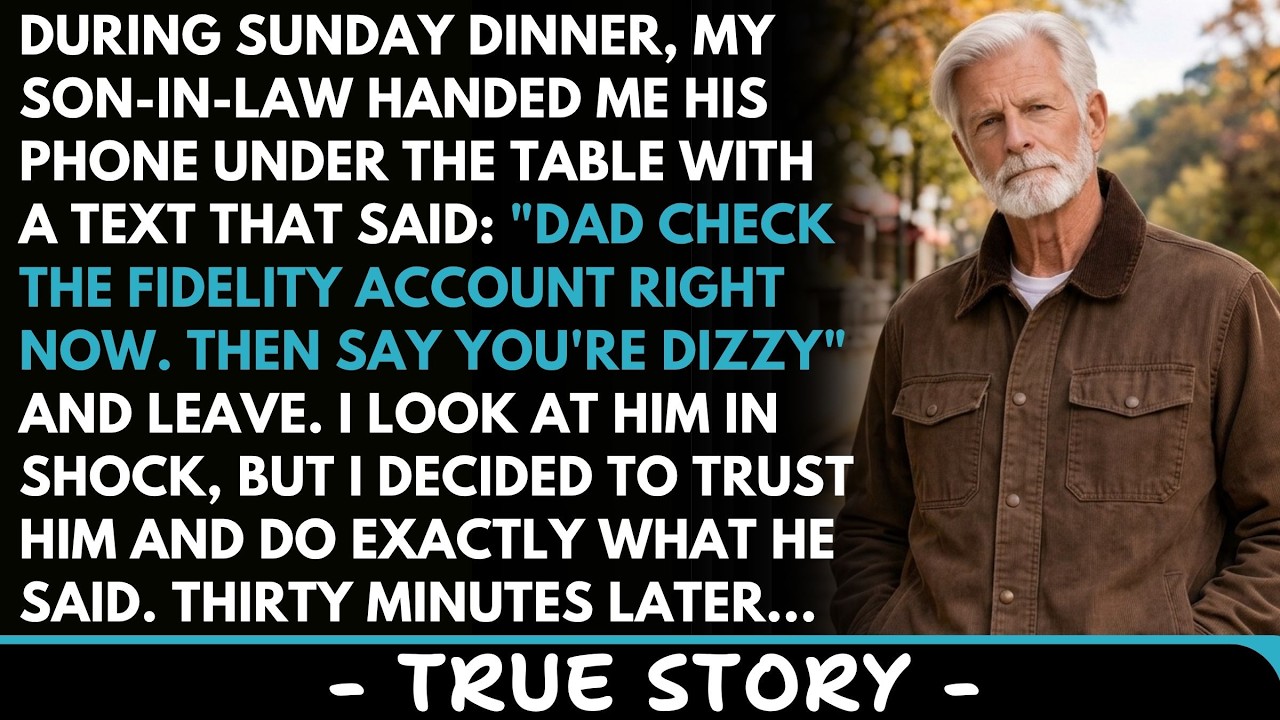
He pressed his phone into my palm without turning his head. Seven words lit up the screen. “Dad, check the Fidelity account right now. ”
Below it, four more words.
“Then say you’re dizzy. ”
I looked up at Daniel. His jaw was set tight. One slow nod.
I opened the banking app under the table with hands that had gone cold. I hadn’t looked at this account in the better part of a year. Marcus handled all of it. That had been the arrangement.
The balance on the screen read $4,190. There had been $286,000 in that account. Every dollar of it set aside across three decades for one single purpose. Keeping Carol safe when I was no longer able to.
Marcus was laughing at his own joke across the table. I put a hand flat against my chest. “I don’t feel right,” I said quietly. “I think I need to sit down somewhere else.
”
Renee was on her feet before I finished the sentence. Daniel helped me out to the car. And Marcus, my son, my own blood, the man I had wept with gratitude over on a phone call 11 months earlier, stood in his sister’s doorway and waved at me with his father’s own face. “Feel better, Dad,” he called out.
“I’ll swing by tomorrow and check on you. ”
I sat in that car and the first thing I thought about was not the money. It was Carol. That $286,000 was her floor.
The memory care wing at the assisted living community over on Fremont Pike that I had toured twice without telling a soul. Gone. And the man who’d taken it was standing in a warm doorway waving goodbye like his hands were clean. —
Daniel pulled out of the driveway without a word and drove us downtown.
Not to a hospital. Not to a police station. To his credit union’s office building on Madison Avenue. Seventh floor.
Empty on a Sunday evening. Our footsteps echoed through the lobby like a church after hours. He shut his office door, sat down across from me, and looked at me the way a doctor looks at you right before delivering news you can’t take back. “Frank,” he said.
He never called me Frank. It was always Dad. “I need you to know everything I’m about to show you has been checked three times over. I didn’t bring you a hunch.
I brought you a case. ”
“How long have you known? ”
“5 months. ”
5 months.
I let that sit. I wasn’t angry yet. Not at him, because I could see on his face that those 5 months hadn’t been easy ones either. “Why did you wait?
”
“Because Renee needed to be completely certain before we took her brother apart in front of her father. And because I needed every exit sealed before he knew a single door was closing. ”
Then he opened the folder. He started with the withdrawals.
14 months of them. Always between $2,800 and $4,900. Never over 5,000. Never the same amount twice.
Never the same interval twice. Careful enough to duck the automatic reporting triggers. “This has a name,” Daniel said. “It’s called structuring.
It’s a federal offense on its own. Separate from the fraud underneath it. ”
My son had robbed me with the same patient discipline I’d spent his whole childhood trying to teach him. He’d finally applied it.
Just not to anything worth being proud of. Then the retirement account. Marcus had used the power of attorney to request my monthly distributions be redirected into a second account he controlled. The paperwork was airtight because Marcus had made sure of that.
Why would the administrator question it? The forms were flawless. Then Daniel slid across a third document, and I knew from the look on his face before I even read it that this one would be the worst. Carol had kept a small private savings account for almost 30 years.
Money that was quietly, entirely hers. Something she’d built without ever making a show of it. The way women of her generation sometimes kept one small thing for themselves in a marriage. Gone.
Liquidated in full using her power of attorney. On her hard days, she didn’t remember the account existed at all. On her good days, she never thought to check. Marcus had picked his moment with a surgeon’s precision.
“There’s one more thing,” Daniel said. He slid the last document across slowest of all. A beneficiary designation change. My signature sat right there at the bottom.
Month eight. A rushed Wednesday. Carol up half the night. Me running on nothing.
Marcus had shown up with coffee and a stack of papers. “Dad, just sign these. Routine account maintenance. I’ve got it handled.
”
I signed without reading a word. Buried in that stack was a form stripping Renee and the grandkids out of my retirement beneficiaries entirely. Replacing every one of them with Marcus. My own hand.
My own signature. Cutting my daughter and my grandchildren out of everything I’d spent a lifetime building. Daniel wasn’t finished. “There’s something else,” he said.
“This is the part that made me move. ”
For months, Marcus had been dropping careful comments to extended family. “Dad’s really struggling more than he lets on. I worry about him constantly.
I’ve had to step in far more than anyone outside the family realizes. ”
An elder law attorney Daniel had quietly consulted recognized the shape of it immediately. Marcus was laying the groundwork for a guardianship petition. If he could get me declared incapable through the courts, everything he’d been doing illegally would become legally sanctioned.
He wasn’t only robbing me. He was building a cage out of concerned phone calls. “How did you find it? ” I asked.
“Routine compliance review,” he said. “The structured withdrawals tripped a pattern flag. I pulled the file. I saw your name on it.
And then I closed my office door and didn’t say a word to anyone until I was certain. ”
My phone rang. Renee. Daniel put it on speaker.
Her voice was controlled. The voice of a woman holding herself together by sheer will. She said Carol was fine. The grandkids were settled.
Marcus was still there, asking about my health, hovering with concern, performing devotion for an audience of exactly one. Then she went quiet. “Dad,” she said softly. “Mom just told Marcus he’s such a good boy.
”
Neither of us spoke for a moment. “I told her he’d just stepped out for some air,” Renee said. “I kept her voice normal. Then I heard her breathing hard through her nose.
The sound of a woman refusing to cry in front of someone who needs her steady. ”
Renee had spent her whole life defending her brother. To me, to Carol, to relatives who whispered about him at holidays, to her own doubts at 2:00 in the morning. She had covered for him and explained him and loved him past every reason not to, because that’s what she believed family meant.
And he had used every ounce of that love as cover while he robbed their father of the one thing being saved for their mother. Then Daniel asked me quietly, almost to himself: “What do you want to do, Frank? ”
You get two choices at a moment like that. You can be loud.
Call your son and say every true, terrible thing sitting in your chest looking for a door out. Or you can be something colder and quieter. Something that actually protects the people left standing. “I want every door shut before he knows one was ever open,” I told him.
“Not for me. For her. Protect her first. ”
Daniel nodded once.
He already had a plan. Revenge is loud. Justice, done right, is almost silent. I picked the quiet one.
—
Nobody tells you that justice, when it finally arrives, doesn’t feel like the movies promise. When it’s real, when it’s your own blood on the other end of it, it doesn’t feel like winning at all. It feels like amputation. Necessary, correct, permanent.
The next morning I sat across from an elder law attorney named Patricia O’Shea. Daniel had already called ahead. I walked in at 8:30 with every document he’d handed me the night before, and she went through them the way a surgeon goes through a chart. Unhurried.
Unflinching. By early afternoon, the power of attorney Marcus held over both Carol and me had been formally revoked. Patricia initiated emergency correction proceedings with the retirement plan administrator. Renee and the grandkids were restored.
Marcus was removed. He had no idea. Day two. Daniel’s compliance department opened a formal internal investigation.
The evidence trail he’d spent five months assembling was handed to the fraud unit in a package so complete that the lead investigator told Daniel it was the cleanest file a private citizen had ever brought him in 14 years on the job. Day three. Marcus came by the house. He brought takeout.
Sat with Carol. Straightened the living room without being asked. Asked how I was feeling after the scare at Sunday dinner. “Much better,” I told him.
“Just tired. You know how it is. ”
“You need to take better care of yourself, Dad,” he said. “I worry about you.
”
I looked at my son across my own living room and thought about the guardianship groundwork he’d been laying in family minds for months, one careful comment at a time. “You’re right, son,” I told him. “I’m going to start paying very close attention to everything from here on out. ”
He nodded.
Looked satisfied. Had no idea what was already moving around him. —
Nine days after that Sunday dinner, I called Marcus in the morning. “Son, I’m feeling a lot better.
Come to dinner at the house this weekend. Bring something nice. We’ve got plenty to be grateful for. ”
He arrived at 6:00 with an expensive bottle of red wine and his widest smile.
The table was set carefully. Carol wore the green sweater, present and warm. Daniel sat beside her, quiet, steady, unremarkable to anyone who didn’t know exactly what he’d done. Marcus sat at the head of the table, charming and generous and devoted.
The golden son at Sunday dinner, as though the last 14 months had never happened. The food was good. The company was almost convincing. Then, midway through the meal, a knock at the front door.
I stood. Walked to it. My house. My floors.
My 34 years. I opened it. Two financial crimes detectives in plain clothes. Calm.
Unhurried. Paperwork in hand. I heard Marcus stop mid-sentence behind me. I stepped aside.
They walked in. I watched my son’s face understand what was happening in real time. There was no guilt on his face first. His eyes moved fast, to me, to Daniel, to Renee, to the door, hunting for an exit that no longer existed.
Every door was already closed. Renee stood up slowly. She’d rehearsed what she wanted to say for 9 days. Revised it.
Stripped it down to almost nothing. When the moment finally came, she found it was simpler than anything she’d practiced. She didn’t raise her voice. She didn’t cry.
“I want you to look at Mom before you leave this house,” she said. The room went still. Marcus looked at Carol. Carol looked back at her son with total, uncomplicated warmth.
She raised her hand and waved gently. “Good night, sweetheart,” she said. “You’re such a good boy. You always have been.
”
Renee let that sit in the room. Let every person at that table feel exactly what her mother’s disease had just done. Protected her son from ever having to watch her face change. Marcus would never see his mother understand what he’d done to this family.
Her mind would carry him safely through the rest of her life with his name warm and clean inside it. He would never have to earn that. Then Renee spoke. Quiet.
Direct. Final. “She’ll probably always believe that, Marcus. Her mind is going to protect you from ever seeing her face change.
You’ll never have to watch her understand what you did to this family. She doesn’t understand it. Dad understands it. And I need you to know I saw every withdrawal you made while he was up at 6:00 in the morning giving her medication.
Every paper you had him sign while he was half blind with exhaustion trying to keep her safe. Every single time you sat at this table and let him thank God for you out loud. I know all of it. And I will spend the rest of my life making sure both of them are all right.
Not because I have to. Because that’s what love actually looks like when it isn’t performing for anyone. ”
Marcus was walked out through the front door of the house on Talmadge Road. Carol, warm and present, watched him go and waved cheerfully from her chair, believing completely that her son was simply leaving after a lovely family dinner.
Marcus pleaded guilty. The trail Daniel built was too clean and too complete for any lawyer to argue around. Elder financial exploitation. Fraud.
Federal structuring charges. Restitution was ordered. It comes back slowly, in pieces. Some of it will never come back at all.
I’ve made my peace with that, or I’m getting there. Carol’s care is secure. The memory care wing on Fremont Pike is within reach now, whenever we need it. Carol is going to be all right.
Not the retirement we planned. Not perfect. But all right. And all right some days is everything a man can ask for.
I still turn over something I never understood until now. Marcus was my blood. But Daniel chose me. And when the people who were supposed to love you show you exactly what they’re capable of, being chosen by someone who owed you nothing at all is the thing that puts you back together.
Not the whole way. But enough to keep going.