The first week of retirement taught me one very important thing. Coffee tastes completely different when you don’t have to drink it standing up, one hand zipping your jacket while the other searches for your keys. For over forty years, my mornings looked almost the same. Alarm clock, bathroom, quick breakfast, checking my watch to see if I was late, even though I usually wasn’t.
Then a person ran, because there was always something to do. Now I was sixty-four, freshly retired, with a very ambitious plan for life. Not to rush. Maria claimed it was the first plan I actually had a chance of sticking to.
We lived in Wrocław, in a large four-room apartment we had bought years ago, when prices didn’t give a person heart palpitations. We had paid it off long ago. The apartment was ours, no mortgage, no bank looking over our shoulder. A few minutes’ walk to the tram.
Old linden trees grew outside the building. Next door was a bakery, a greengrocer, and a small shop where the saleswoman knew Maria so well that she sometimes saved fresh farmer’s cheese for her. In the first days of retirement, I also discovered the pleasure of buying rolls in the morning. A small thing, but before, I only went for fresh bread on Saturdays.
Now I could leave at eight, walk calmly between the buildings, watch others running to work, and return home with a paper bag of still-warm rolls. I won’t lie, it gave me a certain kind of satisfaction. “Don’t look at those people like that,” Maria said one morning, as I stood by the window with my coffee. “Like a king looking at his subjects.
”
“I’m just observing. ”
“Yeah, sure. You’re observing and thinking, run along, I don’t have to anymore. ”
I looked at her.
“You’re reading my mind. ”
Maria was sixty-two and still worked a few days a week, but she increasingly mentioned that she too was starting to count down to retirement. We had been together so long that sometimes we held conversations without words. One look was enough.
On Sunday morning we sat at the table having a very serious discussion. What are we doing today? Maria asked. Nothing.
I also wanted to do nothing. Then we can do nothing together. I don’t know if we’ll quarrel. About what?
Who’s better at doing nothing. Just then, the intercom rang. Maria looked at the clock. Łukasz, our son, was in his mid-thirties.
He had a wife, Dorota, and a ten-year-old son, Kuba. They lived across town. I knew they’d stop by, but I expected coffee, cake, and an ordinary Sunday conversation. Five minutes later, they were sitting at the table.
Kuba immediately went for a piece of the cheesecake Maria had made the day before. Dorota drank coffee. Łukasz, however, stirred his spoon in his cup for so long that I started to suspect he was trying to drill a hole in it. “Alright,” I said.
“What happened? ”
He looked at me. “Why does something have to happen? ”
“Because I’ve known you since you weighed three kilos and screamed all night.
When you stir your coffee like that, it means you want something. ”
Dorota smiled slightly. Łukasz sighed. “We’re having a bit of trouble with the apartment.
”
We knew that a few months earlier they had bought a small apartment that needed renovation. It was supposed to be done quickly. Then the contractor pushed the date back two weeks, then a month. Then it turned out the electrical system needed extra work.
A classic renovation. You start by replacing the floor and end up wondering if it wouldn’t be easier to demolish the building and build a new one. “The contractor moved the date again,” Łukasz said. “Apparently at least two more months.
”
“What about the rental? ” Maria asked. Dorota rolled her eyes. “The landlord raised the rent.
A lot. He said from next month either we pay more, or we can move out. ”
Łukasz put down his spoon. Finally, he looked me straight in the eye.
“Dad, could we stay with you for a while? Two, at most three months. We just need to get back on our feet. ”
I looked at Maria.
She had already made her decision, I could see it on her face. Besides, this was our son, our grandson. We had the space. “Of course,” Maria said.
“You won’t be overpaying for rent when there are two free rooms here. ”
“Really? ” Dorota relaxed immediately. “Sure,” I said.
“Two, three months will fly by. ”
Kuba jumped up. “I’ll live with grandpa? ”
“With everyone,” Dorota corrected him.
“But with grandpa too. ”
“Unfortunately,” I sighed. “It looks that way. ”
Kuba laughed and threw his arms around my neck.
At that moment, I was genuinely happy. I thought there would be more life in the house. Maria would have her grandson close, and I would have someone to play chess with. Although Kuba regularly cheated and claimed it was the new modern rules.
We agreed they would move in the following weekend. A week later, at nine in the morning, Łukasz’s car pulled up in front of the building, then a second one, and a moment later a delivery van. I stood on the balcony and watched them pull out suitcases, boxes, bags, an office chair, a computer, toys, two bicycles, a food processor, several flower pots, and something large wrapped in foil. Maria came out onto the balcony.
They have a lot of stuff. I nodded. Down below, Łukasz was pulling out another box, then another, then one more. I looked at Maria.
Honey, for two or three months, they brought enough things for a mass migration. For the first few weeks, everything went surprisingly well. Really. I was even surprised at myself for having been worried about living together.
The house suddenly felt full again. In the morning, someone walked down the hall, someone opened the fridge, someone looked for socks, someone called from the bathroom saying there was no towel. After years of quiet for two, there was something pleasant about it. What pleased me most was Kuba.
At breakfast, he sat across from me with a cup of cocoa and told me everything that had happened at school. And since he was ten, every story was a matter of utmost importance. “Grandpa, imagine, Filip got a demerit. ”
“For what?
”
“Because he told the teacher the assignment was pointless. ”
“A brave man. ”
Maria put a plate in front of me. “Don’t teach the child nonsense.
”
“I’m just analyzing the situation. ”
Kuba looked at me very seriously. “Did you ever get a demerit? ”
“I never did.
”
Maria snorted. “Stasiu, please. ”
“Alright, maybe a few times. ”
In the evenings, Kuba came to me with the chessboard, although his knowledge of the rules was, to put it mildly, flexible.
Once he moved a rook diagonally, and when I pointed it out, he announced, “There are new rules now. ” Łukasz, sitting nearby, choked on his tea. “He has his grandfather’s talent for negotiation. ” “From me?
” I was offended. “At least I cheat according to the rules. ” Maria threw a dishcloth at me, but a clean one this time. On Sunday mornings she cooked broth, the real kind, slowly, with no shortcuts.
The smell filled the whole apartment from morning, and Łukasz peeked into the pot more often than a chef. After dinner, we usually went for a walk. Sometimes all together, sometimes just me and Kuba. We’d take the tram a few stops to the center, buy ice cream, or walk along the Oder.
One day Maria said, “You know what? It’s good that they’re here. ” I looked at her. “I think so too.
” And I meant it. Even Łukasz seemed more alive. He helped me replace a loose shelf in the hall, fixed a cabinet hinge, and one afternoon he offered to drive me for heavier groceries. We went to the supermarket.
Maria gave us a list. Of course, the list was written as if we were stocking up for Christmas for the whole neighborhood. “Why do we need a kilo of potatoes? ” I asked.
Łukasz shrugged. “Mom wrote it. ” A strong argument. We didn’t argue.
On the way, he told me about the renovation. The contractor was apparently finishing the bathroom, then the painter was coming, then the kitchen. Everything sounded reasonable. “A little more and we’ll be ready to go,” he assured me.
“No need to rush,” I said then. Today, thinking about it, I want to hit myself over the head with a newspaper. But at the time, I really meant it. Dorota was also nice at first.
She helped Maria set the table. Sometimes she came home from work with cake or flowers. Only after about two weeks did the small things start. So small that you don’t even know if they’re worth noticing.
First, the cups. For years, Maria kept them in the cupboard above the sink. Each one had its place. I had a large navy blue mug with a slightly chipped handle.
Kuba had given it to me for Grandfather’s Day, and even though Maria had told me a hundred times to throw it away, I wouldn’t let her. One morning I opened the cupboard. The mug was gone. “Maria, where’s my mug?
” “What mug? ” “Mine, the navy blue one. ” “You have about eight of them, but only one is mine. ” Dorota heard us from the kitchen.
“I moved some of the cups to the upper cupboard. ” “Why? ” She answered completely calmly. “It’s more convenient this way.
” I looked at Maria. Maria looked at me. No one said anything. I found my mug almost at the ceiling.
A few days later, I noticed everything in the fridge had changed places too. The butter, which had stood on the middle shelf for years, was suddenly in the door. The jars went to the bottom. My pickles ended up at the back behind Dorota’s yogurts.
“I did a bit of tidying,” she explained. Alright, tidying. A person isn’t going to call a family meeting over a jar of pickles. Then came Saturday.
Maria was frying pork cutlets. I stood at the kitchen counter cutting cucumbers for salad when Dorota walked in, stopped in the doorway, and slightly wrinkled her nose. “Maybe we shouldn’t fry so much. ” Maria turned from the pan.
“Excuse me? ” “Because then the whole apartment smells. Curtains, clothes, everything. ” I looked at the golden cutlets, then at Dorota, then back at the cutlets.
Interesting, for over sixty years the smell of fried cutlets hadn’t bothered me, and now suddenly we had an almost ecological disaster in the kitchen. I opened my mouth, but Maria shot me a quick look. That married look of ours that meant, Stanisław, don’t start. So I didn’t.
Not yet. After three months, I began to feel that Łukasz’s renovation wasn’t a renovation, but a natural phenomenon. Every week it was supposed to end, every week something happened. Once the contractor didn’t show up because he was sick.
Then there were no tiles. Then it turned out someone had measured the kitchen counter wrong. Then the plumber had to fix something another plumber had already fixed. “Two more weeks,” Łukasz would say.
A month later, again. “Two more weeks. ”
Finally, one evening I looked at Maria and said, “You know, if they were building Malbork Castle, they’d probably be done by now. ” Maria just sighed.
The worst part was that with each passing week, Dorota felt more and more at home. At first, she moved small things. Then she started buying various boxes, baskets, organizers, and containers. Suddenly everything had to have its place.
Only, as it quickly turned out, Dorota was the one designating the places. “This looks unnecessary here,” she said one day, picking up the ceramic rooster that Maria had received from her own mother. “It’s been standing there for twenty-five years,” I noted. “Exactly.
” I didn’t know what that was supposed to mean, but the rooster disappeared. Then three napkins disappeared. An old vase, a newspaper basket, and two pictures from the hallway. Maria initially shrugged.
After all, she’s not throwing anything away, just putting it away. That was very reassuring. One afternoon I came back from a walk and immediately felt that something was wrong. The living room looked different.
The table stood closer to the window. The lamp had been moved. The chest of drawers had been turned to face another wall. I looked around again, and then I understood.
My armchair was gone. Not just any armchair. My big, brown one, a little worn on the armrests. I had sat in it for half my life.
I read the newspaper in it, watched matches, fell asleep after dinner, and held the most important family conversations, meaning those in which Maria told me what to do and I pretended to think about it. “Where’s my armchair? ”
Dorota leaned out of the kitchen. “In the basement?
”
“What do you mean, in the basement? ”
“Just that. Łukasz and I carried it down. ”
“Why?
”
She looked at me as if I had asked why rain is wet. “It ruins the living room. ”
For a moment, I said nothing. That armchair was almost forty years old.
It had survived three renovations, two moves, galloping inflation, one cat named Marla who sharpened her claws on it for five years. It had even survived the times when a person bought furniture not because it matched the interior, but because it happened to be available. And it didn’t survive Dorota. “You could have at least asked,” I said.
“Stasiu, it’s just sitting in the basement,” Maria chimed in. I looked at her. “Someday I’ll just be sitting in the basement too. ”
She snorted, although she tried to keep a straight face.
Dorota had already gone back to the kitchen, as if the matter were settled. That same evening, I went down to the basement, and there was another discovery. My basement was no longer my basement. Łukasz’s boxes stood there, two bicycles, some shelves, furniture parts, suitcases, and equipment whose purpose I didn’t even know.
My tools, which had had their place for years, had been moved against the wall. I searched for my pipe wrench for maybe ten minutes. Finally, I found it in a box labeled “miscellaneous. ” That hurt.
A man organizes his tools according to his own system his whole life, and then someone comes and turns them into “miscellaneous. ”
The next day, Łukasz asked for the car. “Dad, can I take the car? I need to go to the hardware store.
” Sure. Two days later, again. “Dad, can I take the car? ” Take it.
Later, he just announced it. “I’m borrowing the car. ” Fine. Until one morning I walked into the hallway, reached for the keys, and didn’t find them.
“Maria, have you seen the car keys? ” Łukasz took it. Where? I don’t know.
He said he’d be back before noon. I stopped with my hand over the empty shelf. It wasn’t even about the car. It was that for the first time, I felt something really unpleasant.
I started checking whether I could use my own things. I asked if anyone needed the car, whether I could go down to the basement, because maybe I’d left something among their boxes. Whether the chair I wanted to move hadn’t accidentally already been placed better. In the evening, I told Maria, “Something’s not right here.
” She sat down next to me. “I know. ” “Then why aren’t you saying anything? ” She stroked my hand.
“Come on, Stasiu. They’re our children. ” “Our children are in their mid-thirties. ” “A little longer.
” I looked toward Kuba’s room. I could hear him laughing while playing on the computer, and it was because of him that I didn’t want to make a scene. Because of Maria, too. So I just nodded.
“Alright, a little longer. ” At the time, I didn’t know how much that “a little longer” could mean. The worst thing about family help is that it very quickly stops looking like help. At first, you hear, “Dad, when you have a moment,” then, “Dad, can you today,” and after a while, only “Dad, you need to.
” And that’s roughly when I understood that Łukasz treated my retirement not as a new stage of life, but as information about my round-the-clock availability. It started innocently. “Dad, will you pick up Kuba from school today? ” Sure, I liked picking him up.
We’d walk part of the way. Sometimes we’d buy a pastry, and Kuba would give me a full report on his day. The next day, again. “Dad, can you manage to get Kuba?
” I managed. Then came the shopping. “Since you’re going to be in town, stop by for milk. ” Later, milk turned into a list.
Milk, bread, apples, yogurts, toilet paper, dish soap, and something else whose name I didn’t know, but Dorota assured me it was definitely in the health food section. One morning, Łukasz called me before nine. “Dad, could you take my car to the shop? ” “What happened?
” “Something’s knocking in the front. ” “And you? ” “I have meetings all day. ” I went.
I sat in the shop for almost two hours with coffee from a vending machine that tasted like someone had rinsed a cup with coffee water. When I got back, Łukasz just said, “Thanks, Dad. I knew I could count on you. ” Nice.
The next day, I had to go to the post office, then pick up a package, then buy printer ink, then drive Kuba to practice, then take documents to Dorota, because she’d left them on the table and was already at work. At some point, I started wondering if I should buy a cap that said “family services. ” My typical day went something like this. Until eight, I was a retiree.
At nine, I got promoted to driver. At ten, I worked as a courier. In the afternoon, I often became a free mechanic, a warehouse worker, or the guy for “just one tiny thing. ”
The most interesting part was that Łukasz never said any of this maliciously.
On the contrary, for him it was all completely natural. “You’re at home anyway,” he said once, when I asked him to pick up a package himself. “You’re at home anyway. ” It stuck in my head.
As if a person on retirement had no life, as if he sat in the hallway in his jacket, just waiting for someone to give him orders. Maria had it similar. Only hers started in the kitchen. At first, she cooked for everyone with pleasure.
She always liked cooking anyway. Tomato soup, pancakes, pierogi, sometimes roasted chicken. Kuba ate everything, so Maria was happy. Until one evening Dorota walked into the kitchen and asked, “Mom, what’s for dinner tomorrow?
” Maria didn’t even look up. “I don’t know yet. ” “Because if something light, maybe without cream. ” I was sitting at the table reading the newspaper, but I glanced over my glasses.
That didn’t sound like a question. It sounded like a menu inspection in a cafeteria. The next day was similar. “Mom, what are you doing tomorrow?
” “What do you mean? ” “No, are you going to cook? ” “I don’t know, maybe we’ll do something together. Why?
” Maria didn’t notice for a long time. Or she pretended not to. It got worse with the laundry. At first, Dorota threw her things in with ours.
Then a separate bag appeared. After a while, a basket of clothes just stood in front of the washing machine without a word. The basket meant roughly, Maria will know. And Maria knew.
She washed, dried, folded. Sometimes she even ironed Łukasz’s shirt. One evening, I saw her standing at the ironing board with his white shirt in her hand. “Maria, why are you ironing Łukasz’s shirt?
” “Because he has an important meeting tomorrow. ” “He’s in his mid-thirties. ” “I know how old he is. ” “Then he probably knows how to use an iron.
” She looked at me. “Stasiu, don’t start. ” This time, however, I did. “I don’t like this.
” She put down the iron. “What exactly? ” “Everything. You cook, wash, iron, I drive around town like a taxi driver.
They don’t even ask if we can anymore. They just assume we will. ” Maria sighed. “You’re exaggerating.
” “I’m not. ” “It’s only for a while. ” “That ‘a while’ has been going on for a very long time. ” She sat down on a chair.
For a moment, she looked tired, and then I softened a bit. I knew why she was doing it. For Łukasz, for Kuba. Because a mother always finds a reason to help just a little longer.
“A little longer,” she said quietly. “They’ll finish the renovation soon. ” I leaned against the counter and looked at her. “Maria, this renovation is starting to look like a highway construction project.
” She raised an eyebrow. Meaning, everyone had heard about it, but no one had seen the end. She laughed despite herself. Good thing she did, because if she hadn’t laughed then, I think I really would have gotten angry.
But the problem didn’t disappear. On the contrary, for the first time, we both knew it wasn’t about a few favors. Our house had simply become a family service. Except no one asked us if we wanted to work there.
The conversation about a fair division of duties happened on Saturday morning. I remember it well, because Maria made scrambled eggs with chives. Kuba was eating cereal, and I was in an exceptionally good mood. Which, of course, meant it was the perfect time to ruin it.
Łukasz sat at the table across from me and had been scheming for a while. I know my own son. When he starts with, “Dad, I was thinking,” it usually means I’m about to find out what I should do. “So?
” I asked. Łukasz put down his cup. “You know, there are a lot of us in the house now. ”
I looked at Maria.
She had already slightly slowed the movement of her hand holding the fork. “I’ve noticed,” I answered. “Well, exactly. And I think we should organize the chores a bit better.
”
Dorota immediately nodded. Ah, so the conversation had been prepared in advance. That was always a good sign. “What chores?
” I asked. Łukasz assumed the tone of a man presenting a national recovery plan. “Well, normally. So everyone knows what they’re responsible for.
” Kuba stopped eating and started listening. Maria shot him a quick look. “Eat, sweetie. ” Łukasz continued.
“Dad, you’re retired, so you can handle the shopping, the car, and Kuba. Mom cooks anyway, so let that stay on her side. ”
I looked at him. “Mom cooks anyway.
” A beautiful sentence. So warm, so family-like. All that was missing was an Excel spreadsheet. “And you?
” I asked. Łukasz was slightly flustered. “We work. ”
“I see.
”
Dorota put down her knife. “Stasiu, it’s only about being fair. ”
“Of course, because right now everything is a bit chaotic,” she added. “Sometimes you don’t know who’s picking up Kuba, who’s doing the shopping, who’s taking care of what.
”
I thought it was actually very clear to me. “And we need to divide the expenses reasonably too,” Łukasz said. Maria raised her head. Now that was interesting.
“What expenses? ” she asked. “Well, the shared food, fuel, bills. There are five of us.
”
Dorota quickly added, “It’s not about counting every penny, of course. Just everyone should have their responsibilities. That would be fair. ”
Silence fell.
Even Kuba sensed something was happening, because he stopped crunching his cereal. Maria looked at me. I knew that look. Stanisław, please, don’t make a scene.
And indeed, I didn’t. For a few seconds, I just looked at Łukasz and Dorota. Then I felt something settle very calmly in my head. Without anger, without shouting.
Actually, I even found it amusing. I smiled. “You know what? ” Łukasz probably breathed a sigh of relief.
“What? ” “Great idea. ” Maria frowned. Dorota smiled.
“Really? ” “Really. I also think we need rules. ” Łukasz relaxed his shoulders.
“See, I knew we’d come to an agreement. ” “Me too. ” I finished my scrambled eggs and didn’t say another word that day. That evening, I sat down at the computer.
Maria came into the room and stood behind me. “What are you doing? ” “The rules, Maria. They wanted them.
”
She read the first few lines, then covered her mouth with her hand. “You’re really going to hang this up? ” “Of course. ” “They’ll be offended.
” “Maria, I’m not offending anyone. I’m just organizing the chores. ” She looked at me, and I already knew she was trying not to laugh. The next morning, I got up early.
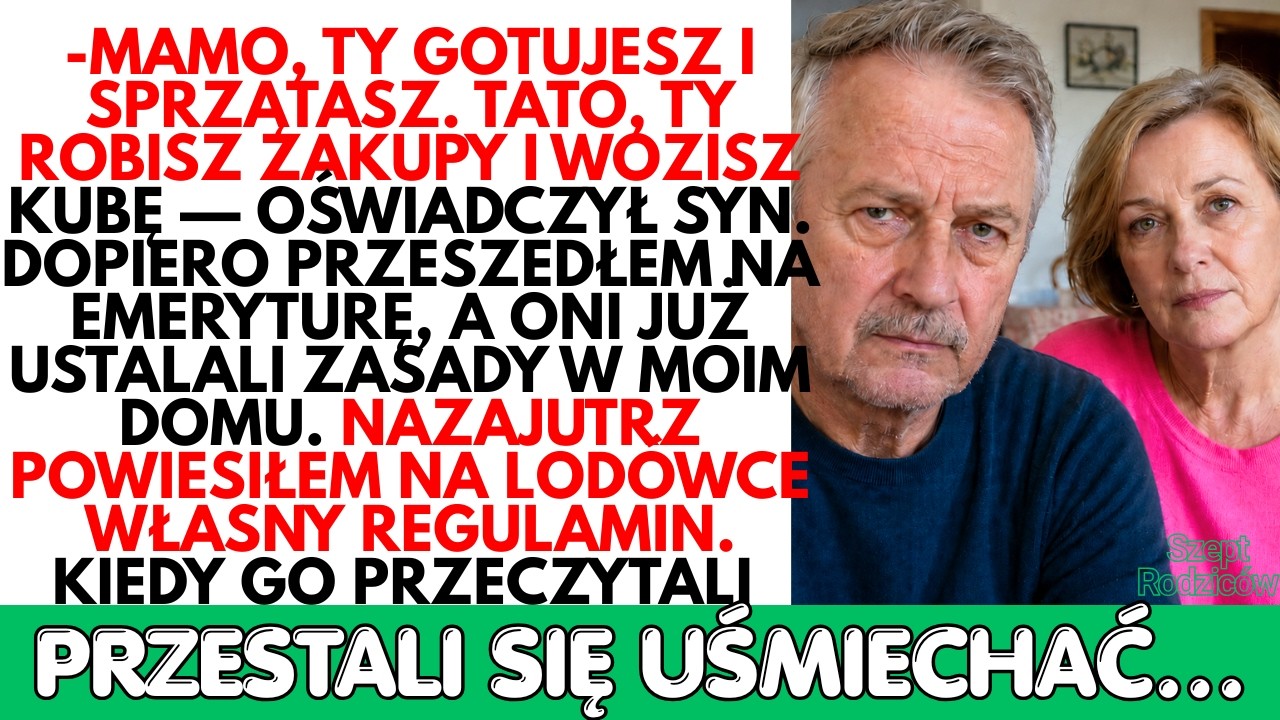
I printed one page. At the top, in large letters, I wrote: RULES FOR LIVING IN THE HOME OF STANISŁAW AND MARIA. I attached the page to the fridge with magnets. Below it read:
Room for two adults: monthly fee set on the first day of each month.
Utility bills for electricity, water, gas, and internet divided proportionally to the number of residents. Garage space and additional basement space are not part of free accommodation. The homeowner’s car is not a family car. Car keys are issued only with the owner’s consent.
Moving furniture, removing armchairs, pictures, decorations, and other items belonging to the owners requires prior agreement. Adult residents wash and iron their own clothes. Maria’s cooking is an expression of goodwill, not a mandatory service. Care for Kuba is provided only after prior scheduling.
Private products belonging to Stanisław and Maria are not common supplies and should not be taken without asking. At the very bottom, I added one more sentence, the most important one. I bolded it. Discount for immediate family: 0%, because immediate family should know best what respect for someone else’s home means.
I stepped back. The page looked very professional. Almost like condo association rules. Maria came into the kitchen, read everything from beginning to end.
“Stasiu, you’re impossible. ” “No, I’m organized. ”
Just then, Łukasz walked into the kitchen. He yawned, opened the fridge, and only then noticed the page.
He read the heading. Then the first point, the second, the third. The morning calm slowly disappeared from his face. Dorota came up behind him.
“What’s that? ” I took my cup of coffee. My navy blue one, the one reclaimed from the upper cupboard. “What does it look like?
” I took a sip. “Our new rules. ”
On the first day of the rules, Łukasz still laughed. He stood in front of the fridge, read everything a second time, and snorted.
“Dad, okay, okay, nice joke. ” “I’m glad you like it. ” “Come on. Do I really have to pay for the basement?
” “You don’t have to. You can take your things. ” “And the car is mine. ” “I know it’s yours.
” “Great. We’re clear. ” Łukasz shook his head, as if talking to a man who had suddenly decided to raise goats on the balcony. He still didn’t understand that the rules weren’t decoration.
He understood the next morning. I was sitting in the kitchen, drinking coffee and reading the news on my phone, when Łukasz rushed into the hallway. A moment later, I heard him opening a drawer, then another, then the characteristic sound of “no. ” Finally, he appeared in the kitchen.
“Dad, where are the keys? ” “Car keys? ” “Yes. ” He looked at me for a moment.
“I need to go to work. ” “Did Dorota take the car? ” “She took it. ” I took a sip of my coffee.
“Well, look at that. Awkward situation. ” “Dad, seriously? ” “Very seriously.
” “Then lend me yours. ” “No. ” He opened his mouth. “Why?
” “Because I need it today. ” “Where are you going? ” “I don’t know yet. ” “Then how can you need it?
” “Very easily. It’s mine. ” Maria, standing at the counter, turned around so Łukasz wouldn’t see her face. I knew that face.
She was about to burst out laughing. Łukasz left the kitchen offended and ordered a taxi. That same day at noon, he called me. “Dad, will you pick up Kuba from school?
” “I can’t. ” Silence. “What do you mean, you can’t? ” “Just that.
” “But you’re retired. ” “That’s exactly why I can’t. ” “What does that mean? ” I looked at Maria, who was just putting on her coat.
“We’re going to the cinema, your mother and I. ” “The cinema? ” “Yes. Apparently there’s a movie showing.
” “So, Łukasz, Kuba is your son. ” “I know. ” “Great. Second clarity this week.
” I hung up. I wasn’t doing it out of anger. We really had tickets. Maria had wanted to see that film for a long time.
Something always came up. Usually something family-related. That day, for the first time in many weeks, nothing came up. Or rather, something did, but it was ours.
After the cinema, we went for coffee. Maria sat across from me, stirring her cappuccino, and suddenly said, “You know what? ” “What? ” “This is even pleasant.
” “The cinema? ” “No, the fact that I don’t have to rush home to make someone dinner. ” I looked at her. “See.
”
Maria started to change slowly. Not as suddenly as me. But with each day, she understood more and more that you can help your family without being on call twenty-four hours a day. A few days later, Dorota came home from work around six, walked into the kitchen.
Maria sat at the table, already made up, putting on earrings. Dorota stopped. “Mom, what’s for dinner tonight? ” Maria didn’t hesitate for a second.
“I don’t know. ” “What do you mean, you don’t know? ” “Stasiu and I have a table reserved at a restaurant. ” Dorota frowned.
“And us? ” Maria looked at her with genuine surprise. “Do you have a reservation too? ” I had to turn my head away.
Not because I wanted to be mean. But if Maria started talking like that, it meant the situation had really gone far. That evening, when we returned, the kitchen smelled of burnt pasta. Łukasz stood by the pot.
“How was it? ” he asked coolly. “Good. We also had an interesting evening.
” I looked into the pot. “I can see. ”
From that moment, everything started to look different. Dorota’s laundry basket stood in front of the washing machine for two days.
On the third, it was still there. On the fourth, Dorota turned on the washing machine herself. Then she discovered that the laundry had to be taken out, and then, which was a true technological breakthrough, that shirts don’t iron themselves. Łukasz started doing the shopping.
The first time, he came back with three bags but without half the things on the list. “They didn’t have it,” he said. “What? ” I asked.
“Some things. ” Maria looked into the bag. “Łukasz, you were supposed to buy milk. ” “I forgot.
” “And bread too. ” “But I bought chips. They were on sale. ” I nodded.
A person learns his whole life. With Kuba, everything also had to be organized themselves now. Who picks him up, who takes him to practice, who supervises his homework. Suddenly, it turned out the family calendar was full of things that had previously somehow gotten done.
That “somehow” was usually me and Maria. The bills also started to make an impression. When I showed Łukasz how much his share for electricity, water, and gas came to, he raised his eyebrows. “That much?
” “Yes. But you were paying bills before too. ” “Of course. ” “Exactly.
Only before, there weren’t three extra people living with us. ”
The first few days, there were more sighs than usual in the house. Then a little slamming of cupboards. Once, Dorota very demonstratively started the washing machine at ten in the evening.
But Maria and I didn’t comment. We didn’t punish them. We didn’t count every slice of bread. We didn’t make winner faces.
We simply stopped doing the work they had come to consider our duty. And then something very interesting happened. After less than two weeks, Łukasz looked more tired than I was before retirement. One evening, he came into the living room, collapsed onto the sofa, and said, “A man comes home from work, and there’s still so much to do.
” I looked up from my book. “Shopping, laundry, Kuba, car? ” “Yeah,” he sighed. “How did you two manage all this before?
” I looked at Maria. Maria looked at me. I just smiled somehow. After about two weeks of the new rules, Dorota stopped pretending everything was fine.
At first, she only sighed. Then she sighed louder. Later, cupboards were slammed with such force, as if each one was personally responsible for her difficult life. I tried not to react.
Maria too. We really didn’t want a war. We just lived our own lives, and I think that’s what annoyed Dorota the most. One afternoon, she came home early from work and found me in the living room.
I was sitting in the armchair. Yes, that armchair. I had temporarily brought it up from the basement, because I figured that since I still lived in my own house, I might have the right to sit in my own furniture. Dorota stopped in the doorway.
“That armchair is here again. ” I looked at the armrest. “It looks like it. ” “We agreed it doesn’t fit here.
” “I don’t remember agreeing to that. ” She narrowed her eyes. “Stasiu, do you really have to do everything to spite us? Isn’t it enough that I’m sitting?
” Maria was in the kitchen, and I could hear her stop chopping vegetables. Dorota took off her coat. “I really don’t understand what these demonstrations are for. ” “What demonstrations?
” “These rules, counting bills, asking about the car, now the armchair. ” “These aren’t demonstrations. It’s called ordinary life. ” “Ordinary?
” She laughed shortly. “Ordinary life is when family helps each other. ” “Helps? Not exactly what I’d call it.
” “What? ” “Dorota, for several months you had an apartment, food, laundry, a car, childcare for Kuba, and half your errands done for you. And now you’re accusing us? ” “I’m not accusing you.
” “Then why are you talking about it? ” “Because you claim we didn’t help you. ”
At that moment, Maria came in. “Maybe everyone calm down a bit?
” Dorota turned to her. “Mom, I’m really trying, but a person feels like they have to ask permission for everything here. ” “Because sometimes it’s worth asking,” I said. “But I live here.
” “Temporarily. ” That word seemed to hurt her. “Temporarily. Temporarily.
I keep hearing that. ” “Because that was the plan. ” “And what am I supposed to do when the renovation drags on? ” “Nothing.
You can live here. Just don’t rearrange our house to your liking. ”
And then she lost her temper. She threw her bag on a chair.
“I don’t feel at home here at all anymore! ” Silence fell. Maria looked at me immediately. She probably already knew I was about to say something.
I looked at Dorota calmly, without a smile. “And finally, we agree on something. ” Dorota froze. Maria closed her eyes.
For a moment, I thought maybe I’d been too harsh, but I didn’t take the words back, because it was the truth. Dorota wasn’t at home. She was at our house. That evening, Łukasz asked me to come out onto the balcony with him.
He closed the door behind us. For a while, we both said nothing. “Dad, can we talk normally? ” “We can.
” “Without jokes. ” “Alright. ” He leaned his hands on the railing. “We’re family.
Why are you turning the house into a hotel? ” I looked at him. This time, I didn’t want to answer with a joke. “I also thought we were family.
Until you decided to make the rules in my house. ” Łukasz sighed. “It was only about chores. ” “No.
It started much earlier. ” He was silent. “I let you live here for free. Without asking for money, without counting food, without a set deadline, because you’re my son and I wanted to help you.
” “I know. ” “No, I don’t think you do. ” He looked at me. “Because help isn’t giving someone the right to decide about our lives.
” “No one is taking anything from you. ” “Really? ” I raised an eyebrow. “Dorota threw my armchair into the basement.
” “Okay, it’s just an armchair. ” “Exactly. My armchair, in my house, and she didn’t even ask. ” Łukasz didn’t answer.
“Then it was the kitchen, the basement, the car, the laundry, the shopping, Kuba. Everything became automatic. Mom was supposed to cook because she cooks anyway. I was supposed to drive because I’m retired.
” “We didn’t mean to take advantage of you. ” “Maybe you didn’t mean to, but that’s exactly what you started doing. ” I said it calmly, without raising my voice, and I think that’s why it sounded stronger. Łukasz looked down.
“So what now? ” “Now we’ll settle something clearly. ” He looked at me uncertainly. “You have two months.
” “For what? ” “To find an apartment. ” He straightened up immediately. “You want to throw us out?
” “No. ” “Well, that’s exactly what you just said. ” “I said I’m giving you two months. That’s not throwing you out on the street.
” “And if we don’t find anything? ” “You will. ” “Dad—” “Łukasz, listen. ” I stepped closer.
“I love you. I love Kuba. I don’t want to treat Dorota like an enemy either. You can stay here peacefully for these two months.
No one will rush you with suitcases. ” I paused briefly. “But me and your mother live here. If you want to be our guests, respect the hosts.
If you want to make your own rules, do it in your own home. ” He looked at me for a long time. I could see he was angry. Maybe even more disappointed than angry.
“I didn’t expect this from you,” he finally said. I felt a pang, but I only nodded. “I didn’t expect this from you either. ” I went back inside.
Maria sat at the table waiting. “You told him? ” “I told him. Two months.
” She sighed. I sat down next to her. “Do you think I did the right thing? ” Maria was quiet for a long time.
Then she placed her hand on mine. “I think it should have been done earlier. ” And for the first time in a long time, I felt like we were truly on the same side. For the first few days after our conversation, Łukasz walked around the house offended.
He didn’t slam doors. That would have been too simple. He just became extremely polite. “Good morning, Dad.
” “Good morning. ” “May I use the kettle? ” “Łukasz, I’m asking because now there are rules. ” Dorota was less subtle.
One evening, she said to Maria, “Honestly, I didn’t think parents could be so selfish. ” I was sitting nearby, I heard it, but I didn’t respond. A few weeks earlier, I probably would have started explaining, proving, reminding who helped whom. Now I felt no need.
Sometimes a person reaches a point where they stop fighting for others to acknowledge they’re right. It’s enough that you know where your own boundary is. The page on the fridge stayed. No one tore it down.
No one joked about it anymore either. After a week, Łukasz started looking at apartment listings. At first, he did it demonstratively at the table. “Well, look, two rooms and that rent.
” “Mhm,” I answered. “And here’s a deposit too. ” “That’s how it is. ” “And a commission.
” “Those happen too. ” He looked at me, as if waiting for me to finally say, “Okay, son, I was joking. You can stay until Kuba retires. ” I didn’t say it.
After a few days, he stopped commenting on prices. He started calling, then driving to see apartments. And then something strange happened. The house became calmer.
As if someone had let the air out of an inflated balloon. Suddenly, there was no more struggle over who’s in charge, because the deadline was clear. Two months. Dorota stopped moving things.
One day, I even saw her take the ceramic rooster, Maria’s rooster, the one that had previously stood “unnecessarily,” out of the cupboard. She put it back in its old place. Maria noticed, said nothing, but later, when we were alone in the kitchen, she looked at me. “Did you see?
” “I saw. ” “The rooster came back. ” “The family is reuniting. ” She snorted.
Łukasz changed too. One morning, he stood by the door, coat in hand. “Dad, can I take the car today? I need to see an apartment on the other side of town.
” I looked up from the newspaper. That was the first normal question in a very long time. “What time will you be back? ” “Around six.
” “Alright, just fill up the tank. ” “Sure. ” And that was it. No lecture, no rules, no irony.
In the evening, the car stood in front of the building with a full tank. I thought then that it could work after all. You just have to remember that other people’s things are other people’s things, even if they belong to your father. In the middle of the second month, they found an apartment.
Small, three rooms, in a different neighborhood, close to Kuba’s school. The rental was for a year, until their own renovation finally finished. This time, Łukasz didn’t say “two more weeks. ” I think he had stopped believing contractors himself.
When he signed the contract, he came into the living room that evening. “We have—” “What? ” “An apartment. ” Maria put down her book.
“Really? ” “From the first of next month. ” “Well, that’s good,” she said, and there was something in her voice that I really liked. Relief, but also ordinary motherly joy that her son had managed on his own.
Without triumph. Without “I told you so. ”
That same week, I decided to permanently bring my armchair back to the living room. I went down to the basement with Łukasz.
“Will you help? ” He looked at the armchair. “You still want it? ” “What do you mean, still?
” “Nothing. ” We grabbed it from both sides. The armchair was heavier than I remembered. Or I was weaker.
I prefer the first version. When we carried it into the living room, Maria stood in the doorway. “It’s really coming back? ” I put the armchair in its old place.
I adjusted the cushion. “Maria, it’s older than our marriage. It deserves respect. ” “Our marriage is old too.
That’s why I don’t take you to the basement. ” “You’d try. ” Łukasz laughed first. That was probably the first time in many weeks we all laughed without tension.
The last days passed very quickly. Boxes appeared in the hallway again. Only this time, the sight of them didn’t worry me. On the contrary, I helped Łukasz pack.
We took apart Kuba’s desk, carried down the bicycles, sorted things in the basement. Along the way, I found my pipe wrench, which had been living in the “miscellaneous” box for several months. “Oh,” I said. “The lost one has returned.
” Łukasz looked at the label on the box and looked a little embarrassed. “Dad, sorry about the tools. ” “It’s fine. ” I didn’t need more.
On moving day, the van pulled up in front of the building again. This time, I helped carry the boxes myself. Dorota was tired but calm. Maria packed them sandwiches for the road, even though I told her they were moving a few kilometers away, not emigrating to Australia.
“A person can get hungry,” she answered. Kuba ran between us and asked every five minutes if he could sleep at grandma and grandpa’s in the new place. “You can,” I said. “We’ll see how you behave.
” “Are there rules? ” I looked at him. “Kuba, don’t start. ” He laughed.
When the last box went into the van, Łukasz stopped next to me. For a moment, he said nothing. Then he extended his hand. Instead of shaking it, I patted him on the shoulder.
“Go on. Dorota’s waiting. ” He nodded. There was no grand reconciliation, no speech.
But there was also no war, and I think that’s what I wanted most. The next morning, I woke up and for a few seconds didn’t know what was wrong. I lay in bed, stared at the ceiling, and listened. Nothing.
Silence. No running in the hallway. No “Dad, have you seen the keys? ” No “Who’s picking up Kuba today?
” No slamming cupboards. Even my slippers stood exactly where I had left them the night before. No one had moved them because they looked wrong next to the dresser. I sat up in bed.
“Maria? ” “I’m in the kitchen,” she called. I got up and followed the smell of coffee. Maria sat at the table in her robe, holding a cup.
She looked suspiciously calm. “So,” she asked. “Do you miss anyone? ” “You know who?
” I didn’t answer. I walked to the fridge and opened it. On the middle shelf stood a small plate, and on it, a piece of cheesecake. My piece.
The one I had saved for myself the previous evening. I stared at it for a moment with genuine emotion. “Maria, what is—” “What? ” “The cheesecake.
” She laughed. For the past few months, if I left something good for the night, there was a good chance I’d find only an empty plate in the morning and Łukasz saying, “I thought you didn’t want it. ” I took out the cheesecake. Maria watched me with a smile.
“So? ” I put the plate on the table. “I don’t miss anyone yet. ”
For the first few days after they moved out, the apartment seemed bigger.
Not just because the boxes were gone, although that helped too. We simply got our space back. Suddenly, you could walk down the hall without dodging someone’s backpack. The bathroom was free in the morning.
In the fridge, I knew where the butter was again. One day, Maria opened the cupboard and said, “Look at that. ” The cups were all standing as they used to. My navy blue one was down low, within reach.
“Civilization has returned,” I said. But the biggest change was the empty room. For a few days, we didn’t do anything with it. It stood empty.
Then Maria started looking in there more and more often. Finally, one afternoon, she stood in the middle of it and said, “You know, I’d like to make this room mine. ” “What do you mean? ” “Maybe a place for sewing, a shelf for books, a small table.
” “Go ahead, Maria. It’s our apartment. Who do we have to ask? ” She looked at me, and we both laughed.
After a week, the room looked completely different. Maria put her sewing machine by the window. She placed a lamp next to it. Two bookshelves appeared on the wall, and flowers on the windowsill.
Of course, I also had to leave my mark. I carried in a small table and an old record player that had been forgotten for years, and of course, the armchair. The same one. Maria saw it and shook her head.
“You’re really going to drag that thing everywhere? ” “It’s not an armchair anymore. It’s a family member. It even has more rights than some people, because it doesn’t touch other people’s things.
”
From then on, we went out more often. To the cinema, for coffee in the center. One weekend, we went to the Karkonosze Mountains without much of a plan. Two nights, a small guesthouse, a walk, good food.
Maria said then, “We haven’t been anywhere alone in a long time. ” And she was right. There was always something. Work, house, son, then grandson, and a person doesn’t even notice when they stop having a life of their own.
Łukasz, Dorota, and Kuba, of course, didn’t disappear, and that was good. They came over on Sundays. Sometimes Kuba stayed the night, but now the difference was huge. They called ahead.
They asked if we could. Dorota brought cake. Łukasz no longer opened cupboards like he owned the place. Once, he even asked, “Dad, can I get some juice from the fridge?
” I looked at him. “You can. ” “Yeah, I’m just asking. ” “I see progress.
” He rolled his eyes but smiled. Our relationship really did improve. Maybe because we were a family again, not five people trying to arrange their lives in one kitchen. One evening, Maria and I sat in the new room.
She was organizing books, I was adjusting a record on the turntable. She looked around. “It’s nice here, Stasiu. ” “Yes.
” “And if they ask to live with us again someday? ” I looked at her. “Of course, we’d take them in. They’re family.
” Maria smiled suspiciously. “For free. ” I looked toward the kitchen. The old page still hung on the fridge, a bit faded.
There was a coffee stain on the corner, but the rules were still legible. I looked back at Maria. “Maria, please. Don’t break the rules.
“