Tuesday afternoon, you are home alone. Maybe your spouse is out running errands. Maybe you live by yourself. And somewhere between the kitchen and the living room, you feel something.
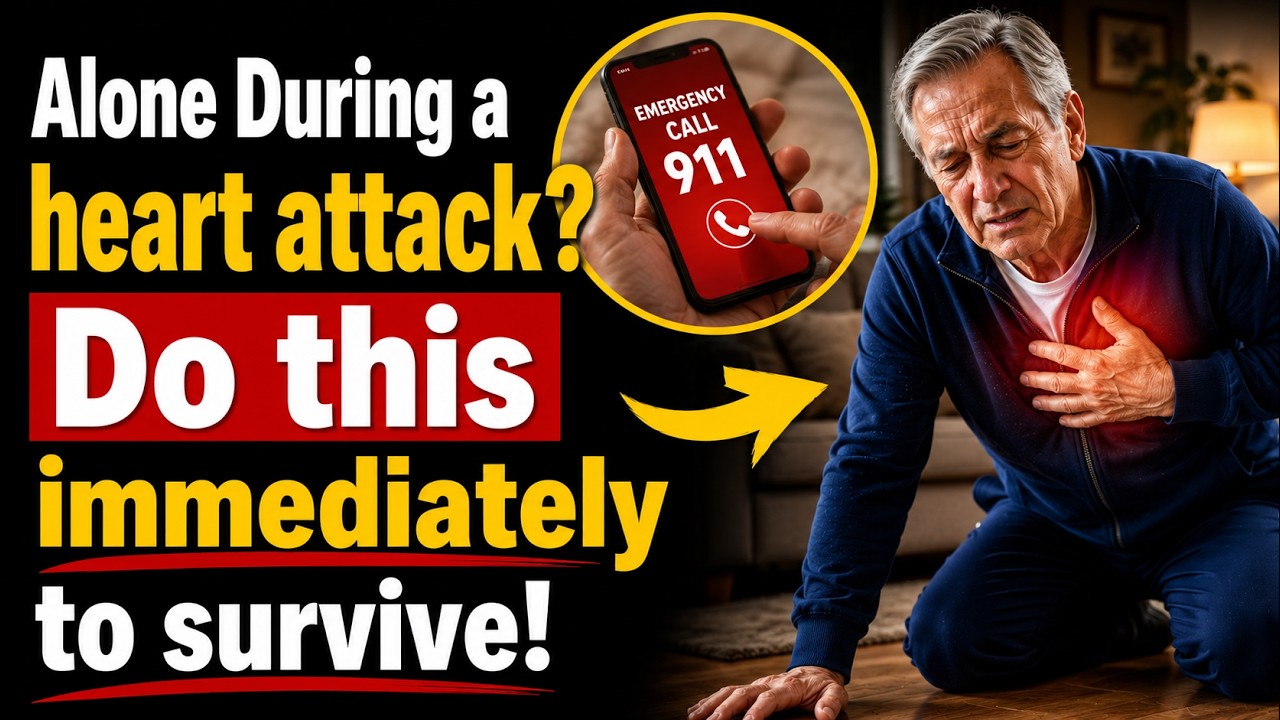
Pressure in your chest. Your left arm feels strange. And your first thought is not, “I am having a heart attack. ” Your first thought is, “I hope this passes.
”
That moment—that specific window of time—is the whole story. Because what you do in the next three to eight minutes after that feeling starts isn’t a minor detail. It’s the difference between a survivable event and one that isn’t. Cardiologists talk about a window of time during a cardiac event.
It varies from person to person, depending on the type of event and which artery is involved. But the consistent message across the research is this: the faster intervention happens, the better the outcome. We’re talking minutes to a couple of hours, not days. The average emergency response time in the United States, from the moment you call 911 to the moment paramedics are working on you, is between eight and twelve minutes in urban areas—longer in rural ones.
Which means the minutes between when you realize something is wrong and when trained help arrives are not a waiting period. They are a survival period. And I want to say something to those of you who feel relatively healthy right now. Some of you are watching because someone you care about sent this to you.
Or because you believe in being prepared. That’s exactly the right instinct. The five things I’m going to walk you through take about a week to fully put in place. They are dramatically easier to set up when you’re healthy than when you need them.
Let’s start at the very beginning. The first sixty seconds. Because this is where most people get it wrong. Not because they panic, but because they simply don’t know there’s something specific they should be doing.
Tip one: call 911. That’s the first action. But here’s the part that most people have never thought through, and it’s something paramedics themselves have spoken about openly. They arrive at a home.
They know someone inside is having a cardiac event. And they can’t get in. The door is locked. The person called 911 and then sat down or lay down, and now they can’t get back to the door.
Breaking down a residential door, depending on the construction and the deadbolt, can take anywhere from thirty seconds to several minutes. Every one of those seconds is time your heart isn’t receiving the intervention it needs. So here’s the specific detail inside this tip. The moment you feel something is wrong, before you dial—or immediately after you dial, while you’re still on your feet—walk to your front door and unlock it.
Open it slightly if you’re able. Then sit or lower yourself into a safe position. That one act takes about ten seconds, and it can shave minutes off the response time once paramedics arrive at your home. When you call 911, do not hang up after you give them your address.
The dispatcher on that line is trained specifically for this scenario. They will keep you calm, give you real-time instructions, and relay your condition to the paramedics who are already on their way. That phone call is not just an alert. That person is your first layer of support.
If you can put the phone on speaker and set it down, your hands are free. One more thing worth knowing. If you have a smart speaker in your home—an Amazon Echo or a Google Home device—in most cases, you can say “call 911” and it will connect you without needing to touch your phone at all. It’s worth checking today whether that feature is active on your device.
Tip two: aspirin. The dosage and method almost nobody gets right. Let me walk you through this carefully because there are three specific details inside this tip that the general “take an aspirin” advice almost always leaves out. The dosage first.
You want 325 mg. That’s one regular adult aspirin. Not two baby aspirin, because two of those only gets you to around 162 mg, which is less than the therapeutic dose in an acute cardiac event. And not ibuprofen, not Tylenol.
Aspirin specifically, because of how it interacts with blood clotting. During a heart attack, a clot is forming in or near a coronary artery. Aspirin disrupts the mechanism that allows platelets to clump together and build that clot. No other common over-the-counter painkiller does this the same way.
Now here’s the part that actually changes things, and almost nobody knows this. Do not swallow it whole. Chew it. When you swallow aspirin whole, it has to dissolve in your stomach before it enters your bloodstream.
That takes time. When you chew it, absorption begins much faster. In a cardiac event, that difference matters. Now, I want to say this clearly.
This applies if you do not have a known aspirin allergy, a bleeding condition, or a specific instruction from your physician to avoid aspirin. If you’re on blood thinners or have a history of GI bleeding, follow your doctor’s guidance. But either way, call your doctor’s office this week and ask directly: given your current health profile, if you thought you were having a heart attack and you were alone, should you take aspirin? Get a real answer.
Write it down. And once you have your answer, keep aspirin somewhere you can actually reach it. Not in a cabinet upstairs. Kitchen counter, nightstand—somewhere within arm’s reach.
Tip three: the position your body is in can work against you. Most people’s instinct here is exactly wrong. If you were in your living room right now and you felt sudden chest pressure, what would you do with your body? Most people would stay in their chair, or they would stand and try to reach their phone, or they would lie down on their back because that feels like the natural thing to do when your body is in distress.
Here’s what the practical reasoning actually supports. If you can do so safely, lower yourself to the floor gently, carefully, using furniture to guide yourself if you need to. Once you’re on the floor, roll onto your left side with your knees bent slightly toward your chest. Why the floor?
If you lose consciousness while seated or on a couch—which can happen during a cardiac event, sometimes without much warning—you fall. And falling from a seated height can mean a serious head injury, a fractured wrist from bracing, a broken hip. Secondary injuries during a cardiac emergency make an already complex situation significantly harder. The floor removes that risk entirely.
You’re already at the lowest point. Why the left side? The heart sits slightly left of center in your chest. Lying on your left side reduces the mechanical pressure on the heart that occurs when you lie flat on your back.
It also keeps your airway in a safer position if you vomit, which can happen under this kind of physical stress. Why knees slightly bent? It keeps your body stable and reduces physical tension. You may be in that position for eight to twelve minutes before help arrives.
Comfort here is not a luxury. It’s a stability issue. I want to be clear about something. This is not a formal emergency protocol the way CPR is.
But it’s sound practical reasoning based on what we know about cardiac physiology and fall risk. If you have a condition that makes getting to the floor genuinely unsafe—severe balance issues, recent hip surgery, significant mobility limitations—then staying in a low stable chair with armrests might be the safer version of this same principle. The goal is getting your body low, stable, and on your left side if possible. Here’s the part I want you to actually do.
At some point this week, when you’re feeling well, practice lowering yourself to the floor and rolling to your left side. Use a carpeted area. Use furniture for support. Do it once.
Just once. The first time you attempt this should not be during a cardiac emergency. I also want to add something that doesn’t get talked about enough. For people over sixty, and particularly for women, a meaningful number of cardiac events do not present with the classic crushing chest pain.
They may feel like unusual sudden fatigue, a strange feeling of fullness or mild indigestion, nausea, a vague sense that something is simply not right. I’m not telling you to panic every time you feel tired. But if you experience an unusual combination of symptoms—particularly fatigue alongside nausea or shortness of breath, alongside a feeling that something is off—do not wait to see if it passes. Apply these steps and call 911.
A false alarm costs you an embarrassing ambulance ride. Not calling costs something else entirely. Tip four: your phone is only useful if you can still use it. You’re on the floor.
You’ve taken aspirin if it’s appropriate. You have your door unlocked. Everything you’ve done so far only buys you time if help is actually coming. And getting help coming is more complicated than it sounds when your hands are shaking and your vision is beginning to narrow.
Here’s the scenario that plays out more often than people realize. You feel the pressure. Your left arm feels heavy. You reach for your phone.
Your hands are shaking. Your vision is narrowing slightly from the drop in blood pressure. You try to enter your passcode—six digits you’ve typed a thousand times. And in this moment, your fingers won’t cooperate.
Or you can’t see the numbers clearly. Or the phone is across the room and walking to it feels impossible. This is not hypothetical. This is how cardiac emergencies actually unfold for many people.
So here’s what I want you to do today. Not in an emergency, but right now, while your hands are steady and your mind is clear. On an iPhone, go to your settings app. Scroll to Emergency SOS.
Make sure “Call with Side Button” is turned on. This means that pressing and holding the side button and a volume button simultaneously—or pressing the side button five times rapidly, depending on your model—will automatically call 911 without requiring your passcode. It will also send your location to your emergency contacts. You can test this.
The phone shows a countdown before it calls. Press cancel during the countdown and it won’t call. Practice the motion so your hands know it. On an Android device, the setup varies slightly by manufacturer.
On most Samsung phones, go to Settings, then Safety and Emergency, then Emergency SOS. On a Google Pixel, it’s under Settings, then Emergency Information. On other Android models, search for Emergency SOS in your settings menu. It’s almost always there.
The principle is identical across all of them: multiple rapid presses of a single button. No unlocking required. 911 is called automatically. Set this up today.
While you’re in there, do one more thing. Go to your Medical ID. On iPhone, that’s in the Health app. On Android, it’s in the Safety and Emergency section of your settings.
Fill it out completely: your name, your emergency contacts, your blood type if you know it, any critical medications you take, any relevant conditions—diabetes, a pacemaker, a prior cardiac history. Paramedics can access this information from your lock screen without your passcode. They use it. It directly affects the care they provide in the first minutes.
And here’s the low-tech version of the same idea, because technology is not always reliable. Take a piece of paper right now. Write your name, your emergency contact name and number, your blood type, and any critical medications or conditions. Put it in a small plastic sleeve.
Tape it to the inside of your front door or on your refrigerator. Emergency responders are trained to look for this. Both systems—digital and physical—cost you nothing and give the people trying to help you exactly what they need without having to ask. Tip five: the neighbor strategy.
Everything we’ve covered so far is about what you do in the moment. But here’s what I’ve come to believe after years in this field: the best emergency plan is the one that means the emergency doesn’t have to unfold entirely alone. I want to ask you a question, and I want your honest answer. Is there one person within a reasonable distance of where you live who would know within a few hours if something had happened to you?
Someone who, if they hadn’t heard from you by a certain time of day, would feel something was off and check? For some of you, the answer is yes. A spouse. An adult child nearby.
A close friend next door. That’s a real form of safety you may be taking for granted right now. But for a significant number of people, the honest answer is no. Not really.
Not in a way that would matter in a two-hour window. I know what some of you are thinking. “I genuinely do not know my neighbors. We wave.
We’ve never had a real conversation. I cannot exactly knock on someone’s door and ask them to be my emergency contact. ”
I hear that. That’s the reality for a lot of people in this country.
Neighborhoods are less connected than they used to be. That’s not anyone’s failure. It’s just the reality of how many American communities function now. So let me give you the fuller version of this tip.
If you do have a neighbor you have any relationship with, even a surface level one, this is the moment to deepen it slightly. You don’t need to have coffee with them every week. You just need a specific, simple agreement. “If you don’t see my kitchen light on by eight in the morning, please knock on my door.
” Or, “If I send you a message that just says the word ‘help,’ call 911 and come over immediately. Don’t text back. Don’t call me first. Just call 911 and come.
”
Most people, when asked directly, will say yes without hesitation. The conversation is far less awkward than you’re imagining. What you’re giving them is not a burden. You’re giving them the ability to help someone they already care about.
But if you genuinely don’t have that relationship, then the alternative is a daily check-in system with someone who knows your schedule. An adult child. A close friend. A church member.
Someone who can realistically notice within a few hours if they haven’t heard from you. There are also applications designed specifically for this—tools like Snug Safety—or simple daily text threads that create a structured check-in without putting full responsibility on one person. The goal is one person or one system that would know within two to three hours if something had happened. Work backward from there and figure out what fits your actual life.
So here’s the five-day action plan. Five days. Five actions. Nothing takes more than ten minutes.
Day one: set up your phone’s Emergency SOS. Then walk to your front door and practice unlocking it quickly. Notice whether anything between you and that door—furniture, a rug, a step—could slow you down in an emergency. Adjust what you can.
Day two: call your doctor’s office. Ask whether aspirin is appropriate for you in a cardiac emergency, given your current medications and health profile. Get an answer. Write it down.
Then check your home for accessible aspirin that’s within its expiration date. Day three: on a carpeted area or rug, practice lowering yourself safely to the floor, rolling to your left side, knees slightly bent. Use furniture for support going down and back up. Do it once.
That’s enough. Day four: fill out your Medical ID on your phone. Then write the paper version. Name.
Emergency contact. Blood type. Critical conditions and medications. Put it in a sleeve and place it somewhere visible near your front door or on the refrigerator.
Day five: identify your person or your system. Make the ask. Decide together what the signal looks like. This conversation takes less than five minutes.
And when it’s done, you will feel something shift. Not just preparedness. Relief. I want to say something before we wrap up that sits a little outside the clinical side of what we’ve been discussing.
I’ve been in medicine long enough to have sat across from family members whose loved ones did not survive cardiac events that were, in the honest assessment of everyone involved, survivable. Where the window existed. Where the person had enough time and enough function to do something that might have changed the outcome. And they didn’t.
Because no one had ever told them specifically what to do. That’s not a failure of medicine. That’s a failure of information reaching the right people in time. That’s why this channel exists.
That’s why this video exists. Not to make you afraid, but to make sure the information that belongs in your hands is actually in your hands, in a form you can use. You are not fragile because you’re over sixty. But you are at a different level of cardiovascular risk than you were at forty.
The people who navigate that reality well aren’t the ones who worry about it constantly. They’re the ones who prepare for it specifically, and then go on living without giving it another thought, because the system is in place. Five tips. Unlock your door before or right after you dial.
Chew 325 mg of aspirin if there are no contraindications. Get to the floor on your left side, knees bent. Set up your phone’s Emergency SOS and fill out your Medical ID. Build your one-person or one-system check-in before the end of this week.
None of these require anything you don’t already have. They just require you to do them before you need them. So before you move on from this video, think of one person. One person in your life who lives alone and is over sixty, or who spends significant time alone during the day.
You don’t need to explain what’s in this video. Just send them the link. That’s the only thing I’m going to ask you to do.


