My house burned down, and I had nowhere to go. So I drove to my daughter Capri’s mansion, hoping she would take me in. Her husband Darius opened the door, took one look at my smoke-stained clothes, and told me I would stain their imported marble floors. He said they weren’t a shelter for beggars and closed the door in my face.
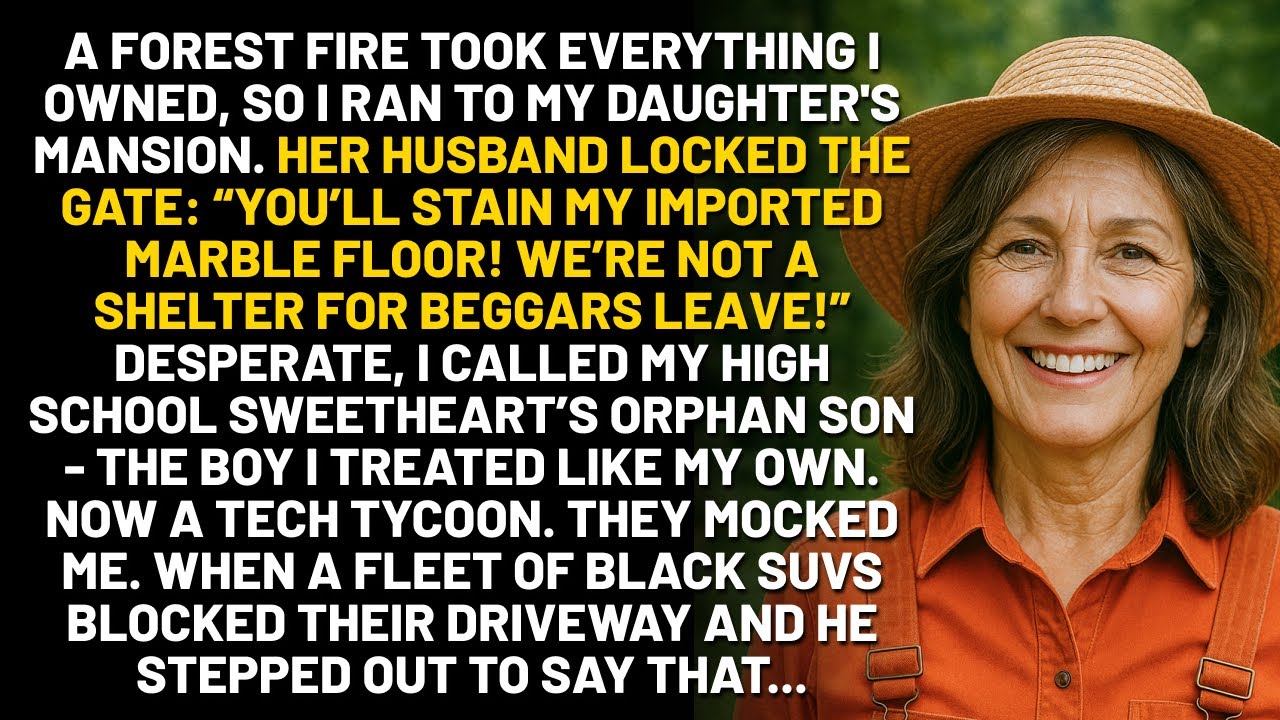
My own daughter watched from the window and did nothing. I called the only other person I had left. Marcus Chen, the orphaned boy I had raised for ten years after his parents died. He became a tech tycoon, and when he arrived in a convoy of black SUVs, Darius and Capri mocked him.
But Marcus knelt beside me on the driveway and said, “I’m glad to have you here, Mom. ”
Here is my story. My name is Lillian, and I’m sixty-six years old. Three days ago, a wildfire swept through my neighborhood and destroyed everything I owned.
All that was left of the house my late husband David had built with his own hands was a pile of ash and twisted metal. The insurance company said my policy didn’t cover acts of God, so I got barely enough to buy a used car. I held David’s wedding ring, a photo of my son Marcus at his high school graduation, and a deed that was now worthless paper. Everything else, the antique furniture, the quilts I had sewn by hand, the garden I had tended for thirty-five years, was gone.
I had been sleeping on my friend Margaret’s couch, but her husband made it clear that two nights was all they could manage. That’s why I drove to Capri’s mansion in the hills. I wasn’t coming as a visiting mother bringing homemade cookies. I was coming because I had nowhere else to go.
The mansion sat behind iron gates, all glass and cold modern lines. I pressed the intercom, and the housekeeper answered. After a long pause, she said, “Mr. Darius says he’ll speak with you.
” Not even his first name, as if I were a stranger seeking an audience with royalty. When the door opened, Darius Wellington, my son-in-law of twenty-two years, stood there, looking at me like I had brought something unpleasant in on my shoe. He was forty-eight but worked hard to look thirty-five, with expensive shirts and perfect hair. I told him my house had burned down, that I had nowhere to go.
He didn’t step aside. Instead, he said, “I’m going to be straight with you. This house is worth two million dollars. Everything inside is imported.
We can’t have someone living in a fire zone tracking ash through our home. ”
I asked if he was saying I was too dirty for his house. He said, “We’re not a shelter for the displaced. There are resources available.
Social services, emergency housing. I’d be happy to give you some phone numbers. ”
Through the window, I saw Capri standing in the kitchen. Our eyes met, and I called out to her, “Capri, please.
”
She took a step toward me, then stopped when Darius shot her a look. My only biological child chose her husband’s comfort over my desperation. Darius closed the door with a soft click. I heard the deadbolt slide into place.
I stood on their perfect porch, feeling like I had been erased from existence. When I reached the street, I turned back. Capri was at the window, watching me leave. I sat in my old Honda for a long time, trying to figure out what to do next.
The Holiday Inn Darius mentioned would eat through my savings in a month. Social services would put me in some depressing apartment with paper-thin walls. That’s when I remembered Marcus Chen. He had come to us at eight years old, after his parents died in a car accident.
David, my husband, was his father’s partner on the police force. When Robert died, David didn’t hesitate. “The boy comes home with us,” he said. “Robert would have done the same for Capri.
”
Marcus was thin and hollow-eyed, with nightmares that left him screaming. He made himself small around Capri, as if taking up less space would make him more welcome. Then one day, he ran into the backyard and shoved a friend of Capri’s to the ground to stop her from stepping on a bumblebee. I asked what happened, and he said, “It’s alive.
You can’t just kill things because you feel like it. ”
I looked at that thin, fierce boy and said, “This is your home. You don’t have to make yourself small to fit here. ” That night he cried in my lap, and then he whispered, “Will you be my mom now?
”
I held him and said, “If you’ll let me. ”
From that night forward, everything changed. Marcus stopped hiding, started laughing, and filled out the space he was entitled to in our family. David adored him.
“That boy is going to change the world someday,” he used to say. When David died of a heart attack during Marcus’s junior year of high school, Marcus grieved like he was losing his father all over again. He graduated valedictorian and got a full scholarship to Stanford. The night before he left, he sat with me and said, “I’m going to take care of you the way you took care of me.
”
I told him he didn’t owe me anything. That’s not how family works. But he was serious. For twenty years, he called, and I assumed he just meant he’d be there when I needed him.
Capri, meanwhile, drifted away. She married Darius right after college and gradually stopped calling Marcus her brother, calling him “Mom’s foster kid” when she bothered to mention him at all. Now, sitting in my car outside her mansion, I scrolled to Marcus’s number and pressed it. He answered on the third ring and said my name.
I told him about the fire, about Darius, about everything. He said, “Don’t move. I’m coming to get you. ”
Forty-five minutes later, a black SUV pulled up behind my Honda.
Marcus got out, taller than I remembered, with silver threading through his hair and the same warm, determined eyes. He knocked on my window, and when I rolled it down, he leaned in and kissed my forehead. “Hi, Mom. ”
Then he looked toward Capri’s house, and his jaw set.
“Stay here for a minute. I need to have a conversation with your son-in-law. ”
He walked to his SUV, made a few phone calls, and within minutes, two more identical black vehicles arrived. Men in dark suits stepped out, professional and alert.
Marcus pressed the intercom and spoke. “Mr. Wellington, this is Marcus Chen. I believe you’ve just had a conversation with my mother.
I’d like to continue that conversation face to face. ”
The gates opened. Marcus walked up the driveway like he owned it, and something about his confidence made me wonder if maybe he did. I watched through the large windows as he was led into the living room.
Darius appeared, then Capri. They talked, and I watched Darius’s posture shift from dismissive to defensive to something that looked like panic. Then Marcus pulled out a folder and spread papers across the coffee table. Darius started shouting.
When Marcus came back to my car, he said, “I told them the truth about your financial situation and mine. ”
He showed me a banking app. The number on the screen had so many digits I couldn’t process it at first. For twenty years, he had been putting money into a trust fund in my name.
Every bonus, every investment, every successful business deal. A percentage went into that account. “This says fifty million dollars,” I whispered. “It’s yours,” he said.
“It’s always been yours. I’ve just been waiting for you to need it. ”
I didn’t understand. If I had all that money, why hadn’t he ever told me?
He smiled and said, “Because you would have given it away. To Capri, to charity, to anyone who needed it more than you thought you did. ”
Before I could process that, Darius stormed down the driveway, his face red with rage. “This is extortion!
” he shouted. Marcus straightened up. “I haven’t made any threats. I’ve simply informed you that your assessment of my mother’s financial situation was inaccurate.
”
Darius said she was on social security, living in a dump that burned down. Marcus’s voice was deadly quiet. “She wasn’t begging. She was seeking comfort from her daughter during a crisis.
The fact that you couldn’t distinguish between those two things tells me everything I need to know about your character. ”
Capri appeared, pale and shaken. She asked if it was true about the money. Marcus said yes, and then he told her, “You thought I was nobody because I didn’t share your DNA.
You thought money was the only thing that mattered. You were wrong about all of it. ”
Then Marcus’s attorney, Sarah, arrived with a convoy of legal and financial professionals. They carried briefcases and tablets, moving with military precision.
Sarah showed me a map of Northern California dotted with red pins. Every property, including my burned-down house, belonged to the Lillian Monroe Family Trust. Even Capri’s mansion. Marcus had bought it from the bank three years ago when Darius defaulted on his payments.
Darius and Capri thought they were still making mortgage payments, but the money was going into an escrow account. The property management company, the bank, the grocery store where Capri shopped, the private school where she volunteered. Marcus owned them all. “Why?
” I asked. “Because I couldn’t bear the thought of you being shut out of your daughter’s life because she couldn’t afford to keep up the lifestyle she wanted,” he said. In the living room, Sarah placed three thick folders on the coffee table. “Complete financial documentation for the Lillian Monroe Family Trust,” she said.
“Mrs. Monroe is worth approximately two hundred thirty-seven million dollars, with assets that appreciate at roughly fifteen million dollars annually. ”
The number hit me like a physical blow. Marcus said, “The trust has been growing for twenty years.
Compound interest on smart investments is a powerful thing. ”
Capri asked why I had been living in that little house, driving that old car, shopping at discount stores. I thought about how to explain that I had everything I needed. A home that held memories of my father’s hands, a car that ran, and the hope that maybe my daughter would visit more often.
Marcus spread blueprints across the coffee table. Three blocks away, he had built me a twelve-acre estate with a main house, guest houses, gardens, and a small lake. “This is your home,” he said. “The one we’ve been building for you since we realized that house might not always be available.
”
Then he walked to the center of the room and gave Capri and Darius a choice. “You can be part of our family,” he said, “or you can continue to be part of your current life. But you can’t have both. ”
If they apologized and committed to being family, they could stay.
If they chose their lifestyle over relationships, they had thirty days to find somewhere else to live, and all financial support would be severed. Sarah added that without their intervention, Darius would have lost everything six months ago. His business hadn’t turned a profit in four years. He was living off credit cards and Capri’s small income while maintaining the appearance of success.
Capri’s face went white. “You’ve been taking care of us this whole time? ” she whispered. “Your mother has been taking care of you,” Marcus said.
“For seven years, we’ve been covering your mortgage, your repairs, your emergencies. Over four million dollars, all given quietly so you wouldn’t have to experience financial stress. ”
Darius tried to fight, clinging to the idea that this was emotional blackmail. But I spoke up.
“What you did to me this afternoon was manipulation. What Marcus is doing is giving you consequences for your choices. ”
I knelt beside Capri, taking her hands. “I love you.
I will always love you. But I can’t pretend anymore that love is enough if it’s not returned with basic respect. ”
She was crying harder now. “I didn’t mean to become this person,” she said.
“The question now,” I said, “is who do you want to be going forward? ”
Darius tried to remind her of everything she’d be giving up. Marcus pulled out his phone and showed him his credit report. Upwards of two hundred seventy-three thousand dollars in personal debt.
His country club membership was in arrears. He was losing everything. Capri looked at Darius with something that might have been seeing him clearly for the first time. “Is that true?
” She asked. His silence was answer enough. She stood up, stepped away from his hands, and turned to me. “Mom, I choose you.
I choose family. I choose being the person you raised me to be. ”
Darius tried to warn her that we would hold this over her head forever. Marcus just smiled.
“We’re going to do something much worse than that,” he said. “We’re going to love her unconditionally, just like we always have. ”
Six weeks later, I stood in the garden of my new home, watching Marcus direct landscapers as they planted tomato seedlings in a vegetable garden designed to match the one that had burned. Capri emerged from the house carrying a tray of iced tea and sandwiches.
She had been living here for three weeks now, sleeping in a guest room while she figured out what came next. The divorce had been finalized the week before. Darius had fought it, but Sarah’s legal team made it clear his options were limited. In the end, he took a settlement that left him comfortable but not wealthy, and disappeared from our lives.
Capri handed me back my grandmother’s engagement ring, the one I had given her on her wedding day. “I don’t deserve to wear it anymore,” she said. “I want to earn the right to wear it again someday, but only when I’m with someone who understands what it really means. ”
She told me she was going back to school to become a nurse.
Marcus was helping her apply to nursing programs. She was already volunteering at the community clinic downtown. That evening, after dinner, Marcus and I sat on the back patio as the sun set. I asked him if he ever regretted it.
All the money, the time, the energy he spent taking care of me. He was quiet for a moment. Then he said, “Mom, do you know what my first memory is? I’m eight years old, standing in our kitchen, crying because I broke one of your good plates while trying to help with the dishes.
You knelt down beside me and said, ‘Marcus, accidents happen. What matters is that you were trying to help. ‘ That was the moment I understood that love doesn’t keep score. ”
He took my hand.
“I’m not taking care of you out of obligation, Mom. I’m taking care of you because you’re the most important person in my world. Because making sure you’re safe and happy is what makes my life meaningful. ”
Later that night, I stood at my bedroom window, looking out over the grounds Marcus had created for me.
For the first time in decades, I wasn’t worried about anyone else’s happiness or comfort or approval. I wasn’t calculating how to make myself smaller so others could be bigger. I was simply, completely, contentedly myself. My phone buzzed.
It was Margaret, my old neighbor. “Saw the article about you in the paper today. So proud of you. Always knew you were special.
”
I thought about David and how proud he would be to see the man Marcus had become. I thought about the scared eight-year-old boy who had once defended a bee in our backyard, and how that same fierce protectiveness now surrounded me like armor. And I thought about all the tomorrows stretching ahead, filled with people who loved me genuinely, in a home built on the foundation of a mother’s love, returned in full measure by a son who understood its worth.
I had finally come home.