Johnny Carson Revealed the 9 Golden Age Guests Who Were ACTUALLY EVIL
For 30 years, one of the most important chairs in American entertainment sat a few feet from Johnny Carson’s desk.
Sit in that chair and have a great night, and a career could change.
A young comedian might suddenly become famous.
An actor could rescue a struggling movie.
A singer could reach millions of homes before midnight.
Johnny Carson did not merely host The Tonight Show.
For an entire generation, he helped decide who America wanted to see again.
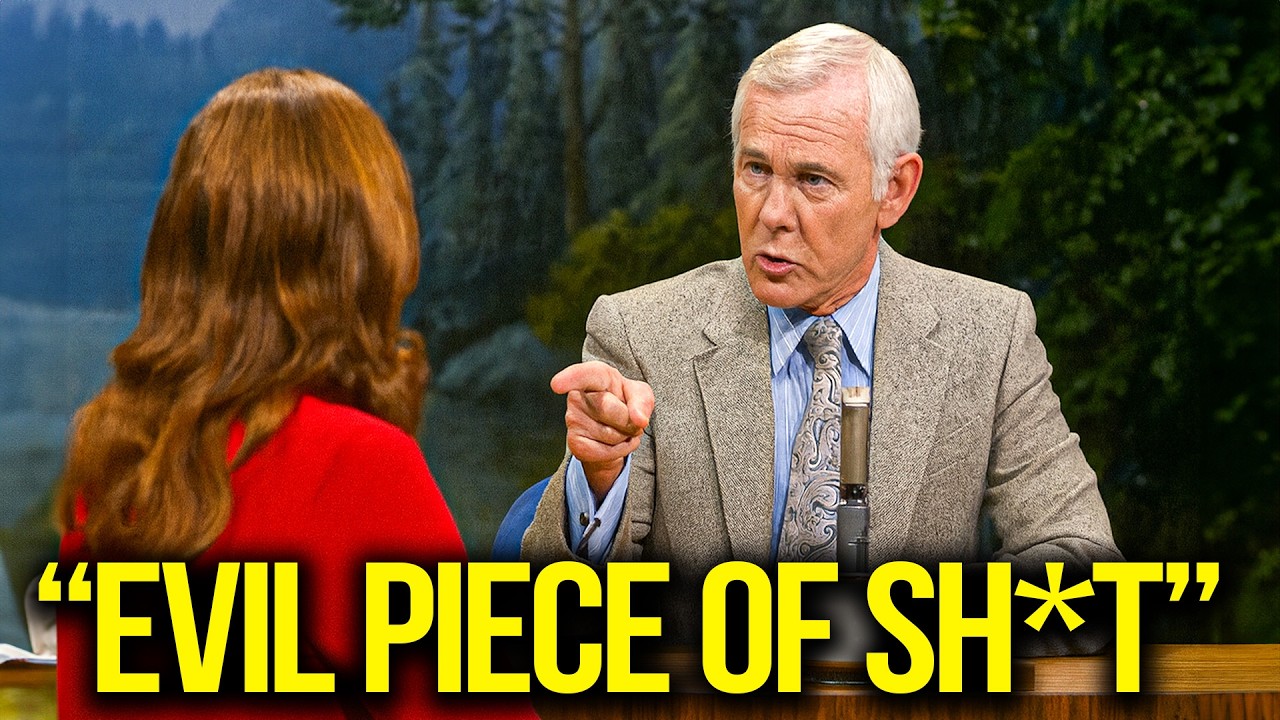
But there was another side to that power.
Some famous people sat beside Johnny once—or dozens of times—and then stopped appearing when Carson was behind the desk.
Not because he had publicly declared them “evil.”
There is no credible evidence that Carson left behind a list of nine Hollywood stars he considered monsters.
The real story is stranger.
A major 2025 biography, Love Johnny Carson by Mark Malkoff with David Ritz, drew on interviews with hundreds of people connected to Carson and The Tonight Show. Producer Peter Lassally, who worked with Carson for more than two decades, confirmed that there were famous people Carson did not want booked when he was hosting. Malkoff says he found no definitive physical master list himself, although Burt Reynolds and Rich Little separately claimed they had seen a hard copy containing more than 30 names.
The reasons were not all the same.
Some guests were accused of treating crew members badly.
One broke an unwritten network rule.
One corrected Johnny twice.
One of Carson’s idols allegedly destroyed his trust with a rigged magic trick.
One future Tonight Show host was dropped simply because Johnny stopped finding him funny.
And the woman Carson had helped turn into a star broke a bond that neither of them ever repaired.
Together, those stories reveal something much more interesting than a celebrity “hate list.”
They reveal the rules of Johnny Carson’s kingdom.
Jerry Lewis Had Appeared More Than 80 Times. Then One Crew Member Said He Was Done.
If there was one rule Carson took particularly seriously, according to people who worked with him, it was how famous guests treated the people who were not famous.
Jerry Lewis learned that the hard way.
By the summer of 1975, Lewis had either appeared on or guest-hosted The Tonight Show more than 80 times.
That is an extraordinary amount of trust.
Lewis was not some troublesome first-time guest the staff barely knew.
He was one of America’s biggest entertainers and an established part of the show’s world.
Then came a week when Lewis was guest-hosting.
According to Malkoff’s account, cue-card man Don Schiff later approached Carson and said he would never handle cards for Lewis again.
Carson wanted to know why.
Schiff said Lewis had become verbally abusive after making a last-minute request Schiff could not complete in time.
Carson’s reaction was immediate.
Lewis would no longer guest-host or appear when Carson was running the show, apart from one brief later exception.
Malkoff summed up the principle simply: Carson would not tolerate disrespect toward his staff, no matter how big the star.
Think about the power imbalance.
Jerry Lewis was Jerry Lewis.
The cue-card man was almost invisible to viewers.
But in Carson’s studio, the invisible man apparently mattered.
That rule would surface again.
Even the Original Host of The Tonight Show Wasn’t Safe
Steve Allen had a unique place in television history.
Before Jack Paar.
Before Johnny Carson.
Allen had been the original host of Tonight.
Carson respected that history and invited him back repeatedly.
Allen appeared as a guest or guest host at least 60 times during Carson’s era.
Then, in 1982, their relationship changed.
Malkoff’s account says Allen made a joke about an injury Carson had suffered.
That irritated Johnny.
But the more serious issue happened behind the cameras.
Allen’s own associates had reportedly requested late changes to his material. Allen mistakenly blamed a Tonight Show crew member and angrily called that employee afterward.
The crew member told the production he did not want to work with Allen again.
When Carson heard what happened, his answer was essentially simple:
He would not have to.
Allen would no longer be invited back when Carson was hosting.
He later returned only on nights with guest hosts.
Again, the pattern is revealing.
Carson could tolerate enormous egos.
He worked with Hollywood stars every night.
But the people behind the cameras were part of his operation.
Humiliate them, and celebrity status might not protect you.
Yet not every ban was based on noble principle.
Sometimes Johnny simply got offended.
Carl Sagan Corrected Johnny Carson Twice
Carl Sagan was not a typical late-night guest.
He was an astronomer.
A scientist.
A professor capable of making questions about the universe understandable to television audiences.
Carson genuinely enjoyed him.
Sagan appeared on The Tonight Show roughly two dozen times and became one of the best-known scientists in America partly because Carson gave him such an enormous platform.
Then came a conversation about Halley’s Comet in January 1986.
Carson made mistakes.
Sagan corrected him.
Twice.
On television, Carson handled it with the familiar smile that had rescued thousands of awkward moments.
According to Malkoff’s reconstruction, however, Johnny felt embarrassed.
Sagan did not return as Carson’s guest afterward.
This is an important story because it complicates the flattering version of the blacklist.
Carson could defend a crew member from a superstar.
He could also be thin-skinned.
Both things could be true.
The same man who valued professionalism could take a correction personally.
And once Carson decided the chemistry was gone, there was rarely a formal announcement.
The phone simply stopped ringing.
William Shatner Apparently Broke Three Rules in One Appearance
William Shatner’s case may be the funniest because he apparently did not realize he was doing anything wrong.
By 1983, Shatner was already permanently associated with Captain Kirk.
He was also starring in T.J. Hooker.
He came onto The Tonight Show and, according to Malkoff’s account, managed to violate three of the show’s unwritten expectations.
First, he spoke for roughly four minutes without giving Carson much opportunity to enter the conversation.
Second, he turned away from Carson to speak to fellow guest Buddy Hackett.
Third, he promoted T.J. Hooker and actually said the name of the competing network airing it:
ABC.
The network name was muted for broadcast.
Afterward, Shatner became persona non grata when Carson was hosting.
He did return to Tonight, but on evenings with guest hosts such as Jay Leno and Patrick Duffy.
Years later, Shatner still seemed confused by Carson’s reaction.
That confusion makes the story better.
No screaming fight.
No destroyed dressing room.
No outrageous scandal.
A guest simply violated rules he barely knew existed.
Then Johnny stopped booking him.
That is how much power the host possessed.
Barbra Streisand Canceled. Johnny Turned the Cancellation Into a Joke.
Barbra Streisand presented a different problem.
She did not implode on Carson’s couch.
She barely made it there at all.
In July 1975, Streisand was scheduled to appear on The Tonight Show and canceled on short notice.
Carson told his audience she would not be appearing.
Then he found a very Johnny Carson way to respond.
The following night, he introduced “Barbra Streisand.”
Actress Madlyn Rhue came out doing an imitation.
She began singing “People.”
Carson quickly cut the gag short.
The message was unmistakable.
He could survive without the real Barbra.
Streisand would not return to The Tonight Show during Carson’s remaining years behind the desk. Later accounts have connected her reluctance to appear on certain talk shows with concerns over which side of her face would be shown to camera, although the exact reason for the 1975 cancellation remains less important than Carson’s response to it.
For Carson, reliability mattered.
A nightly television show was an enormous machine.
Writers.
Producers.
Makeup.
Lighting.
Musicians.
Camera crews.
Guests.
An audience waiting outside.
Cancel at the last moment and hundreds of people had to adjust.
Johnny remembered things like that.
But nothing on this list is quite as strange as what happened with Orson Welles.
Orson Welles Was One of Johnny’s Heroes
Carson loved magic.
Not casually.
He had practiced it since childhood.
He understood tricks.
Misdirection.
Mentalism.
The difference between a skilled illusion and someone pretending to possess supernatural powers.
And Carson admired Orson Welles enormously.
Welles was not merely the director of Citizen Kane.
He was a showman.
A storyteller.
A magician.
By the late 1970s, Welles had become a regular presence on The Tonight Show.
This should have been a perfect relationship.
Then Welles guest-hosted and decided to perform a mentalist act.
According to Malkoff’s account, Carson watched.
The trick failed.
Normally, that might have amused him.
Live television was full of failures.
Carson himself was one of the greatest performers ever at turning failure into comedy.
But he later learned something about how Welles had attempted the trick.
Two men in the audience had allegedly been planted there to help.
They failed to execute the setup properly.
That was why the trick collapsed.
Carson was not angry because Welles had bombed.
He was angry because he considered the method dishonest.
After that, Welles no longer appeared as a guest while Carson was hosting.
There is something almost tragic about that story.
Carson had admired him.
Perhaps that was precisely why the disappointment cut so deeply.
When someone you already distrust behaves badly, you shrug.
When an idol disappoints you, the reaction can be very different.
Johnny Carson Could Forgive a Bad Trick More Easily Than a Fake One
That episode reveals another Carson rule.
Failure was acceptable.
Dishonesty was harder.
Anyone who watched The Tonight Show regularly knew that Carson actually enjoyed comedy going wrong.
An animal refused to cooperate?
Johnny laughed.
A joke died?
He stared into the camera.
A prop broke?
Sometimes the failure was funnier than the bit.
But Carson’s interest in magic made fraud particularly sensitive.
A magician was supposed to create an illusion while everyone understood, at some level, that it was an illusion.
Claiming something false as genuine crossed a different line for him.
The Welles story therefore says as much about Carson as it does about Welles.
But sometimes the line a guest crossed was much simpler:
Johnny told them not to do something.
They did it anyway.
Ellen DeGeneres Made History — Then Ignored a Warning
When Ellen DeGeneres made her first Tonight Show appearance in 1986, it became an important moment in her career.
Carson called her over to the couch after her stand-up set.
For a young comedian, that gesture was enormous.
The couch meant Johnny approved.
It meant America had just watched a new performer get an unofficial blessing from the king of late night.
Ellen returned.
Then, during her third Carson-era appearance in May 1987, trouble arrived.
According to Tonight Show publicist Charlie Barrett’s recollection in Malkoff’s book, DeGeneres had been told not to perform a particular joke because the show considered it offensive.
She performed it anyway.
After the show, talent coordinator Jim McCawley confronted her in the green room.
She did not return with Carson hosting.
When she appeared again in 1989, Jay Leno was sitting behind the desk.
Again, the fascinating element is not that Carson thought Ellen DeGeneres was a bad person.
There is no evidence of that.
The problem was simpler.
The show gave an instruction.
The performer ignored it.
Trust disappeared.
And on Carson’s Tonight Show, trust could matter as much as laughs.
Jay Leno Was Once on the Wrong Side of Johnny’s Door
This may be the most ironic name of all.
Jay Leno.
The man who would eventually replace Johnny Carson as host of The Tonight Show was himself once effectively dropped by Carson.
Leno made his Carson debut in March 1977.
It went extremely well.
Carson even shook his hand and told the audience they would have him back.
And they did.
Several times.
Then came Leno’s fifth appearance in February 1978.
The laughs were weak.
Carson apparently decided he did not want him back.
Talent scout Jim McCawley argued for Leno, but producer Peter Lassally reportedly explained that Johnny simply did not like Leno’s jokes anymore.
For years, Leno disappeared from Carson’s show.
Then something remarkable happened.
Leno kept working.
He became a stronger comedian.
His reputation grew.
By 1986, The Tonight Show reconsidered.
He came back.
Then he guest-hosted.
And in 1992, when Johnny Carson finally left the desk after 30 years—
Jay Leno took the chair.
The man Johnny once stopped booking became his successor.
Few stories better illustrate how strange the so-called blacklist could be.
Sometimes it was permanent.
Sometimes it was not.
Sometimes Carson’s judgment changed.
And sometimes history overruled him.
Then There Was Joan Rivers
If Jerry Lewis shows Carson protecting his staff, and Carl Sagan reveals his sensitivity, Joan Rivers reveals something deeper.
Betrayal.
Carson played an enormous role in Rivers’ career.
When she appeared on The Tonight Show in 1965, he told her:
“You’re going to be a star.”
He was right.
Rivers became a recurring favorite.
Their chemistry was exceptional.
She appeared again and again.
Eventually she became Carson’s permanent guest host.
When Johnny took a night off, Joan could sit behind the desk.
That was not just another booking.
It was trust.
In April 1986, Rivers appeared with Carson again and celebrated the 21st anniversary of her first appearance.
On camera, everything looked warm.
Nine days later, the public learned that Joan Rivers would host a competing late-night program for the new Fox network.
Carson did not hear the news from Joan first.
That was the wound.
Carson Felt Joan Had Broken the One Rule That Mattered Most
Different people involved later disagreed about exactly how communications broke down.
Rivers said she tried to contact Carson.
Carson’s longtime lawyer Henry Bushkin recalled learning about the deal from a reporter and having to tell Johnny before he heard it elsewhere.
What is not disputed is what happened afterward.
Carson felt betrayed.
Rivers called.
Carson hung up.
She called again.
He hung up again.
They never repaired the relationship.
Joan later said she was effectively blacklisted from NBC late night.
She did not return to The Tonight Show until 2014, when Jimmy Fallon finally brought her back—nearly a decade after Carson’s death.
This was not about a bad joke.
Not a cancellation.
Not mistreating a cue-card man.
Joan had been part of Carson’s professional family.
Then she became his direct competitor without personally giving him the news first.
To Carson, that apparently made the difference.
He could forgive many things.
He did not forgive that.
And Yet Carson Wasn’t Always the Injured Party
This is where any honest account has to complicate the legend.
It is tempting to turn Carson’s booking rules into evidence that he was a wise judge of character.
He was not.
Sometimes Carson was simply offended.
Sometimes he was stubborn.
And at least one famous entertainer believed Johnny himself had become the bully.
Wayne Newton spent years as the subject of Carson jokes questioning his masculinity and sexuality.
Newton repeatedly asked for them to stop.
Eventually, he had enough.
According to Newton’s own account, he walked unannounced into Carson’s NBC office in the 1970s.
Producer Fred de Cordova was there.
Newton asked him to leave.
Then he confronted Carson directly.
Newton later recalled asking what he had possibly done to deserve years of attacks.
Then he issued an unmistakable warning:
the jokes had to stop.
They did.
Newton later said Carson never again made those particular jokes about him.
The two men remained deeply estranged.
Years afterward, Newton went on Larry King and described Carson in extraordinarily harsh terms, calling him mean-spirited.
Whether one accepts every interpretation Newton attached to the feud is another matter.
But the confrontation itself reminds us of something important.
Carson could be hurt by other people.
He could also hurt them.
That makes the history more human.
The Blacklist Wasn’t Really About Good People and Bad People
Look at the names.
Jerry Lewis.
Orson Welles.
William Shatner.
Carl Sagan.
Steve Allen.
Barbra Streisand.
Ellen DeGeneres.
Jay Leno.
Joan Rivers.
They do not form a moral category.
Some stories involve genuine bad behavior.
Others involve bruised ego.
Others involve unwritten television rules that seem almost absurd today.
Mentioning “ABC” could matter.
Turning your back on the host could matter.
Correcting Carson could matter.
Canceling late could matter.
A weak comedy set could matter.
And breaking personal trust could matter most of all.
That is why calling this a list of people Johnny Carson thought were “evil” destroys the most interesting part of the story.
The list was inconsistent because Johnny Carson was human.
Carson Had Enormous Power — and Almost Never Needed to Announce That He Was Using It
That may be the most fascinating part.
Today, celebrity feuds unfold publicly.
Instagram posts.
Podcast interviews.
Tweets.
Statements through publicists.
Screenshots.
Carson operated differently.
If he decided you were finished, he did not necessarily need to attack you on television.
He controlled the invitation.
You simply stopped getting it.
For comedians, that could be devastating.
A successful Carson appearance could move a career forward overnight.
Getting invited to sit on the couch after your stand-up routine was practically a cultural certification.
Carson had helped launch or elevate performers including David Letterman, Joan Rivers, Jay Leno and Ellen DeGeneres.
That made absence meaningful.
The most powerful punishment Johnny could deliver was sometimes silence.
The New Book Changes the Way We Understand the Famous Smile
Mark Malkoff did not write Love Johnny Carson simply to expose grudges.
His broader picture is largely affectionate.
He spoke with more than 400 people while researching Carson and found many who still spoke warmly about him decades later. In a 2026 interview, Malkoff emphasized that the book’s title came from hearing person after person essentially say the same thing:
they loved Johnny Carson.
That matters.
Because Carson has sometimes been remembered in two extreme ways.
The perfect gentleman of late night.
Or the cold, isolated king who punished anyone who displeased him.
Neither version is enough.
The evidence suggests a much more contradictory man.
Private.
Generous.
Thin-skinned.
Loyal.
Capable of carrying grudges.
Protective of his staff.
Competitive.
A magician who hated feeling fooled.
A comedian who could laugh at himself—
until sometimes he couldn’t.
That is far more interesting than “Johnny hated these nine evil people.”
Perhaps Jerry Lewis Tells Us the Most About Johnny
Return to that cue-card employee.
Don Schiff was not going to beat Jerry Lewis in a battle of celebrity power.
He did not have to.
He told Carson he would no longer work with him.
Johnny listened.
Whatever else one thinks of Carson, that story survived because it tells us something about the culture he wanted around his show.
Famous people were welcome.
But the show did not belong only to famous people.
The man holding cue cards mattered.
The camera operator mattered.
The producer mattered.
The talent coordinator mattered.
The writers mattered.
The staff had to make more than an hour of network television work every night.
A star who forgot that could discover that Johnny Carson remembered.
Or Maybe Joan Rivers Tells Us More
Because the deepest Carson conflicts were not necessarily with people he disliked.
Sometimes they were with people he had loved professionally.
Nobody needed to explain Joan Rivers’ talent to Carson.
He had recognized it before much of America.
Nobody needed to tell him she was funny.
He put her behind his own desk.
That is why the ending hurt.
A stranger cannot betray you.
Only somebody you trust can do that.
Carson apparently saw Rivers’ move to Fox through that lens.
Rivers saw her own decision differently: as a major career opportunity she could not afford to ignore.
Both positions can make emotional sense.
Neither repaired the friendship.
They spent the rest of Carson’s life apart.
That is a much sadder story than a celebrity blacklist.
Johnny Carson Never Needed an “Evil List”
He already possessed something more powerful.
A chair.
A desk.
A microphone.
And the ability to decide who sat across from him.
For three decades, Hollywood wanted that invitation.
Some people received it dozens of times.
Then one night something changed.
Jerry Lewis allegedly mistreated a crew member.
Orson Welles disappointed an idol who believed the trick was rigged.
William Shatner broke rules he barely knew existed.
Carl Sagan corrected the host.
Barbra Streisand canceled.
Ellen DeGeneres ignored a warning.
Jay Leno stopped getting laughs—then astonishingly fought his way back.
Joan Rivers broke Carson’s trust and never recovered it.
None of them needed to be “evil.”
They simply crossed a line that mattered to Johnny Carson.
And once Johnny decided the line had been crossed, the most famous guest chair in American television could suddenly become impossible to reach.
That may be the real secret behind Carson’s blacklist.
It was never a list explaining who Hollywood’s worst people were.
It was a map of Johnny Carson himself.