If you’re in your 70s, there are probably things you do every day without giving them much thought.
You get out of bed, make breakfast, walk to the mailbox, remember an appointment, pay a bill, call an old friend, or decide what you’re going to do tomorrow.
They may seem ordinary.
But as we grow older, ordinary abilities can become surprisingly meaningful.
Aging well isn’t about looking 20 years younger or doing everything you could do at 40. It’s often about something much simpler: keeping enough strength, independence, mental sharpness, connection, and purpose to continue living life on your own terms.
So if you’re between 70 and 80, take a moment and think about the eight things below.
There’s no need to “pass” every one of them. This isn’t a medical test, and needing glasses, a hearing aid, a cane, or help with certain tasks does not mean someone is aging badly.
But if many of these things still feel natural to you, you may have more to celebrate than you realize.
And some of the most important signs have very little to do with physical strength.
## 1. You Can Still Walk Around Without Depending on Someone Else
Think about your normal day.
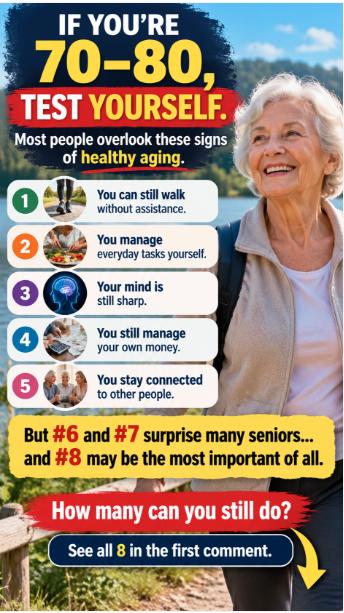
Can you walk from the bedroom to the kitchen without someone holding your arm?
Can you move through a grocery store, walk to a neighbor’s house, or take a short stroll outside without feeling that every step is a major challenge?
For many people, walking is so ordinary that they don’t think of it as an achievement.
But later in life, mobility becomes one of the clearest ways we experience independence.
Walking requires much more than strong legs. Your muscles, joints, balance, vision, coordination, heart, and lungs all work together every time you move from one place to another.
And the real value of mobility isn’t simply exercise.
It’s freedom.
It means being able to get up because you want a cup of coffee.
It means walking outside when the weather is nice.
It means going to another room without waiting for someone to help you.
It means having more choices about where you go and what you do.
That is easy to overlook until it becomes difficult.
So if you are in your 70s and still move around comfortably, don’t dismiss it as “nothing special.”
It is something worth protecting.
## 2. You Still Handle Everyday Tasks Yourself
There are dozens of small jobs most of us barely notice.
Making breakfast.
Putting away groceries.
Washing dishes.
Watering plants.
Changing the sheets.
Preparing dinner.
Tidying the house.
Taking care of a pet.
None of these activities sounds impressive on its own.
But together, they tell an important story.
Being able to manage everyday tasks requires strength, coordination, memory, planning, and enough energy to move from one step to the next.
Consider something as simple as cooking dinner.
You have to decide what to eat, find the ingredients, remember what goes where, use your hands safely, keep track of time, and clean up afterward.
That is a lot of physical and mental activity packed into one ordinary routine.
The same is true of maintaining a home.
For an older adult, doing these things independently can provide more than convenience. They can preserve a powerful feeling:
**“This is still my life, and I can still take care of it.”**
If you can still manage much of your normal routine without someone constantly stepping in, that independence matters.
And sometimes the tasks that seem least important are the ones that give us the greatest sense of control.
## 3. Your Mind Is Still Curious and Engaged
Now forget physical strength for a moment.
How is your mind doing?
Can you follow a conversation without constantly losing track of what people are saying?
Do you remember appointments most of the time?
Can you learn how a new appliance works?
Can you read an article and discuss it afterward?
Can you solve a small problem when something unexpected happens?
Mental sharpness does not mean remembering every name instantly or never walking into a room and wondering why you went there.
People of all ages forget things.
What matters more is whether you can still think through everyday situations, make decisions, learn, communicate, and remain interested in the world around you.
One especially encouraging habit is curiosity.
Some people reach their 70s and still want to know:
“How does that work?”
“What happened next?”
“Can you show me how to use this?”
“What’s going on in the world?”
That willingness to keep learning matters.
Your brain is not simply a storage cabinet filled with old memories. It continues responding to conversation, reading, hobbies, puzzles, music, learning, and new experiences.
So if you still enjoy asking questions, solving problems, reading, learning new things, or having a good debate, don’t underestimate that.
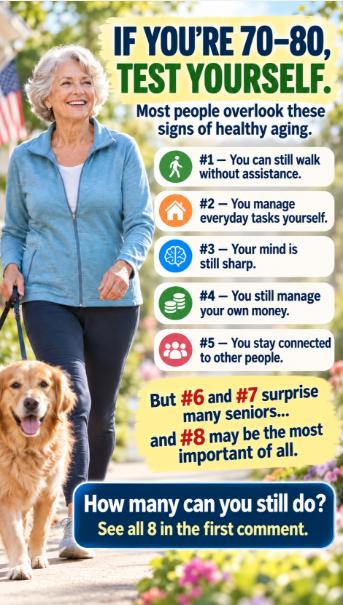
A curious mind is an active mind.
And that brings us to another form of independence that many people rarely think about.
## 4. You Still Manage Your Own Money and Everyday Decisions
Can you keep track of your bills?
Do you generally know where your money is going?
Can you notice when a charge on a statement doesn’t look right?
Can you make ordinary financial decisions without somebody else taking over everything for you?
Managing money is about much more than mathematics.
It involves memory, organization, judgment, attention, and decision-making.
And today, it can be more complicated than it used to be.
Bills arrive by mail, email, or automatic payment. Banks use apps and websites. Scams can come through text messages, phone calls, social media, and email.
For someone in their 70s, continuing to manage these responsibilities can be a meaningful sign of practical independence.
It also protects something deeply personal: the ability to make your own choices.
That doesn’t mean you should never ask a son, daughter, trusted friend, accountant, or financial professional for help.
Everyone needs advice sometimes.
The key difference is whether you are still involved.
You know what is happening.
You ask questions.
You make decisions.
You are not simply handing your entire life over to someone else because you feel unable to understand it.
If that describes you, it is something worth appreciating.
But independence isn’t only about walking, cooking, remembering, or paying bills.
The next sign involves what you deliberately do with your body.
## 5. You Still Make Movement Part of Your Life
You do not need to run marathons at 75.
You don’t need six-pack abs.
And you certainly don’t need to train like someone in their 30s.
Movement can be much simpler.
A morning walk.
Gardening.
Dancing.
Stretching.
Swimming.
Doing light exercises at home.
Walking the dog.
Taking the stairs when appropriate.
Playing with grandchildren.
The important question is this:
**Are you still using your body regularly?**
Bodies generally respond to what we ask of them.
When movement disappears completely from daily life, strength, endurance, balance, and confidence can become harder to maintain.
Regular physical activity is also associated with benefits for cardiovascular health, mobility, mood, and overall function.
But perhaps the greatest benefit is practical.
Exercise can help you keep doing the things you actually care about.
Walking through an airport.
Going shopping.
Attending a family event.
Working in the yard.
Getting up and down more comfortably.
Traveling.
Living independently.
For people in their 70s, the goal of movement doesn’t have to be “getting fit.”
A better goal may simply be:
**Keep doing the things that allow you to keep living your life.**
Of course, health conditions and abilities vary greatly, so exercise should fit the individual. If you have medical concerns, a clinician can help you determine what level of activity is appropriate.
Now we come to something people often notice only after it begins to change.
## 6. You Can Still Stay Connected to the World Around You
Vision and hearing affect far more than reading small print or hearing the television.
They affect connection.
Can you comfortably follow a conversation at the dinner table?
Can you enjoy a book, newspaper, television program, hobby, or drive if you still drive safely?
Can you recognize the expression on someone’s face?
Can you hear a joke well enough to laugh at the right moment?
Our eyes and ears help keep us connected to people and to everyday life.
And when vision or hearing changes, the solution is not to treat corrective devices as a sign of failure.
Glasses, hearing aids, brighter lighting, larger text, and other tools can help people continue doing what matters.
The goal is not perfect eyesight or perfect hearing.
The goal is participation.
If you can still communicate, enjoy your surroundings, follow conversations, and adapt when your senses need support, you are preserving something extremely valuable:
your connection to the world outside yourself.
And that connection leads directly to one of the most overlooked parts of healthy aging.
## 7. You Still Have People You Want to Talk To
Think about the last seven days.
Did you call someone simply because you wanted to hear their voice?
Did someone stop by?
Did you have coffee with a friend?
Did you speak with a neighbor?
Did you attend church, a club, a community activity, or a family gathering?
Did you laugh with somebody?
Social connection can become harder with age.
People retire.
Children move away.
Friends relocate.
Spouses and longtime companions may die.
Driving may become more difficult.
The social world that once seemed automatic can gradually shrink.
That is why maintaining relationships takes effort.
Some people in their 70s learn to video call grandchildren.
Others join a walking group.
Some attend church regularly.
Some meet the same friend every Tuesday for coffee.
Others simply make a habit of calling people instead of waiting for someone else to call first.
These actions may seem small.
They are not.
Relationships give us more than company.
They give us reasons to laugh, listen, speak, help, remember, share, and feel that we still belong somewhere.
You don’t need dozens of friends.
Sometimes one or two meaningful relationships are worth far more than a hundred casual acquaintances.
If there are still people in your life whose voices you want to hear—and people who are happy to hear yours—that is something precious.
But there is one final quality that may be even harder to measure.
## 8. You Still Have Something to Look Forward To
Ask yourself a simple question:
**What are you looking forward to?**
Maybe it’s Sunday dinner.
A granddaughter’s graduation.
A fishing trip.
Planting tomatoes next spring.
A favorite television show tonight.
A vacation.
Coffee with a friend tomorrow morning.
Finishing a book.
Seeing how the baseball season ends.
Or simply sitting outside when the weather cools down.
The answer doesn’t have to be dramatic.
What matters is that there is still a “next.”
Aging inevitably brings losses.
People we love may no longer be here.
Our bodies may not cooperate in the way they once did.
Some roles that defined us—parent of young children, full-time worker, caregiver, spouse, athlete—may change or disappear.
Remaining positive does not mean pretending those losses don’t hurt.
It does not mean forcing yourself to smile every day.
And it certainly does not mean that sadness, grief, or frustration is a personal failure.
It means being able, eventually, to notice that life still contains something worth participating in.
Something worth planning.
Something worth enjoying.
Something worth waking up for.
That ability to keep looking forward may be one of the quietest forms of resilience.
## So, How Many of These Still Sound Like You?
Go back through the list.
Can you still move around with reasonable independence?
Handle much of your daily routine?
Keep your mind engaged?
Stay involved with your finances?
Make movement part of your life?
Remain connected to the world around you?
Maintain meaningful relationships?
And still have things you look forward to?
If several of those answers are yes, don’t take them for granted.
You may spend more time thinking about what has changed with age than about what you have managed to keep.
That is human nature.
Maybe your knees hurt more.
Maybe you need stronger glasses.
Maybe you tire earlier than you used to.
Maybe you don’t remember names quite as quickly.
But aging well is not the same as remaining unchanged.
It is about adapting while preserving as much independence, connection, curiosity, movement, and purpose as possible.
And if you are already in your 70s, there is another important point to remember:
You do not need to be perfect.
You do not need to check all eight boxes.
These are not grades, and they are not a diagnosis.
Every person ages differently. Health conditions, genetics, life circumstances, access to care, and many other factors can affect what someone is able to do.
The better question is not:
**“Am I doing as well as somebody else?”**
It is:
**“What ability do I still have that is worth protecting?”**
Maybe it’s your daily walk.
Maybe it’s your independence in the kitchen.
Maybe it’s your curiosity.
Maybe it’s the weekly phone call with your oldest friend.
Maybe it’s simply the fact that tomorrow morning, you still have somewhere you want to go.
Those things matter.
Growing older does involve change.
But it does not automatically erase usefulness, independence, curiosity, joy, or purpose.
Sometimes the most remarkable signs of aging well are hiding inside the completely ordinary things you still do every day.
And perhaps that is why we overlook them.
**How many of these eight can you still do?**