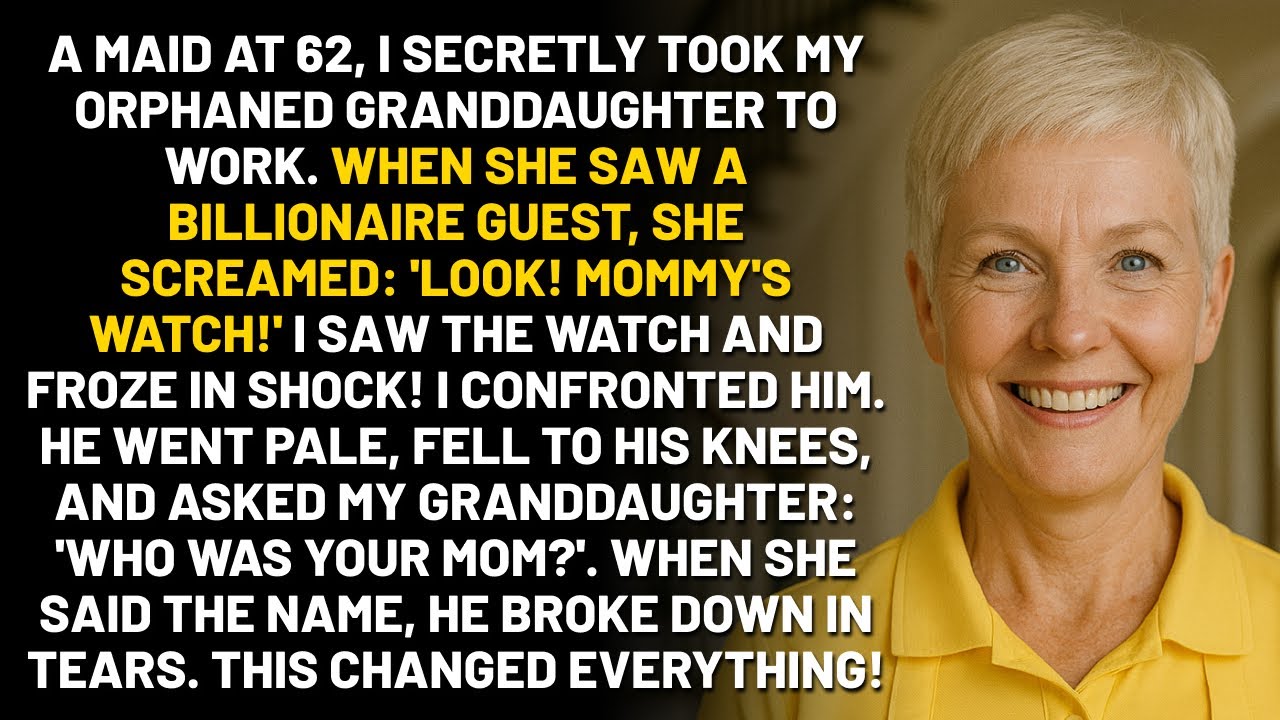
At 62 years old, I never thought a child’s scream would change everything I believed about my life. But that Tuesday morning in March, when my 8-year-old granddaughter Veda spotted something that shouldn’t have existed, our world cracked wide open. I had been working as a housekeeper for the Whitmore family for three years. Five hundred dollars a week to clean marble floors, dust crystal chandeliers, and pretend I didn’t exist when they entertained their wealthy friends.
It wasn’t the life I had imagined for myself, but after my daughter Sarah died seven years ago, leaving me with a baby to raise on my own, dignity became a luxury I couldn’t afford. That morning started like any other. I dropped Veda off at school and arrived at the mansion by 7:30. The house always smelled like expensive furniture polish and fresh flowers, a stark contrast to our small apartment that reeked of the neighbor’s cooking and had heating that worked only when it felt like it.
Mrs. Henderson, the head housekeeper, barely looked up when I signed in. “The master bedroom needs extra attention today,” she said, her voice clipped with authority. “Mr.
Whitmore has guests coming for lunch. ”
I nodded and gathered my supplies. Jonathan Whitmore was rarely home during my shifts, which suited me fine. The few times I had seen him, he struck me as the type of man who looked through people like me as if we were furniture.
Tall, silver-haired, with the kind of confidence that comes from never having to worry about rent money or medical bills. I was halfway through polishing the master bathroom when my phone rang. Veda’s school. My heart immediately jumped to my throat the way it always did when they called.
“Mrs. Morgan, Veda has a fever,” the nurse explained. “You’ll need to pick her up. ”
I closed my eyes, calculating quickly.
If I left now, I’d lose half a day’s pay. But Veda had been fighting a cold all week, and with her asthma, I couldn’t take any chances. I found Mrs. Henderson and explained the situation.
“You can’t just leave in the middle of your shift,” she said, her face pinched with disapproval. “She’s sick. She’s 8 years old and has asthma. ”
Mrs.
Henderson sighed dramatically. “Fine, but this better not become a habit. Take her to the staff room until you’re finished, and keep her quiet. ”
The staff room was barely larger than a closet, tucked away behind the kitchen with no windows and furniture that belonged in a garage sale.
But it was better than leaving Veda alone at home, feverish and struggling to breathe. I picked her up from school and brought her back with me, settling her on the old couch with her tattered stuffed rabbit and a book. “Stay here, sweetheart,” I whispered, smoothing her damp forehead. “Grandma just needs to finish cleaning, and then we’ll go home.
”
Veda nodded sleepily. She had always been good about staying put when I brought her to work. She understood, in the way children do when they have no choice, that we needed this job. That the $500 a week paid for our $800 rent, her medications, and the groceries that kept us fed.
I returned to my duties, working faster than usual. The lunch guests would arrive soon, and everything needed to be perfect. I was buffing water spots from the dining room mirrors when I heard voices in the foyer. Mr.
Whitmore was greeting his guests, his voice carrying that smooth charm that probably opened doors and bank accounts with equal ease. I kept my head down and continued working, invisible. That was the key to keeping jobs like this. Be thorough, be quiet, and never give them a reason to notice you unless absolutely necessary.
But then I heard something that made my blood turn cold. A child’s voice, high, clear, and unmistakably Veda’s. “Grandma? Grandma?
Where are you? ”
My heart stopped. She was supposed to stay in the staff room. I dropped the cloth and hurried toward the sound, but I was too late.
By the time I reached the main hallway, Veda was already standing there in her wrinkled school clothes and mismatched socks, staring up at the group of well-dressed men with wide, fever-bright eyes. “I’m sorry,” I began, rushing forward to collect her. “She’s not feeling well, and I—”
But Veda wasn’t moving. She was staring at something with an expression I had never seen before.
Not confusion or fear, but recognition. Pure, shocking recognition. “That’s Mommy’s watch,” she said, her voice cutting through the polite conversation like a knife. The words hit me like a physical blow.
I followed her gaze to Jonathan Whitmore’s wrist, where a watch with a distinctive gold band and cracked crystal face caught the morning light. A watch I knew better than almost anything else in this world because it had belonged to my daughter Sarah, and I had bought it for her the week before she died. “What did you say? ” Jonathan’s voice was sharp, his composure cracking for the first time I had ever seen.
He stepped toward Veda, his face pale. “That’s Mommy’s watch,” Veda repeated, pointing at it. “She wore it all the time. I remember it from the pictures Grandma keeps.
”
Jonathan’s face went white. He stared at Veda, then at the watch, then back at Veda with an expression of total shock. The other guests exchanged confused glances, but he didn’t seem to notice them. He didn’t seem to notice anything except the small girl standing in front of him.
“Who was your mother? ” he demanded, his voice barely a whisper. “Sarah,” Veda said. “Sarah Elizabeth Morgan.
She went to heaven when I was born. ”
The silence that followed was absolute. Jonathan’s hand went to his chest, and for a moment I genuinely thought he might have a heart attack right there in the middle of his marble foyer. Then, to the horror of everyone watching, his knees buckled and he sank to the floor, his face contorted with emotion.
“Sarah,” he said, the name coming out like a prayer. “Sarah. ”
I stood frozen, unable to move, unable to speak. Veda looked at him with the unflinching curiosity of a child who didn’t understand the weight of what she had just done.
“Do you know my mommy? ” she asked. Jonathan didn’t answer. He just stared at her, tears streaming down his face, his hand reaching out as if to touch her but stopping just short.
“She had my watch,” he said finally. “I gave it to her. I loved her, and I gave her that watch, and she was going to be my wife, and then I ruined everything. ”
The weight of his words slowly penetrated my shock.
He loved her. This man who had everything, who lived in a mansion and entertained billionaires, had loved my daughter. And she had died without ever telling me. “What do you mean, you ruined everything?
” I asked, my voice coming out harder than I intended. “What did you do? ”
Jonathan didn’t answer. He just kept staring at Veda, his tears still falling.
I don’t remember the rest of that morning. I remember the guests being politely but firmly escorted out. I remember Mrs. Henderson appearing in the doorway with a look of shock.
I remember the long, painful conversation that followed in Jonathan’s private study, where he told me the story that had been hidden from me for eight years. He and Sarah had been together. They had loved each other deeply, but he had been engaged to marry someone else, a woman from a wealthy family whose connections his business needed. When Sarah told him she was pregnant, he panicked.
He gave her money and broke it off, told her it was over, told her to forget she ever knew him. She didn’t fight it. She just left. And then she died giving birth to Veda.
Jonathan spent the next eight years carrying the weight of that decision. He had thought she had found someone else and moved on. He hadn’t known she was his daughter until that morning, when a little girl in mismatched socks pointed out the watch he had given to the woman he had loved and driven away. “I let go of everything,” he said, his voice hollow.
“And it cost me the woman I love and eight years of my daughter’s life. ”
“She’s not your daughter,” I said, but the words sounded weak even to me. “She can’t be your daughter. ”
“Look at her face,” Jonathan said.
“Look at her eyes. Tell me she isn’t mine. ”
I couldn’t. Because once he said it, I could see it.
The shape of her eyes, the way her jaw curved, the way she tilted her head when she was listening. They were Jonathan’s features, unmistakably and undeniably his. The weeks that followed were the hardest of my life. Veda was confused and scared, full of questions I didn’t know how to answer.
Jonathan tried to insert himself into her life, calling her, sending gifts, wanting to see her every day. I resisted, not because I wanted to hurt him, but because I was terrified of what would happen when he inevitably got bored and moved on. But he didn’t get bored. He showed up at Veda’s school with cupcakes for her birthday.
He drove her to the library on weekends. He sat through six performances of her school play, even though she didn’t have a speaking part. And slowly, Veda began to love him. “Grandma,” she asked one night, “why didn’t Daddy get to be in my life before?
”
“It’s complicated, sweetheart,” I said, the same answer I always gave when I didn’t know what else to say. “Sometimes complicated things aren’t fair,” she said, and she hugged me tight. “But I’m glad I have him now. ”
I wasn’t sure I was glad.
But I was starting to understand that I didn’t have a choice. He was her father, and she loved him, and the truth was that he loved her more than I had ever thought he was capable of loving anyone. I was still struggling to adjust to this new reality when Jonathan collapsed in his living room. A heart attack, massive and unexpected.
By the time his housekeeper found him, he had already been unconscious for over an hour. He survived, barely. The doctor’s prognosis was not good. His heart was severely weakened, and the substantial damage meant he had at best a few months to live.
Jonathan took the news with a calm that stunned everyone except me. I had seen the way he looked at Veda. I understood why he wasn’t afraid to die. But I wasn’t ready to let him go.
Not because I had grown to care about him, though I had, but because Veda had only just found her dad. She deserved more than a few months with him. “I want to spend my time with Veda,” Jonathan told me from his hospital bed. His voice was weak, but his eyes were clear.
“I know I don’t have much of it, but I want to make the most of what I have. ”
“You should,” I said, the words coming out more gently than I intended. “That little girl already loves you more than anything. ”
“And I love her,” he said.
“More than I ever thought I would love anyone. She’s the best thing that ever came into my life, even if I discovered her eight years too late. ”
I sat beside his bed, trying to figure out what I felt. Anger, still, that I had raised Veda alone for so long.
Grief, still, for my daughter who had carried his child alone, without his support. But also something else. Something that felt dangerously like peace. “Jonathan, there’s something I need to know,” I said carefully.
“How did Sarah end up with your watch? ”
“I gave it to her the night I ended things,” he said, staring at the ceiling. “It wasn’t an expensive watch, just something I had worn for years. I thought if I gave her something of mine, she might understand how hard the decision was for me.
That I wasn’t walking away because I wanted to. That I was walking away because I felt like I had to. ”
“She kept it all that time? ” The thought broke something inside me.
All those years she had practically worn that watch, she had never told me it was from him. She had never told me she had loved anyone at all. “She loved you, Jonathan,” I said, the words surprising me as much as they surprised him. “I can see that now.
She kept your watch because she never stopped loving you. ”
“I know,” he said, and his voice was thick with grief. “I know. And I have to live with that for the rest of my life.
”
“No,” I said, reaching out to take his hand. “You don’t have to live with that. You just have to live with what time you have left. And you have Veda.
She’s the best part of Sarah. She carries Sarah in her eyes and in her smile and in her heart. And she loves you, Jonathan. She loves you.
He began to cry then, not the quiet tears I had seen him shed before, but deep, wrenching sobs that shook his whole body. I held his hand and waited, and eventually the tears stopped. “Thank you,” he said. “Thank you for not keeping her from me all these weeks.
”
“I almost did,” I admitted. “I almost kept her away. But then I saw the way she looks at you. The same way she looks at pictures of Sarah.
I couldn’t take that away from her. ”
We were silent for a long time after that, the weight of everything we had said hanging in the air between us. Then Jonathan’s voice came softly. “I want to change something, Ethel.
I want to legally acknowledge Veda as my daughter. I want her name to be Veda Whitmore. Is that something I can do? ”
“You can try,” I said.
“But legally she’s a minor and I’m her guardian. And I’m not sure I can give you that. Not yet. ”
“Why not?
” he asked. “I’m her father. ”
“You’re the man who gave Sarah a handful of money and walked away,” I said, the anger I thought I had put aside flaring up again. “You were never there.
Not for the birth. Not for the sleepless nights. Not for the hours I spent rocking her when she was sick and crying. You made your choice, Jonathan, and you don’t get to just erase your absence by legalizing your presence.
”
He didn’t argue. He just took the hit, the way he always took the hard truths now. He had changed a lot in the weeks since Veda had cried out about the watch. “I know,” he said.
“I know. And maybe I don’t deserve to be her father on paper. But she knows the truth now. She knows I’m her daddy.
And she’s started calling me that. And I want to make sure she knows that I want to be her dad in every way I can be. ”
It was Veda who eventually made the decision. When I told her what Jonathan had asked, she looked at me with the wisdom that I was constantly amazed she possessed.
“Grandma,” she said, “a name doesn’t matter. What matters is that he loves me. And I love him. And he was in my life before he got sick.
That’s all that matters. ”
The adoption was finalized eight days before Jonathan died. Veda became Veda Whitmore, legally and officially. And when he lay in his hospital bed, too weak to do anything but hold her hand, she hugged him and whispered, “I’m glad you’re my daddy.
”
He died the next morning, holding Veda’s hand and a photograph of Sarah. We had a funeral attended by his business associates, who seemed surprised to discover he had a daughter. Margaret, his estranged wife, came and spoke briefly with me afterward. She was gracious and sad and told me she was glad he had found Veda before he died.
“He was different these last weeks,” she said. “Happier, even though he was dying. You gave him something he didn’t know he needed. ”
Three days after the funeral, Jonathan’s lawyer called to discuss the will.
The meeting was held in his downtown office, all mahogany and leather, and the quiet efficiency of serious money. “Mr. Whitmore was very specific about his wishes,” the lawyer explained, spreading documents across the conference table. “The bulk of his estate, approximately $200 million, is to be held in trust for Veda until her 25th birthday, with Mrs.
Morgan as the trustee. ”
The numbers still didn’t feel real. $200 million. Enough money to ensure that Veda would never have to worry about rent or groceries or medical bills the way I had for the past eight years.
“However,” the lawyer continued, “there are some conditions. ”
I looked up, suddenly wary. Even in death, Jonathan was going to try to control our lives. “The money is to be used exclusively for Veda’s benefit.
Education, medical care, housing, reasonable living expenses. Mrs. Morgan, you’re also provided for with a separate trust of $10 million to ensure you’re never financially dependent on Veda’s inheritance. ”
$10 million.
For me. More money than I had ever imagined having. Enough to quit cleaning houses forever, enough to give Veda the grandmother she deserved instead of one who was always exhausted and worried about money. “There’s one more thing,” the lawyer said, reaching into his briefcase.
“Mr. Whitmore asked me to give this to Veda personally. ”
It was a small jewelry box similar to the one that had held Sarah’s watch. Inside was a locket, gold and delicate with an inscription on the back: “For my daughter, with all my love, Dad.
”
Inside the locket were two tiny photographs: one of Sarah taken when she was young and laughing, and one of Jonathan from around the same time period. That evening, as I fastened the locket around Veda’s neck, she looked at herself in the mirror with satisfaction. “Now I have both of them with me,” she said simply. Six months later, we moved into a house in a good neighborhood with excellent schools and a big yard where Veda could play.
But we kept our routine of visiting Sarah’s grave every Sunday, bringing flowers and updating her on how Veda was doing in school, how she was learning piano, how she had decided she definitely wanted to be a veterinarian when she grew up. “She found her daddy, Sarah,” I told the headstone one autumn afternoon while Veda arranged fresh daisies in the vase. “It wasn’t the way any of us would have chosen, but she found him. And he loved her exactly the way you knew he would if he ever got the chance to know her.
”
The watch, Sarah’s watch, now sits on Veda’s dresser in a place of honor next to the locket her father gave her. She’s too young to wear it yet, but she likes to hold it sometimes while she’s doing homework or reading before bed. “It tells time backward,” she told me one evening, studying the crack in the face. “It goes from when Mommy had it to when Daddy had it to when I have it.
Like a story moving through our family. ”
That’s exactly what it is, I realized. The watch isn’t just a piece of jewelry. It’s proof that love persists even when people make mistakes, even when circumstances tear families apart, even when time runs out too soon.
It’s proof that sometimes, if you’re very lucky, you get a second chance to do the right thing. And sometimes, that’s enough.


