Arrogant Manager Humiliated An Old Man At A Car Dealership — But Never Expected Who He Really Was
The Harrington Auto Center sat on the edge of Columbus, Ohio, where the highway widened into six lanes and every billboard promised a better life with zero down and low monthly payments.
It was not a palace. It was not the kind of place with marble floors, crystal chandeliers, or champagne in the lobby. It was a sprawling glass-and-steel dealership with rows of pickup trucks outside, a service garage that smelled of oil and rubber, and a showroom bright enough to make every polished hood look like a mirror.
On ordinary days, families came in with trade-ins, contractors came in looking for trucks, and nervous young couples walked around pretending they knew the difference between trim packages.
But that Thursday morning was not ordinary.
Inside the showroom, every employee was moving faster than usual.
A regional inspection was scheduled for noon.
The floors had been buffed twice. The coffee station had been restocked with name-brand creamer instead of the cheap powdered kind. The receptionist had been told to smile with teeth. The sales team had been warned not to lean against the desks, not to joke too loudly, and absolutely not to let the service waiting area overflow into the showroom.
For Martin Vale, the general manager, image was everything.
Martin was forty-six, broad-shouldered, clean-shaven, and always dressed like he had just stepped out of a corporate training video. Navy suit. Silver tie clip. Expensive watch. Shoes shined like black glass.
He had been promoted six months earlier, and he wanted the regional office to see one thing when they walked through the front doors:
Control.
No clutter.
No mistakes.
No “undesirable energy,” as he liked to say.
Near the back of the showroom, standing beside a display of floor mats and winter tire packages, was Jonah Reed.
Jonah was twenty-two, thin, soft-spoken, and still new enough to the job that he said “sir” to everyone, even the vending machine repairman. He wore a dark blue dealership polo tucked into black slacks, a name tag clipped slightly crooked to his chest, and the nervous expression of someone afraid to take up too much space.
He had been hired as a lot attendant three months earlier.
His job was simple: move cars, wash cars, sweep the service lane, refill the coffee, and stay out of the way.
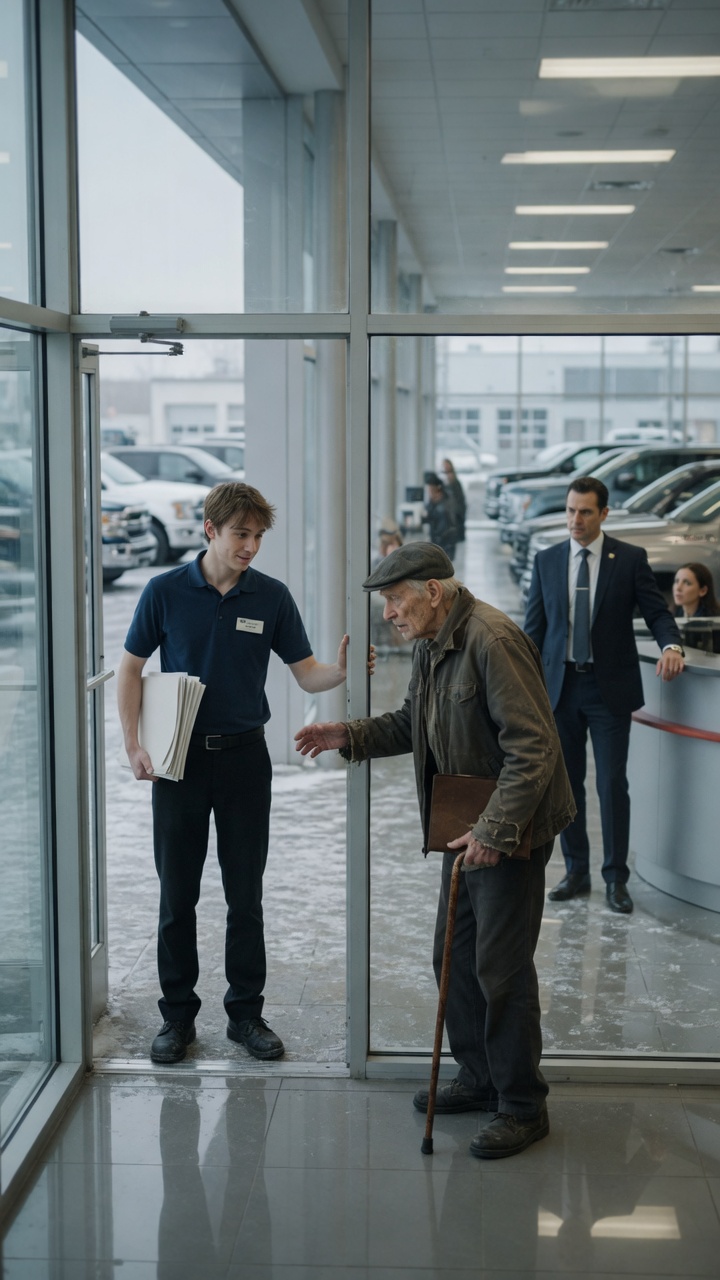
That morning, Jonah was carrying a stack of paper floor mats toward the service desk when he noticed the old man outside.
At first, he thought the man was just waiting for a ride.
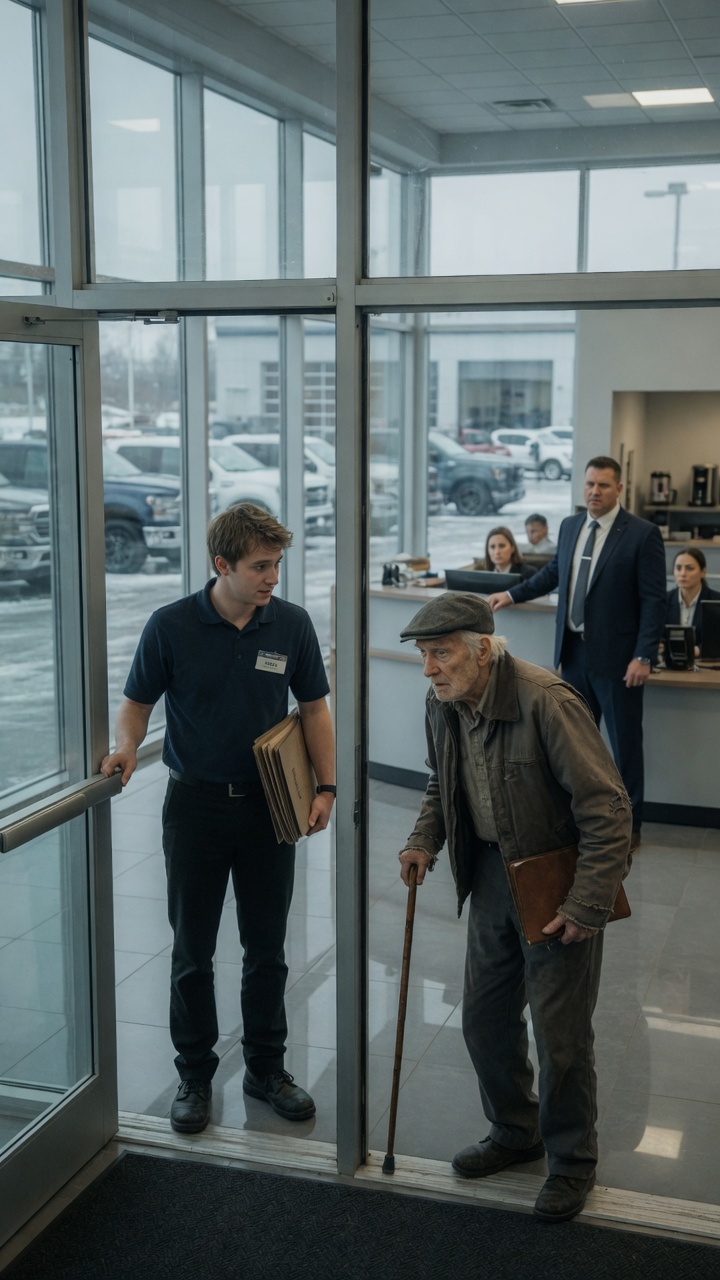
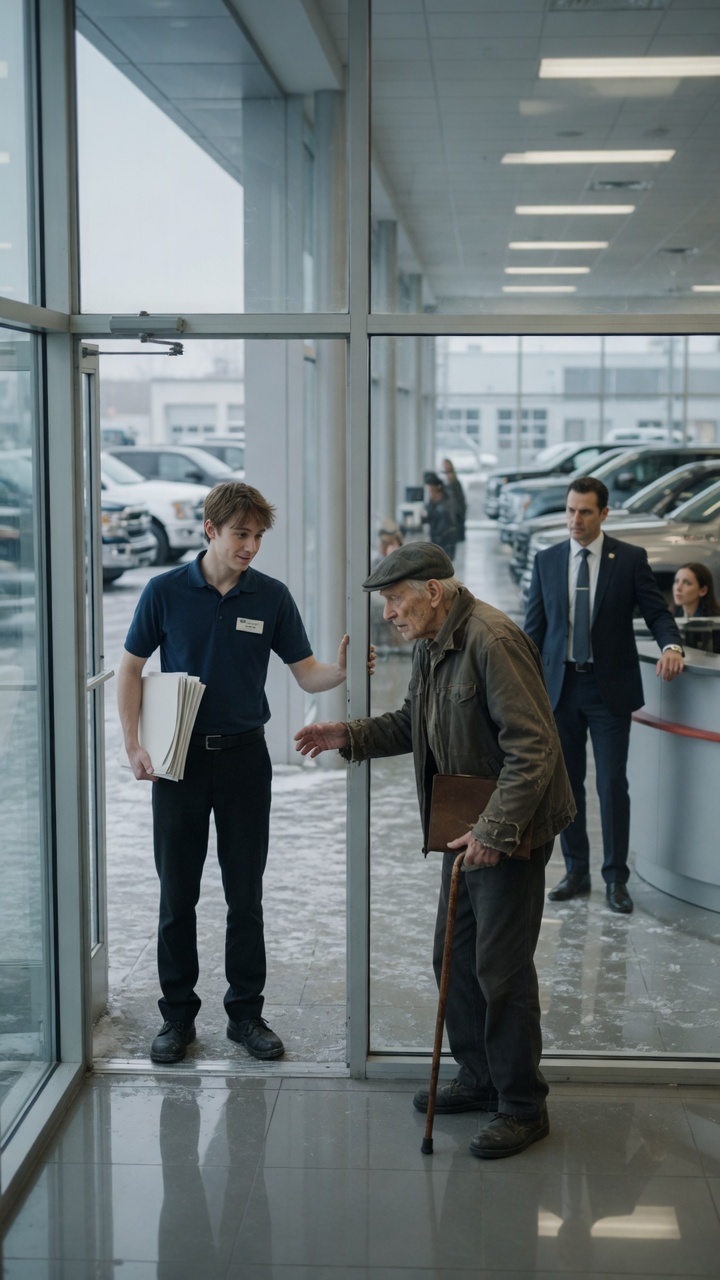
The old man stood near the entrance, not quite inside and not quite outside, one hand resting against the glass door as though he needed it for balance.
He looked to be in his late seventies. Maybe older.
He wore a faded brown work jacket with fraying cuffs, dark trousers that hung loosely from his thin frame, and old boots dusted with dried salt from the winter roads. A gray flat cap sat low over his white hair. His face was narrow and deeply lined, the kind of face shaped by hard weather and harder years.
In his right hand, he held a small leather folder.
In his left, he gripped a wooden cane.
The morning was cold, the kind of cold that made people hurry from parking lot to doorway without looking around. But the old man did not hurry. He stood there quietly, breathing through the pain of each step.
Jonah set the floor mats down and went to the door.
“Good morning, sir,” he said, pushing it open. “Can I help you inside?”
The old man looked up. His eyes were pale green, tired but alert.
“That would be kind of you,” he said.
Jonah held the door with one hand and offered the other.
The old man hesitated before accepting.
His hand was cold and bony.
“Careful,” Jonah said. “The rug bunches up right here.”
“I noticed,” the old man replied, almost smiling. “That rug has been trying to kill customers since 1998.”
Jonah laughed politely, not sure whether the man was joking.
He led him toward the waiting area near the coffee station.
“Are you here for service?”
“In a way.”
“Do you have an appointment?”
The old man looked around the showroom slowly.
Rows of gleaming vehicles. Salesmen in pressed shirts. A giant banner over the front desk that read: HARRINGTON AUTO CENTER — FAMILY VALUES SINCE 1974.
After a moment, he said, “No appointment.”
Jonah nodded. “That’s okay. We can figure it out. Would you like some coffee while you wait?”
“That would be nice.”
Jonah poured coffee into a paper cup, added one sugar after the old man asked for it, and brought it over with both hands.
The old man accepted it carefully.
“What’s your name, son?”
“Jonah.”
“Jonah,” the old man repeated, as if storing it somewhere important. “Thank you.”
“It’s just coffee.”
The old man’s eyes rested on him.
“It rarely is.”
Before Jonah could respond, Martin Vale’s voice cut across the showroom.
“Jonah.”
Jonah turned.
Martin was standing near the reception desk, jaw tight, eyes locked on the old man as if someone had tracked mud across his personal dining room.
“Can I speak to you?”
Jonah walked over.
Martin lowered his voice but not enough.
“Who is that?”
“I’m not sure. He just came in. I was going to ask service if—”
“Look at him.”
Jonah glanced back.
The old man was sitting quietly with his coffee, both hands wrapped around the cup.
“He’s a customer,” Jonah said.
Martin’s eyes narrowed.
“A customer drives here. A customer asks for a salesperson. A customer doesn’t wander in off the street looking like he slept behind a gas station.”
Jonah’s face warmed.
“I don’t think he’s causing any trouble.”
“That is not the point.”
Martin stepped closer.
“We have regional leadership coming in today. I will not have the showroom looking like a bus station.”
“He just needed help getting inside.”
“Then help him back outside.”
Jonah stared at him.
Martin smiled without warmth.
“You heard me.”
At the coffee station, the old man lowered his cup slightly.
He had heard too.
A salesman named Bryce, who had been pretending to organize brochures, muttered under his breath, “Great. Inspection day and we get Grandpa Drifter.”
A couple sitting at a sales desk looked over, uncomfortable.
Jonah swallowed.
“Mr. Vale, maybe he’s here to buy something.”
Martin gave a short laugh.
“With what? Pocket lint?”
Jonah looked down.
The old man set his coffee cup on the small table beside him.
He began to push himself up with his cane.
“I don’t want to cause a problem,” he said.
Jonah immediately moved toward him.
“No, sir, you’re fine. Please sit.”
Martin walked over before Jonah reached him.
“Sir,” he said, his voice smooth now, the voice he used when customers were watching, “this area is for clients with appointments.”
The old man looked at him calmly.
“I understand.”
“Do you have one?”
“No.”
“Are you purchasing a vehicle today?”
The old man glanced at a silver pickup near the center of the showroom.
“Not today.”
“Then I’m going to have to ask you to leave.”
The old man did not argue.
He only nodded once, slowly.
Jonah felt something twist in his chest.
“Mr. Vale, he can sit in the service waiting area until he figures out where he needs to go.”
Martin turned sharply.
“This is not your decision.”
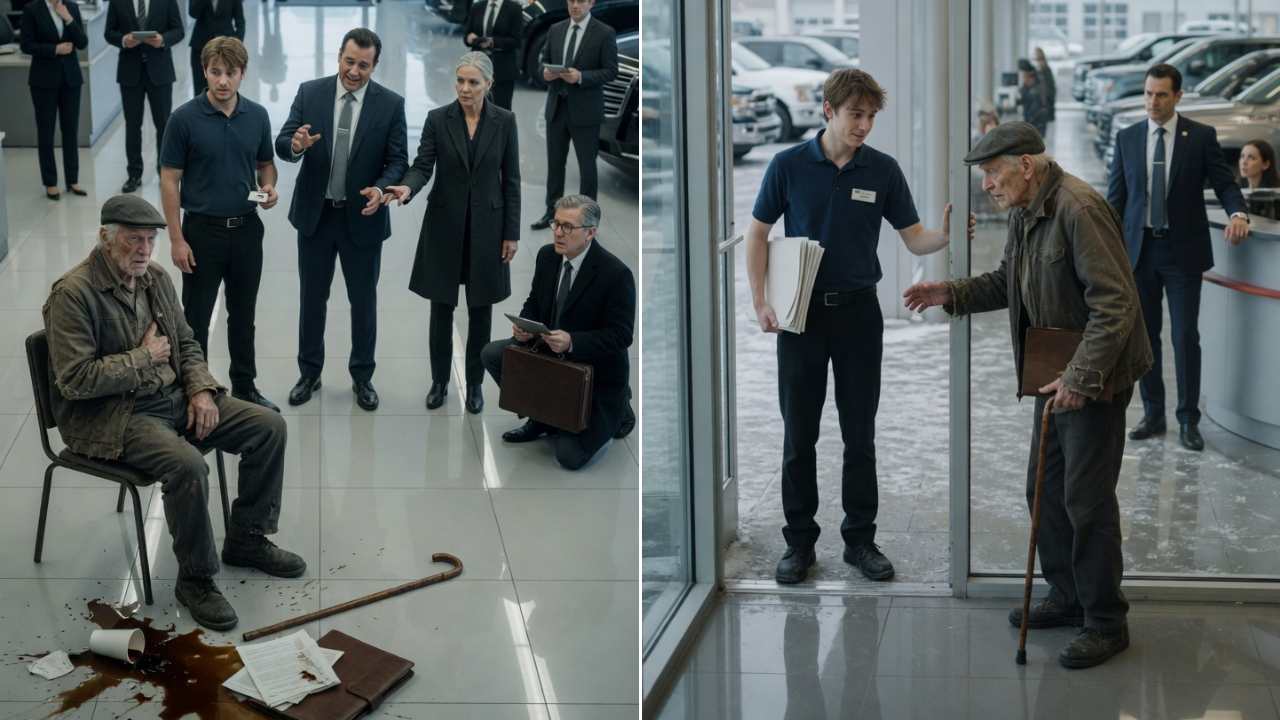
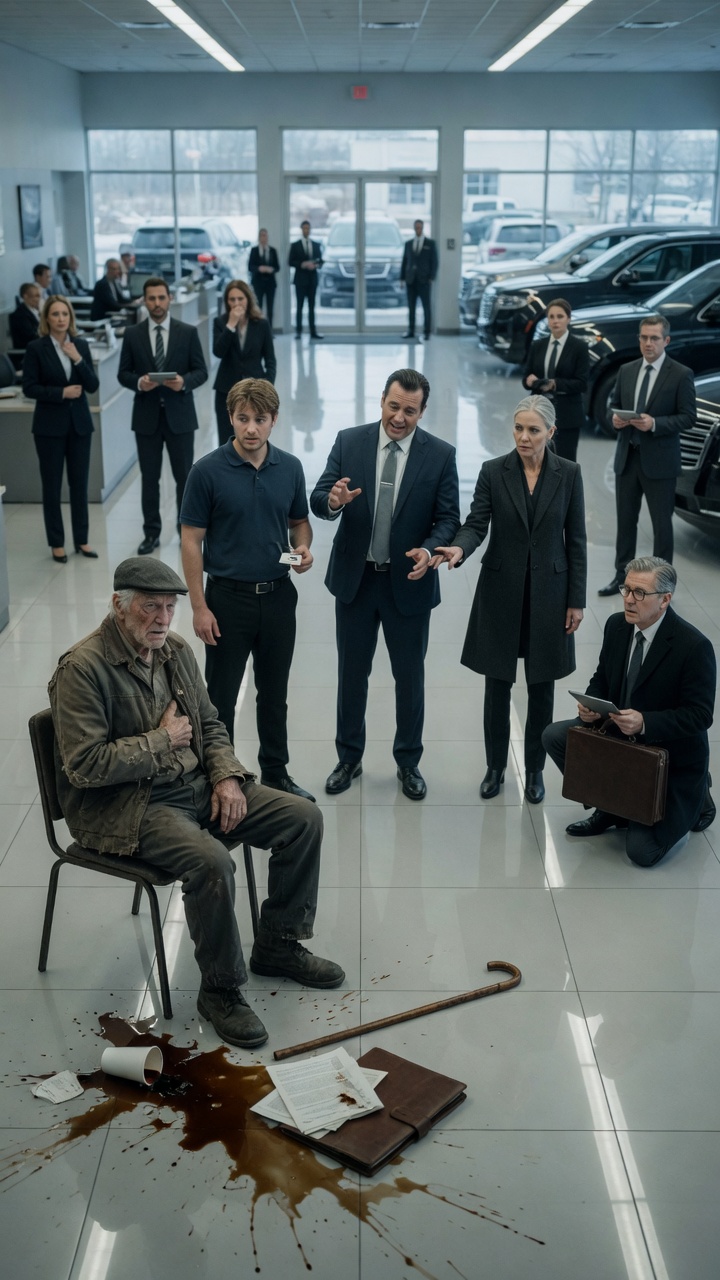
The old man reached for his leather folder, but his hand trembled. The folder slipped from his fingers and fell open on the tile.
A few papers slid out.
Jonah bent down immediately.
At the same moment, Martin stepped forward and caught the edge of the folder with his shoe.
“Sir, I said it’s time to go.”
The old man leaned forward to retrieve the papers.
His cane shifted.
His balance failed.
Jonah saw it happening too late.
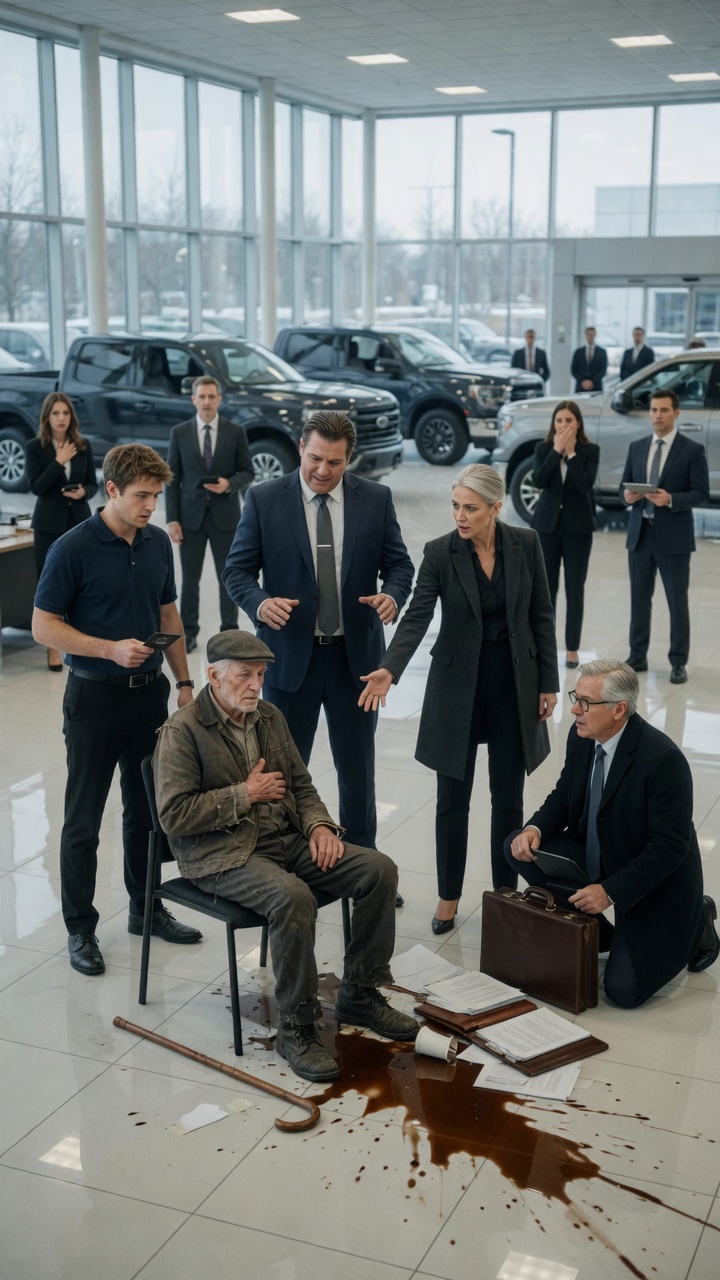
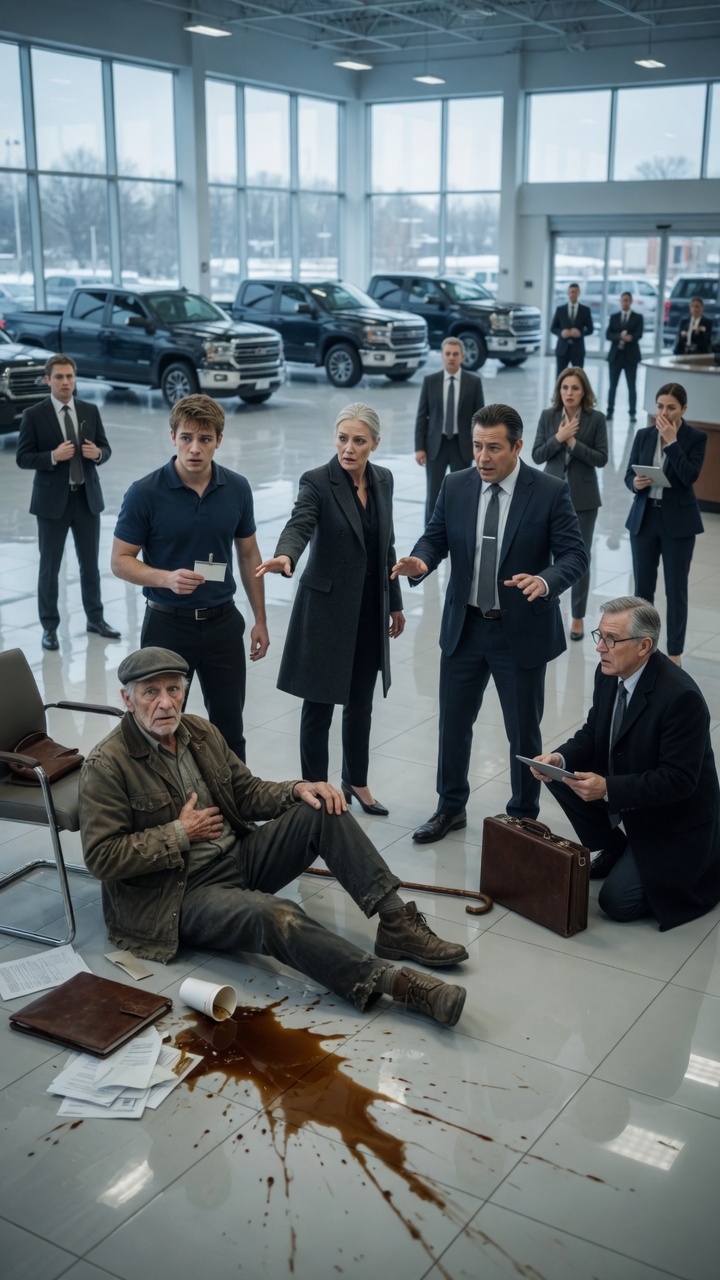
The old man stumbled sideways, hitting the corner of the coffee station with his shoulder before falling hard onto the showroom floor.
The paper cup toppled.
Coffee splashed across the white tile.
The sound of his body hitting the ground seemed to echo through the entire building.
Everything stopped.
The receptionist gasped.
A salesman froze with a tablet in his hand.
A mechanic at the service entrance pulled off one glove and stared.
For two seconds, Martin said nothing.
Then he looked at the coffee spreading across the floor.
“Unbelievable,” he muttered.
Jonah dropped to one knee beside the old man.
“Sir? Sir, are you hurt?”
The old man’s face was tight with pain. His breathing had gone shallow.
“I’m all right,” he whispered, though he clearly wasn’t.
Jonah looked up.
“Someone call 911.”
Martin snapped, “Nobody is calling anyone.”
Jonah stared at him.
“He fell.”
“He tripped. There’s a difference.”
“He needs help.”
“He needs to stop making a scene.”
The old man closed his eyes briefly.
Martin leaned down, anger now visible beneath his polished exterior.
“You people always do this,” he said.
The room went cold.
Jonah looked at him slowly.
“What did you say?”
Martin straightened his jacket.
“I said people like him come into businesses like this looking for sympathy, free coffee, maybe a warm room. Then they fall, and suddenly there’s a lawsuit.”
A woman waiting for her oil change covered her mouth.
Bryce looked away.
Jonah’s voice shook. “He’s an old man.”
Martin pointed toward the door.
“He is a liability.”
The old man opened his eyes.
He looked not at Martin, but at Jonah.
“Don’t lose your job over me, son.”
Jonah felt heat in his throat.
“With respect, sir,” he said, “that might already be happening.”
He helped the old man sit upright. Another employee, a service advisor named Grace, finally stepped forward with a chair.
Martin shot her a warning look.
She ignored it.
“Here,” Grace said. “Let him sit.”
Jonah and Grace helped the old man into the chair.
His hands shook as he held his side.
Martin exhaled sharply.
“Fine. He sits for five minutes. Then he leaves.”
Jonah turned on him.
“No. He stays until someone checks if he’s injured.”
Martin’s face hardened.
“Jonah, office. Now.”
The showroom was silent.
Jonah did not move.
Martin walked toward him, lowering his voice.
“You are a lot attendant. You move cars. You wash tires. You do not challenge me in front of my staff.”
Jonah’s heart pounded.
“Then don’t make it so easy.”
A sharp breath moved through the room.
Martin stared at him with disbelief.
“Clock out.”
Jonah blinked.
“What?”
“Clock out. You are suspended pending review.”
Grace whispered, “Martin…”
He raised a hand.
“Not another word.”
Jonah looked at the old man.
The old man looked devastated, as if Jonah had been the one hurt.
“I’m sorry,” he said softly.
Jonah shook his head.
“You didn’t do anything wrong.”
Martin pointed toward the employee hallway.
“Now.”
Jonah stood slowly.
He removed his name tag, but before he could set it down, the sound of tires on gravel came from outside.
Not one car.
Several.
Through the glass front wall, everyone saw three black SUVs pull into the dealership entrance. They did not park in customer spaces. They stopped directly in front of the showroom.
Doors opened.
Two men in dark suits stepped out first.
Then a woman in a charcoal coat.
Then another man, older, carrying a tablet and a leather briefcase.
The receptionist whispered, “Regional’s early.”
Martin’s face changed instantly.
The anger disappeared. The corporate smile returned.
“Everyone straighten up,” he hissed.
Jonah stood frozen near the coffee station.
The old man lowered his eyes.
The front doors opened.
The woman in the charcoal coat stepped inside first. She was in her fifties, composed, with silver-blonde hair pulled back neatly and a face that did not waste emotion. Beside her was the older man with the briefcase. Behind them, two security personnel scanned the room.
Martin moved quickly toward them.
“Ms. Calder, welcome. We weren’t expecting you until noon.”
The woman did not shake his outstretched hand.
Her eyes moved past him.
She saw the coffee on the floor.
She saw Jonah holding his name tag.
She saw the old man seated beside the coffee station, one hand pressed against his ribs.
Her face went still.
“Where is Mr. Hawthorne?” she asked.
Martin blinked.
“I’m sorry?”
The woman looked directly at the old man.
“Mr. Hawthorne.”
The old man sighed quietly.
The man with the briefcase rushed past Martin and knelt beside him.
“Sir, are you injured?”
The entire showroom seemed to tilt.
Martin’s smile faltered.
“Sir?”
The old man gave the briefcase man a tired look.
“I’ve had better mornings, Richard.”
Richard’s face tightened.
“Should I call the paramedics?”
“No. Not yet.”
Ms. Calder stepped forward.
Her voice was controlled, but every word carried weight.
“Mr. Vale, why is the founder of this company sitting beside spilled coffee with his hand on his ribs?”
No one breathed.
Martin’s face drained.
“The founder?”
Grace whispered, “Oh my God.”
Bryce’s tablet slipped slightly in his hand.
The woman waiting for her oil change sat up straight.
Ms. Calder looked around the showroom and spoke more clearly.
“For anyone who is unaware, this is Elias Hawthorne. Founder of Hawthorne Automotive Group. The man whose name is on the holding company that owns this dealership.”
The old man closed his eyes for a moment, as if embarrassed by the announcement.
Martin took one step back.
“No,” he said quietly. “That’s not— I was told Mr. Hawthorne was arriving with corporate.”
“I did,” Elias said.
His voice was soft, rough, and exhausted.
“I just came through the front door before they did.”
Martin’s mouth opened, but nothing came out.
Ms. Calder turned to Richard.
“Document everything.”
Richard stood and began taking notes on his tablet.
Martin’s hands lifted slightly.
“Ms. Calder, there has been a misunderstanding.”
Elias looked up.
“Has there?”
Martin turned toward him.
“Mr. Hawthorne, I had no idea it was you.”
The old man studied him for a long moment.
“That seems to be the part you find important.”
Martin swallowed.
“I only meant—”
“You thought I was poor,” Elias said. “That was enough.”
The words settled over the showroom like dust.
Martin’s face tightened with panic.
“No, sir. I was protecting the customer experience. We have standards.”
Elias looked around the room.
At the polished trucks.
At the spotless glass.
At the employees too frightened to speak.
At Jonah still holding his name tag.
“I built my first repair bay behind a feed store,” Elias said. “The roof leaked. The coffee was terrible. Half my customers paid with crumpled bills and handshakes. We had one standard.”
He looked back at Martin.
“You treated people like they mattered.”
Martin’s lips trembled slightly.
“Sir, I apologize if my tone—”
“Your tone did not put me on the floor.”
Silence.
Martin turned pale.
“I didn’t push you.”
“No,” Elias said. “But you stepped into a frightened old man’s space. You blocked his folder with your shoe. You rushed him while he was trying to gather his things. Then when he fell, you called him a liability.”
Grace looked down.
Bryce stared at the floor.
Ms. Calder’s expression sharpened.
“Is that accurate?”
No one answered.
Then Jonah spoke.
“Yes.”
Martin spun toward him.
“You are already suspended.”
Ms. Calder looked at Jonah.
“Your name?”
“Jonah Reed.”
“Were you present?”
“Yes, ma’am.”
“Tell me what happened.”
Jonah’s voice was unsteady at first. Then it grew stronger.
“He came in cold. I helped him inside and gave him coffee. Mr. Vale told me to get him out because corporate was coming. Mr. Hawthorne tried to pick up his folder. Mr. Vale stepped too close. He fell. I asked someone to call 911. Mr. Vale said not to. Then he suspended me.”
Martin’s face went red again.
“That is a completely biased version.”
Grace lifted her hand slightly.
“It’s true.”
Everyone turned to her.
She looked terrified, but continued.
“I saw it from the service desk.”
The woman from the waiting area stood.
“I saw it too.”
A mechanic near the service entrance said, “Same here.”
One by one, the room changed.
Not loudly.
Not dramatically.
But enough.
People who had been silent began choosing not to be.
Martin looked around, realizing he no longer controlled the room.
Ms. Calder turned to him.
“Mr. Vale, effective immediately, you are suspended pending formal investigation.”
His mouth dropped open.
“What?”
“You will leave the property for the remainder of the day. Human Resources and Legal will contact you this afternoon.”
“Suspended?” Martin repeated, as though the word belonged to someone else.
Ms. Calder’s voice remained calm.
“Yes.”
“Over this?”
Elias’s eyes hardened.
“Over this.”
Martin looked at Richard.
Then at the employees.
Then at the customers.
“This is absurd. I have raised this location’s monthly sales by eighteen percent.”
Elias leaned back slightly in the chair.
“And somehow lowered its humanity by twice that.”
Martin’s face flushed with humiliation.
“Mr. Hawthorne, please. I have worked too hard for this.”
“So has everyone here,” Elias said. “The difference is, most of them still remember what work is for.”
Martin opened his mouth again, but Ms. Calder interrupted.
“Security will walk you to your office so you may collect your keys and personal items. You are not to access company files or speak to staff about this matter.”
The two security personnel stepped forward.
For the first time that morning, Martin looked small.
He straightened his jacket, trying desperately to rebuild the image that had just collapsed in front of everyone.
“This is a mistake,” he said.
No one answered.
As security escorted him toward the back office, his polished shoes clicked against the tile. The same sharp sound that had once made employees stand straighter now sounded hollow.
At the hallway entrance, Martin looked back.
Jonah was still standing near the coffee station.
Their eyes met.
Martin seemed to want to say something cruel.
But with corporate watching, customers staring, and the founder sitting injured in the showroom, he said nothing.
Then he disappeared down the hall.
Only after he was gone did the room exhale.
Richard turned to Elias.
“Sir, we should still have you examined.”
Elias looked annoyed.
“I fell, Richard. I didn’t explode.”
Ms. Calder stepped closer.
“Elias.”
He sighed.
“Fine. But no ambulance unless I’m actually dying.”
“You are seventy-nine.”
“I am aware.”
That earned a nervous laugh from someone in the showroom.
The sound softened the room.
Jonah finally set his name tag on the counter.
“I should probably go,” he said.
Elias turned sharply.
“Why?”
“I was suspended.”
“Not by anyone who still has authority.”
Jonah blinked.
Ms. Calder picked up his name tag and handed it back.
“Mr. Reed, you are not suspended.”
Jonah stared at the name tag in his hand.
Elias said, “In fact, I’d like you to stay until we finish taking statements. If you’re willing.”
“Of course.”
“And Jonah?”
“Yes, sir?”
“Thank you for the coffee.”
Jonah’s throat tightened.
“It was just coffee.”
Elias looked at him with those tired pale-green eyes.
“No. It wasn’t.”
The police arrived twenty minutes later.
Not with sirens.
Not with a dramatic entrance.
Two officers walked through the front doors calmly, spoke first with Ms. Calder, then with Elias, then with Jonah, Grace, and the customers who had witnessed the fall.
Martin was not handcuffed.
There was no applause.
No one cheered as though justice were a stage show.
Instead, the officers took statements, reviewed the camera footage from the showroom, and asked Elias whether he wanted medical assistance.
He refused twice.
Ms. Calder overruled him on the third attempt and called a private physician affiliated with the company’s insurance provider.
The officers explained that depending on the footage and Elias’s medical condition, the matter could be handled as a workplace incident, a civil complaint, or something more serious if intentional physical intimidation was proven.
Elias listened quietly.
“I’m less interested in punishment,” he said, “than I am in truth.”
One officer nodded.
“Truth still needs paperwork.”
Elias smiled faintly.
“Usually does.”
By early afternoon, the showroom had returned to a strange version of normal.
Customers whispered. Employees moved carefully. The coffee stain had been cleaned, but everyone still looked at the spot on the tile where Elias had fallen.
Martin’s office door remained closed.
His nameplate still sat outside it, but people passed it differently now.
As if it had already become part of the past.
At 3:17 p.m., every employee at Hawthorne Automotive Group received an internal email.
The subject line was simple:
Company Values and Leadership Conduct
It did not mention Martin by name in the opening paragraph.
It did not turn the incident into gossip.
It did not exaggerate.
But the message was clear.
Earlier that day, a senior manager at a Hawthorne-owned location had been suspended pending investigation following an incident involving a guest who was treated in a manner inconsistent with company standards.
The email reminded every employee that hospitality was not reserved for customers with approved credit scores, expensive clothes, or visible purchasing intent.
It stated that no employee had the authority to remove, humiliate, intimidate, or deny basic care to someone based on appearance.
It announced that all locations would undergo renewed training on guest dignity, safety procedures, and incident reporting.
And near the end, there was one line that employees would repeat for weeks:
The measure of this company is not how we treat people when we know who they are, but how we treat them when we believe they can do nothing for us.
Jonah read the email in the break room.
Grace stood beside him with a paper cup of coffee.
“That line sounds like him,” she said.
Jonah looked through the small break room window toward the showroom, where Elias sat with Ms. Calder and Richard at a sales desk, going over documents as if he had not been on the floor in pain a few hours earlier.
“Yeah,” Jonah said. “It does.”
Three days passed.
Martin did not return.
Rumors moved through the dealership, but the official answer was always the same: the investigation was ongoing.
Then, on Monday morning, Jonah arrived at 7:30 to find Ms. Calder waiting near the front desk.
He immediately looked down at his shoes, checking whether he had tracked snow inside.
“Jonah,” she said.
“Yes, ma’am?”
“Do you have a moment?”
His stomach dropped.
“Sure.”
She led him into the small conference room near the service department.
Elias was already inside.
He sat at the head of the table, wearing the same old brown work jacket. This time, however, his cane rested neatly beside him and a small bandage showed near his right wrist.
Jonah stopped in the doorway.
“Sir.”
“Come in, son.”
Jonah sat across from him.
Ms. Calder placed a folder on the table.
Elias looked at Jonah for a long moment before speaking.
“I’ve spent the last few days reviewing statements, camera footage, employee records, customer complaints, and internal reports from this location.”
Jonah nodded, unsure what to do with his hands.
Elias continued.
“Martin Vale’s suspension will continue until the investigation concludes. He will not be returning to active duty here.”
Jonah said nothing.
“That is not why I asked you in.”
Ms. Calder opened the folder.
Elias leaned forward slightly.
“When I was sitting near the door that morning, several employees saw me. Most looked away. Some looked uncomfortable. One made a joke.”
Jonah knew exactly who he meant.
“You came outside,” Elias said. “You held the door. You warned me about the rug. You offered coffee. You called me sir when you had no reason to think I mattered.”
Jonah’s face warmed.
“You did matter.”
Elias smiled.
“That answer is why we’re here.”
Ms. Calder slid a paper toward him.
“Effective immediately, we’d like to promote you to Customer Care Coordinator for this location.”
Jonah stared at her.
“I’m sorry?”
“It’s a new role,” she said. “You’ll help oversee the customer reception experience across sales and service. You’ll also report directly to the interim general manager during the transition.”
Jonah looked at Elias.
“I move cars.”
“You used to,” Elias said.
“I don’t have management experience.”
“Good,” Elias replied.
Jonah blinked.
Elias continued, “Sometimes experience teaches people the wrong things. We can train you on systems. We can train you on reports. We can train you on scheduling, customer follow-up, and service coordination.”
He paused.
“What we cannot train is instinctive decency.”
Jonah looked down at the paper.
The salary was almost double what he made as a lot attendant.
His hands began to shake.
“I don’t know what to say.”
Elias pushed a pen across the table.
“Say yes if you mean it. Say no if you don’t.”
Jonah swallowed hard.
Then he picked up the pen.
“Yes.”
Ms. Calder smiled for the first time.
“Congratulations, Jonah.”
Elias extended his hand across the table.
Jonah shook it carefully.
The old man’s grip was still thin, still fragile, but there was strength in it.
“Don’t let the title change you,” Elias said.
“I’ll try not to.”
“No. Don’t try. Decide.”
Jonah nodded.
“I decide.”
Outside the conference room, word spread faster than any corporate email.
By lunchtime, Grace hugged him in the service lane. Ray from parts slapped him on the shoulder. Even Bryce, the salesman who had made the joke, came over with a stiff, embarrassed expression.
“Hey,” Bryce said. “About what I said the other day…”
Jonah looked at him.
Bryce scratched the back of his neck.
“It was stupid.”
“Yes,” Jonah said.
Bryce nodded.
“Fair.”
Then Jonah surprised himself by saying, “Coffee station needs refilling.”
Bryce looked confused.
“That’s not my job.”
Jonah raised an eyebrow.
Bryce hesitated.
Then he walked toward the coffee station.
Grace laughed so hard she nearly dropped a repair order.
Two weeks later, Hawthorne Automotive Group sent another internal announcement.
Martin Vale’s employment had been terminated following the completion of the investigation.
The email contained no dramatic language. No threats. No public humiliation.
Just the facts.
Violation of safety protocol.
Failure to report a guest injury.
Retaliatory action against an employee who attempted to provide assistance.
Conduct inconsistent with company leadership standards.
The police report remained open for a short time while Elias’s medical records were reviewed. In the end, Elias declined to pursue a criminal complaint unless further evidence required it.
“I don’t need a spectacle,” he told Ms. Calder.
“What do you need?” she asked.
Elias looked through the showroom window at Jonah helping an elderly woman understand her repair invoice.
“I need the company to remember who we are.”
The changes came slowly after that.
The rug near the entrance was replaced.
A bench was installed beside the front doors.
The coffee station was moved closer to the waiting area, with real mugs for people who wanted them.
Every dealership in the group received new training, but Jonah noticed the training felt different from the usual corporate videos. There were fewer slogans. More stories. More practical questions.
What do you do when someone walks in cold?
What do you do when someone falls?
What do you do when a person does not look like a buyer?
What do you do when kindness interrupts efficiency?
At the Columbus location, the staff started calling the front bench “Elias’s seat.”
Elias pretended to hate it.
He visited three more times that winter.
Each time, he wore the same brown jacket.
Each time, someone offered him coffee before he asked.
And each time, Jonah watched carefully to make sure they meant it.
One evening in late February, just before closing, Jonah was locking the front doors when he saw a man standing outside in a mechanic’s coat, staring at the row of used cars.
The man was middle-aged, tired, with grease under his nails and worry in his face. Beside him stood a teenage girl hugging a backpack to her chest.
Jonah opened the door.
“Can I help you?”
The man looked embarrassed.
“My truck died two miles from here. I’m not buying anything. I just need to know if my daughter can wait inside while I call my brother.”
Jonah stepped back and held the door open.
“Of course.”
The man blinked, as if he had expected a different answer.
“She won’t bother anyone.”
“I know.”
Jonah led them to the waiting area.
The girl sat down quietly.
He brought them both coffee, then hot chocolate for the girl when she admitted she didn’t like coffee.
The man looked at the cup in his hands.
“You sure this is okay?”
Jonah smiled faintly.
“It’s rarely just coffee.”
The man didn’t understand.
That was all right.
Some lessons were not meant to be explained immediately.
Outside, snow began to fall under the dealership lights, softening the rows of vehicles and covering the tire tracks in the lot.
Inside, the showroom was warm.
The front bench was clean.
The coffee was fresh.
And near the entrance, mounted on the wall beside a framed photograph of the dealership from 1974, there was a new plaque.
It did not mention Martin Vale.
It did not mention the fall.
It did not mention the investigation.
It only carried one sentence from Elias Hawthorne’s internal memo:
Treat people well before you know who they are.
Jonah read it every morning.
Not because he needed the reminder.
Because he knew someday someone else would.