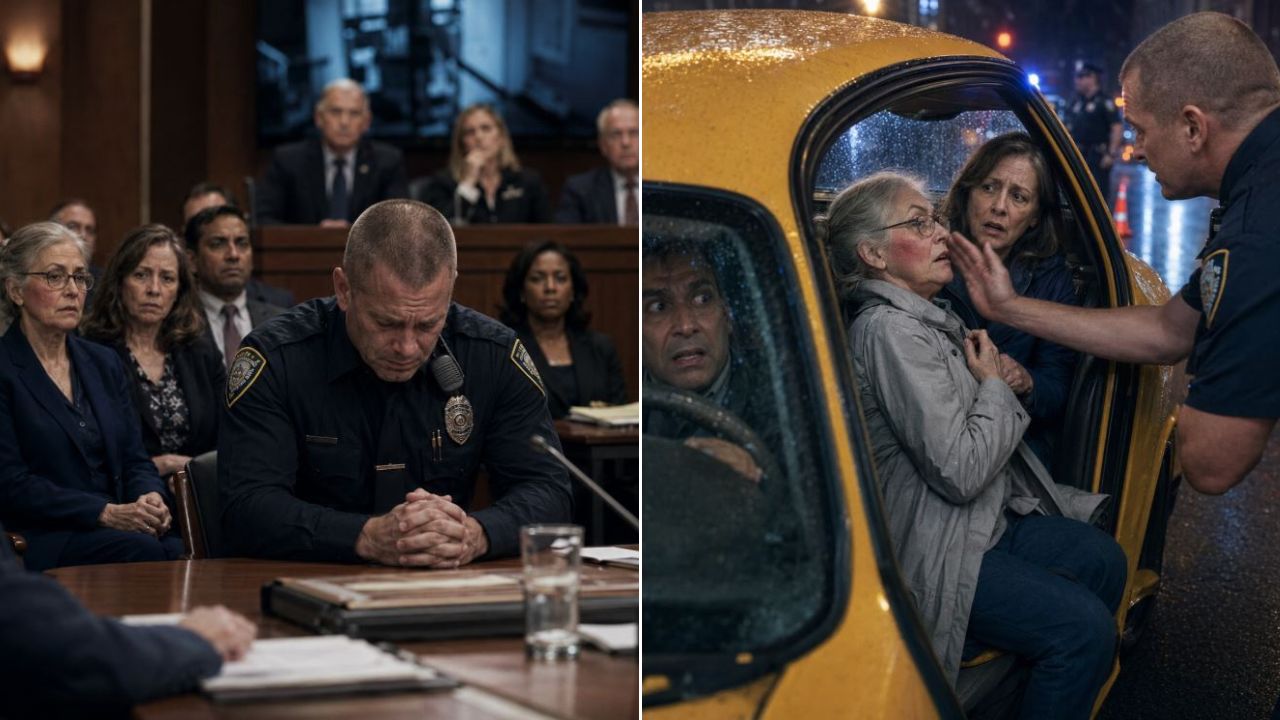
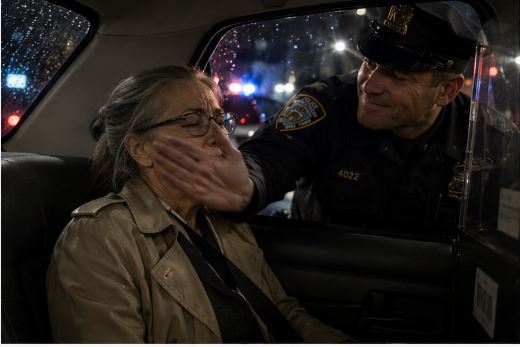
Officer Daniel Miller slapped me in the back of a taxi at 11:42 on a rainy Thursday night.
Then he smiled.
Not the kind of smile people give when they are nervous.
Not the kind people give when they realize they have gone too far.
It was a small, ugly smirk.
The kind of smirk a man wears when he thinks the uniform on his chest makes him untouchable.
He thought I was just another tired woman in the back seat of a yellow cab.
He thought I was old enough to be frightened.
Quiet enough to be ignored.
Ordinary enough to disappear.
What Officer Miller did not know was that I had spent thirty-one years investigating men exactly like him.
My name is Evelyn Carter.
I am sixty-two years old.
I wear comfortable shoes now. I carry peppermint candies in my purse. I do not drive at night unless I have to. My knees complain when it rains, and my daughter says I still use commas like I’m writing court briefs.
But before I retired, I worked for the city’s Civilian Review Board.
For more than three decades, I listened to complaints people were too afraid to file. I reviewed body camera footage. I sat across from mothers whose sons had been shoved against walls for no reason. I interviewed officers who lied badly, officers who lied well, and officers who had forgotten what a badge was supposed to mean.
I had seen fear.
I had seen arrogance.
And I had seen the exact look on Daniel Miller’s face before.
That night, I had not planned to be in that taxi.
My younger sister, Ruth, had talked me into dinner in Manhattan.
“Just one night out,” she said. “You sit in that apartment reading mystery novels like you’re ninety.”
“I like my apartment,” I told her.
“You like your chair.”
“I paid good money for that chair.”
She laughed and won.
So there we were, two older sisters in the back of a taxi after a quiet dinner, carrying leftover cheesecake in a paper bag while rain ran down the windows like melted glass.
Ruth was sixty, still beautiful in the easy way women become beautiful when they stop apologizing for aging. She wore a navy raincoat and silver earrings. I wore jeans, sneakers, and my old gray trench coat.
No makeup.
No jewelry except my wedding band, though my husband had been gone nine years.
Just two women heading home.
The driver’s name was Samir. His photo and license were mounted on the divider. He was polite, quiet, maybe in his late forties. He asked if the heat was okay. Ruth told him it was perfect. I noticed he had a small dashboard camera near the windshield and another camera pointed toward the back seat.
I notice things like that.
Old habits do not retire.
We were crossing Midtown when the traffic slowed.
At first, I thought it was an accident.
Then I saw the flashing lights.
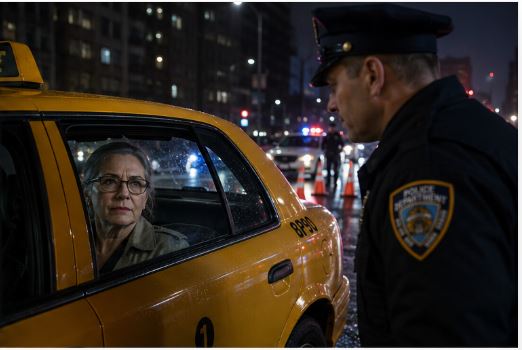
Orange cones narrowed three lanes into one. Two police cruisers sat at an angle beside the curb. A line of cars waited in the rain. A uniformed officer waved vehicles forward one at a time.
Ruth sighed. “Checkpoint?”
“Looks like it,” I said.
Samir tapped the steering wheel with his thumb. “They have been doing these all week.”
Something in his voice made me look up.
“You sound worried,” I said.
He glanced at me through the mirror.
“They ask questions. Sometimes they search. Taxi drivers don’t argue.”
I sat a little straighter.
When we reached the front of the line, Officer Miller stepped toward the cab.
He was broad-shouldered, probably mid-forties, with a shaved head and a face that looked permanently annoyed. Rain ran off the brim of his cap. His badge caught the red and blue lights from the cruiser.
He knocked hard on Samir’s window.
Samir rolled it down.
“License and registration,” Miller said.
Samir handed them over.
“Where you headed?”
“West 86th,” Samir answered.
Miller leaned lower and looked into the back seat.
His eyes moved from Ruth to me.
“IDs from the passengers.”
Ruth reached for her purse automatically.
I did not.
I looked at the officer. “Is there a reason you need passenger identification?”
Miller’s eyes settled on me.
“What did you say?”
“I asked for the reason.”
His jaw tightened.
“You got a problem showing ID?”
“I have a problem with unlawful stops and fishing expeditions.”
Ruth whispered, “Evelyn.”
I kept my eyes on Miller.
He stepped closer to the open window.
“Ma’am, I’m going to ask you one more time. Show me your ID.”
“Am I being detained?”
That was when his face changed.
Not much.
Just enough.
A flicker of irritation. Then a decision.
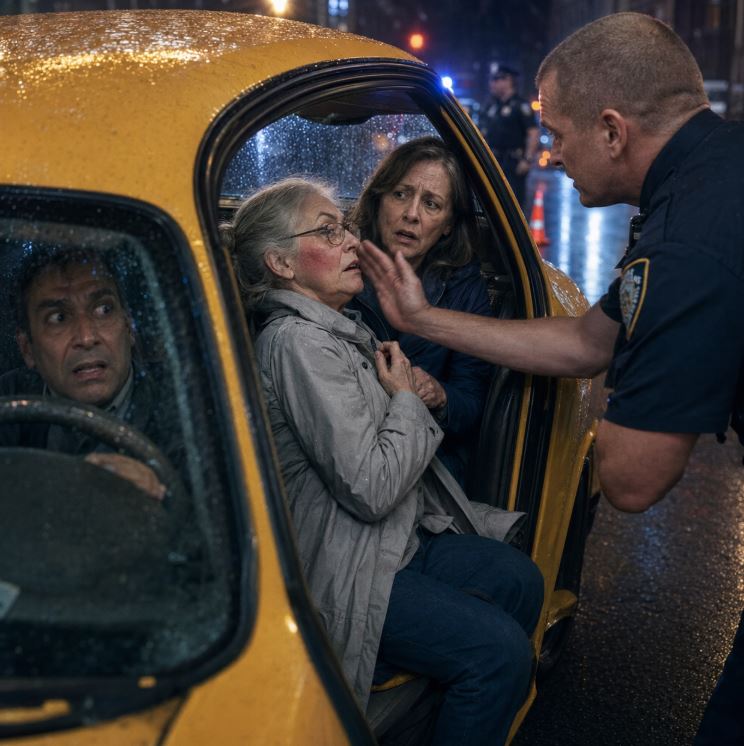
He reached past Samir, shoved the back door open, and leaned inside the cab.
The rain came in with him.
Cold. Sharp. Smelling like asphalt.
“Get out,” he said.
I stayed seated.
“On what grounds?”
His hand came fast.
The slap cracked across the small space of the taxi.
My head turned with it.
For a moment, I heard nothing but Ruth’s gasp.
The side of my face burned. My glasses shifted crookedly on my nose. The paper bag of cheesecake slid off Ruth’s lap and landed on the floor.
Samir froze with both hands on the wheel.
Miller straightened outside the cab and smiled.
“There,” he said. “Now you can decide if you want to cooperate.”
Ruth’s voice shook. “You hit her.”
Miller pointed at her. “Stay out of this.”
I slowly lifted one hand and adjusted my glasses.
My cheek throbbed.
But my mind went cold.
Very cold.
There are moments in life when fear tries to climb into your throat.
If you let it, it takes your voice first.
Then your judgment.
Then your power.
I had taught that to witnesses for years.
Breathe.
Observe.
Remember.
Do not give the bully what he needs.
I looked at Miller’s badge.
Then I looked at his nameplate.
MILLER.
Then I looked at the cruiser number behind him.
I reached down, picked up my purse, and took out my phone.
Miller saw the movement.
“No calls.”
“I’m calling my attorney.”
He laughed.
That laugh told me more than his slap had.
“You think anybody cares?” he said.
Samir whispered, “Ma’am, please…”
I turned slightly toward the driver.
“Samir, is your camera recording?”
His eyes met mine in the rearview mirror.
He hesitated.
Miller looked at him.
“Don’t answer that.”
I said calmly, “Samir, keep both hands visible. Do not turn off the vehicle. Do not delete anything. Do not touch the camera.”
Miller’s smirk faded.
“What did you just say?”
I looked back at him.
“I said don’t touch the camera.”
The rain hammered against the roof.
For the first time, Officer Miller looked toward the windshield.
He saw the dashboard camera.
Then he looked at the small black camera mounted near the divider, facing the back seat.
His face did not show panic.
Not yet.
Men like Miller do not panic when they first realize there may be evidence.
They calculate.
“Step out of the cab,” he said again.
“No.”
“You’re obstructing.”
“No, Officer Miller. I am sitting in a licensed taxi after being struck by a uniformed officer during an unlawful passenger ID demand.”
His eyes narrowed.
“You some kind of lawyer?”
“Retired.”
Ruth closed her eyes.
She knew that tone.
My husband used to call it my courtroom voice, even though I was never a judge.
Miller leaned in again, but this time he did not touch me.
“Then you should know better than to interfere with police work.”
“I know exactly what police work is,” I said. “And I know what it is not.”
Another officer approached from behind him.
Younger. Nervous.
“Miller,” he said quietly, “we’ve got cars backed up.”
Miller did not look away from me.
“Run the driver’s license again.”
“You already did.”
“I said run it again.”
The younger officer looked uncomfortable, but he obeyed.
I unlocked my phone and dialed.
Miller moved toward me.
I lifted my eyes.
“Do not put your hands on me again.”
Something in my voice stopped him.
Not fear.
Not anger.
Certainty.
The call connected.
A woman answered, sleepy but alert.
“Brooks.”
“Marianne, it’s Evelyn Carter.”
There was a pause.
Then her voice sharpened.
“Evelyn? Are you okay?”
“I’m in a taxi at an unauthorized checkpoint near 48th and Ninth. Officer Daniel Miller, badge 4022, just struck me in the face after demanding passenger ID without cause.”
Miller’s expression shifted.
Only a little.
But I saw it.
Marianne Brooks was not just my attorney.
She was my former deputy director at the Civilian Review Board.
She knew every complaint form, every precinct commander, and every emergency oversight number in the city.
She also knew me well enough to understand that if I called her at midnight, I had already collected half the evidence.
“Is there video?” she asked.
“Yes. Taxi dash and interior camera. Driver is named Samir. Cruiser number 718.”
“Any injuries?”
“Facial strike. No bleeding.”
Ruth whispered, “Her cheek is swelling.”
I added, “Witness in vehicle. My sister Ruth Carter.”
Miller took one step back.
Not far.
Just enough.
Marianne said, “Put me on speaker.”
I did.
Her voice filled the taxi.
“Officer Miller, this is Marianne Brooks, attorney for Ms. Evelyn Carter. You are now on notice that all video evidence from this taxi is subject to preservation. Any attempt to interfere with the driver, the passengers, or the recording equipment will be added to a formal complaint and emergency injunction request by morning.”
Miller stared at the phone.
Then he laughed again.
But this time it was thinner.
“You people love making threats.”
Marianne said, “No threat. Just documentation.”
The younger officer came back.
“Driver’s clean,” he said.
Miller snapped, “I didn’t ask for commentary.”
I said, “Are we free to leave?”
Miller looked at me for a long time.
Then he stepped away from the door.
“Get out of here.”
Samir’s hands trembled as he shifted into drive.
As the taxi rolled forward, Ruth grabbed my hand.
“Oh my God, Evelyn.”
“I’m all right.”
“You are not all right. He hit you.”
I looked out the wet window at the lights smearing across the pavement.
“No,” I said softly. “He made a mistake.”
We drove three blocks before Samir pulled over near a deli.
He turned around, his face pale.
“Ma’am, I am sorry. I should have said something.”
“No,” I told him. “You did exactly what you needed to do. You kept the camera running.”
He swallowed hard.
“I have the video saved. Both cameras. But sometimes…” He hesitated. “Sometimes drivers complain and then we get ticketed every week.”
“I know,” I said.
And I did know.
That was how abuse stayed alive.
Not because everyone approved of it.
Because too many people were afraid of what would happen if they spoke.
I gave Samir Marianne’s number.
“Send the video to her tonight. Save a copy somewhere else. Do not post it online. Not yet.”
He nodded.
Ruth touched my cheek gently.
“We need ice.”
“We need evidence first.”
“You are impossible.”
“I’m consistent.”
She almost laughed, then started crying instead.
At 1:18 a.m., Marianne arrived at my apartment with a laptop, two printed forms, and the expression of a woman who had gone from tired to furious.
By 2:00, we had Samir’s footage.
By 2:30, we had written statements from me, Ruth, and Samir.
By 3:15, Marianne had confirmed something I already suspected.
There was no authorized checkpoint at 48th and Ninth that night.
No captain had approved it.
No department notice had been filed.
No traffic safety operation existed on paper.
“That means Miller was freelancing,” Marianne said.
“Or running something off-book,” I replied.
She looked at me over her glasses.
“You think there are others?”
“I know there are others.”
Daniel Miller was not new to me.
I did not recognize his face at first. But I recognized the name after Marianne searched old records.
Three complaints in seven years.
All from taxi drivers or passengers.
All dismissed.
One woman said Miller shoved her teenage son during a traffic stop.
One driver said Miller threatened to plant contraband if he complained.
One elderly man said Miller took his phone and deleted video.
Insufficient evidence.
No witnesses.
Officer denied allegation.
Case closed.
Those words had buried more truth than any shovel ever could.
At 4:05 a.m., Marianne leaned back in her chair.
“You should sleep.”
“I will sleep after eight.”
“Evelyn.”
“Marianne.”
She sighed.
“You always were stubborn.”
“No. I’m old. There’s a difference. Stubborn means you won’t change your mind. Old means you’ve seen the same pattern too many times to pretend it’s new.”
At 7:40 a.m., I stood in front of my bathroom mirror.
The left side of my face was swollen.
A red mark curved along my cheekbone.
I put on a navy suit.
Not because I wanted to look powerful.
Because I wanted no one in that room to mistake me for confused, emotional, or fragile.
Women my age learn that trick.
If you cry, they call you unstable.
If you get angry, they call you difficult.
If you stay calm, they start to worry.
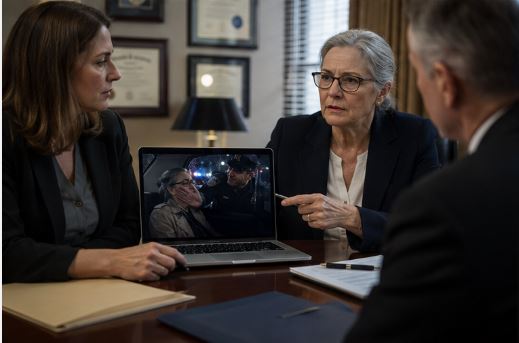
At exactly 8:00 a.m., Marianne and I walked into the office of Deputy Commissioner Harold Grant.
I had known Harold for twenty-five years.
He was not a warm man, but he was a careful one.
Careful men do not like surprises.
Especially not on video.
He stood when he saw my face.
“Evelyn.”
I placed a flash drive on his desk.
“Good morning, Harold.”
He looked at the flash drive, then at Marianne.
“What is this?”
“Officer Daniel Miller,” I said. “Badge 4022. Unauthorized stop. Passenger ID demand without cause. Physical strike. Witness intimidation. Possible evidence tampering history. Taxi video preserved.”
Harold’s jaw tightened.
“Sit down.”
“I’d rather stand.”
Marianne opened her folder.
“We are requesting immediate administrative suspension pending investigation, preservation of all body camera and radio records from Miller and units present, GPS logs from cruiser 718, and identification of the second officer on scene.”
Harold looked at me again.
“Was he wearing a body camera?”
“Yes.”
“Activated?”
“I doubt it.”
Harold inserted the flash drive into his computer.
The video began.
At first, he watched without expression.
Then the slap came.
The sound filled the office.
Sharp.
Flat.
Final.
Harold stopped the video.
He took off his glasses and rubbed one hand over his face.
Nobody spoke.
He played it again.
Then he watched the part where I said Samir’s camera was recording.
He watched Miller look toward the dashboard.
He watched Miller change.
By the third viewing, Harold was no longer looking at me like an old colleague.
He was looking at me like a man calculating how much damage had just entered his building.
At 8:17 a.m., he picked up his phone.
“Get me Internal Affairs. Now.”
By 8:29, Officer Miller’s badge access was frozen.
By 8:41, his precinct captain had been ordered to bring him in from patrol.
By 8:53, all footage from the area had been flagged for preservation.
By 9:06, the younger officer from the checkpoint was sitting in a separate room, asking if cooperation would protect his job.
By 9:22, Internal Affairs found two prior complaints involving missing cellphone footage after encounters with Miller.
By 9:40, Samir’s taxi company confirmed that three other drivers had informally reported similar stops near the same area.
By 10:15, Daniel Miller walked into his precinct thinking he had been called in for a schedule change.
I was not in the room when they took his badge.
I did not need to be.
People imagine revenge as something loud.
A slammed door.
A public scene.
A man begging while everyone watches.
But real justice is quieter.
It is a phone call answered by the right person.
A file opened.
A video preserved.
A witness believed.
A man who thought he was protected suddenly discovering that procedure cuts both ways.
At 11:03, Harold called me.
“He’s suspended,” he said.
“Paid?”
“For now.”
“For now is not enough.”
“I know.”
His voice was tired.
“There’s more, Evelyn.”
I waited.
“They found cash in his locker. Not a lot. Enough to raise questions. And a list of plate numbers. Mostly taxis. Some private vehicles.”
“Why?”
“We don’t know yet.”
But I knew what it felt like.
A pattern.
Abuse rarely starts at its worst.
It practices.
It tests who will complain.
Who will stay quiet.
Who can be frightened into gratitude for being allowed to leave.
Over the next six weeks, the story did not explode the way Ruth thought it would.
There was no dramatic press conference at first.
No viral video.
Marianne advised patience.
“Let the record build,” she said. “If we release it too soon, they’ll make it about you. Your attitude. Your past job. Your tone. They’ll say you provoked him.”
She was right.
So we waited.
Internal Affairs interviewed Samir twice.
They interviewed Ruth once.
They interviewed me for four hours.
I brought notes.
The investigator looked surprised.
I told him, “I’ve been retired, not dead.”
He did not smile.
But his partner did.
More witnesses came forward.
A nurse who had been stopped after a late shift.
A delivery driver who said Miller threatened to impound his van.
A retired teacher who had filed a complaint no one followed up on.
A young mother who cried through her entire statement because she still believed she had done something wrong.
That is what men like Miller leave behind.
Not just bruises.
Doubt.
Shame.
People replaying the worst moment again and again, wondering if they should have been quieter, nicer, more respectful, less noticeable.
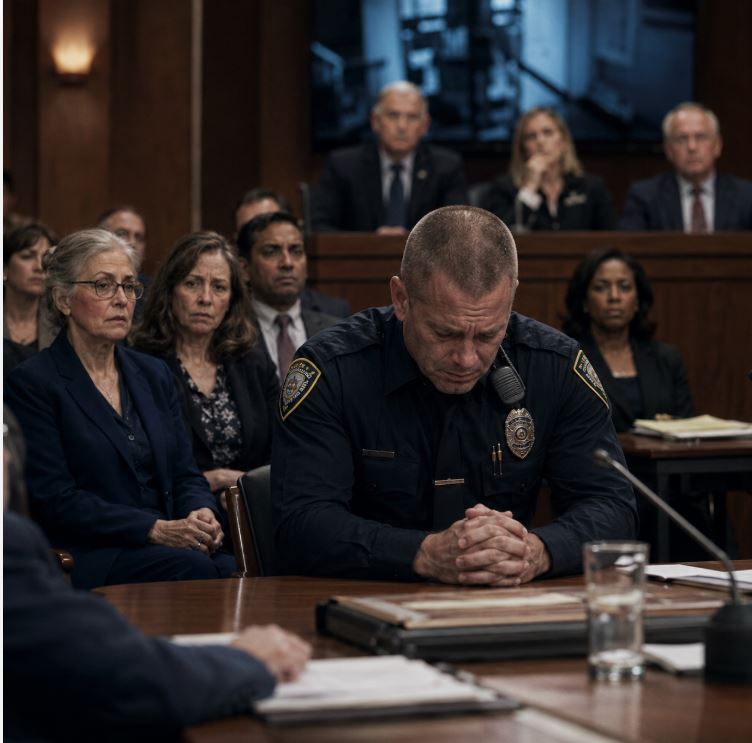
By the time the department held the disciplinary hearing, Officer Daniel Miller no longer smirked.
He sat at the table in a gray suit that did not fit well, flanked by union counsel. His face was pale. His hands stayed folded.
I sat across the room with Ruth on one side and Samir on the other.
Ruth squeezed my hand when the video played.
Samir stared at the floor.
Miller’s attorney tried to say the situation was tense.
He tried to say I had been argumentative.
He tried to say Miller believed I was interfering.
Then Marianne stood.
She did not raise her voice.
She simply played the video from the taxi interior camera.
Then the dashboard camera.
Then the audio.
Then she read from the three prior dismissed complaints.
Then she read the new witness statements.
Then she placed Miller’s own body camera log on the screen.
Not activated.
Again.
And again.
And again.
A board member asked Miller one question.
“Officer Miller, why was your body camera not recording?”
Miller swallowed.
“I forgot.”
The room went still.
Marianne looked at him.
“In seven separate citizen encounters?”
He did not answer.
That was the moment his career ended.
Not when he slapped me.
Not when the video played.
Not even when his badge was taken.
It ended when everyone in that room understood that what happened to me was not a bad moment.
It was a habit.
Miller was terminated two weeks later.
The district attorney later filed charges related to assault and official misconduct. I will not pretend the legal process was quick or perfect. It was not. It was slow, frustrating, and full of language designed to make pain sound administrative.
But he never wore the badge again.
That mattered.
Samir kept driving.
For a while, he was nervous. His company moved him to daytime routes. Ruth and I sent him a card with a grocery gift certificate, which he tried to refuse until Ruth told him arguing with Carter women was bad for his health.
The younger officer who had been at the checkpoint testified.
He admitted Miller had been running informal “traffic checks” without proper approval.
He kept his job, but barely.
I had mixed feelings about that.
Ruth said I was too forgiving.
I told her I was not forgiving him.
I was leaving room for a young officer to become better than the man he had followed.
Six months after that rainy night, the Civilian Review Board asked me to speak at a training session.
I almost said no.
I had retired for a reason.
I liked my quiet mornings. My chair. My mystery novels. My small balcony with the stubborn basil plant that refused to die.
But then Marianne sent me the list of attendees.
New recruits.
Twenty-three of them.
So I went.
I stood at the front of a plain room with fluorescent lights and a projector that took too long to connect.
I showed them the taxi video.
No one moved when the slap happened.
Then I turned off the screen.
“I want you to understand something,” I said. “The badge does not make you powerful. It makes you accountable.”
Some of them looked uncomfortable.
Good.
Comfort rarely teaches anything.
“You will meet people on the worst days of their lives,” I continued. “Tired people. scared people. angry people. confused people. People who ask questions because they have been hurt before. Your job is not to punish them for being afraid.”
A young woman in the front row nodded.
I thought of my younger self.
I thought of every complaint file I had ever read.
I thought of Daniel Miller smiling in the rain.
Then I said, “And remember this: the person you think is powerless may be the person who knows exactly how the system works.”
Afterward, one recruit stayed behind.
He was tall, nervous, maybe twenty-four.
“My father drives a cab,” he said quietly. “Thank you.”
I did not know what to say for a moment.
Then I said, “Tell him to keep his camera running.”
He smiled.
“I will.”
One year after the night in the taxi, Ruth and I went back to the same little restaurant in Manhattan.
She insisted.
“You are not letting that man take cheesecake from us forever,” she said.
So we had dinner.
We talked about her grandchildren, my bad knee, and whether our mother would have liked the waiter. Ruth said yes because he called us “ladies” without sounding sarcastic.
It rained again that night.
Not hard.
Just enough to shine the streets.
When we stepped outside, a yellow taxi pulled up.
For one second, I froze.
The body remembers what pride tries to dismiss.
Ruth touched my arm.
“We can take the subway.”
I looked at the taxi.
Then at the rain.
Then at my sister.
“No,” I said. “We’re taking the cab.”
The driver rolled down the window.
“You need a ride?”
“Yes,” I said. “West 86th.”
Ruth climbed in first.
I followed.
The back seat smelled faintly of coffee and vinyl. The city lights blurred through the wet glass. The meter clicked on.
I noticed the camera near the windshield.
Then I sat back.
Halfway home, Ruth opened the paper bag on her lap.
“Cheesecake survived this time,” she said.
I laughed.
Really laughed.
The kind of laugh that loosens something inside the chest.
Outside, Manhattan moved around us like nothing had happened.
But something had happened.
A man had slapped me because he believed age made me weak, silence made me harmless, and his badge made him safe.
He was wrong about all three.
I am sixty-two years old.
I am slower than I used to be.
I forget why I walked into rooms sometimes.
I keep reading glasses in three places and still lose them.
But I am not invisible.
I am not helpless.
And I am not afraid of men who mistake cruelty for authority.
By 8:00 a.m. that morning, Officer Miller’s career had begun to collapse.
But the real ending came much later.
It came in that second taxi, with my sister beside me, cheesecake between us, rain on the windows, and my hands resting calmly in my lap.
Because justice is not only watching the guilty lose power.
Sometimes justice is getting back into the car.
And going home unafraid.