Alice Edwards stood in the middle of the wedding reception, smiling because that was what grandmothers were supposed to do.
Smile for the photographer.
Smile for the bride.
Smile while your feet hurt inside new shoes.
Smile even when your heart felt heavy.
The ballroom at the Lakeside Country Club was filled with white roses, gold chairs, crystal glasses, and soft music from a string quartet near the windows. It was exactly the kind of wedding Alice’s granddaughter, Chloe, had dreamed about since she was a little girl.
Alice had paid for most of it.
The flowers.
The photographer.
The church donation.
The reception hall deposit.
The dress alterations.
The open bar her son Richard said was “necessary if we don’t want people thinking we’re cheap.”
Alice had written check after check because she loved Chloe.
And because ever since her husband Robert died, her family had become very good at making her feel guilty for saying no.
“Just one more thing, Mom.”
“It’s for Chloe.”
“You know Dad would have wanted this.”
That last one always worked.
Robert had been gone for four years. He had been careful with money his whole life. He built a comfortable life for Alice, not a flashy one. He used to say, “Money should give you peace, not make you foolish.”
Alice had tried to remember that.
But peace was hard to keep when your own family treated your bank account like a family emergency fund.
At the entrance to the ballroom, a young wedding assistant held out a tray of name tags.
“Family table?” she asked brightly.
“Yes,” Alice said. “I’m the bride’s grandmother.”
“Oh, of course.” The girl searched the tray, picked up a white name tag with gold trim, and smiled. “Here you go.”
Alice took it without looking.
The photographer waved her forward.
“Mrs. Edwards, right here, please. We’re doing family pictures before dinner.”
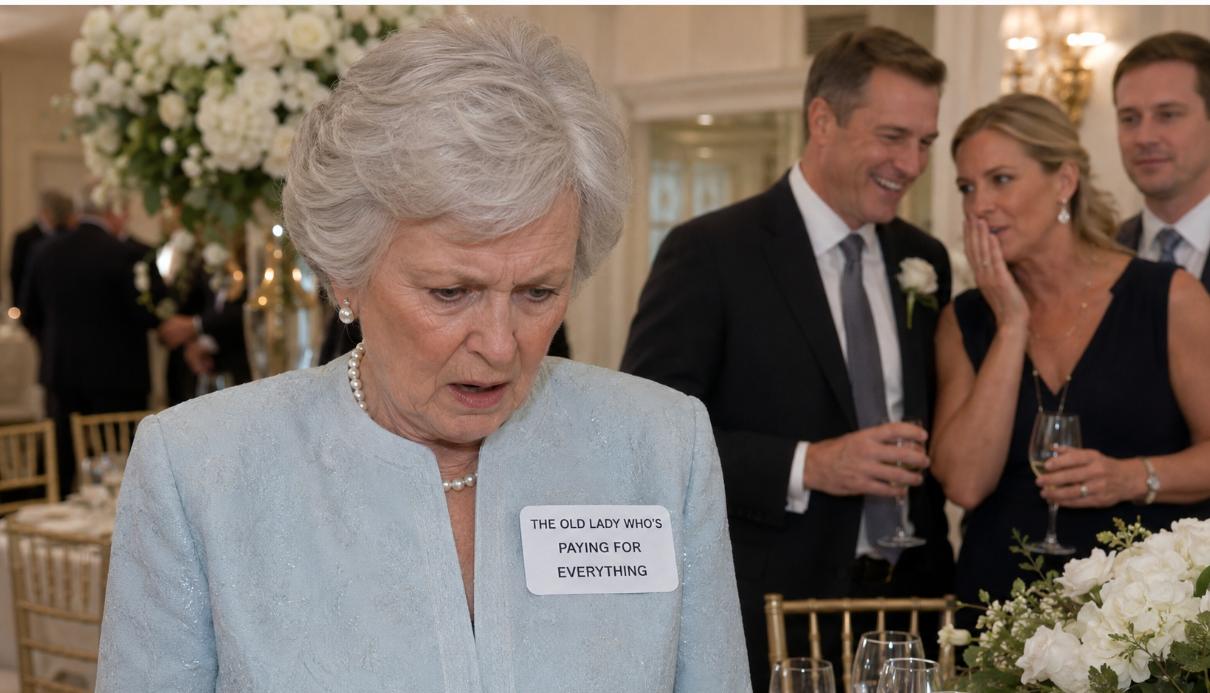
Alice pinned the name tag to the left side of her pale blue jacket.
Then she looked down.
For a moment, she thought she had misread it.
The words were printed in black ink.
Not “Grandmother of the Bride.”
Not “Alice Edwards.”
Not even “Grandma Alice.”
The name tag said:
THE OLD LADY WHO’S PAYING FOR EVERYTHING
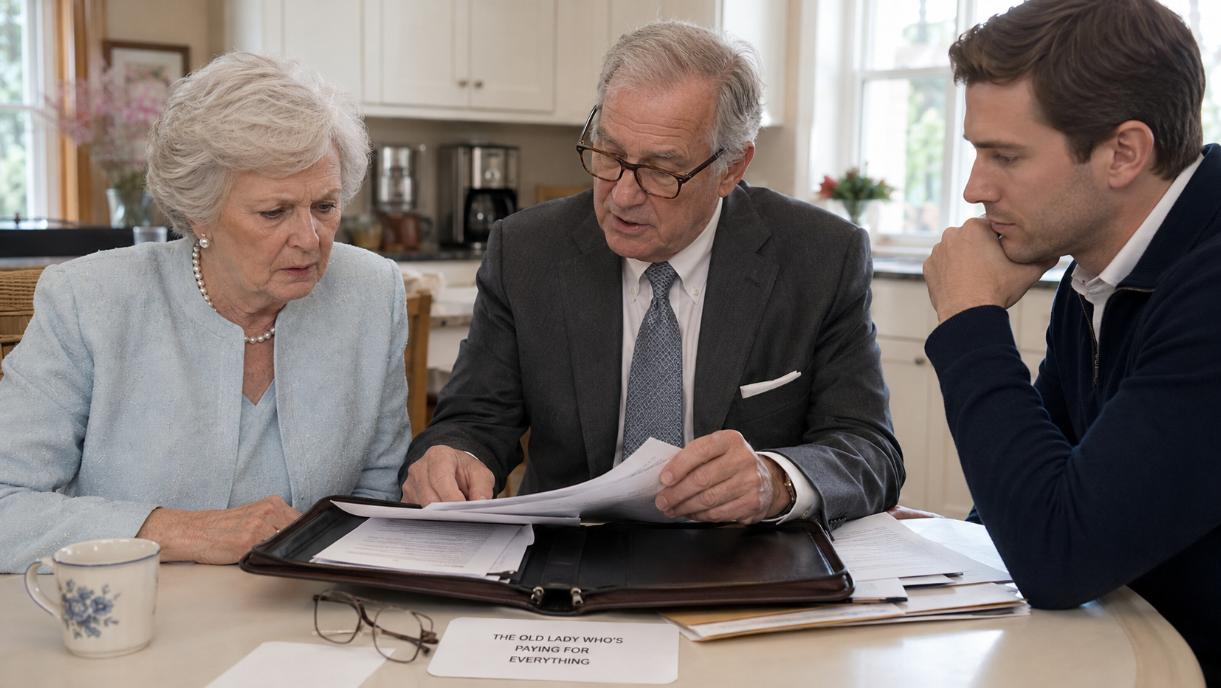
Alice went very still.
The music continued.
Glasses clinked.
Someone laughed behind her.
At first, she told herself it had to be a mistake.
A printer error.
A private joke that had somehow landed on the wrong card.
Then she heard her daughter-in-law Pamela whisper from the table near the bar.
“Oh my God, she actually wore it.”
A few people laughed.
Not loudly.
Not cruelly enough to draw attention from the whole room.
Just enough.
Enough for Alice to hear.
Enough for the heat to rise slowly into her face.
She looked toward Pamela.
Pamela was dressed in champagne silk, her hair swept up, diamonds at her ears. Diamonds Alice had lent her for the day after Pamela said, “It would mean so much for the photos.”
Beside Pamela stood Richard, Alice’s only son.
He did not look embarrassed.
He did not rush over.
He did not remove the name tag.
He was smiling.
Not a warm smile.
A tight, amused smile.
The kind of smile a person gives when they think something is funny as long as it hurts someone else.
Alice touched the name tag with trembling fingers.
The wedding assistant noticed her face and stepped closer.
“Is something wrong, ma’am?”
Alice opened her mouth.
Before she could answer, Richard appeared at her side.
“Mom,” he said softly, but there was warning in his voice. “Don’t make a scene.”
Alice looked at him.
“Did you see this?”
Richard glanced down.
His smile flickered.
“Oh, come on. It’s just a joke.”
“A joke?”
“It’s a wedding. People are having fun.”
Pamela came closer, still holding a glass of champagne.
“Alice, please don’t be dramatic,” she said. “Everyone knows how generous you’ve been. It’s affectionate.”
Alice stared at her.
“Affectionate?”
Pamela gave a little laugh.
“Well, you have been paying for everything.”
Behind Pamela, Richard’s brother-in-law chuckled into his drink.
Alice heard another whisper.
“Walking bank account.”
More laughter.
That was when something inside Alice shifted.
It did not break.
It had been breaking slowly for years.
That day, it simply stopped pretending to be whole.
The photographer approached with his camera.
“Mrs. Edwards? We’re ready for the grandmother shot.”
Alice looked at Chloe across the room.
Her granddaughter looked beautiful. Young, glowing, nervous, completely unaware of the conversation near the entrance.
Alice loved that girl.
She had bought Chloe school shoes when Richard and Pamela said money was tight.
She had paid for Chloe’s braces.
She had covered part of Chloe’s college tuition when Richard “forgot” a payment deadline.
She had never once told Chloe any of that.
Love, Alice believed, did not need an invoice.
But humiliation was different.
Humiliation had a sound.
It sounded like laughter at a family table.
Richard leaned closer.
“Take it off if you’re so upset,” he muttered. “But don’t ruin Chloe’s day.”
Alice looked at him for a long moment.
Then she removed the name tag.
Slowly.
Carefully.
She folded it once and placed it in her small silver purse.
Richard looked relieved.
“There. See? No harm done.”
Alice said nothing.
Because across the room, near table seven, she had just noticed a man in a gray suit.
He was not part of the wedding party.
He was not holding a drink.
He sat alone, straight-backed, with a black leather folder on the table in front of him.
Martin Reynolds.
Robert’s attorney.
Alice had not invited him.
At least, she didn’t think she had.
Martin met her eyes from across the room.
He gave the smallest nod.
Not a greeting.
A signal.
And Alice remembered something Robert had told her a year before he died.
“If they ever forget who you are,” Robert had said, “call Martin.”
At the time, Alice had laughed.
“Who is going to forget who I am?”
Robert had looked at her sadly.
“People who get too used to your generosity.”
Now, standing in a room full of flowers she had paid for, Alice finally understood.
Dinner was served at seven.
Alice sat at the family table between Richard and Chloe’s maid of honor, a young woman who spent most of the meal on her phone.
The chicken was dry.
The speeches were worse.
Pamela spoke first.
She thanked the guests, the vendors, the pastor, the bridesmaids, the groom’s family, and “everyone who helped make this dream wedding possible.”
She did not mention Alice by name.
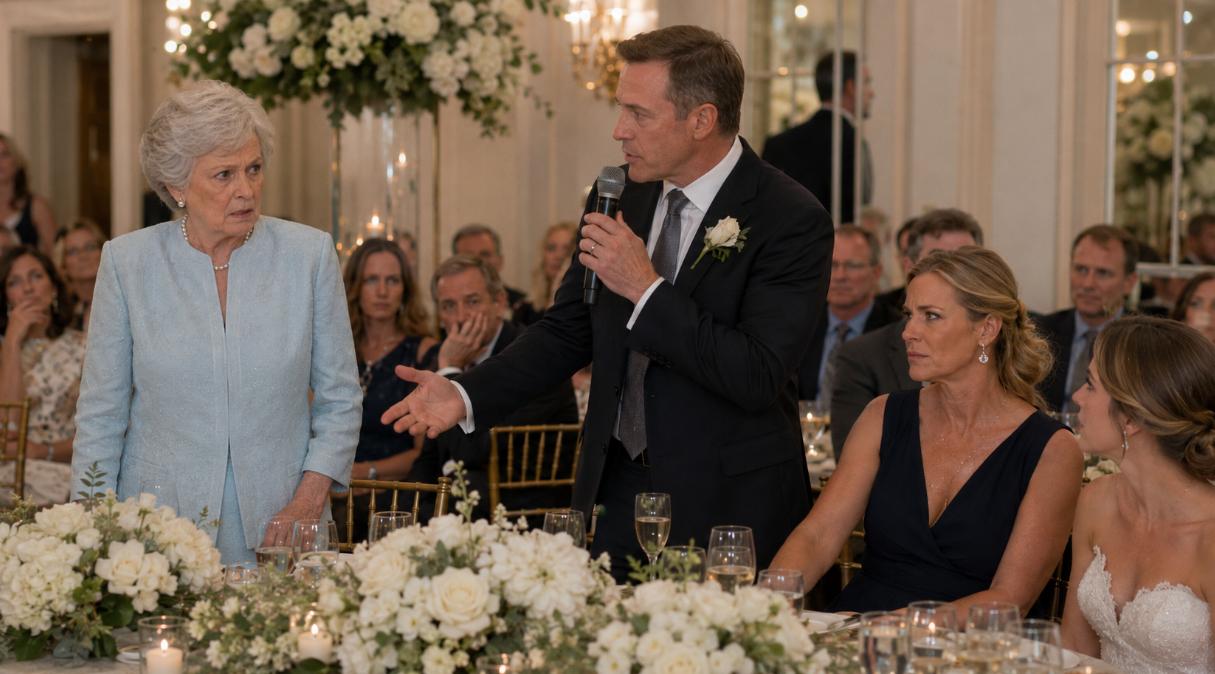
Then Richard took the microphone.
Alice watched him from her seat.
Her son looked confident. Handsome, even. At fifty-two, he still had Robert’s jawline, but none of Robert’s gentleness.
He raised his glass.
“To Chloe and Daniel,” he said. “May your life together be filled with love, patience, and family support.”
People clapped.
Richard smiled wider.
“And of course, let’s all thank the woman who made this beautiful evening possible.”
He turned toward Alice.
For one second, hope moved through her.
Maybe he would fix it.
Maybe he would say, “My mother, Alice.”
Maybe he would show her a little respect in front of everyone.
Richard lifted his glass.
“To Mom,” he said. “The most generous walking bank account a family could ask for.”
The room changed.
Some people laughed.
Some looked down at their plates.
Chloe’s smile froze.
Alice sat perfectly still.
Richard seemed to realize he had gone too far, but instead of apologizing, he laughed louder.
“I’m kidding, Mom. You know we love you.”
Alice looked at her son.
She thought of the first time she held him in the hospital.
The first lunchbox she packed.
The nights she sat by his bed when he had fever.
The college tuition Robert worked overtime to pay.
The down payment she and Robert gave him for his first house.
The checks after Robert died.
The emergencies that were never really emergencies.
And now this.
In front of everyone.
Alice stood.
The chair legs scraped against the floor.
The room quieted.
Richard lowered the microphone.
“Mom?”
Alice picked up her purse.
Pamela’s eyes widened.
“Alice, sit down.”
Alice looked at her daughter-in-law.
“No.”
It was one small word.
But it felt like the first full breath she had taken in years.
Chloe rose from her chair.
“Grandma?”
Alice’s face softened.
“I love you, sweetheart,” she said. “This is not your fault.”
Then she walked away from the family table.
Not quickly.
Not dramatically.
Just steadily.
The way Robert used to walk when he had made up his mind.
Martin Reynolds was waiting by the hallway outside the ballroom.
He held her coat.
“Mrs. Edwards,” he said.
Alice took the coat from him.
“Did Robert send you from the grave?”
Martin’s mouth twitched, almost a smile.
“In a manner of speaking.”
Alice looked back at the ballroom doors.
The music had started again, but quieter now.
“What did he do?” she asked.
Martin opened his folder.
“Your husband added a clause to the family trust three months before his death.”
Alice frowned.
“What kind of clause?”
“The kind he hoped would never be needed.”
Martin handed her a copy of a document.
Alice saw Robert’s signature at the bottom.
Strong.
Certain.
Familiar enough to make her throat tighten.
Martin spoke gently.
“Robert was concerned that some family members had begun treating you as a financial resource rather than as his wife, their mother, and a person with dignity.”
Alice closed her eyes.
“Oh, Robert.”
“The clause states that any beneficiary who publicly humiliates, coerces, defrauds, or attempts to strip you of financial independence forfeits their share of the trust.”
Alice stared at him.
“What?”
“It is very specific.”
“He knew?”
Martin’s face grew solemn.
“He suspected. He asked me to monitor certain situations if you ever requested help.”
“I didn’t request help.”
“No,” Martin said. “But I received a call from your grandson Michael this afternoon.”
Alice looked up.
“Michael?”
Michael was Richard’s son from his first marriage. Quiet, thoughtful Michael, who had spent more time with Alice than anyone else in the family. He helped her change light bulbs. Drove her to appointments when she didn’t want to bother anyone. Called every Sunday.
“He saw the name tag before the ceremony,” Martin said. “He was concerned.”
Alice pressed a hand to her mouth.
“He called you?”
“He did.”
“Where is he?”
“Outside, waiting by the car.”
Alice turned.
Through the glass doors at the end of the hallway, she saw Michael standing under the portico in his dark suit, hands in his pockets, looking worried.
Alice almost cried then.
Not because of the money.
Because someone had seen.
Someone had understood it was not a joke.
Martin placed the document back in the folder.
“What would you like to do?”
Alice looked at the ballroom doors again.
Inside were her son, her daughter-in-law, her granddaughter, guests, flowers, cake, and a family that had laughed at her while spending her money.
For years, Alice had told herself that keeping peace was the same as keeping family.
Now she saw the difference.
Peace built on disrespect was not peace.
It was silence.
She looked at Martin.
“I want to go home.”
He nodded.
“And tomorrow?”
Alice’s voice did not shake.
“Tomorrow, we talk.”
The next morning, Richard called eleven times before 9:00 a.m.
Alice did not answer.
Pamela texted first.
You embarrassed us.
Then:
Chloe cried because of you.
Then:
This family has done nothing but love you.
Alice read that one twice.
Then she placed the phone face down on the kitchen table.
Her house was quiet.
Robert’s chair still sat by the window. His reading glasses were still in the drawer beside it. Alice had never been able to move them.
For four years, she had tried to fill the silence with usefulness.
Pay this bill.
Help with that trip.
Cover this emergency.
Send money for the grandchildren.
Buy the nicer gift.
Say yes.
Always say yes.
Because saying no made the house feel even emptier.
At ten o’clock, Martin arrived with Michael.
Michael hugged her before taking off his coat.
“I’m sorry, Grandma.”
Alice held him tightly.
“You did the right thing.”
“I didn’t want to ruin the wedding.”
“You didn’t.”
He pulled back.
“They did.”
Martin laid several folders on the kitchen table.
“This will not be pleasant,” he said.
Alice smiled sadly.
“Nothing about yesterday was pleasant.”
Martin opened the first folder.
“These are the transfers from your personal accounts over the past three years.”
Alice looked down.
Rows and rows of numbers.
Five thousand for Richard’s business consultation that never became a business.
Twelve thousand for Pamela’s dental work that turned out to be cosmetic veneers.
Eighteen thousand for a vacation rental “for the whole family,” though Alice had never been invited.
Thirty-two thousand for Chloe’s wedding deposit.
Another twenty-four thousand for vendor upgrades.
Seven thousand for Richard’s “temporary tax issue.”
The total sat at the bottom of the page.
$247,600.
Alice stared at the number.
She had known it was a lot.
She had not let herself add it up.
Michael whispered, “Grandma.”
Alice shook her head.
“I’m all right.”
But she was not all right.
Not exactly.
She felt ashamed.
Then angry.
Then ashamed for feeling ashamed.
Martin slid another document forward.
“There is more. Two weeks ago, Richard asked my office to prepare paperwork for a financial power of attorney.”
Alice looked up sharply.
“What?”
“He said you were becoming forgetful and needed help managing your affairs.”
Michael’s face went pale.
“That’s a lie.”
“Yes,” Martin said. “I declined without speaking to Alice directly.”
Alice sat back.
A strange calm settled over her.
The name tag had been cruel.
The speech had been humiliating.
But this was different.
This was not a joke.
This was a plan.
Richard wanted control.
Pamela wanted access.
And Alice had been too busy trying to be loved to see how close they were getting.
At noon, Richard came to the house.
Pamela was with him.
They arrived without calling, as they often did.
Alice saw their car pull into the driveway.
Michael stood.
“I’ll tell them to leave.”
“No,” Alice said. “Let them in.”
Richard entered first.
He looked tired and irritated.
Pamela followed, wearing sunglasses even though it was cloudy.
“Mom,” Richard began, “we need to clear the air.”
Alice sat at the kitchen table.
Martin sat beside her.
Michael stood near the counter.
Richard noticed Martin and stopped.
“What is he doing here?”
Alice folded her hands.
“Protecting me.”
Pamela removed her sunglasses.
“From us?”
Alice looked at her.
“Yes.”
Richard’s face darkened.
“That’s ridiculous.”
“Is it?”
“We made one joke.”
“You made many.”
Pamela sighed.
“Alice, you are taking this far too seriously.”
Alice reached into her purse.
She pulled out the folded name tag and placed it on the table.
The old lady who’s paying for everything.
No one spoke.
Alice looked at her son.
“Did you know about this?”
Richard’s mouth tightened.
“Pamela made them as a joke.”
Alice turned to Pamela.
“You made it?”
Pamela lifted her chin.
“It was supposed to be funny.”
“Was it?”
“It was harmless.”
Alice touched the paper lightly.
“Then why did it hurt?”
Pamela looked away.
Richard stepped forward.
“Mom, nobody meant anything by it. You know how weddings are. People drink. People joke.”
Martin opened his folder.
“Mr. Edwards, before this conversation continues, you should know that your father’s trust contains a dignity protection clause.”
Richard frowned.
“A what?”
Martin explained it.
Slowly.
Clearly.
With no emotion at all.
As he spoke, Richard’s face changed from confusion to disbelief to fear.
Pamela sat down without being invited.
“You can’t be serious,” she said.
Martin continued.
“The clause may be triggered by public humiliation, coercion, attempted financial manipulation, or any effort to diminish Mrs. Edwards’s legal independence.”
Richard pointed at Alice.
“She put you up to this.”
Alice almost laughed.
“Your father put him up to this.”
“That clause won’t hold.”
“You may challenge it,” Martin said. “But I would advise you to consider the evidence first.”
“What evidence?”
Martin looked at Alice.
She nodded.
Michael took out his phone and played a short video.
Alice had not known he recorded it.
The ballroom appeared on the screen.
Richard at the microphone.
His voice clear.
“To Mom. The most generous walking bank account a family could ask for.”
Laughter.
Then Alice standing.
Then Pamela saying, “Don’t be dramatic.”
The video ended.
Richard stared at the phone.
Pamela’s lips parted.
“That was private,” she snapped.
Michael looked at her.
“It was in front of eighty people.”
Richard turned on his son.
“You recorded your own father?”
Michael’s voice was quiet.
“I recorded what you did to Grandma.”
Alice looked at Michael with gratitude so deep it hurt.
Pamela stood.
“This is disgusting. After everything we’ve done for you, Alice.”
Alice’s eyebrows lifted.
“What have you done for me?”
Pamela blinked.
“We include you.”
“No,” Alice said. “You invite me when you need a check.”
Richard slammed his hand on the table.
“That’s enough.”
Alice did not flinch.
For the first time in years, she was not afraid of his anger.
She was tired of it.
“No, Richard,” she said. “It is enough. Enough money. Enough guilt. Enough pretending disrespect is humor.”
Richard’s voice dropped.
“Mom, think carefully. You don’t want to lose your family.”
Alice looked at him.
“I lost my family when they laughed at me in a room I paid for.”
The words landed hard.
Pamela’s face flushed.
Richard looked suddenly older.
Martin closed his folder.
“From this moment forward, all financial requests go through my office. Mrs. Edwards will not be signing any power of attorney. She will not be funding vacations, luxury purchases, or personal debts. Any further attempts to pressure her may affect your standing as beneficiaries.”
Richard whispered, “You’re cutting me off?”
Alice looked at the folded name tag.
Then at her son.
“No,” she said. “You did that yourself.”
Three weeks passed.
The family split the way families do when money stops flowing.
Some people called Alice cruel.
Some said Richard and Pamela had gone too far.
Chloe came to see Alice alone.
She cried in the doorway.
“Grandma, I didn’t know about the name tag.”
Alice believed her.
Chloe looked young without the wedding makeup. Young and ashamed.
“I should have noticed.”
“It was your wedding day,” Alice said. “You were allowed to be happy.”
Chloe sat beside her on the couch.
“Dad said you’re ruining everything.”
Alice smiled sadly.
“Your father thinks boundaries are punishment.”
“Are you cutting all of us out?”
“No.”
Chloe wiped her eyes.
“Then what are you doing?”
Alice looked toward Robert’s empty chair.
“I am learning the difference between helping and being used.”
Chloe nodded slowly.
“I’m sorry.”
Alice took her hand.
“I know.”
That apology mattered.
It did not fix everything.
But it mattered.
Michael visited every Sunday after that.
Not because of the trust.
Not because of inheritance.
Because he always had.
One afternoon, he found Alice in the garage, standing in front of Robert’s old easel.
“You used to paint,” he said.
Alice laughed softly.
“A lifetime ago.”
“Why did you stop?”
She looked at the dusty brushes.
“Life got busy.”
“That’s what people say when they give themselves away piece by piece.”
Alice looked at him.
“When did you get so wise?”
“College debt,” he said.
She laughed for real then.
The next day, she bought new paints.
Not expensive ones.
Just enough.
At first, her hands felt clumsy.
The first canvas was terrible.
The second was worse.
The third had a blue sky Robert would have liked.
Painting did something money never had.
It gave Alice back to herself.
She stopped waiting for calls from Richard.
She stopped answering Pamela’s guilt-filled messages.
She stopped offering before anyone asked.
She paid for what she chose.
Not what others demanded.
Six months later, Martin called a formal family meeting.
Richard came with Pamela.
Chloe came alone.
Michael sat beside Alice.
The meeting took place in Martin’s office, where the walls smelled faintly of old books and lemon polish.
Richard looked thinner.
Pamela looked angry.
Martin read from Robert’s trust.
This time, he read the full clause.
Robert had written a personal note beside it.
Martin handed it to Alice first.
She recognized her husband’s handwriting.
My Alice spent her life giving. If our family mistakes her generosity for weakness, let this trust remind them that love is not permission to take.
Alice pressed the paper to her heart.
Richard looked down.
For the first time, shame crossed his face.
Maybe real.
Maybe not.
Pamela spoke first.
“So that’s it? One joke and we lose everything?”
Martin looked at her.
“It was not one joke. It was a pattern, documented over years.”
Richard said quietly, “Dad really wrote that?”
Alice answered.
“Yes.”
He swallowed.
“He thought I would hurt you?”
Alice looked at her son.
“He hoped you wouldn’t.”
No one spoke for a long time.
In the end, Richard’s share of Robert’s trust was suspended pending review. Pamela had no direct claim, which made her furious. Chloe’s portion remained protected. Michael’s portion increased, not because he asked for it, but because Robert had included a provision rewarding consistent care and support.
Richard stood at the end of the meeting.
“Mom,” he said, “I’m sorry.”
Alice studied his face.
She wanted to believe him.
A mother always wants to believe.
But she was no longer willing to confuse an apology with change.
“Then become someone who doesn’t have to apologize for this again,” she said.
He nodded once.
Pamela left without saying goodbye.
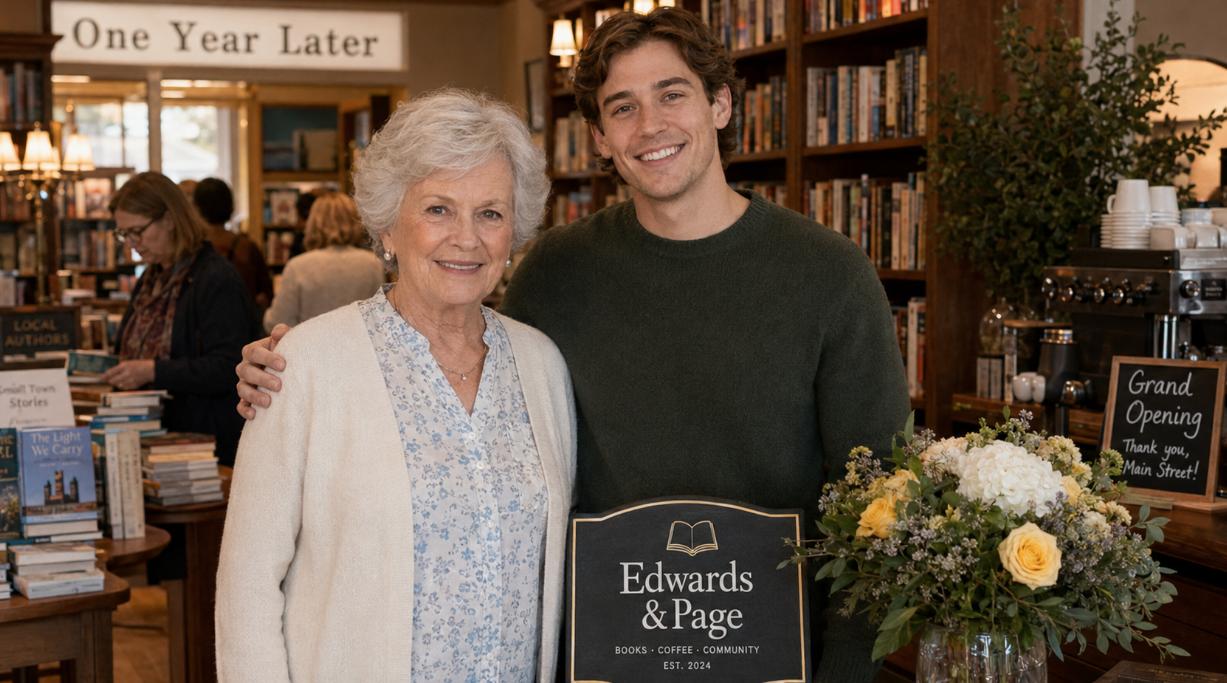
One year after the wedding, Alice stood in a small bookstore on Main Street.
Michael had dreamed of opening it for years.
Not a chain store.
Not something grand.
Just a warm little place with used books, new books, coffee in the corner, a children’s reading rug, and a shelf for local authors.
Alice had invested in it.
Not gifted.
Invested.
Michael insisted on a business plan, repayment terms, and signed documents.
Robert would have loved that.
The sign above the door read:
Edwards & Page
Alice had painted the small watercolor hanging by the register.
It showed a blue chair by a window.
On opening day, Chloe came with flowers.
Richard came too.
Alone.
He stood near the door for a while before approaching Alice.
“I didn’t know if I’d be welcome,” he said.
Alice looked at him.
“You’re welcome if you came as my son.”
He nodded.
“I did.”
It was not a perfect ending.
Families rarely have those.
Pamela did not come.
There were still wounds.
Still silence.
Still legal matters unfinished.
But Richard stayed for an hour. He bought a book. He asked Michael about the store. Before leaving, he touched Alice’s shoulder and said, “You look happy, Mom.”
Alice smiled.
“I am.”
That evening, after the last customer left, Alice helped Michael turn off the lights.
On the counter sat a small frame.
Inside it was not a photograph.
It was the name tag.
The old lady who’s paying for everything.
Michael had asked if she wanted to burn it.
Alice said no.
Some things should be kept.
Not because they are precious.
Because they remind you when you finally woke up.
Beside the frame was another card, written in Alice’s own hand.
I am not paying for everything anymore.
I am choosing what matters.
Alice looked at it for a long moment.
Then she took the old name tag out of the frame.
Michael watched silently.
Alice walked to the back room, dropped it into the shredder, and turned it on.
The machine buzzed.
The paper disappeared in thin white strips.
Alice stood there until the last piece was gone.
Then she picked up her purse, turned off the light, and stepped outside into the cool evening.
For years, her family had called her generous when they meant useful.
Sweet when they meant silent.
Dramatic when she finally spoke.
But Alice Edwards was not a wallet.
Not a walking bank account.
Not the old lady paying for everything.
She was a mother.
A grandmother.
A widow.
A painter.
A woman with a life still unfolding.
And at seventy-six years old, Alice had finally learned that saying no did not make her less loving.
It simply made room for people to love her correctly.