Imagine trying to sleep outdoors on a warm night.
There are no walls, no window screens and no insect repellent. You do not know what germs are, and you have no idea that a mosquito bite can carry a dangerous disease.
All you know is that the insects return every evening.
They hover around your face, follow your breath and find every patch of uncovered skin.
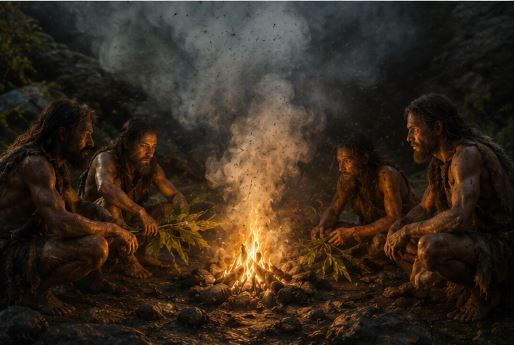
For ancient humans, this was not a summer inconvenience. In some places, it was part of daily survival.
So how did our ancestors live with mosquitoes for thousands of years before modern medicine?
The answer was not one forgotten invention. It was a combination of observation, fire, shelter, plants, changing habits—and, over many generations, changes within the human body itself.
An enemy humans could not see clearly
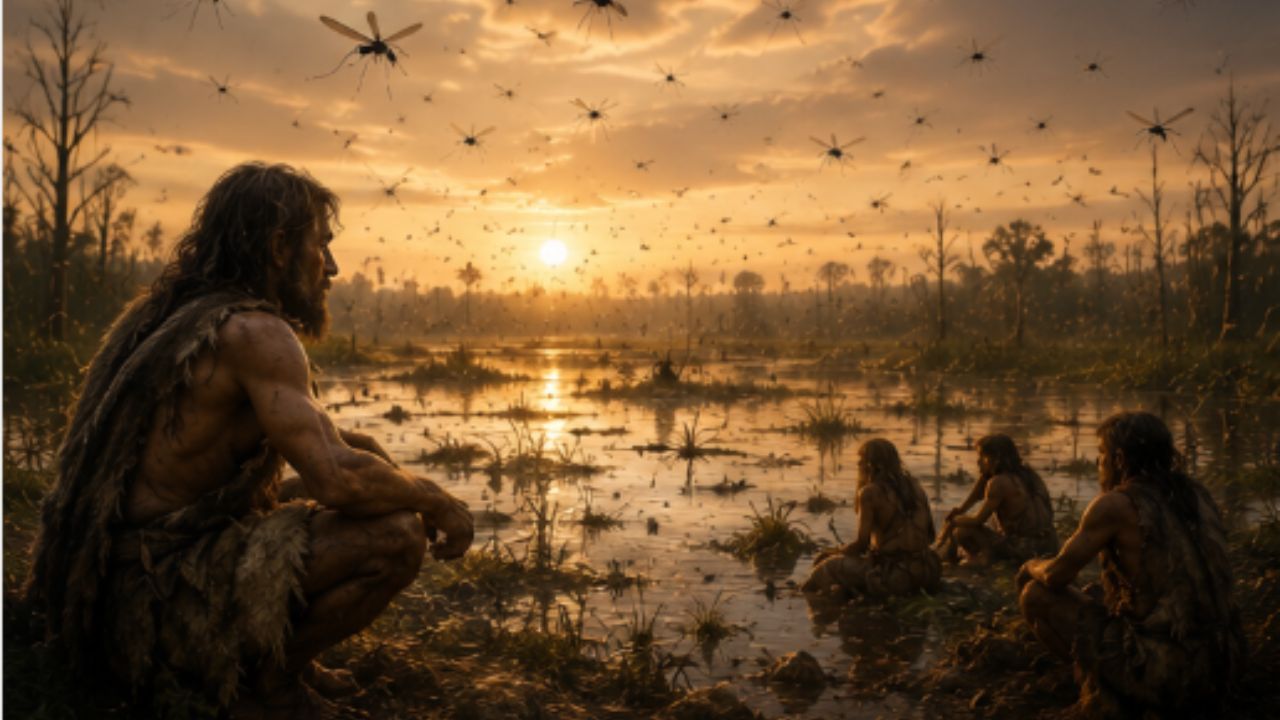
Ancient people understood that some places were more dangerous than others, even if they did not understand why.
They could notice that insects gathered near standing water. They could see that certain seasons brought more bites. They may also have recognized that sickness sometimes followed visits to particular wetlands, riverbanks or low-lying areas.
They did not know that some mosquitoes could transmit parasites responsible for malaria. That scientific connection would not be demonstrated until the late nineteenth century.
But people did not need a microscope to recognize a pattern.
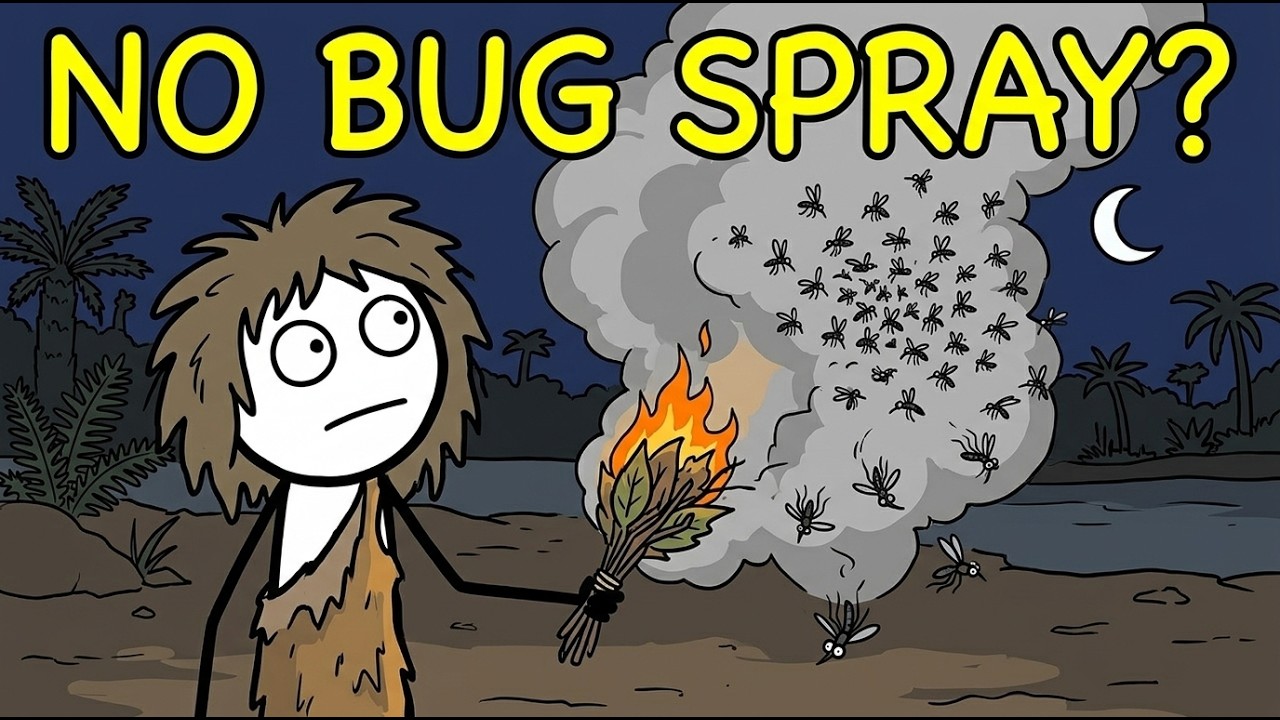
Families who slept in breezier or drier locations may have been bitten less often. Groups that moved away from stagnant water at certain times of year may have faced fewer insects. Knowledge like this could be remembered and passed from parents to children without ever being written down.
It may have sounded less like science and more like practical advice:
Do not sleep too close to the marsh.
Keep the fire burning.
Move camp when the insects become unbearable.
Sometimes survival begins long before anyone understands the reason.
Fire offered more than warmth
Fire changed human life in countless ways. It provided light, warmth, cooked food and protection from predators.
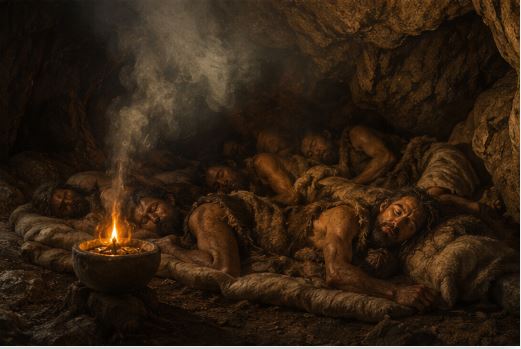
It may also have made nights more tolerable.
Smoke can discourage many insects, including mosquitoes, although its effectiveness varies according to the fuel, the mosquito species and the conditions. Ancient people probably did not know the chemistry involved. They only had to notice that fewer insects came close when thick smoke drifted through a resting area.
A smoky fire would not have created a perfect shield. It would not have prevented every bite or every infection.
But even imperfect protection mattered.
A family sitting close to smoke might receive fewer bites than one sleeping beside still water without a fire. Over many nights and many generations, small advantages could mean the difference between greater exposure and a better chance of survival.
Ancient humans were not helpless victims waiting for modern science. They were careful observers who tested the natural world through experience.
A remarkable discovery in a South African cave
One of the most fascinating clues comes from Sibudu, a rock shelter in South Africa.
Archaeologists discovered layers of ancient plant bedding there dating back roughly 77,000 years. The bedding was made from grasses and sedges and included aromatic leaves containing natural chemicals known to have insect-repelling or insect-killing properties.
Researchers cannot prove that mosquitoes were the only target. Fleas, ticks and other pests may also have been a problem.
Even so, the discovery reveals something important: these early humans were not simply dropping grass on the ground and going to sleep.
They selected plants, arranged sleeping surfaces and maintained the area. Later occupants also burned old bedding, possibly as a way to clean the living space and reduce pests.
This was tens of thousands of years before written medicine.
The people of Sibudu may not have understood active chemical compounds, but they clearly knew that some plants made better bedding than others.
That knowledge probably came from repeated observation:
Which leaves smelled strongest?
Which sleeping areas attracted fewer pests?
Which materials stayed cleaner?
Which plants caused insects to disappear?
What looks simple to us may have represented generations of accumulated experience.
Shelter mattered—but it was not a sealed fortress
Caves and rock shelters offered some protection from wind, rain and large animals, but they were not mosquito-proof homes.
Insects could still enter. People living close together could also attract fleas, lice and other parasites.
Even so, the choice of sleeping place mattered.
A dry, elevated shelter exposed to moving air could be more comfortable than a damp hollow near standing water. A smaller entrance might be easier to fill with smoke. Animal skins, woven fibers and plant coverings could reduce exposed skin, even if that was not their only purpose.
Later societies developed more deliberate barriers. Fine cloth and netting were used in parts of the ancient world, although it is difficult to say exactly when mosquito nets first appeared or how widely ordinary people could obtain them.
For most early humans, protection was probably far less elegant: clothing, coverings, smoke, location and experience.
No single method worked perfectly.
Together, however, they could reduce the number of bites.
Mosquitoes were not equally dangerous everywhere
It is easy to imagine the ancient world as one endless cloud of mosquitoes, but the risk varied enormously.
Mosquito species differ in where they live, when they bite and whether they carry diseases that infect humans. Climate, altitude, rainfall, vegetation and access to standing water all affect mosquito numbers.
Many ancient communities lived in places where mosquitoes were seasonal or relatively uncommon. Others faced intense exposure.
This distinction is important because ancient humans did not need to “defeat” every mosquito on Earth. They needed to survive the conditions in the places where they lived.
Some communities may have moved when conditions worsened. Others adapted their homes, sleeping habits and daily routines. Still others remained in high-risk regions because rivers, fertile soil, food or trade made those places valuable.
Human history has always involved trade-offs.
The safest place was not always the place where people could find enough water and food.
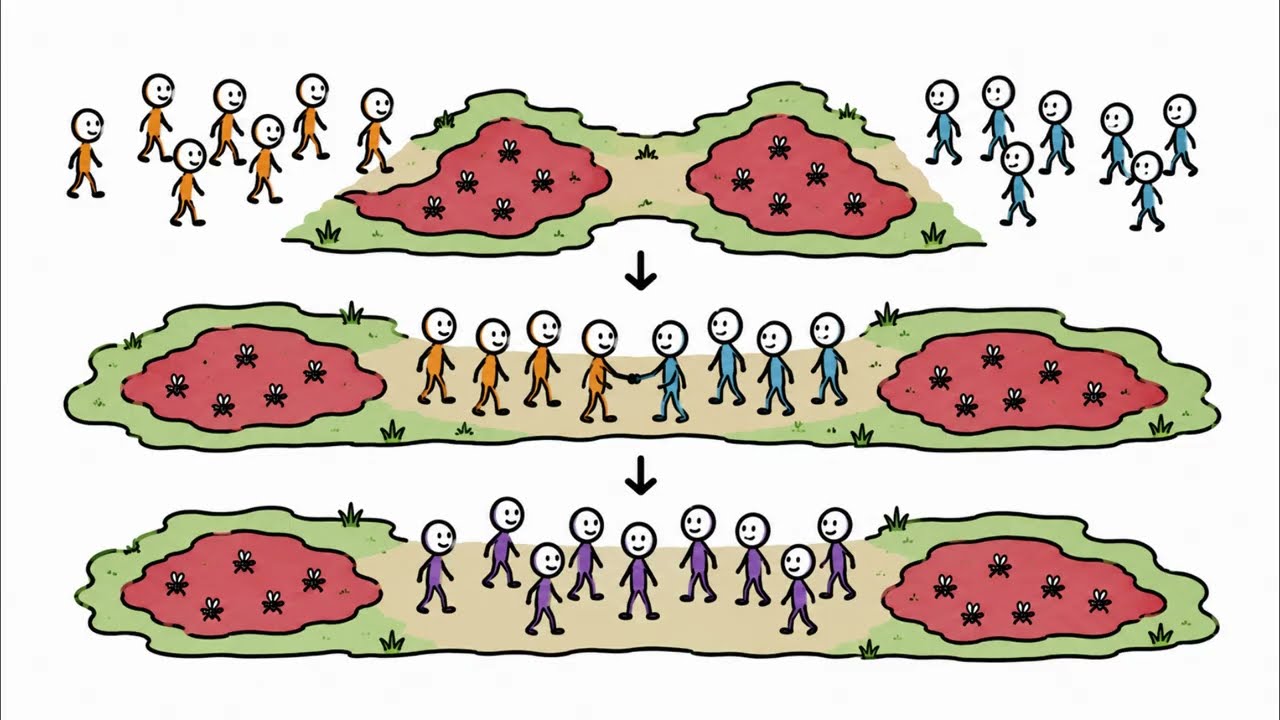
The battle eventually reached human DNA
Cultural knowledge was only part of the story.
In regions where malaria remained common for many generations, natural selection favored certain genetic traits that gave some protection against severe disease.
The best-known example is the sickle cell trait.
A person who inherits one altered copy of the relevant gene may receive some protection against severe malaria. But inheriting two altered copies can cause sickle cell disease, a serious and sometimes life-threatening condition.
It is a powerful example of evolution’s harsh compromises: a trait that can improve survival in one form can cause great suffering in another.
Other inherited traits also affect malaria risk, including variations involving red blood cells and the way malaria parasites enter them.
Ancient people knew nothing about genes. Their bodies were simply responding, generation after generation, to one of the strongest disease pressures in human history.
Mosquitoes did not only disturb human sleep.
The diseases they carried helped shape which genetic traits became common in certain populations.
Did mosquitoes shape civilization?
Mosquito-borne disease may also have influenced where people settled, how armies moved and whether large projects succeeded.
Malaria became closely associated with marshlands and warm climates. It weakened communities, affected military campaigns and made some regions dangerous to outsiders.
But history rarely has a single cause.
Mosquitoes did not bring down every empire attributed to them, nor can every ancient fever be confidently diagnosed as malaria. Historical records are incomplete, and modern researchers must be careful when interpreting deaths that occurred centuries or millennia ago.
What can be said with confidence is that malaria has been—and remains—a major human disease. The World Health Organization identifies Plasmodium falciparum as the deadliest malaria parasite, especially in Africa. Without treatment, severe malaria can progress rapidly.
For ancient families, however, there was no diagnosis and no laboratory test.
There was only fever, weakness, recovery—or loss.
Mosquitoes had a remarkable tracking system
Part of the mosquito’s success comes from its ability to locate a host.
Female mosquitoes seeking a blood meal can use several signals, including carbon dioxide from breathing, body odor, warmth and visual cues. Different species rely on these signals in different ways, but together they create an effective tracking system.
Ancient humans could not stop breathing or hide their body heat.
That is why their defenses were never perfect.
Smoke might confuse or discourage insects. Coverings could block access to skin. Moving air could make flight more difficult. Choosing a different sleeping location could lower exposure.
The goal was probably not to eliminate mosquitoes.
It was to make life slightly safer.
The true secret was accumulated knowledge
Ancient humans survived mosquitoes in much the same way they survived cold, hunger and predators: by noticing what worked and teaching it to others.
One person discovered that a certain leaf kept pests away.
Another learned that a smoky fire helped during the evening.
A family noticed that one campsite brought more sickness than another.
A community remembered when to move, where to sleep and what materials to place beneath the body at night.
None of this required written language.
It required memory.
It required people to watch carefully, compare outcomes and trust knowledge passed down through generations.
That may be the most important lesson of all.
Our ancestors did not survive because nature was gentle. They survived because they were flexible, social and remarkably good at learning from experience.
A struggle that never truly ended
Modern humans have insecticides, screens, bed nets, medicines and a scientific understanding of mosquito-borne disease.
Yet mosquitoes remain dangerous.
The ancient struggle did not disappear. It simply changed form.
What began with smoke, plants and carefully chosen sleeping places eventually became public-health campaigns, vaccines, medicines and advanced mosquito control.
The tools are different, but the human instinct is the same: observe the threat, share knowledge and adapt.
Ancient people never found one perfect answer to mosquitoes.
Instead, they built many imperfect defenses—and combined them well enough to survive.
Every mosquito bite today is a small reminder of that long relationship.
For thousands of generations, these tiny insects shaped where humans slept, how they lived and, in some regions, even the genes they carried.
The surprising truth is not that ancient humans defeated mosquitoes.
It is that they learned to live with an enemy they could barely understand—and passed enough knowledge forward for humanity to endure.