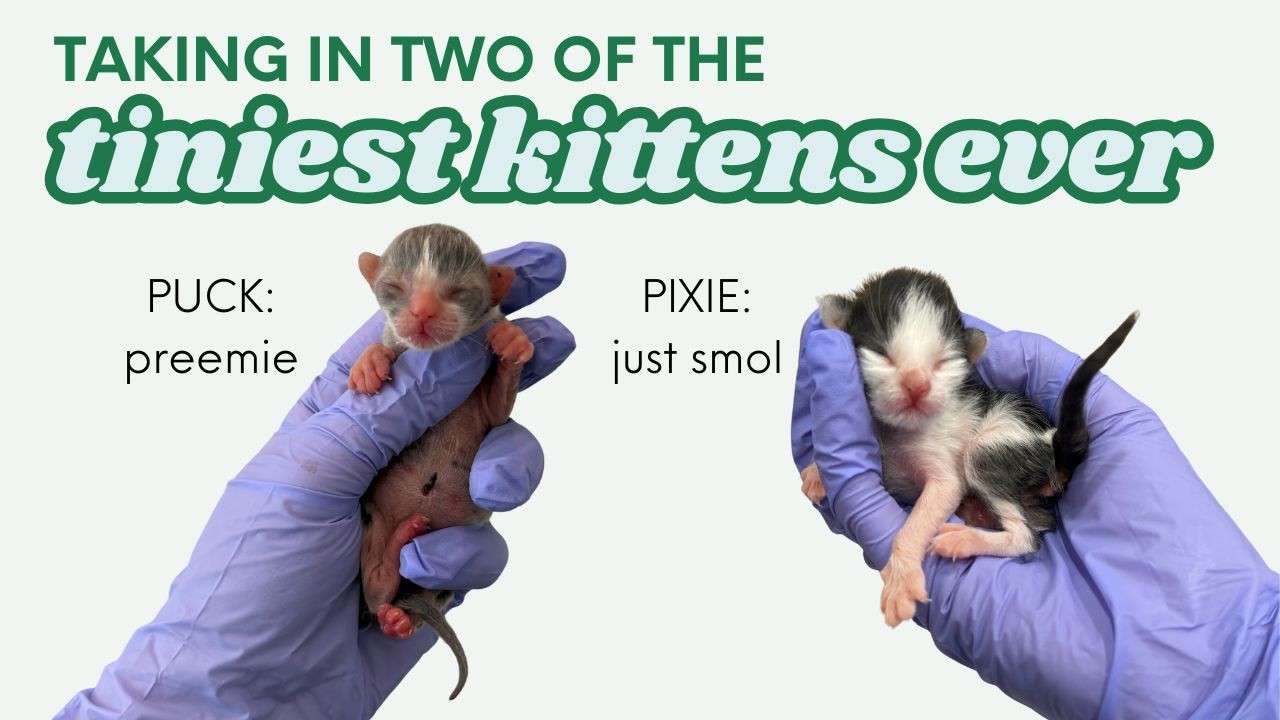
Pixie weighed only 49 grams when she arrived.
She was so small that one of her caregivers could hold her entire body in the palm of a hand. Her legs were thin, her cries were faint, and her stomach could hold barely two milliliters of formula at a time.
No one could promise that she would survive the night.
But Pixie was still trying.
She responded when touched. She had a weak but noticeable suckling reflex. And beneath her fragile appearance, there was a tiny determination that gave her rescuers one reason to keep hoping.
Only a short time later, another critically small kitten named Puck would arrive under equally heartbreaking circumstances.
Together, they became two of the smallest kittens their caregivers had ever attempted to save.
Pixie’s condition was critical

Pixie had been brought in by a shelter after being discovered in dangerously fragile condition.
At just 49 grams, she was far below the weight expected for a healthy newborn kitten. Her size alone placed her at serious risk, but caregivers soon noticed another alarming problem: there was blood in her urine.
She needed veterinary treatment immediately.
Antibiotics were started, and Pixie was placed inside a temperature-controlled incubator kept at approximately 90 degrees Fahrenheit. Newborn kittens cannot regulate their own body temperature, and for a kitten as small as Pixie, even a slight drop could become life-threatening.
Her caregivers began feeding her tiny amounts of formula throughout the night.
Each meal was measured carefully. Too little nutrition could cause her blood sugar to fall, but too much formula could overwhelm her tiny stomach.
Sometimes she was able to suckle from a syringe. At other times, she became too tired and needed to be fed through a tube.
There was no room for guessing.
Her weight, feeding volume, urine output, stool and body temperature were recorded after every session. The smallest change could be either a sign of progress or an early warning that something was going wrong.
That first night was less about expecting a miracle and more about helping Pixie make it from one feeding to the next.
Then came the first signs of hope

Within 24 hours, Pixie began showing subtle but encouraging improvements.
She gained weight.
Her urine gradually became closer to a normal color, suggesting that the medication and supportive care might be working. She also passed her first meconium—the dark first stool produced by a newborn.
To most people, those details might seem small.
To neonatal kitten rescuers, they were enormous.
They meant Pixie’s digestive system was beginning to function. They meant her body was responding. Most importantly, they meant she was still fighting.
She remained extremely vulnerable, but for the first time, her caregivers could see a path forward.
Puck was found alone in a parking lot
While Pixie was receiving intensive care, another urgent call came in.
A tiny kitten had been found in the parking lot of a shopping center.
His name would become Puck.
He weighed just 64 grams.
Like Pixie, Puck was dangerously underweight. His thin, almost translucent ears and underdeveloped coat suggested that he had been born prematurely.
He had not been found alone originally. A sibling was discovered with him, but tragically did not survive the night.
That loss made Puck’s condition feel even more urgent.
He was at risk of becoming hypothermic, but his initial examination revealed one encouraging sign: he still had a fairly strong suckling reflex.
That meant he could take some formula from a syringe, although tube feeding was still used whenever he became too tired to finish a meal safely.
Puck’s progress was slow, but his weight began moving in the right direction.
For a healthy adult cat, gaining a few grams would mean almost nothing. For a premature kitten weighing less than three ounces, those grams could mean the difference between decline and survival.
Caring for kittens this small never stops

Neonatal kittens require constant attention, but caring for premature, severely underweight kittens is even more demanding.
Pixie and Puck could only take tiny meals. Their stomachs held approximately two milliliters, which meant they needed to be fed frequently throughout the day and night.
There were alarms for feeding times.
There were late-night weight checks.
There were moments when a kitten refused to suckle, forcing caregivers to decide whether tube feeding was necessary.
After every meal, the kittens needed help urinating and passing stool because newborns cannot reliably do it on their own.
Their bedding had to remain warm, clean and dry. Their equipment had to be sterilized. Their temperatures, behavior and breathing had to be watched closely.
A kitten could appear stable during one feeding and begin declining before the next.
That is why neonatal rescue is often described as care measured not in days, but in hours.
They cannot be together yet
Pixie and Puck may eventually become companions, but for now, they must remain separated.
Their immune systems are not developed enough to protect them from infections that an older kitten might easily survive. Because both arrived from different locations with unknown medical histories, strict quarantine is essential.
Each kitten has separate, color-coded equipment.
They have their own syringes, feeding tubes, cleaning supplies, blankets and scales. Caregivers wear gloves and follow careful hygiene procedures before moving between their spaces.
The precautions may look excessive, but one infection could undo every bit of progress they have made.
For now, protecting them means keeping them apart.
If both continue to grow and complete their quarantine periods safely, their caregivers hope they may eventually meet.
Young kittens often benefit from companionship. They learn social behavior through play, sleep more comfortably beside another kitten and gain emotional security from having a sibling-like presence nearby.
Pixie and Puck lost the protection of their mothers far too early.
Perhaps, one day, they will be able to give each other some of the comfort they missed.
Every gram is a victory
Their journey is still uncertain.
Pixie’s urinary condition requires continued monitoring. Puck remains premature and vulnerable to complications associated with his extremely low birth weight.
Neither kitten is completely out of danger.
But they are no longer simply two abandoned newborns with almost no chance.
They are eating.
They are responding to care.
They are slowly gaining weight.
Their caregivers continue documenting every feeding, every bodily function and every change in behavior. The notes may look clinical, but behind every number is a moment of relief.
One more milliliter of formula.
One normal urine sample.
One stable temperature check.
One more gram on the scale.
These are the milestones that matter when a kitten begins life this close to the edge.
The hidden reality of kitten season
Pixie and Puck’s story also reveals a difficult truth about kitten season.
Every year, shelters and rescue organizations receive newborn kittens who have been abandoned, separated from their mothers, born prematurely or left exposed to dangerous temperatures.
Some arrive cold and dehydrated. Others are too weak to eat. Many need specialized foster caregivers who understand incubator care, tube feeding and neonatal monitoring.
Providing that level of support is exhausting.
It requires training, supplies and a willingness to wake repeatedly throughout the night. It also brings the emotional burden of knowing that even with perfect care, not every kitten can be saved.
Puck’s sibling is a painful reminder of that reality.
But Pixie and Puck are reminders of something else: immediate intervention can give even the smallest animals a chance.
Their fight is only beginning
The names Pixie and Puck were inspired by tiny figures from fairy folklore—a fitting choice for two kittens so impossibly small that they hardly seemed real when they arrived.
There is still a long road ahead.
They must continue gaining weight. They must remain free of infection. They must learn to regulate their body temperatures, transition to larger feedings and eventually reach the stage when they can eat independently.
For now, their entire world consists of warm incubators, careful hands and meals measured one milliliter at a time.
But that world is keeping them alive.
Pixie entered care at only 49 grams.
Puck arrived at 64 grams after losing his sibling.
Neither was expected to have an easy beginning.
Yet every few hours, they wake, search for food and show their caregivers that they are still here.
In neonatal rescue, hope rarely arrives as one dramatic miracle.
Sometimes, it appears as a kitten swallowing one more drop of formula.
Sometimes, it is the number on a scale moving upward by a single gram.
And sometimes, it is two tiny lives—once found alone and barely holding on—slowly becoming strong enough to imagine a future together.