Chapter 1: The Envelope
At the divorce hearing, my husband smiled like he had already won.
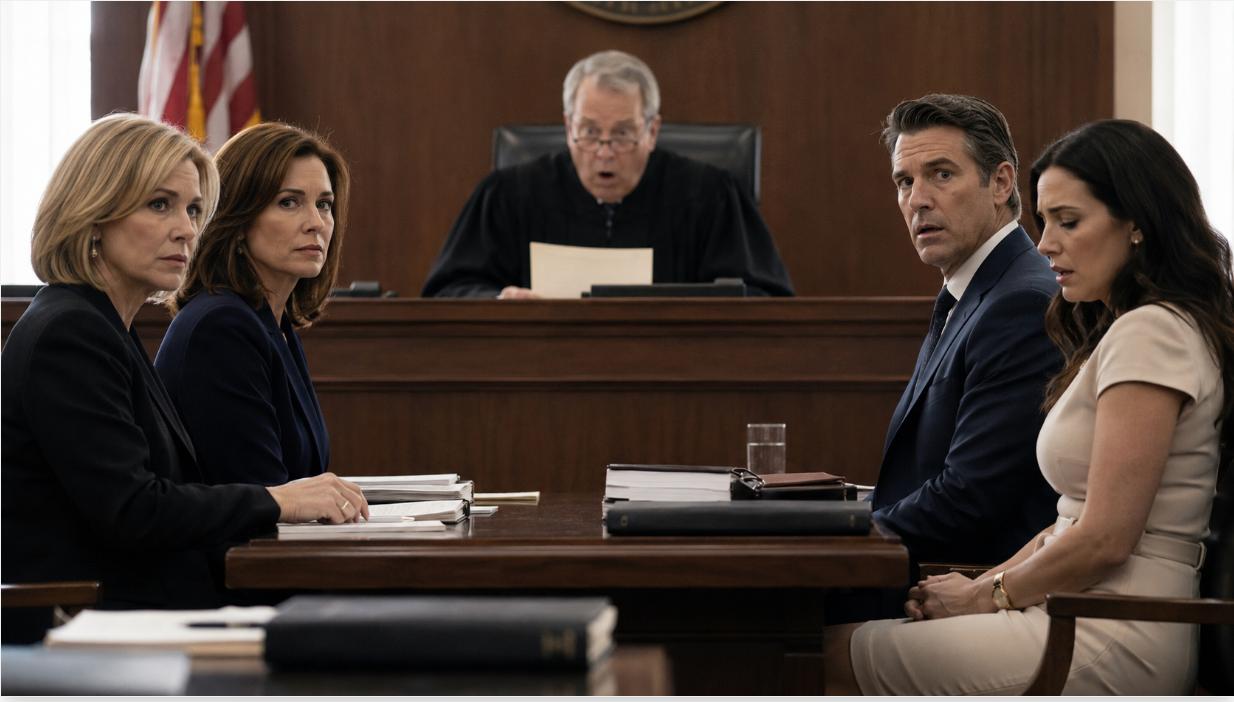
Daniel Mitchell sat across the courtroom in a navy suit I had bought him for our twentieth anniversary. His back was straight, his chin lifted, his wedding ring long gone. Beside him sat Vanessa Brooks, the woman he had chosen after nineteen years of marriage, crossing one leg over the other as if she were attending a business luncheon instead of watching a family collapse in public.
Daniel’s attorney had just finished arguing that I had no right to a large share of Daniel’s company assets. According to him, the construction business was Daniel’s achievement, Daniel’s risk, Daniel’s money. I was merely the wife who had “benefited from his success.”
Then Daniel leaned back and said, loud enough for the second row to hear, “She’ll never touch my money again.”
Vanessa smiled.
“She doesn’t deserve a single dime,” she added.
A few people in the gallery shifted uncomfortably. My attorney, Karen Reed, went very still beside me. For a moment, the old Sarah—the woman who apologized when other people hurt her—almost rose to the surface. She wanted to explain herself. She wanted to say she had worked double shifts while Daniel built that company. She wanted to say she had paid bills, packed lunches, answered late-night calls from suppliers, and stayed loyal long after loyalty stopped being returned.
But I had learned something during the previous six months.
People who lie are not defeated by emotion.

They are defeated by paper.
So I did not argue. I reached into my purse, removed a sealed envelope, and slid it across the table toward Karen. She passed it to the court clerk, who handed it to Judge Harrison.
Daniel watched with mild annoyance at first. Vanessa looked bored.
Then the judge opened the envelope.
He read the first page.
His eyebrows lifted.
He read the second page.
The corner of his mouth twitched.
Then, unexpectedly, he laughed.
Not loudly. Not cruelly. Just once, under his breath, the way a person laughs when a locked door opens from the inside.
“Oh,” he said, leaning back in his chair. “This is interesting.”
Daniel’s smile disappeared.
Vanessa uncrossed her legs.
The judge tapped the envelope against the bench and looked directly at my husband.
“Mr. Mitchell,” he said calmly, “I believe we need to discuss some missing money.”
For the first time since the divorce began, Daniel looked afraid.
And for the first time in nineteen years, I knew something he didn’t.
I had found the trail.

Chapter 2: Before the Money Went Missing
My name is Sarah Mitchell, and I was forty-two when my marriage ended in front of strangers.
The strange thing is, by the time we reached court, I was no longer grieving Daniel. I was grieving the woman I had been when I married him—the one who believed love meant carrying half the weight even when the other person quietly stopped carrying anything at all.
I met Daniel when I was twenty-three. I was working as a nurse at a small hospital outside Chicago, and he was trying to start a construction company with two employees, a borrowed pickup truck, and a level of confidence that made people forgive the fact he was usually broke. Back then, he was not rich or powerful. He was ambitious, restless, and charming in a way that felt warm instead of practiced.
Our first apartment had a radiator that hissed all night and kitchen cabinets that never closed properly. Some months, we had to choose between fixing the car and replacing the refrigerator. I worked double shifts. Daniel took weekend jobs and came home with dust in his hair and sawdust in the cuffs of his jeans. We ate cheap pasta at midnight, laughed over unpaid bills, and told ourselves that hard years made strong marriages.
For a while, I think we were right.
Then the business grew.
One truck became three. Three became a fleet. A rented office became a building with Mitchell Construction printed on the front in dark metal letters. People started calling Daniel “a self-made man,” and he liked the sound of it more each time he heard it.
I stayed in healthcare because I loved the work. I liked knowing that when I entered a room, someone usually felt less alone. Daniel used to say he admired that. Later, he said less. Later still, he spoke of my job as if it were a hobby I kept because it made me feel useful.
Success did not change Daniel all at once. It changed him slowly, the way rust travels under paint.
First he became impatient with waiters. Then with receptionists. Then with me. He started correcting my stories at dinner. He bought watches that cost more than our first car. He began saying “my company” in a tone that erased every year I had held us together while he built it.
Still, I tried.
Marriage counseling. Weekend trips. Long conversations. Short conversations. Silence when he wanted peace. Patience when he wanted space. Forgiveness when he gave me very little reason to offer it.
Nothing worked, because you cannot save a marriage alone.
The first sign of Vanessa came nine months before the hearing.
Daniel became protective of his phone.
At first, it was subtle. He turned the screen facedown at dinner. He took calls in the garage. He laughed at messages and then locked the screen when I walked into the room. When I asked who he was texting, he gave me that offended look guilty people use when they want the question itself to seem like a betrayal.
“Sarah,” he said one night, “you either trust me or you don’t.”
That sentence stayed with me.
Because the guilty person always seems to demand trust the loudest.
A month later, I saw a hotel charge on our credit card statement. Nearly seven hundred dollars at a luxury hotel downtown. Daniel had not been traveling that week.
“What’s this?” I asked.
He barely glanced at the paper. “Business dinner.”
“Seven hundred dollars?”
“Clients drink expensive wine.”
He made it sound reasonable. Daniel was good at that. He could take a crooked thing and hold it under the light until it looked straight enough to pass.
Then came restaurants. Spa charges. Jewelry stores where I never received anything. Weekend expenses in cities he claimed not to have visited.
I wanted to believe stress explained it. I wanted to believe success had made him careless, not cruel.
The truth arrived after a fourteen-hour hospital shift.
Traffic was backed up, so I took a different route home. At a red light near River North, I saw Daniel’s truck parked outside an upscale restaurant forty minutes from our neighborhood. For one foolish second, I thought he must be with a client.
Then I looked through the window.
Daniel sat at a table near the back, laughing. Across from him was a woman with long dark hair and a cream-colored dress. Vanessa. I did not know her name yet. I only knew she was holding his hand in a way that told me this was not new.
It was comfortable.
Practiced.
Familiar.
That was the part that broke something in me.
I stood outside for less than thirty seconds. I did not go in. I did not make a scene. I simply turned around, walked back to my car, and drove home in silence.
The crying came later, in the shower, where the water could do what dignity would not let me do in public.
Two weeks later, I confronted him.
“Who is she?”
Daniel looked at me for a long moment. No denial. No panic. Just irritation, as if I had finally become inconvenient.

“Her name is Vanessa,” he said.
“How long?”
“Several months.”
Nineteen years of marriage sat between us, and he said “several months” as if he were discussing a delayed permit.
“Are you sorry?” I asked.
He sighed.
Not with guilt.
With impatience.
“Maybe we both deserve a fresh start.”
A fresh start.
As if he were changing office furniture.
Two weeks later, he filed for divorce.
That was when I learned the affair was not the worst thing he had done.
Chapter 3: The First Missing $80,000
Divorce changes the way you see a person.
At first, I thought Daniel was just cruel because he wanted out. Then I realized he was cruel because he wanted to win. His attorneys came in aggressive. His financial disclosures were thin. His attitude was colder than I had ever seen it.
He wanted the house sold. He wanted the company protected. He wanted me to leave quietly with whatever he decided I deserved.
But the numbers were wrong.
I was a nurse, not an accountant, but nineteen years of managing household bills had taught me enough to know when money vanished. Daniel’s declared income looked too low. Several accounts were missing. His company’s valuation had suddenly dropped in ways that did not match the contracts I had seen him celebrate months earlier.
When Karen, my attorney, requested clarification, Daniel’s team called the discrepancies “clerical confusion.”
I almost believed them.
Then I found the transfer.
It was a Tuesday night. I was sitting at the small dining table in my apartment, surrounded by bank records and half-drunk coffee. The apartment was nothing like the house I had lived in with Daniel. The walls were plain, the couch was secondhand, and the silence was sharp around the edges. But at least that silence was honest.
I clicked into one of our joint accounts and saw it.
$80,000.
Transferred out six months earlier.
I stared at the screen so long the numbers blurred.
I checked the date. The account. The routing number. Then I checked again.
The money had left our joint account, and I had never authorized it.
The receiving account was not connected to any project I recognized. No invoice. No contract. No legitimate trail. Just a transfer large enough to matter, quiet enough to miss, and buried deep enough that Daniel must have believed I would never find it.
I called Karen the next morning.
“Send me everything,” she said.
An hour later, she called back.
“Sarah, don’t confront him.”
“I wasn’t planning to.”
“Good,” she said. “Because if there’s one hidden transfer, there are probably more.”
There were.
Over the next several weeks, my evenings became a second job. Hospital shift, drive home, dinner I barely tasted, then documents until midnight. Bank statements. Company disclosures. Tax records. Credit card bills. Every page felt like another room in a house I thought I knew.
Patterns began to form.
The unusual transfers started shortly after Vanessa entered Daniel’s life. Some were large. Some were small. Many went to companies I had never heard of: Stonebridge Consulting, Apex Development Solutions, Northline Management.
The names sounded professional in the most forgettable way possible. That bothered me. Real companies usually have traces. Websites. Reviews. Vendor histories. Public records. These companies seemed built from fog.
One Friday night, I searched state business records.
Nothing where there should have been something.
That was when I understood the divorce was no longer just about betrayal.
It was about concealment.
A few days later, Karen called.
“I want you to meet someone,” she said.
“Who?”
“A former accountant from Daniel’s company.”
His name was Richard Barnes. He was in his early sixties, with wire-rimmed glasses, gray hair, and the careful posture of someone who had spent decades making sure numbers behaved. We met in a coffee shop near downtown. He looked around twice before sitting down.
“You found transfers,” he said.
It was not a question.
I nodded.
Richard stirred his coffee even though he had added nothing to it.
“I wondered when someone would.”
The sentence chilled me.
For the next thirty minutes, he explained why he had left Mitchell Construction. Missing documentation. Questionable reimbursements. Transfers without proper approval. Payments to companies he could not verify.
“Did you report it?” I asked.
“I raised concerns.”
“And?”
He gave a small, bitter smile. “Daniel told me to focus on accounting.”
Then he leaned forward.
“This isn’t just about the woman.”
My hands tightened around my coffee cup.
“What do you mean?”
“Some of these transactions started before anyone knew about Vanessa.”
The affair had not caused the financial deception.
It had exposed it.
That night, when I returned to my apartment, an envelope was waiting outside my door.
No stamp. No return address.
Just my name written across the front.
Inside were three copied wire transfers.
$20,000.
$35,000.
$15,000.
All connected to accounts I had never seen.
One name appeared twice.
Vanessa Brooks.
I sat down at the table slowly.
Daniel had not just cheated with her.
He had paid her.
Or she had received money from accounts he had sworn were irrelevant, empty, or nonexistent.
My phone rang.
Karen.
“You’re not going to believe what I just found,” she said.
I looked down at the wire transfers.
“I was about to say the same thing.”
Karen exhaled.
“Sarah, tomorrow we’re meeting a forensic investigator.”
“Why?”
Her answer came quietly.
“Because I don’t think your husband is just hiding assets anymore.”
Chapter 4: The Letter
The forensic investigator’s name was Rebecca Cole.
She arrived at my apartment the next morning with a leather briefcase, sharp eyes, and the calm expression of someone who had seen too many people underestimate paper. She spent nearly three hours reviewing the documents Karen and I had gathered.
When she finally looked up, her face gave away nothing.
“What do you think?” I asked.
Rebecca folded her hands.
“I think someone worked very hard to make this look complicated.”
Karen leaned forward. “Meaning?”
“Real fraud often hides behind complexity,” Rebecca said. “The goal is to exhaust people before they understand what they’re seeing.”
She tapped the page with her pen.
“But this is not as complex as Daniel thinks it is.”
I stared at her.
“What is it?”
“Sloppy.”
That word hit me harder than I expected.
Sloppy.
For months, Daniel had seemed untouchable. Confident. Controlled. Surrounded by lawyers. Protected by money. But Rebecca saw something else.
Carelessness.
The kind that comes from arrogance.
“He believed nobody would look closely,” she said.
And there it was.
Daniel’s mistake.
Not the affair. Not Vanessa. Not even the missing money.
His mistake was believing I would stay too heartbroken to follow the numbers.
By noon, Rebecca had identified several major issues: hidden transfers, undisclosed accounts, payments tied to Vanessa, suspicious company records, and one direct contradiction in Daniel’s sworn disclosure.
That contradiction became the key.
Daniel had stated under oath that he no longer had control over one particular account after February 12. But a transfer record showed he personally authorized money from that same account three days later.
Not suspicion.
Not interpretation.
A contradiction.
The kind judges do not ignore.
For the next week, I wrote.
At first, I planned to make a simple timeline. Dates. Transfers. Names. No emotion. But the timeline grew into something stronger. A letter to the court, written plainly enough that anyone could understand the pattern.
I removed anger.
Then I removed anything that sounded like pain.
Then I removed everything that was not supported by records.
By the time I finished, the letter was only six pages. It did not accuse Daniel of being evil. It did not mention how humiliating it felt to be replaced by a younger woman. It did not ask the court to pity me.
It simply showed the map.
Date by date.
Transfer by transfer.
Lie by lie.
Karen read the final version twice.
Then she looked up and smiled.
“This isn’t evidence,” she said.
“I know.”
“It’s a guide.”
“Yes.”
Daniel’s biggest advantage had been confusion.
The letter took that away.
Chapter 5: Back in Court
The morning of the hearing was gray and cold.
I wore a navy blazer and a white blouse. Nothing dramatic. Nothing expensive. I was not trying to impress anyone. I was trying to remain steady.
Daniel was already in the courtroom when Karen and I arrived. Vanessa sat beside him, dressed in cream again, her dark hair smooth over one shoulder. They looked confident. Almost bored.
Then the hearing began.
Daniel’s attorney repeated the same arguments. Daniel had built the business. Daniel had earned the money. Daniel had been generous enough already. I sat still and let the words pass over me.
Then Daniel said, “She’ll never touch my money again.”
Vanessa added, “She doesn’t deserve a single dime.”
That was when I handed Karen the sealed envelope.
Now the judge held my letter.
And Daniel’s face had begun to change.
Judge Harrison lifted the second page.
“Mr. Mitchell, in your sworn disclosure, you stated that you had no control over account ending in 4421 after February 12. Is that correct?”
Daniel straightened.
“Yes, Your Honor.”
The judge nodded.
“Then can you explain why records show you personally authorized a transfer from that account on February 15?”
The courtroom went silent.
Daniel blinked.
His attorney leaned toward him.
“There may be an error in the documentation,” Daniel said.
“An error,” the judge repeated.
His tone was polite.
That made it worse.
He turned another page.
“Let’s discuss Stonebridge Consulting.”
Daniel’s jaw tightened.
“Stonebridge provided consulting services.”
“What services?”
“Business consulting.”
“What kind of business consulting?”
Daniel opened his mouth.
Nothing came out.
Karen stood.
“Your Honor, we have supporting documentation showing repeated transfers to Stonebridge Consulting, Apex Development Solutions, and Northline Management. We have been unable to verify legitimate services connected to these payments.”
Daniel’s attorney objected.
The judge overruled it.
Then Vanessa’s name came up.
Karen placed the wire transfer copies before the court.
Several payments, routed through accounts connected to Daniel’s company records, had ended in accounts tied to Vanessa Brooks.
Vanessa went pale.
“Ms. Brooks,” the judge said, “were you aware of these payments?”
Vanessa swallowed.
“I don’t know what those are.”
Karen handed over another document.
“Are you saying these accounts do not belong to you?”
Vanessa looked at Daniel.
Just once.
But everyone saw it.
Daniel did not look back.
That moment told me everything.
Their loyalty lasted only as long as the lie protected both of them.
The judge called a short recess. The second he left, the courtroom filled with whispers. Daniel sat motionless at the table. Vanessa leaned toward him, whispering fast, her face tight with fear.
Karen and I stepped into the hallway.
“He’s losing control,” I said.
Karen nodded.
“He lost it the moment the judge read your letter.”
When we returned, Judge Harrison reviewed several pages in silence. Then he looked at Daniel.
“Mr. Mitchell, based on the records presented today, I have serious concerns regarding the accuracy of your financial disclosures.”
Daniel’s attorney stood. “Your Honor—”
The judge raised one hand.
The attorney sat.
“I am ordering an immediate forensic review of all financial records connected to this matter,” the judge continued. “Additionally, certain documents may be referred for further investigation.”
Vanessa inhaled sharply.
Daniel stared forward, frozen.
The hearing ended shortly after.
As people began filing out, Daniel turned toward me.
His voice was quiet now.
“How much do you know?”
For months, he had treated the divorce like a game he had already won.
Now he was asking the only question that mattered.
I picked up my purse and met his eyes.
“Not enough.”
Because the truth was, we had only just begun.
Chapter 6: The Life After
The forensic review took months.
Daniel’s lawyers became less aggressive. Some business partners stopped returning his calls. Lenders began asking questions. Vanessa disappeared from public view almost immediately. The woman who had entered court smiling beside him wanted distance once consequences arrived.
People enjoy standing next to power.
Few enjoy standing next to exposure.
The final ruling came on a Thursday afternoon while I was finishing paperwork at the hospital. Karen called, and I could hear the answer in her voice before she said it.
“The court granted your financial claims,” she told me.
I sat down slowly.
The concealed assets played a major role. Several transfers were ordered to be reimbursed. Daniel’s disclosures were formally challenged. The business, once his symbol of success, became part of a much larger investigation.
I did not celebrate.
That surprised people.
They expected triumph. Champagne. A speech about karma.
But what I felt was relief.
Relief that I had not imagined it.
Relief that the documents had been enough.
Relief that the woman Daniel dismissed as replaceable had found the one thread capable of unraveling everything he tried to hide.
A few weeks later, I saw him outside a building downtown.
He looked older. Not because much time had passed, but because confidence had left him. The easy smile was gone. The expensive suit hung differently on his shoulders.
For a moment, we just looked at each other.
Two people who had once shared cheap pasta at midnight in a broken apartment.
Two people who now had nothing honest left between them except history.
“How long did you know?” he asked.
The same question again.
I thought about the restaurant, the missing money, the envelope, the hearing, the months of searching, the woman I had almost lost inside my own marriage.
Then I answered.
“Long enough.”
He waited for more.
A speech. An accusation. A final wound.
But I had none left to give him.
Some chapters do not need dramatic endings.
They just need to end.
“I hope you become someone better than this,” I said.
Then I walked away.
By autumn, my life looked smaller from the outside but larger from within. I had a quiet apartment, a steady job, and evenings that belonged to me. I bought flowers every Friday from the market. I cooked food Daniel never liked. I slept without wondering what lie was waiting in the next room.
One morning, I sat outside a coffee shop as leaves moved across the sidewalk. For the first time in years, I was not thinking about court dates or bank records or Vanessa’s name on a transfer. I was thinking about the future.
Not a perfect future.
An honest one.
For nineteen years, I thought I needed Daniel’s love to feel secure. Then, after he betrayed me, I thought I needed justice to feel whole.
In the end, I needed something simpler.
I needed myself back.
The sealed envelope did not destroy Daniel.
His own choices did.
All I did was stop protecting him from the truth.