Chapter 1: The Call
I was standing in my new kitchen, unwrapping wedding china I had not used in twelve years of marriage, when a stranger told me my life was not what I thought it was.
The house still smelled like fresh paint and cardboard. Boxes lined the hallway. The dining room table was buried beneath bubble wrap, old newspapers, and the careful dreams of a woman who had waited too long to feel safe.
Seven days earlier, my husband Jonathan and I had closed on the house.
A two-story colonial with a wraparound porch, white trim, hardwood floors, and a small garden bed along the side yard where I had already imagined tomatoes, hydrangeas, and maybe lavender if the soil behaved. I was forty years old, and for the first time in my adult life, I believed I had built something permanent.
Most of the down payment came from my father’s inheritance.
My father had taught high school chemistry for thirty years. He drove the same car until the driver’s seat split at the seam. He packed his lunch in the same metal box until the latch finally gave out. He never had much, but he saved carefully, quietly, faithfully.
When he died, he left me enough to make that house possible.
So when I signed the closing papers, I remember thinking, Dad would have liked this porch.
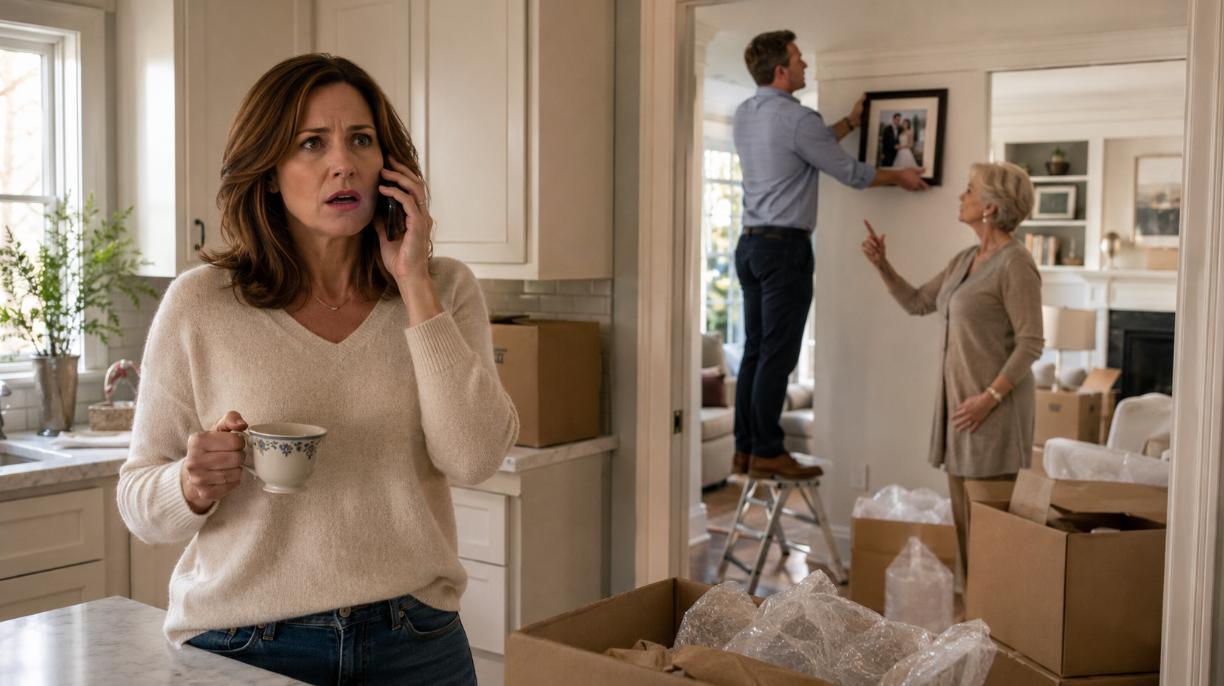
That Tuesday afternoon, I was drying a teacup when my phone rang.
Unknown number.
I almost ignored it.
Then I answered.
“Mrs. Baker?” a man asked.
“Yes?”
“This is Thomas Reed. I sold you the house.”
I remembered him immediately. Seventy-something, soft-spoken, retired electrical engineer. He had lived in the house with his wife for more than thirty years before she passed. At closing, when he handed me the keys, his eyes had gone wet.
“She was happy here,” he told me. “I hope you will be too.”
Now his voice sounded different.
Careful.
Troubled.
“Mr. Reed,” I said, “is everything all right?”
There was a pause long enough that I looked at my phone to make sure the call had not dropped.
“I need to apologize,” he said finally.
“For what?”
“When my wife was alive, I installed a small security system in the house. Mostly for her peace of mind when I traveled. Before the sale, I disconnected everything I remembered.”
My hand tightened around the dish towel.
“Everything you remembered?”
“I missed one camera.”
The kitchen went very quiet.
“It’s hidden behind the built-in bookshelf in the living room,” he continued. “I forgot it was still wired into the old outlet. It stayed connected to my cloud account. I didn’t realize until I got a storage alert.”
I did not speak.
“I went in to delete the footage,” he said. “But then I saw something.”
From the living room, my husband laughed.
Jonathan was standing on a step stool, hanging a framed photograph of his parents’ wedding day. His mother, Diane, stood below him, one hand lifted like a conductor directing an orchestra.
“A little to the left,” she said.
Jonathan moved the frame without question.
They both laughed softly.
I looked at them through the kitchen doorway, the phone pressed to my ear, a teacup still in my hand.
“What did you see?” I whispered.
Thomas Reed lowered his voice.
“Your husband and his mother. Please don’t tell him I called. Come alone.”
My stomach went cold.
“Mr. Reed—”
“I saved everything to a drive. You need to see it yourself.”
I stared at Jonathan and Diane in my living room.
The two people who had been inside my marriage longer than anyone else.
Jonathan turned and smiled at me.
The same smile I had trusted for twelve years.
“Everything okay?” he asked.
I forced myself to nod.
“Fine,” I said. “I forgot we need more paint for the guest room. I’m going to run out for a bit.”
Diane’s eyes rested on me half a second too long.
“Take your time, dear,” she said.
Dear.
She always made that word sound like a lace glove hiding a fist.
I grabbed my purse and keys. By the time I reached the car, my hands were shaking so badly I dropped the keys once before getting the door open.
As I backed out of the driveway, I looked at the house in the rearview mirror.
My house.
The house my father’s money had made possible.
I did not know yet that I was driving toward the moment that would end my marriage.
I only knew that whatever Thomas Reed had seen, he had sounded like a man who wished he had not seen it at all.
Chapter 2: The Video
Thomas Reed’s new place was a small rental across town. Neat lawn, quiet street, no decorations except a bird feeder near the porch.
He opened the door before I knocked.
“I’m sorry,” he said.
That was the first thing.
Not hello.
Not come in.
Just: “I’m sorry.”
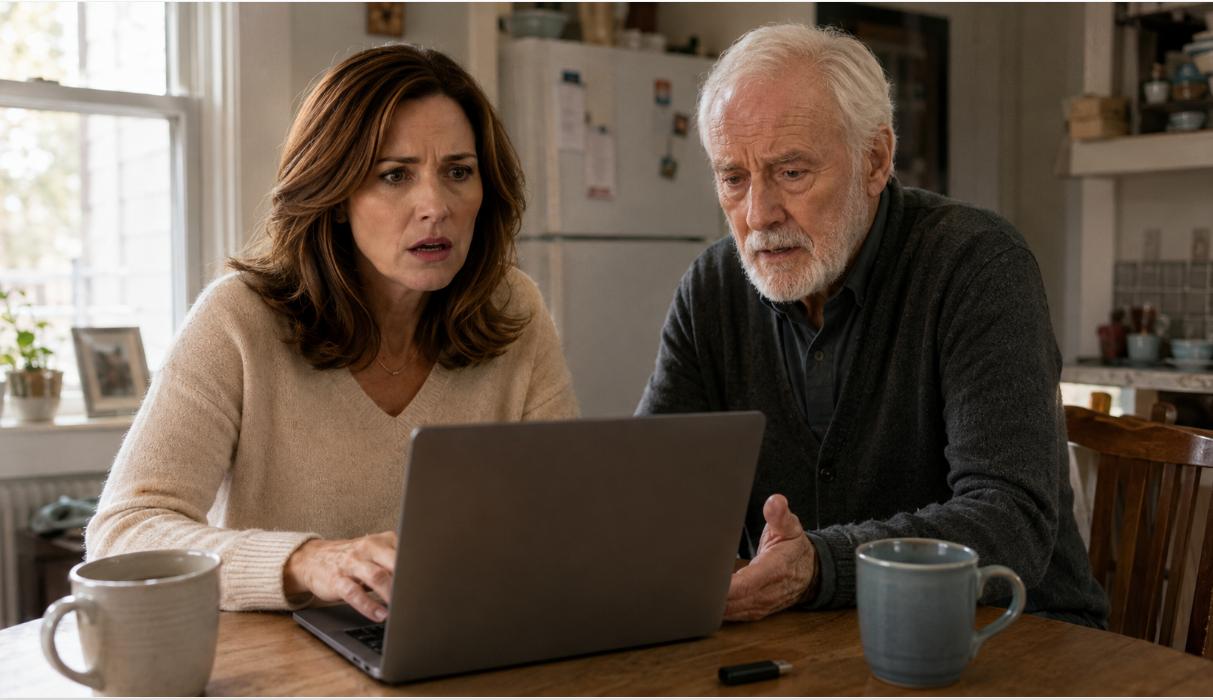
He led me to a kitchen table where a laptop was already open. Beside it sat a small black USB drive.
“I don’t want you to think I was spying,” he said. “I was going to delete the footage. I should have deleted it. But after I watched it…”
He stopped.
I sat down.
“Show me.”
He turned the laptop toward me and pressed play.
The footage was from four days earlier, a Friday afternoon when I had stayed late at work. The camera angle looked down over the living room. Our moving boxes still sat against the wall. The couch was covered with folded blankets. Half of our life had not yet been unpacked.
Then Jonathan entered.
A moment later, Diane followed.
She walked through the room slowly, looking around the way some women look at a house during an open showing.
Not admiring it.
Claiming it.
“She still thinks this house belongs to both of you,” Diane said.
Jonathan laughed.
My husband laughed.
“Of course she does,” he said. “She trusts me.”
Diane sat on the arm of the sofa.
“Sweet girl,” she said. “She never reads the fine print.”
Jonathan smiled.
“Why would she? I’m her husband.”
I felt my body go still.
On the video, Diane crossed her legs and looked toward my kitchen.
“Trust is useful,” she said, “as long as you use it correctly.”
I forgot how to breathe.
They talked for fourteen minutes.
I watched every second.
Diane mentioned a refinance package. A mortgage broker she knew. Someone who could “smooth out the complicated parts.” Jonathan talked about how my father’s inheritance had covered nearly seventy percent of the down payment. Diane said money like that should have gone through “proper family channels.”
Family channels.
My father’s thirty years of saving had become, in her mouth, a resource that had somehow failed to flow toward the right people.
Then came the part that made the room tilt.
Diane said there was a clause they needed me to sign.
A power of attorney provision buried in the refinance papers.
Jonathan shrugged.
“She won’t notice.”
“She might ask questions,” Diane said.
“Then I’ll tell her it’s routine.”
“And if she hesitates?”
Jonathan smiled again.
“I’ll remind her that paperwork stresses her out. She’ll let me handle it. She always does.”
The video continued.
They discussed transferring authority slowly. Not all at once. That would scare me, Diane said. Over time was better. A signature here. A refinance there. A little authority now. More later.
By the end, I understood the shape of it.
They were not trying to steal my house in one dramatic move.
They were trying to make me hand it over piece by piece while calling it love.
When the video ended, Thomas closed the laptop gently.
“I’m sorry,” he said again.
I stared at the blank screen.
For twelve years, I had believed Jonathan’s steadiness was love. His confidence. His habit of handling bills. His insistence that I should not worry about the financial details because he was “good at that stuff.”
I had thought it was care.
Now I wondered how long it had been control.
Thomas pushed the USB drive toward me.
“I copied everything. The footage. The timestamps. All of it.”
I picked it up. It was so small it could have been lost in a coat pocket.
Yet it held the truth my marriage had been hiding.
“Why did you call me?” I asked.
Thomas looked toward the window.
“My wife and I built a life in that house,” he said. “I sold it to you because I thought you’d build one too. I couldn’t delete what I saw and let someone take that chance from you.”
I pressed the drive into my palm until the edges hurt.
“Thank you.”
At the door, he stopped me.
“Mrs. Baker?”
I turned.
“You still have time,” he said. “Whatever you decide, do it before they know you know.”
I drove home in silence.
The USB drive sat in my coat pocket like a second heartbeat.
When I pulled into the driveway, warm light glowed from the living room windows. Jonathan and Diane were still there, probably still hanging photographs, still moving through my house as if they were already rearranging my future.
I sat in the car for one minute.
Then two.
By the third, I had made my decision.
I would not confront them.
Not yet.
First, I would read the fine print.
Chapter 3: Page Fourteen
I walked back into my house and became a better actress than I ever wanted to be.
“How was the paint store?” Jonathan asked.
“Busy,” I said. “I’ll go back tomorrow.”
He nodded without looking up.
Diane was in the kitchen, opening cabinets.
“Just helping organize,” she said.
“Of course,” I replied.
My voice sounded normal.
That surprised me most.
Over the next few days, I watched.
Not obviously. Not dramatically.
I simply paid attention.
Jonathan collected the mail before I could. Diane visited almost every afternoon under the excuse of helping us settle in. Their conversations softened whenever I entered a room. Not stopping, exactly. Just changing direction.
Then, three days after Thomas Reed showed me the video, Jonathan placed a thick folder on the dining table.
“Refinance paperwork,” he said casually. “Nothing major. Just cleaning up loan terms now that we’ve closed.”
Diane, who “happened” to be visiting, smiled at me over her coffee.
“Everyone does it, dear. You sign a few pages and then you don’t have to worry about it anymore.”
I looked at the folder.
My heart pounded once.
Then I smiled.
“I’d like to read it first.”
Jonathan’s jaw tightened for half a second.
Only half.
But I saw it.
“Of course,” he said. “No rush.”
There was a rush.
I could feel it in the room.
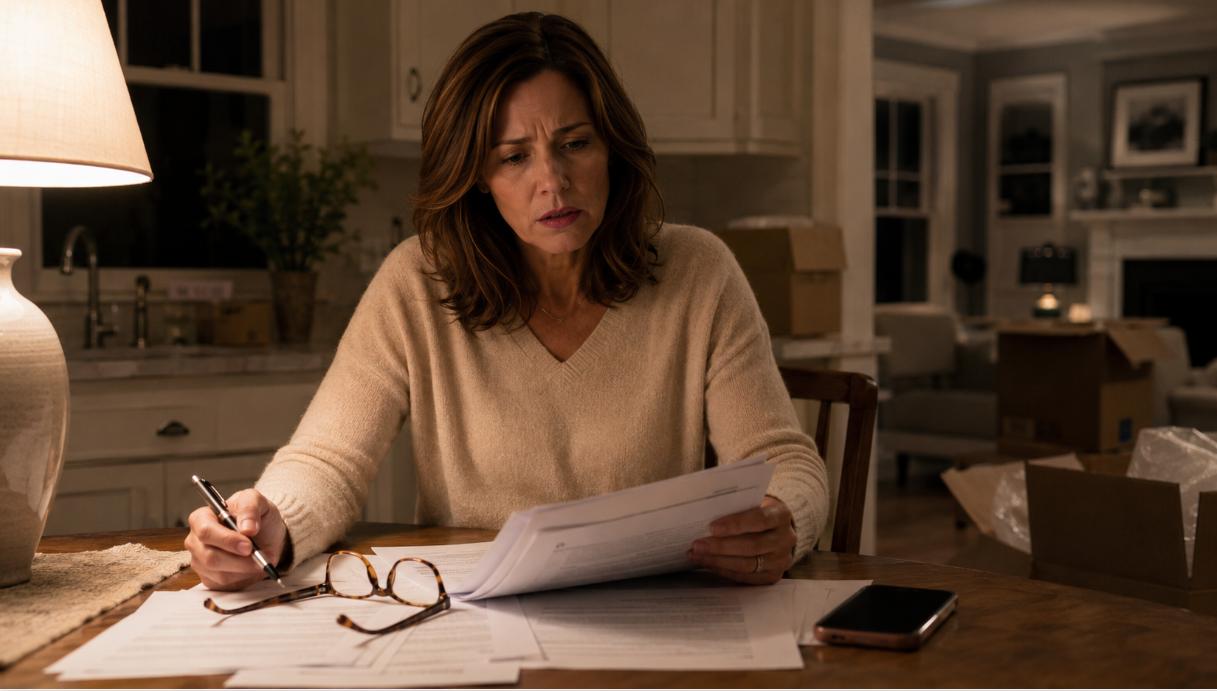
That night, after Jonathan fell asleep, I took the folder to the kitchen table. The house creaked softly around me, unfamiliar noises in a place I was still learning to trust.
I photographed every page.
Then I read.
And read.
And read.
Most of it was boring enough to make someone tired on purpose. Loan terms. Administrative language. Signature blocks. Cross-references. Dense paragraphs designed to punish attention.
Then I found page fourteen.
Buried in the middle was a clause granting Jonathan limited power of attorney over matters related to the property after my signature and notarized approval.
It was framed as convenience.
To reduce administrative burden.
To streamline future property-related decisions.
To allow my husband to act on my behalf.
I read it three times.
Then a fourth.
It was not a refinance.
It was a key.
Once I signed, Jonathan would have authority to make decisions about the property. Not total control immediately. Nothing so obvious. But enough to build on. Enough to refinance later. Enough to transfer authority. Enough to slowly move my father’s gift out of my hands while telling me he was protecting me from stress.
I sat in the kitchen until almost dawn.
I thought about my father grading chemistry tests at our old dining table, red pen in hand, coffee going cold beside him. I thought about him saving money he never spent on himself. I thought about how proud he had looked the day I bought my first used car with money I earned on my own.
He used to say, “Katherine, trust people. But never stop reading what they put in front of you.”
I pressed both hands flat on page fourteen.
For the first time since Thomas’s call, I smiled.
Not because it was funny.
Because now I knew exactly where the trap was.
And that meant I could build one of my own.
Chapter 4: The Lawyer Above the Dry Cleaner
I found Michael Grant at 1:12 in the morning through a search on my phone.
Real estate attorney.
Twenty-six years’ experience.
Discreet. Thorough. Protective.
His office was above a dry cleaner on a quiet street, which made me trust him more than if it had been in a glass tower with marble floors. Michael Grant looked about fifty-eight, gray at the temples, calm in a way that felt earned rather than performed.
I brought everything.
The USB drive.
Photos of the refinance papers.
Screenshots.
Notes.
Recordings I had quietly made during dinners when Jonathan and Diane discussed “future plans” for the house.
Michael watched the footage from Thomas Reed’s camera without interrupting. He paused twice to take notes. When it ended, he sat back and looked at me.
“I’m going to be direct,” he said.
“Please.”
“This is not routine. The power of attorney clause is dangerous. On its face, it may be legal. That’s what makes it useful to people like this.”
My stomach tightened.
“So if I signed it…”
“You would be handing your husband a legal tool. Not the whole house at once, but enough authority to create problems before you understood what happened.”
“Can they force it?”
“Not if we move quickly.”
He tapped his pen against the folder.
“I can file protective documents today. Updated deed language. A notice of interest. A formal record making clear that no transfer, refinance, lien, or encumbrance on the property can proceed without your verified consent and independent review.”
I understood most of it.
But not all.
Michael seemed to know.
“In plain English,” he said, “I’m building a wall around the house. Only you can open the gate.”
Relief came so fast I nearly cried.
But I was tired of crying in private.
“I want it documented,” I said.
Michael studied me.
“What exactly do you want?”
“I don’t want to just stop them. I want them to know I know. I want what they tried to do recorded so they can never tell the story differently later.”
He nodded slowly.
“Then we do this carefully.”
He told me not to confront them. Not to refuse too quickly. Not to change my behavior. Let them believe I was nervous but close to signing.
“The more comfortable they feel,” Michael said, “the more careless they become.”
He was right.
Within two days, Jonathan relaxed.
Diane grew bold.
She arrived with paint swatches and furniture catalogs, holding them against my walls.
“This living room needs warmth,” she said. “Once the ownership side is cleaner, we can make real decisions.”
We.
Cleaner.
Real decisions.
I smiled and poured coffee.
Jonathan talked openly about renovations. A basement office. A wet bar. Removing a dining room wall. Pulling equity later for “investments.” Diane suggested a new fireplace mantel because the current one lacked “family character.”
Family character.
In a house my father paid for.
On Sunday night, I got the final piece of proof.
I was washing dishes when Jonathan came up behind me and wrapped his arms around my waist. The gesture was so familiar that for one unbearable second, my body remembered loving him before my mind could stop it.
He kissed the side of my head.
“After tomorrow,” he murmured, “you won’t have to think about any of this again.”
My phone was recording inside my cardigan pocket.
Jonathan continued, his voice warm and low.
“Once everything’s transferred, it’ll all be handled. You won’t even realize how easy it was. That’s the point. I don’t want you stressed.”
My hands stayed in the soapy water.
“That sounds nice,” I said.
He hugged me tighter.
He thought I was grateful.
He did not know he had just said the quiet part out loud.
Chapter 5: The Dinner
Monday evening, I came home to candles on the dining table.
The good china had been set out.
The same wedding china I had been unwrapping when Thomas Reed called.
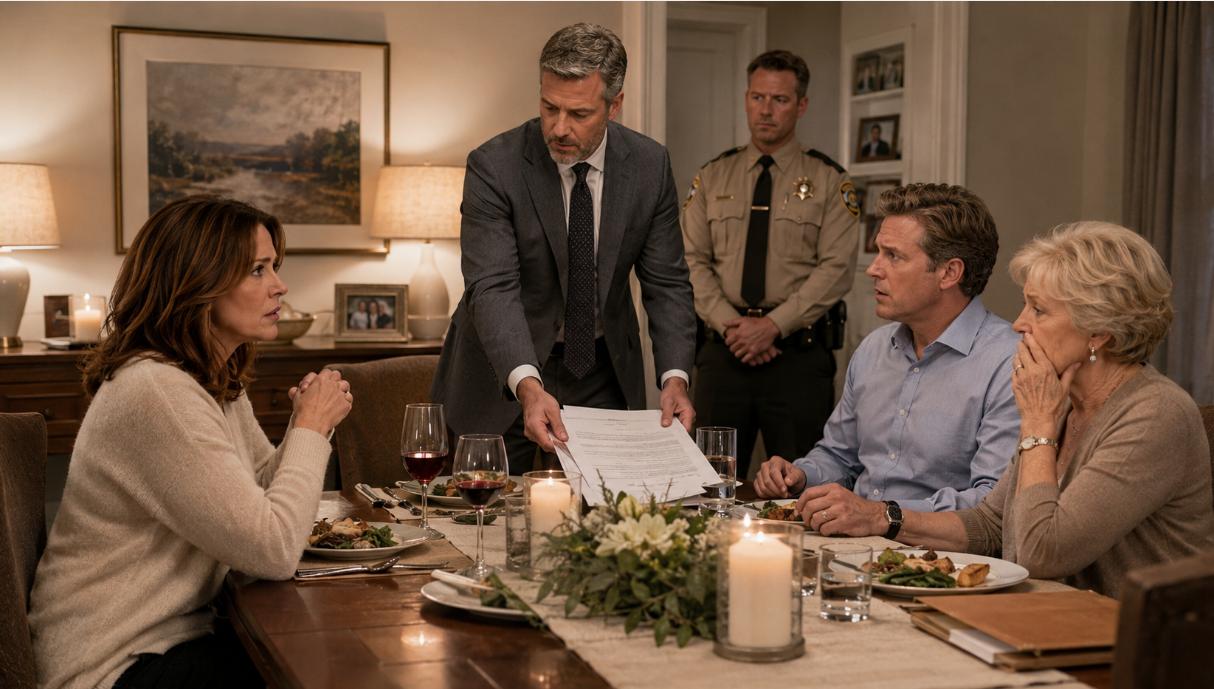
A bottle of wine breathed near the centerpiece. Jonathan wore a blue shirt I used to love. Diane arrived ten minutes later in pearl earrings and a cream sweater, dressed for a celebration she thought she deserved.
“A little dinner before the signing,” Jonathan said.
“You’ve been so understanding,” Diane added.
I took my seat.
Across from me sat my husband and his mother, both smiling like people waiting for a door to open.
They talked through dinner as if everything was already settled. Diane told stories about Jonathan as a boy. Jonathan squeezed my hand twice. He poured wine too often. He laughed too loudly.
I ate almost nothing.
Nobody noticed.
At 8:14, Jonathan reached into the sideboard drawer and pulled out the folder.
He placed it on the table gently, almost reverently.
Then he opened to the signature page.
“No rush,” he said.
His eyes said the opposite.
Diane leaned forward.
I picked up the pen.
For two weeks, I had carried the truth alone. In my pocket. In my phone. In my face every time I smiled across from them and pretended not to know they were trying to turn my trust into a weapon against me.
Now the pen hovered over the line.
Jonathan stopped breathing.
The doorbell rang.
His head snapped up.
“We’re not expecting anyone,” he said.
“No,” I replied. “You’re not.”
I set the pen down without signing a single letter.
Then I walked to the front door.
Michael Grant stood on the porch in a gray suit, leather folder under one arm. Behind him stood a uniformed court officer holding a stack of documents.
“Good evening, Mrs. Baker,” Michael said. “I believe this is the right time.”
I stepped aside.
“Come in.”
Jonathan rose so fast his chair scraped across the floor.
“What is this?”
Diane’s face tightened.
Michael walked into the dining room and placed his folder beside Jonathan’s paperwork.
Two stacks on one table.
One meant to take my house.
One meant to protect it.
“Mr. Baker,” Michael said, “Mrs. Baker. I represent Katherine Baker regarding the property at this address.”
Diane lifted her chin.
“This is a family matter.”
Michael looked at her calmly.
“It became a legal matter when documents were prepared to alter property authority without my client’s fully informed consent.”
Jonathan turned to me.
“Katherine, what is going on?”
I sat back down at the head of the table.
“My father paid for most of this house,” I said. “And you tried to use my trust in you to take control of it.”
His face changed.
Just slightly.
Enough.
Michael opened the folder.
He placed the first document on the table.
A transcript from Thomas Reed’s security footage.
Then screenshots from page fourteen.
Then copies of emails between Diane and the mortgage broker.
Then the protective filings Michael had recorded that morning.
Finally, he placed my phone on the table and pressed play.
Jonathan’s own voice filled the room.
“Once everything’s transferred, it’ll all be handled. You won’t even realize how easy it was.”
The silence afterward was enormous.
Diane stared at the phone as if it had personally betrayed her.
Jonathan went pale.
“How long have you known?” he asked.
Not: That’s not what I meant.
Not: I’m sorry.
How long have you known?
That told me everything.
“Long enough,” I said.
Diane recovered first.
“This is ridiculous,” she snapped. “We were trying to protect the family.”
Michael turned to her.
“Protecting the family does not require hiding legal authority inside refinance paperwork.”
She opened her mouth.
Michael continued.
“Nor does it require describing my client’s trust as something to ‘use correctly.’ I have that recording as well.”
Diane closed her mouth.
The court officer explained the documents formally. The property was protected. Any attempt to transfer, refinance, encumber, or alter authority over the home would require my verified consent and independent legal review. Any further effort to pressure or mislead me could become part of a larger legal action.
Jonathan sat down slowly.
The candles burned between us.
The china gleamed.
The wine remained untouched.
The dinner they had planned as a celebration became a record.
A witness.
A line in the sand.
Jonathan looked at me once more.
“Katherine, I was trying to make things easier.”
“No,” I said. “You were trying to make me unnecessary.”
He had no answer for that.
Chapter 6: The House That Told the Truth
Jonathan packed two suitcases that night.
He moved through the bedroom in silence, opening drawers, folding shirts badly, refusing to look at me. Diane waited near the front door with her arms crossed, her face stiff with anger.
Just before leaving, she turned back.
“You’ll regret this,” she said. “Family is family. You’ll learn that the hard way, alone in this house.”
I looked at her.
“I already learned it,” I said. “That’s why you’re leaving.”
For the first time in twelve years, Diane had nothing to say.
The door closed behind them.
Quietly.
Almost gently.
I stood in the hallway for a long time.
Nothing in the house had changed. The same floors. The same staircase. The same kitchen waiting to be unpacked. The same living room where a hidden camera behind a bookshelf had captured the truth when no one else was willing to say it.
Yet everything felt different.
Not emptier.
Clearer.
The next morning, I called Thomas Reed.
When I told him what had happened, he was quiet for a moment.
Then he said, “Houses hold on to the truth longer than people do, Mrs. Baker. I’m glad this one still had some truth left to give you.”
I think about that often.
Months passed.
The divorce became ugly, then procedural, then final. Jonathan tried to frame the refinance documents as a misunderstanding. Diane claimed she had only been helping. But Michael’s folder was thorough, and Thomas Reed’s footage said what people could not talk their way around.
In the end, the house remained mine.
Fully.
Legally.
Undeniably.
I kept living there.
At first, every room hurt. The dining room reminded me of the pen. The living room reminded me of the video. The kitchen reminded me of the phone call that split my life in two.
But slowly, the house became something else.
I painted the guest room sage green.
I planted tomatoes in the side garden.
I put lavender near the porch steps.
I kept my father’s framed photograph on the mantel—not Jonathan’s family portrait, not Diane’s chosen decorations, but my father smiling awkwardly in his old classroom with a chalkboard behind him.
Some mornings, I sit on the porch with coffee and watch the light move across the yard. I think about how close I came to signing away the life my father worked thirty years to help me build.
Not because I was foolish.
Because I was trusting.
There is a difference.
Love should not require you to stop reading.
Marriage should not turn your faith into someone else’s legal strategy.
And family should never ask you to hand over your future just to prove you belong.
I still have the USB drive.
It sits in a small box in my desk drawer beside the original house keys Thomas Reed gave me. I rarely open that box, but I like knowing it is there.
A reminder.
Not of betrayal.
Of the day I finally trusted my own eyes more than someone else’s smile.
Jonathan thought the house would become his.
Diane thought I would sign whatever they placed in front of me.
They were both wrong.
My father did not leave me money so another family could quietly take it.
He left me a foundation.
And I finally learned how to stand on it.