Chapter 1: The Last Train
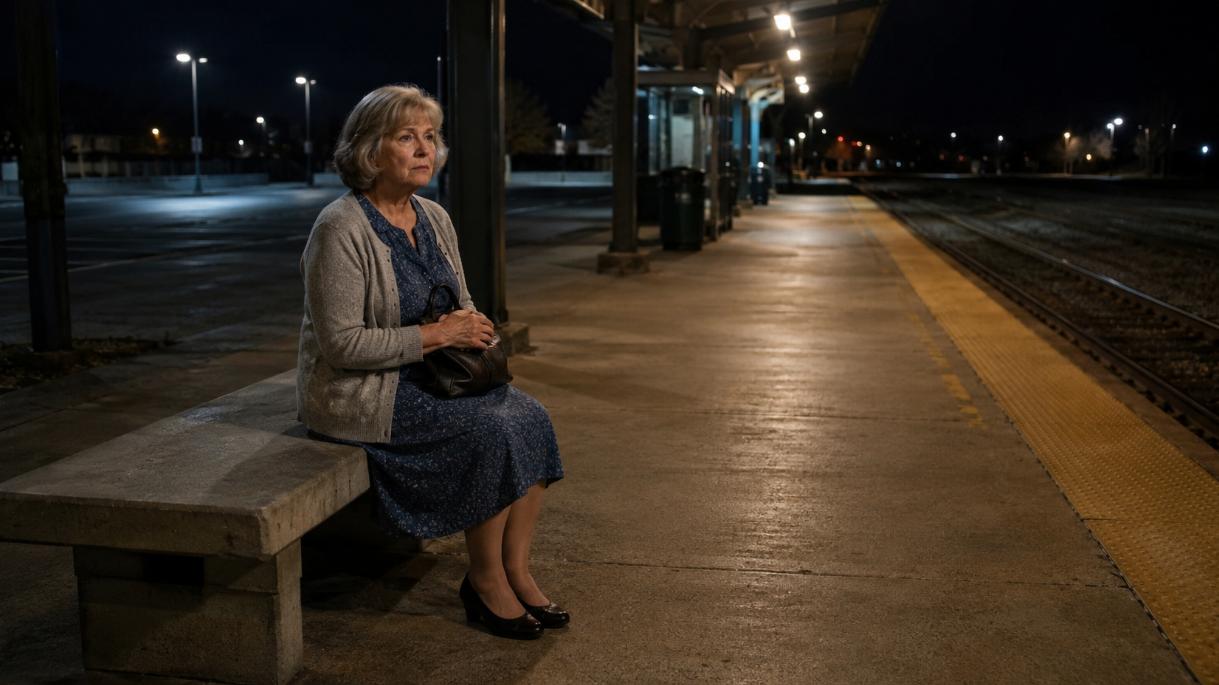
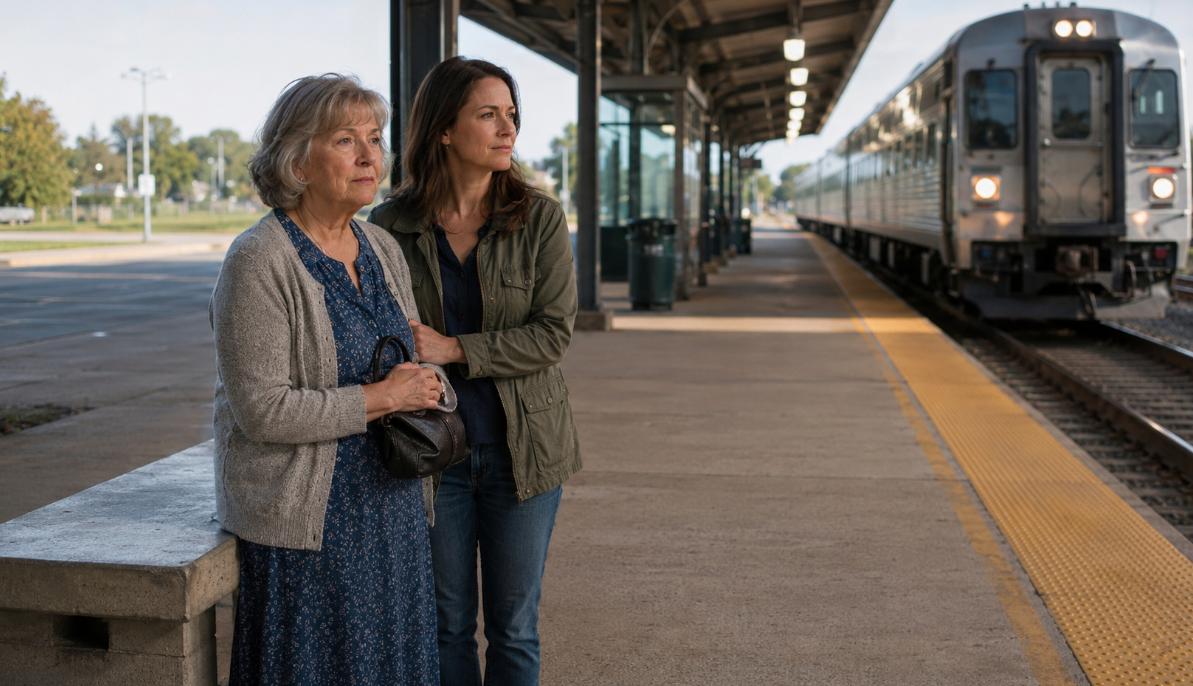
The concrete bench was cold through my cardigan.
I sat very still under the yellow station lights, my purse clutched in both hands, watching darkness settle over Milbrook Station. The last train had left twenty minutes earlier. I had seen its red tail lights disappear around the bend, taking with it my only easy way home.
I was sixty-seven years old, wearing church shoes, a thin sweater, and the same blue dress my daughter once told me made me look “soft but elegant.” I had no phone. I had seventeen dollars in cash. The industrial buildings around the station were already dark, and the parking lot was empty except for a broken soda machine buzzing near the wall.
David Richardson, my daughter’s husband, had dropped me off there ten minutes before.
“Train should be here soon,” he had said, checking his watch.
Then he smiled, handed me my purse, and drove away.
He knew there was no train.
Of course he knew.
David was not a careless man. He was the kind of man who checked details twice when they mattered to him. He knew which restaurants gave the best impression, which watch made him look successful, which tone made cruelty sound like concern. He had offered to drive me to the station after Sunday dinner, not because he was being kind, but because he wanted me alone.
That evening, in his car, under the dim light near the freight entrance, he had talked to me about “the future.”
He said Sarah worried about me living alone. He said Social Security did not go far these days. He said families needed to pool resources, make arrangements early, think practically before a crisis came.
Then came the real words.
Power of attorney.
Beneficiaries.
Joint account.
“Just so Sarah can help you manage things when the time comes,” he said.
I had looked at him in the passenger seat and seen, very clearly, what he thought I was.
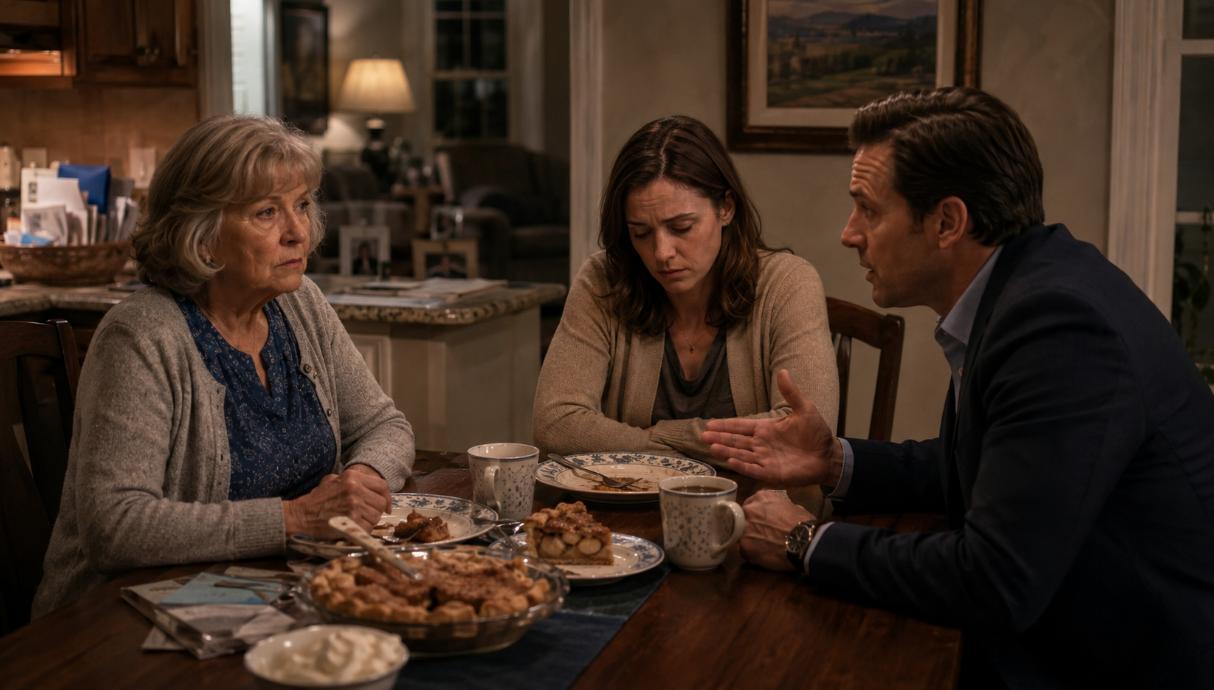
An aging widow.
Modest apartment.
Old handbag.
Homemade pie.
Small savings.
Easy target.
When I did not agree immediately, his face stayed pleasant, but something behind his eyes hardened. Ten minutes later, he left me at a station where the final train had already gone.
He wanted me frightened.
He wanted me cold.
He wanted me to feel how vulnerable I would be without his “help.”
I pulled my cardigan tighter and looked down at my hands. They were older now, yes. The knuckles were thicker, the skin thinner. But they were the same hands that had balanced books at midnight while raising a child alone. The same hands that had signed contracts men thought I was too timid to understand. The same hands that had built a life from almost nothing after my husband died.
David Richardson had just made a serious mistake.
He had mistaken quiet for weak.
Chapter 2: Sunday Dinner
The evening had started with apple pie.
I baked it that morning in my small downtown apartment, rolling the crust the way my mother taught me and cutting little vents in the top so the cinnamon steam could escape. Sarah loved my apple pie. When she was little, she would stand on a chair beside me with flour on her nose, pressing scraps of dough into shapes no one could identify.
She was thirty-four now, married, and thinner than she should have been.
When she opened the door that Sunday, she hugged me tightly. A little too tightly. Her face looked tired under her makeup, and her smile had the careful brightness people use when they are trying to hide something.
“Mom, you look wonderful,” she said.
“So do you, sweetheart.”
That was a lie, but a kind one.
David appeared behind her with his practiced smile. He was tall, handsome in a polished way, and always dressed as if someone might photograph him unexpectedly. Even at home, he wore a fitted sweater and a watch that cost more than my monthly rent.
“Stephanie,” he said. “Good to see you.”
He kissed my cheek like a dutiful son-in-law.
His eyes moved to the pie, then to my purse, then back to my face. Always calculating.
The apartment looked different. A leather recliner David had once bragged about was gone. The side table near the window had been replaced by something cheap and mismatched. On the kitchen counter, I noticed two overdue envelopes tucked under a magazine. Sarah swept them away when she saw me looking.
Dinner was chicken, rice, and salad. Sarah had made too much, the way she did when she was nervous. David talked more than both of us combined. Groceries were expensive. Rent was ridiculous. Utilities kept going up. Sarah’s certification program at the library was “a nice idea,” but maybe not practical right now.
Sarah stared at her plate.
“It’s only temporary,” she said quietly. “Once I finish the program, I can apply for full-time positions.”
David gave a short laugh.
“Temporary costs money too.”
I watched my daughter’s shoulders drop.
There are many ways to silence a person. Some men shout. Some men break things. David did neither. He used disappointment like a leash. One tug, and Sarah shrank.
“The program is a good investment,” I said. “Sarah has always been gifted with people. She remembers what others need before they know how to ask.”
David smiled without warmth.
“Easy to say when you’re not the one paying for it.”
I said nothing.
What David did not know was that I had been helping for months. An electric bill paid anonymously when the shutoff notice came. Grocery cards slipped into Sarah’s mailbox. A “birthday check” in March that was really rent money disguised as affection. I did it quietly because David’s pride rejected help, but his spending habits kept putting my daughter in danger.
After dinner, Sarah went to the kitchen to make coffee.
David leaned back in his chair and looked at me.
“You know,” he said, “Sarah worries about you.”
“Does she?”
“You live alone. You’re getting older. At some point, we need to be realistic.”
There it was again.
Realistic.
The favorite word of people who want to take control.
“I manage quite well,” I said.
“For now.” He folded his hands on the table. “But when that changes, Sarah will be the one responsible. That kind of pressure is hard on a marriage.”
I looked at him carefully.
“What are you suggesting?”
“Nothing dramatic. Just planning. Maybe Sarah on your accounts. Maybe power of attorney. Maybe some kind of shared arrangement so we can make sure you’re cared for.”
We.
He said “we,” but he meant himself.
I had spent too many years around contracts and ambitious men not to hear the shape of a trap.
“I’ll think about it,” I said.
He smiled.
But his smile did not reach his eyes.
Chapter 3: Rosa
The first person to help me that night was a young security guard named Caleb.
He found me sitting on the bench almost an hour after David left. His flashlight swept over the platform, then stopped when he saw me.
“Ma’am?” he called gently. “Train service ended a while ago. Are you waiting for someone?”
I considered lying.
Then I was too tired.
“My son-in-law seems to have misunderstood the schedule,” I said. “I’m afraid I’m stranded until morning.”
Caleb frowned immediately. “Do you have a phone?”
“At home on the kitchen counter.”
He pulled out his own without hesitation.
“Use mine. Call someone.”
The kindness nearly undid me.
I could have called Sarah, but David would answer. Or worse, he would stand beside her while she spoke, shaping every word afterward. I could have called a car service if I remembered the number, but I did not. I could have called my attorney, but at that hour, it would go to voicemail.
“I don’t want to worry my daughter,” I said.
Before Caleb could answer, a woman’s voice came from the stairwell.
“What’s going on?”
She was carrying a ring of keys and wearing a navy custodial uniform. Her gray hair was pulled into a practical ponytail, and her face had the kind of strength that comes from working nights and raising children.
“This lady missed the last train,” Caleb said. “I was telling her about Murphy’s Diner.”
The woman snorted.
“Murphy’s isn’t safe for her this time of night.”
She looked at me directly.
“I’m Rosa Martinez. I clean the Hartwell building across the street. There’s a break room with a couch and a coffee maker. It’s warm. I’ll be there all night.”
I did not know what to say.
Rosa shrugged as if inviting strangers into office break rooms was ordinary.
“I’ve got three daughters,” she said. “If one of them was stranded somewhere at night, I’d want somebody to help.”
So I followed her.
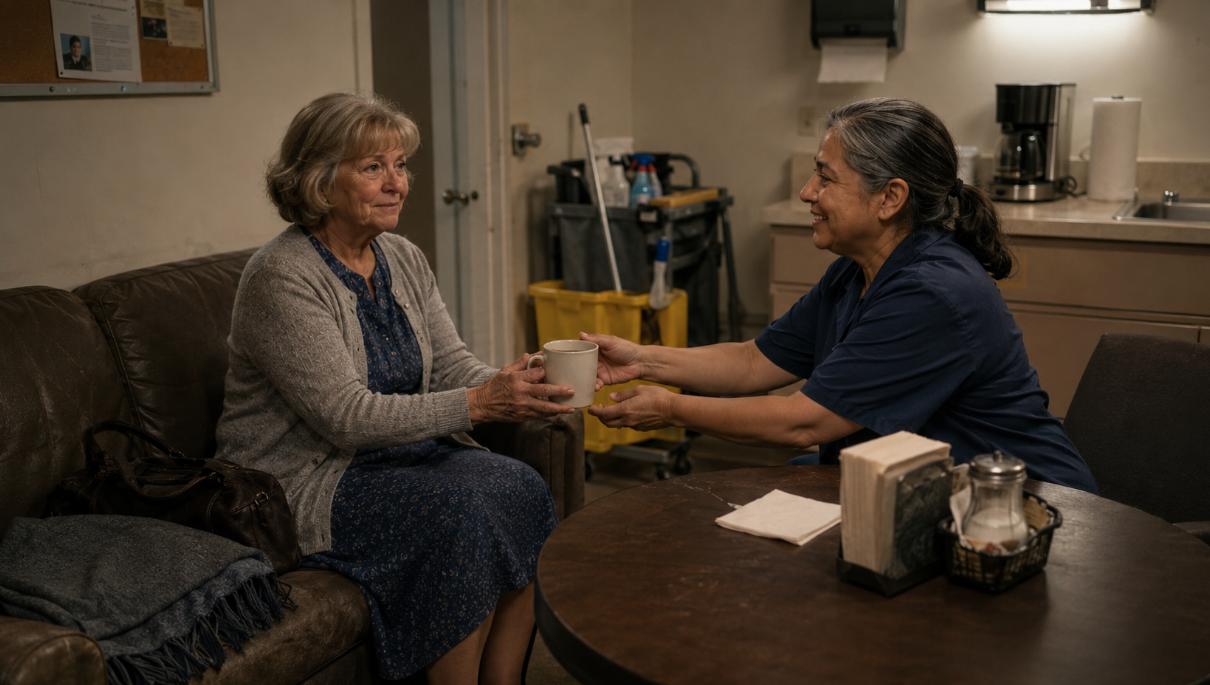
The Hartwell building smelled of lemon cleaner and old carpet. Rosa unlocked the side door, led me upstairs, and turned on the lights in a small break room with a round table, a worn brown couch, and a coffee maker that had seen better days.
“Sit,” she said. “You look frozen.”
She made coffee in two mismatched mugs and handed me one.
Then she sat across from me and studied my face.
“So,” she said, “who really left you at that station?”
I looked at her.
“My daughter’s husband.”
Her mouth tightened.
“On purpose?”
“Yes.”
I told her some of it. The dinner. The questions about my accounts. The talk of power of attorney. The way he left me after the last train had gone.
Rosa listened without interrupting.
When I finished, she leaned back and said one word I will not repeat.
Then she added, “Men like that don’t start with money. They start by making women doubt themselves.”
I looked up.
“You’ve seen it before?”
“My oldest daughter’s first husband. He started with little things. Her friends were bad influences. Her job was too stressful. Her mother didn’t understand their marriage. Then he took over the bank account.”
I thought of Sarah’s hollow eyes at dinner.
My stomach sank.
“I think he’s doing that to my daughter.”
“Then don’t waste time proving to him you’re strong,” Rosa said. “Show her she still is.”
That sentence stayed with me.
At two in the morning, Rosa gave me a blanket from her cleaning cart and told me to rest on the couch. She stayed in the chair, reading a paperback and keeping watch. I woke several times and saw her there, steady as a lighthouse.
At dawn, she drove me back to the station in her old Honda.
Before I got out, I reached into my purse and gave her a business card. Not the simple one I used for casual acquaintances. The real one.
Long Property Group.
Her eyes widened.
“You’re that Stephanie Long?”
“I am.”
“You own half the office buildings downtown.”
“Not half,” I said. “But enough.”
She looked from the card to me.
“Does your son-in-law know?”
“No.”
For the first time that night, I smiled.
“And that is going to become very useful.”
Chapter 4: What David Didn’t Know
I did not become wealthy all at once.
There was no lottery ticket, no secret billionaire husband, no sudden miracle. My husband Michael died when Sarah was six, leaving me with grief, a small life insurance policy, and medical bills that frightened me more than widowhood did. I worked days as a bookkeeper and spent nights learning real estate accounting from library books.
My first investment was a failing laundromat building no one wanted. I bought it with fear in my throat and a calculator beside my bed. I rented the upstairs apartment to a retired nurse, leased the ground floor to a repair shop, and learned very quickly that numbers tell the truth when people do not.
One building became two.
Two became six.
By the time Sarah graduated college, Long Property Group owned modest commercial spaces across the city: clinics, small offices, storage units, a pharmacy, two dentist practices, and the Hartwell building Rosa cleaned every night.
I kept my life simple on purpose.
I lived in the same two-bedroom apartment. I drove an older car. I shopped sales, baked my own pies, took the bus when parking annoyed me, and wore clothes comfortable enough for grocery lines and board meetings. People saw what I let them see.
That privacy protected me.
It also protected Sarah.
I wanted my daughter to know she was loved, not funded. I wanted her to build a life because it mattered to her, not because she expected inheritance to solve every difficulty. Maybe I hid too much. Maybe secrecy, like generosity, can become a wall if you build it too high.
David had looked at that wall and decided there was nothing behind it.
By seven-thirty that morning, I was home.
I showered, changed, made tea, and called Marcus Chen, my attorney.
“Stephanie,” he said. “You sound serious.”
“My son-in-law tried to pressure me into giving him access to my accounts. When I did not agree, he abandoned me at Milbrook Station after the last train.”
Silence.
Then Marcus said, “He did what?”
I told him everything.
When I finished, his voice was no longer warm.
“That is attempted financial exploitation. At minimum. Possibly elder abuse depending on jurisdiction and circumstances.”
“I don’t want to rush to police,” I said. “Not yet. Sarah still trusts him, and if I move too fast, he’ll make me look like a meddling old mother.”
“What do you want?”
“I want to know exactly who he is. His debts. His accounts. Whether he has done this before. And I want to protect Sarah without putting money where he can touch it.”
Marcus understood immediately.
“I’ll start with a background check and review Sarah’s legal options. We can also set up a protected support trust for her if needed.”
“Good.”
Next, I called a private investigator I had used twice in business matters. Her name was Elena Rodriguez. She was discreet, thorough, and did not waste words.
“I need you to look into David Richardson,” I told her. “Quietly.”
“How deep?”
“As deep as possible without alerting him.”
“Personal or business?”
“Family protection.”
There was a pause.
“Understood.”
My third call was to Rosa.
She answered on the second ring.
“Mrs. Long?”
“Stephanie,” I said. “And I meant what I said this morning. I need someone I can trust. Someone who knows people, buildings, schedules, and when something feels wrong. Would you consider working for me?”
She laughed softly, still sounding stunned.
“I clean offices.”
“You read character better than half the executives I’ve hired.”
“What would I do?”
“Help me manage properties, coordinate appointments, and for now, help me protect my daughter.”
Rosa was quiet.
Then she said, “When do I start?”
Chapter 5: Sarah’s Bank Statement
The first crack in Sarah’s belief came from her debit card.
She called me two days later from the library, whispering because David did not like her calling me during work.
“Mom,” she said, “something is wrong.”
I sat up straight.
“What happened?”
“I tried to buy groceries yesterday, and my card was declined. David said it was a banking error, but when I asked to see the account, he told me I was creating stress.”
Her voice shook with embarrassment.
“I used to be good with money. I paid my own bills all through college. When did I become someone who can’t even understand her own bank account?”
“You didn’t become that,” I said. “Someone convinced you.”
She was silent.
I knew better than to push too hard.
“Go to the bank today,” I said. “Ask for printed statements on every account with your name on it. You have that right.”
“David will be furious.”
“Then don’t tell him until after you know the truth.”
That afternoon, Sarah called again.
She was crying.
Three accounts had been closed. One had forty-seven dollars left. Two credit cards had been opened in her name. Her paycheck had been redirected twice, then replaced before she noticed. There were withdrawals she did not recognize, electronic signatures she did not remember giving, and late notices David had hidden from her.
“He said he was managing everything,” she whispered.
“He was,” I said. “Just not for you.”
I invited her to meet me at a quiet cafe the next day.
She arrived pale, carrying a folder against her chest like it might bite her. I had brought copies of Elena’s preliminary findings: David’s hidden debts, gambling transactions, loan applications, forged signatures, and evidence that he had done something similar to a widow named Patricia Chen before he met Sarah.
Not murder. Not some unbelievable scheme.
Just theft.
Control.
Humiliation.
The kind of cruelty that hides behind marriage vows and shared bills.
Sarah read the first page. Then the second. Then she put a hand over her mouth.
“He told me Patricia was crazy,” she said.
“People who hurt others often make sure their victims sound unreliable first.”
Her eyes filled.
“Mom, he was going to take your money too.”
“Yes.”
“And I helped him. I believed him when he said you were getting older and needed planning.”
I reached across the table and took her hand.
“Sweetheart, loving someone does not make you guilty of what they do with that love.”
She broke then.
Not loudly. Sarah had become too practiced at quiet pain. She folded over the table, shoulders shaking, while I held her hand and let her cry.
When she could speak again, she asked, “What do I do now?”
That was the moment everything changed.
Not because I told her what to do.
Because she asked herself the question.
I opened another folder.
“You have options. A safe apartment in a building I own. A divorce attorney already prepared to meet you. An account in your name only. Enough money to finish your certification and decide what comes next.”
Sarah stared at me.
“Mom, how can you afford all that?”
I smiled sadly.
“David is not the only person who underestimated me.”
I told her then. Not everything, but enough. The buildings. The investments. The years of quiet work. The reason I lived modestly.
She looked stunned, then hurt, then strangely relieved.
“All this time?”
“All this time.”
“Why didn’t you tell me?”
“Because I wanted you to feel free from my money.”
She wiped her eyes.
“I didn’t feel free, Mom. I felt alone.”
That hurt because it was true.
“I’m sorry,” I said.
Then my daughter did something she had not done in years.
She sat up straight.
“I want to leave him.”
Chapter 6: The Lunch
David asked me to lunch on Saturday.
He wanted to “clear up the misunderstanding” about the train station. Sarah forwarded his text to me with one sentence: He thinks I don’t know.
I agreed to meet him at an upscale restaurant where he could perform sincerity under good lighting.
I arrived fifteen minutes early with a small recorder in my purse. Marcus Chen had advised me that state law allowed it under the circumstances. I wore a soft gray sweater, low heels, and the same old handbag David believed represented my financial limits.
He arrived confident.
“Stephanie,” he said, kissing my cheek. “I’ve felt terrible all week.”
“I appreciate you saying that.”
He ordered coffee, declined food, and began.
He said family looked after family. He said the station had been a terrible miscommunication. He said Sarah was worried about me. He said he was worried too. Then, smoothly, he returned to the real subject.
“If you moved some of your savings into a joint account,” he said, “Sarah and I could help manage things. You wouldn’t have to worry about bills. And honestly, it would help us stabilize too.”
“How much money are we discussing?”
He leaned forward.
“I know you probably have something set aside. Maybe forty or fifty thousand. If you were willing to pool that with us, we could catch up and make sure you’re cared for.”
Forty or fifty thousand.
Less than one month’s rental income from two buildings.
I kept my face neutral.
“And Sarah agreed to this?”
“I wanted to discuss it with you first. No need to get her hopes up.”
“Her hopes?”
He smiled.
“She wants to take care of you, Stephanie. Don’t make this difficult for her.”
There it was.
The threat wrapped in a ribbon.
For forty minutes, I let him talk. He invented debts. He blamed Sarah’s education. He spoke of my age, my future, my supposed vulnerability. He described control as care and theft as stability.
When he finally paused, I folded my napkin and stood.
“I’ll think about it.”
He looked pleased.
“I knew you would.”
He had no idea the recorder had caught every word.
That evening, Sarah listened to the recording in the safe apartment Rosa had arranged. Her face did not change much while it played. That told me more about the state of her marriage than tears would have.
When David said, “No need to get her hopes up,” Sarah closed her eyes.
When he said, “Don’t make this difficult for her,” she opened them again.
“He used me,” she said.
“Yes.”
“And he knew exactly what he was doing.”
“Yes.”
She took a long breath.
“Then I’m done.”
Chapter 7: Consequences
We moved carefully.
Men like David are most dangerous when they feel control slipping. Sarah packed essentials while he was at work: documents, medication, her laptop, a few clothes, her grandmother’s necklace, and the small framed photo of her father she kept hidden in a drawer because David said it made the bedroom “depressing.”
By six that evening, she was in the safe apartment.
By seven, her attorney filed emergency motions to separate finances, freeze disputed accounts, and protect her from liability for debts David had created fraudulently in her name.
By the next morning, David knew.
He called Sarah twenty-three times.
Then he called me.
I answered on speaker with Marcus Chen present.
“Stephanie,” he said, voice shaking with anger under a layer of fake concern, “I don’t know what you’ve told Sarah, but she’s confused. She’s making a terrible mistake.”
“No,” I said. “She is reading bank statements.”
Silence.
Then: “You have no idea what you’re interfering with.”
“I know exactly what I’m interfering with.”
His voice dropped.
“You think you’re powerful because you hired a lawyer?”
“No, David. I hired a lawyer because I’m powerful enough to make sure this is handled properly.”
Another silence.
For the first time, he sounded unsure.
“What does that mean?”
“It means you picked the wrong woman to leave at a train station.”
The legal process was not instant or cinematic. Real consequences rarely are. But they came.
The bank confirmed unauthorized accounts. Sarah’s employer confirmed pay deposits had been redirected without her knowledge. Patricia Chen agreed to provide a statement about David’s prior theft. Elena uncovered unpaid debts, false loan applications, and a pattern of using women’s trust as collateral for his lifestyle.
Within weeks, David lost his job.
Within months, he pled guilty to financial fraud, identity theft, and attempted financial exploitation of an elderly person. The attempted elder exploitation charge came directly from the recorded lunch and the station incident. The judge did not care for his explanation that he had “only been trying to help family.”
He received prison time. Not decades. Not the exaggerated sentence of a movie villain. But enough years to change the shape of his life. Enough restitution to follow him long after release. Enough public record that the next woman he approached could find the truth with one search.
Sarah cried when it was over.
Not because she missed him.
Because grief still comes when a lie dies.
“I feel stupid,” she said outside the courthouse.
I took her face in my hands.
“No. You were trusting. He was cruel. Do not confuse the two.”
Rosa stood beside us, arms folded, watching David being led away. She had become my assistant by then, but more than that, she had become family in the way people do when they show up on the worst night of your life and expect nothing in return.
“Well,” she said, “he got his family financial planning.”
Sarah laughed through her tears.
So did I.
Chapter 8: The Platform
One year later, Milbrook Station looked different.
Long Property Group purchased the old Hartwell building and renovated the second floor into office space for a nonprofit Sarah started with Patricia Chen. It helped women recognize financial abuse, rebuild credit, open safe accounts, and find legal support before things became unbearable.
Rosa ran the intake team.
No one was better at knowing when a woman was telling only half the story because the rest hurt too much.
Sarah finished her certification, then went further. She began studying part-time for a degree in social work, saying she wanted to help women before they lost years of their lives to men who called control love.
She got stronger slowly.
That is the only honest way people recover.
There were good days. There were days she still questioned herself. There were nights she called me just to say, “Tell me again that I wasn’t crazy.” And I did. Every time.
As for me, I still lived in my modest apartment.
I still baked pies.
I still took the bus sometimes because I liked watching the city move around me. The difference was that Sarah knew who I was now. Not just her quiet mother with sensible shoes and a small kitchen. She knew the woman who had built something from grief. The woman who had hidden power, then used it when it mattered.
One evening, Sarah and I walked past Milbrook Station after a meeting.
The platform was empty again, but not frightening this time. The lights were brighter. The security booth had been repaired. A new sign announced expanded Sunday service.
Sarah stopped near the bench where I had spent that awful night.
“I hate thinking of you here alone,” she said.
“I wasn’t alone for long.”
“You were scared?”
“Yes.”
She looked at me.
“You never say that.”
“I was scared,” I said. “And then I was angry. And then I remembered who I was.”
Sarah slipped her arm through mine.
“I’m trying to remember who I am too.”
“You will.”
We stood there a while, mother and daughter, listening to the distant rumble of an approaching train.
David had left me there to teach me a lesson.
He wanted me to understand that I was old, vulnerable, dependent, and easy to frighten.
But the lesson went another way.
I learned that strangers can be kinder than family by marriage.
I learned that silence can hide strength.
I learned that a mother may age, but the part of her that rises when her child is threatened does not grow old.
Most of all, I learned that some men look at a quiet woman and see weakness because they have never had the courage to be quiet themselves.
The train arrived, doors opening with a soft hiss.
Sarah squeezed my arm.
“Ready to go home?”
I looked at the platform one last time.
The cold bench.
The yellow lights.
The place where David Richardson thought he had left a helpless old woman.
Then I smiled.
“Yes,” I said. “Let’s go.”