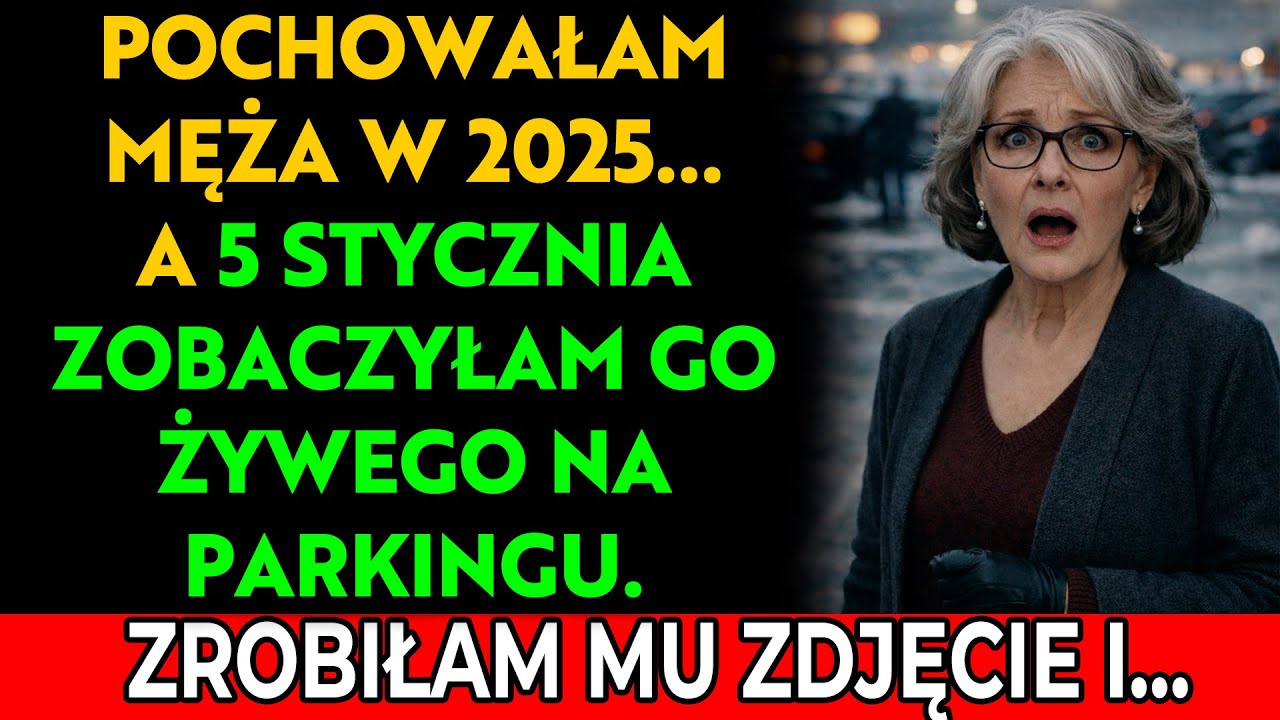
I buried my husband in 2025, and on January 5th, I saw him alive in a parking lot. I stood there with a bag of potatoes pressed against my knee, just staring as my dead husband closed the trunk of a stranger’s car. The same scar on his chin, the same hunched shoulders, the same stupid habit of pushing up his glasses with his middle finger. Only one thing was new.
He was pretending he’d never seen me in his life. That day at the shopping center parking lot, my old life died. So did the trusting Ligia Nowacka, the wife and mother who believed every word her husband and son ever told her. Let me take you back to the beginning.
Back to the phone call and the funeral. When the police called, dirty snow still lay on the streets. I was sorting through old tablecloths, deciding which one to use for next year’s Christmas dinner. The phone vibrated in my hand, and my whole world shook with it.
A calm voice explained that there had been an accident on a ferry in the Baltic Sea. My husband had been among the passengers. There was a travel bag, documents, witnesses, a body. They asked me to come in, collect his things, talk.
All I remember is saying, “I’m on my way,” and suddenly my legs felt like they belonged to someone else. At the station, I was seated on a chair against the wall. They placed a clear bag on the table with his watch, wallet, and keys. I recognized the keychain immediately.
A little boat pendant we had bought together in Kołobrzeg. My hands trembled when I touched the cold plastic. Then they showed me a document and asked me to sign. I read the lines, but the words wouldn’t reach my brain.
They spoke about the body carefully, saying it was badly damaged, that it was better not to look, that it would only traumatize me. An elderly priest with kind eyes nodded along. “Take my word for it, dear. It will be better for your memory of him.
”
My son Cyprian was already at the funeral home. His cheeks were red from the cold and from tears. He hugged me, held me, patted my back the way I used to pat his. He whispered hotly into my ear, “Mom, don’t look at him.
Remember him alive, please. ”
I tried to protest. It felt wrong to say goodbye at a closed coffin. I wanted to touch his hand one last time, even if it was cold.
But around me were only serious faces. The policeman repeated that the body was badly damaged. The funeral home worker talked about sanitary regulations. The priest nodded sympathetically.
And my son kept squeezing my hand, convincing me as if I were a small child. In the end, I gave up. I signed the paper agreeing to a farewell at a closed coffin. I remember the pen scratching the page, my signature shaking.
Everything inside me rebelled, but I was alone against a whole world of confident male voices. The funeral passed like a dream. Black coats, the smell of incense, snow crunching underfoot in the cemetery. People came up and said kind words.
I nodded without always understanding who stood before me. I stared at the lacquered coffin lid, waiting for it to lift, for him to climb out and say his usual line: “What is it now, women, crying again? ” But the lid stayed closed. The gravediggers threw in the earth.
Clumps of frozen clay hit my heart like blows. Then came the wake, the paperwork, the bank accounts, the inheritance talks. People drifted back to their own lives. Only mine had stopped.
I lived out of habit. I cooked soups, washed clothes, went to church. At night I listened to the silence and caught myself waiting for his footsteps in the hallway. Then January came.
The frost strengthened. The air turned dry. One day I had to go to Łódź, to a big shopping center. I needed new underwear, towels, a few small things.
You have to keep living, I told myself, putting my wallet and shopping list into my bag. The shopping center was loud and bright, smelling of coffee and baked goods. I wandered between the rows, picked things out, stood in line at the register like everyone else. I even caught myself looking at a display of men’s shirts, thinking which one would suit Irek.
My heart twinged. I looked away, paid, and headed for the exit. The parking lot air was sharp and biting. Cars stood in rows.
Headlights flashed on and off. I walked toward the bus stop, clutching my shopping bag. When I saw the figure by the open trunk, my brain first decided it was just someone who looked like him. But then he turned his head.
The streetlamp moved across his face. I saw the familiar scar on his chin, the same downturn at his mouth when he frowned while closing the trunk. I watched him push up his glasses with his middle finger, that same habitual gesture. The world around me vanished.
There was only him. My dead husband, standing three steps away. Alive, warm, a little older, but unmistakably him. I took a step forward, my legs like cotton.
“Irenusz,” I whispered. He flinched and looked straight at me. In his eyes, I saw recognition first, one flash, then cold calculation. “Excuse me, ma’am, I think you’re mistaken,” he said in a strained, foreign voice.
“My name is Wiktor Laskowski. ”
I nearly dropped my bag. “What do you mean, Wiktor? Irenusz, it’s me.
Ligia. ”
He shook his head, calmer now. “I don’t know you. You must have confused me with someone else.
”
He got into the car. My phone was in my hand before I knew it. My shaking fingers pressed the camera button. I managed to photograph his face through the side window and one of the license plate.
The car pulled smoothly out of the parking lot and disappeared into traffic. I stood there, clutching my bag, which had suddenly become unbearably heavy. Only one thought pounded in my head. If he’s alive, then who exactly did we lower into the ground under his name?
And why did my son beg me not to open that closed coffin? The house greeted me with silence and a cold hallway. I took off my coat, set the bag on a chair, and realized I couldn’t remember the drive back. How I got there, what I was wearing, who was around me.
All of it had blurred. Only his face behind the car window and that strange name remained. Wiktor Laskowski. I went to the kitchen, poured myself a glass of water, took one sip, and set it down immediately.
The water smelled like rust, or maybe I only imagined it. Panic built in my chest until the walls seemed to be closing in. I sat at the table, pulled out my phone, and opened the parking lot photos. I zoomed in, first one, then the other.
The pixels blurred, but I still saw everything. The same scar, the same slight bend at his right eyebrow, the same flattened earlobe. My Irenusz always had slightly odd ears. He was ashamed of them.
He said they made him look like an elf. If that’s not him, then who is it? I whispered into the empty air. I went to the room with the display case and old dresser.
From the bottom drawer I pulled out heavy photo albums with worn spines. They smelled of paper and a warm past. I opened one at random and saw us young by the sea. He was laughing.
His hair blew in the wind. Sunlight hit the lens. I turned pages until I found a large portrait. His face in profile, the same ear, the same scar on his chin.
I placed the album and the phone side by side. I started comparing. The line of his nose, the prominent cheekbone, the small spot on his neck like a birthmark. Everything matched.
This wasn’t just a similar man, not a random double. It was him. My husband, whom I had mourned, for whom I had lit candles in church, for whom I had recited prayers. Then, like a flash, another memory surfaced.
How my son had almost forcibly pulled me away from the door to the viewing room. How he whispered with reddened eyes, “Mom, you won’t survive this. Trust me, I saw. You don’t want to remember him like that.
” How he took over all the conversations with the funeral home, the priest, the police. How he brought me documents and said, “Here, Mom, just sign, it’s formalities. ”
Then it had seemed like he was a hero, my boy taking on the weight to protect me. Now those same images took on different colors.
My son had taken on too much. Too insistently he had pushed me away from everything involving the body and the papers. I sat at the table, and simple threads connected in my head. The closed coffin.
His persuasion. My husband’s unfamiliar face in the parking lot. The new name. Where did those threads lead?
I didn’t know yet, but I felt they led to something dirty. And my Cyprian was standing knee-deep in it. I tried to lie down, but sleep wouldn’t come. I tossed and turned, listening to the sounds of the house and my own breathing.
Every few minutes I reached for my phone, opened the parking lot photo, and confirmed again, yes, it was him. At some point I understood that this knot would not untangle itself. If I gave in again, waited for a convenient moment, they would push me aside again. They would say, “Mom, don’t worry, we’ll take care of everything,” and they would do it without me.
I sat up in bed. Outside the window was a thick, true winter night. I turned on the bedside lamp. The light was dim and yellow, like in my childhood.
I took my phone, my fingers trembled, but I dialed my son’s number. He didn’t answer right away. Several long rings squeezed everything inside me. Then his sleepy voice.
“Mom, do you know what time it is? ”
I breathed in deeper than usual. “Cyprian,” I said very slowly, trying to keep my voice steady. “Get dressed and come over right now.
”
He paused, then sighed. “Mom, I have early meetings tomorrow. Can we talk in the morning? You’re getting worked up again.
”
“Don’t interrupt me,” I said, surprising myself with how hard it sounded. “Either you come now, or in the morning I go to the police with the photos. ”
Silence again. I heard his breathing on the line, like when he was a child and had done something wrong and was trying to invent an excuse.
“What photos? ” he asked at last. And in his voice I heard something I had never heard before. Panic.
“Photos of your living father, Cyprian. The same one we buried together in a closed coffin. I saw him today in the parking lot. I know it’s him, and I want you to explain what the hell is going on.
”
Somewhere in the background his bed creaked. Then a dull thud, as if he had struck the nightstand with his fist. “Mom,” his voice turned hoarse. “You don’t understand anything.
”
“Then come and explain it so I understand. ”
I cut him off. “You have one night, Cyprian. This night.
”
I hung up first. For me, that was a small but important breakthrough. Before, I had always listened to the end. Always feared offending someone.
Now I set down the phone, turned off the light, and went to the kitchen. I put on the kettle, sat at the table. In front of me lay my phone with the open photo and the old album with young Irenusz. I waited.
For the first time in years, not like a mother ready to forgive everything, but like a woman demanding the truth. And somewhere deep inside, I already knew that after this night, there was no going back. He arrived faster than I expected. The tea hadn’t even cooled.
An engine roared in the yard. A car door slammed. A key turned in the lock. I didn’t go to the hallway to meet him like I used to.
I sat at the kitchen table. In front of me I placed the phone with the open photo and the album. Let him see right away why he had been summoned. Cyprian came in without knocking, tore off his jacket, and hung it on the hook.
His face was white as chalk. His eyes darted away. His hands shook, though he tried to hold himself together. “Mom, what is this hysteria in the middle of the night!
” he muttered, but there was no confidence in his voice anymore. I turned the phone toward him. On the screen, his father’s face behind the car window. “Look,” I said calmly.
“And tell me who this is. ”
He glanced at it and immediately looked away. “No idea. Some guy.
There you go again. ” He waved a hand near his temple. “Mom, this is unhealthy. ”
I didn’t let him finish.
I took the album, opened it to the portrait of young Irenusz, and placed it beside the phone. “Look properly, Cyprian. The scar, the ear, the birthmark on the neck, the way he holds his head. That’s your father, alive.
The one we supposedly buried. ”
He swallowed. I saw the muscle twitch in his cheek. He looked at the photo again, longer than he wanted.
Then he sank onto the chair as if his legs had given out. “Mom,” he started hoarsely. “Dad is gone. It’s a coincidence.
You’re grasping at straws. ”
“I’m not grasping at anything,” I interrupted. “I have eyes and questions. And I also have a phone I can take to the police.
They like strange coincidences, especially when they come with death certificates and a closed coffin. ”
He raised his eyes to me. In that look was what I feared most. Not confusion, not pain.
Fear of exposure. “Mom, don’t go to the police,” he said quietly. “Then tell me the truth. All of it, without embellishment.
Because if I find out you’ve lied to me again, I’ll go not just with photos but with myself. And I’ll say that my son and my husband decided to erase me from my own life. ”
Silence fell. The clock ticked in the kitchen.
The radiator pipe hummed. A rare night car passed by outside. Cyprian sat staring at the table, and I could almost physically feel the war going on inside him. Between the habit of making excuses and the awareness that the net had closed too tightly.
Finally he let out the air, as if all of it had drained out of him. “Fine,” he said. “You wouldn’t let it go anyway. ”
He wiped his forehead with his hand, ran his fingers through his hair.
“Dad… Dad had been planning this for a long time. Not a year, not two. Over twenty years. He lived… well, he lived a double life.
”
I gripped my hands into fists to keep from screaming. But that was only the first blow. “You knew he traveled for work. Delegations, meetings, warehouses, suppliers.
But near Toruń, he had a second life. A woman, Jagoda, and a son. ”
The word “son” hit me in the face like a slap. “He has an almost grown boy.
Barely younger than kids in school. I know him,” he added more quietly. “We met. I knew.
”
Coldness washed over me. It was hard to breathe. “And you never once told me. ” Every word cost me effort.
He spread his hands. “What was I supposed to do? Would you have survived it? Forgiven it?
Dad said it was better if you didn’t know, that everyone would be calmer. ”
But worse was still to come. “When problems started at his company,” Cyprian continued, “loans, debts, inspections. Dad realized that if everything fell apart, you’d have to split the assets.
The house, the accounts, the cars. He didn’t want that. He said he was tired, that he wanted to start fresh with his other family, without old obligations. ”
Old obligations.
Meaning me. A wife he had spent years with. “So the idea of faking his death came up,” my son said, his voice hardening. “He found people who can make documents.
Then one of his contacts called about a man who had died in a homeless shelter. No documents, no family, no name. Dad said it was a chance. A supposedly accidental death on the ferry.
A body found late, badly damaged. You heard those stories yourself. ”
The station flashed before my eyes. The bag with the watch.
The convincing words about the damaged body. “His people planted the right things in the right place,” he said, almost mechanically now. “Documents, watch, keys. Everything had to match.
Then his contacts in the services wrote up the reports, handled the paperwork, presented you with a done deal. ”
I remembered standing with a pen over pages I barely understood, obediently signing my name. “And you? ” I asked.
“What was your role? ”
He lowered his eyes. “I helped with the paperwork. Dad already had a new identity prepared.
A birth certificate under the name Wiktor Laskowski. A new passport. Cars had to be re-registered, accounts closed and opened. I signed powers of attorney, carried documents to notaries.
”
He paused, then added almost in a whisper, “And Dad convinced me that for a while we should limit your access to everything so you wouldn’t do something stupid out of shock. We drew up papers where a doctor wrote that you needed protection, that you were in a state of severe emotional instability. That was the first step toward having a court declare you… incapable of managing your own affairs. ”
I felt the chair collapse beneath me.
My son, my own son whom I had carried under my heart, had helped create documents to declare me, a living, thinking woman, legally incapable. So they could remove me from their path like a sack of potatoes. “So,” I said slowly, “you and your father decided it would be most convenient to make me a crazy widow, with no right to speak, no access to money, so you could calmly divide everything between yourselves and his new family. ”
He flinched at the word “family” but didn’t deny it.
“Mom, you have to understand,” he started. “I finally see,” I interrupted. “I don’t understand. I see.
You buried more than him. You buried me, piece by piece. First the closed coffin. Then the signatures.
Then the emotional instability. Then the court. ”
He covered his face with his hands. “Dad said it had to be this way,” he said dully.
“That you couldn’t manage on your own anyway, that it was better for you to live under our care. We would have given you money, bought you food. ”
“So nothing would be missing except the right to your own life. Right?
” I asked. My voice was icy. I didn’t recognize myself. At that moment, everything inside me settled into place.
The picture was complete. A husband with a faked death, a second family, money, a new identity. And my son, who hadn’t just stood by but had helped fuel this dirty machine. I looked at him for a long time.
In front of me was no longer the boy with scraped knees I used to give tea to when he was sick. In front of me sat a grown man who had consciously signed his name under a decision to erase me from my own life. I understood that I no longer had the right to cry or beg. I had to act.
I don’t remember how that night ended. I only remember that at some point Cyprian fell silent, stared at his cup of cold tea, and whispered, “Mom, I’m sorry. ”
For the first time in my life, I didn’t rush to hug him. I didn’t say, “It’s okay, son, I understand everything.
” I only said, “It’s not me you should ask for forgiveness, Cyprian. You’ll be asking the court and God. ”
He stood up unsteadily, put on his jacket, and left. The door slammed.
The apartment became so quiet I could hear my own pulse in my ears. I sat at the table until dawn. In front of me lay photos, the album, a napkin crumpled into a ball in my hand. At some point I felt it very clearly.
If I started feeling sorry for him now, searching for excuses, remembering what a good boy he had been, I would become a convenient victim again. And I didn’t want that anymore. I didn’t need hysteria. I needed a plan.
My first thought was the police. But then I remembered: his contacts in the services had handled the documents, helped with everything. If he had connections there, if the people who had faked the death and the new life sat at the same table, they would make me out to be a crazy widow who had windmill-chased again. So first I had to gather my own evidence.
Not just the parking lot photo and a nighttime confession with no witnesses. Someone smarter than me needed to dig up the traces of this whole Wiktor Laskowski. I remembered Teofil Cieślak. A friend from church had mentioned him once.
A private detective, a former policeman, who found missing people, checked up on husbands, helped in difficult cases. Back then I had only smiled. I would never need that. Well, look at me now.
In the morning, as soon as the clock hand crawled to a reasonable hour, I found his number in my notebook. My hands trembled as I dialed. A raspy male voice answered. “Cieślak.
”
“Mrs. Grażyna from the parish recommended you,” I said. “I have an unusual case. My husband died on a ferry.
I buried him. Yesterday I saw him alive. ”
Silence on the other end. Then, calmly, “Can you come to the office and tell me everything?
And bring any documents you have about his death. ”
Teofil’s office was in an old building near the center. Narrow stairs, a dark hallway, a plaque on the door. Inside was a desk, two chairs, a cabinet full of files, and the smell of coffee.
He was tall, gray-haired, with the tired eyes of a man who had seen a lot. I laid everything out on the table. Copies of the death documents, certificates, the funeral home’s business card, photos of my husband in life, and the photos from the parking lot. I told him everything as it had happened, not hiding the pain or the shame, even my son’s nighttime confession.
He listened in silence, sometimes nodding, sometimes asking a short clarifying question. Then he picked up the parking lot photo, brought it close to his eyes, studied it. “This is the same person,” he said at last, placing it next to the photo of young Irenusz. “No doubt.
”
My heart clenched, but at the same time I felt a strange relief. So I wasn’t crazy. “What can you do? ” I asked.
“Check who Wiktor Laskowski is. Where he came from, where he appears, what accounts and property he has. In parallel, see how your husband’s death was processed. Documents, signatures, officials’ names.
”
He looked at me carefully. “But understand, this won’t be pleasant. You may learn things you didn’t want to know. ”
“It can’t be worse than the night I already had,” I said.
We signed a contract. The deposit was smaller than I had feared. At the door he said, “Find a good financial lawyer. This isn’t an ordinary betrayal.
This is fraud and an attempt to strip you not only of money but of rights. ”
I didn’t ignore his advice. The next day I went to a law office whose website promised “financial crimes, corporate law, protection of fraud victims. ” I was given an appointment with Bożena Rybak.
Bożena turned out to be a short woman with a short haircut and very attentive eyes. She didn’t use diminutives with me, didn’t console me with empty words. She simply asked me to tell her everything in order. Again I took out the documents and photos.
Again I told the story of the ferry, the funeral, my son’s nighttime confession, the detective. “A classic scheme, only exceptionally dirty,” she said when I finished. “Faking death, moving assets, a new identity, an attempt to have you declared incapable of deciding anything. Your son isn’t a victim in this story.
He’s a participant. ”
The word “participant” hurt, but I didn’t look away. “What should I do? ” I asked.
“First,” she counted on her fingers, “no scenes. Don’t call your husband, don’t write, don’t threaten. Let the detective gather maximum objective evidence. Account statements, camera footage, account data.
Second, we need to record your son’s confession. Preferably audio, where he calmly, without pressure, tells what he did. ”
I shuddered. “You’re suggesting I trap him into a conversation?
”
“I’m suggesting you stop being convenient,” Bożena said firmly. “He’s scared, but he still believes his mother will soften in the end. Let him feel you’re ready to understand and forgive. He’ll want to justify himself on his own.
Men in these schemes love to brag about their clever solutions. We’ll just record it. ”
She slid a piece of paper toward me. “And third, the moment we have materials from the detective and your recording, we file a report with the prosecutor.
Fraud, document forgery, attempted restriction of your legal capacity. They’ll handle the rest. ”
I sat there clutching the pen, feeling fear rising in me. But also something new.
A cold determination. “Alright,” I said. “Let’s do it that way. ”
That evening I called Cyprian.
I made my voice soft, almost like before. “Son, we need to talk without fighting. I want to understand how you and your father planned all this. Maybe I really was doing something wrong.
Come for lunch tomorrow. I’ll make your favorite bigos. ”
On the other end, a careful sigh of relief. “Okay, Mom, I’ll come.
”
I set down the phone and said quietly to myself, “Come, my boy. Come to your own confession dinner. ”
The next day, I woke earlier than usual. The kitchen was still dark, only the lamp above the stove casting a yellow circle of light.
I took out pots, chopped cabbage for the bigos, but I wasn’t thinking about spices. I was thinking about the phone that would not lie beside the plates but face down with the recorder on. Bożena had explained exactly how to do it. Turn on the recorder early, place the phone so it wouldn’t slide or knock against the table.
Speak calmly, don’t push, don’t shout. Let him feel his mother was ready to understand. That’s when men start making excuses and bragging. While the meat sizzled with the cabbage, Teofil called.
“I found something, Mrs. Ligia,” he said. “Under the name Wiktor Laskowski, there’s a house near Toruń, registered to a proxy, but the traces clearly lead to your husband. And another thing.
There were strange movements in the company accounts over the last years. Money was funneled through several shell companies. ”
I wrote down the company names on a piece of paper and put it in the drawer. The kitchen felt like a war room, and I its commander.
Ridiculous, of course. An old woman with bigos and a tape recorder. But the thought calmed me a little. Cyprian arrived for lunch as promised, with a bouquet of generic supermarket chrysanthemums.
He came in quietly, guilty, his eyes red. “Mom, thank you for inviting me,” he said without looking at me. I smiled as gently as I could. “Sit down, son.
Eat first. Men always talk more easily when they’re full. ”
We sat at the table. I quietly swiped the phone screen, turning on the recorder, and pushed it against the wall as if it were in the way.
My heart pounded so loudly I was afraid the microphone would pick up only that. We started with small talk. Work, traffic, weather. I listened to his voice and thought how little I knew this grown man, even though we had lived under one roof for years.
Then I carefully steered the conversation. “Cyprian,” I said, “I’ve been thinking a lot about what you told me at night. I need to understand it completely. Maybe I really was doing something wrong, if both you and your father decided I couldn’t manage on my own.
Explain it to me calmly. How did you organize all this? Step by step. ”
He looked up at me.
Relief flickered in his eyes. Mom isn’t screaming. Mom wants to understand. He leaned back in his chair, picked up his fork, and began circling it over his plate.
And he talked. He told me in detail, with enthusiasm, as if describing a successful business deal. How he and his father had devised funneling money through fictitious companies. How they hired an accountant who, for a percentage, handled the shady transactions.
How they forged my signature on powers of attorney, because, he said, “Mom doesn’t understand these things anyway. Dad said you were too trusting. You’ll sign anything if it’s explained nicely. But sometimes there wasn’t time, so we had to draw your signature without you.
Nothing personal, Mom. Business. ”
Everything inside me clenched, but I kept a calm face. I nodded and asked questions.
“And those new companies? Who did you register them under? ”
And then came the moment Bożena had talked about. Cyprian smiled, almost with pride.
“Various people. Friends, partners. One—” he paused, as if showing off, “one Dad registered to my future child. Back when Agata and I were just planning the wedding.
‘Potential heir of Cyprian Nowacki, date of birth to be determined later. ’ Can you imagine? Even if they tried to cut me out of the scheme, the child would still have shares. Genius.
”
The word “child” pierced me like a needle. They had been planning generations ahead, juggling my name and other people’s lives like pawns. He talked for a long time. About a doctor friend who signed the paper about my instability.
About a lawyer who prepared the guardianship documents. About plans to sell the house, move me to a small apartment, and control my expenses. Every word fell on the table like a heavy stone. But along with the pain, something else grew in me.
Right now, in front of my eyes, my own son was assembling the puzzle of his crime, not realizing that every word no longer belonged only to him. The phone lay motionless against the wall, recording this confession without a cross to bless it. The next day I brought the recording to Bożena. We sat in her office.
She listened through the earphones, her face growing harder and harder. At one point she paused, looked at me, and said briefly, “This is enough, Mrs. Ligia. ”
A few days later, we had the first documents from Teofil.
Bank statements, company data, security camera footage from the morgue showing that the body of “Irenusz” clearly didn’t match my husband in height or build. A different blood type at the morgue. All of it went into one folder, heavy as a brick. Bożena filed the report with the prosecutor herself.
I was only asked to sign. This time I read every line. I saw the words there: fraud, forgery, attempted restriction of legal capacity. And the names: Nowacki Irenusz.
Nowacki Cyprian. After that, everything moved faster than I had expected. One morning, still in my pajamas, I heard tires screeching in the yard. I looked out the window.
Two police cars, people in uniform. After a few minutes, the intercom buzzed, and a voice asked, “Does Cyprian Nowacki live here? ”
I answered quietly, “Yes, but he’s at his own place now, one floor up. ”
I watched from the window as they led my son out in handcuffs.
He turned, saw me behind the glass. Everything was in his eyes at once. Fear, regret, accusation. His lips moved silently.
“Mom…”
I didn’t raise my hand. I didn’t wave. I just stood there. Love hadn’t gone anywhere.
But beside it stood a new me, one who knew: I didn’t destroy his life. He had put his hand to it himself. A day later, Teofil called. “They’ll take Irenusz—that is, Wiktor—into custody at his house near Toruń.
If you want, you can come. It will be your right to appear as the legal wife. ”
I looked at the phone for a long time. Then I said, “I want to.
”
The house near Toruń turned out to be neat, bright, with a small garden and a child’s swing in the yard. Jagoda opened the door herself. A short woman, tired face, wearing an apron. Behind her, I caught a glimpse of a boy’s silhouette.
“I’ve come to see Wiktor,” I said. “And my name is Ligia Nowacka. I’m his wife. ”
She went pale.
“This is some kind of joke. His wife died of cancer many years ago. ”
I took the copy of our marriage certificate and the prosecutor’s documents out of my bag. The paper rustled like a verdict.
“No, ma’am,” I said quietly. “I’m the one who supposedly died of cancer. Alive and officially the only legal wife of Irenusz Nowacki. ”
He appeared in the hallway.
Older, graying, but the same man. Our eyes met. In his I saw anger flash, then that familiar, calculating assessment. “Ligia, come on, let’s talk calmly,” he began.
At that moment, the police came into the yard. Uniforms, badges, short commands. “Irenusz Nowacki, also known as Wiktor Laskowski, you are under arrest for fraud and document forgery. ”
The handcuffs snapped around his wrists like the lid of that coffin.
I stood facing him, Jagoda beside me, pressing her son to her. Their world was collapsing in front of my eyes, the way mine had once collapsed. He tried to shout something, to explain himself, to call me crazy. But his voice drowned in the commands.
The car drove away, leaving only tire tracks in the gravel. Then came the interrogations, the papers, the waiting. I no longer walked in circles. I walked straight and spoke clearly.
A few weeks later, a call came from the detention center. The voice was official, unfamiliar, but the words I remembered exactly. “Mrs. Ligia Nowacka, your husband Irenusz Nowacki died tonight from a ruptured aneurysm.
As his legal wife, you must decide on the funeral arrangements. ”
I sat in the kitchen, looking at the floral curtain, feeling emptiness. I had buried him once with screaming and tears. The second death came quietly, administratively.
“Cremation,” I said. “Without a ceremony. The ashes go into the sea, no name on the urn. ”
The man on the other end paused, then asked, “Are you sure?
”
For the first time in my life, I answered, “Yes. ”
I set down the phone and understood. Now he was truly dead to me. No tears, no speeches, no flowers.
Just a man who chose lies and finally drowned in them. After Irenusz’s death, the case wasn’t closed. Bożena explained that the schemes, signatures, and forged documents hadn’t disappeared. And as long as they remained, responsibility remained.
My son, my Cyprian, had become the main figure. The investigation lasted a long time. I was summoned repeatedly. I sat in the prosecutor’s office, answering questions again and again, listening to fragments of that lunch recording, my own voice and my son’s.
Sometimes I felt like I was in a film playing a strange woman. But each time, walking out onto the street, I saw my old hands. This was my life. Bożena insisted I attend the trial.
“Don’t hide yourself, Mrs. Ligia. For years they pushed you out of your own fate. It’s time to sit in the courtroom, not behind the door.
”
On the first day of the trial, I couldn’t button my coat for a long time. My fingers shook. But I made it to the courthouse. I passed through the gate, climbed the stairs.
The hallway smelled of paper and other people’s perfume. When the defendants were brought in, I saw my son for the first time in the glass cage. He wore a plain sweater, his face was thin, his gaze tired, yet he was still my boy. He searched for me with his eyes, found me, froze.
I didn’t look away. The prosecutor read the charges point by point. Financial fraud, document forgery, participation in staging a death, attempted restriction of the mother’s legal capacity. My name was repeated many times in the room.
But no longer as the name of a poor widow. As the name of the injured party, whose voice mattered. Cyprian’s lawyer sought a plea deal. My son partially confessed, confirmed the forged powers of attorney.
He talked about the shell companies, the money laundering, the doctor’s documents. He tried to present it all as if he had acted under his father’s pressure. That might be true. His father had pushed.
But my son had laid his hand to the documents. When I was given the floor, I stood up. My legs trembled, but my voice was calm. I told the court I didn’t want revenge.
I only wanted the law to call things by their proper names. So that no one would ever again think an older woman could be quietly erased from life by declaring her insane. The verdict was read in silence. The judge spoke for a long time, in dull legal language.
But the most important words I remembered. A sentence without suspension. Compensation. The obligation to return part of the recovered assets.
Behind me, I heard Agata, Cyprian’s wife, sobbing. Someone put a hand on her shoulder. I felt sorry for her, humanly. But it wasn’t my fault or my responsibility.
After some time, I was allowed to see my son in prison once. Bożena asked if I was sure. “Yes,” I said. “I want to put a period at the end of this.
”
The prison greeted me with the smell of metal and chlorine. A long corridor, doors, the jangle of keys. They led me to the visiting room. A table, two chairs, a guard by the door.
Cyprian came in with his head down. He wore the gray prison sweatshirt that makes everyone look the same. He sat across from me. For a few seconds we just looked at each other.
“Mom,” he said first. “Every night I think about how this happened. I didn’t want it to be like this. ”
I sighed.
“I know. Neither of you ever wanted anything bad. You only wanted convenience, money, and quiet. And I was in the way.
”
He closed his eyes. “I’ve done a lot of thinking here. You’re still my mom. I… I love you.
”
Those words pierced my heart. The maternal part of me wanted to jump up, hug him, say it would all be forgotten. But the other part, the new, hard part, raised its head. “I love you too, as my son,” I said calmly.
“But love doesn’t cancel consequences. You’re a grown man. You made choices, and now you’re paying for them. I didn’t put you here.
Your signatures and your decisions did. ”
He looked at me as if seeing me for the first time. Maybe he actually was. All his life he had a soft, convenient mother in front of him who would cover for everything.
That day, a woman sat opposite him who had finally chosen herself. Our conversation was short. I didn’t promise to get him out at any cost. I didn’t swear to sell my house for lawyers.
I only said, “Serve your time. Think. If you ever learn to respect another person’s life as much as your own gain, maybe we can talk again. But the old mother who tolerated everything is gone.
”
As they led me out of the prison, the sky was low and gray. Yet inside, I felt a strange relief. As if a heavy stone that had pressed on my chest for years had finally shifted a little. The trial was over.
The verdict became final. Part of the assets was returned to me, part went to the state, part was lost forever in other people’s pockets. But that wasn’t the most important thing. The most important thing was that for the first time in years, my fate was back in my own hands.
After the trial, I returned to a house where every wall was soaked in lies. Everything there reminded me of him and of how convenient I had been. I walked from room to room, touching the furniture, the curtains, the dishes, and understood: this house was no longer mine. It was the decoration of an old life where I had almost been erased.
I sold the house without hysteria. I packed my things calmly, keeping only a small box of photos and a few mugs I was used to. I moved to a small apartment in Szczecin, almost at the top, with windows overlooking the port. Now I drink coffee in the morning and watch the ships come and go.
I watch and think: people aren’t afraid to go out to sea, and I was afraid for so long to step out of my role as the wife and mother who owes everyone something. I bought a new sofa, light curtains, delicate dishes. I signed up for an art class at the community center. Can you imagine?
A gray-haired woman with a sketchbook and paints. Sometimes we go on short trips around Poland with the group. Sometimes I sit alone on a bus and watch through the window, and for the first time in years, I’m not traveling to someone. I’m traveling to myself.
One day, though, I went to the cemetery. To that grave where an unknown man lies under the name Irenusz. I stood, looked at the stone. There were no tears.
Suddenly I felt it clearly. This isn’t my husband’s grave. This is a monument to the trusting Ligia who signed papers without reading them and believed loud words. I placed a small bouquet of wildflowers on the stone and said aloud, “Thank you for dying, Ligia.
Because of that, I was born anew. ”
As I walked away, I understood a simple thing. The most important turn in my story wasn’t that the dead husband turned out to be alive, or even the handcuffs on my son’s wrists. The most important thing was that I stopped being a convenient victim.
I stopped confusing loyalty with self-destruction. Today I live modestly, but free. I still love my son, but I no longer close my eyes to what he did. I remember Irenusz young and laughing, but I don’t excuse his betrayal anymore.
And I know for certain: love and respect can’t be bought with money or clever papers. They have to be earned.