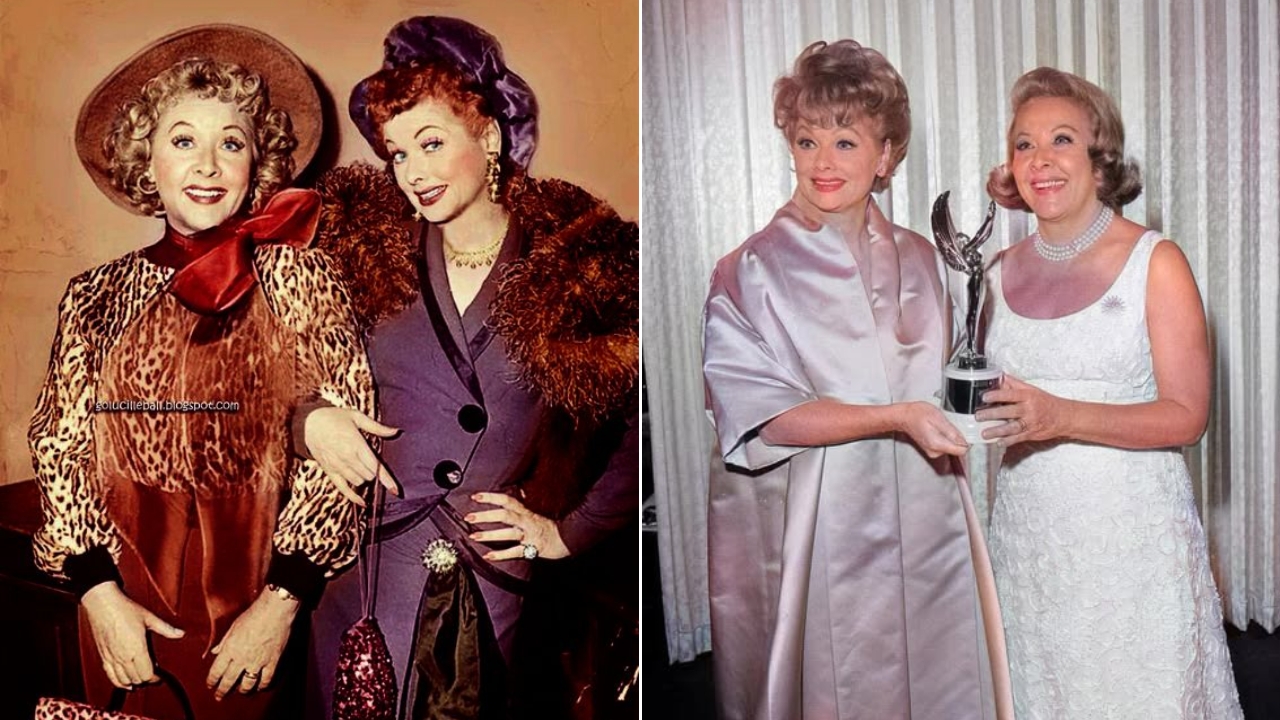
In August 1979, Lucille Ball walked into a house in Belvedere, California, knowing she might be seeing Vivian Vance for the last time.
For nearly three decades, America had known them as Lucy and Ethel—the redheaded dreamer and the loyal neighbor who somehow kept getting pulled into every impossible scheme.
They had stuffed chocolates into their mouths on a speeding factory line.
They had schemed against their husbands.
They had fought, forgiven each other and gotten into trouble together in millions of American living rooms.
Now there was no studio audience.
No writers.
No cameras.
Vivian was gravely ill. Breast cancer diagnosed years earlier had spread to her bones. A friend who was nearby that day later remembered Vivian resting on a couch while she and Lucy ate lunch and talked for a long time.
At first, there was laughter.
Later came crying.
When Lucille finally emerged from the house, the woman who had made generations laugh was in tears and unable to speak.
Vivian Vance died only days later, on August 17, 1979. She was 70.
Years afterward, Lucille’s daughter Lucie Arnaz explained how deeply the loss affected her mother.
Lucille “cried about losing Viv for months,” she recalled.
And then she used a description far more revealing than any story about Hollywood rivalry:
Vivian had been “like a sister to my mother.”
That final goodbye raises an obvious question.
If their bond had become that deep, why have stories of competition, jealousy and tension followed Lucille Ball and Vivian Vance for so long?
The answer is more complicated—and more interesting—than either “best friends” or “secret rivals.”

1. Vivian Vance Wasn’t Lucille Ball’s Handpicked Ethel
One of the most persistent myths about I Love Lucy is that Lucille personally discovered Vivian Vance and immediately knew she had found the perfect Ethel Mertz.
That isn’t what happened.
When I Love Lucy was being cast in 1951, Lucille had other actresses in mind for Ethel. Vivian came to the production through director Marc Daniels, who had worked with her and recommended her for the role.
The Lucille Ball Desi Arnaz Museum specifically credits Daniels with suggesting Vance. Desi Arnaz and producer Jess Oppenheimer went to see Vivian perform in The Voice of the Turtle in La Jolla, California, and Arnaz was impressed enough to want her for the show.
Lucille was less certain.
The problem wasn’t Vivian’s talent.
It was that she didn’t resemble the Ethel Lucille had imagined.
Vivian was only two years older than Lucy and attractive enough that the production deliberately styled Ethel more conservatively and less glamorously than Vance herself. Lucille later acknowledged that Vivian went along with the dowdier wardrobe and limited makeup required for the character.
So their story did not begin with instant devotion.
It began with uncertainty.
That makes what followed much more meaningful.
2. Then They Read Together
Whatever hesitation Lucille initially had, it didn’t survive Vivian’s performance for long.
Vivian was already an experienced Broadway actress.
She understood timing.
She understood reaction.
And comedy depends as much on the person receiving the joke as the person delivering it.

Lucy Ricardo could be enormous—wild-eyed, impulsive, desperate, theatrical.
Ethel had to ground her without killing the joke.
Vivian learned exactly how much resistance to give Lucy before surrendering and joining the scheme herself.
A glance could do it.
A pause could do it.
Sometimes Ethel’s face was funnier than Lucy’s entire plan.
That balance became one of the foundations of I Love Lucy.
Vivian would go on to win the 1953 Emmy for supporting actress for playing Ethel. She was not simply standing beside the star.
She had become essential to the machinery of the comedy.
3. The Real Backstage Feud Wasn’t Necessarily Lucy Versus Vivian
Stories about women in Hollywood are often framed around competition.
Who was prettier?
Who received the better clothes?
Who had more lines?
Who was jealous?
There were genuine tensions surrounding the way Vivian was presented as Ethel, and it would be inaccurate to pretend Lucille and Vivian never disagreed.
But the far more notorious conflict on the original series involved Vivian and the man playing her husband.
William Frawley.
Fred and Ethel Mertz looked like an old married couple who had spent decades getting on each other’s nerves.
That chemistry was remarkably convincing partly because Vance and Frawley were hardly close off camera.
Accounts of the production consistently describe a difficult relationship between them.
Yet they remained professionals.
America watched Fred and Ethel bicker and believed the marriage.
That was the job.
With Lucille, something different gradually developed.
4. Lucille Learned She Could Trust Vivian
Lucille Ball was not an easygoing performer who simply arrived, read the script and hoped everything worked.

Comedy mattered enormously to her.
Timing mattered.
Rehearsal mattered.
If something wasn’t working, everyone around her knew it.
Lucille later described what Vivian could do in those moments.
When Lucy became frustrated, Vivian could often recognize what was really bothering her and help her work through it.
In Lucille’s own recollection, Vivian became a kind of stabilizing presence when pressure on the set rose.
That matters because trust is unusually important in physical comedy.
Lucy could fall.
Get covered in food.
Climb onto something she shouldn’t.
Destroy a room.
Make herself ridiculous.
For those scenes to work, she needed someone beside her who understood precisely how far to push and when to pull back.
Vivian understood.
The audience eventually stopped seeing two actresses performing comedy.
They saw Lucy and Ethel.
5. Their Friendship Wasn’t Built Because They Were Identical
The women were different.
Lucille was the star and, increasingly, one of the most powerful people in television.
Vivian had spent years on Broadway and knew exactly what it meant to support another performer’s big moment without disappearing herself.
That distinction can be misunderstood.
A lesser supporting actress might have tried to steal the scene.
A weaker one might have vanished inside it.
Vivian did neither.
She could make Lucy funnier simply by looking at her.
And Lucille knew how valuable that was.
The proof would come after I Love Lucy itself was over.
6. The First Great Era Ended—but Lucy Wasn’t Finished With Vivian
The weekly I Love Lucy series ran from 1951 to 1957, followed by hour-long Lucy–Desi specials that continued the characters for several more years.
By then, enormous changes were happening away from the cameras.
Lucille and Desi Arnaz’s marriage was collapsing.
Their divorce became final in 1960.
The television partnership that had transformed both of their careers was breaking apart.
Lucille would eventually face another frightening professional question:
Could she return to series television without Desi?
She decided she could.
But there was someone else she didn’t want to do it without.
Vivian.
7. Lucille’s Own Memoir Gives the Clearest Answer
When plans for The Lucy Show developed in the early 1960s, Lucille wanted Vivian beside her again.
Her later recollection leaves little room for the idea that she secretly considered Vance an unwanted rival.
Lucille wrote:
“I refused to even consider being in a continuing series without Vivian.”
Think about what that means.
This was not 1951.
Lucille no longer needed to prove she could carry a television show.
She was Lucille Ball.
She had enormous recognition and considerable industry power.
If Vivian had truly been someone Lucy resented, feared or merely tolerated for contractual reasons, this was the perfect opportunity to move on.
Instead, Lucille wanted her back.
Vivian agreed.
And for American viewers, Lucy and Viv were together again.
8. But Friendship Did Not Make Working for Lucille Easy
This is where the story becomes more believable if we resist turning it into a fairy tale.
Lucille could love Vivian and still be extremely demanding.
Vivian could adore Lucille and still become exhausted by the work.
Those truths can coexist.
The Lucy Show demanded a great deal from Vance. By then she had remarried and built a life on the East Coast, while production was centered in California.
Eventually the demands became too much.
Vivian left the series as a regular after its third season, although she would return for guest appearances.
For Lucille, the departure hurt.
For Vivian, it was about reclaiming a life that could not revolve indefinitely around one television show.
Neither interpretation requires a villain.
9. Vivian Could Leave the Show Without Leaving Lucy
This distinction matters.
Hollywood friendships are often measured through contracts.
If two performers stop appearing together, people assume the relationship ended.
Vivian’s story with Lucille suggests otherwise.
After leaving The Lucy Show as a regular, she returned more than once to work with her friend.
She later appeared on Here’s Lucy.
And in 1977, they appeared together in the CBS special Lucy Calls the President, one of their final television collaborations.
By then, nobody needed to recreate Ethel Mertz exactly.
The relationship had survived beyond the role that created it.
That is perhaps the clearest evidence that what existed between them was not simply professional convenience.
10. Vivian Had Her Own Life—and Her Own Battles
It is easy to write Vivian Vance only as “Lucy’s best friend.”
That undersells her.
Before television, she had built a substantial Broadway career.
She had worked for years before America knew the name Ethel Mertz.
And fame came with complications.
Playing Ethel made Vivian beloved, but it also linked her permanently to a character deliberately made to look older and less glamorous.
For an actress, that can become a cage.
Vivian eventually wanted more control over her image and her life.
When she joined The Lucy Show, her new character even shared her first name: Vivian.
The woman who had made Ethel unforgettable did not necessarily want to spend the rest of her life being treated as Ethel.
Lucille appears to have understood that better over time.
11. They Had Enough History to Irritate Each Other
Close friendship does not mean constant harmony.
Lucille had strong opinions.
Vivian had strong opinions.
They had spent hundreds of hours working under pressure together.
There were disagreements.
Moments of irritation.
Professional decisions that hurt.
The interesting question is not whether Lucy and Vivian ever clashed.
Of course they did.
The remarkable part is what happened afterward.
They continued to come back to each other.
That is very different from a rivalry story in which one woman succeeds only if the other loses.
For Lucy and Vivian, the strongest work usually happened when both were present.
12. The Public Image Was Lucy and Ethel. The Private Relationship Had Become Lucille and Viv
Television froze them at a certain age.
Lucy Ricardo always wants to get into Ricky’s show.
Ethel always knows the scheme is a terrible idea and joins anyway.
Reruns preserve them endlessly.
Real life did not.
Their marriages changed.
Their careers changed.
Their bodies aged.
The television industry moved into a different era.
Vivian’s health eventually changed too.
In 1973 she was diagnosed with breast cancer.
She underwent treatment, including a mastectomy.
Later the disease spread.
By the late 1970s, people close to Vivian understood that her condition had become grave.
And eventually Lucille had to face something no rerun could prevent.
Ethel was going to leave first.
13. By 1979, Vivian Was Dying
Vivian spent her final period in Belvedere, north of San Francisco.
Her illness had advanced into bone cancer.
The woman who had once raced through Lucy Ricardo’s apartment was increasingly frail.
But she remained surrounded by people who cared about her.
Among them was Paige Peterson, who later provided one of the most valuable accounts of Vivian and Lucille’s final meeting.
Peterson was close enough that day to hear what happened without intruding on it.
Lucille arrived.
Vivian was brought downstairs and rested on the couch.
They ate.
They talked.
And talked.
These were women who had known each other for almost 30 years.
There must have been enough memories to fill far more than one afternoon.
14. First Came the Laughter
This is the detail that makes the scene almost impossible to forget.
From nearby, Peterson could hear them laughing.
Of course they laughed.
What else would Lucy and Viv do?
They had spent decades understanding exactly how to make the other woman laugh.
Perhaps there were old stories.
Perhaps private jokes.
Perhaps memories nobody else in the room would have understood.
We do not know.
And we should not invent them.
What Peterson could hear was enough.
The laughter eventually changed.
Toward the end of the visit came sobbing.
The two women understood what the meeting was.
This wasn’t another goodbye after filming.
There would probably be no next episode.
15. When Lucille Walked Out, She Couldn’t Speak
Peterson saw Lucille as she left.
The image stayed with her for decades.
Lucy was crying.
The pain was visible.
She was unable to speak.
There is no punch line after that.
No need for dramatic dialogue.
No need to invent a final declaration between Lucy and Ethel.
The silence tells us enough.
A few days later, Vivian Vance died.
Lucille Ball had lost someone who had been part of almost her entire television life.
But Lucie Arnaz later made clear that the grief reached much further than television.
16. Lucille Didn’t Simply Grieve for a Co-Star
According to Lucie, her mother continued crying over Vivian’s death for months.
She described Vivian as being like a sister to Lucille and said Vivian was someone her mother could talk to in ways she could not with many other people.
That description transforms the story.
Lucille Ball lived in a world where nearly everyone around her had a reason to want something.
A job.
Approval.
Money.
A role.
Access to a star.
Vivian had known her before Lucille became one of television’s great institutions.
She had seen Lucy angry.
Exhausted.
Divorcing.
Starting over.
Running a studio.
Trying again.
Growing older.
By 1979, Vivian did not need anything from Lucille Ball.
And Lucille did not need Ethel Mertz.
They simply needed each other.
17. Why, Then, Do the Rivalry Stories Persist?
Partly because conflict makes better gossip than friendship.
And partly because the relationship did contain tension.
Vivian really was styled down to play Ethel.
Lucille really was demanding.
Vivian eventually really did leave The Lucy Show as a regular.
The women did not agree on everything.
But turning those facts into:
Lucille hated Vivian.
or:
Vivian secretly resented Lucille.
throws away most of the evidence that came afterward.
Vivian kept returning.
Lucille wanted her back.
They stayed close until Vivian’s death.
The story is not powerful because there was never friction.
It is powerful because friction did not destroy the relationship.
18. They Were Better Because Neither Woman Was Disposable
Lucille Ball was obviously the star.
But one reason Lucy Ricardo became such an enduring character is that she had Ethel.
Without Ethel, Lucy’s schemes become monologues.
Ethel gave them rhythm.
Resistance.
Complicity.
A witness.
Vivian understood something about supporting comedy that can be easy to overlook: the funniest person in a scene is not always the person delivering the joke.
Sometimes it is the woman staring at her friend as if she has finally lost her mind.
Lucille recognized that value.
It explains why, when she returned to weekly television in 1962, she did not simply hire another woman to stand beside her.
She wanted Vivian.
19. Vivian Also Gave Lucille Something Fame Could Not
There is another reason Lucie’s “like a sister” description matters.
Lucille Ball could command a set.
She could fire people.
Hire people.
Change material.
Argue with executives.
Build television history.
But power creates its own loneliness.
The more powerful someone becomes, the harder it can be to know who is speaking honestly.
Vivian had no problem doing that.
Lucille herself remembered Vivian as someone capable of recognizing what lay underneath her anger and helping her understand it.
That’s not simply chemistry.
That’s intimacy.
Perhaps that is what Lucille was really losing in August 1979.
Not Ethel.
Not a supporting actress.
Someone who knew how to read her.
20. Their Final Scene Wasn’t on Television
Vivian and Lucille had already given America hundreds of scenes.
Some lasted minutes.
Some became television history.
But perhaps their most revealing scene happened where audiences could not see it.
A quiet home.
A couch.
Lunch.
Two women talking.
Laughter coming from the room.
Then crying.
Lucille walking outside unable to speak.
No director shouted “cut.”
There was no applause.
Vivian died a few days later.
And for months afterward, according to Lucie, her mother continued mourning her.
It is difficult to reconcile that image with the idea that Vivian had simply been a rival Lucille tolerated.
You don’t grieve a convenient co-star that way.
21. They Were Not Perfect Friends. They Were Real Ones.
Maybe that is where simplified versions of Lucy and Vivian’s story go wrong.
One version wants them to be jealous enemies.
Another wants them to be flawless “soulmates” who never competed, argued or disappointed each other.
Neither is necessary.
They were two ambitious, talented women working in an industry that could be brutal.
Lucille had more power.
Vivian sometimes lived in the shadow created by that power.
They disagreed.
Vivian eventually needed distance from the workload.
And yet the friendship endured.
That is more interesting than perfection.
And more believable.
22. America Remembered Lucy and Ethel. Lucille Remembered Viv.
When Vivian Vance died in 1979, television lost Ethel Mertz.
Lucille Ball lost something else.
Ten years later, Lucille herself would be gone.
But I Love Lucy never disappeared.
New audiences kept discovering the candy factory.
The grapes.
The apartment.
The disguises.
The arguments.
Lucy turning toward Ethel with that unmistakable expression that meant another terrible idea was already forming.
The scenes still work because the timing is extraordinary.
But perhaps they also work because underneath the characters was something audiences could feel even before they understood it.
Trust.
Lucy knew Vivian would be there for the reaction.
Vivian knew Lucy would give her something worth reacting to.
They did it again and again until the rhythm became instinctive.
Then the cameras stopped.
The friendship didn’t.
And when Vivian’s life was nearing its end, Lucille came one more time.
They ate lunch.
They talked.
They laughed.
Then they cried.
Years later, Lucie Arnaz gave the relationship a description far simpler—and far more credible—than any story about secret rivalry.
Vivian was like a sister to her mother.
Perhaps that is why the final image matters so much.
For generations, America watched Lucy Ricardo grab Ethel Mertz by the arm and pull her into one more impossible adventure.
In August 1979, there was nowhere left for the two women to go together.
So Lucille sat beside Vivian one last time.
And when she finally walked away, there was no laughter left to hide behind.