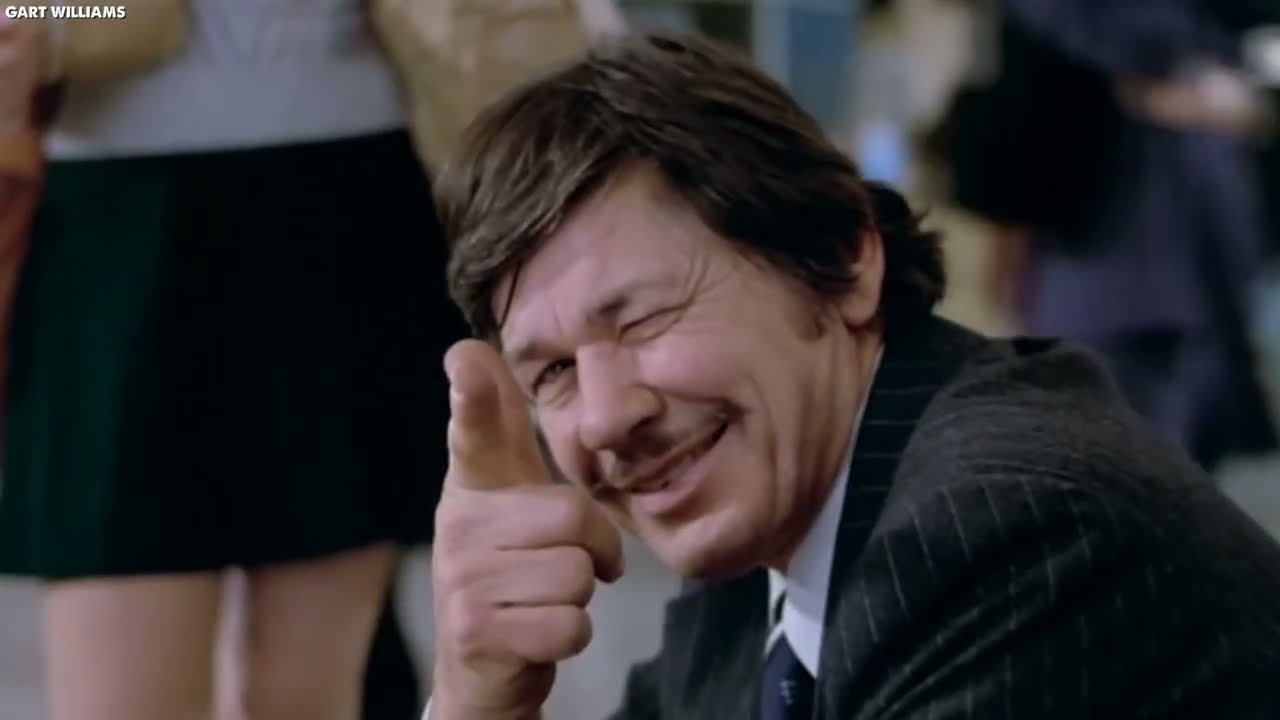
For decades, Charles Bronson barely had to say a word.
A squint.
A clenched jaw.
A slow turn of the head.
That was often enough.
In movies like The Magnificent Seven, The Great Escape, Once Upon a Time in the West and Death Wish, Bronson perfected an image Hollywood could sell almost anywhere in the world: the man who did not frighten easily, did not talk unnecessarily and certainly did not ask anyone for sympathy.
By the 1970s, his face had become a kind of international shorthand for toughness.
In France, he became an enormous star.
In Italy, audiences knew him as “Il Brutto” — the ugly one.
Hollywood directors learned that Bronson could dominate a scene simply by standing still.
And millions of moviegoers came to believe the man must be almost identical to the characters.
He wasn’t.
The real Charles Bronson was private to an almost extraordinary degree.
He painted.
He avoided attention when he could.
He admitted that he deliberately made himself look unapproachable in public.
He could be short-tempered and intensely guarded, yet people who knew him closely also remembered tenderness that rarely appeared in his publicity.
And in one revealing interview, the man Hollywood sold as fearless admitted there were things that frightened him.
Fires.
Earthquakes.
Vulnerability itself.
“I guess I didn’t want to seem vulnerable,” he finally confessed.
“It’s not my image.”
Those six words may explain more about Charles Bronson than decades of tough-guy publicity ever did.
Because before Hollywood turned him into an indestructible hero, Charles Bronson had already spent a lifetime learning how not to look afraid.
## Long Before Hollywood, There Was a Pennsylvania Coal Mine
Charles Bronson was born Charles Buchinsky on November 3, 1921, in the Pennsylvania coal-mining community of Ehrenfeld.
He was the eleventh of fifteen children.
His father was a coal miner.
Money was scarce enough that hardship was not an occasional disruption in the Buchinsky household.
It was normal life.
Bronson later remembered his childhood surroundings with brutal simplicity:
“You had nothing to lose because you’d already lost it all.”
His father died when Charles was about ten.
By sixteen, Bronson followed several of his brothers underground.
He worked night shifts in the mines while continuing to attend school during the day.
The work paid roughly a dollar for every ton of coal he dug.
Imagine the future movie star there.
Not yet Charles Bronson.
Not yet Paul Kersey.
Not yet the man with the mustache, narrowed eyes and gun.
Just a teenager working on his knees in wet, cramped darkness, breathing coal dust while the earth creaked around him.
Years later, Bronson could still describe the rats.
The blasting.
The tight spaces.
The ominous noises inside the mine.
He never needed a Hollywood acting coach to explain what physical danger felt like.
He had grown up around it.
He also grew up fighting.
Bronson later recalled that violence was simply part of childhood in the world he knew. Fistfights were common. For excitement, he and other boys would jump onto moving freight trains.
It sounds almost like a scene invented later to explain his movie persona.
But Bronson did not become tough because Hollywood cast him as a tough man.
Hollywood eventually cast him that way because the toughness was already visible.
His face, as he once said of actor Wallace Beery, showed “the hard times.”
## The War Gave Him a Way Out
In 1943, during World War II, Bronson entered the military.
For a young man who wanted desperately to get away from the mines, the service offered something almost unimaginable:
another life.
He initially drove a mess truck in Arizona and later served as a B-29 tail gunner in the Pacific.
It was hardly a comfortable assignment.
The gunner’s position was cramped — something Bronson later joked his years in the mines had prepared him for.
Even the airplanes, he remembered, had rats crawling through the insulation.
When the war ended, Bronson did not go back to spending his life underground.
He had escaped.
But he had no obvious road toward Hollywood.
In fact, acting was not his first ambition.
Art was.
After leaving the service, Bronson headed to Philadelphia with very little money and worked a series of ordinary jobs while studying art.
He was interested in painting.
At one point, through people he met while exercising at a police gym, he became involved with an acting group.
Something changed.
He began to perform.
And the former coal miner discovered that acting might offer another kind of escape.
## Hollywood Didn’t Know What to Do With His Face
Bronson eventually moved west and studied at the Pasadena Playhouse.
But Hollywood in the early 1950s was built around a particular idea of a male star.
Smooth.
Polished.
Conventionally handsome.
Bronson knew he was not Cary Grant.
He later remembered that his accent, appearance and manner immediately pushed casting directors toward character roles.
He did not look like the man who “got the girl.”
His face looked lived in.
His voice sounded different.
So he played sailors.
Thugs.
Soldiers.
Native Americans.
Gangsters.
Prisoners.
Men standing several places behind the star.
His film debut came in You’re in the Navy Now in 1951.
More small roles followed, including House of Wax and Pat and Mike.
For years, Hollywood saw something useful in Bronson without seeing a movie star.
That distinction mattered.
Bronson worked constantly.
But stardom kept moving ahead of him.
Even his name became part of the adjustment.
He had entered films as Charles Buchinsky.
By 1954 he was Charles Bronson, a change generally associated with the political climate of the McCarthy era, when a Slavic-sounding surname could make life more complicated in Hollywood.
A different name was easier to sell.
The face remained the same.
## The Great Escape Put His Past Right on the Screen
Director John Sturges helped give Bronson some of his most memorable early roles.
First came The Magnificent Seven.
Then, in 1963, The Great Escape.
Bronson played Danny Velinski, the “Tunnel King,” one of the prisoners responsible for digging escape tunnels beneath a German POW camp.
For audiences, it was another strong supporting performance in an extraordinary ensemble.
For Bronson, the physical environment must have been familiar in a way most actors could never understand.
He had already spent years underground.
He knew what it meant to work in cramped spaces.
He knew dirt, darkness and labor.
The difference was that now a camera was watching.
Bronson was surrounded by actors including Steve McQueen, James Garner, Richard Attenborough and David McCallum.
And it was during the making of The Great Escape that another side of his life began quietly taking shape.
McCallum’s wife, actress Jill Ireland, suffered a miscarriage while the film was being made in Germany.
Bronson accompanied McCallum to visit her in the hospital.
Ireland later remembered being surprised by what she saw.
From a distance, Bronson had seemed intimidating.
Up close, during one of the most painful moments of her life, she saw what she described as extraordinary tenderness and depth of feeling.
That memory would matter.
Years later, Jill Ireland would become Charles Bronson’s wife.
## Europe Saw a Star Before America Did
By the mid-1960s, Bronson had appeared in important films.
The Magnificent Seven.
The Great Escape.
The Dirty Dozen.
Yet in America he still was not quite a major leading man.
Then Europe changed everything.
Bronson had already gained attention overseas with Machine Gun Kelly.
In 1968 he appeared opposite Alain Delon in Adieu l’Ami, known in English as Farewell, Friend.
It became a major success in France.
The same year, Sergio Leone cast Bronson as the mysterious harmonica-playing gunman in Once Upon a Time in the West.
Suddenly, the face American studios had considered unconventional became an enormous advantage.
European audiences loved him.
His silence became mysterious.
His age became character.
The weathered lines on his face became authenticity.
His refusal to act like a conventional movie star became part of the appeal.
Bronson, already in his late forties, became an international sex symbol and box-office attraction.
Hollywood had spent years treating him as a supporting player.
Europe looked at the same man and saw a star.
It was a vindication.
It may also help explain why Bronson never seemed particularly impressed by Hollywood approval afterward.
He had waited too long for it.
## Roger Ebert Discovered How Deep the Silence Really Went
By the early 1970s, Bronson’s reluctance to talk had become part of his mythology.
Film critic Roger Ebert experienced it firsthand.
Bronson did not make interviews easy.
He did not volunteer theories.
He did not expand an answer simply because a journalist wanted another paragraph.
At one point he explained the problem perfectly:
“It’s just that I don’t like to talk very much.”
It was not a performance for the press.
Ebert noticed that Bronson behaved similarly on movie sets.
He would often sit apart from everyone else.
He did not constantly joke with the crew.
He did not wander around trying to be the center of attention.
Bronson later admitted that in public he sometimes intentionally tried to disappear.
He stayed quiet so people would not notice him.
More revealingly, he said he tried to make himself appear unapproachable.
That is very different from simply saying Charles Bronson was cold.
Coldness implies a lack of feeling.
Bronson’s own description suggests something more deliberate.
Distance was useful.
If people thought he did not want to be approached, they left him alone.
For one of the most recognizable faces in the world, being left alone had become a luxury.
## Michael Winner Saw Something Beneath the Silence
Director Michael Winner worked with Bronson repeatedly.
He understood the quality audiences responded to.
Bronson could stand still and somehow create the expectation that something was about to happen.
Winner described a sense of enormous energy being held inside the actor.
A kind of suppressed force.
But Winner also complicated Bronson’s off-screen reputation.
Stories circulated about Bronson losing his temper or being difficult on sets.
Winner said that was not his own experience.
He remembered Bronson as controlled and reasonable.
There was anger beneath the surface, Winner believed.
But control mattered.
Bronson did not need to constantly prove he was dangerous.
Perhaps that was one reason he found exaggerated macho behavior ridiculous.
By the 1980s, he had become almost the definition of cinematic masculinity.
Yet Bronson himself said he did not spend much time worrying about whether he seemed macho enough.
“I have a temper,” he acknowledged.
But, he added, “most of the time I’m mild.”
That distinction is important.
The movie image was becoming bigger than the man.
## Then Death Wish Changed Everything
In 1974, at 52 years old, Charles Bronson finally became a major American box-office star.
Death Wish did it.
Bronson played Paul Kersey, a mild-mannered New York architect whose wife is killed and daughter attacked during a brutal home invasion.
Kersey responds by becoming a vigilante.
The movie was controversial immediately.
To some viewers, it was a cathartic fantasy about crime and urban fear.
To critics, it risked glorifying vigilante violence.
Even Brian Garfield, who wrote the original novel, was uncomfortable with the direction the movie took.
But whatever critics thought, audiences responded.
Death Wish transformed Bronson’s American career.
The quiet international star became the face of revenge.
The film led to sequels.
And those sequels gradually hardened the Bronson image even further.
The strange part is that Bronson himself did not always sound enthusiastic about the caricature.
When discussing later Death Wish movies, he acknowledged that the material had become repetitive.
He said that if he wrote his own characters, they would be “a little more human.”
That may be one of the great ironies of his career.
The public wanted less humanity from Charles Bronson precisely because he was so effective at suggesting a human being underneath the violence.
## He Finally Admitted That Charles Bronson Was Afraid
In 1985, while promoting Death Wish 3, a reporter asked Bronson whether anything frightened him.
At first, he could not give a proper answer.
He moved away from the question.
Hours later, something about it bothered him.
Bronson called the reporter back.
He had been walking through Central Park and thinking.
Yes, he said.
There were things that frightened him.
Earthquakes.
Fires.
The answer was ordinary.
That is what made it extraordinary.
Here was the man movie posters sold as almost indestructible admitting to basic human fear.
Then came the more revealing confession.
Why hadn’t he simply said so during the interview?
Because he did not want to appear vulnerable.
“It’s not my image.”
There it was.
The division between the actor and the product.
Bronson understood exactly what audiences expected from Charles Bronson.
Fear did not belong in the package.
But it existed in the man.
That does not mean the entire tough persona was fake.
His childhood certainly was not fake.
The coal mine was not fake.
The war was not fake.
His physical strength was real.
His temper was real.
But fearlessness?
That belonged partly to Hollywood.
## He Almost Turned Down an Oscar-Winning Role Because His Character Died
Years later, Billy Crystal discovered just how seriously Bronson guarded that screen image.
While developing City Slickers, Crystal wanted Bronson for the role of Curly, the intimidating old cowboy who becomes an unlikely mentor to his character.
Bronson read the script.
Then he called.
He had discovered a problem.
Curly died.
According to Crystal, Bronson erupted over the fact that the character was dead by page 53.
“Nobody kills Charles Bronson,” Crystal remembered him saying.
Crystal tried to explain that Curly’s death was essential to the story.
Bronson was not interested.
He declined.
The role went to Jack Palance.
Palance won the Academy Award for Best Supporting Actor.
It is a wonderful Hollywood “what if.”
But it is also revealing.
By then, Bronson was not simply an actor choosing roles.
“Charles Bronson” had become a brand with rules.
One of those rules, apparently, was that Charles Bronson did not die.
## Jill Ireland Saw the Man Behind the Product
If the public saw Bronson through movies, Jill Ireland saw him at home.
She married him in 1968 after the end of her marriage to David McCallum.
Their relationship lasted until her death in 1990.
They worked together frequently, but their marriage cannot be understood only through movie credits.
Ireland spoke openly about the tenderness she had first seen in Bronson during her hospital stay years earlier.
That tenderness became more important when Ireland was diagnosed with breast cancer in the 1980s.
She underwent surgery.
Treatment followed.
The cancer returned.
Ireland turned her illness into a public campaign, speaking openly about cancer when many celebrities would have hidden the diagnosis.
Bronson was by her side.
When her condition worsened, accounts from the time described him as shocked and fearful.
Again, there is that word.
Fear.
Not fear of a gunman.
Not fear of losing a fight.
Fear of losing someone he loved.
When Jill Ireland died at their Malibu home on May 18, 1990, Bronson was there.
So were members of their family.
For a man who spent decades portraying characters capable of solving problems through force, this was a loss no physical strength could solve.
The tough guy could not punch cancer.
He could not intimidate it.
He could not outstare it.
Jill was gone.
## The Man Hollywood Called Cold Had Built His Life Around Family
Bronson’s family life was complicated, like most blended families.
He had children from his first marriage to Harriet Tendler.
Ireland had children from her marriage to David McCallum.
Together, Bronson and Ireland had a daughter.
Their household included biological children, stepchildren and adopted children.
The image hardly resembles the lonely men Bronson so often played.
He also maintained homes far from Hollywood’s public machinery, including a Vermont farm where the family could retreat from Los Angeles.
His privacy was not accidental.
He wanted distance.
He wanted control over who entered his world.
That could make him difficult for journalists.
It could make him appear unfriendly.
But Roger Ebert’s observations offer another possibility.
Bronson was not constantly hunting for opportunities to dominate people.
Sometimes he simply preferred his own thoughts.
There is a difference.
## He Never Became Comfortable With the Myth
By the late 1970s and 1980s, Bronson had become trapped in a strange bargain.
The image had made him rich.
It had made him internationally famous.
It had given a former coal miner a life that would have seemed impossible when he was sixteen.
But it also narrowed the roles audiences expected him to play.
People wanted Charles Bronson to be Charles Bronson.
The strong man.
The quiet man.
The man who took punishment without complaint.
The man who eventually fought back.
Even Bronson recognized the distortion.
At times, he compared the public image to looking at himself in an exaggerated mirror.
Hollywood had taken genuine pieces of him — the silence, the anger, the physical strength, the working-class hardness — and enlarged them until they became almost a separate person.
That may be why the private details are still interesting decades after his death.
Not because they expose him as a fraud.
They do the opposite.
They reveal how much truth had been hiding underneath the exaggeration.
## His Final Years Were Quiet
Bronson continued acting into the 1990s.
He married actress Kim Weeks in 1998.
But age and illness gradually pulled him away from the screen.
The physical presence that had once seemed nearly indestructible faded.
His health declined, and he suffered from Alzheimer’s disease in his later years.
On August 30, 2003, Charles Bronson died at Cedars-Sinai Medical Center in Los Angeles.
He was 81.
The immediate cause was pneumonia.
The man who had spent so much of his career surviving bullets, beatings, criminals, prisons and war ultimately died the same way every human being does:
not as an image,
but as a man.
## Twenty-Three Years Later, the Movies Still Encourage the Wrong Question
It is tempting to look back at Charles Bronson and ask:
Was the tough-guy act fake?
But that is probably the wrong question.
The toughness was real.
You do not grow up as one of fifteen children in a coal-mining family, lose your father at ten, work underground as a teenager, serve during a world war and then fight your way through two decades of Hollywood rejection without developing toughness.
Bronson had it.
What Hollywood did was pretend toughness was all he had.
That is the myth.
The real man could be angry and mild.
Private and internationally famous.
Physically imposing and uncomfortable with attention.
He could make himself appear unapproachable, then show unexpected tenderness to a frightened woman in a hospital.
He could spend decades refusing to look vulnerable and then call a reporter hours after an interview because he felt compelled to admit that fires and earthquakes frightened him.
He could play men who solved everything with violence while saying he would have written those same characters with more humanity.
These things are not contradictions that need to be solved.
They are the person.
## Charles Bronson Never Needed a Daughter to Reveal the Secret
Perhaps the strangest thing about the mythology surrounding Bronson is that we keep looking for someone else to explain him.
A hidden interview.
A family confession.
A shocking revelation.
A secret finally exposed decades after his death.
But Charles Bronson had already left clues everywhere.
He told Roger Ebert that he did not like to talk.
He admitted that he deliberately made himself look unapproachable in public.
He told reporters he was milder than his screen image suggested.
He admitted he had fears.
Jill Ireland described the tenderness she saw in him.
Michael Winner described both the great fury underneath and the control surrounding it.
The mystery was never completely hidden.
People simply preferred the myth.
And who could blame them?
The myth was magnificent.
Charles Bronson could enter a room on screen and seem capable of changing the temperature without saying a word.
He had one of the most recognizable faces in cinema.
He became a star in his late forties, an American superstar in his fifties, and then remained an emblem of toughness long after most actors his age would have been offered grandfather roles.
Yet the older you get, perhaps the more interesting the other Charles Bronson becomes.
Not Paul Kersey.
Not the Tunnel King.
Not the gunfighter.
The boy in Pennsylvania who wanted out of the mine.
The veteran who wanted to become an artist.
The actor whom Hollywood initially thought was too unusual-looking to be a leading man.
The husband sitting beside Jill Ireland as cancer took away the woman he loved.
The private man walking through Central Park after an interview because one simple question about fear would not leave him alone.
That Charles Bronson is harder to put on a movie poster.
He is also much more interesting.
## His Greatest Performance May Have Been the One Audiences Never Realized They Were Watching
For most of his career, Bronson seemed to do almost nothing.
That was his gift.
He could hold still while the audience projected everything onto him.
Anger.
Strength.
Danger.
Revenge.
Fearlessness.
The less he said, the more powerful the illusion became.
Maybe his public life worked the same way.
Bronson rarely explained himself, so people explained him for him.
He was called cold.
Violent.
Reclusive.
Impossible.
Indestructible.
Some of those descriptions contained pieces of truth.
None contained the whole man.
Twenty-three years after his death, the most interesting discovery is not that Charles Bronson was secretly weak.
He wasn’t.
It is that strength and vulnerability were never opposites in the first place.
The coal miner could be afraid.
The action hero could be tender.
The silent man could feel deeply.
The movie star could hate being noticed.
And the actor who became famous for men who feared nothing could finally admit that sometimes he hid his fears because the world expected Charles Bronson not to have any.
That expectation helped make him a legend.
It may also explain why so few people ever felt they knew him.
Charles Bronson spent decades giving audiences the walls.
If you look closely enough at what he actually said — and what the people closest to him remembered — you can finally see some of the man standing behind them.