Dale Robertson was not trying to become a movie star.
He was a young American soldier stationed in California during World War II when he did something completely ordinary.
He had a photograph taken for his mother.
She wanted a picture of her son.
That was all.
A copy of the portrait was displayed in the photographer’s shop window.
Then people from Hollywood saw it.
By the time Robertson returned from overseas, letters from agents were waiting for him.
The handsome Oklahoma soldier suddenly had an invitation into a world he had never seriously planned to enter.
Hollywood would eventually put him in cowboy hats, hand him six-shooters and turn him into one of television’s most familiar Western heroes.
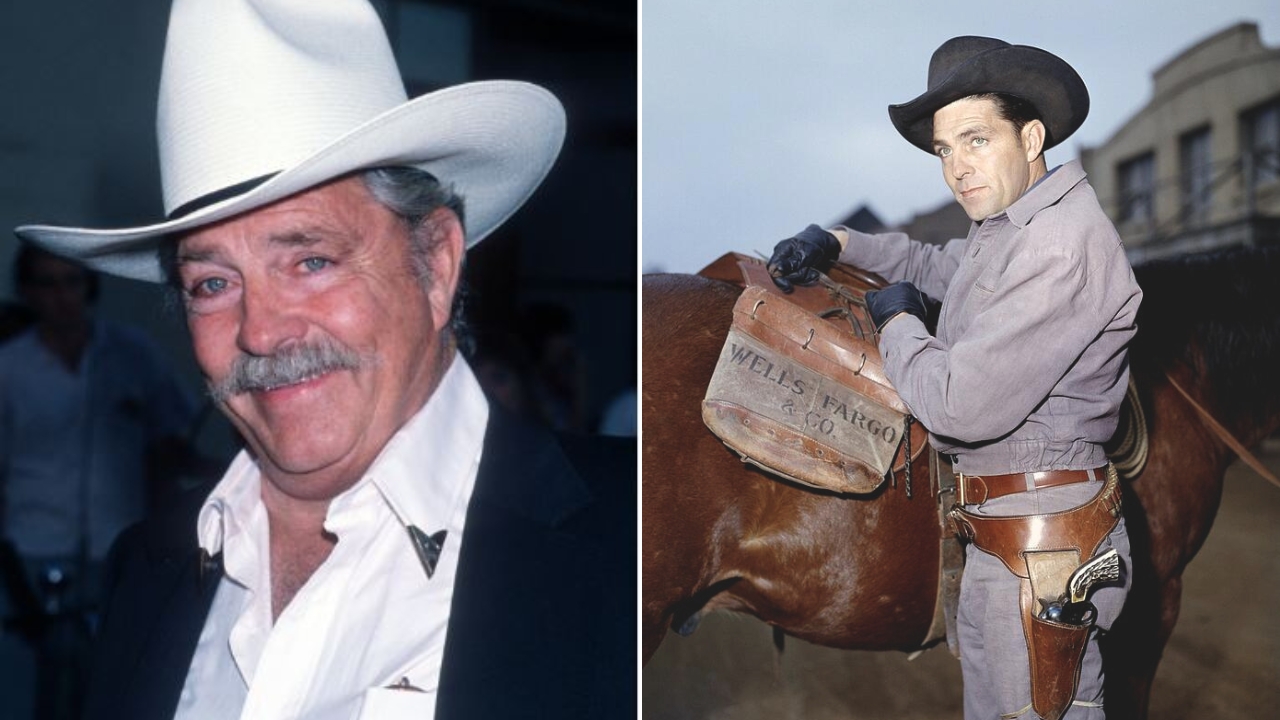
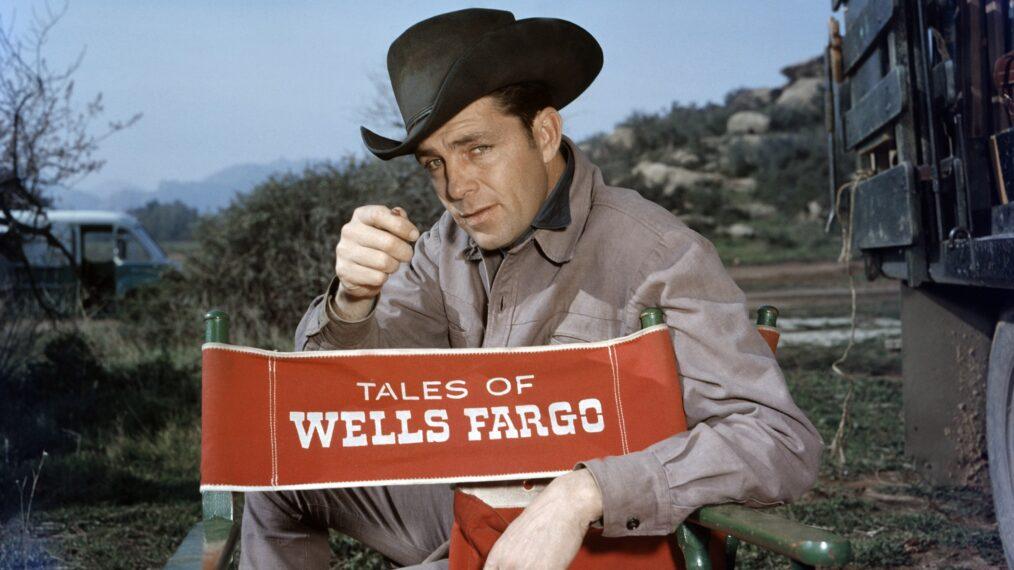
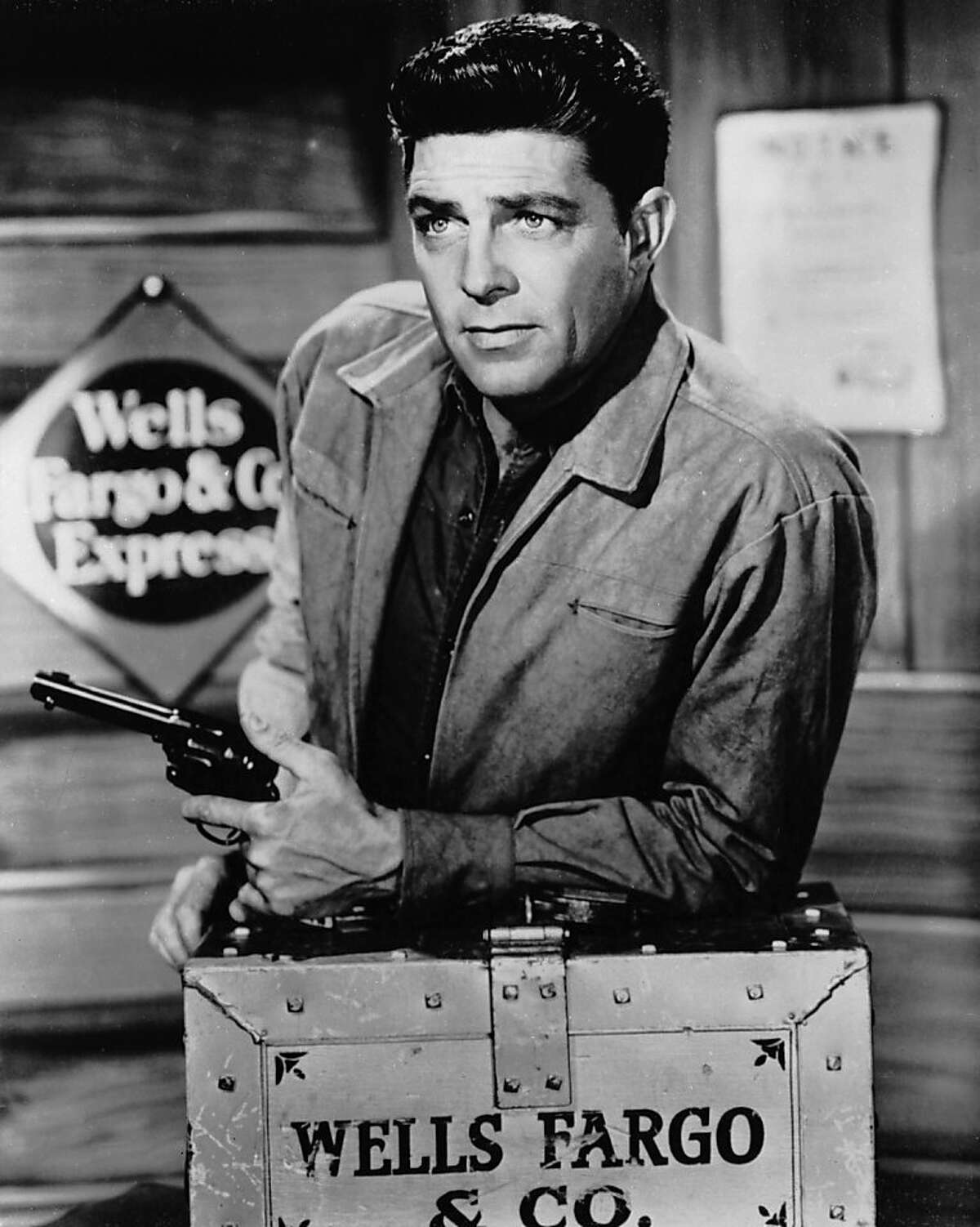
Millions of Americans would know him as Jim Hardie on Tales of Wells Fargo.
But here is the part that made Robertson different from many men who played cowboys during television’s Western boom:
Hollywood did not have to invent very much.
Long before he stood in front of a camera, Robertson had grown up around horses in Oklahoma.
He could ride.
He boxed professionally.
He served in combat during World War II.
He had been wounded.
He possessed the Oklahoma drawl Hollywood might normally have tried to remove.
And when someone finally advised him how to become an actor, the advice was almost unbelievable:
Don’t learn how to act.
Robertson listened.
It may have been one of the smartest decisions of his career.
Before Hollywood, He Was an Oklahoma Horseman
Dale Robertson was born Dayle Lymoine Robertson on July 14, 1923, in Harrah, Oklahoma.
This was not the polished Western world of studio backlots.
Horses were part of his real life.
By around age 10, Robertson was already an experienced rider.
As a teenager, he trained polo ponies.
Later, when Hollywood audiences watched him sit easily in a saddle, there was a reason he did not look like an actor desperately trying to remember what a riding instructor had taught him the previous week.
He knew horses.
Robertson would later make an revealing distinction when people wanted to talk about fast draws and Western tricks.
He was less interested in being called the fastest gun than in being recognized as a genuinely good horseman.
That attitude tells you a great deal about him.
For Robertson, authenticity mattered more than showmanship.
But horses were only one part of his early life.
He also fought.
He Earned Money in the Boxing Ring
At 17, Robertson attended Oklahoma Military Academy.
He also competed in professional prize fights to earn money.
The ring taught him another quality audiences would later associate with his screen characters:
calm under pressure.
Robertson was not built around flashy emotional performances.
He often seemed controlled.
Measured.
Almost deceptively relaxed.
Critics did not always appreciate that style.
Some later considered him too understated.
But audiences who liked him saw something else.
They saw a man who did not need to prove he was tough every second.
That quality had roots long before Hollywood.
Then the war came.
And the stakes became real.
World War II Changed the Young Fighter
Robertson entered the U.S. Army during World War II and served in North Africa and Europe.
He was wounded twice.
Contemporary accounts and later obituaries credit him with receiving the Bronze Star and Silver Star for his service.
For generations who later knew Robertson as the clean-cut hero of television Westerns, it is easy to overlook what preceded that image.
The gunfire in his later movies was manufactured.
The danger during his military service was not.
Yet Robertson rarely built his Hollywood persona around presenting himself as a war hero.
Instead, a much quieter incident during his time in uniform opened the door to his next life.
The photograph.
The Picture Was Supposed to Be for His Mother
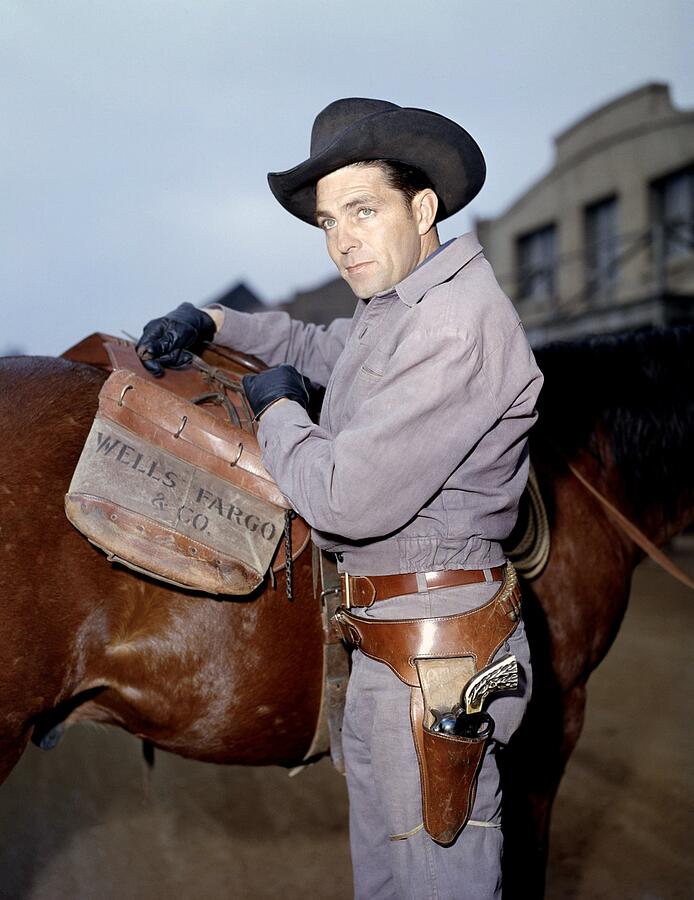
While Robertson was stationed at San Luis Obispo, California, he arranged to have his portrait taken.
His mother did not have a good photograph of him.
So he got one.
The photographer liked the result enough to display a large copy.
Hollywood talent scouts noticed the face in the window.
Robertson was tall, lean and strikingly handsome.
He had the kind of face that looked as if it belonged in the Westerns American audiences already loved.
While he was away serving overseas, inquiries began arriving from people interested in representing him.
Imagine returning from war and discovering Hollywood had been looking for you.
Robertson eventually decided to give it a try.
But there was a problem.
He wasn’t trained.
There was no prestigious drama school in his background.
No long apprenticeship in Shakespeare.
No elaborate acting technique.
Then another Oklahoma man gave him advice.
Will Rogers Jr. Told Him Something Almost No Acting Teacher Would Say
Will Rogers Jr., son of the legendary humorist and actor Will Rogers, encouraged Robertson not to lose the qualities that made him different.
His basic advice was simple:
Don’t take acting lessons.
Rogers feared formal instruction might polish away Robertson’s natural Oklahoma voice and personality.
Robertson took the advice seriously.
He avoided formal acting training.
Years later, he would describe his own approach in a way that probably would have horrified some acting instructors.
He did not really think of himself as an actor.
He thought of himself as a personality.
An actor, in Robertson’s view, changed himself to fit a part.
A personality changed the part until it fit him.
That philosophy became the key to his career.
And it explains why Dale Robertson often seemed like Dale Robertson no matter which Western hat he was wearing.
Hollywood had hired him partly because of what he already was.
Why erase it?
Hollywood Quickly Put Him on a Horse
Robertson began getting movie work in the late 1940s.
One of his early credited roles came as Jesse James in the 1949 Randolph Scott Western Fighting Man of the Plains.
More Westerns followed.
There was The Cariboo Trail.
The Outcasts of Poker Flat.
Sitting Bull.
And other pictures that established Robertson as another handsome leading man who looked comfortable in the American West.
He worked opposite well-known actresses including Betty Grable and Mitzi Gaynor.
For a man who had not planned a Hollywood career, things had moved remarkably fast.
But movies would not ultimately define him.
Television would.
And Robertson himself initially had very little confidence in the show that made him a household name.
Dale Robertson Thought Tales of Wells Fargo Would Fail
This may be one of the best pieces of trivia in Robertson’s career.
Before Tales of Wells Fargo became his signature role, Dale Robertson apparently thought it would not last.
The character of Jim Hardie first appeared with Robertson in a 1956 episode of Schlitz Playhouse of Stars.
A television series followed in 1957.
Robertson played a special agent working for Wells Fargo in the American West.
Hardie traveled from town to town investigating robbery, kidnapping, gunrunning and other threats to the company’s stagecoach and freight operations.
He was part detective.
Part troubleshooter.
Part gunfighter.
It was an ideal role for Robertson.
But in a 1958 interview, after the show was already a success, he admitted he had expected it to fail quickly.
He had reportedly thought Wells Fargo might not survive even three months.
Instead, it ran from 1957 until 1962.
Six seasons.
More than 200 episodes.
And Dale Robertson became Jim Hardie to millions of viewers.
Sometimes even the star does not recognize the role that will define him.
Jim Hardie Had a Trick Audiences Remembered
Hardie became known as the “Left-handed Gun.”
But Robertson himself was naturally right-handed.
There was a practical reason behind the choice.
Robertson was extremely fast drawing with his dominant hand—so fast, according to accounts, that it created problems for the camera.
Using the left hand also gave Jim Hardie a memorable advantage in scenes.
Hardie could shake a suspicious man’s hand with his right.
Hold him there.
And still draw with his left.
It was the sort of small piece of character business that gave a television Western personality.
But Robertson never seemed especially interested in winning competitions over who could perform the fastest Hollywood gun draw.
His pride was elsewhere.
Horses.
And the horse viewers saw Jim Hardie riding had a personal connection to Robertson.
Jubilee Wasn’t Just a Television Horse
The horse Dale Robertson frequently rode on Tales of Wells Fargo was named Jubilee.
And Jubilee belonged to Robertson himself.
That detail almost perfectly captures why he worked so well in Westerns.
The saddle did not feel like a prop.
The horse was not simply something production had assigned him that morning.
Robertson brought part of his real life onto the screen.
Viewers may not consciously have known the difference.
But authenticity often works that way.
You feel it before you can explain it.
Robertson’s Oklahoma accent was real.
His ease with horses was real.
His physical confidence had been built through boxing and military service.
So when Jim Hardie rode into trouble, Robertson did not appear to be assembling a cowboy from costume pieces.
The pieces already belonged to him.
Westerns Offered America an Escape
The late 1950s were a remarkable period for television Westerns.
At various points, American schedules seemed filled with cowboys.
Gunsmoke.
Wagon Train.
Have Gun – Will Travel.
Maverick.
Cheyenne.
Rawhide.
And Tales of Wells Fargo.
Why were they so popular?
Robertson had his own theory.
He believed Westerns offered true escapism.
People were living through Cold War anxiety, fears about nuclear weapons, recessions and their own personal problems.
A Western could take them somewhere simpler for half an hour.
The morality was often clearer.
The landscape was open.
A man knew where he stood.
That view fit Robertson himself.
He came from a culture in which directness was a virtue.
Sometimes that made him appealing.
Sometimes it got him into trouble.
Dale Robertson Was Never Very Good at Pretending to Agree
One of the qualities that made Robertson seem believable on screen could make Hollywood relationships difficult.
He spoke his mind.
He knew it.
He joked about it.
And people around him knew it too.
In a 1958 profile, Robertson was already described as unusually outspoken.
He did not automatically praise Hollywood.
In fact, he could be deeply suspicious of it.
He once described the town in extremely unflattering terms.
The man whose career depended on Hollywood never completely became part of Hollywood culture.
That contradiction followed him for decades.
He enjoyed the work.
He appreciated success.
But he remained an Oklahoma man who happened to work in entertainment.
He never seemed desperate to transform himself into what the industry thought a star should be.
That independence helped him survive the end of one successful show.
After Wells Fargo, He Stayed in the Saddle
When Tales of Wells Fargo ended in 1962, Robertson did not disappear.
He returned to television Westerns with Iron Horse, which ran from 1966 to 1968.
This time he played Ben Calhoun, a gambler who wins an unfinished railroad line in a poker game and then has to build it.
Again, the part fit Robertson’s image:
self-reliant,
resourceful,
difficult to intimidate.
After Iron Horse, he became a host of Death Valley Days, another program deeply connected to American Western storytelling.
By then, Robertson had spent years representing a kind of frontier masculinity television understood immediately.
But American television was changing.
Eventually the Western boom faded.
Robertson changed with the industry—but only up to a point.
Then Dale Robertson Walked Into Dynasty
For longtime Western viewers, seeing Dale Robertson appear in Dynasty must have been strange.
The world of Dynasty could hardly have been farther from Jim Hardie’s Wells Fargo routes.
Instead of dusty streets and stagecoaches:
mansions,
oil money,
luxury,
betrayal,
romance,
and increasingly sensational storylines.
Robertson joined the early series as Walter Lankershim, a business rival connected to the oil world surrounding Blake Carrington.
But he did not remain long.
Years later, Robertson suggested that his personal values had clashed with where the program was going.
He disliked the increasing emphasis on sex.
And Robertson had never developed the diplomatic skill of quietly doing something he disliked.
His own description of the problem was perfect:
“I never had the ability to keep my big mouth shut.”
The role disappeared.
There was something almost Jim Hardie-like about the whole episode.
Dale Robertson had gotten older.
Television had changed.
But Dale Robertson had not become much better at pretending.
Hollywood Had Changed Around Him
By the 1980s, the television Western that had made Robertson famous belonged to another era.
The American entertainment business increasingly favored different kinds of heroes.
Different language.
Different sexuality.
Different pacing.
Different values.
Robertson could sound old-fashioned when he complained about those changes.
And in many ways, he was.
He knew it.
But dismissing him merely as an aging actor complaining about modern television misses the larger point.
Consistency had always been the foundation of his appeal.
He had been hired because audiences sensed that Dale Robertson was not manufactured.
Changing himself simply to remain fashionable would have contradicted the entire career.
Hollywood had once rewarded him for remaining exactly who he was.
Now that same stubbornness could make him harder to fit into modern television.
Then life delivered another challenge that had nothing to do with scripts.
The Western Star Faced Serious Financial Trouble
In 1986, Dale Robertson filed for bankruptcy protection in Tulsa.
Court records at the time listed approximately $1 million in debts against assets of roughly $179,709.
Those numbers told a painful story.
This was not a forgotten actor who had never succeeded.
Robertson had starred in one of television’s recognizable Western series.
He had made movies.
Worked for decades.
Earned a Hollywood Walk of Fame star.
Yet financial trouble could still arrive.
At the time, Robertson was living on a 436-acre ranch near Yukon, Oklahoma, where he bred horses.
There is an important temptation in celebrity storytelling to make every setback into a dramatic moral collapse.
There is no need to do that here.
Bankruptcy itself is enough.
A man who had spent years playing characters capable of solving almost any problem found himself facing one of the hardest problems of his real life.
And he continued working.
He Came Back as J.J. Starbuck
The following year Robertson returned to television in J.J. Starbuck.
The character was almost perfectly designed for an older Dale Robertson.
Jerome Jeremiah “J.J.” Starbuck was a wealthy Texan who traveled the country solving mysteries.
He was eccentric.
Independent.
Rich.
Western-flavored without being trapped inside a traditional Western.
The series did not become another Tales of Wells Fargo.
It was short-lived.
But Robertson remained recognizable.
That was the advantage of being what he called a personality.
Jim Hardie could disappear.
Dale Robertson remained Dale Robertson.
By the early 1990s, however, his priorities were changing.
Hollywood had given him nearly half a century.
The horses were still waiting.
Eventually, He Went Back to the Ranch
Robertson’s final screen role came in the television series Harts of the West in the early 1990s.
Then he stepped away.
He returned to life centered on his ranch near Yukon, Oklahoma.
He raised horses.
The career that had begun because Hollywood spotted an Oklahoma soldier in a photograph ended with the actor returning to the kind of life he had understood before Hollywood knew his name.
There is something unusually satisfying about that circle.
The horseman became a Western actor.
The Western actor became famous.
The famous actor became a horseman again.
For Robertson, ranching was not a retirement fantasy invented after years in Los Angeles.
It had always been part of the man.
Susan Became the Constant in His Later Life
Robertson had several marriages during his life.
Rather than reduce those relationships to a number, the more meaningful fact is how his final marriage ended.
He married Susan Robbins in 1980.
They remained together for approximately 33 years.
She was still his wife when he died.
For someone whose working life had involved constant movement—film sets, television schedules, Hollywood, Oklahoma—the final decades offered a kind of stability.
Susan.
The ranch.
The horses.
A quieter life away from the machinery that had discovered him almost by accident.
But Hollywood did not completely forget him.
Neither did the Western community.
The Cowboy World Remembered Him as One of Its Own
In 1985, Robertson received the Golden Boot Award recognizing his contribution to the Western genre.
He was also honored within Western performer halls of fame.
These awards meant something different from conventional acting trophies.
They recognized not merely a performance but a career connected to the mythology of the American West.
Robertson had spent decades within that mythology.
Yet the amusing thing is that he never fully accepted Hollywood’s terminology for what he did.
Remember:
He did not think of himself primarily as an actor.
He thought of himself as a personality.
That idea becomes increasingly understandable when you watch him today.
Watch Jim Hardie Again
Return to an old episode of Tales of Wells Fargo.
Ignore for a moment the plot.
Watch Robertson get onto a horse.
Watch the posture.
Listen to the Oklahoma voice.
Notice how little theatrical effort appears on the surface.
There is no sense that he is desperately trying to convince you he belongs there.
He just does.
Modern viewers accustomed to more visibly transformative acting might underestimate that.
Robertson’s gift was not disappearing completely inside someone else.
His gift was making Dale Robertson useful to a character.
Jim Hardie was built around qualities Robertson already possessed.
The calm.
The drawl.
The physical confidence.
The skepticism.
The refusal to fuss.
And sometimes the stubbornness.
Will Rogers Jr. had understood something early.
Polishing those qualities away might have made Robertson a technically different actor.
It might also have destroyed the thing audiences liked.
Even His Famous Left-Handed Gun Was More Practical Than Flashy
That may be why the Jim Hardie gun trick feels so appropriate.
Robertson did not use his left hand because somebody in a publicity office decided it looked cool.
There was practical thinking behind it.
A left-handed draw gave Hardie possibilities within scenes.
And Robertson’s own physical ability made the trick believable.
The same was true of Jubilee.
The horse belonged to him.
The same was true of the voice.
The accent belonged to him.
The same was true of his bluntness.
Unfortunately for some producers, that belonged to him too.
The complete package was Dale Robertson.
Hollywood got the strengths and the complications together.
There Was No Final Secret to Reveal at 89
This is where stories about old Hollywood stars often become misleading.
When someone dies at an advanced age, headlines appear:
“At 89, He Finally Revealed the Truth.”
But Dale Robertson did not spend his final days unveiling one shocking secret that changed everything audiences thought they knew about him.
The better story is almost the opposite.
Much of the truth had been visible all along.
He really was an Oklahoma horseman.
He really had boxed.
He really had served in wartime.
He really was naturally outspoken.
He really did prefer bringing himself to roles rather than transforming into someone entirely different.
And he really did return to ranch life when Hollywood was finished.
The surprise is not that the cowboy image was fake.
It is how much of it wasn’t.
Dale Robertson Died in 2013
In his final months, Robertson moved from Oklahoma to the San Diego area.
He had lung cancer and pneumonia.
He died in February 2013.
He was 89 years old.
His wife Susan survived him, along with his children.
The headlines understandably remembered the television star.
Dale Robertson, Western actor.
Star of Tales of Wells Fargo.
Jim Hardie dies at 89.
Those descriptions were correct.
But incomplete.
Robertson had lived several lives before and after Jim Hardie.
Boxer.
Soldier.
Horseman.
Movie actor.
Television star.
Rancher.
Husband.
Father.
And occasionally, by his own admission, a man whose mouth got him into trouble.
The Photograph Makes More Sense at the End
Go back to the beginning.
A young soldier walks into a California photography studio.
He is not preparing a portfolio.
He is not auditioning.
He is not imagining television fame.
He wants a photograph for his mother.
Someone puts a copy in the window.
Movie people see it.
Hollywood calls.
That story almost sounds like something written for one of the old movies Robertson later made.
Except it happened.
The soldier returned from war.
He tried acting.
An older Oklahoma performer told him not to let acting teachers polish away the very qualities people noticed.
Robertson listened.
A few years later, he became one of television’s cowboys.
Then the genre faded.
Hollywood changed.
His finances stumbled.
His career slowed.
And eventually Dale Robertson went back to Oklahoma and to horses.
There is no sensational confession required to make that life interesting.
Hollywood Sold America a Cowboy
For decades, viewers watched Dale Robertson ride across television screens.
They saw the hat.
The gun.
The horse.
The confident walk.
The slow Oklahoma voice.
Hollywood presented him as an idealized Western man:
quiet,
independent,
capable,
difficult to frighten.
Usually, when audiences look behind an old screen image, they discover how carefully the illusion was constructed.
Dale Robertson presents a different case.
Look behind Jim Hardie and you find a man who had ridden horses since childhood.
Look behind the staged fights and you find a former prizefighter.
Look behind the fictional danger and you find a World War II veteran who had been wounded in combat.
Look behind the Western drawl and you find Oklahoma.
Look behind the television horse and you find Robertson’s own Jubilee.
And look behind the stubborn character on screen and you find a man who admitted he had never been very good at keeping his opinions to himself.
Maybe that is the real reason Dale Robertson endured.
He wasn’t Hollywood’s greatest illusion.
He was one of its better accidents.
A photograph meant for his mother put him in front of a movie scout.
Hollywood supplied the cameras.
The scripts.
The costumes.
The fame.
But much of the cowboy?
Dale Robertson had brought that with him.