At 60, Martina McBride Finally Opens Up About George Strait
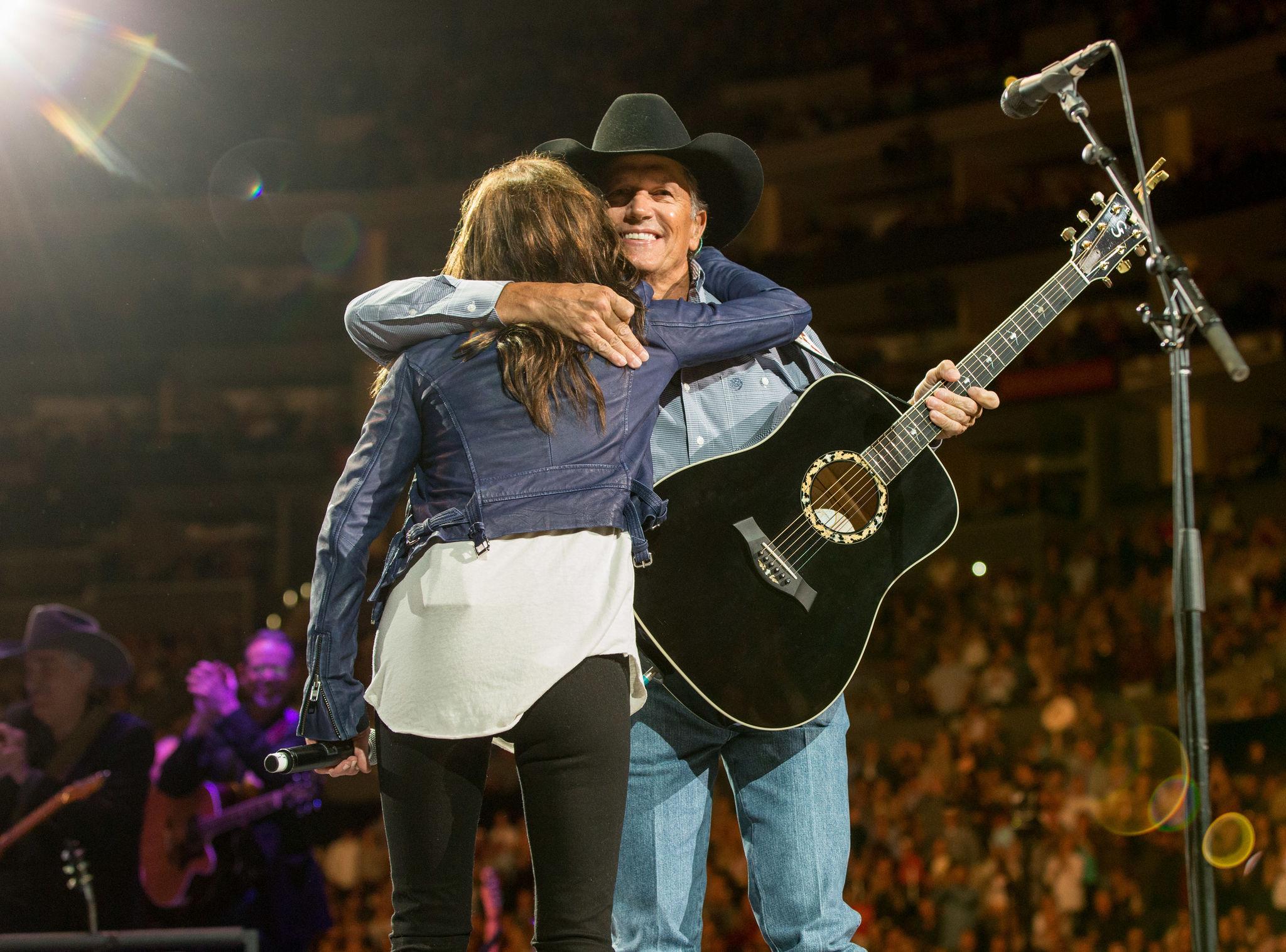
On June 7, 2014, Martina McBride walked onto a stage surrounded by 104,793 people.
Across from her stood George Strait.
For millions of country fans, there was no introduction necessary.
The cowboy hat.
The pressed shirt.
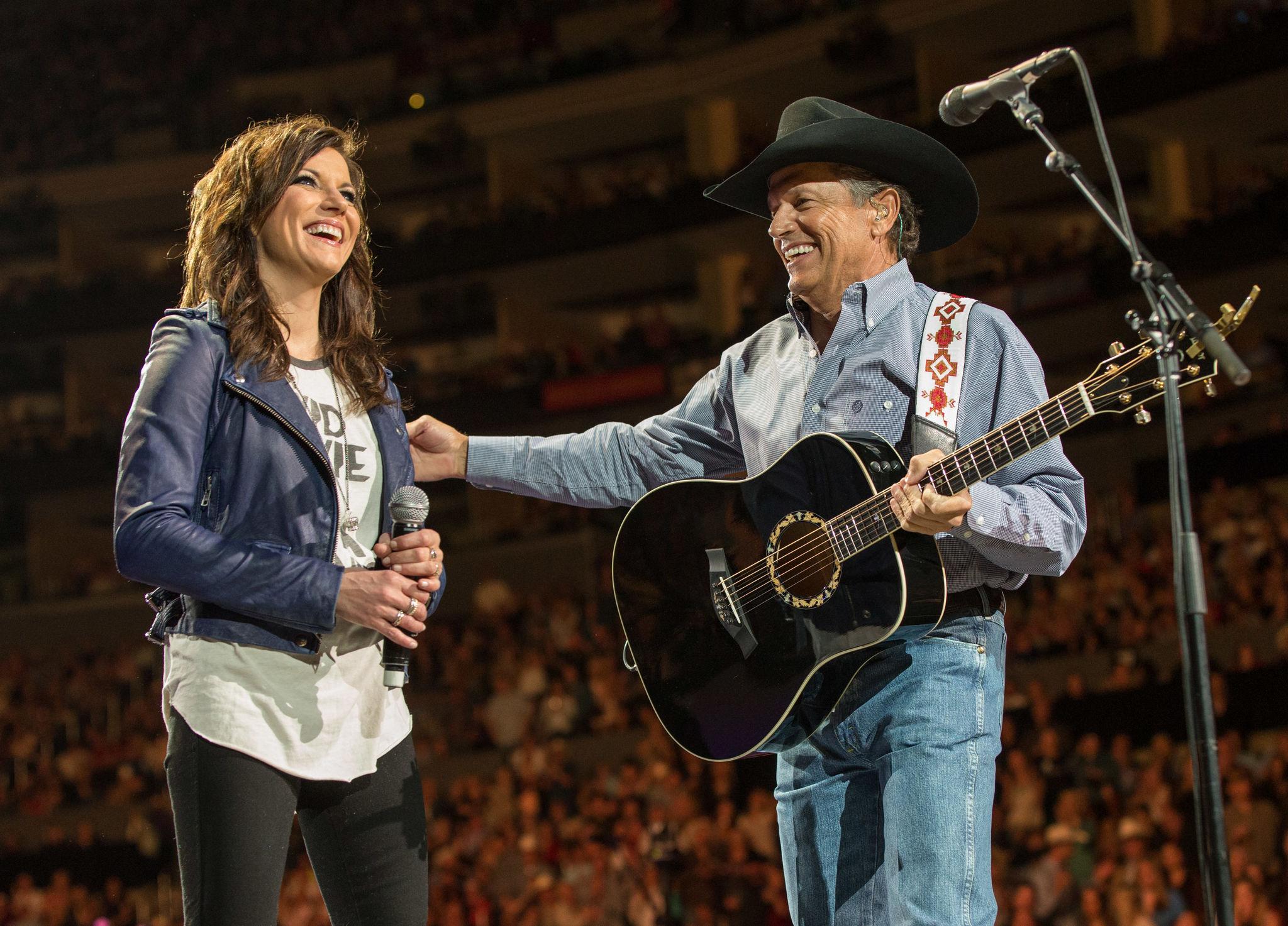
The voice that had carried heartbreak, rodeos, marriages, goodbyes and Texas across American radio for more than three decades.
This was the final night of Strait’s The Cowboy Rides Away Tour, held at AT&T Stadium in Arlington, Texas. An extraordinary group of country stars had gathered around him: Vince Gill, Alan Jackson, Faith Hill, Kenny Chesney, Miranda Lambert, Sheryl Crow, Eric Church, Jason Aldean and others.
Then it was Martina’s turn.
She and George traded lines on “Jackson.”
Then they moved into “Golden Ring,” the George Jones and Tammy Wynette classic.
Two country singers who had spent years crossing paths were suddenly standing together during one of the biggest nights in the genre’s modern history.
To the people in the stadium, George Strait looked exactly like George Strait was supposed to look.
Calm.
Controlled.
Almost impossibly comfortable in front of a crowd larger than many American towns.
But Martina had already seen another version of him.
She had spent months on the road with Strait.
She had watched him when the lights were not pointed at him.
She had seen what happened after his concerts ended and the roar disappeared.
And when Martina described that George Strait, she did not reach for grand words about royalty or greatness.
She called him warm.
Fun.
Funny.
A good guy.
For an entertainer whose public image had grown almost mythic, the simplicity of that description may reveal more than any dramatic “secret” ever could.
Long Before Martina Shared a Stadium With George, She Was Selling T-Shirts for Garth Brooks
Martina McBride turned 60 on July 29, 2026.
By now, it is easy to look at her career backward and see inevitability.
The powerhouse voice.
“Independence Day.”
“A Broken Wing.”
“Wild Angels.”
“This One’s for the Girls.”
Four CMA Female Vocalist of the Year awards.
Decades of arenas, television appearances and country radio.
But nothing about the beginning looked inevitable.
Martina Mariea Schiff grew up near Sharon, Kansas, a tiny farming community.
She started performing at seven with her family band, the Schiffters.
Music was not something she discovered after arriving in Nashville.
It was part of everyday life.
Years later, after playing in rock bands around Wichita, she met sound engineer John McBride. They married in 1988.
In January 1990, they moved to Nashville.
John eventually became production manager for Garth Brooks.
Martina found a way to stay close to the touring world too.
She sold T-shirts at Garth concerts.
It is one of those details that feels almost too perfect in hindsight.
Before Martina McBride was one of the women standing at the center of an arena, she was working a merchandise table while somebody else commanded it.
Before she became a major country star, she was watching one of the biggest country phenomena of the era happen from the other side of the building.
And she still needed someone in Nashville to listen to her demo.
Even Getting Her Demo Heard Required Nerve
Martina recorded five songs and wanted RCA Records to hear them.
There was a problem.
The label did not accept unsolicited material in the normal way.
So Martina tried something.
She put her tape in a bright purple package and wrote:
“REQUESTED MATERIAL.”
It had not actually been requested.
The trick worked.
RCA listened.
In 1991, the label signed her.
Her debut album, The Time Has Come, arrived in 1992.
It did not immediately turn her into the Martina McBride people remember today.
That transformation came with her second album, The Way That I Am.
“My Baby Loves Me” became her first major Top 10 country hit.
Then came the song that changed how many listeners understood Martina.
“Independence Day.”
Written by Gretchen Peters, the song tells the story of domestic abuse from the perspective of a child.
It was not easy subject matter for country radio.
But Martina’s performance gave the song enormous emotional force.
The video won CMA Video of the Year.
The song won CMA Song of the Year.
Martina had found something that would become a defining part of her career:
songs with both melody and something to say.
She did not need George Strait to create her career.
By the time their touring relationship became important, Martina McBride had already built an identity entirely her own.
That distinction makes what happened between them more interesting.
This was not a king choosing an unknown apprentice.
It was one established country artist studying another.
George Strait Had Chosen a Very Different Path to Stardom
By the time Martina was breaking through in the 1990s, George Strait was already one of country music’s most dependable stars.
Yet he had built his fame in a peculiar way.
There was comparatively little spectacle.
No need to reinvent his image every album cycle.
No frantic attempt to chase every new fashion in Nashville.
George often appeared to walk onto a stage, stand there and sing.
That sounds simple.
It is not.
The bigger a performer becomes, the stronger the temptation to behave like a big performer.
George’s public image worked because he rarely seemed to be trying to convince anyone that he was important.
The songs did the convincing.
So did the consistency.
For younger and newer artists, that kind of career naturally became something worth observing.
Martina eventually got a closer look than most.
She and Strait toured together before 2012.
Then George invited her out again.
And this time, he publicly explained why.
“I Love Martina”
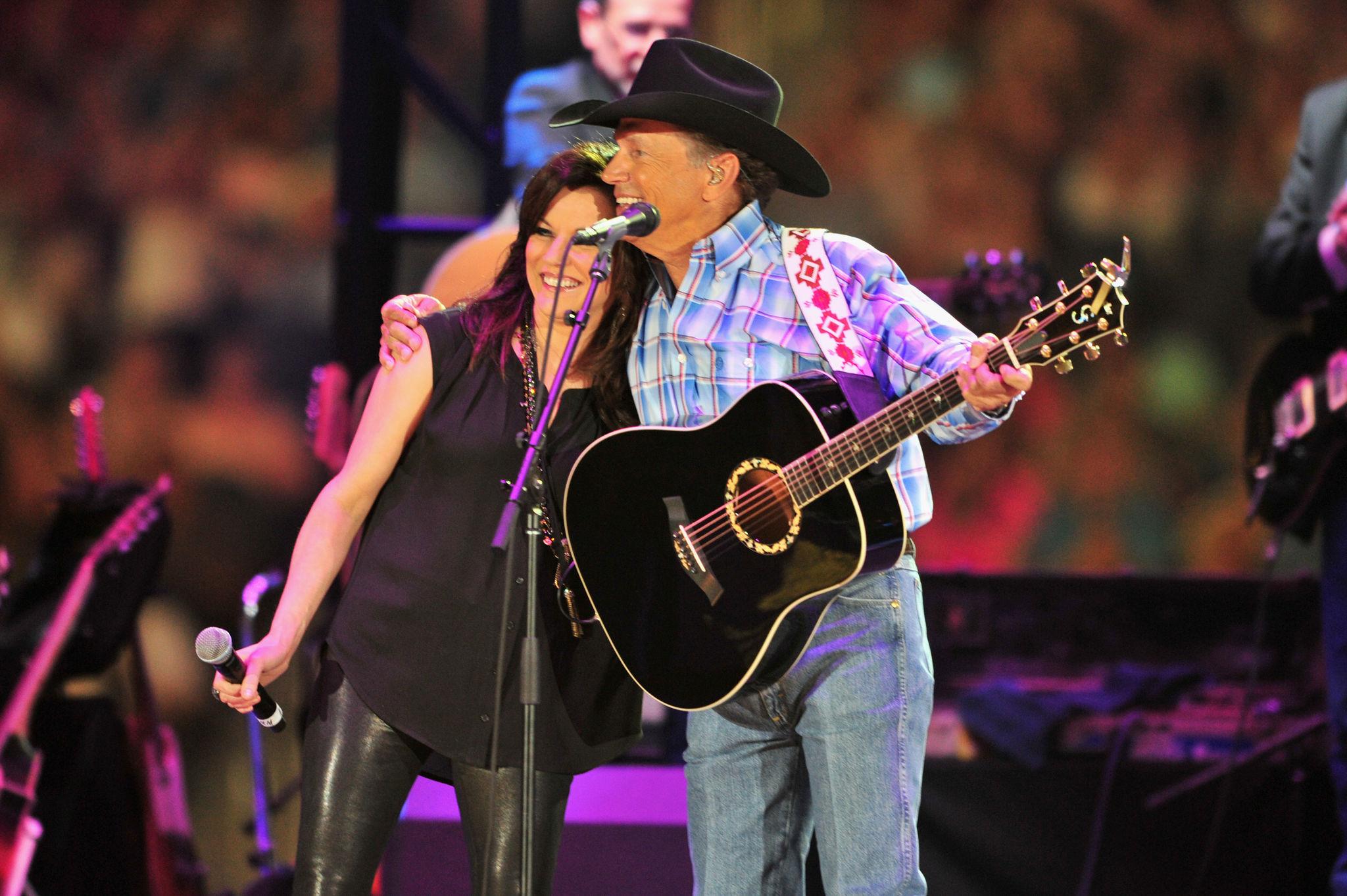
When Strait announced his 2012 tour, Martina McBride was his special guest.
George did not give a complicated explanation.
He said:
“I love Martina. She’s been on our tours before and she’s great.”
He added that having her there would make the night special.
That comment is more useful than vague claims about some secret relationship.
It establishes something concrete.
George Strait wanted Martina McBride on his tour.
Not once.
Again.
And Martina clearly wanted to be there.
The tour put two veterans with very different performance styles in the same arena.
Martina possessed a huge, soaring vocal style capable of turning a ballad into a full emotional event.
George could achieve the opposite effect.
He often seemed to reduce a song rather than enlarge it.
Less movement.
Less visible effort.
More restraint.
For Martina, spending night after night around that approach gave her a chance to observe something fans experienced only from their seats.
And some nights, after Martina finished her own set, she did exactly what ordinary George Strait fans would have done.
She went out and watched him.
Martina Would Finish Her Set — Then Go Watch George
During a 2012 interview while touring with Strait, Martina described the routine.
George largely kept to himself during the day.
Then he performed.
Martina and others on the tour would go out to watch.
That detail says a lot.
Martina McBride had already been performing professionally for decades.
She had sold millions of records.
She had won major awards.
She knew what an arena concert looked like.
And yet after finishing her own job, she still wanted to watch George Strait do his.
She explained why simply:
He sounded great.
The songs were great.
But her most revealing comments came when she described what happened backstage after the show.
That was where she encountered a George fans rarely saw.
She described him as:
“warm and fun and funny… he’s a good guy.”
There is no dark revelation hidden inside those words.
That is precisely why they are interesting.
The public George Strait had become almost monumental.
The private impression Martina chose to share was remarkably ordinary.
Behind “King George” Was a Grandfather Showing Off Baby Pictures
One little story from that 2012 tour may do more to humanize Strait than pages of mythology.
George and his wife, Norma, were waiting for the arrival of their first grandchild.
Martina knew they were excited.
Then the baby arrived.
Soon afterward, George had pictures on his phone.
And Martina got to see them.
Think about the contrast.
Outside the backstage area were thousands of people waiting to hear one of the most successful singers country music had ever produced.
His face was on tickets and posters.
Fans called him the King of Country.
Backstage, George Strait was showing someone pictures of his new grandchild.
Martina remembered how cute the pictures were.
That is not a scandal.
It is not a confession.
It is something better for understanding a person.
It is ordinary life happening a few yards away from extraordinary fame.
Fame Hadn’t Apparently Made Backstage Life Dramatic
The backstage atmosphere Martina described was relaxed.
Laid-back.
George was not constantly holding court.
He was not spending the entire day demanding attention from everyone around him.
He kept largely to himself.
Then, after the work was done, there could be conversation and laughter.

That contrast fits the public career Strait built.
Fans rarely associated George with celebrity overexposure.
His marriage to Norma stretched back to 1971.
He did not build his brand around tabloid headlines.
He did not need to narrate every part of his private life publicly.
So when Martina had the opportunity to know him in a working environment, what struck her was apparently not some hidden flamboyant personality.
It was how comfortable and normal he could seem.
That may be one reason their touring partnership worked.
There was enough room for both stars.
Martina Was Learning Something Without Needing a Formal Mentor
It would be tempting to turn these years into a traditional mentorship story.
George gives Martina private advice.
Martina follows it.
George changes her career.
There is little reason to manufacture that narrative.
Martina was already one of country music’s most successful female singers.
She did not need permission to become Martina McBride.
But established artists still observe one another.
They notice how another performer handles pressure.
How they structure a show.
How they deal with longevity.
How they respond when trends change.
And George Strait offered an unusual example.
Country music around him changed dramatically.
The 1980s became the 1990s.
The 1990s became the 2000s.
Traditional sounds competed with country-pop, rock influences and younger stars.
George remained recognizably George.
He adapted without making reinvention itself the point.
Martina’s career was different.
But she too would eventually confront the question every long-term artist faces:
How do you age in a business constantly searching for someone new?
George’s career offered one possible answer.
You do not always have to become someone else.
Then George Announced the Cowboy Was Riding Away
In September 2012, George Strait made the announcement many fans had dreaded.
He would stop regular touring after one final two-year run.
The name was inevitable:
The Cowboy Rides Away Tour.
But one detail is important.
George was not announcing retirement.
He explicitly said he intended to keep recording and might continue playing selected dates.
The tour was a goodbye to the grind of full-scale touring, not a goodbye to music.
For the first leg in 2013, George again chose Martina McBride as his special guest.
Martina reacted almost like a fan who had somehow been handed the best ticket in the building.
At the press event, she joked about getting to watch 21 George Strait shows.
She even imagined spending time at front-of-house with Norma Strait after finishing her own set.
For someone who already knew George’s show well, she still wanted to watch.
That enthusiasm feels significant.
Familiarity had not made the performance less impressive to her.
“I Get to Tour With George Freakin’ Strait”
During the 2013 run, Martina did not disguise her excitement.
At one stop she jokingly described herself as incredibly lucky because she got to tour with George freakin’ Strait.
The line worked because Martina was hardly an awestruck newcomer.
By then, her own catalog included songs that had become permanent fixtures of country radio.
She had four CMA Female Vocalist trophies.
She had spent years headlining.
Yet George remained George.
There was respect in the relationship without the need to pretend Martina was beneath him.
That is a much more convincing dynamic than the mysterious mentor-protégé relationship sometimes invented around famous stars.
They were peers.
But one peer could still admire the other.
Martina’s Career Had Always Been Louder in a Different Way
George and Martina also made an interesting pairing because they represented two different kinds of strength.
George’s power often came through restraint.
Martina’s could arrive like a storm.
Listen to “A Broken Wing.”
Or “Independence Day.”
Or “Where Would You Be.”
The voice rises and rises until there seems to be nowhere else for it to go.
Her choice of material also repeatedly placed women’s experiences at the center of country songs.
The Country Music Hall of Fame would later devote an exhibition to Martina titled The Power of Her Voice, highlighting both the force of her singing and the socially aware material that helped define her career.
“Independence Day” confronted domestic violence.
“Concrete Angel” dealt with child abuse.
“This One’s for the Girls” became an anthem aimed across generations of women.
Martina also became an advocate for female performers and for women receiving more attention from country radio and the industry.
George did not turn Martina into that artist.
She already knew what she wanted to say.
But spending years alongside a performer who had protected his own identity for decades offered another kind of example:
longevity without surrendering the center of yourself.
By 2014, One Last Giant Night Was Waiting
The final stop of The Cowboy Rides Away Tour was not designed to feel ordinary.
AT&T Stadium in Arlington was enormous.
The attendance reached 104,793.
At the time, it was a record-setting concert crowd in North America.
And George did not stand alone.
One famous country artist after another joined him.
Vince Gill.
Jason Aldean.
Eric Church.
Sheryl Crow.
Faith Hill.
Alan Jackson.
Miranda Lambert.
Kenny Chesney.
And Martina McBride.
It looked almost like several generations of Nashville gathering to acknowledge what George Strait’s touring career had meant.
When Martina appeared, their song choices did not come from her catalog or George’s.
They reached backward.
First came “Jackson,” famously associated with Johnny Cash and June Carter.
Then “Golden Ring,” the George Jones and Tammy Wynette classic.
Before “Golden Ring,” Strait noted Martina’s love of Jones and Wynette.
For a few minutes, two modern stars used an enormous contemporary stadium to pay tribute to country music that had come before either of them.
That mattered.
Neither George nor Martina had built a career by pretending country music began with them.
There Was No Need to Manufacture Chemistry
“Jackson” naturally gave the performance a playful edge.
The song is built around a battling couple.
The man boasts.
The woman answers.
The lines snap back and forth.
George’s controlled delivery and Martina’s stronger attack made the contrast entertaining.
Then “Golden Ring” changed the mood.
That song is built around the collapse of a marriage, following the symbolic life of a wedding ring.
Different tone.
Different emotional weight.
Together, the two performances showed why the pairing worked.
Martina did not need to imitate George.
George did not need to compete with Martina’s vocal power.
Each remained recognizable.
And after the duet, the night continued.
More stars walked out.
More memories accumulated.
Finally George sang the song that had given the tour its name.
The cowboy rode away from full-time touring.
But not from performing forever.
That Distinction Matters
Over time, “farewell tour” stories tend to become simplified.
Someone supposedly retired.
Then they performed again.
Fans accuse them of breaking a promise.
That was not what Strait said.
When he announced The Cowboy Rides Away, George made clear that the end of touring did not necessarily mean the end of live appearances.
And that is what happened.
He continued to record and later returned for selected concerts and residencies.
So that 2014 Arlington night was not the final time George Strait ever sang for an audience.
It was the end of something more specific:
decades of conventional touring.
For Martina, it marked the culmination of years spent sharing that touring world with him.
And perhaps that is why her backstage memories are more revealing than dramatic speculation about some hidden relationship.
She had seen the machinery repeatedly.
Not for one award-show encounter.
Not for a single duet.
For months at a time.
What Did Martina Actually Discover About George Strait?
Not that he was secretly a different man.
Not that they shared a hidden romance.
Not that he privately directed her career.
Not that he revealed some shocking truth about Nashville.
What Martina described was almost the opposite.
The George behind the curtain appeared remarkably consistent with the George people thought they knew.
Reserved during the day.
Relaxed backstage.
Interested in family.
Warm after the show.
Funny when the pressure was off.
And still capable of making another superstar walk out after her own set simply because she wanted to hear him sing.
The legend was enormous.
The backstage personality apparently did not need to be.
That may be the real revelation.
George’s Respect for Martina Wasn’t One-Sided, Either
It is easy to tell this story only through Martina’s admiration.
But George’s own words matter.
He chose her for repeated tours.
And when announcing the 2012 dates, he did not speak about her as merely another opening act.
He said he loved Martina.
He reminded fans that she had toured with them before.
He called her great.
He said she would make the tour special.
For George Strait—a performer never famous for excessive public commentary—that was a meaningful endorsement.
Their history therefore works better as a story of mutual respect than secret mentorship.
Martina admired what George did.
George valued what Martina brought.
They shared a stage because both could stand on it without diminishing the other.
At 60, Martina’s Own Career Makes That Relationship Easier to Understand
Martina McBride is now the age George Strait was when he announced The Cowboy Rides Away Tour.
That parallel is worth noticing.
George was 60 when he began publicly talking about stepping away from full-scale touring.
Martina turned 60 in 2026.
Both reached the age after spending decades in a business notorious for chasing youth.
And Martina can now look back on a career that no longer needs to be measured by the latest radio single.
Her place is secure.
She helped define 1990s and 2000s country.
She became one of the genre’s most acclaimed vocalists.
She carried songs about subjects country radio often preferred to avoid.
She became an advocate for younger women in the business.
And she stood beside some of the biggest artists the genre has produced.
George Strait was one of them.
But perhaps his importance to her story is not that he changed it.
Perhaps it is that she got to see, unusually close, another way of surviving fame.
The Hardest Thing in Nashville May Be Remaining Recognizable
Country music constantly changes.
Radio changes.
Production changes.
Fashion changes.
Audiences age.
New audiences arrive.
Artists who once seemed permanent suddenly disappear from playlists.
The temptation is obvious:
chase everything.
George Strait became unusual partly because he rarely appeared to chase.
Martina McBride did not copy his career.
But she also built a catalog that remained identifiable.
Even when production changed, listeners knew what Martina was trying to do.
A powerful melody.
A powerful vocal.
Often, a story with emotional consequence.
That kind of clarity has something in common with George.
Different voices.
Different personalities.
Different careers.
A similar refusal to become unrecognizable just to remain current.
Maybe the Most Important Lesson Was Never Spoken
The original temptation in telling a story like this is to invent one perfect backstage conversation.
George pulls Martina aside.
The arena is empty.
He tells her the secret to longevity.
She remembers his exact words for decades.
It would make a nice movie scene.
There is no need for it.
The lesson was visible every night.
George walked out.
He sang.
The audience responded.
He did not have to tell Martina that consistency mattered.
She could see it.
He did not have to lecture her about protecting an identity.
His career demonstrated it.
And he did not have to explain that a person could possess enormous status without turning every backstage interaction into a display of status.
Martina’s own description tells us what she saw.
Warm.
Fun.
Funny.
A good guy.
Sometimes the simplest testimony is the hardest to fake.
The Phone Full of Baby Pictures May Tell the Story Best
Go back to 2012.
Forget the giant stadium.
Forget the record sales.
Forget the phrase “King George.”
A baby had just arrived in the Strait family.
Norma was excited.
George was excited.
And somewhere backstage during a major country tour, one of the most successful singers in the history of the genre pulled out his phone.
There were pictures.
Martina looked at them.
Then eventually everyone went back to work.
That image is small enough to be believable because it is small.
Fame wants everything to become mythology.
Real life keeps interrupting.
Even kings become grandfathers.
Even superstars show baby pictures.
Even Martina McBride, after decades in the business, can finish her own concert and go stand in the crowd to listen to somebody she still admires.
And Then There Is That Final Image From Arlington
June 7, 2014.
More than 100,000 people.
Martina McBride standing beside George Strait.
The same woman who once sold T-shirts during somebody else’s arena tour was now one of the stars invited to help close George Strait’s final full-scale tour.
They sang songs older than either of their careers.
Then Martina stepped aside.
Others came forward.
Eventually George was left with the song everyone knew was coming.
“The Cowboy Rides Away.”
It was a goodbye.
But not to a friendship.
Not to music.
Not even completely to the stage.
It was a goodbye to one chapter.
And more than a decade later, the memories Martina shared about the man behind that chapter still sound surprisingly uncomplicated.
George Strait did not need to tell her that he was the King of Country.
Everybody already knew.
What Martina saw backstage was more revealing.
He apparently didn’t need to behave like one.