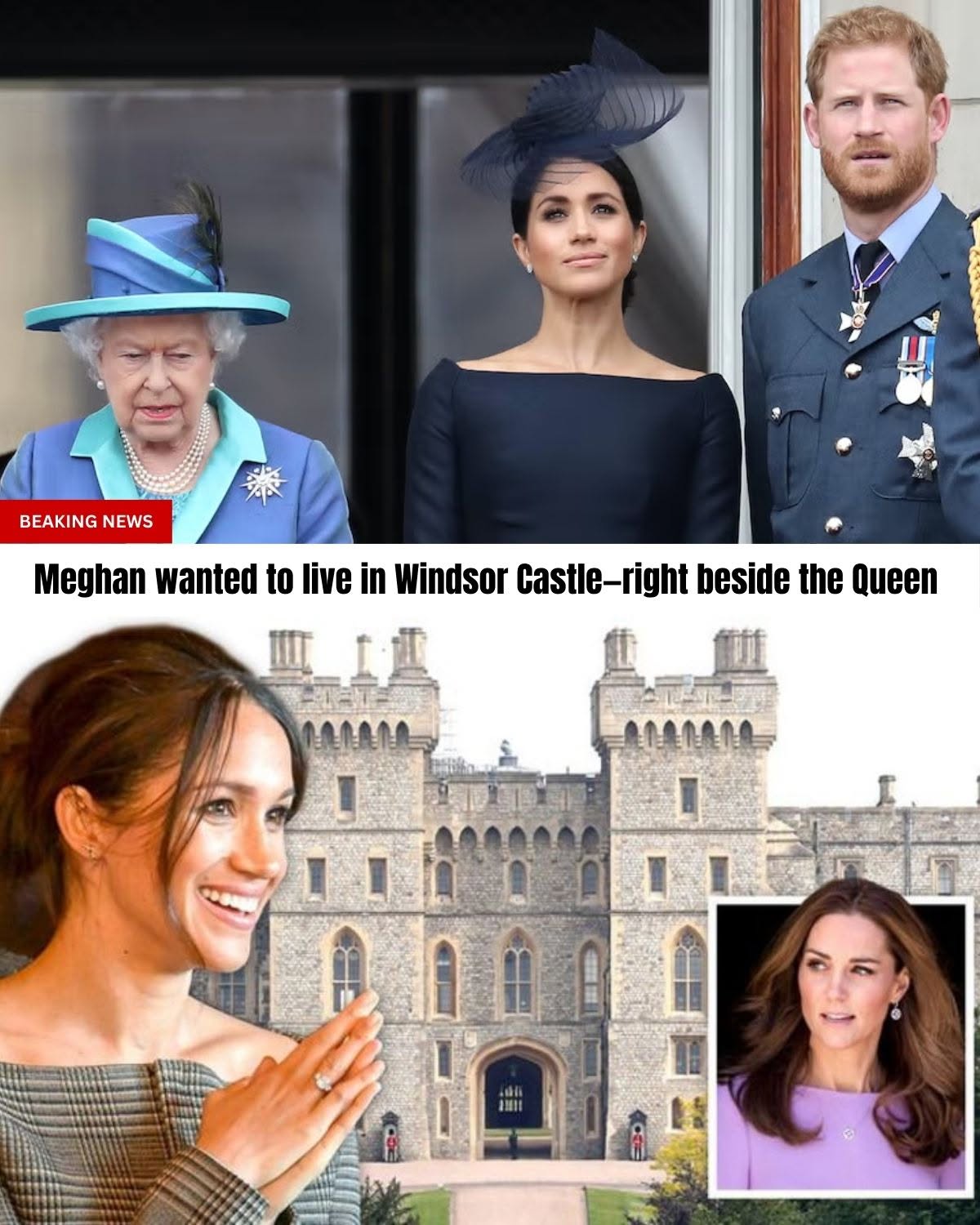
The story sounds, at first, like another argument about royal privilege: a duchess, a cottage, and a reported request to live inside one of the most iconic castles in the world. But the controversy surrounding Meghan Markle, Prince Harry, Nottingham Cottage and Windsor Castle was never really about square footage. It was about expectation. It was about status.
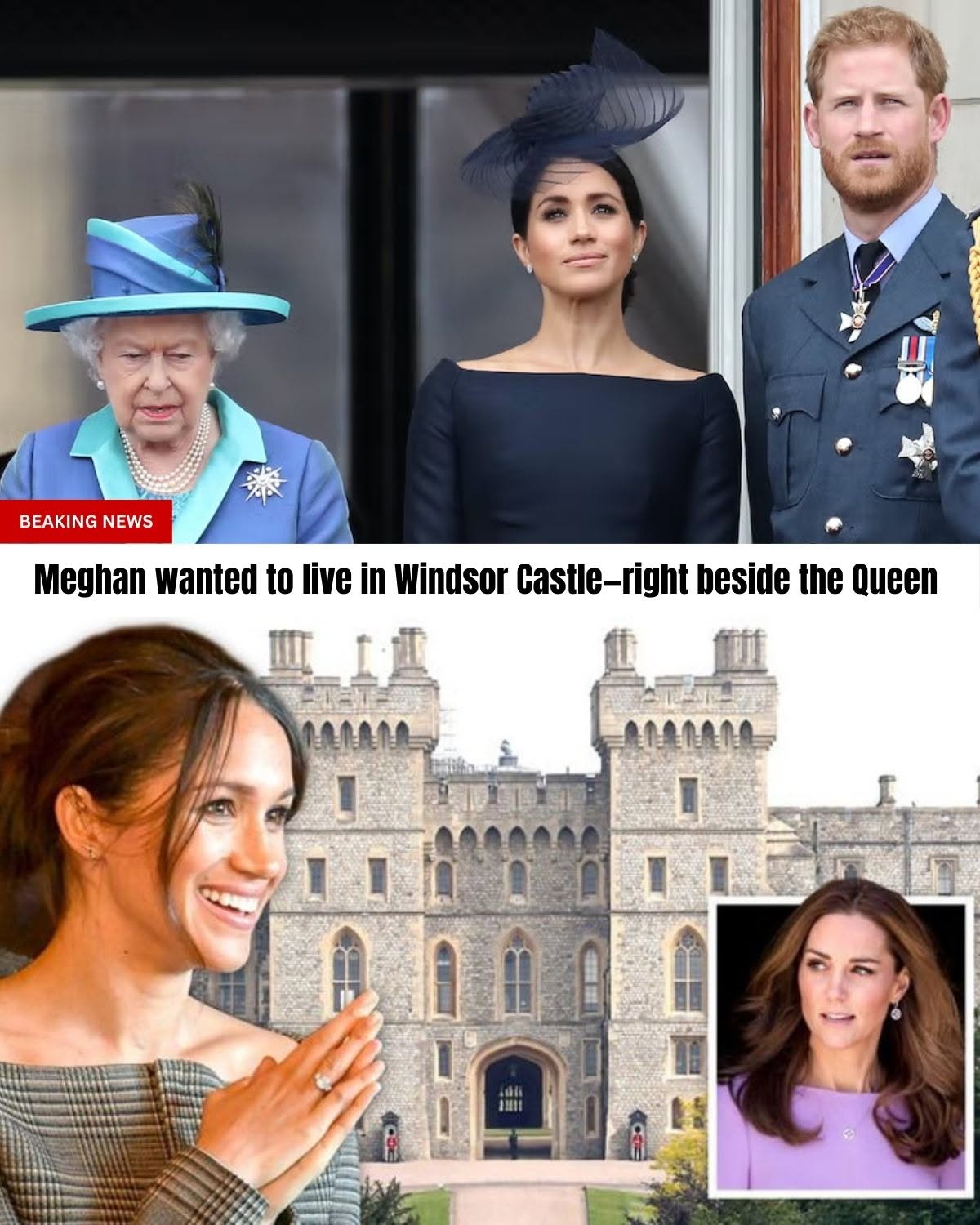
And most of all, it was about whether Meghan truly understood the royal hierarchy she had married into — or whether she believed her new title should have immediately placed her at the symbolic centre of the Crown.
According to long-running reports, Harry and Meghan once hoped living quarters could be made available inside Windsor Castle after their 2018 wedding. The request was reportedly rejected, with Queen Elizabeth II said to have considered it inappropriate. Instead, the couple later moved to Frogmore Cottage, a royal residence on the Windsor Estate, close to the Queen’s private world but not inside the castle itself.
To Meghan’s defenders, the request could be read as practical, even understandable: a newly married royal couple seeking security, privacy and a suitable home close to the monarch.
To her critics, it became something far more damaging: an early warning sign that Meghan expected royal grandeur without first earning the patience, rank and restraint the institution demands.
That is why this story still matters.
Because inside the Royal Family, where you live has never been just about comfort. It is a statement of position.
Nottingham Cottage Was Modest — But It Was Not an Insult
Before Frogmore, before California, before the open war with the Palace, Harry and Meghan’s royal life together began at Nottingham Cottage.
Known informally as “Nott Cott,” the two-bedroom home sits within the grounds of Kensington Palace. It is historic, intimate and undeniably modest by royal standards. It has low ceilings, small rooms and a far less grand public image than the palaces the world associates with monarchy.
Harry himself did not pretend otherwise.
In Spare, he described Nottingham Cottage as small and admitted feeling embarrassed when he first brought Meghan there. In the couple’s Netflix series, Meghan also spoke about how difficult it was for outsiders to believe that their real life behind the scenes looked so unglamorous.
That part of the story is not hard to understand. For someone marrying into the British Royal Family, Nottingham Cottage could feel surprisingly underwhelming. The phrase “royal residence” creates an image of marble staircases, sweeping gardens and grand state rooms. Nott Cott was not that.
But this is where the criticism begins.
Nottingham Cottage was not a punishment created for Meghan. It had also served as an early married home for Prince William and Kate before they moved into larger accommodation. It was, in royal terms, a starter home — not the final measure of one’s status.
That detail changes the meaning of the complaint.
If William and Kate could begin there, then the cottage was not inherently degrading. It was part of a pattern: younger royals start smaller, then move as their roles, families and responsibilities expand.
The question is whether Meghan saw it that way.

The Windsor Castle Question
The sharper controversy came from reports that Harry and Meghan asked whether living quarters might be made available inside Windsor Castle itself.
Windsor Castle is not simply another royal property. It is a working royal residence, a fortress, a ceremonial symbol and one of the emotional centres of the monarchy. For Queen Elizabeth II, it was also a deeply personal place. During the later years of her reign, it became increasingly central to her private life.
That is why the reported request carried such symbolic weight.
To ask to live inside Windsor Castle was not the same as asking for a larger cottage, a renovated apartment or a more comfortable family home. It placed the Sussexes’ domestic expectations directly beside the monarch’s own space.
Reports have claimed that the Queen found the idea inappropriate. Whether that word came directly from the late Queen or from those interpreting the Palace’s thinking, the institutional logic is clear. Windsor Castle was not simply a housing option. It was the sovereign’s space.
For a newly married couple who were not in the direct line of succession, living inside it would have sent a powerful signal — and not necessarily the one the Palace wanted to send.
Why Frogmore Cottage Was the Compromise
In the end, Harry and Meghan were given Frogmore Cottage, located on the Windsor Estate.
That was not a minor offer. Frogmore placed them close to Windsor Castle, close to the Queen’s orbit, and in a home that could provide more privacy and space than Nottingham Cottage. It was extensively renovated before they moved in, and it became the place where they prepared for the birth of their son, Archie.
To Palace defenders, Frogmore was generous. It gave the Sussexes proximity, independence and a family base without disrupting the Queen’s private residence inside Windsor Castle.
To Sussex sympathisers, however, Frogmore may have still felt like a consolation prize. It was near the castle, but not in the castle. Close to the centre, but not at the centre.
That distinction is exactly why this episode became so revealing.
The Palace offered a royal home.
The Sussex story, as critics read it, seemed to ask for royal centrality.
Those are not the same thing.
The Real Issue Was Rank
Royal housing has always reflected hierarchy.
It is not a system based purely on need, personal taste or emotional fairness. It reflects proximity to the throne, seniority, workload, family structure and the monarch’s judgement.
That is why Prince William and Kate’s living arrangements were always going to be viewed differently from Harry and Meghan’s. William was not just Harry’s older brother. He was the future King. His household represented the direct line of succession. His wife was a future Queen. Their children were future heirs.
Harry was loved, popular and important — but he was not the heir.
Meghan’s critics argue that this was the reality she struggled to accept. In their view, she entered the monarchy with the public profile of a global celebrity and the confidence of a woman used to being judged on personal achievement. But the Royal Family does not rank people by charisma, career or press attention. It ranks them by succession.
That is the brutal truth of monarchy.
A royal title does not automatically place someone at the centre.
The line of succession does.
Why the Cottage Story Became a Symbol of Entitlement
The reason Nottingham Cottage still appears in discussions about Meghan is not because people genuinely care about the ceiling height.
It is because the cottage became a symbol.
For supporters of Harry and Meghan, it symbolised the gap between the royal fantasy and the less glamorous reality behind Palace walls. It showed that even senior royals can live in surprisingly modest conditions, and that the institution can feel colder and less generous than outsiders imagine.
For critics, it symbolised something very different: Meghan’s alleged shock that royal life came with limits.
That is why the phrase “too small” became so politically loaded. A small cottage can be a practical inconvenience. But when filtered through royal status, it starts to sound like a complaint about rank.
And rank is where the Sussex crisis always returns.
Harry and Meghan repeatedly argued that they were not protected, not valued and not supported in the way they believed they should have been. Their housing story fits neatly into that wider narrative. It suggests a couple who felt their place in the institution did not match their public importance.
The Palace, however, seemed to see the matter differently.
In the Palace view, role comes before visibility. Duty comes before demand. Hierarchy comes before personal expectation.
The William and Kate Comparison Made It Worse
The comparison with William and Kate made the issue even more explosive.
William and Kate had lived at Nottingham Cottage in their early married life, but later moved into Apartment 1A at Kensington Palace, a far grander residence. For Meghan, seeing the difference between Harry’s smaller home and William’s larger residence may have sharpened the emotional gap between the brothers.
Some royal accounts have suggested Meghan felt Harry deserved more and that his living arrangements reflected how the institution viewed him compared with William.
If true, that reaction reveals one of the deepest wounds in the entire Sussex story: Harry’s place as the spare.
For Harry, the difference between his life and William’s was never just architectural. It was emotional. It was symbolic. It told him, again and again, that his brother mattered more to the system.
Meghan may have entered that world and seen the same imbalance with fresh eyes.
But seeing the imbalance is one thing.
Expecting the monarchy to erase it is another.
Queen Elizabeth’s Likely Calculation
Queen Elizabeth II understood royal symbolism better than anyone.
If she rejected the idea of Harry and Meghan living inside Windsor Castle, it was likely not because she wanted to humiliate them. It was because the monarchy cannot afford to send confused signals about status, proximity and future power.
Allowing the Sussexes to live inside Windsor Castle could have created exactly that confusion.
It might have suggested that Harry and Meghan occupied a uniquely intimate position beside the sovereign at the same time William and Kate were being prepared as the monarchy’s future.
That would have been constitutionally awkward and politically unnecessary.
Frogmore Cottage solved the problem more neatly. It gave the couple a Windsor base without placing them inside the symbolic heart of the Queen’s residence.
In royal terms, that was not rejection.
It was containment.
Why This Became a Breaking Point
The Windsor Castle story matters because it exposes a clash that would later define the entire Sussex exit.
Harry and Meghan wanted recognition of their emotional and public value.
The Palace measured them by institutional role.
Harry and Meghan wanted flexibility.
The Palace insisted on hierarchy.
Harry and Meghan wanted to define their royal lives in a modern, personal way.
The Palace expected them to accept an ancient system whose rules existed long before either of them arrived.
This is why a housing request could become a fault line.
It was not about whether Meghan deserved a comfortable home. It was about whether she understood that royal comfort is not the same as royal power.
The Bigger Pattern
Seen alone, the Nottingham Cottage and Windsor Castle dispute might look like gossip.
Seen in context, it becomes part of a larger pattern.
The Sussexes would later seek a hybrid royal role, balancing public duties with financial independence. The Palace rejected that model. They would later argue that the institution failed to protect them from the press. The Palace largely remained silent. They would later build a life outside the monarchy while continuing to use royal identity as part of their public brand.
Again and again, the same tension appears.
Harry and Meghan seemed to believe royal life should adapt to them.
The Palace expected them to adapt to royal life.
That is the central conflict. The cottage was simply one of the first visible signs.
The Final Question
Did Meghan truly demand Windsor Castle because she believed Nottingham Cottage was beneath her?
That exact claim remains disputed and should be treated carefully. But the broader story is undeniable: there was a significant mismatch between Sussex expectations and Palace reality.
For Meghan’s critics, the housing episode confirmed their view that she wanted status, luxury and influence faster than the institution was prepared to grant them.
For Meghan’s defenders, it showed how quickly the Palace made her feel secondary, undervalued and boxed into a role she never fully understood.
But perhaps the most revealing answer lies somewhere between the two.
Meghan may not have wanted merely a bigger house.
She may have wanted proof that she and Harry mattered.
The Palace gave them Frogmore.
It did not give them Windsor Castle.
And in the language of monarchy, that difference said everything.


