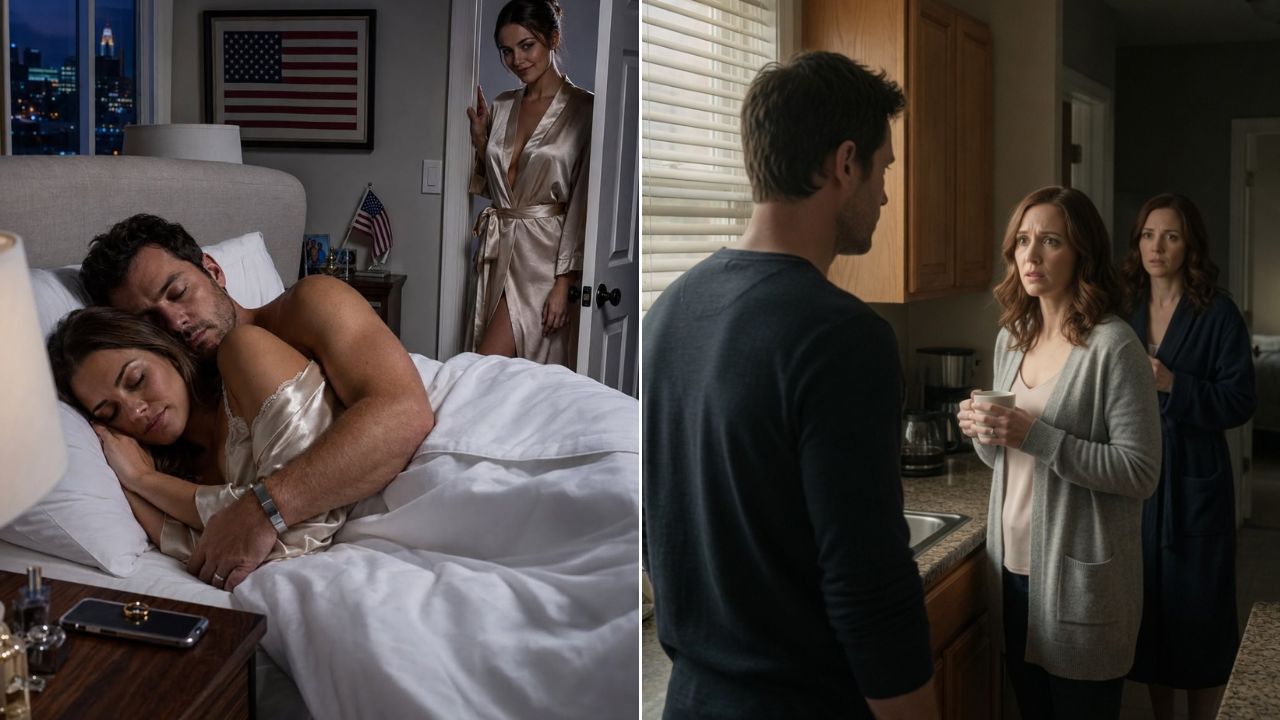
My Wife Let Her Twin Sister Pretend To Be Her… And Thought I Would Never Notice. Three Days Later, I Asked Her One Question That Changed Everything.
At first, Claire did not answer me.
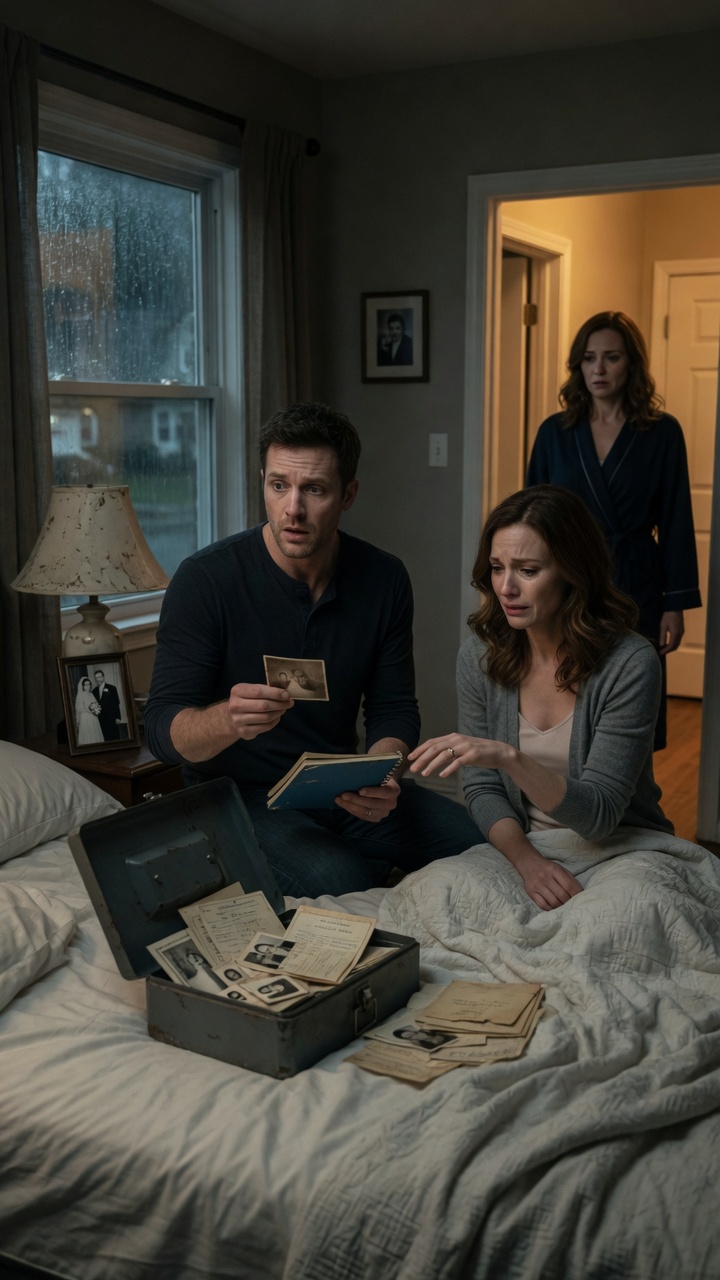
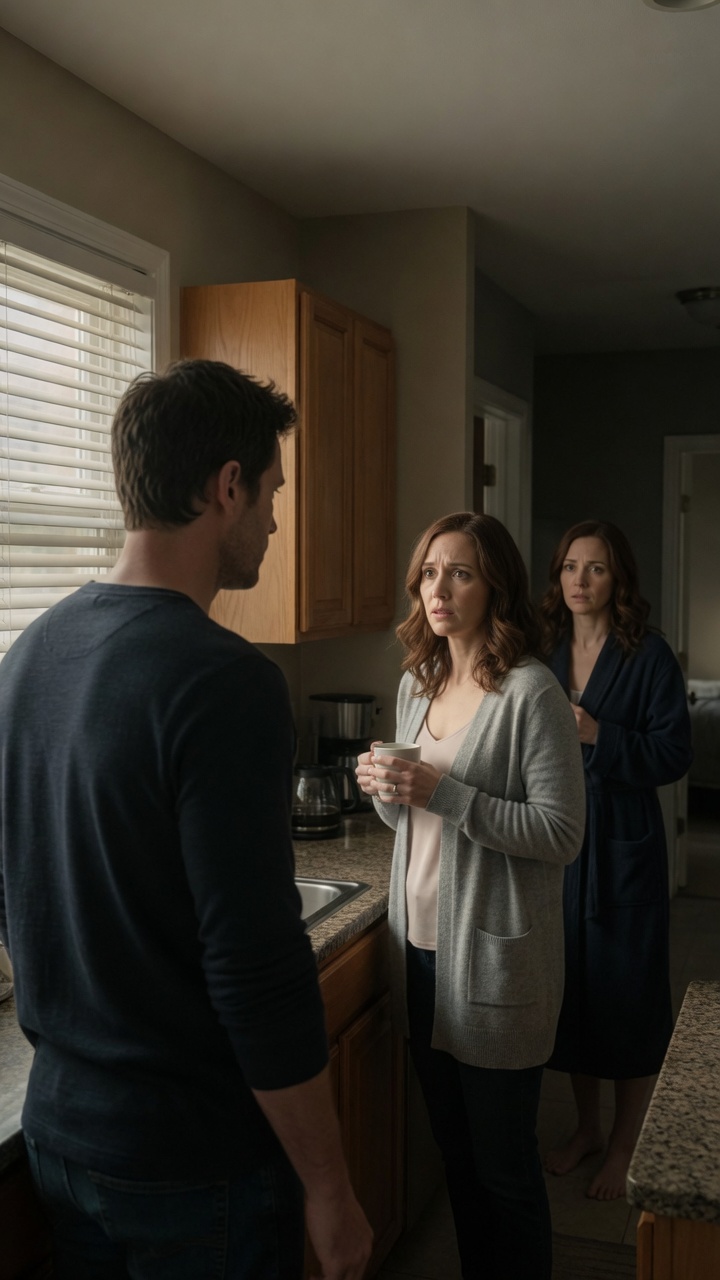
She stood in our kitchen in Cleveland, Ohio, with both hands wrapped around her coffee mug, staring at me as if I had just said something in a language she once understood but no longer wanted to hear.
Outside the window, our neighbor’s flag moved gently in the morning wind.
A dog barked once.
Everything outside our house sounded ordinary.
Nothing inside it was.
I kept my voice low.
Not because I was calm.
Because shouting would have made this feel like a normal argument.
And this was not normal.
This was not about a forgotten bill, a cold dinner, or a late night at work.
This was a door opening.
A door I now realized my wife had been standing in front of for years.
Claire looked toward the hallway that led to our bedroom.
For one second, her face changed.
Not guilt.
Not fear.
Something worse.
Recognition.
“You noticed,” she whispered.
I gave a short laugh, but there was no humor in it.
“I noticed three days ago.”
Her mouth opened, then closed again.
That told me more than any denial could have.
Three nights earlier, I had woken before dawn with the uneasy feeling that something in a familiar room had been moved by half an inch.
The room was the same.
The soft hum of the ceiling fan.
The pale glow from the alarm clock.
The white comforter Claire had picked out two months after we bought the house.
But the woman beside me was not the same.
She had Claire’s hair.
Claire’s shoulder.
Claire’s quiet way of breathing when she tried not to wake me.
But she was not Claire.
I could not prove it that night.
Not in the dark.
Not with sleep still sitting heavy behind my eyes.
Not with the familiar warmth beside me making my own mind feel like the unreliable thing.
So I stayed still.
I said nothing.
The mistake she made was small.
Too small for anyone else to notice.
When Claire slept on her left side, she always left one foot outside the blanket, even in January.
The woman beside me kept both feet covered.
It was ridiculous.
It was nothing.
It was everything.
I turned my head slightly.
She froze.
Not shifted.
Not stirred.
Froze.
That was when I knew.
“Claire?” I said softly.
She answered too fast.
“Yes?”
The voice was right.
The timing was wrong.
My wife had spent eight years waking up beside me. She never answered instantly. She always surfaced slowly, half annoyed and half amused, as if she had been pulled back from somewhere far away.
This woman answered like she had been waiting for the test.
I rolled onto my back and stared at the ceiling.
“Nothing,” I said. “Go back to sleep.”
She did not move for a long time.
Neither did I.
By morning, Claire was in the kitchen making toast, wearing the navy robe her mother had given her for Christmas.
Her hair was twisted into a messy knot.
Her wedding ring was on her finger.
She smiled when I walked in.
“Did you sleep okay?”
It was such a simple question.
It should have felt simple.
But her eyes were watching me too carefully.
I reached for the coffee pot and said, “Fine.”
“Really?”
I turned.
“Why?”
She shrugged.
“No reason.”
That was the first lie.
I did not call it a lie then.
Not out loud.
Instead, I drove to work at the insurance office, sat in the parking lot for almost ten minutes, and replayed the night in my head until the whole thing began to sound impossible.
My wife had a twin sister.
Identical twin, technically.
Mara had the same brown eyes, the same sharp cheekbones, the same calm mouth that always looked like it was keeping a secret.
Strangers confused them constantly.
Waiters.
Neighbors.
Old classmates.
Even Claire’s aunt once hugged Mara at a family barbecue and started crying about how much she had missed Claire before Mara gently said, “Aunt June, wrong twin.”
Everyone laughed.
Claire did not.
She never liked those jokes.
When we were first dating, she once told me, “People think being identical means being interchangeable.”
I said, “You’re not.”
She studied me for a long time.
Then she said, “Promise me you’ll never forget that.”
I promised.
I meant it.
Eight years later, in our own house, someone had tested that promise.
The second night was worse because by then I was awake before it happened.
Claire said she had a headache after dinner.
She told me she was going upstairs early.
I watched her climb the stairs in a cream sweater and gray pajama pants, one hand on the railing, her wedding ring catching the hallway light.
Twenty minutes later, Mara texted me.
Just dropping off Claire’s charger. She left it in my car.
I stared at the message until the screen dimmed.
Mara lived across town.
She did not “just drop by” at night unless Claire asked her to.
When the doorbell rang, Claire did not come downstairs.
I opened the door.
Mara stood on the porch under the yellow light, wearing jeans, a white jacket, and an expression too composed to be casual.
The neighborhood behind her was quiet.
“Hey,” she said.
“Hey.”
She held up a phone charger.
“Claire left this.”
I took it.
Our fingers almost touched.
They did not.
“Thanks.”
Mara glanced past my shoulder into the house.
“She asleep?”
“You tell me.”
Her eyes came back to mine.
For half a second, she forgot how to smile.
Then she recovered.
“She said she was tired.”
I leaned against the doorframe.
“You two talk a lot tonight?”
Mara’s face softened into something almost sad.
“Ethan…”
My name in her mouth felt like a warning.
I waited.
She looked down at the porch boards, then back at me.
“Take care of her.”
That was all she said.
Then she turned and walked back to her car.
I stood there until she drove away.
When I went upstairs, Claire was asleep.
Or pretending to be.
I put the charger on the nightstand and got into bed.
For almost an hour, nothing happened.
Then the woman beside me moved closer.
She touched my arm.
Gently.
Carefully.
Like someone stepping onto thin ice.
“Ethan?” she whispered.
I did not answer right away.
Her hand tightened.
I knew then it was Mara.
Not because of the voice.
Not because of the perfume.
Because Claire never said my name like a question when we were alone.
She said it like a place she had already arrived.
Mara said it like she was asking permission to enter.
I closed my eyes.
I let the silence stretch.
Then I said, “I’m tired.”
Her hand withdrew.
The bed shifted.
A minute later, I heard the faintest sound.
Not crying.
Breathing too hard through the nose, trying not to make noise.
In the morning, Claire was back.
Or maybe she had never left.
That was what made me feel like I was losing my mind.
She stood by the sink, rinsing blueberries in a colander, sunlight cutting across her face.
“You’re up early,” she said.
“I could say the same.”
She glanced at me.
“Couldn’t sleep.”
“Headache?”
“Better.”
She turned back to the sink too quickly.
I watched her left hand.
The wedding ring was on the wrong side of her engagement band.
Claire never wore it that way.
Mara did.
I did not say anything.
That was the day I started collecting small truths.
Not proof.
Truths.
Proof is for other people.
Truth is what your body knows before your mouth can explain it.
At lunch, I drove home instead of going to the diner with a coworker.
My truck sounded too loud in the driveway.
The house looked normal from the street.
White siding.
Black shutters.
A small wreath Claire insisted on keeping up even after the holidays.
Inside, the air smelled faintly of lavender.
Claire wore orange blossom.
Mara wore lavender.
I walked upstairs and stood in our bedroom without touching anything.
The bed was made.
Too neatly.
Claire made beds quickly, practically, with one corner always slightly loose because she hated wasting time on something that would be undone again.
This bed looked like a hotel room.
Mara had made it.
On the nightstand, our wedding photo faced slightly away from the bed.
That stopped me.
I picked it up.
In the photo, Claire and I were laughing outside the courthouse after our small ceremony.
She wore a simple white dress and a denim jacket because March in Ohio could never decide what season it wanted to be.
Mara stood behind us, clapping, her smile bright and unreadable.
I had always liked that photo.
Now I wondered if there had been something in it I had never noticed.
I put it back exactly as I found it.
That evening, Claire made spaghetti and acted like a woman pretending not to watch a clock.
At 7:12, her phone lit up.
She turned it over before I could see the name.
At 7:19, she said, “I need to run to the pharmacy.”
I looked at the cabinet behind her.
We had everything.
Toothpaste.
Aspirin.
Bandages.
The allergy medicine she always bought twice because she forgot she already had some.
“What do you need?”
She paused too long.
“Just something.”
I set my fork down.
“Want me to come?”
“No.”
Too quick.
“No, I’ll be fast.”
She took her purse and left through the garage.
I waited four minutes.
Then I walked to the front window.
Her car did not turn toward the pharmacy.
It turned toward Mara’s apartment.
I did not follow.
Every part of me wanted to grab my keys, drive after her, and force the truth into the open beneath fluorescent parking lot lights.
But anger makes you loud.
And loud people miss things.
So I stayed home.
At 8:03, Mara arrived.
Not in her own car.
In Claire’s blue Subaru.
She parked in the garage like she belonged there.
The door from the mudroom opened.
I was sitting in the living room, lights off, television on mute, watching her reflection in the dark window.
She stepped inside wearing Claire’s coat.
Claire’s scarf.
Claire’s face.
She saw me and stopped.
For a moment, neither of us moved.
Then she smiled.
A small, careful smile.
“You didn’t say you’d be home.”
“I live here.”
A flicker.
There it was.
Fear.
Not guilt.
Fear.
She recovered and crossed the room, setting Claire’s purse on the entry table.
“I meant awake.”
I looked at the purse.
“The pharmacy was quick.”
“Yeah.”
“What did you get?”
Her fingers curled once, then released.
“Claire said you were acting strange.”
The sentence hung between us.
She had made the wrong choice.
A person pretending to be Claire would have said, “Why are you acting strange?”
Mara said Claire’s name.
I leaned forward.
“Say that again.”
Her face went still.
“I’m tired, Ethan.”
“So am I.”
She looked toward the staircase.
“I’m going to bed.”
I should have stopped her.
I know that now.
I should have stood up and said her real name.
Not Claire.
Mara.
I should have ended it there.
But a colder part of me wanted to know how far they were willing to go.
So I let her walk upstairs.
I sat in the living room for almost an hour, listening to the house settle.
The refrigerator clicked.
A car passed outside.
My phone buzzed twice with emails I did not read.
At 9:11, Claire texted me.
Are you okay?
I stared at the message.
My wife was asking if I was okay while her twin sister was upstairs in our bedroom.
I typed one word.
Yes.
Three dots appeared.
Disappeared.
Appeared again.
Then her reply came.
I love you.
That was the first time I felt real anger.
Not confusion.
Not suspicion.
Anger.
Because whatever this was, Claire was not outside it.
She was not being fooled.
She was part of it.
I went upstairs at 10:04.
The hallway was dark except for the small night-light Claire used to tease me about.
The bedroom door was half open.
Mara lay on Claire’s side of the bed.
Her back was to me.
For a second, I saw both of them at once.
Claire, the woman I married.
Mara, the woman I had known since our first Christmas together, sitting on our couch with a glass of wine, laughing at my terrible attempt to carve a turkey.
Two faces.
One outline.
One lie.
I changed clothes in the bathroom and brushed my teeth longer than necessary.
When I came out, she had turned toward me.
“Ethan,” she said quietly.
I stood by the dresser.
“What?”
Her eyes shone in the dark.
“I’m sorry.”
I waited.
She did not say more.
I got into bed as far from her as I could.
She did not touch me.
But near midnight, when she thought I was asleep, she whispered something so softly I almost missed it.
“Please notice.”
My eyes opened.
She was facing away again.
The room felt suddenly smaller.
Please notice.
Not please don’t notice.
Please notice.
That changed everything.
The third day, I took off work.
I told Claire I had a headache.
She looked at me with an expression I could not read.
“Maybe you should rest.”
“I plan to.”
She kissed my cheek before she left.
The kiss was Claire’s.
That bothered me more than if it had not been.
I spent the morning going through the house, not like a suspicious husband, but like a man searching for the seam in a wall.
I checked nothing private at first.
Not drawers.
Not passwords.
Not her phone.
I walked.
I listened.
I looked.
In the laundry room, under a stack of folded towels, I found a small white paper bracelet.
A hospital bracelet.
St. Vincent Medical Center.
The printed name was blurred where water had touched it.
But the date was clear.
Two days ago.
The night Claire claimed she had a headache.
My stomach tightened.
I turned it over.
On the inside, written in black pen, were four words.
Tell him before Friday.
Friday was tomorrow.
I stood in the laundry room with the dryer humming beside me, holding that bracelet like it had a pulse.
That was when I stopped thinking this was about betrayal.
Or boredom.
Or some strange game between sisters who had forgotten where the lines were.
This was about fear.
That did not make it better.
It made it deeper.
By noon, I drove to Mara’s apartment.
A light rain had started, turning the city into a gray ribbon of headlights and brake lights.
Mara lived on the second floor above a small bakery that smelled like cinnamon every time you walked past.
Her car was there.
Claire’s Subaru was not.
I knocked twice.
No answer.
I knocked again.
“Mara, it’s me.”
Something moved behind the door.
Then her voice came through.
“Ethan, you shouldn’t be here.”
“Open the door.”
“I can’t.”
“You can.”
Silence.
Then the lock turned.
She opened the door only as far as the chain allowed.
Her face looked exhausted.
Without makeup, without the careful posture she usually wore, she looked less like Claire than ever.
“What is going on?” I asked.
She swallowed.
“You need to ask your wife.”
“I did.”
“No,” Mara said. “You asked Claire.”
That sentence dropped between us like a glass on tile.
I stared at her.
“What is that supposed to mean?”
Mara’s eyes filled with tears, but she did not let them fall.
“Please go home.”
“Not until you explain.”
“I can’t explain it in a hallway.”
“Then let me in.”
She shook her head.
“No.”
“Why?”
“Because if I let you in, she’ll know I told you first.”
“Claire?”
Mara closed her eyes.
When she opened them again, the fear was gone.
Only sadness remained.
“Ethan, by tomorrow afternoon, a judge may ask you a question no husband should ever have to answer.”
My mouth went dry.
“What question?”
She looked down at the chain between us.
Then she whispered, “Which one of us is really your wife.”
The hallway seemed to tilt.
Somewhere downstairs, the bakery door opened and a bell jingled cheerfully, absurdly.
I gripped the railing beside me.
“That’s not funny.”
“I know.”
“What does that mean?”
“It means you need to go home and make Claire tell you everything before someone else does.”
“Mara—”
She stepped back.
“I’m sorry.”
Then she shut the door.
I stood there for a long time, listening to the lock click into place.
On the drive home, Cleveland blurred behind the rain.
Traffic lights bled red across the windshield.
My phone rang twice.
Claire.
I did not answer.
Then a text came.
Where are you?
I drove past our street once because I was not ready to go in.
The houses in our neighborhood looked too peaceful.
Porch lights.
Basketball hoops.
Delivery boxes.
A child in a yellow raincoat splashing through a puddle while his mother called after him from the driveway.
Lives that looked simple from a distance.
I wondered how many of them were held together by secrets no one on the sidewalk could see.
When I finally pulled into the garage, Claire was waiting in the kitchen.
The coffee mug was in her hands again.
Same mug.
Same hands.
Different woman?
No.
I knew her.
That was the maddening part.
I knew the woman in that kitchen.
I knew the tiny scar on her thumb from the night she cut herself opening a can of peaches because she refused to use the proper opener.
I knew the song she hummed when she was nervous.
I knew she always checked the stove twice before leaving the house and then pretended she had not.
I knew her.
But now Mara’s words stood between us.
Which one of us is really your wife?
Claire looked at my wet jacket.
“You went to see her.”
I closed the garage door behind me.
“Yes.”
Her face crumpled for one second before she forced it smooth.
“What did she say?”
“Enough.”
Claire set the mug down.
The sound was too loud.
“Ethan—”
“No.”
She stopped.
“No more soft voice,” I said. “No more half answers. No more pretending I’m too tired or too stupid to know when the woman beside me isn’t my wife.”
She flinched.
Good.
I wanted her to flinch.
“You let your sister take your place,” I said. “You let me question my own mind for three days. You watched me notice things and still said nothing.”
Her eyes shone.
“I know.”
“Then start talking.”
She looked toward the hallway.
Again.
Always the hallway.
“Not here.”
I laughed bitterly.
“Where, Claire? The bedroom?”
She closed her eyes.
When she opened them, she seemed older.
“Ethan, please.”
I hated that the word still worked on me.
Please.
From her, it was not just a word.
It was a hand reaching through a locked door.
I followed her upstairs.
Our bedroom looked ordinary.
That was the cruelest thing.
The white comforter.
The framed courthouse photo.
The lamp with the chipped shade I kept meaning to replace.
Claire walked to the closet and knelt.
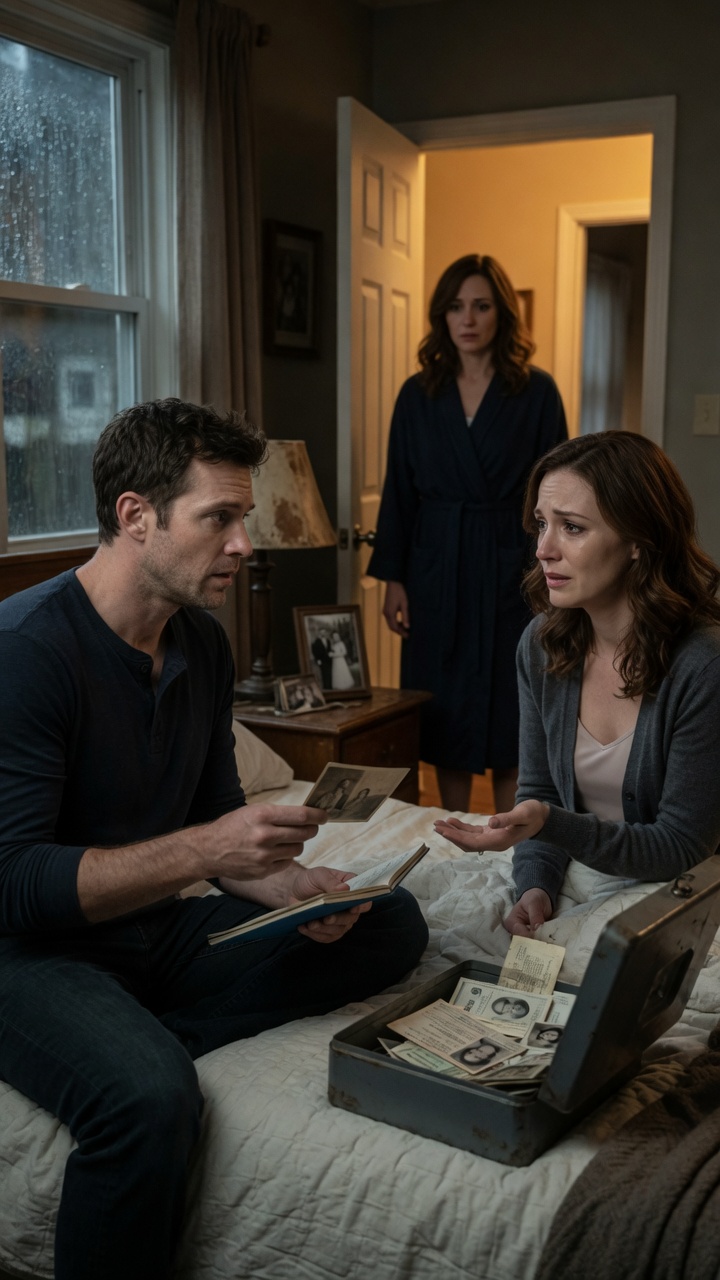
From behind a row of shoe boxes, she pulled out a small metal cash box.
Not a folder.
Not an envelope.
A cheap gray cash box with a dent in the corner and a strip of blue tape across the lid.
I had seen it before.
I thought it held old birthday cards.
She set it on the bed.
Her fingers shook as she opened it.
Inside were photographs.
A birth certificate.
A marriage license.
Two old driver’s licenses.
And a thin blue notebook with a cover bent from years of being opened and closed.
Claire touched the notebook but did not pick it up.
“Our mother kept this,” she said.
I stood by the dresser, arms folded, because if I relaxed them I did not know what I might do.
“Your mother died six years ago.”
“I know.”
“And you’re only showing me now?”
“She made us promise not to unless we had to.”
“Unless what?”
Claire looked at me.
“Unless someone came looking for Mara.”
The name landed wrong.
Not because of what she said.
Because of how she said it.
Like Mara was not the person I thought she meant.
I took one step closer.
“Claire.”
Her chin trembled.
“My name is Claire.”
“I didn’t say it wasn’t.”
She laughed quietly, painfully.
“No. You don’t understand. My name is Claire now.”
The room went silent.
Rain ticked softly against the window.
I stared at her.
“Now?”
She looked down at her wedding ring.
Then she slipped it off.
I felt something inside me go cold.
“Don’t do that,” I said.
She held the ring in her palm.
“I was born Mara Elizabeth Hayes.”
The words did not make sense at first.
They entered the room and stood there like strangers.
“No,” I said.
She nodded once.
“The woman you know as Mara was born Claire Rose Hayes.”
I shook my head.
“No.”
“Ethan—”
“No.”
I stepped back.
The dresser hit my hip.
“You are Claire.”
“I am your wife.”
“That is not the same answer.”
Her face broke.
“I know.”
The rain grew harder.
I heard it against the roof, against the gutters, against the glass.
Claire, or Mara, or whoever she was, reached into the box and pulled out one of the driver’s licenses.
She handed it to me.
The photo showed the face I knew.
Younger.
Nineteen maybe.
Hair shorter.
Eyes wider.
The name printed beside it was Mara Elizabeth Hayes.
My hand started to shake.
I looked at the date of birth.
Same birthday.
Of course.
I looked back at her.
“When?”
“Before I met you.”
My laugh came out sharp.
“That’s supposed to help?”
“No.”
“Why?”
She covered her mouth with one hand, then dropped it again.
“Because the real Claire was the one everyone believed in. The good daughter. The scholarship. The clean record. The future. And I was the one who made mistakes.”
I looked toward the box.
“What mistakes?”
“Nothing like you’re thinking.”
“I don’t know what I’m thinking.”
She nodded, tears sliding down now.
“When we were twenty-one, I got involved with a man named Victor Hale. He was older. Charming. Connected. He made me feel like I was the only person in the world who understood him.”
Her voice turned flat, like she had rehearsed saying this without feeling it.
“Then he started using my name. My signature. My face. He opened accounts. Signed documents. Moved money through things I didn’t understand until it was too late.”
I said nothing.
“One night, he told me if I ever tried to leave, he would make sure I was the one blamed for everything.”
She looked at the notebook.
“Our mother found out. Claire found out. They made a plan.”
I knew before she said it.
I hated that I knew.
“You switched names.”
“For a little while.”
“But you didn’t switch back.”
She closed her eyes.
“No.”
“Why?”
“Because Victor kept looking for Mara.”
My throat tightened.
“And Claire?”
“She became Mara on paper. She moved away for two years. Came back when things got quiet.”
I stared at the woman in front of me.
My wife.
Not my wife.
The only woman I had loved for eight years.
A stranger with the same memories.
No.
That was not right.
She was not a stranger.
That was what hurt most.
She had still been the woman laughing with me in the courthouse photo.
Still the one who held my hand when my father had surgery.
Still the one who stayed up all night with me when we lost our first pregnancy and I could not make myself speak.
Still the one who knew how I liked my coffee, how I hated being late, how I pretended not to cry at old movies.
But her name had been a locked room inside our marriage.
And now I was standing in it.
“Why now?” I asked.
She wiped her face.
“Victor is out.”
“Out of where?”
“Federal prison.”
My stomach dropped.
“He found her first,” she said.
“Claire?”
She nodded toward the window.
“The woman you know as Mara.”
I pressed my fingers against my eyes.
“Stop saying it like that.”
“I’m sorry.”
“No, you’re not sorry enough.”
She flinched again.
This time it did not feel good.
“He sent a message last week,” she said. “To her old email. The one she forgot existed.”
“What did it say?”
Claire reached into the box and took out her phone.
She opened a screenshot and handed it to me.
Unknown number.
I read the message twice.
Eight years is a long time to wear someone else’s life. I wonder if your husband can tell which one is which.
My skin went cold.
Below the text was a photo.
Our house.
Taken from across the street.
At night.
My truck in the driveway.
The bedroom window glowing softly upstairs.
I looked up.
“When was this?”
“Last Thursday.”
“You didn’t tell me.”
“I wanted to.”
“But instead you and your sister decided to test me?”
Her face twisted.
“It wasn’t supposed to happen like that.”
“How was it supposed to happen?”
“She was supposed to come here during the day. Sit with you. Talk to you. See if you could tell when she used my name.”
I stared at her.
“That is not better.”
“I know.”
“No, Claire, you don’t.”
“My name is—”
“Don’t.”
The word came out harder than I meant it to.
She stopped.
I pointed to the bed.
“You crossed a line no explanation can erase.”
Her shoulders folded inward.
“I know.”
“Then why?”
“Because Victor filed a petition yesterday morning.”
“What petition?”
“To challenge my identity.”
I stared at her.
“He says the woman married to you is not Claire Hayes Mercer.”
The room tilted again.
“He knows?”
“He suspects.”
“How?”
She looked at the courthouse photo on the nightstand.
“Because someone sent him our marriage announcement.”
“Who?”
“We don’t know.”
I picked up the photo.
My hand was still shaking.
The three of us smiled in the picture like people who believed the past had stayed buried because no one was holding a shovel.
“Tomorrow,” she said, “there’s an emergency hearing.”
I turned back.
“What hearing?”
“Victor is claiming that Claire Hayes Mercer committed identity fraud to avoid responsibility for the old accounts.”
I stared at her.
“He’s trying to put his crimes on you.”
“Yes.”
“And on your sister.”
She nodded.
“And if the court decides there is enough confusion, they can freeze everything. Accounts. Documents. Insurance. Our house.”
“Our house?”
Her mouth tightened.
“Because it’s in Claire Mercer’s name.”
I looked at my own hands, at the wedding band I had not removed in eight years.
“And me?”
Her eyes filled again.
“You may be called as a witness.”
“To say what?”
“To say whether you can identify your wife.”
For a long moment, I could not speak.
That was what Mara had meant.
A judge may ask you which one of us is really your wife.
I sat down on the edge of the bed because my legs no longer trusted the floor.
Claire sat beside me but left space between us.
For the first time in three days, she did not reach for me.
Good.
I would not have known what to do if she had.
“So you tested me,” I said.
She lowered her head.
“Yes.”
“You let her take your place because you needed to know if I could tell the difference under the most personal circumstances possible.”
Her silence was answer enough.
“That is insane.”
“I know.”
“That is cruel.”
“I know.”
“That is something you should have asked me, not done to me.”
She looked at me then, and the pain in her eyes was so raw I almost looked away.
“If I asked you, it wouldn’t have proved anything.”
I stood so fast she startled.
“Do you hear yourself?”
“Yes.”
“No. You hear fear talking and you think it sounds like logic.”
She covered her face.
I paced once across the room, then back.
Part of me wanted to leave.
Another part wanted to pull every item out of that gray cash box and force the entire truth into the light.
A third part, the weakest and most dangerous part, wanted to sit beside her and ask how afraid she had been.
I hated that part.
I hated it because it was still love.
Not clean love.
Not trusting love.
But love does not vanish just because the truth arrives.
Sometimes it stands there bleeding, asking what comes next.
I picked up the blue notebook.
Claire stiffened.
“Don’t.”
That made me open it.
The first page was written in an older woman’s handwriting.
Evelyn Hayes.
Claire and Mara’s mother.
I had loved Evelyn.
She was stern, funny, impossible to impress, and secretly kind in ways she hoped no one noticed.
The first line of the notebook made my chest tighten.
If Ethan ever reads this, then my girls waited too long.
I looked at Claire.
She was pale now.
“What is this?”
She whispered, “The thing I was supposed to give you before the wedding.”
The room seemed to shrink around us.
I looked back at the notebook.
The next page had my name again.
Ethan Mercer is a good man, or at least I believe he is. But goodness is not the same as knowing the whole truth. If one of my daughters is going to build a life with him, then he deserves more than a name.
I stopped reading.
“You had this before we got married?”
Claire did not answer.
I turned the page.
There was a photograph tucked inside.
Not of Claire.
Not of Mara.
Of me.
Younger, standing outside a hardware store, holding a paper bag and laughing at something outside the frame.
I had never seen the photo before.
I looked up slowly.
“Why did your mother have a picture of me?”
Claire stood.
“Ethan, please.”
My mouth went dry.
I looked back at the photograph.
On the back, in Evelyn’s handwriting, were five words.
He knew her before Cleveland.
I stared at the sentence until the letters blurred.
Before Cleveland?
I had met Claire in Cleveland.
At a charity dinner Mara had dragged her to because she hated going alone.
That was the story.
That had always been the story.
“What does this mean?” I asked.
Claire shook her head.
“That part isn’t what you think.”
“Then explain it.”
“I can’t.”
“You can.”
“No.” Her voice cracked. “I mean I don’t know all of it.”
I held up the photograph.
“You don’t know why your mother had a picture of me before I met you?”
She looked toward the doorway.
At first, I thought she was looking for a way out.
Then I heard it.
The front door opened downstairs.
A key turned in the lock.
Claire closed her eyes.
“No.”
Footsteps entered the house.
Slow.
Careful.
Not hiding.
Not rushing.
A woman’s voice called from below.
“Claire?”
I knew the voice.
Mara.
Or Claire.
The real Claire.
The name no longer meant what I thought it meant.
My wife turned toward the stairs.
“You shouldn’t have come,” she whispered.
The woman downstairs answered, “He needs to hear it from both of us.”
I looked at the photo again.
Then at the notebook.
Then at my wife, who had been born under another name and had carried mine for eight years.
The footsteps came up the stairs.
I did not move.
I did not breathe.
When the woman I had called Mara appeared in the doorway, her eyes went straight to the photograph in my hand.
Her face changed.
Not with fear.
With recognition.
She looked at my wife, then at me.
“Ethan,” she said softly, “before you ask another question, there’s something Evelyn never wrote down.”
My voice barely worked.
“What?”
She stepped into the room.
Behind her, rain tapped steadily against the bedroom window.
She looked at the courthouse photo on the nightstand, then at the blue notebook, then finally at me.
“The first time you met one of us,” she said, “it wasn’t at that charity dinner.”
My wife made a sound like a warning.
The other twin ignored her.
She looked straight into my eyes and said, “And if you remember where it really happened, you’ll understand why Victor came back now.”
To be continued…
If this story pulled you in, the next part reveals what Ethan forgot, why Evelyn had his photograph, and the real reason Victor waited eight years to return.


