My daughter Clara called me just after eight on a Thursday morning.
I was standing on a ladder, one hand buried in a gutter full of wet leaves, when my phone buzzed in my pocket.
“Morning, Dad,” she said.
The first thing I noticed was how tired she sounded.
The second thing I noticed was the noise behind her.
A loudspeaker. Rolling suitcases. The low murmur of impatient travelers.
“You at the airport already?” I asked.
“Of course,” she said with a weak laugh. “You know me. I’d rather sit there two hours early than arrive five minutes late and panic.”
That was Clara.
Even as a child, she had hated uncertainty. She packed her schoolbag the night before. She checked the stove twice. She made lists for everything.
But lately, after the divorce, that habit had turned into something sharper.
Doors locked twice.
Curtains closed before sunset.
Receipts filed in folders.
Her phone always faceup, always within reach.
She never told me she was afraid.
A father does not always need to hear the word to recognize the feeling.
“I just wanted to thank you,” she said, “for checking on the house while I’m gone.”
“It’s no trouble.”
“And for finding someone to mow the lawn.”
“Jesse,” I said. “Young guy from the hardware store bulletin board. Said he could come by around one.”
“Perfect.”
There was a pause.
Not long.
But long enough for me to notice.
“If you stop by today,” she said carefully, “don’t worry if the inside looks… empty.”
I frowned.
“Empty?”
“I packed a lot of things away before I left.”
“You moving to Phoenix without telling me?”
She laughed, but not the way she usually did.
“No, Dad. I just wanted everything tidy.”
It was a strange thing to say before getting on a plane.
But Clara had been strange for months.
Careful. Quiet. Measured.
Since her divorce from Evan, every conversation felt like it had a door behind it she refused to open.
“You’ll call when you land?” I asked.
“I promise.”
“I love you.”
“I love you too, Dad.”
Then the line went dead.
At the time, I thought it was an ordinary goodbye.
By sunset, I would understand it was the last normal moment of the day.
Around noon, I drove over to Clara’s house to water her flowers.
The neighborhood was quiet.
Her white shutters were closed. Her porch was spotless. No packages on the steps. No lights on inside.
Everything looked exactly the way it should have looked if a woman had locked up carefully and left town.
I checked the mailbox, watered the hanging baskets, and made sure the side gate latched behind me.
As I pulled away from the curb, a dark pickup truck rolled out from the far end of the street.
I could not see the driver.
I barely thought about it.
Later, I would wish I had.
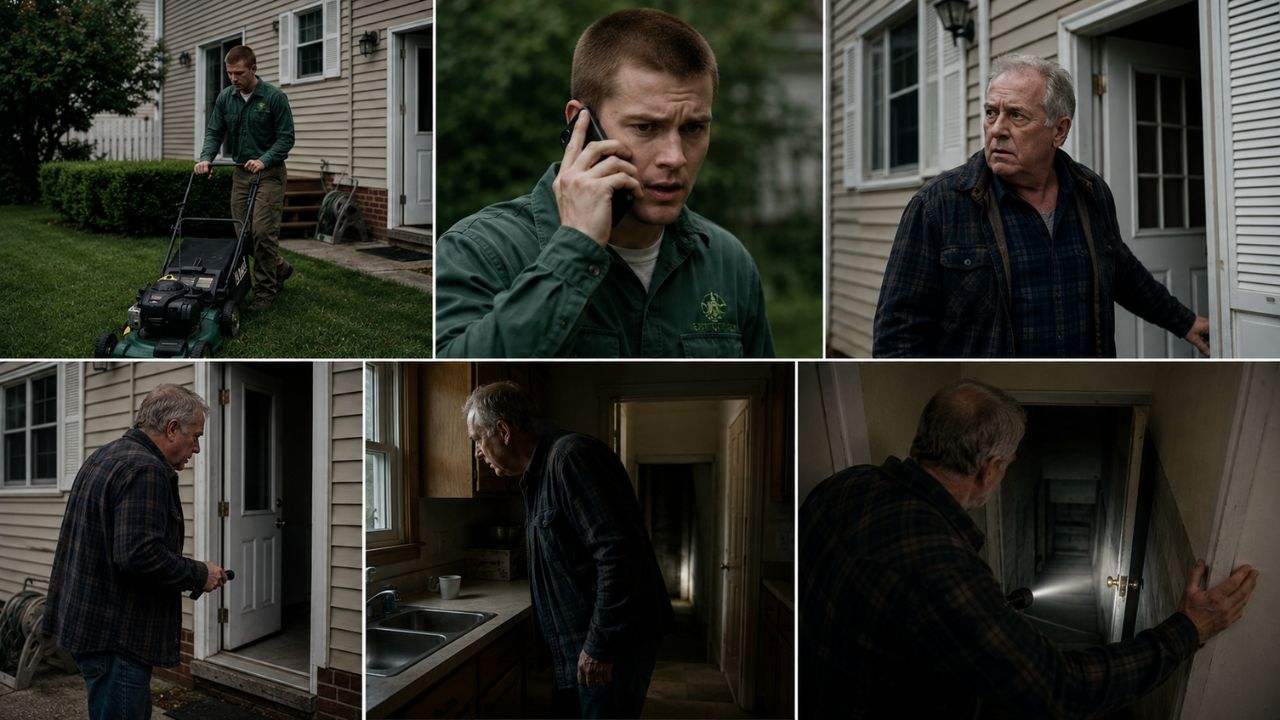
At 1:17 p.m., Jesse texted me a photo of Clara’s front lawn.
Freshly cut. Clean edges. Straight lines.
Looks good so far, Mr. Whitmore. Starting the backyard now.
I sent him a thumbs-up and went back to cleaning out my garage.
Forty minutes later, my phone rang.
It was Jesse.
But this time, his voice did not sound like the easygoing young man who had sent me the picture.
It was low.
Careful.
Almost embarrassed.
“Mr. Whitmore?”
“Everything alright?”
“I don’t know.”
Something in those three words made me put down the box I was holding.
“What happened?”
“I keep hearing somebody crying.”
My grip tightened around the phone.
“Crying?”
“Yes, sir.”
“From where?”
There was a pause.
Then he said the sentence that turned an ordinary Thursday into something I still think about months later.
“Inside your daughter’s house.”
For a second, I did not understand him.
“That’s impossible,” I said.
“I thought it was coming from another yard,” Jesse explained quickly. “I shut the mower off twice to check. But every time I stop, it sounds like it’s coming from inside.”
“Jesse, that house should be empty.”
“I know.”
“I was there this morning.”
“I haven’t gone in,” he said. “I swear. I just thought… if someone needed help…”
Behind his voice, I heard the mower engine go silent.
Then, through the phone, I heard it too.
Faint.
Thin.
A child crying.
Not a scream.
Not a tantrum.
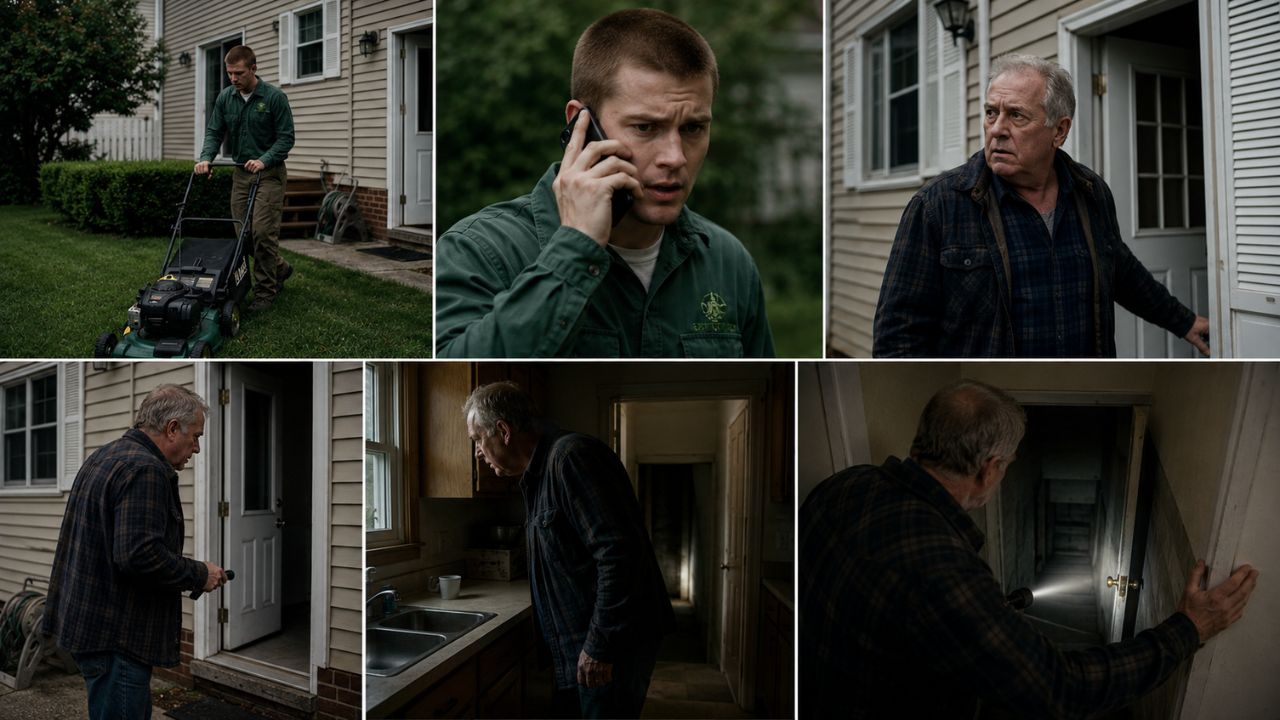
The kind of exhausted little cry a child makes after he has already cried too much.
Jesse whispered, “That’s what I’ve been hearing.”
My stomach tightened.
“Stay outside.”
“Yes, sir.”
“I’m on my way.”
I called Clara first.
Straight to voicemail.
I told myself she was on the plane.
Then I called Evan.
No answer.
That did not surprise me.
Evan rarely answered when my name appeared on his phone.
Their divorce had been final for nearly a year, but the fight over their two-year-old son, Liam, had never really ended. Court dates. Temporary schedules. Supervised exchanges. Lawyers speaking for parents who could no longer stand in the same room.
I backed out of my driveway so fast my trash cans rattled.
Halfway to Clara’s house, a memory returned.
Three weeks earlier, Clara had come to dinner with Liam.
She barely ate.
After I cleared the plates, she asked, “Dad, would you think it was strange if someone kept driving past your house?”
I looked up.
“How often?”
“Almost every evening.”
“Is someone doing that to you?”
She stared down at her glass.
“It’s probably nothing.”
I should have pressed her.
I should have gone outside that night and checked every street.
I should have asked the question fathers sometimes avoid because they are afraid of the answer.
Instead, I let her change the subject.
Now there was a child crying inside a house that was supposed to be empty.
And I was suddenly afraid Clara had been telling me the truth in pieces because the whole truth was too frightening to say out loud.
When I reached the house, Jesse was standing beside his mower in the backyard.
He looked relieved to see me.
“I stayed outside like you said.”
“Good.”
He pointed toward the back door.
“It comes and goes.”
As if the house had been waiting for me, the cry drifted out again.
Soft.
Weak.
A little boy’s cry.
My grandson’s cry.
“I hear it,” I said.
Jesse swallowed.
“I thought maybe I was imagining it.”
“You weren’t.”
We walked around the back steps.
At first, nothing looked wrong.
No broken glass.
No forced lock.
No footprints in the flowerbeds.
But then I saw the grocery bag tipped over near the door.
A carton of crackers had spilled onto the grass.
Beside it was a receipt.
I picked it up.
The timestamp was less than two hours old.
Chicken noodle soup.
Bananas.
Apple juice.
Children’s fever medicine.
Diapers.
Pediatric electrolyte drinks.
Someone had been shopping for a sick toddler.
Someone had been inside Clara’s house that day.
Jesse stared at the receipt.
“I never saw anyone come back here.”
Neither had I.
Then I noticed the back door.
It was closed, but it had not latched.
That stopped me cold.
Clara never left doors unlatched.
Not anymore.
Since the divorce, she checked locks like they were life support.
I reached beneath the ceramic frog by the flowerpot.
The spare key was still there.
My fingers closed around it.
Jesse shifted behind me.
“Maybe we should call the police first.”
He was right.
That would have been the reasonable thing.
Then the cry came again.
This time, softer.
More tired.
And every reasonable thought in my head lost to one simple fact.
If Liam was inside that house, I was not waiting on the porch.
The kitchen smelled like warm soup.
A small saucepan sat on the stove.
A child’s plastic cup rested beside the sink, still wet from being washed.
The house was not abandoned.
Someone had been living in it.
Quietly.
Carefully.
Jesse stayed near the doorway.
“I’ll stay right here.”
I nodded.
Then I heard a whisper.
A woman’s whisper.
“It’s okay, sweetheart.”
My heart slammed against my ribs.
The voice was coming from the basement.
The basement door stood at the end of the hall, cracked open.
Clara hated open doors.
Closets, cabinets, bedrooms, basement — everything had to be closed.
Always.
I pushed the door wider.
Cool air drifted up the stairs.
The whispering stopped.
So did the crying.
“Hello?” I called.
No answer.
Only the faint creak of someone moving below.
Jesse’s voice dropped behind me.
“Mr. Whitmore… maybe we should wait.”
But halfway down the stairs, I saw something that made the air leave my lungs.
A baby blanket.
Folded neatly on the landing.
Yellow ducks stitched along the edge.
My wife had sewn that blanket before Clara was born.
It had stayed in an old cedar chest upstairs for years.
It did not belong on a basement staircase.
At the bottom, I stepped into a room I no longer recognized.
Clara’s unfinished basement had become a hidden apartment.
A mattress in one corner.
Children’s books stacked on a low shelf.
Bins of folded toddler clothes.
Diapers.
Bottled water.
Canned food.
Medicine.
A small fan.
A cooler.
And on a folding table, rows of legal documents arranged with the kind of precision only fear can create.
Nothing was messy.
Nothing was neglected.
This was not a place someone had fallen into.
This was a place someone had prepared.
Then I heard a tiny cough.
Liam sat on the mattress, clutching his stuffed rabbit.
His cheeks were flushed red with fever.
His eyes filled when he saw me.
“Grandpa,” he whispered.
Before I could move, a woman stepped from the corner and lifted him into her arms.
She kissed his forehead.
Then she looked at me.
“Dad.”
Clara.
She was wearing the same sweater from the morning phone call.
Her hair was tied back loosely.
Dark circles sat beneath her eyes.
She looked exhausted.
She did not look surprised.
Only relieved.
“You never got on the plane,” I said.
She held Liam closer.
“No.”
Her voice broke.
“I couldn’t leave him.”
For a moment, I could not speak.
Because anger came first.
Not at her.
At the fear that had made my own daughter hide beneath her own house.
At the fact that she had been close enough for me to help, and still believed she had to stay silent.
Jesse quietly stepped back up the stairs.
“I’ll give you both a minute,” he said.
Clara waited until his footsteps faded.
Then she whispered, “I’m sorry.”
I looked around the basement again.
“This is why you told me the house would look empty.”
She nodded.
“I needed Evan to believe I was gone.”
“The truck,” I said.
Her eyes sharpened.
“You saw it?”
“One leaving the neighborhood earlier.”
“It was him.”
She said it without hesitation.
“Not today for the first time. He’s been driving past almost every night.”
My blood went cold.
“Why didn’t you tell me?”
“Because I know you.”
That hurt because it was true.
“If I told you everything,” she said, “you would have gone straight to his house.”
“I might have.”
“And then his lawyer would say my family was interfering. That I was escalating. That I was trying to turn people against him before Monday.”
“Monday?”
She pointed to the table.
“My attorney filed for an emergency custody order.”
She handed me a folder.
Inside were photographs.
Messages.
Police reports.
Notes from missed exchanges.
A statement from Clara.
A neighbor’s written account of Evan’s truck circling the block.
One photo showed bruising on Liam’s upper arm.
Another document showed Evan had returned him nearly four hours late after a visit.
Then I saw the sentence Clara had written in her statement.
He told me one day he would not bring Liam back.
I looked up.
“He threatened you.”
Her eyes filled.
“At the last drop-off. He smiled like he was telling a joke and said, ‘One day I won’t bring him back, Clara. You’ll never see him again.’”
My hands tightened around the folder.
“I reported it,” she said quickly. “I did everything right. Police. Lawyer. Documentation. But without a witness, it was his word against mine.”
“So you pretended to leave town.”
“I really went to the airport,” she said. “I checked in. I sat at the gate. I called you from there.”
“But you came home.”
“When they called my boarding group, I stood up…”
She looked down at Liam.
“And all I could think was, what if I leave and something happens? What if Monday is too late?”
Liam coughed again, and she rubbed his back.
“He had a fever this morning. I couldn’t put him on a plane. And I couldn’t leave him here with someone circling the house.”
“So you came back and hid downstairs.”
“I stayed in my legal residence,” she said quietly. “My lawyer told me not to disappear with Liam unless there was an immediate emergency. Evan’s attorney would use it against me.”
I understood then.
She had not been hiding from the law.
She had been hiding inside the law.
Trying to survive the weekend without giving Evan a weapon to use in court.
“And the upstairs?” I asked.
“Empty. Clean. Curtains closed. No lights. If he drove by, I wanted him to think I was gone.”
“The blanket on the window?”
She nodded toward the basement window.
“I covered it after dark so no light showed.”
My wife’s blanket.
Used as a shield.
Something inside me broke a little at that.
Liam stirred in her arms and reached one hand toward me.
“Grandpa.”
I stepped forward and touched his warm cheek.
“Hey, buddy.”
He lifted his stuffed rabbit.
“Rabbit sick too.”
I smiled, though my throat burned.
“Then we’ll take care of both of you.”
Clara looked away.
“I didn’t want you dragged into this.”
“You are my daughter.”
“I know.”
“And he is my grandson.”
“I know.”
“Then listen carefully,” I said. “You are not spending another night in this basement.”
Fear crossed her face.
“Dad—”
“No. You’ve been smart. You’ve been careful. But you’re done being alone.”
“What if Evan drives by?”
“Then he’ll see what you wanted him to see.”
“What?”
“An empty house.”
She stared at me.
“Where would we go?”
“My house.”
“What if he follows?”
“He won’t.”
“How do you know?”
“Because we won’t leave without witnesses.”
I called Daniel, an old friend who had retired after thirty years with the sheriff’s department.
He arrived twenty minutes later with another retired deputy from the neighborhood watch.
They did not come to threaten anyone.
They came to observe.
To document.
To make sure Clara and Liam could leave without disappearing into someone else’s story.
“If Evan comes by tonight,” Daniel said, “he’ll be on three cameras before he knows he’s being watched.”
For the first time all day, Clara’s shoulders dropped.
She was still scared.
But she was no longer alone inside that fear.
We packed only what Liam needed.
Medicine.
Pajamas.
Two books.
Clean clothes.
The stuffed rabbit.
Before we left, Clara folded the duck-patterned blanket and held it to her chest.
“Mom made this,” she whispered.
“I know.”
“I kept thinking… if she were here, she’d know what to do.”
I put my hand on her shoulder.
“She would tell you exactly what I’m telling you.”
Clara looked at me.
“You don’t have to prove you’re strong by suffering quietly.”
Monday morning came with rain.
The courthouse steps were slick and gray.
Clara’s attorney met us near the entrance, carrying more folders than I could count.
The emergency hearing lasted most of the afternoon.
The judge reviewed photographs, police reports, messages, neighbor statements, and security footage showing Evan’s truck lingering outside Clara’s house on multiple evenings.
Evan’s attorney argued.
Clara’s attorney answered.
Clara sat straight-backed with her hands folded in her lap.
Once, when Liam’s name was mentioned, I saw her fingers tremble.
But she did not break.
By the end of the hearing, the judge issued a temporary emergency order.
Evan’s visitation was suspended until a full custody hearing.
All future contact regarding Liam would be supervised through the court.
It was not the end.
It was not a perfect victory.
There would be more hearings. More questions. More pages of evidence. More days when Clara would have to tell the same painful story in rooms full of strangers.
But for the first time in months, she walked out of a building without checking over her shoulder.
Outside, rain fell softly.
Liam reached for her.
She lifted him and held him close.
Not because she was afraid someone would take him.
Because, for one breath at least, she was allowed to hold him like a mother instead of a guard.
Months later, I went back to Clara’s house to help organize the basement.
The mattress was gone.
The cooler was gone.
The folding table had been put away.
Sunlight came through the uncovered window.
Liam’s books were upstairs in his room now.
His clothes were in his dresser.
The duck blanket went back into the cedar chest where it belonged.
Outside, I heard a lawn mower.
Jesse was cutting the front yard again.
He saw me and waved.
“Everything okay now, Mr. Whitmore?”
I looked toward the house.
The shutters were open.
The porch had toys on it.
A small pair of muddy shoes sat by the door.
For once, the house looked lived in.
“Yes,” I said. “Much better.”
Sometimes people think a mystery begins with a scream, a broken window, or a shadow at the door.
Ours began with a young man stopping a lawn mower because something did not feel right.
It began with a faint cry in a house that was supposed to be empty.
And it ended with me learning the hardest truth a father can face:
My daughter had not been hiding a secret from me.
She had been hiding her fear.
And the real mystery was not who was inside the house.
It was how long she believed she had to survive alone.