For fifteen years, I told people my stepmother left because she never truly loved us.
I said it at family dinners.
I said it to friends.
I said it to my wife the first time she asked why there were no pictures of that woman in my house.
“She walked away right after my father’s funeral,” I would say. “That tells you everything you need to know.”
And for fifteen years, I believed it.
I believed she had been kind only because my father was alive.
I believed the packed lunches, the birthday cakes, the rides to school, the nights she sat beside my bed when I had the flu — all of it had been an act.
Because when my father died, she disappeared.
No explanation.
No goodbye.
No phone call.
No letter.
Just gone.
She took her son with her and left our house empty in a way death alone had not managed to do.
My father’s death broke my heart.
Her leaving hardened it.
I was twenty years old then, old enough to think I understood betrayal and young enough to turn pain into certainty.
So I hated her.
Quietly at first.
Then completely.
Her name was Margaret.
But after she left, I stopped calling her that.
To me, she became “my father’s wife.”
Not my stepmother.
Not family.
Just the woman who walked out when the ground beneath me had already collapsed.
Fifteen years passed that way.
I graduated from college.
I got my first apartment.
I married a woman named Claire.
I built a life.
And every time someone asked about my childhood, I told the same short version.
My mother died when I was young.
My father remarried.
My stepmother pretended to care.
Then Dad died, and she left.
That was the story I carried.
That was the story I polished until it became truth.
Then, on a cold Thursday morning in November, my phone rang.
The number was unfamiliar.
I almost didn’t answer.
“Is this Daniel Whitaker?” a man asked.
“Yes.”
“My name is Alan Reeves. I’m an attorney in Vermont. I represented Margaret Hayes.”
I froze.
I had not heard her name spoken aloud in years.
“Margaret passed away last week,” he continued.
I looked out the kitchen window at the bare trees behind my house.
I waited to feel something.
Grief.
Shock.
Even satisfaction.
But all I felt was a strange, hollow silence.
“I’m sorry,” I said, because that was what people said when someone died.
“There are documents she wanted you to receive,” the attorney said. “She was very specific that they be given to you in person.”
I almost laughed.
“In person? Why?”
“I believe it would be best if you came to the office.”
“I haven’t spoken to that woman in fifteen years.”
There was a pause.
“I understand,” he said gently. “But she left instructions. And there is someone else who would like to be present.”
“Who?”
“Her son. Michael.”
My stepbrother.
I had not seen Michael since the day after my father’s funeral.
He had been sixteen then. Quiet. Thin. Always looking like he wanted to say something but didn’t know whether he was allowed.
I remembered him standing near the front door with a backpack over one shoulder while Margaret carried two suitcases to her car.
I remembered yelling at her.
“You’re just leaving?”
She had turned around, and for one second, I thought she might run back inside and explain everything.
Instead, she pressed her lips together.
“I’m sorry, Daniel,” she said.
That was all.
Then she got in the car and drove away.
I never forgave her for those three words.
I told the attorney I would think about it.
Then I hung up.
Claire found me still standing in the kitchen ten minutes later, coffee untouched in my hand.
“What happened?” she asked.
I told her.
She was quiet for a moment.
“You should go.”
I shook my head. “There’s nothing she could say to me now.”
“She’s not saying it,” Claire said softly. “She’s gone.”
That made me angry in a way I didn’t understand.
Maybe because she was right.
Maybe because death has a way of stealing the argument you spent years preparing.
Two days later, I drove three hours north to the attorney’s office.
It sat above a small bank on Main Street, in one of those old brick buildings with narrow staircases and frosted glass doors.
Michael was already there when I arrived.
For a second, I didn’t recognize him.
He was thirty-one now, broader in the shoulders, with a beard and tired eyes.
But when he stood, I saw the same quiet boy from fifteen years ago.
“Daniel,” he said.
“Michael.”
We didn’t hug.
There was too much history between us, and not enough of it spoken.
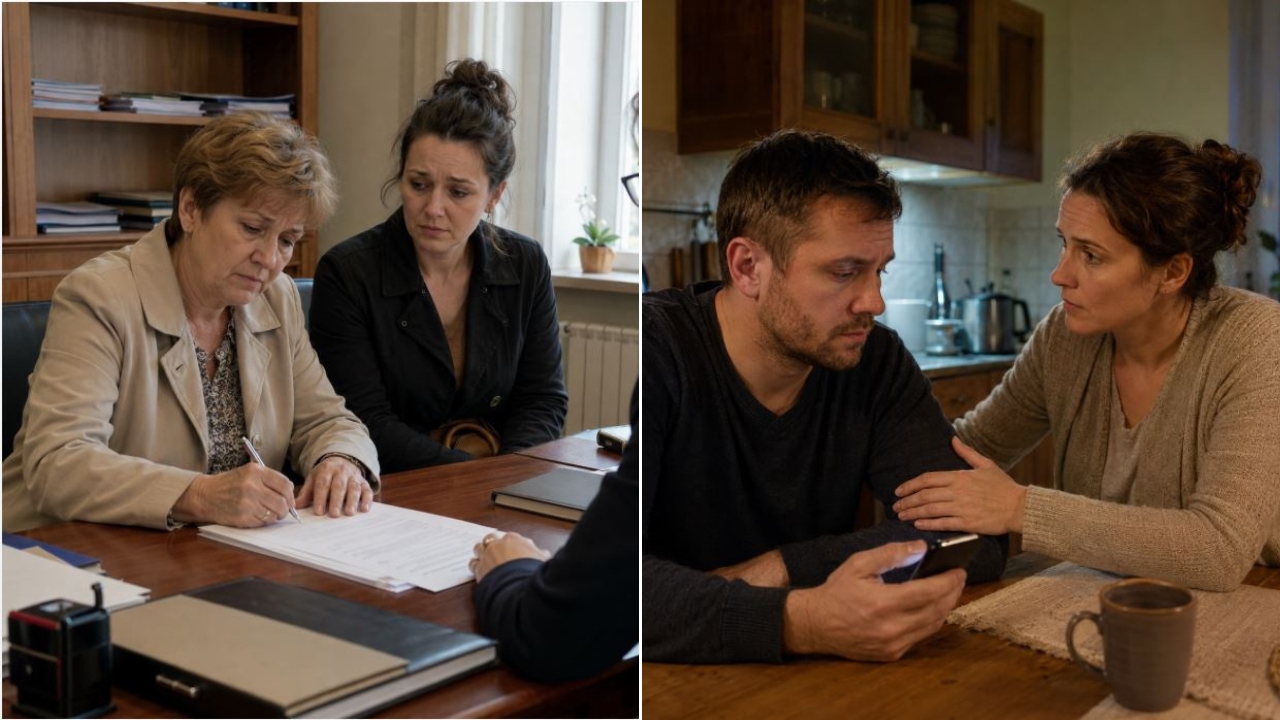
The attorney led us into a conference room.
On the table sat a cardboard file box, a leather photo album, and a sealed envelope with my name written across the front.
The handwriting stopped me cold.
It was my father’s.
I knew it immediately.
The sharp D.
The way he crossed his T’s too hard.
The slight tilt of every word, like he was always writing in a hurry.
My mouth went dry.
“What is this?” I asked.
The attorney folded his hands.
“Your father wrote this shortly before he died. Margaret kept it according to his instructions.”
I stared at the envelope.
“My father died fifteen years ago.”
“Yes.”
“And she had this the whole time?”
“Yes.”
Anger rose in my chest before anything else could.
“She had a letter from my father and never gave it to me?”
Michael lowered his eyes.
The attorney did not flinch.
“Mr. Whitaker, I think you should read it.”
I wanted to leave.
I wanted to push the envelope away and tell them whatever performance they had planned was fifteen years too late.
But my father’s handwriting held me there.
My hands trembled as I opened it.
Inside were several folded pages.
The first line made my stomach drop.
My son,
If you are reading this, then both Margaret and I are gone. And if she kept her promise, you have spent many years believing she abandoned you.
I stopped reading.
The room seemed to tilt.
Michael sat across from me, his eyes already red.
“What is this?” I whispered.
He swallowed.
“Please keep reading.”
I looked back at the page.
I know you will hate me for what I asked her to do. Maybe you already do. Maybe you hated her first, because that was easier. I don’t blame you. You were young, and grief makes simple stories feel safer than complicated truths.
I blinked hard.
Three months before my death, I was diagnosed with an aggressive illness. I tried to keep the worst of it from you because you were already carrying too much. But during that time, my attorney discovered something else. Years earlier, a business partner had manipulated financial records connected to the company your grandfather and I built. There was an investigation coming. A real one.
I frowned.
My father had owned part of a small manufacturing company when I was young.
I knew almost nothing about it.
By the time I was in high school, he rarely mentioned it. I assumed he had sold his share or stepped back from it.
The letter continued.
I was not the target, but my name was still on old documents. If the investigation moved forward before I put things in order, assets tied to me could have been frozen for years. Your college fund. The house. The accounts I had built for you. Even property that should have been yours could have become trapped in a legal battle you were too young and too heartbroken to fight.
My fingers tightened around the paper.
So I did the only thing I could do. I asked Margaret to help me create a legal trust for you. Everything was handled through attorneys. Everything was documented. Everything was meant to protect you, not hide anything from the law. But if certain relatives, creditors, or old business associates knew Margaret was helping me, they would have challenged her, pressured her, or used her connection to you to reach what I wanted protected for your future.
A strange buzzing filled my ears.
Margaret offered to stay and fight it openly. I told her she could not. If she stayed, people would come after her. If she explained, the plan could unravel. If she defended herself, she would expose what I was trying to protect.
I covered my mouth with one hand.
Then came the sentence that changed the shape of my entire life.
So I asked her to do something cruel. I asked her to leave after my funeral. I asked her to let everyone believe she had abandoned you.
I stopped breathing.
For fifteen years, I had built my anger around that moment.
Her suitcase.
Her car.
Her quiet apology.
I had thought those things proved she never loved me.
Now my father was telling me they had been part of his final request.
She argued with me for hours, Daniel. She cried harder than I had ever seen her cry. She said you had already lost too much. She said leaving you would break something between you that might never heal. She was right. But she loved you enough to let you hate her if it meant protecting what I could leave behind.
The page blurred.
I remembered Margaret sitting at our kitchen table with a calculator, helping me fill out college forms.
I remembered her sewing a button onto my graduation shirt because I had forgotten until the morning of the ceremony.
I remembered her standing in the rain during my baseball games, clapping even when I struck out.
I remembered the year I turned fourteen and pretended I was too old for birthday cake.
She made one anyway.
Chocolate, with crooked white frosting.
She placed it on the table and said, “You don’t have to admit you like it. Just eat it.”
I had laughed.
Back then, I had loved her.
That was the part I had buried deepest.
Not because it wasn’t real.
Because it had been real.
And losing her after losing my father had hurt so badly that hatred became easier than grief.
I forced myself to keep reading.
After I die, Margaret will move away with Michael. She will not explain herself. She will not defend herself. She will never ask you to understand. That is the price I asked her to pay.
I looked up.
Michael was crying silently.
“You knew?” I asked.
He nodded.
“I knew some of it. Not all of it. I was sixteen. My mom told me your dad made her promise not to contact you. She said one day you’d know.”
“One day?” My voice broke. “Fifteen years, Michael.”
“I know.”
“She could have told me.”
“She wanted to.”
“Then why didn’t she?”
He wiped his face with his sleeve.
“Because she gave your dad her word.”
I almost laughed because it sounded impossible.
Who keeps a promise that destroys them?
Who lets a child hate them for fifteen years?
Who chooses silence when the truth could save them?
The answer sat in front of me in my father’s handwriting.
Margaret did.
The next pages were harder to read.
My father explained the trust.
He named the attorney who created it.
He listed accounts, insurance policies, property transfers, and investment funds.
All legal.
All documented.
All protected for me.
When I was twenty, I thought the modest inheritance I received after my father’s death was all he had left.
It paid for part of school.
It helped me buy my first car.
But I struggled for years after that. I worked two jobs. I took loans. I told myself my father had done what he could.
He had.
I just hadn’t known how much.
The attorney opened the cardboard box and began placing documents on the table.
Bank records.
Trust statements.
Property deeds.
Investment summaries.
Insurance documents.
Every folder had labels.
Every account had records.
And every final beneficiary listed my name.
The total was more than two million dollars.
I stared at the number.
A week earlier, that amount would have stunned me.
It would have changed everything.
But sitting in that room, with my father’s letter in my hands and Margaret’s name on every document as trustee, the money felt almost meaningless.
Because the real inheritance was not the accounts.
It was the truth.
And the truth was devastating.
For fifteen years, I had called her selfish.
For fifteen years, I had told people she left because she did not care.
For fifteen years, I had erased every good thing she had ever done because one painful ending made it easier to rewrite the beginning.
The attorney slid the final page toward me.
“There is one more paragraph from your father,” he said quietly.
I looked down.
If you are reading this now, then Margaret kept her promise until the end. Please do not remember her as the woman who left. Remember her as the woman who sacrificed everything so you could have a future. If you can, forgive us both.
That broke me.
Not quietly.
Not politely.
I bent forward over the table and cried like I had not cried since my father died.
I cried for him.
I cried for Margaret.
I cried for the boy I had been, standing in the doorway, watching the second parent in his life leave without understanding why.
And I cried because I had been wrong.
So completely wrong.
After a long time, Michael pushed the leather photo album across the table.
“My mom wanted you to have this too.”
I wiped my face.
“What is it?”
“Open it.”
The cover was worn at the corners.
Inside were photographs.
At first, I didn’t understand what I was looking at.
There was a picture of me in my college graduation gown, standing between two friends.
Another of me outside my first apartment.
Another from my wedding day.
Claire and I walking down the church steps.
Me laughing with my best man.
Me holding my newborn daughter in the hospital hallway.
My hands went cold.
“How did she get these?”
Michael smiled sadly.
“She followed your life from a distance.”
I looked up.
“What?”
“Not in a strange way,” he said quickly. “She never tried to interfere. She never came close enough for you to see her. But she kept track. Through public posts. Through people who still knew both families. Through announcements. Sometimes through me.”
“You?”
“She asked about you all the time.”
I turned another page.
There were newspaper clippings.
My college graduation announcement.
A small article about the company where I got promoted.
A printed photo from my wedding website.
A birth announcement for my daughter.
Each page had notes written in Margaret’s handwriting.
Daniel looks happy.
He has his father’s smile here.
I wish I could tell him how proud I am.
My chest tightened until it hurt.
“She came to your graduation,” Michael said.
I looked at him sharply.
“No, she didn’t.”
“She sat in the back. She left before it ended.”
I stared at the photo again.
“She came to the wedding too,” he added.
My mouth opened, but no words came out.
“She stood across the street for about ten minutes. Mom said you looked so happy she didn’t want to ruin the day by making you angry.”
I pressed my hand against my eyes.
All those years, I thought she had vanished.
But she had been there.
Not in the way I wanted.
Not in the way I deserved as a grieving young man.
But in the only way she believed she was allowed.
Michael reached into the file box and pulled out a bundle of envelopes tied with a blue ribbon.
“There’s more.”
I knew before he said it.
“Every birthday,” he whispered. “She wrote you a letter. She never mailed them.”
He placed them in front of me.
Fifteen envelopes.
Each one had my name.
Daniel — 21
Daniel — 22
Daniel — 23
The room went quiet again.
I opened the first one with shaking hands.
My dear Daniel,
Today you turn twenty-one. I wonder if your father would have made a terrible joke about you being old enough to buy him a drink. He would have been so proud of you. I hope you are eating well. I hope school is not too hard. I hope someone remembered to make you chocolate cake.
I covered my mouth.
Chocolate cake.
She remembered.
Another letter.
Daniel,
I saw a photo from your graduation. You looked so much like your father that I had to sit down. I wanted to run to you. I wanted to tell you I was proud. I wanted to say I was sorry. But I promised him. I hope one day that promise will make sense to you.
Another.
Daniel,
I heard you got married today. I stood far enough away that you would not see me. Your bride looked beautiful. You looked nervous and happy. I cried in the car afterward for almost an hour. Not because I was sad you married. Because I was not there to straighten your tie the way I once thought I would be.
The letters became impossible to read without stopping.
Every page carried the life I thought she had ignored.
Every sentence proved she had carried me in silence.
Then I reached the final envelope.
It was different.
The paper was thicker.
The handwriting weaker.
On the front, Margaret had written:
For my son.
Not stepson.
Not Daniel.
My son.
I sat there for a long time before I opened it.
Inside was one page.
My dear boy,
If this letter has reached you, then I am gone, and you know at least part of the truth.
I have imagined this moment many times. Sometimes I imagined you angry. Sometimes I imagined you refusing to read anything at all. Sometimes, on days when I allowed myself to be selfish, I imagined you forgiving me.
I need you to know this.
Leaving you was the hardest thing I ever did.
Not losing my reputation.
Not hearing what people said about me.
Not knowing you believed I had never loved you.
The hardest part was knowing you needed comfort and that I had promised not to be the one to give it.
Your father was afraid. Not for himself. For you. He wanted your future protected. He believed I was strong enough to carry the blame.
I told him I was not.
But I did it anyway.
Because I loved him.
And because I loved you.
You may wonder why I never broke the promise. I asked myself that question for fifteen years. Every birthday. Every Christmas. Every time I saw a picture of you smiling and knew I had no right to stand beside you.
The only answer I have is this: your father trusted me with the last thing he could still protect.
You.
I hope one day you understand that I did not leave because I loved you less.
I left because I loved you more than my own need to be remembered kindly.
Not a single day passed that I did not think of you.
I loved you from the moment I became part of your life.
And I never stopped.
Margaret
I pressed the letter to my chest and broke down again.
Michael moved to sit beside me.
For the first time in fifteen years, I hugged my stepbrother.
Not politely.
Not awkwardly.
I held on to him like he was the last living bridge to a family I had misunderstood.
“I’m sorry,” I said.
He shook his head.
“You were a kid.”
“I hated her.”
“She knew.”
That made it worse.
“Did she hate me for it?”
Michael looked at me, almost surprised.
“No. Never.”
I stared at him.
“She defended you,” he said. “Whenever I got angry and said you should have tried to find her, she would say, ‘He lost his father. Let him be angry at me if that helps him survive it.’”
I closed my eyes.
There are certain kinds of love that look weak from the outside because they do not fight to be seen.
But maybe the strongest love is the kind that keeps protecting someone even after being hated for it.
The attorney explained the remaining details.
The trust was now fully mine.
Margaret had managed it for years without taking a cent beyond legal administrative expenses, all documented and approved.
She had lived modestly.
She had worked as a bookkeeper for a local nonprofit.
She had never remarried.
When I asked where she was buried, Michael gave me the name of the cemetery.
It was only twenty minutes away.
I drove there alone.
The sky had gone gray by then, and a light rain had begun to fall.
The cemetery sat behind a white church at the edge of town.
Margaret’s grave was near a line of maple trees.
Her headstone was simple.
Margaret Elaine Hayes
Beloved Mother
There was no mention of sacrifice.
No mention of promises.
No mention of the boy who had hated her because she loved him enough to keep silent.
I stood there with my coat open and the rain soaking through my shirt.
For a long time, I said nothing.
What do you say to someone who spent fifteen years loving you from a distance?
What do you say when the apology comes too late to be heard?
I knelt in the wet grass.
“I’m sorry,” I whispered.
The words felt too small.
So I said them again.
“I’m so sorry.”
I told her I remembered the lunches.
I told her I remembered the birthday cake.
I told her I remembered how she sat beside me when I was sick and rubbed circles on my back until I fell asleep.
I told her I remembered how she used to call me “my boy” when she thought I wasn’t listening.
Then I cried because I finally understood that she had never stopped meaning it.
The rain softened.
A wind moved through the trees.
I do not believe grief disappears.
I think it changes shape when the truth finally reaches it.
For fifteen years, my grief had worn the face of anger.
That day, at Margaret’s grave, it became something else.
Sorrow.
Gratitude.
Love.
And peace.
I could not give her back the years I had spent hating her.
I could not unsay the things I had said.
I could not let her hear me call her family while she was still alive.
But I could tell the truth now.
So I did.
At her funeral service the following week, only a small group of people attended.
A few neighbors.
Some former coworkers.
Michael.
Me.
When the pastor asked if anyone wanted to speak, I stood.
My hands shook as badly as they had when I first opened my father’s letter.
I looked at the people gathered there and realized most of them knew Margaret as a quiet woman who kept to herself.
They did not know she had carried another family’s future on her shoulders.
They did not know she had allowed herself to be misunderstood because a dying man asked her to protect his son.
So I told them.
Not everything.
Some details belonged only to us.
But I told them enough.
I told them she had been loyal.
I told them she had been brave.
I told them she had loved a child who spent too many years believing otherwise.
And at the end, I said the words I should have said long ago.
“She was not the woman who left me. She was the mother who kept loving me when I gave her nothing in return.”
Michael cried.
Claire squeezed my hand.
And for the first time in fifteen years, when I said Margaret’s name, I did not feel anger.
I felt the ache of being loved better than I deserved.
After the service, Michael handed me one last thing.
It was a small photo in a silver frame.
I recognized it immediately.
I was fourteen.
My father stood on one side of me, Margaret on the other.
There was chocolate frosting on my chin, and I looked annoyed that someone had taken the picture.
But Margaret was laughing.
My father was looking at her.
And her hand rested lightly on my shoulder.
On the back, in her handwriting, she had written:
The year Daniel pretended he was too old for cake.
I keep that photo on my desk now.
Beside it, I keep the envelope that says For my son.
Sometimes my daughter asks about the woman in the picture.
For a long time, I did not know what to call her.
Now I do.
“That’s your grandmother Margaret,” I tell her. “She loved us very much.”
And when my daughter asks why she never met her, I tell her the simplest truth I can.
“Because sometimes grown-ups make painful choices trying to protect the people they love. And sometimes we understand them too late.”
I wish I had understood sooner.
I wish I had opened my heart before I opened that letter.
But life does not always give us truth when we want it.
Sometimes it gives us truth when we are finally ready to be broken by it.
For fifteen years, I thought Margaret’s silence meant she had abandoned me.
Now I know her silence was the sound of a promise being kept.
And some promises cost more than anyone will ever see.