For most of my life, I believed Harold Whitaker hated me.
Not loudly. Not cruelly in a way other people could see.
His rejection was quieter than that.
It was the empty chair he never pulled out for me at dinner. It was the way he called me “your daughter” when speaking to my mother, as if saying my name would make me too real. It was how he bought his son new work boots every winter while I learned to stuff cardboard inside mine when the soles split.
I was fourteen when my mother married him.
We lived in a small town outside Asheville, North Carolina, in a yellow house with a sagging porch and hydrangeas that bloomed every spring no matter how hard the winter had been.
My mother, Elaine, had been a widow for six years. My father died when I was eight, and for a long time, it had been just the two of us.
Then Harold came along.
He owned a hardware store on Main Street. He was tall, quiet, and practical, the kind of man who smelled like sawdust, metal shelves, and black coffee. Everyone in town respected him. Women at church told my mother she was lucky to have found a steady man.
I wanted to believe that too.
At first, I tried.
I set the table before he came home. I helped my mother make meatloaf and mashed potatoes. I said, “Good evening, Mr. Whitaker,” because I didn’t know what else to call him.
He would nod, hang his coat by the door, and walk past me.
My mother noticed. Of course she did. Mothers notice everything, even the things they pretend not to see.
“Give him time, Claire,” she would whisper. “He isn’t good with feelings.”
But children do not understand emotional limits. They understand who reaches for them and who does not.
Harold did not.
When I turned sixteen, my mother got sick.
At first, it was small things. She sat down while cooking. She forgot names of neighbors she had known for twenty years. She said her bones hurt.
By Christmas, the doctors were using careful voices.
Cancer.
I remember sitting in a hospital hallway with Harold while snow tapped against the windows. I was crying so hard I could barely breathe.
Harold did not put his arm around me.
He only said, “Your mother needs quiet now.”
That was Harold. Always rules. Always distance. Always walls.
My mother died the following September.
The funeral was held on a gray Saturday. The church was full of casseroles, lilies, and people saying things like, “She’s in a better place,” because no one knows what to say when a good woman is gone too soon.
I stood beside Harold at the graveside service. His face looked carved from stone.
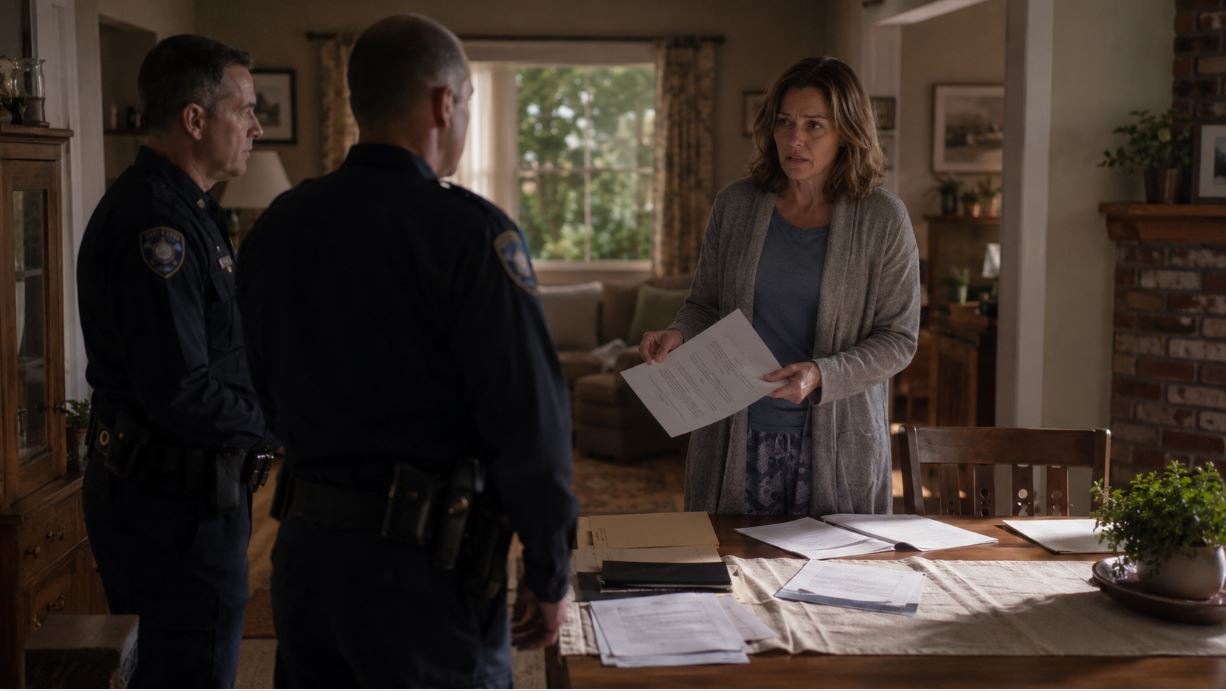
That night, after everyone left, I found him in my mother’s sewing room. He was sitting in her chair, holding one of her scarves.
For one second, I thought grief might finally make us family.
Then he looked up and said, “You’re eighteen in four months.”
I stared at him.
“What?”
He folded the scarf and set it on the table.
“I think it’s best if you start making arrangements.”
“Arrangements?”
“For your own place.”
The room went silent around me.
“My mother just died,” I said.
He looked away.
“This house was mine before she married me.”
I packed two suitcases the next morning.
Not because I had somewhere to go, but because pride can feel like shelter when nothing else is left.
My high school English teacher, Mrs. Parker, took me in until graduation. I worked nights at a diner, saved every dollar, and left town that summer with a duffel bag, a bus ticket, and a promise that I would never ask Harold Whitaker for anything.
For thirty-two years, I kept that promise.
I built a life in Raleigh. I became a nurse. I married a kind man named Peter. We had two children. I lost him to a heart attack when our youngest was in college, and I kept going because that is what women like my mother taught me to do.
I thought about Harold sometimes.
Usually when something reminded me of him: the smell of cedar boards, the sound of a screen door, a man measuring twice before cutting once.
But I never called.
He never called either.
Then, one Tuesday morning in October, my phone rang while I was making coffee.
The number had an Asheville area code.
“Is this Ms. Claire Bennett?” a woman asked.
“Yes.”
“My name is Marjorie Ellis. I’m an attorney handling the estate of Harold Whitaker.”
I set the mug down.
For a moment, my kitchen went very still.
“Harold died?” I asked.
“Yes, ma’am. Last week. I’m sorry for your loss.”
Loss was a strange word for a man I had already buried in my heart thirty-two years earlier.
“I don’t know why you’re calling me,” I said. “Harold and I weren’t close.”
“I understand,” the attorney said. “But Mr. Whitaker left specific instructions. He wanted you to receive something.”
“I don’t want his money.”
“It isn’t money.”
“What is it?”
“A key.”
I closed my eyes.
“A key to what?”
“To the old greenhouse behind his property.”
I had almost forgotten about the greenhouse.
It stood at the far end of Harold’s backyard, half-hidden behind blackberry bushes and an old oak tree. When I was a teenager, it was always locked. Harold used to say it was full of broken tools and dead plants.
“Mr. Whitaker’s instructions were very clear,” Marjorie said. “The greenhouse is not to be opened by anyone except you.”
I should have said no.
But grief is not the only thing that pulls people back to old houses. Sometimes anger does too. Sometimes curiosity. Sometimes an old wound wants to look at the knife one last time.
Three days later, I drove to Asheville.
The town had changed. The gas station where I used to buy candy was now a pharmacy. The diner where I worked nights had become a coffee shop with chalkboard menus. But Main Street still curved the same way, and the mountains still rose blue and soft in the distance.
Harold’s house looked smaller than I remembered.
The yellow paint had faded. The porch still sagged. The hydrangeas were brown for the season.
Marjorie met me by the front steps. She handed me a small envelope with my name written across it.
Inside was an old brass key tied with a piece of red yarn.
I recognized the yarn immediately.
My mother used to tie red yarn around things she didn’t want to lose: suitcase handles, Christmas boxes, jars of buttons.
My throat tightened.
“Do you want me to come with you?” Marjorie asked.
“No,” I said. “I’ll go alone.”
The backyard was overgrown. My boots sank into damp leaves as I walked toward the far fence.
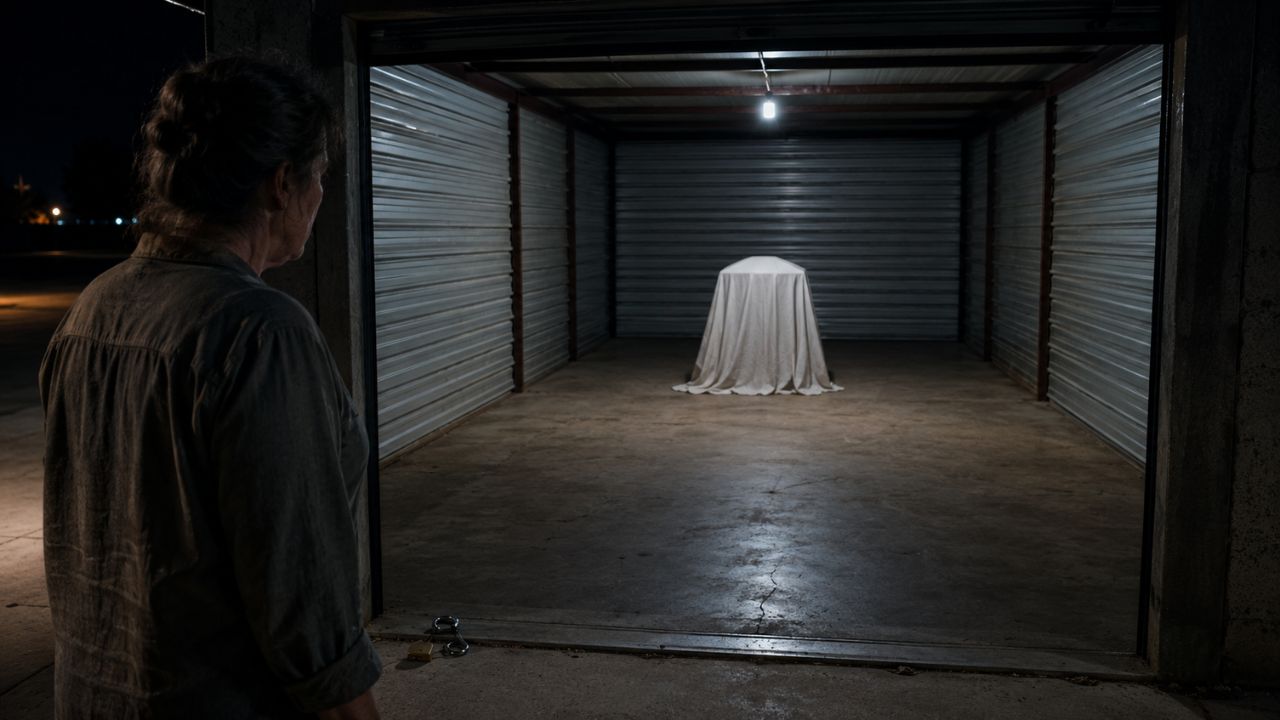
The greenhouse appeared through the branches like something from another life: cloudy glass panels, green-painted wood, rusted hinges, and one cracked window patched from the inside with cardboard.
The lock was old but clean.
That surprised me.
The key turned easily.
When I opened the door, the smell hit me first.
Dust. Soil. Dry wood. And something faintly floral, like lavender that had been gone for years but left its ghost behind.
The greenhouse was not empty.
It was full of shelves.
Not gardening shelves.
Memory shelves.
Cardboard boxes lined the walls, each labeled in Harold’s careful handwriting.
CLAIRE — SCHOOL
CLAIRE — PHOTOS
ELAINE — LETTERS
CLAIRE — IMPORTANT
In the center of the greenhouse sat a small metal table.
On top of it was an old blue lunchbox.
My lunchbox.
I had carried it in ninth grade. It had a dent on one corner from the day I dropped it running for the bus. I remembered being ashamed of it because everyone else had newer bags, and mine looked like something from a thrift store.
I touched it with shaking fingers.
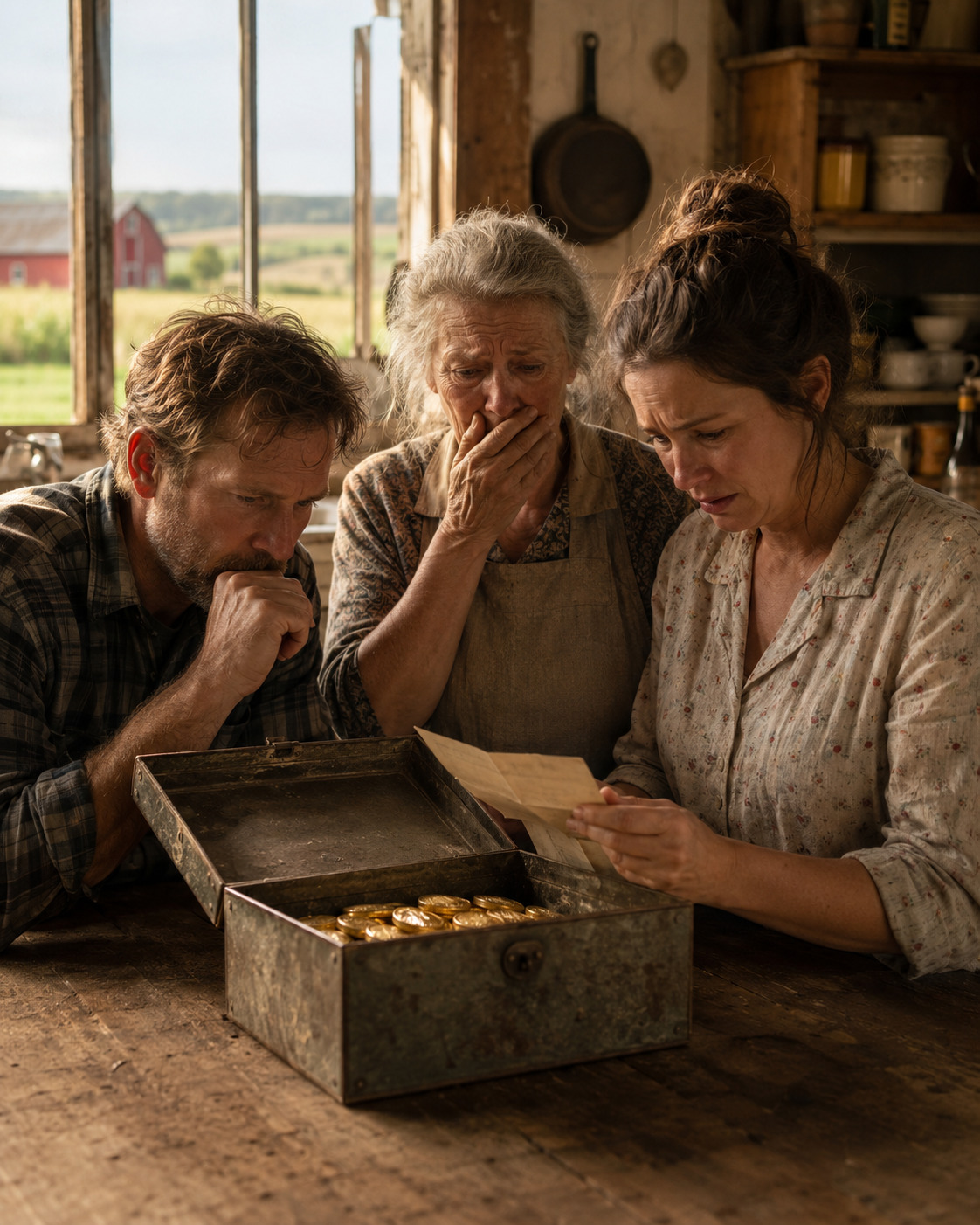
Inside was a folded note.
Claire,
If you are reading this, then I failed to say in life what I should have said many years ago.
I do not expect forgiveness.
But I owe you the truth.
— Harold
I sat down on the old wooden stool beside the table.
For a long time, I only stared at the paper.
Then I opened the first box.
Inside were photographs.
Not family photographs.
Photographs of me.
Me at high school graduation, standing beside Mrs. Parker in a blue cap and gown.
Me outside the nursing school building in Raleigh.
Me in a newspaper clipping from a hospital charity drive.
Me with Peter on our wedding day, clipped from the local announcements.
Me holding my first baby.
Me standing outside my house years later with both my children.
Each photo had a date written on the back.
Some had notes.
Claire graduated today. Elaine would have cried.
Claire became a nurse. No surprise.
Claire married a good man, I hope.
Her daughter has Elaine’s eyes.
My hands began to tremble.
I opened another box.
It was full of envelopes.
Some were addressed to me in my mother’s handwriting.
For a second, I could not breathe.
My mother’s letters.
I picked up the first one.
My dearest Claire,
If you are reading this, it means I didn’t get as much time as I begged God for…
I pressed the paper to my chest and closed my eyes.
There were twenty-three letters.
Birthday letters. Graduation letters. Wedding letters. Letters for days she knew she would miss.
On one envelope, she had written:
For Claire when she feels alone.
Why had I never seen them?
Why had Harold kept them?
The answer was in his second note, tucked beneath the letters.
Your mother asked me to give these to you over the years.
I did not.
There is no excuse that will make that right.
After she died, I was angry at the world. Angry at God. Angry that she loved you in a way I did not know how to be loved. You were her heart walking around outside her body, and when she was gone, looking at you felt like standing in front of everything I had lost.
So I did the cruelest thing a lonely man can do.
I made you lonely too.
I covered my mouth with my hand.
For thirty-two years, I had believed Harold threw me out because I meant nothing to him.
The truth was uglier and sadder.
He threw me out because I reminded him of the only woman he had ever loved.
It did not excuse him.
But it explained the shape of the wound.
In another folder, I found receipts.
A payment to my college bookstore.
A cashier’s check sent anonymously to the nursing program the year I almost dropped out because I couldn’t afford tuition.
A repair bill for my first car, paid by someone named “H.W.” after the mechanic told me a stranger had covered it.
A hospital foundation donation made in Peter’s name after his funeral.
I remembered those moments.
The scholarship I thought was luck.
The car repair I thought was kindness from a stranger.
The anonymous donation card I had thrown away because I couldn’t bear to think about death anymore.
Harold had been there.
Not enough.
Not properly.
Not bravely.
But there.
At the back of the greenhouse, under a canvas tarp, I found one more thing.
A rocking chair.
My mother’s rocking chair.
The one from our old living room. The one she used to sit in while brushing my hair when I was little. Harold had told me it was given away after she died.
It hadn’t been.
On the seat was a final envelope.
Claire,
I do not deserve to ask anything from you.
But if you can, take this chair home.
Your mother rocked you in it. After you left, I used to sit here when the house was too quiet. I told myself I was keeping it safe for you.
The truth is, I was too selfish to let go of the last thing that still felt like both of you.
I should have given you the letters.
I should have let you stay.
I should have said your name like it mattered.
Claire, your name mattered.
It always did.
I am sorry.
Harold
For the first time in thirty-two years, I said his name out loud.
“Harold.”
It came out broken.
I did not forgive him in that instant.
Real forgiveness is not a switch. It is not something a dead man earns by leaving boxes in a greenhouse. It does not erase the girl who packed two suitcases the morning after her mother’s funeral.
But something shifted.
The story I had carried for most of my life had been simple.
Harold hated me.
Now it was not simple anymore.
He had hurt me. He had failed me. He had hidden the love I needed most.
But he had also watched from the edges of my life, paying debts I never knew he paid, preserving memories I thought were gone, guarding my mother’s words until shame finally loosened his hands after death.
I stayed in that greenhouse until the sun began to sink behind the trees.
Then I carried the blue lunchbox to my car.
Marjorie was waiting by the porch.
“Are you all right?” she asked.
I looked back at the greenhouse.
“No,” I said honestly. “But I understand more than I did this morning.”
A week later, a moving truck brought my mother’s rocking chair to my house in Raleigh.
I placed it by the window in my bedroom.
That night, I opened the letter my mother had written for when I felt alone.
My darling Claire,
There will be days when the people who should love you best do it poorly. Do not let their failure become the measure of your worth.
You were loved before you understood the word.
You are loved even when people are too broken to say it right.
And if Harold becomes hard after I go, remember this: hard things are often protecting something cracked inside.
But you, my girl, must not become hard just to survive him.
Stay kind.
Stay open.
Stay yourself.
I cried until the paper blurred.
Then I folded the letter and placed it back inside the blue lunchbox.
My children came over the next Sunday. I told them the whole story. My daughter sat on the floor beside the rocking chair. My son stood by the window with his hands in his pockets, quiet in the way men are quiet when they are trying not to cry.
“So what do you feel?” my daughter asked.
I looked at the lunchbox.
“At first, angry,” I said. “Then sad. Then angry again.”
“And now?”
I thought about Harold sitting alone in that greenhouse, surrounded by boxes he was too ashamed to deliver.
“I think some people spend their whole lives standing outside the door of an apology,” I said. “And by the time they finally find the courage to knock, no one is home.”
My son wiped his eyes.
“Do you forgive him?”
I looked at my mother’s chair.
“I don’t know yet,” I said. “But I don’t hate him the same way anymore.”
And maybe that was the first step.
Not forgiveness.
Not forgetting.
Just setting down a story that had become too heavy to carry unchanged.
Sometimes the truth does not arrive in time to fix what was broken.
Sometimes it comes late, tied with red yarn, hidden inside an old greenhouse, waiting beside a blue lunchbox.
And sometimes, even when it cannot give you back the years you lost, it can still hand you one final gift.
A different ending.