For the first week after my mother’s funeral, I moved through the world like I was walking underwater.
Everyone kept telling me grief came in waves. They were wrong. Grief was not a wave. It was a house with every light turned off, and I was trapped inside it, reaching for walls that no longer knew my name.
My mother, Evelyn Parker, had been my safe place for forty-two years.
She was the woman who put a cool hand on my forehead when I was sick, who mailed me grocery-store coupons even after I became old enough to buy my own groceries, who still called every Sunday evening just to ask if I had eaten something warm.
Even after she married Arthur Bell, I never doubted her love.
Arthur was never cruel in a way that left bruises. That would have been easier to explain. He was colder than that. He could make a room feel smaller just by entering it. He spoke to me with the thin patience people use for bad weather. His son, Kyle, was worse. He had Arthur’s smile, but none of his restraint.
Still, my mother kept trying to make us a family.
“People soften with time,” she used to say.
But Arthur never softened. He only waited.
The will was read six days after the funeral in a small attorney’s office in Dayton, Ohio. Rain tapped against the window while I sat with my hands folded in my lap, wearing the black dress my mother had once said made me look “too serious for my own good.”
Arthur sat beside me in a navy suit. Kyle leaned back in his chair as if he were watching a game he already knew he would win.
The attorney cleared his throat and read from the document.
The house went to Arthur.
The savings went to Arthur.
The furniture, the car, the property, the personal effects—everything went to Arthur.
My name was not mentioned once.
At first, I thought I had misheard. I waited for the attorney to turn the page. I waited for him to say there had been an amendment. I waited for my mother to reach through the grave and correct the room.
But no correction came.
Arthur pressed his lips together, not quite smiling.
Kyle did not bother hiding his.
On the drive back to the house, I sat in the passenger seat while Arthur drove in silence. The house on Maple Ridge Road had been my childhood home. My father had died when I was nine, and my mother had paid that mortgage herself by working at the county clerk’s office for nearly thirty years.
Every flower bed, every dent in the kitchen table, every creaking stair held some piece of her.
By morning, Arthur had already erased me from it.
He sat at the kitchen table drinking coffee, the same table where my mother had taught me how to make pie crust.
“You’ll need to start making arrangements,” he said, without looking up from his newspaper.
I stood in the doorway. “Arrangements?”
“To leave.”
The word landed between us like a plate dropped on tile.
“This is still my home,” I said quietly.
Arthur folded the paper. “Not legally.”
I looked at him for a long moment. “My mother has been gone less than a week.”
“And I’m sorry for your loss,” he said, in a voice that carried no sorrow at all. “But I’m selling the house. The realtor is coming next week. I don’t need this becoming complicated.”
Kyle walked in then, tossing his truck keys from one hand to the other.
“You should be grateful he’s giving you time,” he said.
I turned toward him. “This has nothing to do with you.”
Kyle laughed. “It has everything to do with me. Dad gets the house. Eventually, I get what’s his.”
Then he tilted his head, studying my face like he enjoyed the damage.
“Guess your mom didn’t love you as much as you thought.”
Something inside me cracked, but it did not break loudly.
I wanted to scream. I wanted to throw his coffee across the room. I wanted to ask Arthur how he could sit in my mother’s kitchen and speak to me like I was a stranger who had overstayed a visit.
But grief had made me hollow. And they were both waiting for a fight.
So I gave them nothing.
Over the next two days, I packed my life into boxes. Clothes. Books. A few dishes my mother had bought at an estate sale. Every photograph of her I could find before Kyle started claiming things for himself.
When I found her blue cardigan hanging behind the laundry room door, I pressed my face into it and cried so hard I had to sit on the floor.
On the third morning, Arthur stood by the front door while I carried the last box to my car.
“I’ll have the locks changed this afternoon,” he said.
I nodded.
Kyle stood on the porch with a coffee mug in his hand.
“Don’t worry,” he called after me. “We’ll take good care of the place.”
I looked back once.
Then I got into my car and drove away.
For seven days, I lived in a motel near the interstate. It had brown carpet, a rattling heater, and curtains that smelled faintly of cigarette smoke. At night, I ate canned soup with a plastic spoon and watched television shows I could not follow.
But none of that hurt as much as the question that kept circling in my head.
Had my mother really left me nothing?
Not a letter?
Not a ring?
Not even a sentence in her will?
By the fifth night, Kyle’s words had started to poison me.
Maybe she had chosen Arthur.
Maybe she had wanted peace so badly that she sacrificed me for it.
Maybe I had been wrong about the one thing I had trusted my whole life.
On the seventh evening, my phone rang.
Arthur.
I stared at his name until it almost stopped ringing. Then I answered.
“What do you want?”
For a few seconds, there was only breathing.
Then Arthur sobbed.
Not a polite, restrained sound.
A broken one.
“Laura,” he choked. “You need to come to the house.”
I sat up. “What happened?”
“Please. Come now.”
“Where’s Kyle?”
Another sob.
“He’s gone.”
The line went dead.
Every sensible part of me said not to go. Arthur was not my responsibility. Kyle was not my problem. That house was no longer mine.
But my mother’s house had called me one last time.
So I drove back.
The front door was open when I arrived. Not unlocked. Open.
Inside, the air smelled like dust, sawdust, and panic.
“Arthur?” I called.
He stumbled out of the living room looking ten years older than he had the week before. His shirt was wrinkled. His hair stuck up in gray clumps. His eyes were red.
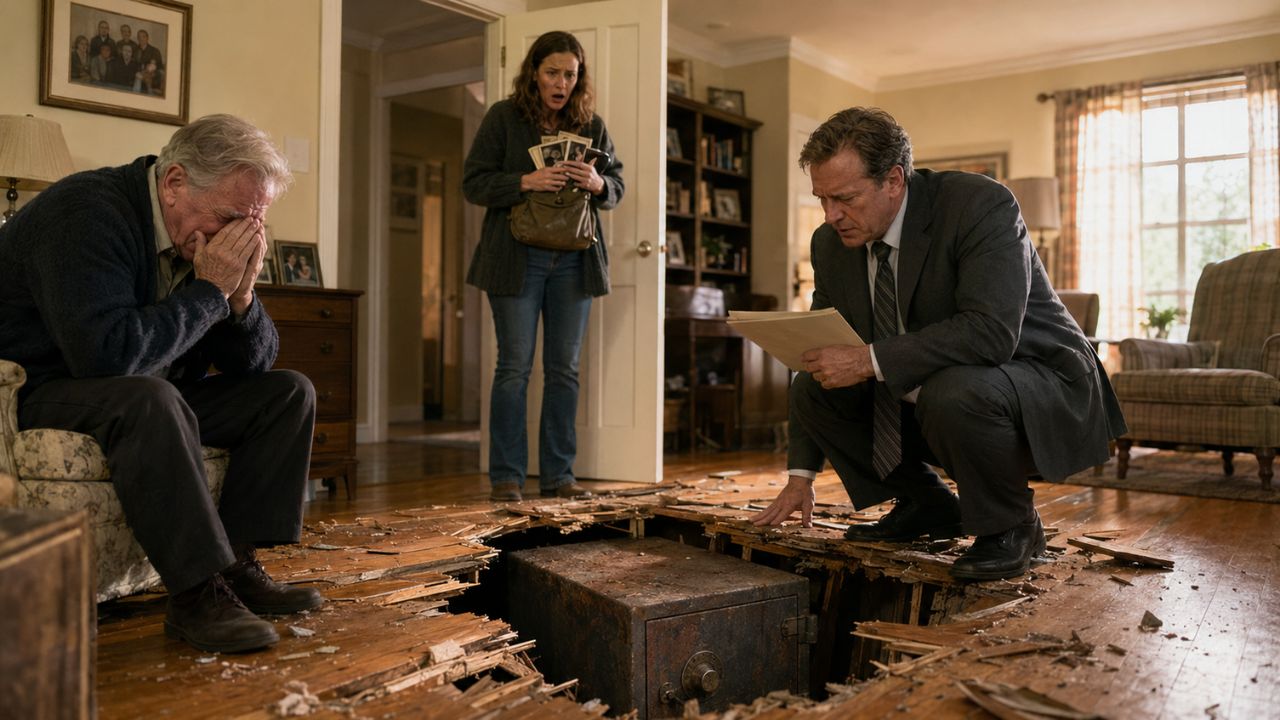
Behind him, the living room floor had been torn apart.
The polished hardwood my mother used to clean every Saturday was splintered and stacked against the wall. A section near the fireplace had been ripped open, exposing old beams and concrete beneath.
And in the middle of the mess sat a rusted metal safe.
Beside it stood a man in a gray suit, holding a leather briefcase.
I took one step back. “What is going on?”
Arthur sank into the nearest chair and covered his face.
“She knew,” he whispered. “She knew what we’d do.”
The man in the suit turned toward me.
“Ms. Parker?”
“Yes.”
“My name is Thomas Vance. I was your mother’s estate planning attorney.”
I frowned. “I thought Mr. Bradley handled the will.”
“He handled the public will,” Mr. Vance said. “I handled the trust.”
Arthur made a sound like someone had pressed a hand against his throat.
I looked from him to the safe. “What trust?”
Mr. Vance opened his briefcase and removed a thick folder, sealed in plastic.
“This was found inside the safe by the contractors this morning. Your mother left instructions for me to be contacted if the safe was ever opened. The contractors called the number taped inside the lid.”
Arthur stared at the floor.
“Kyle wanted renovations done fast,” he muttered. “Said we could list the house for more if we opened up the living room.”
Mr. Vance’s expression stayed calm. “He thought there might be valuables under the floor.”
Arthur began crying again. “We thought it was jewelry. Cash. Gold coins. Something.”
The attorney looked at me.
“It was paperwork.”
My hands started to tremble before he even gave me the folder.
Inside were copies of mortgage documents, property liens, tax notices, private notes, and a letter in my mother’s handwriting.
“What is all this?” I whispered.
Mr. Vance spoke gently.
“Your mother knew Arthur wanted the house. She also knew he and Kyle would likely remove you from it once she was gone. So she allowed the public will to leave the house to Arthur.”
My stomach twisted. “Why would she do that?”
“Because the house was no longer the asset they thought it was.”
Arthur let out a bitter laugh that turned into a sob.
Mr. Vance continued, “Over the final years of her illness, your mother used the equity in this property. There are mortgages, liens, unpaid property taxes, and private notes attached to the house. Anyone who wants to keep it or sell it with a clean title will have to satisfy those claims.”
I stared at the broken floor.
“How much?”
“A little over six hundred and eighty thousand dollars.”
The room tilted.
Arthur gripped the arm of the chair.
“The house won’t sell for that much,” he said, as if he were still trying to convince someone to change reality. “Not after fees. Not after repairs. Not with the foreclosure notice.”
Foreclosure.
The word chilled the room.
Mr. Vance nodded once. “The lender has already started proceedings. Your mother was current as long as she lived. But the moment Arthur inherited the property, the obligations tied to it became his problem if he wanted to keep control of it.”
I looked at Arthur.
The man who had ordered me out of my own childhood home was now trapped inside the prize he had wanted.
“And Kyle?” I asked.
Arthur wiped his face with shaking hands.
“He left,” he whispered. “He read the papers and said I was an idiot. Said he wasn’t going down with me.”
A strange quiet moved through me.
Kyle had laughed when I lost my home.
Then he ran when his father lost the money.
Mr. Vance handed me the letter.
“Your mother asked that you read this before we discuss the trust.”
I unfolded the pages.
My mother’s handwriting filled the paper, careful and familiar.
My dearest Laura,
If you are reading this, then I am gone, and Arthur has shown you who he is.
I am sorry.
I know those two words are too small for what I allowed you to suffer. I know you may have believed, even for a moment, that I forgot you. I need you to understand that I never did.
I knew Arthur would want the house. I knew Kyle would circle it like a vulture before I was even in the ground. I also knew that if I left everything to you openly, they would fight you, delay you, shame you, and drain you until my love became another courtroom battle.
So I gave them what they wanted.
The house.
But the house was only walls.
Everything that mattered, I moved where they could not reach it. Mr. Vance will explain the trust. It is in your name. It is protected. It is enough for you to begin again, buy a home of your own, and never beg for a place at anyone’s table.
You were never a burden.
You were never second.
You were never forgotten.
You were my child, my joy, and the only true family my heart ever recognized.
Forgive me for the pain I had to let happen so the truth could finish its work.
Love always,
Mom
By the time I reached the end, I could not see the paper through my tears.
For a week, I had wondered whether my mother had erased me.
Instead, she had protected me with the last strength she had.
Mr. Vance explained the rest.
The money drawn from the house had been placed years earlier into an irrevocable trust in my name. It had been done legally, carefully, and long before the final months of her illness. Arthur could not touch it. Kyle could not touch it. Creditors tied to the property could not take it from me.
It was not a fortune large enough to buy a mansion.
But it was enough.
Enough for a down payment.
Enough to start over.
Enough to prove my mother had not left me empty-handed.
Arthur slid from the chair to his knees.
“Laura,” he said, his voice cracking. “Please. You have to help me.”
I looked at him.
Seven days earlier, he had stood in the kitchen and told me to make arrangements. He had watched me carry boxes out of my mother’s home. He had let his son laugh at my grief.
Now he was reaching for me like I was the only door left unlocked.
“The bank is taking the house,” he said. “Kyle won’t answer my calls. I don’t have that kind of money.”
I folded my mother’s letter carefully and placed it in my purse.
For a moment, I thought rage would come.
It did not.
What came instead was peace.
Not forgiveness. Not yet.
Just peace.
“I’m sorry for your loss,” I said quietly.
Arthur blinked, confused.
I looked at the broken floor, the rusted safe, the ruined room, and the man who had mistaken ownership for victory.
Then I turned back to him.
“But I’m not your safety net.”
His face collapsed.
I walked out before he could say my name again.
Outside, the evening sun was warm against my face. The house behind me looked smaller than it ever had, its windows glowing with the last light of day.
For the first time since my mother died, I did not feel abandoned.
I felt chosen.
My mother had not left me the house.
She had left me something better.
Freedom.
Proof.
And the truth, waiting under the floor until greed came looking for treasure.