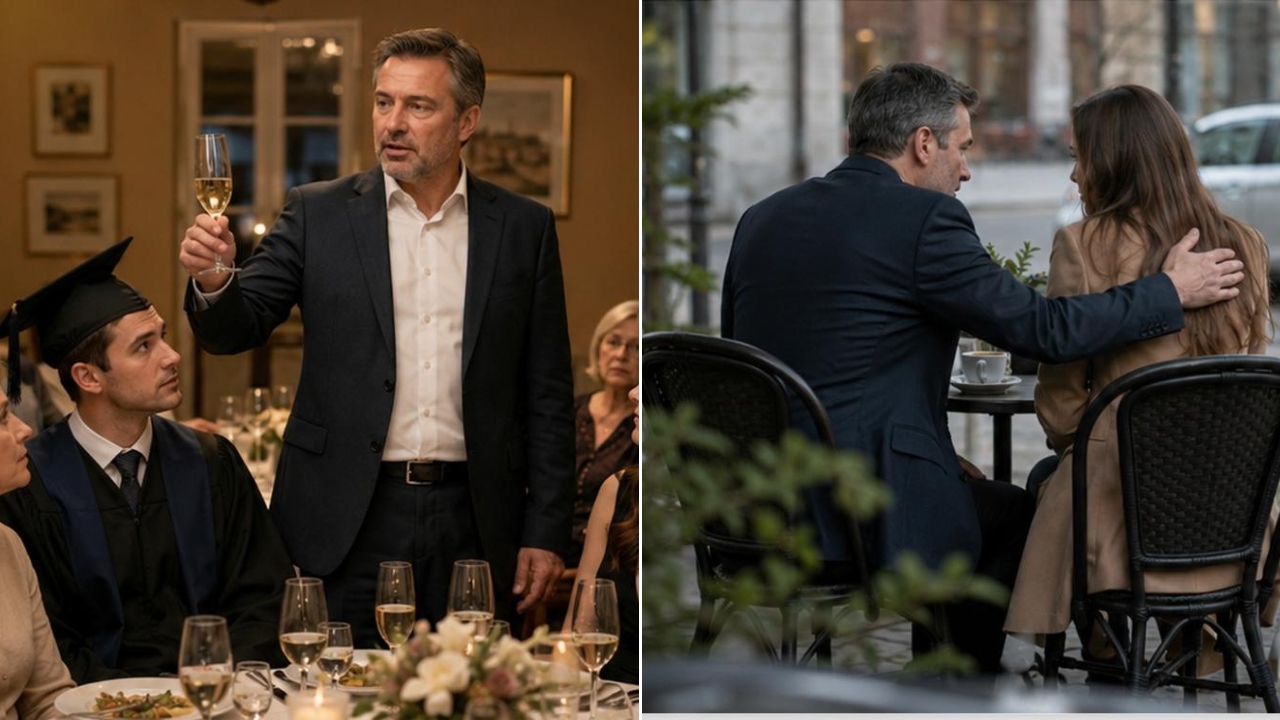
My father raised his glass at my sister’s birthday party and smiled at me like he was about to say something kind.
For one foolish second, I thought maybe he was finally going to thank me.
Maybe for paying for the party.
Maybe for covering my parents’ mortgage when Dad’s business slowed down.
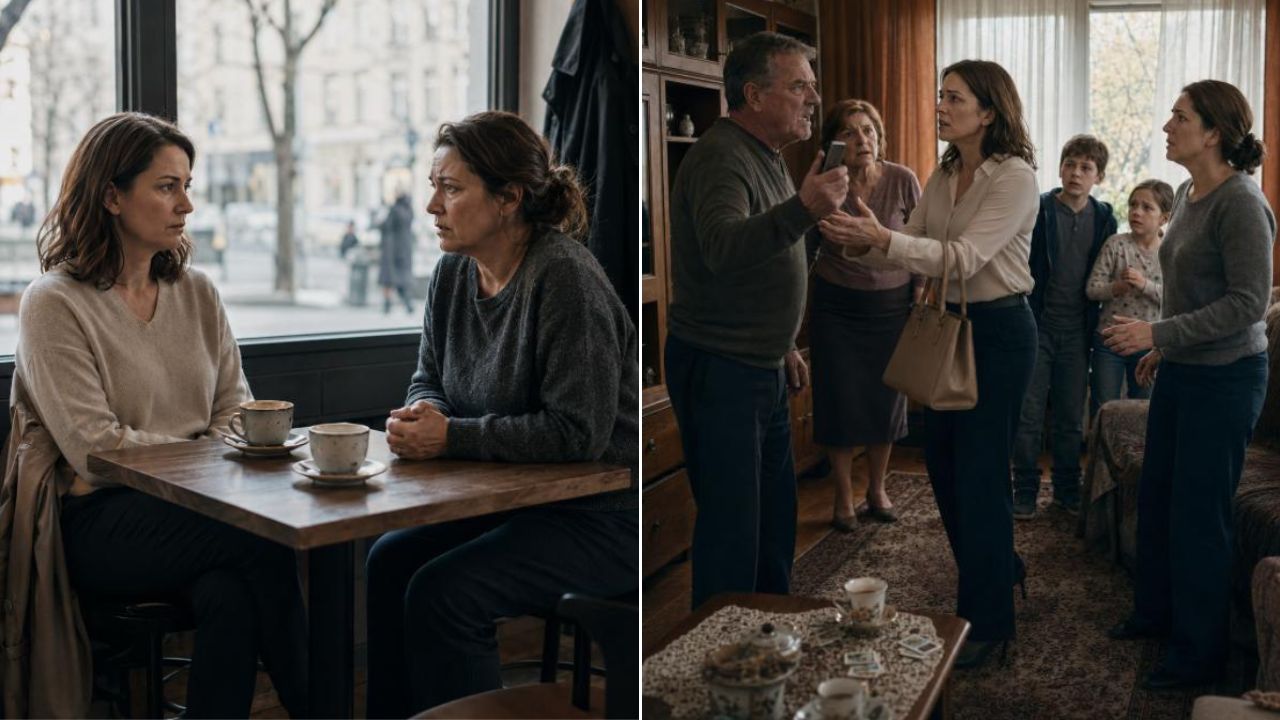
Maybe for helping my sister Tara every time she “needed just one more month to get back on her feet.”
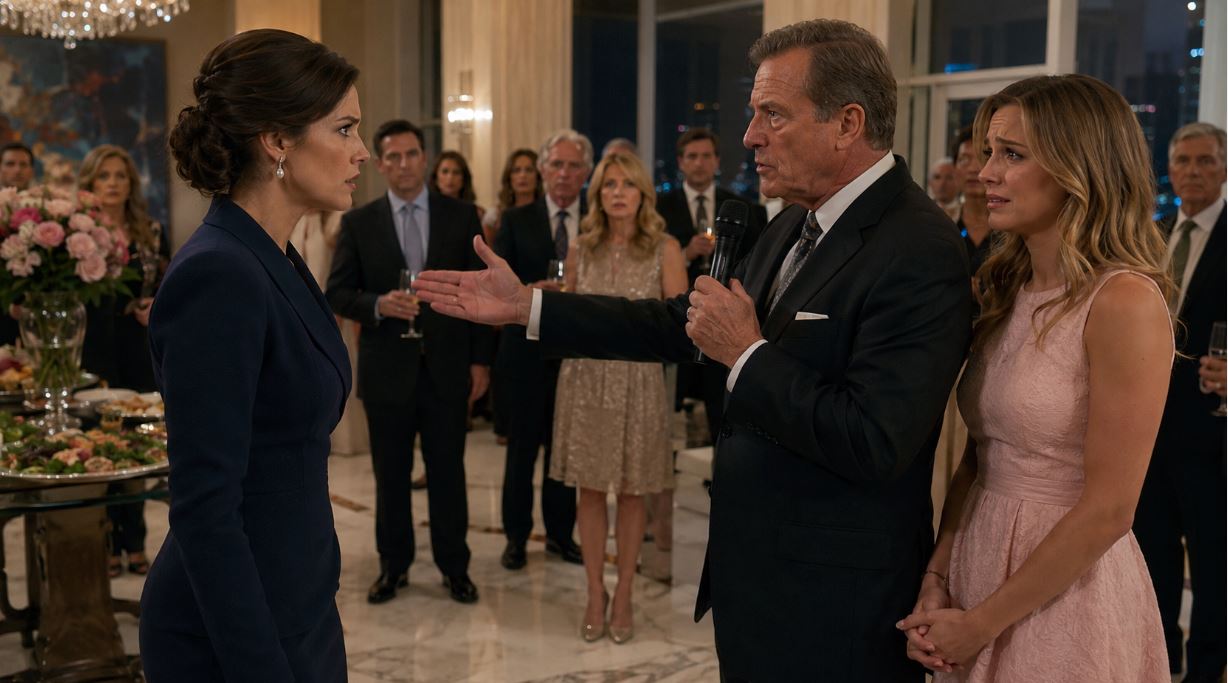
Instead, my father looked across the room, held out his hand, and said, “Jenna, give your sister the keys to your penthouse.”
The room went silent.
At first, I thought I had misheard him.
Music still played softly from the speakers. The caterers stood frozen near the kitchen island. Tara’s friends stared at me with half-smiles, waiting to see if this was some strange rich-family joke.
But my father was not joking.
He had a microphone in his hand.
He had planned this.
My sister Tara stood beside him in her pale pink birthday dress, her eyes wide and wet, as if she were the victim of something that had not even happened yet.
My mother placed a hand over her chest and smiled nervously.
“Jenna,” she said softly, but loud enough for everyone to hear, “your sister needs a fresh start.”
I looked from my mother to my father.
Then to Tara.
“My home?” I asked.
Dad gave a short laugh, the kind he used when he wanted to make me feel unreasonable.
“Don’t be dramatic. It’s not like you’re being asked to live on the street. You have money. You have options.”
“I have a home,” I said. “One I worked for.”
A few people shifted uncomfortably.
My father’s smile tightened.
“That penthouse is too big for one woman.”
I almost laughed.
Too big for one woman.
I was thirty-two years old. I had worked twelve-hour days for a decade. I had built a software company from a folding table in my apartment. I had skipped vacations, delayed relationships, and missed more family dinners than I could count because I was trying to build something no one could take away from me.
The penthouse was not just marble counters and a skyline view.
It was proof.
Proof that every lonely night, every risk, every person who told me I was too ambitious had been wrong.
And now my father wanted me to wrap it in a bow and hand it to my younger sister because she had turned thirty and still had not kept a job longer than six months.
“Tara is getting married next spring,” my mother said. “She needs stability.”
I looked at Tara.
She lowered her eyes, but not before I saw the little flash of hope on her face.
She knew.
Of course she knew.
This had been discussed before I walked in.
I had paid for the flowers. The private chef. The cake. The champagne. The gold balloons spelling out Tara’s name above the windows.
And while I was busy paying invoices, they had been planning to take my home.
My father held the microphone closer.
“Jenna, this family has always believed in taking care of each other.”
That was rich coming from him.
Taking care of each other had always meant one thing in our family.
I gave.
They received.
When Tara dropped out of college, I helped pay off her apartment lease.
When my parents “fell behind just this once,” I wired them money.
When my mother wanted knee surgery at a better clinic, I covered what insurance would not.
When Dad’s company needed a “temporary bridge loan,” I wrote a check I never saw again.
Nobody called me selfish then.
Nobody told me I was cold.
Nobody said my money made me lonely when they were spending it.
But the minute I drew a line, I became the problem.
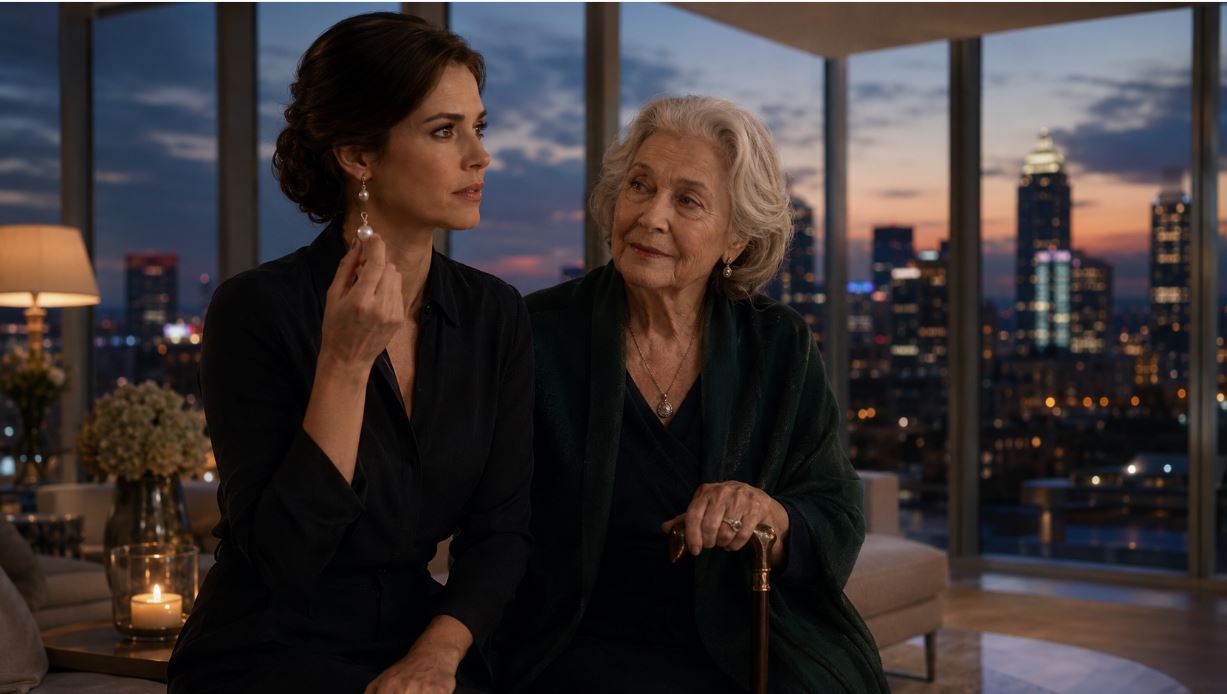
My grandmother Margaret sat near the fireplace in her wheelchair, wrapped in a dark green shawl. She was eighty years old, small, elegant, and still somehow the most powerful person in any room she entered.
She had been quiet all evening.
Too quiet.
Her eyes stayed on my father.
Not on Tara.
Not on me.
On him.
I should have noticed that sooner.
Dad continued, “Your sister has had a difficult few years.”
“So have I,” I said.
The room went still again.
My mother’s lips parted.
Tara finally looked up, wounded.
“Jenna,” she whispered. “This isn’t about comparing pain.”
“No,” I said. “It’s about pretending yours is the only kind that matters.”
Someone near the bar coughed.
Dad’s face darkened.
“You’ve always had a sharp tongue.”
“I learned from you.”
My mother gasped like I had thrown a glass.
Dad stepped down from the small platform where the musicians had been playing earlier.
“Do not embarrass me in my own house.”
I looked around the room.
The crystal chandelier.
The polished floors.
The caterers carrying trays of food.
The flowers I had chosen because Tara once said white roses made her feel like a movie star.
“Your house?” I said quietly. “I paid for tonight.”
Dad’s eyes flickered.
There it was.
The thing no one was supposed to say out loud.
The thing my parents had trained me to hide so they could keep pretending they were still in charge.
My father lowered the microphone, but he forgot to turn it off.
His voice carried through the speakers.
“You will give your sister those keys tonight.”
I stared at him.
“No.”
It was one word.
Small.
Plain.
But it moved through the room like a crack in glass.
Tara’s face crumpled.
Mom rushed to her side.
Dad looked at me as if I had slapped him.
“You don’t mean that.”
“I do.”
“Jenna,” Mom said, her voice shaking now, “don’t be cruel.”
Cruel.
That word hit me harder than I expected.
I had been called difficult. Ambitious. Cold. Too independent. Too career-obsessed. Too much like my grandmother.
But cruel?
After everything I had done?
I looked at my mother.
“Cruel is inviting me here so you can trap me in front of strangers.”
“They’re not strangers,” Tara cried. “They’re family.”
“Then they should know the truth.”
Dad moved toward me.
“Enough.”
“No,” I said. “Not enough. I bought that penthouse with my own money. Tara has never paid one bill there. You have no right to ask for it, and she has no right to expect it.”
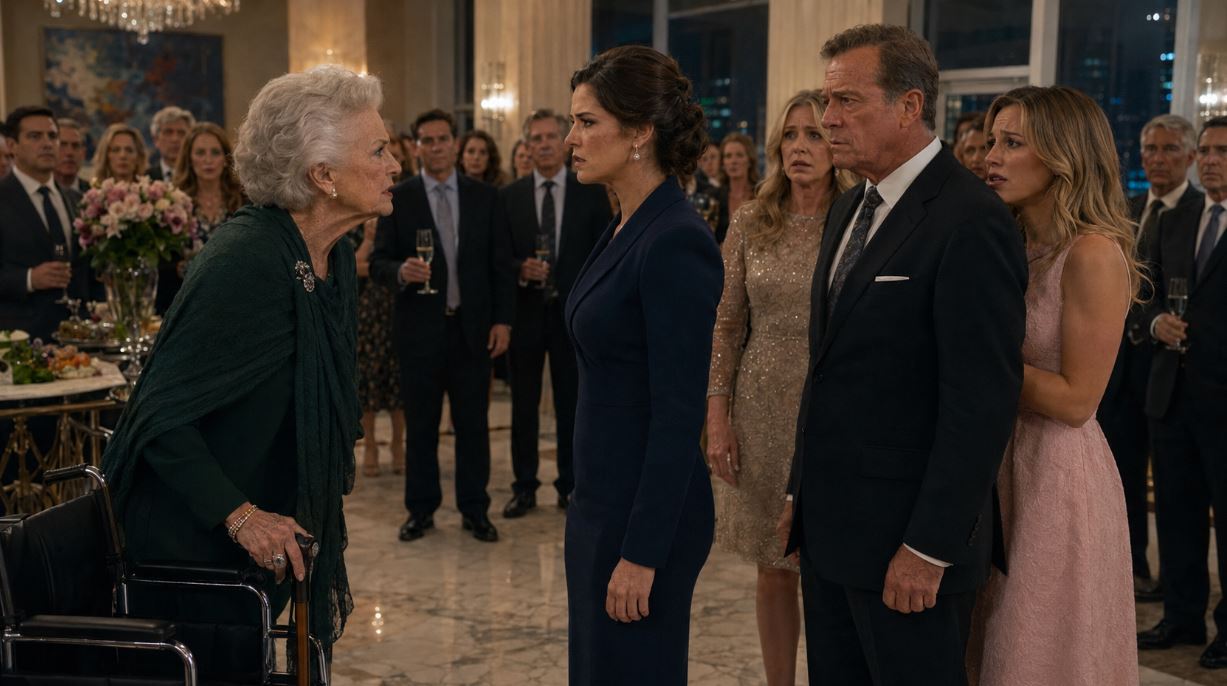
Tara’s fiancé, Evan, stood near the dining table, pale and silent. His parents were beside him. His mother looked like she wanted to disappear into the wallpaper.
I almost felt sorry for them.
Almost.
Then Tara whispered, “You have everything.”
I turned to her.
“No, Tara. I have what I earned.”
Her tears stopped.
For a second, the softness fell from her face.
There was something else underneath.
Anger.
Entitlement.
The kind of resentment that grows when someone spends years being told that someone else’s hard work is somehow unfair to them.
“You think you’re better than us,” she said.
“No,” I said. “I think you’ve been allowed to be helpless for too long.”
My father crossed the distance between us in three steps.
I saw his hand rise.
I had time to understand what was about to happen.
Not enough time to move.
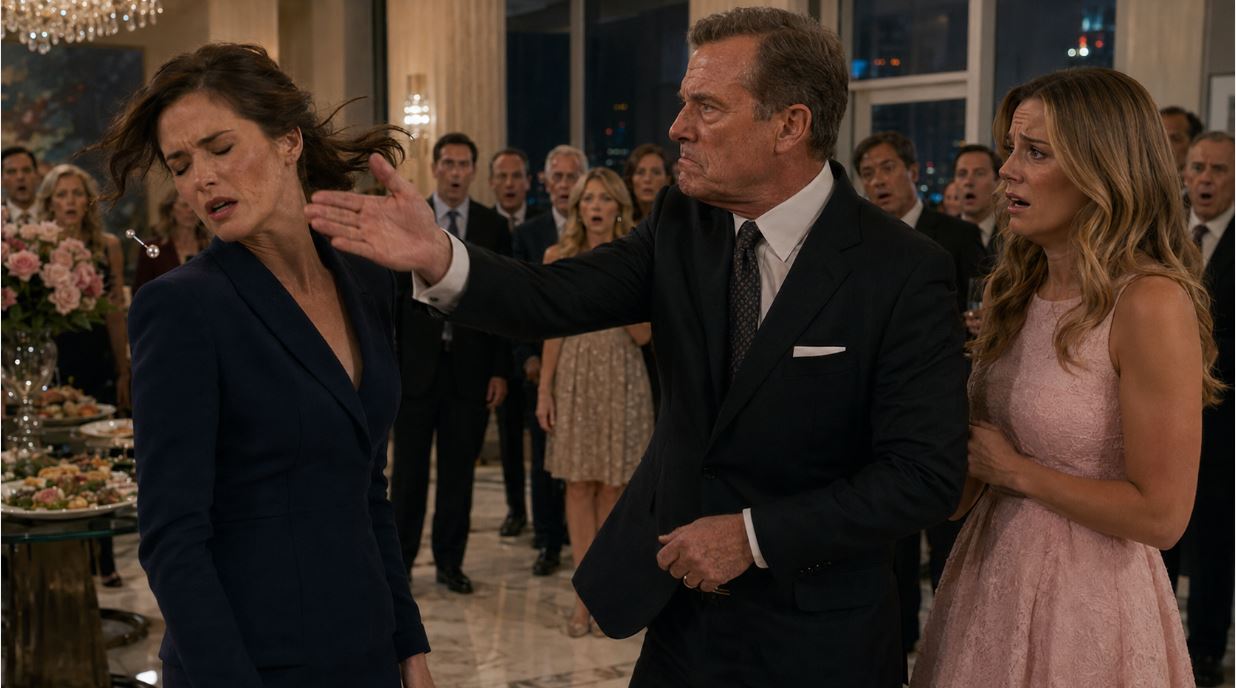
The slap cracked across my face so hard my head turned.
My pearl earring flew off and skittered across the marble floor.
The microphone squealed.
The room went completely silent.
Not uncomfortable silent.
Horrified silent.
My cheek burned.
My eyes watered.
For a moment, I was not thirty-two. I was sixteen again, standing in the kitchen while my father told me I was ungrateful for wanting to apply to a college out of state.
I was twenty-one, being told I cared more about grades than family.
I was twenty-eight, being asked why I could not just help Tara one more time because “success means nothing if you don’t share it.”
I touched my cheek.
My father looked shocked by his own hand.
Then, almost immediately, he looked angry again.
Because men like my father would rather blame the person they hurt than face what they did.
“You pushed me,” he said.
That sentence did something to me.
It did not break me.
It finished something.
The last small piece of me that still wanted his approval went quiet.
I bent down, picked up my earring, and placed it carefully in my purse.
Then I looked at Tara.
She was crying again, but she was not looking at my face.
She was looking at my purse.
At the keys inside.
I smiled.
It was not a warm smile.
“No,” I said again.
Then I turned to leave.
My mother grabbed my arm.
“Jenna, don’t make this worse.”
I looked down at her hand until she let go.
“You should have said that to him.”
I walked toward the door.
No one stopped me.
Then a voice, thin but sharp as a blade, cut through the room.
“Jenna.”
I stopped.
Every head turned.
My grandmother Margaret had risen from her wheelchair.
No one moved.
Even my father stepped back.
Grandmother had one hand on her cane and the other on the arm of the chair. Her caregiver hovered beside her, terrified she might fall.
But Margaret Brooks did not fall.
She stood.
Slowly.
Painfully.
With a dignity that made the entire room straighten.
“Come here,” she said.
I walked to her, my face still burning.
She reached up and touched my cheek with trembling fingers.
Her eyes went cold.
Then she turned to my father.
“Robert.”
My father swallowed.
“Mother, this is a family matter.”
Margaret looked around the room.
“At a party? With a microphone? In front of guests? No, Robert. You made it a public performance. So let us perform.”
Someone in the back lifted a phone.
My father saw it and snapped, “Put that down.”
Grandmother did not even glance at the person.
“Let them record,” she said. “For once, this family can stop hiding behind closed doors.”
Tara sobbed louder.
“Grandma, please.”
Margaret looked at her.
“Do not ‘please’ me, child. You stood there waiting to be handed another woman’s home.”
Tara flinched.
My mother rushed forward.
“Margaret, she’s upset. This has gone too far.”
“It went too far when your husband struck his daughter.”
My mother’s face turned red.
“He lost his temper.”
Grandmother’s cane hit the floor.
“No. He showed his character.”
That silence was different.
Heavier.
My father’s jaw tightened.
“You don’t understand what Jenna has become.”
Grandmother tilted her head.
“What has she become?”
“She thinks money makes her above this family.”
Grandmother laughed once.
It was not a kind laugh.
“Money? You want to discuss money?”
My father’s face changed.
Just slightly.
But I saw it.
So did Grandmother.
She turned to her caregiver.
“Elaine, bring me my handbag.”
Elaine hurried to the side table and brought over a black leather handbag.
Grandmother opened it with slow hands and took out a folded stack of papers.
My stomach tightened.
I had no idea what they were.
But my father did.
“Mother,” he warned.
Grandmother ignored him.
“Jenna,” she said, “do you know who paid the property taxes on this house for the last three years?”
I frowned.
My parents’ house was beautiful. Old Atlanta. Brick walls, white columns, wide porch, magnolia trees. I knew Dad’s business had struggled, but I did not know things had gotten that bad.
“No,” I said.
Grandmother held up one page.
“You did.”
The room shifted.
I stared at her.
“What?”
My father stepped forward.
“That is not necessary.”
“Oh, it is very necessary.”
Grandmother looked at me.
“Your father told you the money was for a business loan.”
I remembered the transfer.
$68,000.
He had said payroll was tight. Said a major client was late. Said he would pay it back before the end of the quarter.
That was two years ago.
I looked at Dad.
He would not meet my eyes.
Grandmother held up another paper.
“And the roof repair?”
I whispered, “He said insurance denied the claim.”
“It did not. Insurance paid half. You paid the other half. But your mother told everyone your father handled it.”
My mother turned pale.
Tara looked confused now, like the story she had believed all her life had suddenly lost pages.
Grandmother kept going.
“The credit card debt Tara called an emergency?”
Tara stiffened.
“That was private.”
Margaret’s eyes snapped to her.
“So was Jenna’s face before your father hit it in public.”
A few guests murmured.
Tara began crying again, but this time it sounded different.
Less wounded.
More afraid.
Grandmother unfolded another paper.
“Jenna paid for your last apartment. Your car insurance. Your certification course you quit after two weeks. Your medical bills after your ski trip. Your engagement photographer. And half of this party.”
Tara looked at me.
For the first time that night, she looked ashamed.
But not enough.
“She offered,” Tara whispered.
“No,” I said. “I was asked.”
Grandmother nodded.
“Always quietly. Always with guilt. Always with the same sentence.”
I already knew what sentence she meant.
Family helps family.
It had followed me my whole adult life.
Grandmother looked toward the guests.
“Tonight, my son decided that family helping family meant one daughter must surrender her home to another, while everyone applauded.”
No one breathed.
Then Margaret looked directly at Dad.
“You are not angry because Jenna has money. You are angry because you cannot control it anymore.”
My father’s face flushed dark red.
“You’re humiliating me.”
Grandmother’s voice dropped.
“You slapped my granddaughter.”
For the first time, my father looked small.
I had never seen him that way.
Not once.
My whole life, Robert Brooks had filled every room. His voice was law. His disappointment was punishment. His approval was something we all chased, even when we pretended not to.
But in front of his mother, he was just a man who had been caught.
Grandmother turned to me.
“Jenna, did you agree to give Tara your home?”
“No.”
“Did you ever tell your parents they could offer it on your behalf?”
“No.”
“Did you pay for part of this party?”
I swallowed.
“Yes.”
“Did anyone thank you tonight?”
I looked around.
My mother stared at the floor.
Tara wiped her cheeks.
Dad said nothing.
“No,” I said.
Grandmother nodded like she had expected that answer.
Then she turned back to the room.
“I want everyone to hear me clearly.”
My father shook his head.
“Mother, don’t.”
She smiled.
That smile made me understand where my own cold smile had come from.
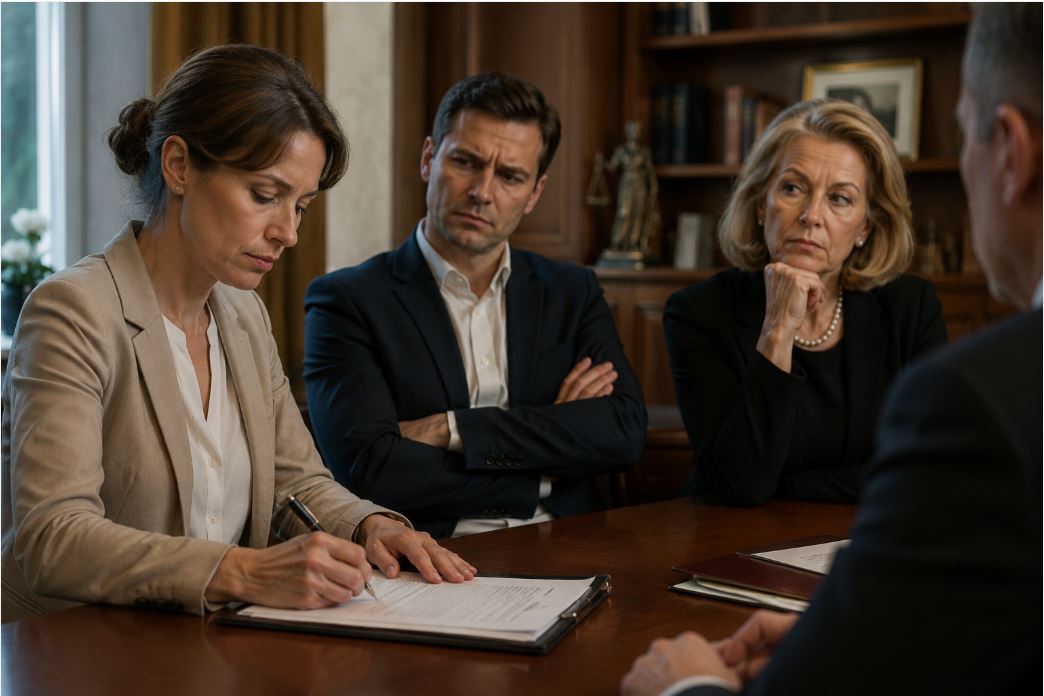
“I am rewriting my will.”
My mother gasped.
Tara stopped crying.
Dad’s mouth opened.
Grandmother continued, “As of tomorrow morning, Robert will no longer control one dollar of the Brooks family trust.”
The room erupted.
Not loudly.
Worse.
Whispers.
Sharp inhales.
A glass set down too hard.
Tara grabbed Evan’s hand. He did not squeeze back.
My father took one step toward Grandmother.
“You can’t do that.”
She looked almost amused.
“I built the trust with your father before you learned how to sign your name. Do not tell me what I can do with it.”
His face twisted.
“You’re punishing all of us over one argument?”
Grandmother pointed her cane toward my cheek.
“That is not an argument. That is evidence.”
My mother started crying now.
Real tears, maybe.
Or frightened ones.
“Margaret, please. Think about Tara.”
“I have thought about Tara for years,” Grandmother said. “That is why she is thirty years old and still believes needing something is the same as deserving it.”
Tara made a wounded sound.
Grandmother looked at her, and for the first time, her voice softened.
“You were not born entitled, Tara. You were trained into it.”
That hit harder than yelling would have.
Tara’s face crumpled.
Grandmother continued, “Your parents made Jenna the mule and you the porcelain doll. One of you was expected to carry everything. The other was expected to break at the slightest pressure. They failed you both.”
For a moment, I forgot to breathe.
Because that was the truth I had never been able to say.
I had resented Tara for years.
Her weakness.
Her excuses.
Her ability to turn any inconvenience into a crisis that everyone else had to solve.
But standing there, watching her shake under Grandmother’s words, I realized something ugly and sad.
Tara had been damaged too.
Just differently.
I had been taught love had to be earned.
She had been taught love meant never being made uncomfortable.
Neither of us had been loved cleanly.
My father pointed at me.
“She turned you against us.”
Grandmother laughed again.
“No, Robert. You did that when you raised your hand.”
Then she handed the papers to Elaine.
“Tomorrow morning, my attorney will amend the trust. Jenna will be the primary trustee. My house in Savannah, my investments, and my share of the family company will pass to her.”
My mother covered her mouth.
Tara whispered, “Everything?”
Grandmother looked at her.
“No. Not everything. I am leaving you something more useful than money.”
Tara blinked through tears.
“What?”
“A chance to learn how to stand on your own feet.”
That was when Evan’s father cleared his throat.
All eyes turned to him.
He was a quiet man, neatly dressed, with the careful expression of someone who had just watched a family reveal too much.
He looked at Tara, then at my parents.
“I think,” he said slowly, “we should postpone any wedding discussions until things are… clearer.”
Tara’s face went white.
“Evan?”
Evan looked miserable.
“Tara, I didn’t know any of this.”
“Any of what?” she cried. “They’re exaggerating!”
I looked at her then.
Not with anger.
With exhaustion.
“Tara, you were going to take my home.”
She opened her mouth.
Closed it.
Then whispered, “Mom said you didn’t need it.”
There it was.
The whole tragedy in one sentence.
Mom said.
Dad said.
Family said.
And Tara had never asked herself what I said.
I picked up my purse.
Grandmother reached for my hand.
“Stay,” she said.
I shook my head.
“I can’t.”
My voice cracked, but I did not cry.
Not there.
Not for them.
“I paid for this party,” I said, looking at my parents. “But I’m done paying for the performance.”
Then I turned and walked out.
This time, no one stopped me.
Outside, the Atlanta air was warm and thick. The city lights blinked beyond the driveway like nothing had happened.
My cheek still burned.
My hands shook as I unlocked my car.
Before I could get in, the front door opened behind me.
I expected my mother.
Maybe Tara.
Maybe Dad with some angry final word.
It was Grandmother.
Elaine pushed her wheelchair down the ramp, but Grandmother was sitting tall, one hand folded over the other.
“Leaving without saying goodbye?” she asked.
That did it.
I broke.
Not loudly.
Just enough that I had to cover my mouth and turn away.
Grandmother reached for me.
I knelt beside her chair like I had when I was little.
She touched my hair.
“Oh, Jenna,” she said.
“I’m sorry,” I whispered.
“For what?”
“I should have said no sooner.”
Grandmother sighed.
“Yes. You should have.”
I laughed through tears because only she would say that.
Then her voice softened.
“But saying it late is better than never saying it at all.”
I wiped my face.
“Did you really mean it? About the will?”
“Yes.”
“Grandma, I don’t want your money because of this.”
“I know. That is one reason you should have it.”
I looked back toward the house.
Through the tall windows, I could still see people moving inside. My father stood near the fireplace, alone now. My mother was talking to Tara. Evan’s parents were leaving.
Everything looked broken.
Maybe it had been broken for years.
Tonight just turned on the lights.
Grandmother followed my gaze.
“Your father has spent his life confusing authority with respect,” she said. “I allowed too much of it.”
I looked at her.
“You?”
She nodded.
“He was my son. I made excuses. Your mother made excuses. Then Tara learned to benefit from them. And you learned to survive them.”
I swallowed hard.
“I’m tired.”
“I know.”
“I don’t want to hate them.”
“Then don’t,” she said. “But do not keep handing them knives and calling it forgiveness.”
That sentence stayed with me.
The next morning, I woke up to forty-three missed calls.
My mother.
My father.
Tara.
Two aunts.
One cousin who never called unless someone had died or embarrassed the family.
There were texts too.
Your father is devastated.
You know he didn’t mean it.
Your grandmother is old and emotional. Don’t let her ruin the family.
Tara cried all night.
This could have been handled privately.
That last one made me laugh.
Privately.
They had put a microphone in my father’s hand and tried to shame me into giving away my home in front of eighty guests.
But now privacy mattered.
I blocked almost everyone.
Not forever.
Just long enough to hear myself think.
Around noon, Grandmother’s attorney called.
He was polite, efficient, and already fully informed.
By Friday, the trust documents had been changed.
By Monday, my father’s access to several accounts had been removed.
By Wednesday, my parents’ social circle knew enough to stop calling it “a misunderstanding.”
Someone had posted the video.
Not the whole scene.
Just the slap.
My father’s hand.
My face turning.
The pearl earring hitting the floor.
Then Grandmother’s voice:
“You slapped my granddaughter.”
It spread faster than I expected.
I hated that.
I hated strangers discussing my pain.
But I also noticed something.
For the first time, my family could not rewrite the story.
They could not say I overreacted.
They could not say I was dramatic.
They could not say Dad only raised his voice.
The truth had witnesses.
A week later, Tara came to my building.
The doorman called up.
“Miss Brooks, your sister is here.”
I almost said no.
Then I looked around my penthouse.
My home.
The one they had tried to take.
“Send her up,” I said.
Tara stepped out of the elevator wearing jeans, no makeup, and the expression of someone who had not slept well.
For once, she did not look like the golden child.
She looked like my little sister.
That made it harder.
“I’m not giving you the apartment,” I said before she could speak.
She flinched.
“I know.”
We stood in silence.
Then she looked around.
“I’d never actually been here before.”
That surprised me.
“You came to the Christmas brunch two years ago.”
“No,” she said. “I came to the lobby. Mom said you were too busy to host upstairs.”
I stared at her.
“What?”
Tara gave a sad little laugh.
“She said you didn’t like having family in your space.”
My chest tightened.
“I invited everyone. Mom said you all had plans.”
Tara looked at me then.
Something passed between us.
Not forgiveness.
Not yet.
Recognition.
Of how many lies had sat between us wearing our parents’ voices.
Tara sat on the edge of my sofa.
“I knew about the party,” she said.
I stayed standing.
“I know.”
“I didn’t know Dad was going to ask like that.”
“But you knew he was going to ask.”
She nodded.
“And you were okay with that.”
She wiped her cheek.
“I wanted to be.”
That answer was more honest than I expected.
“I told myself you had so much. That it wouldn’t hurt you the way it would help me.”
“It’s my home, Tara.”
“I know that now.”
“You should have known it then.”
She nodded again.
For once, she did not argue.
“My whole life,” she said, “Mom made it sound like you were different from us. Stronger. Harder. Like things didn’t hurt you the same way.”
I sat across from her.
“They hurt.”
Her mouth trembled.
“I saw that when Dad hit you.”
I looked away.
She whispered, “I’m sorry.”
I wanted that apology to fix something.
It did not.
But it landed somewhere.
Small.
Real.
“I don’t know what happens next,” I said.
Tara nodded.
“I don’t either.”
“Are you still marrying Evan?”
She looked down.
“I don’t know. His family wants a pause.”
“And you?”
She gave a broken little smile.
“I think I need a job before I need a wedding.”
For the first time in days, I almost smiled.
“That would be a start.”
Tara looked around the room again.
“I don’t want your home.”
I believed her.
Maybe not because she had become a different person overnight.
People do not change that fast.
But because, for the first time, she looked embarrassed by wanting it.
That mattered.
When she left, she did not hug me.
I was grateful.
A hug would have pretended we were fine.
We were not fine.
But maybe we were no longer pretending.
My father did not come to my door.
He sent flowers.
I threw them away.
Then he sent a message.
You know I love you.
I stared at those five words for a long time.
Once, they would have been enough to pull me back.
Not anymore.
I typed one reply.
Love without respect is control. Do not contact me until you understand the difference.
Then I blocked him.
My mother left a voicemail crying.
She said she never meant for things to go that far.
She said Dad was under pressure.
She said Tara was fragile.
She said family should not be destroyed over one bad moment.
I listened once.
Then I saved it.
Not because I wanted to hear it again.
Because I needed a reminder.
Some people can witness your wound and still ask you to protect the person holding the knife.
Grandmother moved into my guest room two weeks later.
Not permanently, she insisted.
Just “until the vultures stop circling.”
She brought three suitcases, Elaine, two boxes of legal files, and a silver-framed photograph of herself at twenty-five, standing beside my grandfather with a smile that could have started wars.
My penthouse changed with her in it.
It became warmer.
Louder.
She complained about my coffee.
She rearranged my flowers.
She called my white sofa “a cry for help.”
Every evening, we sat by the windows and watched the city lights.
One night, she said, “You know, your father was not always cruel.”
I did not answer.
“He was charming. Ambitious. Afraid of failure. Your grandfather was hard on him.”
“So he became hard on everyone else?”
Grandmother sighed.
“That is the lazy version, yes.”
I looked at her.
“What is the real version?”
“The real version is that pain explains people, but it does not excuse them.”
I thought about that for a long time.
A month after the party, I returned to my parents’ house.
Not alone.
Grandmother came with me.
So did her attorney.
My father looked smaller when he opened the door.
He had lost weight.
Or maybe I had lost the habit of seeing him as larger than life.
My mother stood behind him, twisting her wedding ring.
Tara was there too, sitting on the sofa, hands folded.
No microphone this time.
No guests.
No performance.
Grandmother’s attorney explained the trust changes formally. My father tried to argue twice. Grandmother silenced him both times with one look.
Then my father turned to me.
“I made a mistake.”
I waited.
He hated silence.
Always had.
“I should not have hit you,” he said.
“No,” I said. “You shouldn’t have.”
His jaw worked.
“I was angry.”
“I know.”
“I felt disrespected.”
I looked at him.
“You confused disobedience with disrespect.”
His face tightened.
There was the man I knew.
Then he looked at Grandmother.
At the attorney.
At Tara.
And maybe, for once, he understood that anger would cost him more than humility.
He lowered his eyes.
“I’m sorry.”
The words were there.
But they were thin.
Like paper over a hole.
Maybe one day they would mean more.
That day, they did not.
My mother cried and asked if we could all have dinner.
I said no.
Tara walked me to the door.
“I got an interview,” she said quietly.
I looked at her.
“Good.”
“I’m scared.”
“That’s normal.”
She nodded.
Then she said, “I don’t think Mom likes it.”
“Mom likes people where she can manage them.”
Tara gave a small, sad laugh.
“Yeah.”
For a second, we were sisters again.
Not close.
Not healed.
But standing on the same side of a truth.
As I left, I saw something on the floor near the wall.
A tiny pearl.
My earring.
The one that had flown off when Dad slapped me.
No one had found it that night.
Or maybe no one had looked.
I bent down and picked it up.
My mother saw.
Her face crumpled.
I closed my hand around it.
Not because it was valuable.
Because it was proof.
Some things that are broken can be repaired.
Some should simply be kept as a reminder.
Six months later, my life is quieter.
I still live in my penthouse.
Tara has a job now. Entry-level. Nothing glamorous. She complains sometimes, but she stays.
Evan did postpone the wedding. They are still together, but slower now.
My mother writes letters I do not always answer.
My father has gone to therapy, according to Tara. I hope it helps him. I am not ready to be his test result.
Grandmother still spends half her time with me, though she pretends it is because my building has better security.
Every Sunday, we have dinner by the windows.
Sometimes Tara comes.
Sometimes she brings takeout and looks embarrassed when she offers to pay.
I let her.
Not because I need the money.
Because she needs the practice.
As for the trust, Grandmother did exactly what she promised.
She made me trustee.
But the first thing I did was not punish anyone.
I set rules.
No more secret loans.
No more emotional blackmail disguised as family emergencies.
No more money without accountability.
No more using love as a bill someone else has to pay.
My father called that cold.
Grandmother called it overdue.
I call it peace.
People still ask me about that night.
They want to know if I hate my father.
If I forgave my sister.
If becoming the heir felt like revenge.
The truth is less exciting.
I did not win because I got money.
I won because I finally said no and survived the silence that came after it.
For most of my life, I thought being loved by my family meant being useful to them.
Pay the bill.
Fix the problem.
Cover the shame.
Smile through the insult.
Do not embarrass anyone.
Do not say what things cost you.
But that night, in a room full of people, my father asked me to give away the home I had built from my own exhaustion.
And when I refused, he showed me exactly what my obedience had been protecting.
Not love.
Control.
My grandmother stood up when everyone else froze.
But the truth is, she did not save me by changing her will.
She saved me by naming what everyone else wanted to excuse.
“You slapped my granddaughter.”
Five words.
Simple.
Public.
Impossible to twist.
Sometimes that is all it takes to begin breaking a family curse.
One person telling the truth in a room trained to lie.
I still have the pearl from that night.
It sits in a small glass dish near my front door, beside my keys.
Every morning, when I leave for work, I see it.
A little white pearl.
A little broken memory.
A reminder that the home they tried to take from me was never just a penthouse.
It was my boundary.
My proof.
My life.
And I finally chose it.
Not over my family.
Over their version of love.
There is a difference.
And I paid too much to forget it.