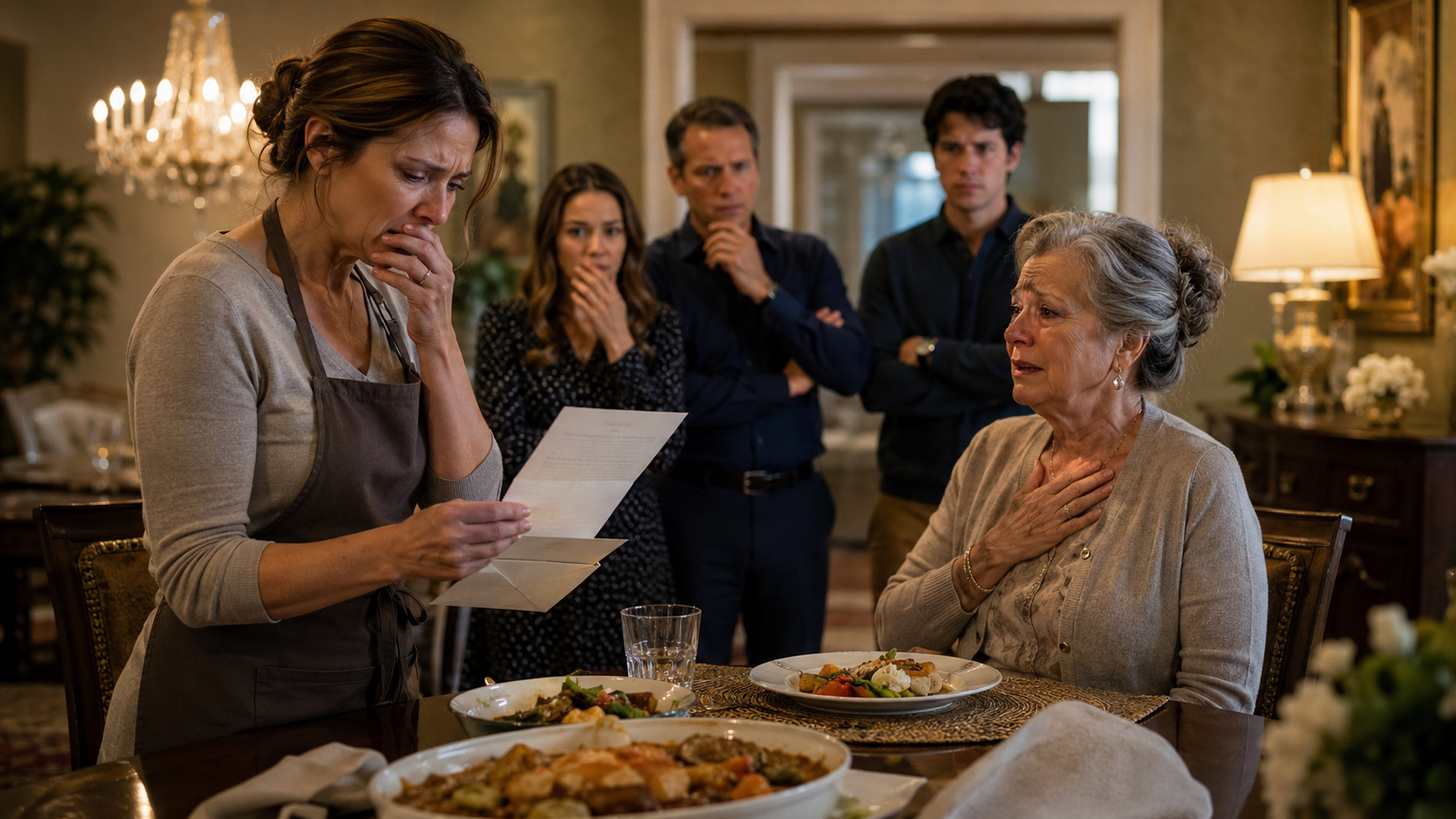
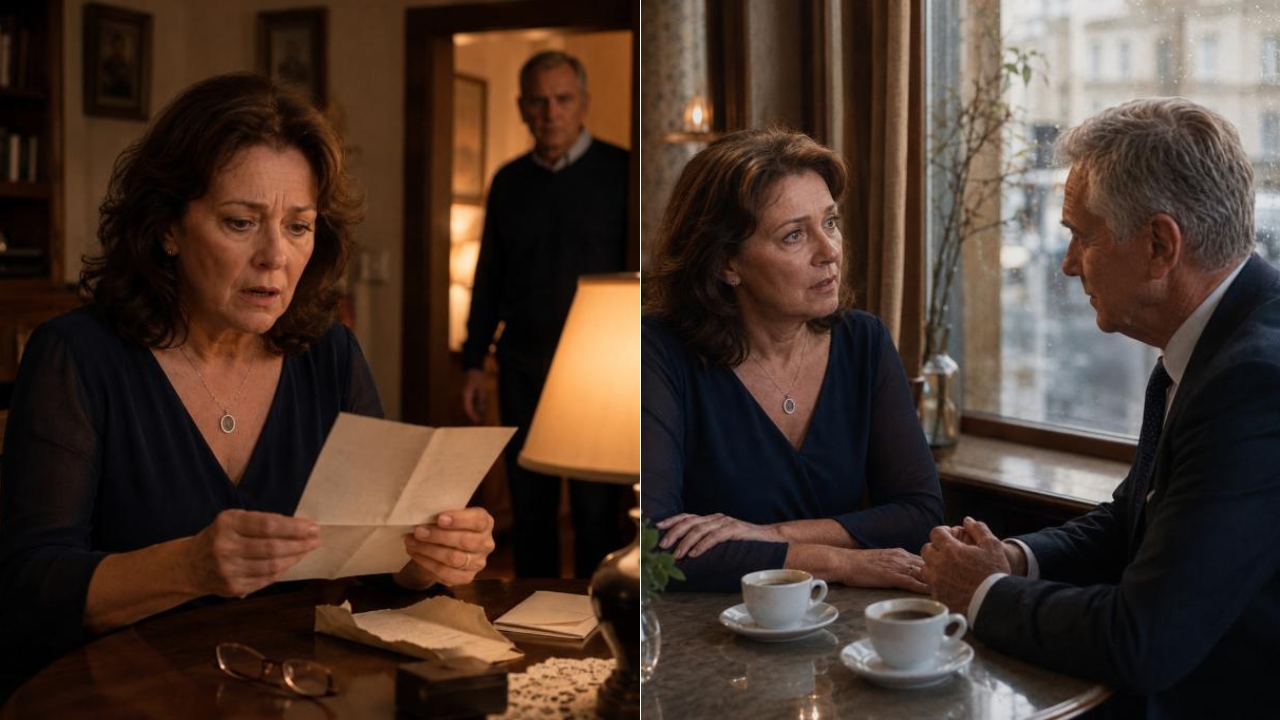
I was one day away from giving birth when my husband zipped his suitcase and told me not to ruin his parents’ trip.
At first, I thought I had misunderstood him.
I was standing in our bedroom doorway with one hand on my belly and the other gripping the wall because another sharp pain had just moved through my lower back.
Ethan did not look up.
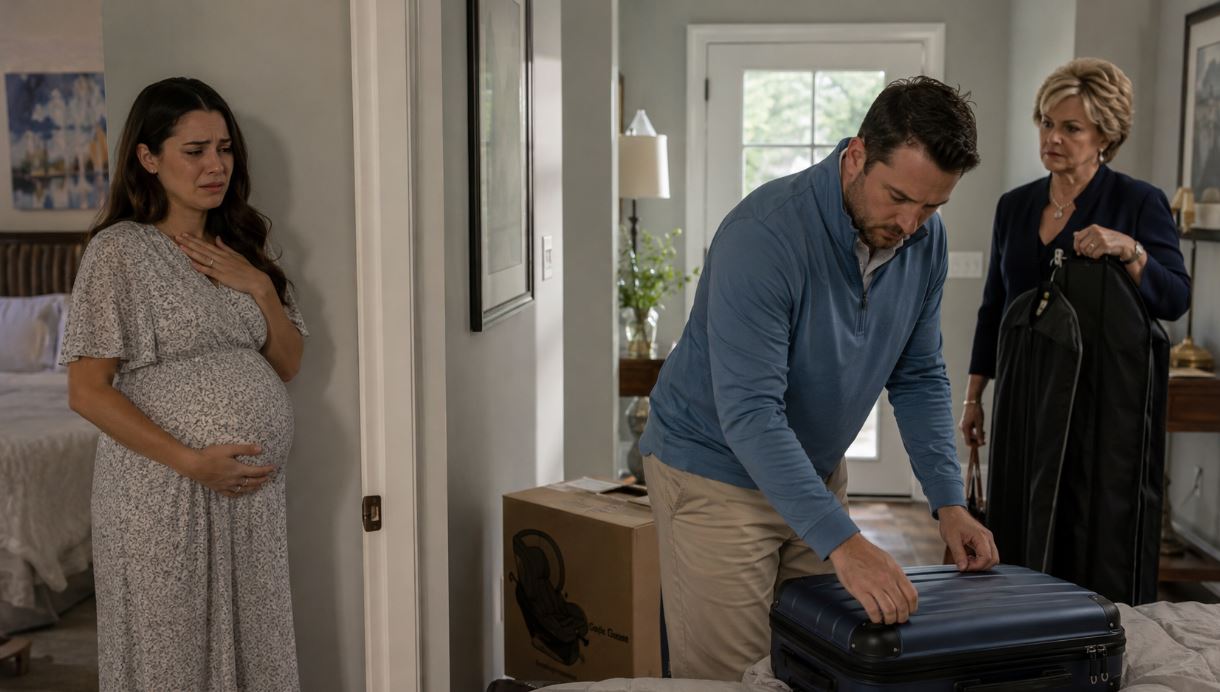
He folded a navy polo shirt, placed it carefully into his suitcase, and said, “My parents already paid for the resort, Maya. The tickets are non-refundable.”
I stared at him.
Non-refundable.
That was the word he chose when I was nine months pregnant with his son.
“Ethan,” I said slowly, “I’m due tomorrow.”
He sighed like I had reminded him to take out the trash.
“Due dates are estimates.”
Behind him, his mother, Patricia, stood near the dresser holding a garment bag. She was dressed for travel already, gold bracelets on her wrist, sunglasses pushed up in her hair.
She smiled at me.
Not kindly.
“Maya, women have babies every day,” she said. “You young wives act like pregnancy is some rare emergency.”
My throat tightened.
I had heard little comments like that for months.
When I was too tired to cook, Patricia said she had made dinner every night until the day Ethan was born.
When my feet were swollen, she said walking helped.
When I cried because Ethan missed our last birthing class, she said men did not belong in those rooms anyway.
And when I asked Ethan to please stay close during my final week, she laughed and said, “A baby should fit into a family, not control it.”
A baby.
Our baby.
But in that house, our son had become an inconvenience to their plans.
I looked at Ethan.
“Please,” I said. “I don’t feel right.”
He zipped the suitcase harder than necessary.
“You’ve been saying that for two weeks.”
“Because I’m nine months pregnant.”
His father, Richard, called from the hallway.
“Ethan, we need to leave in ten if we want to beat traffic to the airport.”
I waited for Ethan to answer him with, “I’m not coming.”
I waited for him to look at me and finally understand that this was not a normal weekend.
This was the birth of our first child.
Instead, he lifted the suitcase off the bed.
“I’ll be back Monday.”
Monday.
It was Friday morning.
I laughed once, but it came out broken.
“What if I go into labor?”
Ethan checked his watch.
“Then you call the hospital. Or your mom. Or an Uber.”
Something inside me went very still.
Not calm.
Still.
There is a difference.
“An Uber?” I repeated.
He finally looked annoyed.
“Maya, don’t start.”
Patricia stepped closer.
“She’s trying to make you feel guilty.”
I turned to her.
“I am asking my husband not to leave me alone when I could give birth any hour.”
Patricia’s face hardened.
“And I am asking you not to make my son choose between his parents and your anxiety.”
That was when I understood.
She did not see me as family.
She saw me as the woman who had taken her son.
And now, even with his child inside me, she still expected me to step aside.
Ethan walked past me with the suitcase.
I followed him down the hallway because some desperate part of me still believed this could not really be happening.
The car seat was by the front door.
Still in the box.
For three weeks, I had asked Ethan to install it.
Every time, he said he would do it later.
Later had become our marriage.
Later for appointments.
Later for baby classes.
Later for painting the nursery.
Later for asking if I was scared.
Later, later, later.
Until now there was no later left.
“You didn’t install the car seat,” I said.
He did not stop.
“I’ll do it when I get back.”
My hand tightened on the banister.
“What if the baby comes before then?”
Patricia laughed softly.
“Then he can ride home with you in your mother’s car. Really, Maya, must every detail become a crisis?”
I looked at Ethan one last time.
“If you leave right now, something changes between us.”
He paused at the front door.
For a moment, I thought I had reached him.
Then he turned.
His face was cold in a way I had never seen before.
“No,” he said. “What changes is you finally learn that not everything revolves around you.”
The pain came again.
Harder this time.
I bent slightly, pressing both hands to my belly.
Ethan saw it.
So did his mother.
No one moved toward me.
Then I felt warmth run down my legs.
At first, I did not understand.
Then I looked at the floor.
My water had broken.
The room went silent.
I whispered, “Ethan.”
He stared at the floor.
Then at his watch.
Patricia stepped back as if the water might stain her shoes.
Richard appeared in the hallway, frowning.
“What happened?”
“My water broke,” I said.
I thought that would end it.
Surely now, Ethan would drop the suitcase.
Surely Patricia would stop.
Surely someone would remember I was not just a difficult daughter-in-law.
I was a woman about to give birth.
Ethan ran a hand over his face.
“Maya…”
I knew from his tone before he said anything else.
“No,” I said.
He looked away.
“We can miss the flight, but then we lose the whole package.”
The whole package.
My child was coming.
His son was coming.
And Ethan was thinking about golf.
Patricia touched his arm.
“She has time. First babies take hours.”
I stared at her.
“You are telling him to leave me?”
She looked me straight in the eye.
“I am telling my son not to let fear control his life.”
That sentence did something to me.
It burned away the last excuse I had made for her.
She was not old-fashioned.
She was not protective.
She was cruel.
Ethan picked up his suitcase.
I gripped the doorframe.
“If you walk out that door, do not expect to walk back in as my husband.”
He looked at me then.
For the first time, there was a flash of panic.
Not because he was afraid of losing me.
Because I had said it in front of his parents.
Patricia scoffed.
“She’s being dramatic.”
Ethan’s face closed again.
“I’ll call you when we land.”
Then he left.
His father followed.
Patricia was last.
At the doorway, she turned back and gave me a small smile.
“Try to calm down before the baby comes. Stress is bad for children.”
Then she shut the door.
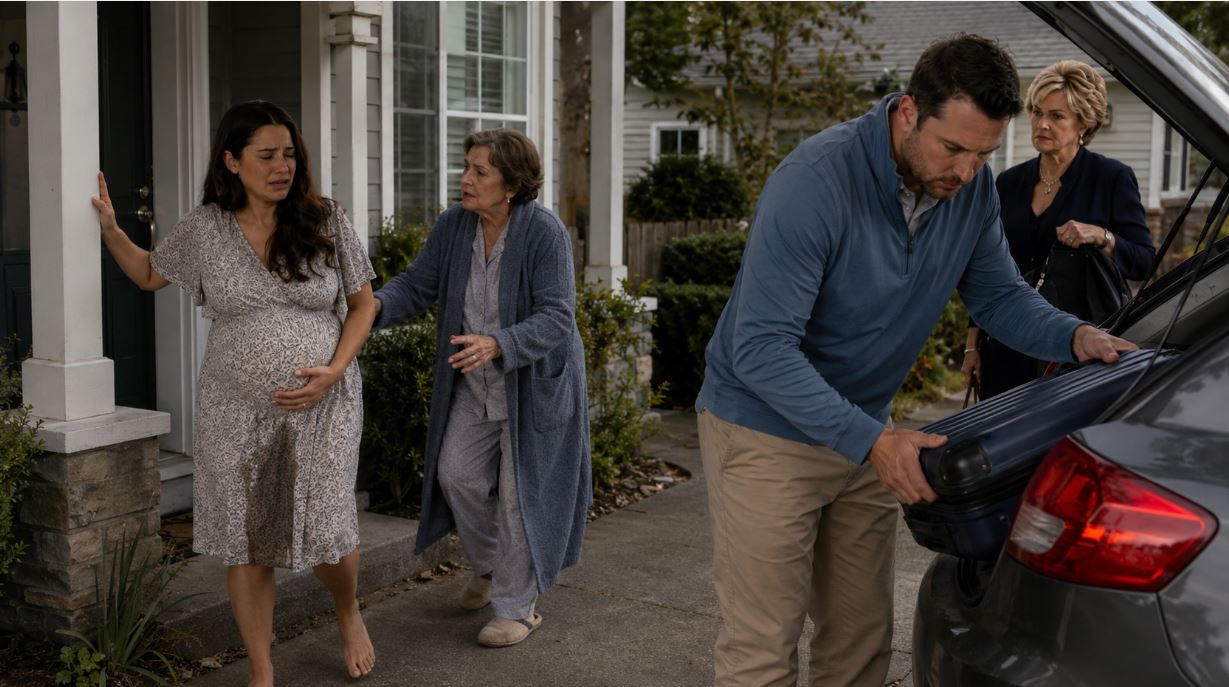
I stood in the entryway, barefoot, soaked, shaking, listening to the sound of their car start.
I do not remember walking to the porch.
I remember the sunlight hurting my eyes.
I remember Ethan putting his suitcase in the trunk.
I remember calling his name.
He did not turn around.
The car backed out of the driveway.
And just like that, my husband left me in labor.
For a few seconds, I could not move.
Then another contraction hit.
This one brought me to my knees.
I reached for my phone and called Ethan.
No answer.
I called again.
No answer.
I called Patricia.
Straight to voicemail.
I called 911, but my fingers were shaking so badly I almost dropped the phone.
Before the dispatcher even finished asking my address, I heard someone shouting.
“Maya!”
My neighbor, Mrs. Caldwell, was running across the lawn in house slippers.
Her first name was Mira, but I had always called her Mrs. Caldwell because she had that grandmotherly way about her. She was sixty-eight, widowed, and had worked as a labor and delivery nurse for more than thirty years.
She reached me, took one look at my face, then at the wet porch floor.
“Oh, honey,” she said. “How far apart?”
I started crying.
“He left.”
Her face changed.
Not shock.
Fury.
But she did not waste time on it.
“Look at me. How far apart are the contractions?”
“I don’t know. Close. They’re close.”
She took the phone from my hand, spoke to the dispatcher, then helped me stand.
“You are not taking an Uber,” she said. “You are taking me.”
She grabbed a towel from my hallway, wrapped it around my waist, picked up my hospital bag by the door, and guided me to her car.
As she buckled me in, I saw the small black doorbell camera on her porch.
It was pointed directly at my driveway.
At my house.
At the place where Ethan had left.
Mrs. Caldwell saw me looking.
Her jaw tightened.
“Don’t worry about that now,” she said. “We’re getting this baby here safely.”
The ride to the hospital was a blur of pain, traffic lights, and Mrs. Caldwell’s voice telling me to breathe.
She did not panic.
She did not shame me.
She did not make me feel dramatic.
She said things like:
“You are doing beautifully.”
“Your body knows what to do.”
“You are not alone.”
I cried harder at that last one.
Because I had been alone for months, even with a husband sleeping beside me.
At the hospital, nurses rushed me into a room.
Someone asked where the father was.
I could not answer.
Mrs. Caldwell did.
“He is unavailable.”
The nurse’s face said she understood more than those three words.
My parents arrived two hours later.
They had taken the first flight they could get after I called my mother from the hospital bed.
My father walked into the room first.
Thomas Wallace was sixty-four, broad-shouldered, quiet, and the kind of man who believed love was not something you announced. It was something you did.
He had built cribs for every baby in our family.
Fixed sinks without being asked.
Changed oil.
Showed up early.
Stayed late.
He came into that room, saw me sweating and shaking, and his face broke.
Not loudly.
Just around the eyes.
“Where is he?” Dad asked.
I shook my head.
My mother covered her mouth.
Dad stepped closer.
“Maya.”
“He went,” I whispered.
“Went where?”
“With his parents.”
My father went completely still.
I had seen him angry before.
This was different.
This was controlled rage.
“While you were in labor?”
I nodded.
He looked toward the door like he might walk out and find Ethan with his bare hands.
My mother touched his arm.
“Thomas. Not now.”
Dad closed his eyes.
When he opened them, he came to my bedside and took my hand.
“You look at me,” he said.
I did.
“You and this baby are my only job today. Nothing else matters.”
I broke then.
Fully.
The kind of crying that makes nurses look away because it feels too private.
Dad stayed.
Mom stayed.
Mrs. Caldwell stayed until a nurse convinced her to sit down.
Ethan did not call.
He sent one text after his plane landed.
Just saw your calls. Everything okay?
Everything okay.
I stared at those words while another contraction tore through me.
My father saw the message.
His face hardened.
“Do you want me to answer?”
I shook my head.
“No.”
“Good.”
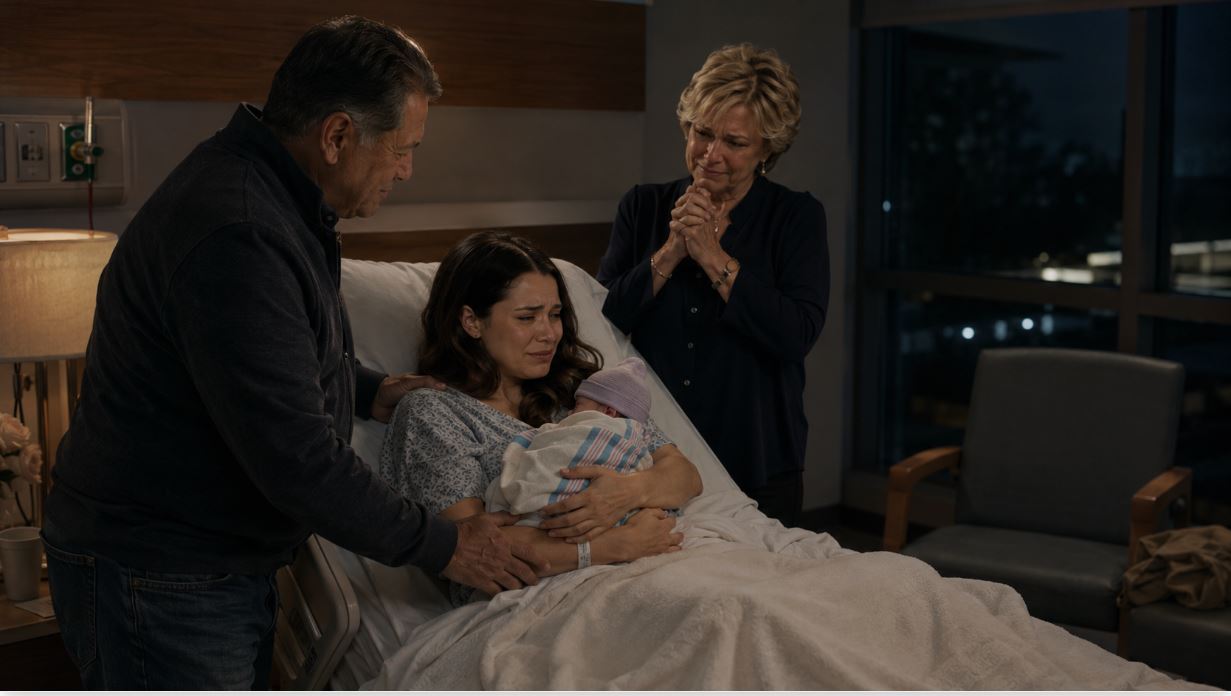
My son was born at 8:43 that evening.
Seven pounds, two ounces.
A full head of dark hair.
A cry loud enough to fill every empty place in me.
When they placed him on my chest, I forgot Ethan for one whole minute.
Maybe two.
I forgot the suitcase.
The driveway.
Patricia’s smile.
The car pulling away.
There was only this tiny warm body against me, this little mouth searching, this impossible life that had chosen to arrive whether his father was ready or not.
I named him Leo.
Ethan and I had argued for months about names.
He wanted Richard Ethan Vance Jr., after his father and himself.
I wanted Leo Thomas.
Leo because my grandmother once told me a lion does not need to announce its strength.
Thomas after my father.
Ethan said it sounded “too much like my side of the family.”
That night, holding my son, I understood something clearly.
A name is not just a sound.
It is a direction.
It tells a child where he comes from.
And sometimes, it tells the world who showed up.
The nurse brought the birth certificate paperwork the next morning.
I stared at the blank line.
Child’s last name.
Vance.
That was what everyone expected.
That was what Patricia expected.
That was what Ethan expected.
I looked at my father asleep in the chair by the window, arms crossed, chin on his chest.
He had not left once.
I looked at my mother folding tiny baby clothes into the hospital drawer.
I looked at Mrs. Caldwell’s text on my phone.
Checking on you and little Leo. Proud of you.
Then I picked up the pen.
First name: Leo.
Middle name: Thomas.
Last name: Wallace.
My son would carry my name.
The name of the family that came when called.
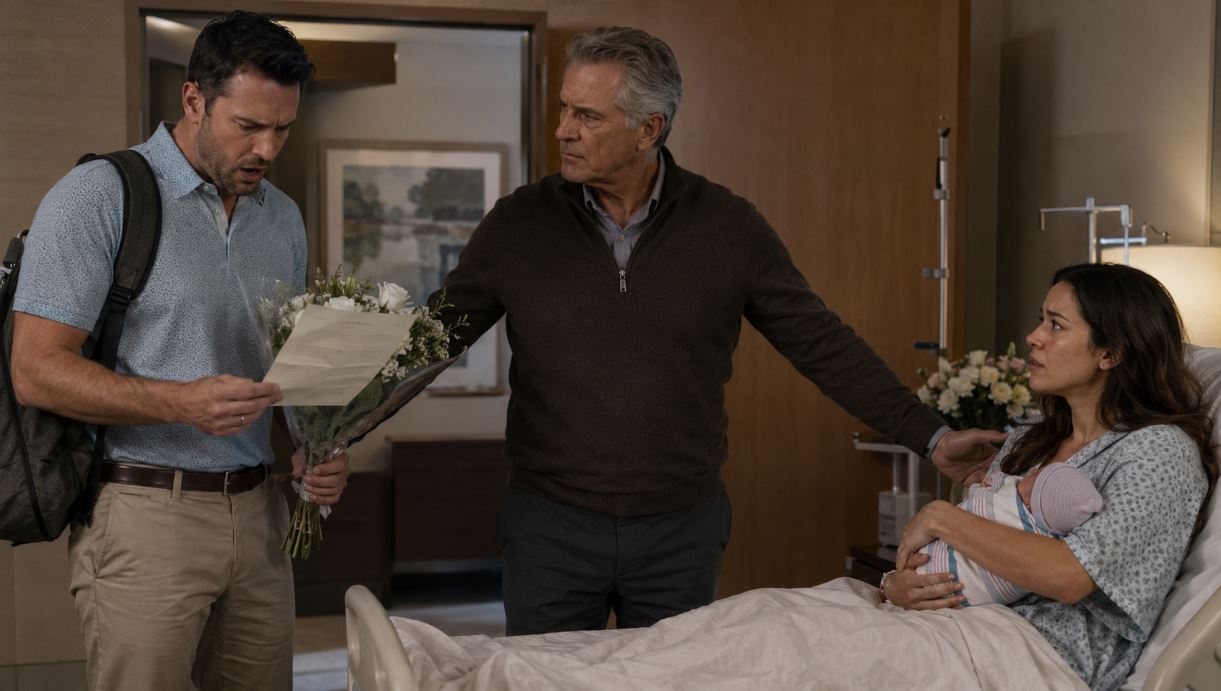
When Ethan finally arrived three days later, he brought flowers from the hospital gift shop.
Not the kind I liked.
The kind you buy when you are already in the building and remember you should be holding something.
He walked into my room wearing his resort hoodie.
Sunburn on his nose.
Golf tan on his arms.
He looked tired.
Not from labor.
From travel.
“Maya,” he said, like my name was an apology.
My father stood immediately.
Ethan froze.
“Mr. Wallace.”
Dad did not answer.
Ethan looked at me, then at the baby in my arms.
His face softened.
“Is that him?”
I held Leo closer.
“Yes.”
He stepped forward.
Dad moved half a step too.
Ethan stopped.
“I’m his father,” Ethan said.
My father’s voice was low.
“Then you should have been here when he became your son.”
Ethan swallowed.
“I couldn’t get an earlier flight.”
I laughed.
It surprised everyone, including me.
“You didn’t try to get an earlier flight until the video went around.”
His face changed.
There it was.
The truth.
Fear, not guilt.
“What video?” my mother asked sharply.
Ethan looked at the floor.
Mrs. Caldwell’s doorbell camera had recorded everything.
Me on the porch.
Ethan loading his suitcase.
Me calling his name.
His mother turning back to say something.
The car leaving.
Mrs. Caldwell running across the lawn minutes later.
I had not posted it.
Mrs. Caldwell had not posted it.
But her grandson, who helped manage her phone apps, saw it after she asked him to save the footage.
He sent it to me.
I sent it to my attorney.
Somehow, by the time Ethan returned, half his family had seen enough to start calling him.
Ethan rubbed his forehead.
“My mother said it looked worse than it was.”
My father took one step forward.
My mother said, “Thomas.”
Dad stopped, but his voice cut through the room.
“It was exactly what it was.”
Ethan looked at me.
“I made a mistake.”
“No,” I said. “You made a choice.”
His eyes filled, but I did not trust tears anymore.
Tears can be regret.
They can also be strategy.
“I was scared,” he said.
I looked at the baby.
“So was I.”
He flinched.
“I didn’t know your water had really broken.”
“You saw it.”
“I thought we had time.”
“You had a flight.”
The room went quiet.
Then he noticed the paperwork on the side table.
The copy of Leo’s birth record.
He picked it up before I could stop him.
His eyes moved down the page.
Then froze.
Child’s name: Leo Thomas Wallace.
His face went pale.
“Wallace?”
I met his eyes.
“Yes.”
“That’s not his name.”
“It is.”
“He’s my son.”
“He is my son too. And I was the parent present when he entered the world.”
Ethan looked around, panicked now.
“You can’t just do that.”
“I did.”
His voice rose.
“My family is going to lose their minds.”
That told me everything.
Not “I am hurt.”
Not “I failed you.”
Not “I want to make this right.”
His first fear was his family.
My father’s hands curled at his sides.
Ethan turned to him.
“You had something to do with this.”
Dad’s voice was calm.
“I had something to do with staying.”
Ethan looked back at me.
“Maya, we can fix the certificate.”
“No.”
“You’re angry right now.”
“Yes,” I said. “But I am also very clear.”
He pointed toward Leo.
“You are trying to take my rights.”
I felt my whole body go cold.
There it was.
The word Patricia had probably fed him on the flight home.
Rights.
Not responsibility.
Not love.
Rights.
I sat up straighter, though it hurt.
“You left your wife in active labor and ignored my calls. You did not come when your son was born. You arrived three days later with flowers and a sunburn. Do not stand in this room and lecture me about rights.”
My mother started crying quietly.
Dad looked at me with something like pride and pain mixed together.
Ethan’s mouth opened.
Closed.
Then he said the worst possible thing.
“My mother said you would try to punish me with the baby.”
My father moved so fast I barely saw it.
He did not hit Ethan.
He did not touch him.
He simply stepped between Ethan and my bed.
“You will leave now,” Dad said.
Ethan tried to look around him.
“Maya.”
Dad’s voice lowered.
“Now.”
For once, Ethan obeyed.
But Patricia did not.
She arrived twenty minutes later like a storm in pearls.
She marched into my hospital room without knocking, holding her phone in one hand and her purse in the other.
“Where is my grandson?”
My father stood again.
Patricia stopped when she saw him.
Good.
“Mrs. Vance,” he said.
She lifted her chin.
“I am here to see my grandchild.”
I held Leo close.
“He is sleeping.”
“I can see that.”
“No,” I said.
Her eyes snapped to mine.
“Excuse me?”
“You cannot see him right now.”
Her face flushed.
“Maya, do not start this nonsense.”
My mother turned slowly.
“Nonsense?”
Patricia ignored her.
“That child is a Vance.”
“No,” I said. “He is a Wallace.”
She stared at me.
Then laughed.
A sharp, ugly laugh.
“You cannot be serious.”
“I am.”
She looked at Ethan, who had followed her back in and now stood near the door looking miserable.
“Tell her,” she snapped.
Ethan did not speak.
Patricia turned back to me.
“You are emotional. You are exhausted. You are using this baby to hurt my son.”
I looked at her and saw every small insult from the past year stacked behind her eyes.
Every comment about my weight.
My birth plan.
My mother.
My job.
My cooking.
My body.
My supposed anxiety.
For months, I had swallowed it because I wanted peace.
But peace that requires one person to disappear is not peace.
It is surrender.
“You told him to leave me,” I said.
“I told him not to be manipulated.”
“My water broke in front of you.”
“First labors take time.”
“You were wrong.”
She looked away.
Not ashamed.
Annoyed.
“My son deserves to hold his child.”
“My son deserved a father who stayed.”
The words landed hard.
Ethan covered his face.
Patricia’s lips thinned.
“You will regret turning this family against you.”
My father stepped forward again.
“No,” he said. “She has a family.”
Patricia looked him up and down.
“And who are you to decide anything?”
He smiled then.
Not kindly.
“I’m the man who drove through the night to sit beside my daughter while your son played golf.”
Patricia had no answer for that.
A nurse appeared at the door.
“Is everything okay in here?”
I looked at Patricia.
“No,” I said. “These visitors need to leave.”
For the first time since I had met her, Patricia Vance looked truly shocked.
Not because she was being removed.
Because she had been told no by someone she expected to control.
Security came.
Quietly.
Professionally.
Ethan left with his head down.
Patricia left with hers high.
But she left.
That mattered.
The next weeks were not easy.
People like Ethan do not lose control gracefully.
He called.
Texted.
Sent emails.
Apologized.
Then blamed me.
Then apologized again.
Then said I was keeping his son from him.
Then said his parents were devastated.
Then said I was destroying his reputation.
Reputation.
That word again.
Not marriage.
Not trust.
Not fatherhood.
Reputation.
My attorney, Rachel Greene, told me to document everything.
So I did.
Every message.
Every voicemail.
Every missed call.
Every screenshot.
The doorbell video.
The hospital visitor report.
The birth record.
The text Ethan sent after landing: Everything okay?
That one became my favorite piece of evidence.
Not because it was dramatic.
Because it was casual.
It showed exactly how little he understood.
Everything was not okay.
Everything had changed.
When we met for the first emergency custody hearing, Ethan wore a gray suit and the face of a wounded husband.
Patricia sat behind him, dabbing her eyes with a tissue.
My father sat behind me.
Still.
Silent.
Present.
Ethan’s attorney tried to make it sound like a misunderstanding.
A frightened husband.
A nervous first-time father.
A family trip planned months before.
A labor that progressed faster than expected.
My attorney played the doorbell footage.
The courtroom went quiet.
There I was on the screen, standing on the porch, doubled over, calling Ethan’s name.
There he was, putting his suitcase into the trunk.
There was Patricia, turning back toward me.
The audio was not perfect, but it caught enough.
“Try to calm down before the baby comes.”
I watched the judge’s face.
She did not move.
But her eyes changed.
Then the video showed their car leaving.
Minutes later, Mrs. Caldwell ran across the lawn.
My attorney stopped the video.
No one spoke.
Ethan stared at the table.
Patricia’s tissue froze halfway to her face.
The judge looked at Ethan.
“Mr. Vance, did you leave after your wife’s water broke?”
Ethan swallowed.
“I believed there was time.”
The judge looked down at the papers.
“And you did not answer repeated phone calls?”
“My phone was on airplane mode.”
“Because you boarded a plane.”
“Yes.”
“To attend a golf trip.”
His attorney stood slightly.
“Your Honor—”
The judge raised a hand.
“I understand.”
But her tone said she understood more than Ethan wanted.
I did not get everything I asked for that day.
Real life rarely gives clean victories.
But I got enough.
Temporary primary custody.
Supervised visitation.
No unscheduled visits from Ethan or his parents.
All communication through a parenting app.
Patricia was not allowed at visits unless approved.
When the judge said that, Patricia made a sound like she had been slapped.
I did not look back.
On the way out of court, Ethan caught up to me in the hallway.
My father stepped between us immediately.
Ethan looked past him.
“Maya, please.”
I stopped.
He looked tired now.
Really tired.
For a second, I saw the man I had married.
The one who brought me soup when I had the flu.
The one who cried when the pregnancy test turned positive.
The one who promised he would be different from his father.
Maybe that man had existed.
Maybe he had been real.
But he was not the man who stayed.
“I want to see my son,” he said.
“You will,” I answered. “When the court says. Under the rules.”
His eyes filled.
“You changed his name.”
“No,” I said. “I gave him one.”
“That was supposed to be our decision.”
“So was becoming parents.”
He looked down.
“I know I failed you.”
I wanted those words to matter.
I really did.
But some failures do not fit inside an apology.
Some failures become a line in the floor.
Before and after.
“You did,” I said.
Then I walked away.
Six months later, Leo is a happy baby with serious eyes and my father’s stubborn chin.
He laughs when Mrs. Caldwell sings old church songs off-key.
He falls asleep faster in my mother’s arms than anywhere else.
He grips my father’s finger like he knows exactly who showed up first.
Ethan visits twice a week now.
Supervised.
He is learning how to change diapers without acting like the room should applaud.
He brings formula.
He asks questions.
He has not earned trust, but he is learning responsibility.
Those are not the same thing.
Patricia has seen Leo twice.
Both times, she cried.
Both times, she referred to him as “a Vance boy.”
Both times, I corrected her.
“His name is Leo Wallace.”
She hates that.
I know.
I do not care.
The name is not revenge.
It is memory.
It is the story of the day my son was born and the people who came when called.
One afternoon, Ethan asked if we could talk alone after his visit.
My father was in the next room.
The door stayed open.
Ethan looked at Leo sleeping in the bassinet.
“I’m in therapy,” he said.
I nodded.
“That’s good.”
“My mother hates it.”
“I believe that.”
He almost smiled, then didn’t.
“She keeps saying you turned everyone against me.”
I looked at him.
“No. You left. People reacted.”
He nodded slowly.
“I know that now.”
Maybe he did.
Maybe he only knew enough to say it.
Time would tell.
“I don’t know if I can ever fix what I did,” he said.
“You can’t undo it.”
“I know.”
“But you can decide what kind of father you become after it.”
He looked at Leo.
For once, he did not mention his rights.
He did not mention his mother.
He did not mention the Vance name.
He just whispered, “I don’t want him to grow up ashamed of me.”
That was the first thing he had said that sounded like fatherhood.
Not ownership.
Not pride.
Fear of failing a child.
I said, “Then start by showing up when it is inconvenient.”
He nodded.
After he left, my father came into the room carrying two cups of coffee.
“He sounded better,” Dad said.
“Maybe.”
“Do you believe him?”
I watched Leo sleep.
“I believe actions.”
Dad smiled faintly.
“That’s my girl.”
I leaned against him for a moment.
“I wish I had called you sooner.”
“You called when you were ready.”
“I should have known.”
Dad set his cup down.
“Maya, listen to me. You were trying to keep your marriage together. That is not a crime.”
“He left me.”
“Yes.”
“I feel stupid.”
“You were not stupid,” Dad said. “You were hopeful.”
That made me cry.
Because hope sounds beautiful until you realize how long it kept you standing in a burning room.
I still think about that driveway.
Not every day.
But often.
I think about the suitcase wheels rolling over the porch step.
Patricia’s bracelets flashing in the sun.
Ethan’s hand closing the trunk.
The moment I said his name and he did not turn around.
For a while, that memory made me feel abandoned.
Now it makes me feel warned.
Some people show you who they are only when your crisis interrupts their comfort.
Ethan had a choice that morning.
So did I.
He chose the trip.
I chose the truth.
I chose to stop begging a man to become a husband while I was already becoming a mother.
I chose to let my father protect me without feeling ashamed that I needed help.
I chose to let Mrs. Caldwell’s kindness remind me that family is not always the person with the title.
Sometimes family is the neighbor in house slippers running across the lawn.
Sometimes it is the father sitting in a hospital chair all night.
Sometimes it is the mother folding tiny onesies while trying not to cry.
Sometimes it is a baby taking his first breath in a room full of people who stayed.
Leo will know the truth one day.
Not when he is little.
Not as a weapon.
But as a lesson.
I will tell him that love is not proven in photographs, announcements, or last names.
Love is proven in the moments when leaving would be easier.
The night he was born, his father was not there.
That is true.
But his story did not begin with absence.
It began with presence.
Mine.
My parents’.
Mrs. Caldwell’s.
The nurses who held my hand.
The people who did not ask whether my pain was convenient.
And that is why his name is Leo Thomas Wallace.
A lion.
A father who stayed.
A family that answered.
And a mother who finally understood that being abandoned does not make you weak.
Sometimes it is the moment you stop waiting at the door and lock it behind you.