My Stepfather Threw Me Out After My Mother Died. Thirty Years Later, His Lawyer Sent Me a Key
PART I
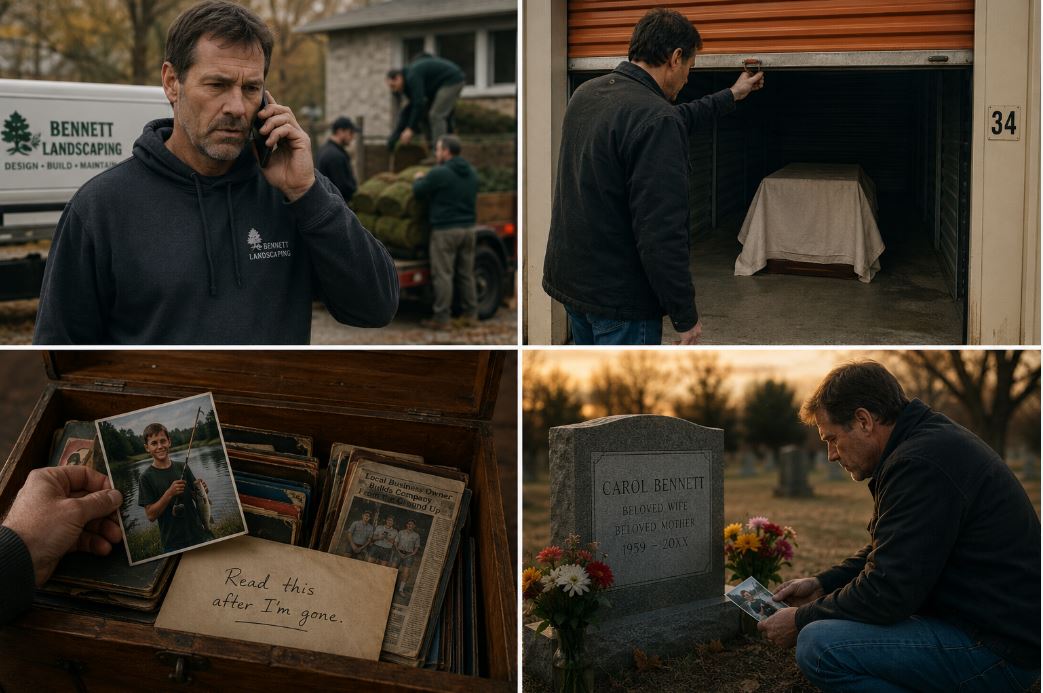
The lawyer called on a Tuesday morning while I was standing beside a half-finished backyard in northern Ohio.
My crew was unloading stone pavers from a trailer. A leaf blower whined somewhere across the street, and the air had that sharp October chill that told you winter was closer than it looked.
“Mr. Bennett?” the man asked.
“This is him.”
“My name is Arthur Hendricks. I’m calling regarding the estate of Dale Morrow.”
For a second, I thought I had misheard him.
I had not heard Dale’s name spoken aloud in nearly thirty years.
Not since the week he handed me four hundred dollars, pointed toward the front door and told me it was time to begin my own life.
“What about him?” I asked.
“He passed away in August. Heart failure. He was seventy-eight.”
I looked across the yard at one of my workers struggling to guide a wheelbarrow over damp grass.
I felt nothing at first.
Then something old shifted inside me.
Not grief.
Not exactly anger either.
More like the ache of an old injury when the weather changes.
“I’m sorry to hear that,” I said, although I wasn’t sure I meant it.
“There is a will,” Hendricks continued. “Most of the estate has been divided between his children, Marcus and Diane.”
“That sounds right.”
“But Mr. Morrow left one separate item to you.”
I almost laughed.
“What item?”
“A storage unit outside Lenora. Unit thirty-four. It has been paid for through next year.”
I said nothing.
“The contents are yours,” the lawyer added. “And the key was to be delivered only to you.”
That caught my attention.
“Marcus and Diane know about this?”
“No.”
“Why not?”
“I was instructed not to tell them.”
Two days later, a padded envelope arrived at my office.
Inside was a plain brass key taped to an index card.
On the card, Hendricks had written:
Lenora Storage
Route 9
Unit 34
That was all.
No explanation.
No message from Dale.
Just a key from a man who had not called me once in three decades.
Dale married my mother when I was eleven.
Her name was Carol Bennett, and she had the kind of tired beauty that never disappeared, even when life gave her every reason to stop smiling.
She worked mornings at a diner and cleaned offices three nights a week. Still, she always found enough energy to sit at the kitchen table while I did my homework.
She remembered everyone’s birthday.
She sang badly while washing dishes.
She kept spare change in a coffee tin for emergencies, although everything in our life seemed to qualify as one.
Dale owned a small appliance store downtown.
He wasn’t cruel in the obvious way.
He never hit me.
He rarely raised his voice.
In public, he introduced me as Carol’s boy.
Not his stepson.
Not his family.
Carol’s boy.
His own children, Marcus and Diane, visited every other weekend.
When they came, the house changed.
Dale bought better groceries.
He took them bowling.
He asked about their grades and laughed at their stories.
I was never forbidden from joining them. That would have been too obvious.
Instead, he simply never asked.
The difference in how he treated us was quiet but constant.
It was the larger piece of chicken placed on Marcus’s plate.
The new winter coat Diane received while I wore one with a broken zipper.
The way Dale looked through me whenever his children entered the room.
My mother noticed.
Of course she did.
Sometimes beneath the dinner table, she would squeeze my hand.
It was her way of saying:
I see it too.
But during the last three years of her life, she became weaker.
First came the exhaustion.
Then the coughing.
Then the hospital visits.
By the time I turned nineteen, her heart had begun to fail.
She died in February while snow pressed against the hospital windows.
I sat beside her bed and held her hand until it became cold.
Dale stood in the hallway.
A month later, he asked me to sit with him at the kitchen table.
He had already placed an envelope beside his coffee mug.
“The house belongs to me,” he said.
I remember the calmness of his voice more than the words.
“Marcus and Diane will be spending more time here. You’re an adult now. It would be better for everyone if you found somewhere else to stay.”
I stared at him.
“My mother just died.”
“I know.”
“This was her house too.”
“It was in my name.”
He slid the envelope toward me.
“There’s four hundred dollars in there. I’ll give you one week.”
I left in three days.
I slept on a friend’s couch, took every landscaping job I could find and eventually built a business of my own.
I got married.
I got divorced.
I bought a small house.
I hired people.
I watched my hair turn gray.
Dale never called.
Neither did Marcus or Diane.
After enough years passed, I stopped expecting them to.
I told myself I had put the past behind me.
Then the key arrived.
The storage facility sat beyond the edge of Lenora, between an abandoned feed store and a field of harvested corn.
A faded sign near the entrance read:
CLEAN. SAFE. SECURE.
The fence leaned slightly toward the road.
A teenage attendant sat behind the office counter watching something on his phone.
“Unit thirty-four?” I asked.
He pointed toward the last row without looking up.
The gravel crunched beneath my boots as I walked.
Cold wind pushed dry leaves against the orange metal doors.
Unit thirty-four was near the far end.
The padlock looked new.
I took the brass key from my pocket.
For a moment, I simply held it.
Thirty years earlier, Dale had taken my house key and told me I no longer lived there.
Now, after his death, he had given me another one.
I slid it into the lock.
It turned easily.
The metal door rattled as I lifted it.
The unit was almost completely empty.
Bare concrete floor.
Gray walls.
No boxes.
No furniture.
Nothing stacked along the sides.
Only one object stood in the exact center of the room.
It was covered by an old white sheet.
About four feet high.
Wide enough that I couldn’t tell what was underneath.
The wind moved behind me, lifting one corner of the fabric.
I stepped inside.
My footsteps echoed against the walls.
For a second, I wondered whether I should call Hendricks.
Then I reached for the sheet.
I pulled it away.
And when I saw what Dale had hidden there, I could not move.
PART II — FINAL
The sheet fell onto the concrete.
There was no safe underneath.
No stack of cash.
No expensive antique.
It was an old cedar chest.
The wood was dark and scratched, and one brass hinge had been repaired with mismatched screws.
I recognized it immediately.
It had belonged to my mother.
She used to keep blankets inside it at the foot of her bed.
I had assumed Dale threw it away after she died.
The lock was already open.
I lifted the lid.
The smell of cedar rose into the cold air.
Inside were photo albums.
Dozens of them.
I opened the first one.
There I was at twelve years old, standing beside a muddy pond with a fishing rod in my hand.
My mother had bought it for my birthday.
I remembered that day.
I remembered Dale complaining that I had tracked mud into his car.
But I had never known anyone took a picture.
The next page showed me at a middle-school baseball game.
Then at my high-school graduation.
There were report cards.
Old birthday cards.
A newspaper clipping from when I opened my first landscaping office.
A printed photograph of me standing beside my crew after we won a local business award.
I stared at it for a long time.
Dale had not been invited.
I had never sent him a copy.
Yet somehow, he had kept it.
Every important moment of my adult life seemed to be inside that chest.
My marriage announcement.
A photograph of my first company truck.
An article about a park renovation my business completed.
Even a picture from my mother’s grave, taken after the cemetery replaced her damaged headstone.
He had been watching from a distance.
For thirty years.
At the bottom of the chest lay a thick envelope.
My name was written across the front.
Underneath it, five words:
Read this after I’m gone.
I sat down on the concrete floor.
My hands had begun to shake.
The letter was several pages long.
The first line stopped me.
Michael, I owe you the apology I should have given thirty years ago.
I read it twice.
Then I continued.
I failed you.
I treated you like proof of a life Carol had before me, instead of seeing you for what you were—the son she loved more than anything in this world.
After she died, I told myself sending you away was practical. You were nineteen. You were strong. You would manage.
The truth is that I could not look at you without seeing her.
Instead of facing my grief, I punished you for it.
I lowered the letter.
The storage unit was silent except for the wind scraping branches against the fence outside.
I kept reading.
Dale wrote that he had followed my life through newspaper articles, mutual acquaintances and people who had hired my company.
He had driven past my first office.
He had attended one of my high-school baseball games without speaking to me.
Years later, he had stood across the street from my business during its grand opening.
He never walked inside.
Every year I told myself I would call.
Every year I decided too much time had passed.
Pride becomes cowardice when you carry it long enough.
At the bottom of the envelope was a cashier’s check.
Fifty thousand dollars.
I stared at the number without feeling anything.
Then I saw the final paragraph.
This money is not payment for what I did.
Nothing could pay for the years I took from you or for the home I made you leave while you were still grieving your mother.
It is simply the last thing an old man can offer after spending most of his life refusing to do the first thing he should have done.
Tell the truth.
I was wrong.
You deserved better.
If you can forgive me, I am grateful.
If you cannot, I understand.
But please believe this: I never forgot you.
I folded the letter.
For years, I had imagined what I would say if Dale ever apologized.
I thought I would tell him it was too late.
I thought I would remind him of the nights I slept on a borrowed couch, the jobs I worked while still grieving, the birthdays he ignored.
But sitting there beside my mother’s cedar chest, I realized he had already known all of it.
The photographs were proof.
He had watched my life from the outside, too ashamed to step back into it.
That did not erase what he had done.
It did not turn him into a father.
It did not return thirty years.
But it changed one thing.
I had spent most of my life believing I had been easy to discard.
The chest told a different story.
I loaded it into the back of my truck and drove to the cemetery.
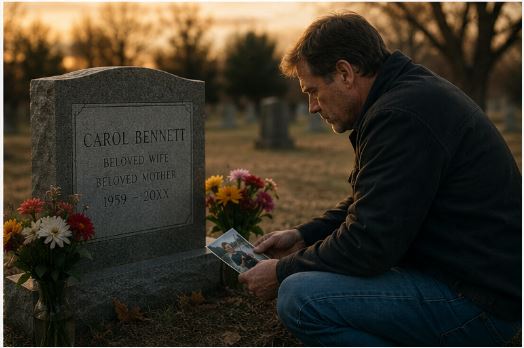
The sun was dropping behind the bare trees when I reached my mother’s grave.
I carried one of the old photographs with me—the one of the two of us beside the pond.
I placed a small bunch of grocery-store flowers against her headstone.
Then I sat on the cold grass.
“He finally admitted it,” I said.
My voice sounded strange in the open air.
“He knew what he did.”
For a long time, I said nothing else.
I did not tell her I had forgiven him.
I wasn’t sure I had.
Forgiveness, I had learned, was not a door that opened simply because someone finally handed you the key.
Sometimes it was only the decision to stop standing outside the same locked room.
When I left the cemetery, the cedar chest sat beside me in the truck.
The check was still inside.
But the money was not what mattered.
What mattered was the letter.
The photographs.
The proof that Dale had carried the memory of his failure for the rest of his life.
He had waited far too long to tell me the truth.
But as I drove home with my mother’s chest beside me, the anger I had carried for thirty years no longer felt quite as heavy.
Dale had once taken away my key and told me I no longer belonged.
Three decades later, he left me another key.
It did not open a fortune.
It opened the part of the past he had been too ashamed to face while he was alive.