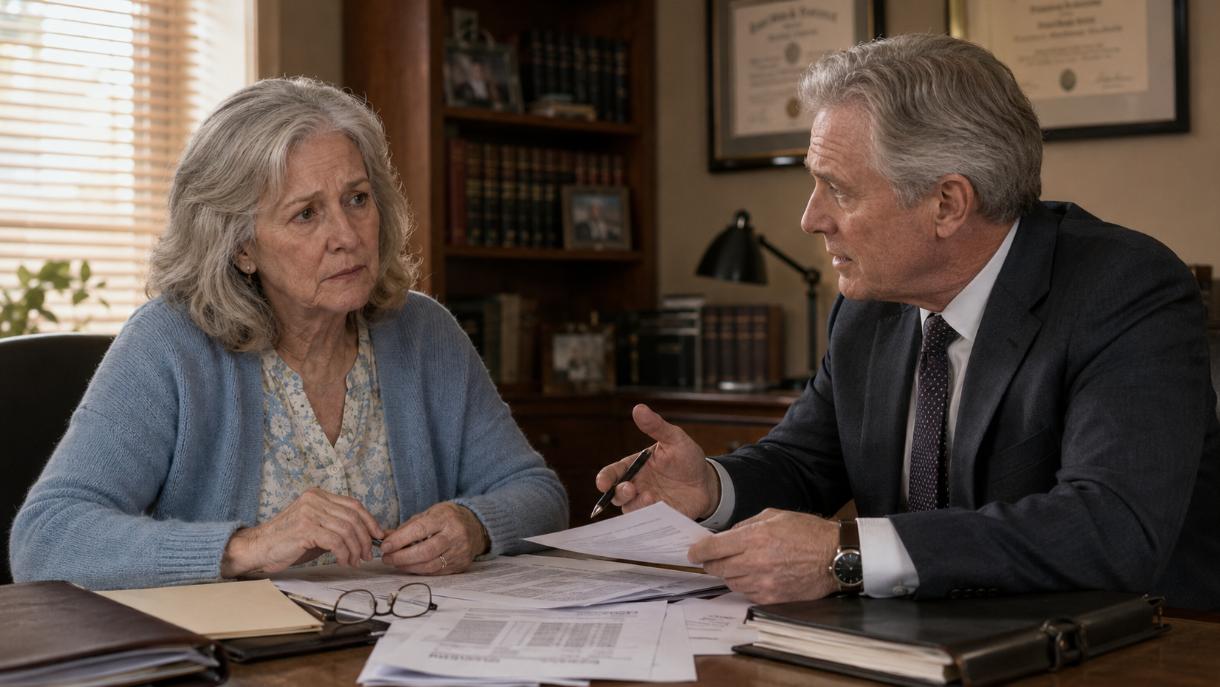
“Mom, from now on, your pension checks should go directly into my account.”
My son Julian said it while sitting at my kitchen table, stirring sugar into his coffee.
He did not sound nervous.
He did not sound ashamed.
He sounded like a man telling me the trash pickup had changed from Tuesday to Wednesday.
I was sixty-four years old.
I had worked since I was sixteen. I had paid bills, raised a child alone, buried a husband who never stayed long enough to be called one, survived layoffs, rent increases, medical debt, and lonely winters.
But in Julian’s eyes, I had suddenly become a woman who could not be trusted with her own money.
I looked at him across the table.
He wore a gray sweater I had bought him last Christmas. His watch was expensive. His shoes were polished. His phone lay face down beside his coffee, though I knew he was still waiting for it to buzz.
“My pension?” I asked.
He smiled.
“That’s right. It’ll be easier. I’ll handle everything.”
“Everything?”
“Bills. Groceries. Repairs. Whatever you need.”
He said the last part like he was offering me mercy.
The kitchen was quiet except for the spoon tapping against his cup.
Clink.
Clink.
Clink.
I searched his face for the boy I had raised. The little boy who used to climb into my lap during thunderstorms. The teenager I had worked double shifts to keep in good sneakers. The young man I had helped through college until my own hands ached from cleaning offices at night.
For a moment, I wanted to find him there.
I wanted one flicker of love.
One trace of hesitation.
One sign that my son understood what he was asking.
I found nothing.
Only confidence.
The kind of confidence people have when they have already counted on your surrender.
I lowered my eyes to my coffee.
“All right,” I said.
Julian’s smile widened.
“Good. I knew you’d understand.”
He reached across the table and patted my hand.
Not held it.
Patted it.
Like I was a child.
“It’s for the best, Mom.”
For the best.
He stood, kissed my forehead, and left with the papers still in his leather folder. He said he would bring the forms back Monday.
I stayed at the table long after his car pulled out of the driveway.
The house was still.
Too still.
On the wall above the stove hung the clock I had bought from a thrift store twenty years ago. It ticked loudly in the silence.
For the first time in years, I listened to that sound without moving.
Tick.
Tick.
Tick.
Then I got up and started making phone calls.
On Friday evenings, Julian always came for dinner.
He had been doing it for three years.
At first, I thought it meant he missed me. I planned meals days in advance. Roast chicken. Potatoes. Green beans with butter. Apple pie if I had the energy.
Then his wife Alana began coming too.
Then they began arriving empty-handed.
No flowers.
No dessert.
Not even a carton of milk when they knew I was stretching my grocery money.
They would come in with Julian’s key, sit down, eat, scroll on their phones, and leave before the dishes were dry.
Still, I cooked.
Because a foolish part of me believed that if I kept feeding my son, he might one day remember I was his mother.
That Friday, I did not cook.
At six-thirty, I heard Julian’s key turn in the front door.
I was sitting in a wooden chair in my kitchen.
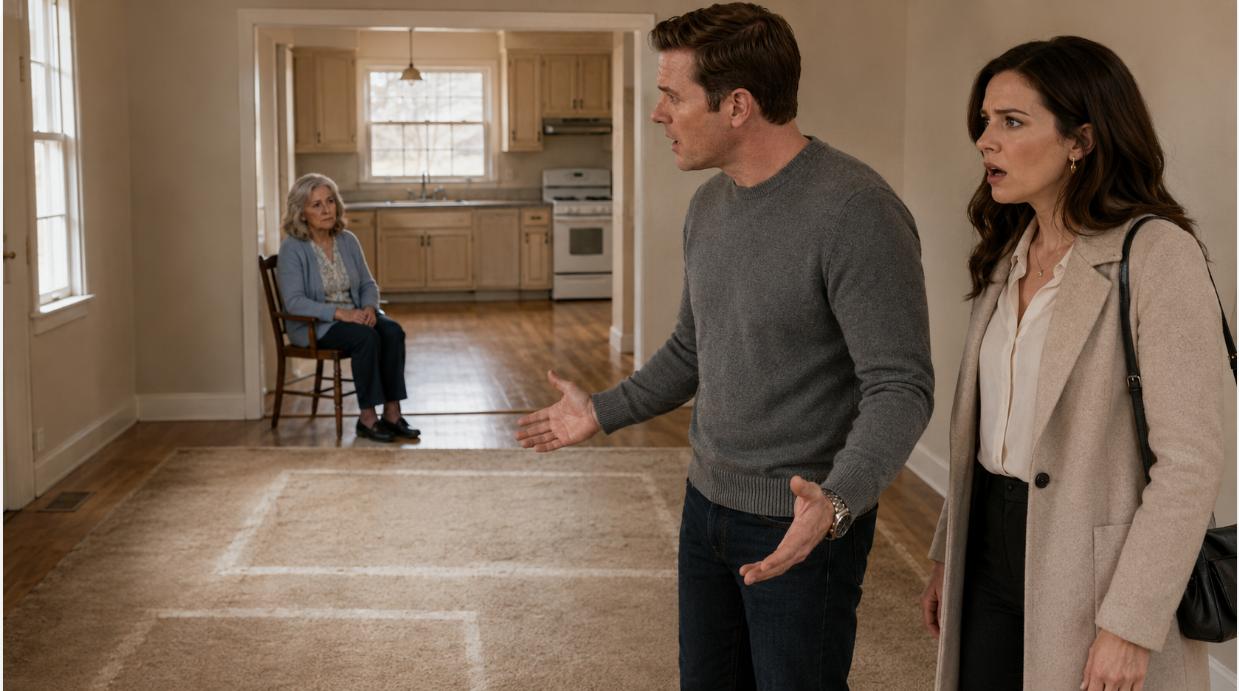
The house around me was nearly empty.
No sofa in the living room.
No television.
No coffee table.
No guest chairs.
No lamp beside the window.
Only the outlines remained on the carpet, pale rectangles where furniture had sat for years.
I heard the front door swing open.
Then Alana screamed.
Not from fear.
From offense.
The sound of a woman discovering that the convenience she expected had been removed.
Julian shouted from the living room.
“Mom?”
I did not answer.
Footsteps rushed through the house. Julian appeared in the kitchen doorway, his face pale with disbelief. Alana stood behind him, one hand pressed to her chest, her mouth open as if the walls had personally insulted her.
“Where is everything?” Julian demanded.
I looked at him calmly.
“I sold a few things.”
“A few things?” His voice cracked. “The sofa is gone. The TV is gone. The dining chairs are gone.”
“Yes.”
Alana looked around my bare kitchen.
“Where are we supposed to sit?”
That was when I knew.
Not suspected.
Knew.
She had not asked if I was all right.
Julian had not asked if I was in trouble.
No one asked why a sixty-four-year-old widow had sold the furniture from her own home.
Their first concern was comfort.
Their comfort.
Julian stepped toward me.
“Mom, what did you do?”
“I needed money,” I said. “Since you’ll be managing my pension soon, I thought I should make sure I had some cash first.”
His face changed.
The shock drained away.
Anger rose under it, hot and ugly.
“You sold your furniture without talking to me?”
“My furniture,” I said.
He stared at me.
“What is wrong with you?”
Alana folded her arms.
“This is selfish, Eleanor. We come here every week to keep you company, and this is how you repay us?”
Keep me company.
I almost laughed.
They came to eat.
They came because my house was warm, my food was free, and I never asked them to bring anything except themselves.

Julian’s eyes narrowed.
“Maybe this proves my point.”
“What point?”
“That you’re not making sound decisions.”
There it was.
The turn.
The one I had been waiting for.
Not concern.
Not fear.
Control.
He lowered his voice.
“Maybe the pension arrangement isn’t enough. Maybe we need to talk about power of attorney.”
Alana nodded quickly.
“That might be best.”
Best.
That word again.
I looked at my son and finally saw him clearly.
Not as the child I had sacrificed for.
Not as the man I wished he had become.
But as the man standing in my kitchen, angry because the woman he wanted to control had moved one step before him.
“Dinner isn’t ready,” I said.
Julian blinked.
“What?”
“There is no dinner. If you’re hungry, you can find somewhere else to eat.”
For several seconds, neither of them moved.
Then Julian leaned closer.
His voice became low.
“You should be careful, Mom. A woman your age, living alone, without family who truly cares about her, can end up in a very bad place.”
The words were quiet.
That made them worse.
Alana looked away, but she did not stop him.
Julian continued.
“I’m all you have. Remember that before you do something stupid.”
They left a minute later.
The door slammed so hard the window over the sink rattled.
I sat in my empty kitchen and felt something inside me break cleanly in two.
But what came after was not despair.
It was clarity.
Julian did not want to help me.
He wanted access.
To my pension.
To my accounts.
To my house.
To whatever was left of me after a lifetime of giving.
I looked at the bare wall where my old hutch had stood.
Then I smiled.
Because the furniture was never about money.
It was a test.
And my son had failed before he even knew he was being examined.
There was a time I believed sacrifice was proof of love.
Maybe that is why I made so many of them.
Julian was born during a February snowstorm. His father left when he was two, saying he needed to “find himself.” I never had the luxury of finding myself. I had rent, a toddler, and a job that paid just enough to keep hunger polite.
I worked days as a receptionist and nights cleaning offices.
I left Julian with Mrs. Genevieve Croft, the widow next door, who watched him for less money than she deserved.
Every night at nine, after feeding him and reading one story, I kissed his forehead and walked back into the cold to scrub floors in buildings where no one knew my name.
I slept four hours if I was lucky.
I did that for years.
When Julian wanted sneakers I could not afford, I bought them anyway and ate oatmeal for dinner for three weeks.
When he wanted private university, I took out loans against my own future.
When he graduated, I cried so hard the woman beside me handed me a tissue.
I thought I had done it.
I thought I had built a good man.
After college, Julian got a job in finance. He earned more in his first month than I used to make in three.
Still, he stayed with me.
“Just until I save for a place,” he said.
Of course, I said yes.
For five more years, he lived in my house without paying rent. I bought groceries. Paid utilities. Cooked. Cleaned. Packed leftovers for him to take to work.
He saved almost everything he earned.
When he finally moved out, it was not to a small apartment.
It was into a house in the suburbs.
He paid cash.
A quarter of a million dollars.
Everyone praised his discipline.
I smiled and said I was proud.
No one asked how he saved so much while I was still clipping coupons.
Then he married Alana.
Their wedding cost more than my car, my furniture, and three years of groceries combined. I sat near the back, close to the kitchen doors, because Julian said the front tables were for “networking.”
I told myself not to be sensitive.
That became my life’s worst habit.
Do not be sensitive.
Do not complain.
Do not make him feel guilty.
Do not push him away.
The Friday dinners started after the wedding.
I mistook them for love.
They were routine.
There is a difference.
The Monday after I sold the furniture, Julian returned with papers.
This time, he did not sit for coffee.
He laid the documents on my bare kitchen table and placed a pen beside them.
“Sign here, here, and here.”
I picked up the first page.
My reading glasses were in my apron pocket. I put them on slowly, though I could feel Julian watching me with irritation.
The words were small.
Legal.
Cold.
Power of attorney.
Authority over bank accounts.
Authority to open and close accounts.
Authority to make transfers.
Authority to act on my behalf.
Not just my pension.
Everything.
I looked up.
“Julian, this gives you full control.”
He spread his hands.
“It’s standard.”
“Standard for whom?”
“For older parents who need help.”
“I pay my bills.”
“For now.”
The words landed softly, but the threat inside them was sharp.
He sat down across from me.
“Mom, look at what happened Friday. Selling furniture? Emptying the house? That’s not rational.”
“I sold things I owned.”
“You scared us.”
“No,” I said. “I inconvenienced you.”
His eyes hardened.
“Don’t twist this.”
I looked down at the papers.
The old me would have signed.
The old me would have trusted, or pretended to trust, just to keep him from leaving angry.
The old me had spent decades confusing obedience with peace.
But the old me had been alone in an empty kitchen Friday night.
And she had finally learned something.
Loneliness is not the worst thing.
Being consumed is worse.
“I need a few days,” I said.
Julian’s smile disappeared for half a second.
Then it returned.
“Fine. Take a few days. But don’t overthink this.”
He left the papers on my table like a flag planted in territory he believed he would soon own.
That night, I did not sleep.
The next morning, I went to the bank when it opened.
The teller printed six months of statements. I sat in my car and read every line.
Most were familiar.
Groceries.
Pharmacy.
Electric.
Insurance.
Then one transaction stopped me.
Cash withdrawal.
$1,500.
A branch across town.
I had never withdrawn $1,500.
Not there.
Not anywhere.
My card had been in my purse.
Except once.
Three months earlier, Julian had stopped by without calling. I was in the shower. I yelled for him to let himself in. When I came out, he was in the living room. My purse sat on the coffee table.
At the time, I thought nothing of it.
Now I sat in my car outside the bank and felt my stomach turn.
I did not file the claim yet.
I needed to know more.
At home, I pulled an old shoe box from my closet. It held medical bills, insurance letters, bank notices, and statements I had been too tired to organize.
I sorted for six hours.
By evening, my kitchen floor was covered in paper.
A credit card in my name I never opened.
Balance: $4,500.
Hardware stores.
Electronics.
Furniture outlets.
A personal loan I had never applied for.
$7,000.
A utility account tied to Julian’s address, opened under my name.
Late payments damaging my credit.
And the worst part?
Health insurance claims from appointments I never attended, filed while I had been recovering from pneumonia two years earlier.
My son had not only tried to take control of my future.
He had been stealing pieces of my life for years.
I sat on the floor with the papers around me and felt foolish.
Then angry.
Then strangely calm.
If I confronted him immediately, he would deny it.
He would say I was confused.
He would say I was old.
He would say I needed help.
He would use my shock as proof.
So I did something new.
I said nothing.
I gathered the papers into a folder.
The next morning, I went downtown to see a lawyer.
His office was small, above a bakery, with narrow stairs and a brass sign that read:
Arthur Thorne, Attorney at Law
Mr. Thorne was in his late fifties, with kind eyes and a voice that never rushed. He listened while I told him about the pension, the furniture, the power of attorney, the withdrawal, the credit card, the utility account, and the loan.
I expected him to look shocked.
He did not.
That frightened me more.
When I finished, he folded his hands.
“Mrs. Vance, what you are describing is a pattern of financial elder abuse and identity fraud.”
I stared at him.
“Elder abuse?”
“Yes.”
“He’s my son.”
“That does not make it less serious.”
The room seemed to tilt.
Mr. Thorne slid the power of attorney papers back toward me.
“If you sign this, you will hand him the tools to finish what he has already started.”
I looked at my own name typed neatly on the document.
Eleanor Vance.
Not mother.
Not burden.
Not old woman.
A legal person.
With rights.
“What do I do?” I asked.
“First, you sign nothing. Second, we report the fraudulent accounts. Third, you change every password, PIN, and account number. Fourth, you document every interaction from this moment forward.”
He paused.
“And if he threatens you again, you call the police.”
My throat tightened.
“I don’t want him arrested.”
Mr. Thorne’s expression softened.
“Mrs. Vance, your son has made choices. You are not creating consequences. You are allowing them to arrive.”
I left his office with a folder of forms and a spine I did not recognize.
That afternoon, I changed my bank accounts.
I froze my credit.
I filed fraud reports.
I called the utility company.
I disputed the credit card.
I documented the personal loan.
Then I walked next door to Mrs. Genevieve Croft’s house.
She was eighty-one now, still sharp, still wearing house slippers by three in the afternoon.
She opened the door and said, “Finally.”
I blinked.
“Finally what?”
“Finally you look angry enough to tell the truth.”
I cried in her kitchen for twenty minutes.
Then I told her everything.
She did not interrupt. When I finished, she took my hand.
“I watched that boy take and take,” she said. “But you never wanted to see it.”
“No.”
“Now you do.”
I nodded.
She stood, went to her desk, and returned with a spare key.
“If you ever feel unsafe, you come here.”
I gave her copies of my documents and Mr. Thorne’s business card.
“If anything happens,” I said, “open this envelope.”
Her eyes grew wet.
“Eleanor, honey, nothing is going to happen because we are not letting it.”
Julian called that night.
His voice was tight.
“Mom, we need to talk.”
“We can talk with lawyers present.”
There was silence.
“What?”
“I’m not signing anything, Julian.”
“You’re being ridiculous.”
“I know about the $1,500 withdrawal.”
Another silence.
This one was different.
He did not breathe.
“I don’t know what you mean.”
“I know about the credit card. The utility account. The loan.”
His voice sharpened.
“Who have you been talking to?”
“A lawyer.”
The word changed everything.
I heard it happen.
His confidence cracked.
“A lawyer?” he repeated.
“Yes.”
“Mom, that’s insane. You’re confused.”
“No, Julian. I’m done being confused for your convenience.”
“You’re making a mistake.”
“No,” I said. “I made the mistake years ago when I taught you that my silence meant permission.”
He shouted then.
Called me ungrateful.
Paranoid.
Old.
Difficult.
He said I was ruining the family.
I listened to the storm of his anger without moving.
Then I said, “If you come to my house without permission, I will call the police.”
“You wouldn’t dare.”
“I would.”
I hung up.
My hands trembled afterward.
But the house did not collapse.
The world did not end.
The phone did not jump back into my hand.
For the first time, I understood that boundaries feel like cruelty only to people who benefited from your lack of them.
Two days later, Julian and Alana came anyway.
I saw their car pull up from the kitchen window.
I called Mrs. Croft.
“They’re here.”
“I’m watching,” she said.
Then I opened the front door but did not step aside.
Julian tried to walk past me.
I blocked him.
“We can talk here.”
Alana scoffed.
“This is embarrassing, Eleanor.”
I looked at her.
“Yes. It is.”
Julian’s face was red.
“You’ve taken this way too far.”
“No. You did.”
“I was helping you.”
“You stole from me.”
His jaw tightened.
“After everything I’ve done for you?”
I almost smiled.
“What have you done for me, Julian?”
He looked genuinely offended by the question.
Alana stepped closer.
“You’re going to destroy your own son over money?”
“No,” I said. “Your husband tried to destroy his mother for money.”
Julian exploded.
“You owe me.”
The words came out like a confession.
He seemed to hear them at the same time I did.
I stood very still.
“For what?”
“For my childhood,” he snapped. “For growing up without a father. For watching you struggle. For all of it.”
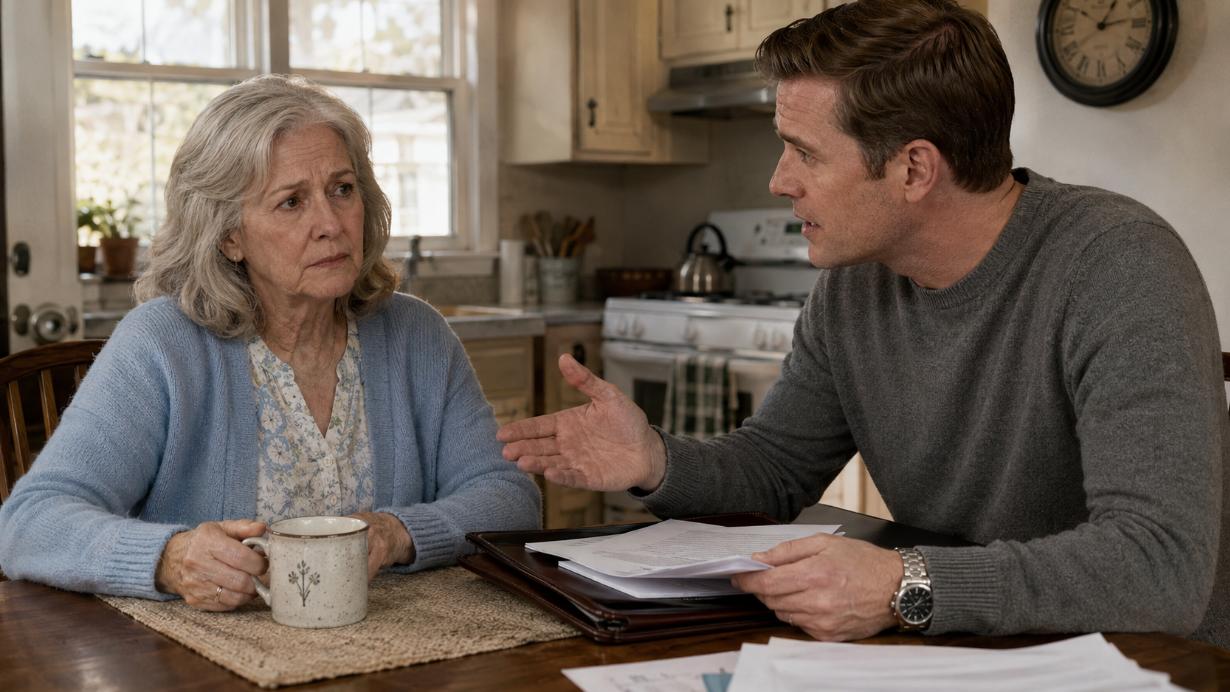
I looked at the man on my porch.
The man I had fed, clothed, educated, sheltered, and excused.
“You’re right about one thing,” I said. “I chose to have you. And I gave you everything I could. But nothing I survived gave you the right to steal from me.”
Alana grabbed his arm.
“Let’s go.”
Julian pointed at me.
“You’ll regret this.”
“No,” I said. “I already regret enough.”
I closed the door.
Mrs. Croft called ten seconds later.
“You did beautifully.”
I leaned my forehead against the door.
“I’m shaking.”
“Brave people shake,” she said. “They just don’t hand over the pen.”
After that, Julian changed strategies.
He stopped trying to scare me privately and started performing publicly.
On social media, he posted vague messages about “toxic family patterns” and “protecting your mental health.”
Then he posted an old photo of us.
I was younger in it, holding him as a toddler.
He wrote about how sometimes the people who claim to love you are the ones who hurt you most.
He called me controlling.
He called himself heartbroken.
He said he had made the difficult decision to distance himself from an abusive parent.
People commented.
So brave.
Protect your peace.
You don’t owe anyone access to your life.
I stared at those words for a long time.
He had stolen my money.
Now he was trying to steal my story.
The next morning, I went back to Mr. Thorne.
I placed printed copies of the posts on his desk.
“I want to file.”
He looked at me carefully.
“A private demand letter may be enough.”
“No.”
“Once we file, it becomes public record.”
“I know.”
He studied my face.
“Are you sure?”
I thought of the pension papers.
The stolen card.
The empty furniture outlines.
The Friday dinners.
The post where my son called me abusive.
“Yes,” I said. “He used silence against me. I’m done giving it to him.”
Mr. Thorne nodded.
“Then we file.”
Julian was served on a Thursday afternoon.
Within an hour, my phone began ringing.
I did not answer.
The voicemails came in stages.
First confusion.
“Mom, call me. This is a misunderstanding.”
Then pleading.
“You’re destroying your own son.”
Then rage.
“You’ll regret this. My lawyers will prove you’re not competent.”
I saved every message.
The lawsuit listed everything.
Dates.
Amounts.
Accounts.
Fraud reports.
Utility records.
Credit card charges.
The attempted power of attorney.
The social media posts.
The demand for repayment.
It was not gossip.
It was not family drama.
It was documentation.
And once people saw the court filing, Julian’s online performance began to rot.
Friends stopped commenting.
Neighbors stopped waving.
Alana deleted photos.
Their lawyer requested settlement talks within two weeks.
The final amount was more than what he stole.
Full repayment.
Damages.
Legal fees.
Correction of fraudulent accounts.
And one condition Julian fought harder than the money.
A public statement.
On the same social media account he had used to paint me as a villain.
His apology appeared on a Tuesday.
It was short.
Dry.
Clearly written by lawyers.
But the words were there.
He admitted to unauthorized use of financial accounts.
He admitted to opening credit and utilities without my consent.
He admitted his public statements had misrepresented the situation.
He admitted regret.
Not love.
Not remorse.
Regret.
But it was enough.
Not for my heart.
For the record.
Payments began every month from his account into mine. A single missed payment would trigger further legal action and potential criminal referral.
For years, I had feared my son leaving.
Now his distance felt like oxygen.
I sold the house six months later.
Not because I had to.
Because every wall held an old version of me.
The version who waited for footsteps on Friday nights.
The version who cooked meals no one thanked her for.
The version who thought loneliness meant failure.
I bought a small cottage in a coastal town three hours away.
It had uneven floors, a leaking garden hose, and a kitchen window that faced the morning sun.
I planted rosemary, tomatoes, lavender, and marigolds.
For the first time in my adult life, I bought a chair simply because I liked it.
Not because it was on sale.
Not because someone else needed it.
Because I liked it.
Julian called once after the final payment cleared.
I let it go to voicemail.
Then I listened.
“Mom,” he said.
His voice sounded smaller.
“I know things got out of hand. I know mistakes were made. I just want to know if we can ever talk again.”
Mistakes were made.
Not “I made them.”
Not “I hurt you.”
Mistakes.
Floating things with no owner.
He continued.
“You’re still my mother.”
I stood in my small kitchen, listening to the sea wind brush against the windows.
For a moment, grief moved through me.
Not fresh grief.
Old grief.
The grief of a woman finally admitting that the son she loved existed mostly in memory.
I did not call him back.
Instead, I wrote a letter.
Julian,
The son I raised may still exist somewhere inside you. I hope one day you find him.
But I will not offer my life as proof that I love you.
I have paid enough.
Do not come to my house.
Do not contact me again unless it is through counsel.
I wish you peace.
From far away,
Mother
I mailed it.
Then I blocked his number.
That evening, Mrs. Croft called.
“How is the sea?” she asked.
“Loud,” I said.
“Good. Let it talk over all the nonsense.”
I laughed.
A real laugh.
One that came from my chest and surprised me.
Now, most mornings, I drink coffee in my garden.
The pension checks still come.
Into my account.
Under my name.
I pay my bills.
I buy my groceries.
I invite people over when I choose, not because they arrive with a key and an appetite.
Sometimes I miss the child Julian was.
Sometimes I miss the idea of the family I thought I had built.
But missing something is not the same as needing it back.
I used to believe motherhood meant giving until nothing was left.
Now I know better.
Love without respect is not love.
Sacrifice without boundaries becomes self-erasure.
And protecting your peace is not cruelty.
It is survival.
My son thought I was too old, too lonely, and too afraid to fight back.
He thought pension checks were easier to take from a woman who had spent her life saying yes.
He was wrong.
I did not win by destroying him.
I won by refusing to keep destroying myself.