Chapter 1: The Suitcase
The day my nephew handed me a suitcase, I was sixty-five years old and had nothing left in my name except a used Toyota, two nursing uniforms, and a lifetime of receipts no one had ever asked to see.
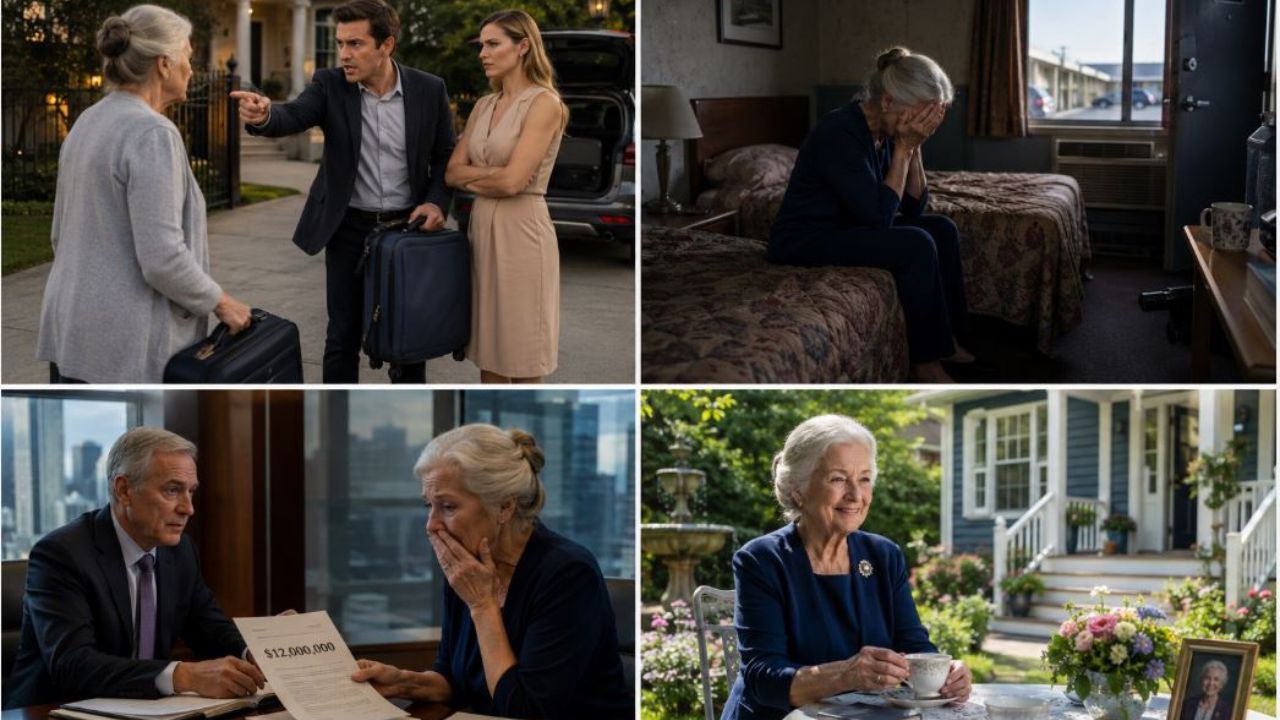
James stood in the doorway of the guest house with his wife behind him, his expression careful and professional, the same expression I had seen him use in courtrooms on the local news.
“Aunt Ella,” he said, “we have to be realistic.”
Realistic.
That was the word people used when they wanted cruelty to sound reasonable.
I looked at the suitcase in his hand. It was one of mine, old navy fabric, frayed near the zipper. I had bought it twenty-three years earlier for James’s first trip to a high school debate competition. He had been so excited he slept with his blazer hanging over the bedroom chair.
Now he was handing it back to me.
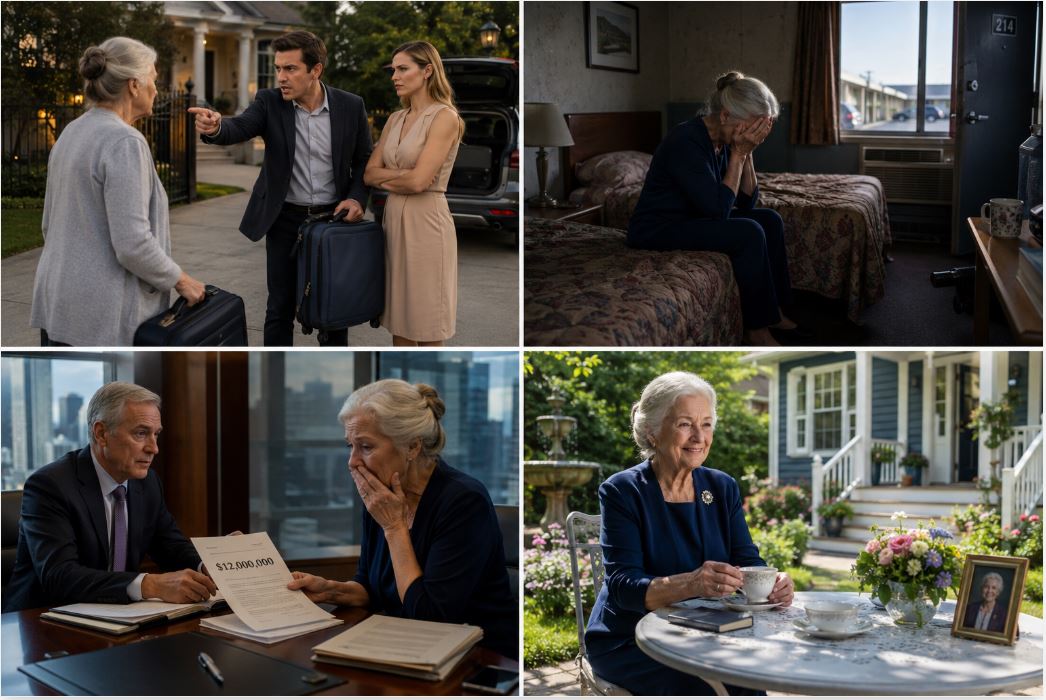
Empty.
“You have forty-eight hours,” he said.
Behind him, Vanessa adjusted the gold bracelet on her wrist and avoided looking directly at me.
“The contractors start Monday,” she added. “The guest house needs to be cleared before then.”
I stared at the two of them from the small living room where I had lived for fifteen years. My books were on the shelf. My teacup sat beside my armchair. The quilt James and I had made together when he was ten still hung over the back of the sofa.
“This is my home,” I said quietly.
James sighed.
“It was never meant to be permanent.”
Those words landed harder than the suitcase.
I had been forced into early retirement that morning after forty-five years at Westlake Memorial Hospital. Budget cuts, they said. Restructuring, they said. An opportunity to rest, they said.
But I had no savings left.
No house.
No retirement fund.
I had spent all of that on James.
His private school. His summer programs. His college applications. His Princeton expenses. His Harvard Law rent when the scholarship wasn’t enough. His first car. His first suit. His bar exam review course.
Years of night shifts, holiday shifts, double shifts.
And still, I looked at him and saw the toddler I had once held in my arms after my sister disappeared “for the weekend” and never came back.
“What am I supposed to do?” I asked.
James glanced at Vanessa.
She answered before he could.
“There’s a senior living facility about forty minutes from here. James made an appointment for you tomorrow. They have a work exchange option in their medical office.”
I blinked.
“A work exchange?”
James cleared his throat.
“It would help offset the cost. You’re still capable, Aunt Ella. It’s not charity.”
I had been head nurse of a long-term care unit for almost two decades.
Now my nephew was suggesting I work at a retirement facility to afford a room.
“I raised you,” I said.
His face tightened.
“I know.”
“I sold my parents’ farmhouse to help pay for law school.”
“I know.”
“I gave you everything I had.”
The silence that followed told me he knew that too.
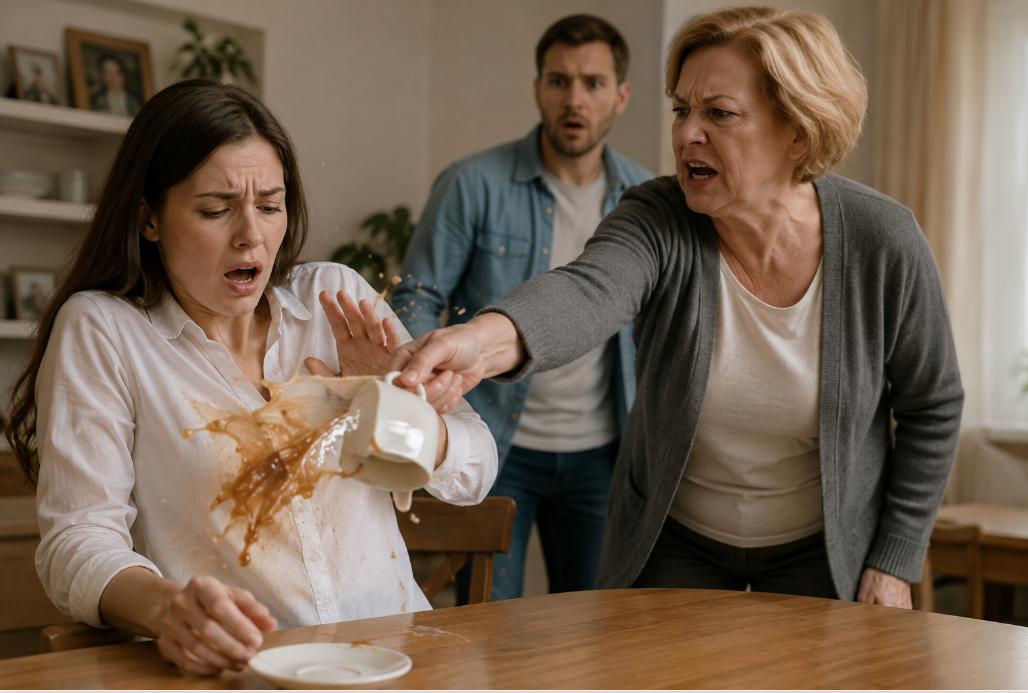
Vanessa finally set down her wine glass on the counter with a sharp little click.
“Eleanor, no one is denying your sacrifices. But financially speaking, you’ve become a liability we simply can’t sustain.”
A liability.
There are words that do not just hurt.
They erase.
In that moment, I was no longer the woman who had taught James how to tie his shoes. No longer the aunt who sat beside his hospital bed when he had pneumonia at eight. No longer the person who clapped until my palms hurt when he crossed the stage at Harvard.
I was a number.
A cost.
A problem to move before the contractors arrived.
I looked at James one last time, waiting for him to correct her.
He did not.
So I stood.
“I see,” I said.
James looked relieved, as if my heartbreak had agreed to be convenient.
“I can help you pack,” he said.
“No,” I replied. “You’ve helped enough.”
Then I took the suitcase from his hand and closed the door.
Chapter 2: The Boy I Chose
His name was James Wright, and when he came to me, he still had chocolate on his cheeks.
I was twenty years old, newly graduated from nursing school, drowning in student loans and convinced my life was about to begin. I had plans. Real plans. A research fellowship I had applied for. A dream of working with Doctors Without Borders. A fiancé named Thomas who wanted two children and a small house near the river.
Then my older sister showed up with James on a Friday afternoon.
“Just for the weekend,” she said.
He was two.
He clung to my skirt and cried when she walked away.
That weekend became forty-three years.
My sister vanished into addiction. There were calls from strangers. Promises to come back. Apologies that led nowhere. After a while, even the apologies stopped.
I could have called social services.
People told me I should.
“You’re too young,” Thomas said. “You can’t raise someone else’s child.”
Maybe he was right.
But the first night James stayed with me, he cried until he fell asleep sitting up. When I lifted him into bed, he wrapped his small hand around my finger and would not let go.
Something in me made a decision before my mind caught up.
I chose him.
Then I chose him again.
And again.
I declined the fellowship.
I ended the engagement.
I picked up extra shifts at the hospital and learned how to make one paycheck stretch across rent, daycare, groceries, shoes, medicine, field trips, and birthday cakes.
James called me Auntie L.
When he was little, he would run to meet me after school, backpack bouncing, shouting my name like I was the best part of his day. When he made honor roll, he taped the certificate to the refrigerator himself because I was at work and he wanted it to be the first thing I saw when I came home.
I still remember the night he asked if I was his mother.
He was seven. We were sitting at the kitchen table, both of us eating cereal for dinner because I was too tired to cook.
“Are you my mom?” he asked.
I put down my spoon.
“I’m your aunt,” I said gently. “But I love you like you’re mine.”
He thought about that for a moment.
“Then you’re enough,” he said.
For years, I lived on those words.
When he showed academic promise, I pushed harder. Better schools. Better tutors. Better opportunities. He earned scholarships, but scholarships never covered everything. So I sold what I had.
My parents’ farmhouse was my only inheritance. White siding. Green shutters. A porch swing my father had built himself. I signed the sale papers with hands that would not stop shaking, then wired the money toward James’s education.
“You’re going to be somebody great,” I told him.
He cried at his law school graduation.
Everything I am is because of you, Aunt Ella.
That was what he said, arms around me, cameras flashing.
When I’m established, you’ll never have to worry about anything again.
I believed him.
Not because I was foolish.
Because I loved him.
There is a difference.
Chapter 3: Mrs. Blackwell
Even after James became successful, I kept working.
By then, I was head nurse at Westlake Memorial’s long-term care unit. My knees ached. My feet hurt every night. But I loved my patients. I understood the quiet fear of growing old in rooms where people spoke over you as if age had made you less human.
That was where I met Eleanor Blackwell.
The staff called her Mrs. Blackwell. Never Eleanor. Never Ellie. Just Mrs. Blackwell, as if her wealth had built a wall around her name.
She was a billionaire, though you would not know it from her room. No flowers. No family photographs. No constant stream of visitors. Just a chessboard, a worn copy of Middlemarch, and a woman with sharp eyes who missed nothing.
“You’re the other Eleanor,” she said the first time I checked her vitals.
“I suppose I am.”
“Do you play chess?”
“Badly.”
“Good. I’m tired of people letting me win.”
For fifteen years, I was her nurse.
Then her companion.
Then, quietly, her friend.
We played chess on Sunday afternoons. She asked about my life. I told her about James. Not to complain, never to complain, but because she asked real questions and waited for real answers.
“You gave up quite a lot for him,” she said once.
“He was a child.”
“So were you.”
I had no answer for that.
She watched me carefully across the chessboard.
“People who take sacrifice for granted often call it love,” she said. “But love should remember what it cost.”
I laughed it off then.
I wish I had listened harder.
When Mrs. Blackwell died last spring, the funeral was small. Too small for a woman whose name sat on hospital wings, university buildings, and research foundations. There were lawyers, foundation board members, a few distant acquaintances, and me.
I stood at the back of the chapel in my black dress and cried quietly.
Not for her fortune.
For the Sundays.
For the chessboard.
For the one person in years who had looked at me and seen more than usefulness.
Two weeks later, the hospital announced budget cuts.
Three days after that, I was told my position would be eliminated.
One week later, James gave me the suitcase.
Chapter 4: The Motel
I packed my life into two suitcases and three boxes.
The rest I left behind.
The chair where I read mystery novels. The little table by the window. The dishes I had bought one at a time from thrift stores because I liked blue patterns. The framed photo of James at his law school graduation stayed on the shelf.
I could not carry it.
Not because it was heavy.
Because I was.
Vanessa came by that morning with a coffee mug in hand.
“The senior facility director is expecting you at two,” she said.
“I’m not going.”
Her eyebrows rose.
“I’ve made other arrangements,” I lied.
“With whom?”
“A former colleague.”
It was the first time I had ever lied to her.
The confusion on her face gave me a small, shameful satisfaction.
“Well,” she said, recovering, “that’s probably best. James was concerned you might not afford the facility without help.”
Without help.
I had spent my life helping.
Now help had become a word used to make abandonment sound polite.
That night, while James and Vanessa attended a charity gala, I called a rideshare and loaded my belongings into the trunk. At the gate, the security guard, Tony, looked surprised.
“Moving out, Miss Wright?”
“Yes.”
He frowned.
“Mr. James didn’t mention anything.”
“He’s expecting it.”
Tony hesitated.
Then he said softly, “You deserve good things, Miss Wright.”
I almost broke down right there.
The Starlight Motor Lodge was the only place I could afford for two weeks.
The sign flickered. The stairs were rusted. The carpet in my room had stains I did not want to identify. A cockroach ran under the dresser within the first five minutes.
I sat on the edge of the sagging bed in my best navy dress and sensible shoes.
Forty-five years of work.
Forty-three years of raising James.
And this was where I had landed.
My phone buzzed.
James.
Quite dramatic, Aunt Ella. Let me know where you’re staying in case there’s news from the lawyer tomorrow.
The lawyer.
I had almost forgotten the call that came earlier that afternoon while I was sitting in a coffee shop, trying to stretch one small cup for an hour.
Michael Goldstein.
Executor of Eleanor Blackwell’s estate.
You are named as a beneficiary.
At the time, I assumed Mrs. Blackwell had left me a book. A brooch. Maybe a small token.
Something kind enough to hurt.
I placed my phone facedown and lay back on the motel bed without undressing.
Through the wall, a couple argued. Somewhere outside, someone laughed too loudly. The faucet dripped in the bathroom.
For the first time since James handed me the suitcase, I cried.
I cried for the young woman I had been before responsibility swallowed her whole. I cried for Thomas, the fiancé I had lost. I cried for the farmhouse. I cried for every holiday I worked so James could have more than I did.
Most of all, I cried because the person I had called my son in every way that mattered had looked at me and seen a bill.
By morning, my eyes were swollen.
But I put on my navy dress, pinned Mrs. Blackwell’s small silver brooch to my lapel, and called a car to take me downtown.
Whatever she had left me, I would receive it with dignity.
It was all I had left.
Chapter 5: The Will
Goldstein, Meyers & Associates occupied the top floor of a downtown building with glass elevators and silent carpets.
The receptionist offered me water in a real glass.
Such a small courtesy.
After the motel, it nearly undid me.
Michael Goldstein was in his sixties, silver-haired, calm, and kind in a way that did not feel performative. He led me into a conference room overlooking the city.
“Ms. Wright,” he said, “Mrs. Blackwell spoke of you often.”
I folded my hands in my lap.
“She was very dear to me.”
“She knew that.”
He opened a leather folder.
“Three years ago, Mrs. Blackwell amended her will after a conversation with you about retirement.”
I frowned.
“I don’t remember saying much.”
“You told her you had limited savings because you had helped raise and educate your nephew.”
I looked down.
“I didn’t mean to make it sound like a complaint.”
“She did not take it as one.” His voice softened. “She took it as evidence.”
“Evidence of what?”
“That you had spent your life giving security to someone else without keeping any for yourself.”
My throat tightened.
Michael slid a document across the table.
“This is the relevant section.”
The legal language blurred at first. Then one sentence became clear.
To Eleanor Marie Wright, who showed me the meaning of selfless care, I leave the sum of twelve million dollars, to be held in trust and used according to her needs and wishes.
I stared at it.
Then looked at him.
“I’m sorry,” I whispered. “I don’t understand.”
“There is no mistake,” he said gently. “Mrs. Blackwell was very clear.”
“Twelve million dollars?”
“Yes.”
I gripped the edge of the table.
Yesterday, I had been counting cash in a motel room.
Yesterday, I had wondered whether I would run out of money before finding safe housing.
Yesterday, I had been a liability.
Now I was a millionaire.
Not because James valued me.
Not because family remembered.
Because an old woman I had cared for had seen me more clearly than the child I raised ever had.
Michael continued explaining the trust, the funds, the protections, the immediate advance available to me. His words came from far away.
“Ms. Wright,” he said finally, “are you safe right now?”
The question broke something open.
“I’m staying at the Starlight Motor Lodge,” I admitted.
His expression changed.
Only slightly.
Enough.
“I see,” he said. “Then we will address that first.”
By the time I left his office, I had a bank check for immediate expenses, a direct line to his firm, and a suite reserved at the Four Seasons while I decided where to live next.
In the elevator, my phone buzzed.
James.
Any news from the lawyer? Call me ASAP.
I looked at his name.
For decades, that name had been my first priority.
His needs.
His problems.
His future.
This time, I turned the phone off.
The car Michael arranged waited at the curb.
“Where to, Ms. Wright?” the driver asked.
I almost said the hotel.
Then I thought of the motel room. The young mother I had heard crying down the hall. The baby who had not stopped coughing through the night.
“The Starlight Motor Lodge first,” I said.
When I checked out, the clerk reminded me there were no refunds.
“I know,” I said. “There’s a young woman with a baby in room 214. Put the rest of my week toward her stay.”
He blinked.
“And give her this.”
I handed him five hundred dollars in cash.
He stared at me like people always do when kindness interrupts their expectations.
Then I walked out.
This time, when I climbed into the black car, I did not feel rich.
I felt free.
Chapter 6: The Nephew Returns
James called fourteen times in three days.
His messages changed shape.
At first, they were demanding.
Aunt Ella, answer your phone.
Then concerned.
I’m worried about you.
Then legal.
You shouldn’t sign anything without consulting me.
Then soft.
We’re family. Let me help.
Family.
The word sounded different now.
When I finally answered, I was sitting by the window of my hotel suite, drinking tea from a cup so delicate I held it with both hands.
“Aunt Ella,” James said, relief rushing into his voice. “Finally. Where are you?”
“I’m safe.”
“What happened with Mrs. Blackwell’s will?”
There it was.
Not How are you?
Not I’m sorry.
The will.
“She left me enough,” I said.
“Enough for what?”
“Enough that I won’t need the senior facility.”
Silence.
Then his voice warmed too quickly.
“That’s wonderful. Vanessa and I have been talking. We feel awful about the other night. Things came out wrong. You know how stressful renovations can be.”
“Renovations.”
“Yes. The timing was bad. But there’s no reason you can’t come back for now. The guest house is still available until Monday. After that, we could make up the den for you.”
The den.
A room off the kitchen where Vanessa stored winter boots and dog towels.
I almost laughed.
Three days ago, I was too expensive to keep in a guest house.
Now I had been promoted to the den.
“That won’t be necessary,” I said.
“Aunt Ella, please be practical. Whatever she left you, money can disappear quickly if you don’t know how to handle it. I’m an attorney. I can help manage everything.”
“Everything?”
“Your investments. Housing. Estate planning. You don’t want people taking advantage of you.”
People.
He said it as if he were not one of them.
“James,” I said, “when I told you I had lost my job, you gave me a suitcase.”
He exhaled sharply.
“That’s not fair.”
“You gave me forty-eight hours.”
“I was under pressure.”
“You called me a liability.”
He said nothing.
For the first time, the silence was mine to fill or leave empty.
I chose to leave it empty.
When he finally spoke, his tone had changed.
“How much did she leave you?”
I closed my eyes.
There it was.
The question he had been circling since the first call.
“Enough,” I said.
“That’s not an answer.”
“It’s the only one you’re entitled to.”
His voice hardened.
“After everything I’ve done for you—”
The words stopped me cold.
Everything he had done for me.
I thought of a toddler crying himself to sleep in my apartment. I thought of tuition checks. Hospital shifts. The farmhouse. My engagement ring in a padded envelope. My retirement fund drained so he could live near campus.
“What exactly did you do for me, James?” I asked quietly.
He did not answer.
“You allowed me to live in a guest house on property I helped you build. Then you took it back the moment I became inconvenient.”
“That’s not what happened.”
“It is exactly what happened.”
“Aunt Ella—”
“No.” My voice surprised me with its calm. “You don’t get to use that name right now.”
Another silence.
Longer this time.
“I raised you,” I said. “I loved you. I sacrificed for you. And I did it willingly. But I will not spend the rest of my life pretending your comfort is more important than my dignity.”
“You’re cutting me off?”
“No. I’m setting boundaries.”
“Boundaries?” He said the word like it belonged to someone else’s family.
“Yes. You will not manage my money. You will not choose where I live. You will not call my attorneys. You will not use concern as a way to regain control.”
His breath came hard through the phone.
“You’re making a mistake.”
“Maybe,” I said. “But for once, it will be mine.”
I hung up.
My hands shook afterward.
Courage, I discovered, does not always feel strong while you are using it.
Sometimes it feels like grief with a straight back.
Chapter 7: What Wealth Could Not Buy
Within a month, I moved into a small blue townhouse in Lakeside Heights.
Not the biggest place I toured.
Not the most expensive.
But the first one that felt like it had room for the woman I was becoming.
It had stained glass transoms, built-in bookshelves, a sunny kitchen, and a little garden with a fountain that murmured softly in the evening. I bought new bedding in colors I liked without asking whether they were practical. I subscribed to the theater. I ordered flowers every Friday simply because they made the room feel alive.
At first, guilt followed me around the house like a shadow.
I had spent so long measuring my worth by what I gave away that keeping anything for myself felt selfish.
Then, one morning, I made tea and sat in the garden with Mrs. Blackwell’s brooch pinned to my sweater.
I thought about her words.
You deserve security regardless of gratitude.
That was when I understood.
The money had not made me valuable.
It had only made it harder for others to pretend I was not.
Michael Goldstein helped me settle the trust. A financial adviser explained what I could spend safely. An estate attorney revised my will. James was removed as beneficiary.
That signature hurt more than I expected.
Not because I regretted it.
Because it confirmed what had already died.
A few weeks later, a letter arrived from James.
Not an apology.
A letter from his attorney.
Formal language. Careful phrasing. A request for “family mediation” regarding “misunderstandings” and “future support expectations.”
I folded it back into the envelope and placed it in a drawer.
Then I went outside and pulled weeds from the garden until my knees ached.
Some things do not deserve immediate response.
Some things deserve time to become small.
I did not sue James.
People expected me to.
Maybe part of me wanted to at first. I had records of what I paid toward his education. Proof of the farmhouse sale. Old bank transfers. Enough to embarrass him publicly, if nothing else.
But the longer I sat with my new life, the more I understood something.
Revenge would keep him in the center.
I had already given him enough years there.
So instead, I built something else.
The Eleanor Blackwell Foundation invited me to join its healthcare access board. At first, I laughed at the idea. Me, a board member among donors and executives? But at the first meeting, they discussed rural clinics, underfunded elder care, nursing shortages, and patients who fell through the cracks.
I knew those people.
I had cared for them.
So I spoke.
And people listened.
For the first time in years, my experience was not dismissed as “just nursing.” It was expertise.
Months passed.
The rural healthcare initiative I helped shape began funding mobile clinics in counties that had lost their hospitals. I established a nursing scholarship for older students changing careers, people who had spent years caring for others and wanted a chance to build something of their own.
I named it after Mrs. Blackwell.
But privately, I knew it carried pieces of me too.
One autumn afternoon, my doorbell rang.
When I opened it, James’s daughter Lily stood on my porch.
She was eighteen, tall and nervous, with her father’s eyes but none of his practiced certainty.
“Dad doesn’t know I’m here,” she said.
I stepped aside.
“Come in.”
She sat in my living room, twisting her hands together.
“I found some papers,” she said. “About the house. The one we live in. Dad always said he bought it himself after law school.”
I waited.
“But you paid for it, didn’t you?”
The old pain moved through me, but softer now.
“Yes.”
Lily looked down.
“He lied.”
“He told the version that made him feel successful.”
“That’s not the same as the truth.”
“No,” I said. “It isn’t.”
Her eyes filled with tears.
“I’m sorry, Aunt Ella.”
Those words.
Simple.
Late.
But from the wrong person, and somehow the right one.
I reached across the table and covered her hand with mine.
“Thank you.”
She wiped her cheek quickly.
“I want to study nursing,” she said. “Not business. Not law. Nursing. I think Dad will be furious.”
I smiled, a real one.
“Nursing is hard.”
“I know.”
“It will ask more of you than you expect.”
“I know.”
“And if it’s truly yours, it will give something back.”
She nodded.
“Will you help me?”
For a long moment, I looked at the young woman sitting in my home, asking not for money, not for rescue, but for guidance.
Maybe love could skip a generation.
Maybe truth could too.
“I’d be honored,” I said.
That evening, after Lily left, I sat in my garden until the sky went dark.
James had called me a liability.
Mrs. Blackwell had called me selfless.
Lily had called me teacher.
But for the first time in my life, none of those names defined me completely.
I was Eleanor Wright.
Sixty-five years old.
Starting over.
Wealth had given me comfort, yes. Security. Choices. A beautiful home and a future without fear.
But the real inheritance was not the twelve million dollars.
It was the moment I finally understood that my life had value even when I was not sacrificing it for someone else.
The fountain whispered in the dark.
The house glowed behind me.
And for the first time in decades, I did not wonder who needed me tomorrow.
I wondered what I wanted.
Then I smiled.
Because I finally had time to find out.