CHAPTER ONE: THE LETTER
The first time I realized my son no longer saw me as his mother, I was sitting at the kitchen table where I had written my first novel. It was a Saturday morning in February, and the house was quiet except for the hum of the refrigerator and the old wall clock above the doorway. I had just poured myself a second cup of coffee when Patrick knocked on the front door. He usually called before coming over, but that morning he didn’t. When I opened the door, he was standing there with a folder under his arm and an expression I had seen before on other people’s faces—the expression of someone who had already made a decision and was waiting for you to accept it.
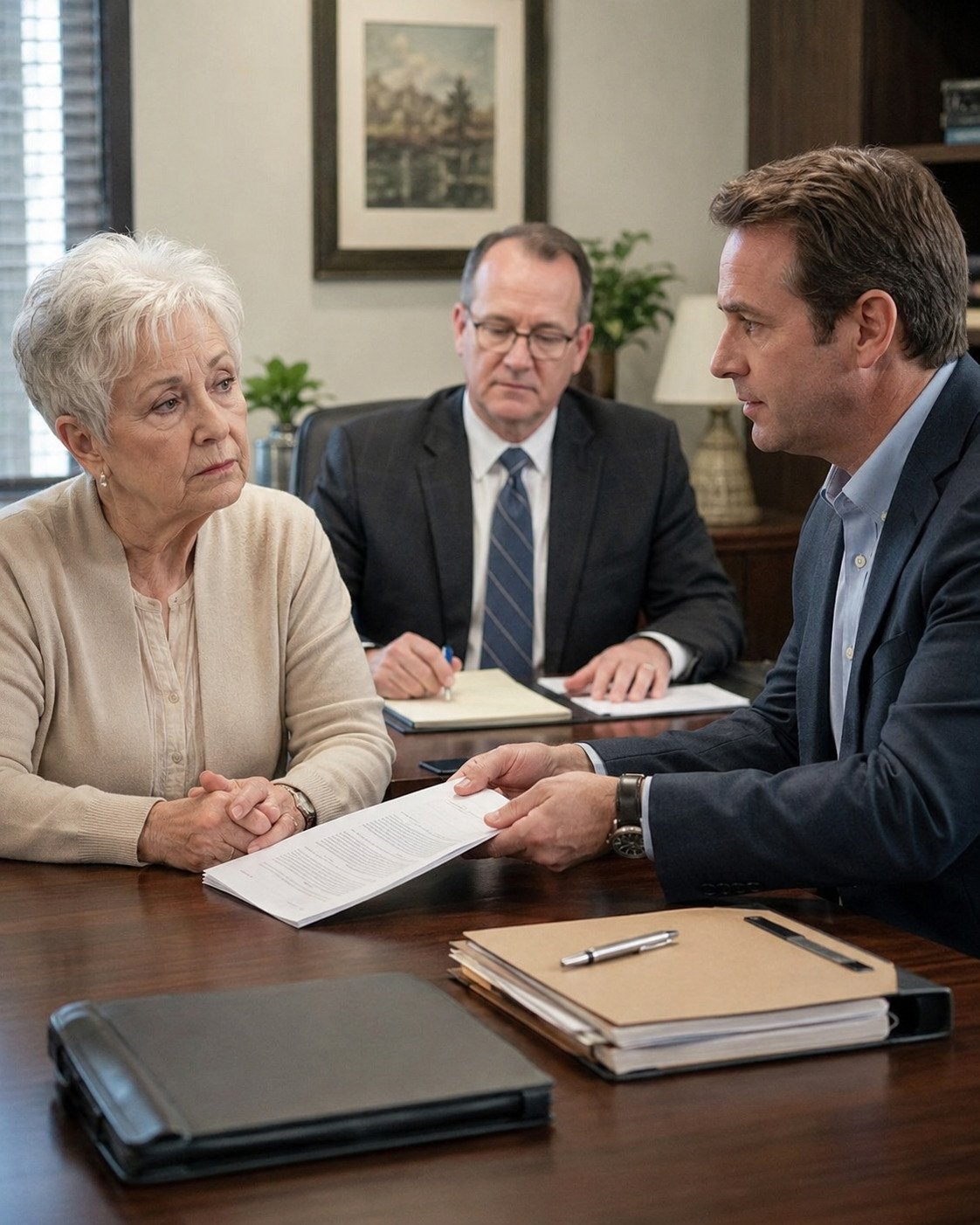
“Mom, we need to talk about the house,” he said.
I let him in.
The house on Archer Road had been mine for more than forty years. My husband, Tom, and I had moved there when Patrick was still a little boy, and our daughter Claire was only a toddler. The kitchen was small, the floors creaked in winter, and the upstairs bathroom had never been quite right. But it was the house where my children had grown up, where Tom had built a walnut cabinet in the shed, and where I had spent fifteen years writing books that almost nobody in my family knew existed.
Patrick knew I wrote.
What he did not know was that I had become a successful writer.
That difference would eventually change everything between us.
He placed the folder on the table and began pulling out photographs of the house, repair estimates, and brochures for a senior living community called Millbrook Terrace. He talked about the roof, the plumbing, the size of the property, and how much easier my life would be if I moved somewhere with maintenance included.
I listened.
When he finished, I said, “I have no plans to leave.”
He looked at me for a long moment.
“Mom, you can’t stay here forever.”
“I know,” I said. “But I’m staying here now.”
He didn’t argue that day. He simply gathered his papers and left.
At the time, I thought we had had a difficult conversation.
I didn’t realize it was the beginning of something much bigger.
CHAPTER TWO: WHAT MY SON THOUGHT HE KNEW
Patrick had always been practical. Even as a child, he liked knowing what things were worth. He grew up to become a commercial developer, and I was proud of him. He worked hard, built a good life, and was the kind of person who could walk into an empty building and immediately see what it could become.

But over the years, I began to notice that he had started looking at my house differently.
He no longer asked what I had been reading.
He asked whether I had considered selling.
He didn’t ask what I did with my mornings.
He asked whether I could still manage the property.
After Tom died, the questions became more frequent.
“Are you sure you’re keeping up with everything?”
“Have you thought about downsizing?”
“Do you need someone to look over your finances?”
I understood where some of it came from. I was seventy-one. I had been widowed. My house was old, and I lived alone. From the outside, I probably looked like a woman who had spent most of her life raising children and was now quietly aging in the same place where she had raised them.
That was the story Patrick had built in his head.
The problem was that it was not my life.
For fifteen years, I had woken up before six, made coffee, and sat at the kitchen table with my laptop. I wrote under the name A. V. Sable. Five novels had been published. All five had sold steadily. None had become a cultural phenomenon, but together they had built something I was proud of—a loyal readership, a reliable income, and a life that belonged entirely to me.
My royalties had been growing for years.
Recently, a production company in Los Angeles had optioned two of my novels for television.
I had an agent.
I had contracts.
I had property.
I had been managing all of it myself for more than a decade.
Patrick knew none of this.
Not because I had lied to him.
Because I had never felt the need to explain every part of my life to my children.
My husband had known.
Tom had been the first person to read the manuscript that became my first novel. He sat across from me at that same kitchen table, wearing a flannel shirt, drinking coffee, and turning pages while I pretended not to watch his face.
When he finished, he closed the manuscript.
“You’re going to publish this,” he said.
I laughed.
“I don’t think so.”
“You should.”
So I did.
For fifteen years, that quiet part of my life continued.
Tom never asked me to show the world everything I wrote.
He simply trusted me.
That was something I had begun to realize my son was no longer doing.
CHAPTER THREE: THE PETITION
The first letter from Patrick’s attorney arrived on a Thursday.
It was written in polite language, but I understood what it meant.
They wanted documentation of my ability to manage my finances.
The letter referred to concerns about my “capacity” to handle complex financial matters.
I read it twice.
Then I put it beside my coffee cup.
The word stayed with me for the rest of the day.
Capacity.
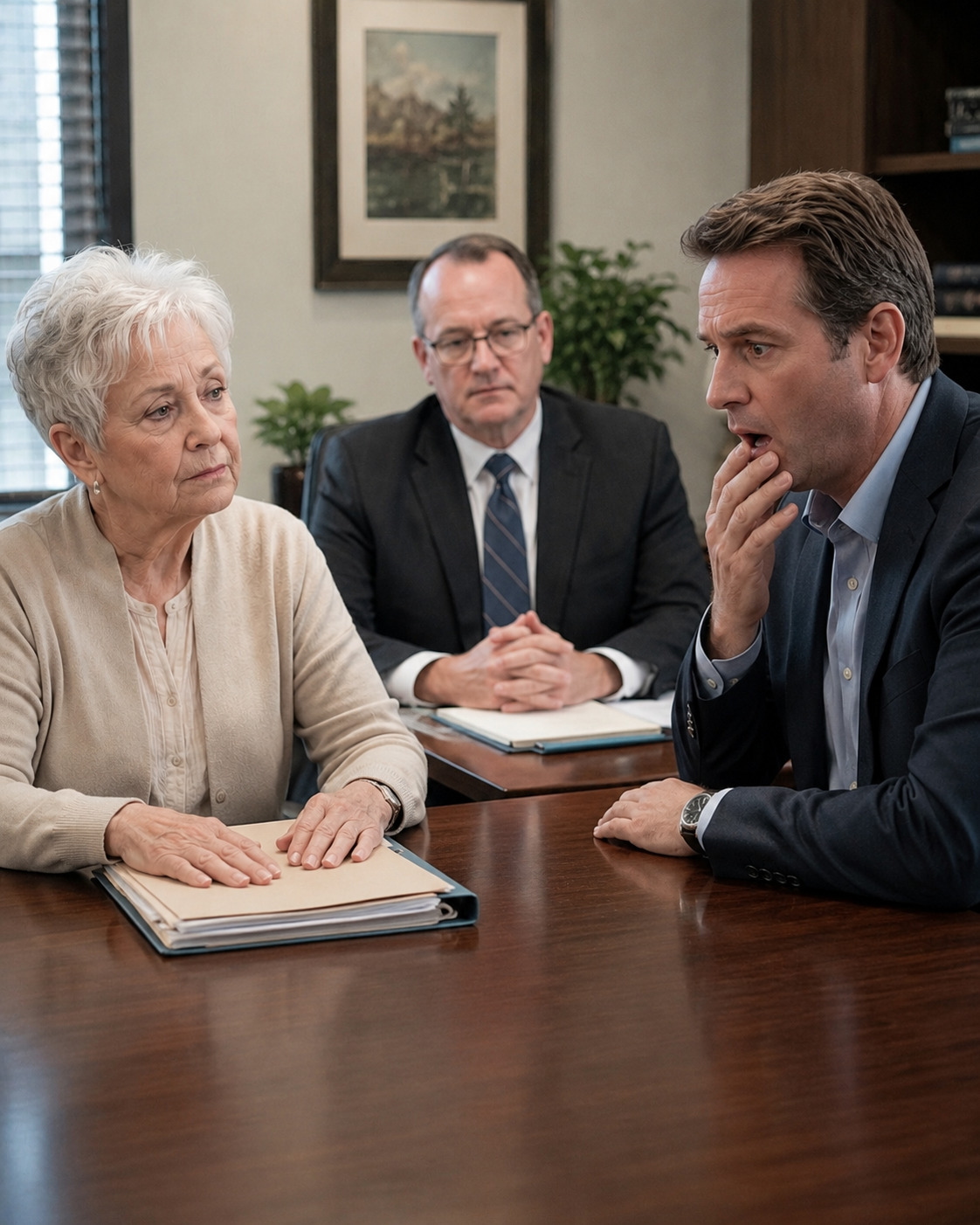
I had spent fifteen years managing contracts, royalties, property records, tax documents, and publishing agreements. I had negotiated with agents and lawyers. I had recently reviewed a television option agreement that contained more pages than the first novel I ever wrote.
But apparently, my son had decided that I might no longer be capable of managing my own life.
A few weeks later, I learned that Patrick had filed a guardianship petition.
He claimed he was concerned about me.
He said the house was becoming difficult to maintain.
He said my financial situation was complicated.
He said he was trying to protect me.
I believed that he might have convinced himself those things were true.
That was almost harder than believing he was acting out of greed.
The confrontation happened on a Saturday.
Patrick came to the house alone.
He was angry because I had refused to cooperate with the process. I was angry because someone had entered my property to inspect the house without asking me first.
We stood in the kitchen, surrounded by the memories of our family.
When he finished explaining why he thought he needed to take control of certain decisions, I looked at him.
Then I pointed toward the kitchen island.
“Open the drawer.”
He looked at me.
“What?”
“The drawer.”
It was an ordinary wooden drawer. Patrick had opened it hundreds of times as a child. It had held batteries, tape, scissors, receipts, and all the small practical things a family accumulates over the years.
He didn’t open it.
“Mom, this isn’t about a drawer.”
“Yes,” I said. “It is.”
He still refused.
So I opened it myself.
And I began taking things out.
CHAPTER FOUR: THE LIFE HE NEVER ASKED ABOUT
The first document was a royalty statement.
Patrick glanced at it and frowned.
“What is this?”
“My most recent quarterly statement.”
He looked at the name.
A. V. Sable.
Then he looked at me.
I said nothing.
He picked up the next document.
Then another.
Twelve years of annual royalty summaries.
The numbers were consistent. Some years were better than others, but the overall trend was clear. My writing had earned money every year for more than a decade.
Patrick stopped turning pages.
“You write books?”
“I have written books.”
“How many?”
“Five.”
He stared at me.
I could see him trying to reorganize the version of me he had carried in his mind for years.
Then I handed him the letter from the production company.
He read it once.
Then again.
The figure connected to the television option was written in the high six figures.
He put the paper down.
For the first time since the guardianship process had begun, he looked less like a man trying to solve a problem and more like a son who had suddenly realized he had never really asked his mother what she did all day.
There were also two property deeds in the drawer.
Both were in my name.
One covered the house.
The other covered the half-acre lot behind the backyard.
Patrick had spent months talking about what should happen to the property.
He had never checked who owned it.
“Does Dad’s name appear on these?” he asked.
“No.”
He looked at me.
“Why not?”
“Your father wanted the house to be mine.”
Patrick sat down.
For a while, neither of us spoke.
Then I took out the photograph.
It was a picture of Tom sitting at the same kitchen table.
He was wearing a flannel shirt.
His coffee was beside him.
The first A. V. Sable novel was open in front of him.
Behind him, the maple tree outside the window was glowing orange.
Patrick took the photograph from my hand.
His face changed.
“He knew?”
“Of course he knew.”
“All this time?”
I nodded.
Patrick looked down at the photograph.
“He was proud of you.”
“Yes.”
There was something in the way he said it that made me look at him.
He wasn’t angry anymore.
He looked hurt.
Not because I had kept my writing private.
Because he was beginning to understand how much of my life he had never bothered to ask about.
CHAPTER FIVE: THE DECISION
Patrick withdrew the guardianship petition the following Monday.
His attorney filed for dismissal.
The process that had taken months to build collapsed almost immediately once the documentation was presented.
There was no confusion about my finances.
There was no evidence that I was incapable of managing my affairs.
There had never been a real basis for the guardianship proceeding.
The truth was much simpler.
My son had been worried about me.
He had also made assumptions about me.
And he had acted on those assumptions without asking the questions that mattered.
Patrick later apologized.
Not with a dramatic speech.
Not with tears or a grand gesture.
He simply said, “I should have asked.”
That sentence meant more to me than he probably understood.
Because that had been the real problem.
He had spent months trying to manage my life without ever asking what my life actually looked like.
I did not need him to be ashamed forever.
I did not need him to pay for the mistake forever.
I needed him to see me.
Not as an old widow living in a house that needed repairs.
Not as someone who needed to be moved, managed, or protected from decisions.
As his mother.
A woman who had built a life he had never taken the time to know.
CHAPTER SIX: THE HOUSE REMAINED
After everything was over, my routine did not change.
I still woke before six.
I still made the same coffee.
I still sat at the same kitchen table.
And I still wrote.
My sixth novel was nineteen pages long when the guardianship case ended.
It was about a woman learning the difference between protecting something and refusing to let it go.
I hadn’t planned for the story to become personal.
But sometimes life finds its way into your work before you realize it.
The television adaptation of my first two novels continued moving forward. The production company had already been working with my agent, and I was involved in the creative process.
For the first time, people outside my family knew who A. V. Sable was.
My granddaughter Emma had actually figured it out before everyone else.
She was sixteen when she noticed the five novels on the hallway shelf.
She knew the author’s photograph from the back covers.
Then she looked at me.
“Grandma?”
I had laughed.
She had been the first person in the family to connect the two identities.
“I knew you were smart,” she told me later. “I didn’t know you were secretly famous.”
I told her I wasn’t secretly famous.
She disagreed.
The maple tree in the front yard was planted by Tom in 1981.
Every spring, I photographed it.
I had done so for forty-two years.
Some people thought that was strange.
I didn’t.
I liked seeing the change happen slowly.
Bare branches.
Small buds.
The first green leaves.
Then, almost overnight, the entire tree was full.
The house had changed in other ways too.
The walnut cabinet Tom had started building before he died was finally finished by a local cabinetmaker. The frame had been square and tight. The doors fit perfectly.
I left it in the shed.
Some things did not need to be rushed simply because they had been unfinished for a long time.
CHAPTER SEVEN: LEARNING TO ASK
Patrick began visiting on Saturdays.
At first, things were awkward.
He no longer brought folders.
He no longer arrived with repair estimates.
He brought coffee.
That was a start.
Over time, our conversations became easier.
He read my novels.
After each one, he sent me a message.
The first was short.
The second was longer.
By the fifth book, he called me.
“What are you working on now?” he asked.
I told him about the sixth novel.
He listened.
That was the part I noticed most.
He didn’t interrupt.
He didn’t try to tell me what the story should be.
He simply listened.
Later, he said something that stayed with me.
“I spent ten months trying to manage your life,” he told a reporter. “You spent fifteen years building something extraordinary. I never saw it because I never looked.”
I understood what he meant.
But I also knew that the past could not be changed by one honest sentence.
Trust was rebuilt differently.
One Saturday at a time.
One cup of coffee at a time.
One question at a time.
My daughter Claire told me that she and her husband had started reading my books aloud to each other over dinner.
“I always knew you were capable,” she said.
Then she smiled.
“I didn’t know you were extraordinary.”
I laughed.
“Neither did your brother.”
CHAPTER EIGHT: WHAT I NEEDED HIM TO UNDERSTAND
People asked me whether I felt like I had won.
I never knew how to answer that.
There had been no victory celebration.
No moment when I stood in front of the house and felt triumphant.
I was simply relieved that the truth had finally been seen.
That was all.
The legal documents had proven that I could manage my own affairs.
The royalty statements had proven that my writing was real.
The deeds had proven that the property was mine.
But none of those things should have been necessary for my son to treat me like an adult.
That was the part that hurt.
I had not needed Patrick to know every detail of my life.
I had only needed him to ask.
When someone asked me about the case, I often thought about that word from the attorney’s letter.
Capacity.
People had questioned whether I had the capacity to manage my life.
But for fifteen years, I had been quietly doing exactly that.
Writing.
Negotiating.
Managing.
Building.
Living.
The difference was that nobody had been looking.
“I don’t think this is about winning,” I once said. “It’s about being seen.”
That is still what I believe.
Sometimes the people closest to us think they know us best.
Sometimes they remember who we were twenty years ago and forget that we continued becoming someone after they stopped paying attention.
My son remembered the woman who raised him.
He had forgotten the woman who existed after he grew up.
I didn’t blame him for remembering me as his mother.
I only wished he had remembered that I was also a person.
CHAPTER NINE: THE DRAWER
The kitchen drawer no longer contains the documents.
The royalty statements are stored safely elsewhere.
The property deeds are with my attorney.
The television contract is in a file where it belongs.
The photograph of Tom has been moved to the hallway shelf, between the second and third A. V. Sable novels.
Anyone who walks into the house can see it now.
For fifteen years, I kept that part of my life private.
It had served its purpose.
Tom had known.
I had known.
The readers had known.
That had been enough.
Now, I no longer feel the need to hide the books.
Not because I need recognition.
Because privacy and secrecy are not always the same thing.
There is a difference between keeping something for yourself and being afraid someone will take it from you.
I understand that difference better now.
The drawer itself holds only a flashlight and a roll of electrical tape.
The practical things Tom used to keep there.
Sometimes I open it and smile.
Patrick still remembers that Saturday.
So do I.
He had spent months trying to understand whether I was capable of managing my life.
I had shown him a drawer.
Inside it was an entire life he had never thought to ask about.
CHAPTER TEN: THE NEXT SENTENCE
The sixth novel is still unfinished.
I am not in a hurry.
I have learned that some things take the time they take.
The maple tree outside my window is green again.
Every morning, I take a photograph.
My granddaughter still sends me messages about her favorite lines from the books.
My daughter still asks when the sixth novel will be finished.
Patrick still comes on Saturdays.
Sometimes we talk about writing.
Sometimes we talk about his work.
Sometimes we sit in silence and drink coffee.
The silence is different now.
It no longer feels like the space between two people who don’t understand each other.
It feels like the quiet that exists between people who are learning how to listen.
A few weeks ago, Patrick asked me how I knew when a sentence was right.
I thought about it.
Then I told him, “When it tells the truth about the thing it’s about.”
He nodded.
I don’t know if he understood immediately.
Maybe he didn’t.
Some lessons take time.
But he is learning.
And I am learning too.
I am learning that being loved and being understood are not always the same thing.
Sometimes the people who love us most can still misunderstand us completely.
Sometimes they make decisions for us because they are afraid.
Sometimes they confuse protection with control.
And sometimes, if we are lucky, they realize what they have done before the distance becomes permanent.
I don’t know what will happen with the sixth book.
I don’t know how long I will continue writing.
But I know this.
I am still here.
The house is still mine.
The maple tree is still growing.
The drawer is closed.
The photograph of Tom is where everyone can see it.
And every morning, I sit at the same kitchen table, take a sip of coffee, and write the next sentence.
My hands are steady.
Outside, the tree he planted more than forty years ago stands in full green.
It has outlasted one owner.
It may outlast another.
I suppose I intend to outlast it too.
Not out of stubbornness.
Simply because I have built a life on a foundation that is square and tight.
And square things hold.