CHAPTER ONE: THE DECISION THEY HAD ALREADY MADE
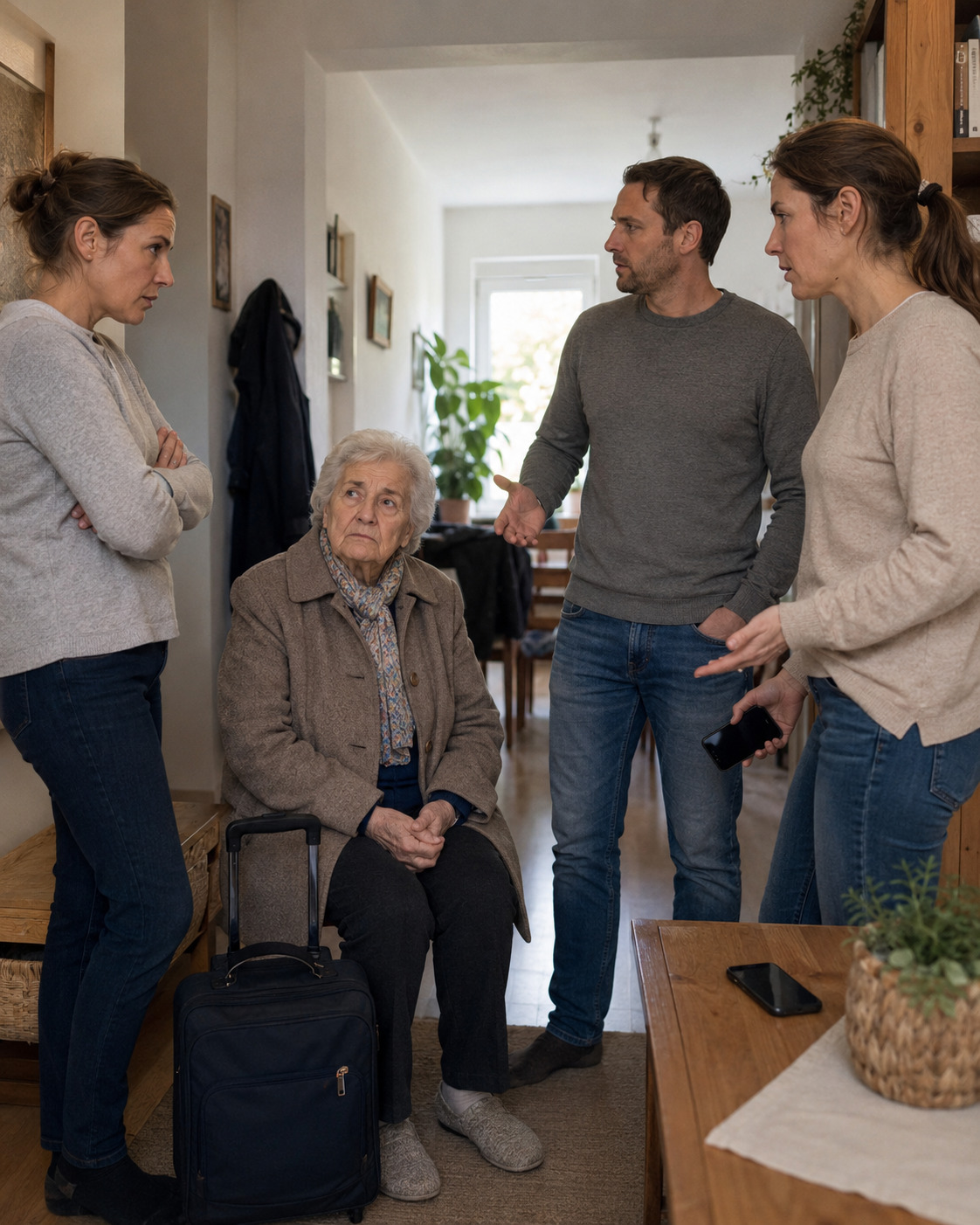
The first time my children told me they had found the perfect senior living community for me, I knew something was wrong. Not because the place looked bad. In fact, the brochure they handed me showed beautiful gardens, bright rooms, wide windows, and a dining area that looked more like a quiet hotel than a retirement facility. The problem was that they were speaking as if the decision had already been made. They had not asked whether I wanted to move. They had simply gathered around my living room, placed the brochure on my coffee table, and explained what was going to happen next.
Dennis, my oldest son, did most of the talking.
“You’ll have more support there,” he said.
His wife, Carol, nodded beside him. My daughter Patty had brought notes about the activities. Kevin sat quietly in the corner, listening.
I looked at the brochure.
The name of the facility was Cloverfield Senior Living.
I had heard of it.
Actually, I knew it better than any of them could have imagined.
But I didn’t say anything.
Instead, I turned another page.
There was a photograph of the east garden. I had personally chosen the flowers three years earlier. Another photograph showed a hallway with large windows facing the morning sun. I had approved those windows during the renovation. The dining room had the exact tables I had selected because they were easier for older hands to use.
My children were sitting in my living room, explaining my future to me.
And they had no idea they were showing me photographs of a place I had helped create.
“I think you should at least visit,” Carol said.
I looked at her.
“All right,” I replied.
They seemed relieved.
None of them noticed that I was smiling.
CHAPTER TWO: WHAT THEY THOUGHT THEY KNEW ABOUT ME
I was seventy-four years old when this happened.
I had been a widow for nineteen years.
My husband, Chester, had been gone for a long time, but I still found myself thinking about him almost every day. We had been married for forty-seven years, and when someone has been part of your life for that long, their absence does not disappear simply because the calendar keeps moving.
After Chester died, my children worried about me.
At first, I understood.
Dennis called more often.
Patty brought groceries.
Kevin checked the furnace.
They were trying to help.
Over time, however, their concern slowly changed into assumptions.
They assumed I was lonely.
They assumed I was becoming fragile.
They assumed that because I lived alone, I must be struggling.
What they did not know was that I had spent the previous twenty years building something.
I had never been interested in announcing every decision I made. I did not post my plans on the refrigerator or call my children every time I signed a document. I simply handled things.
After Chester died, I began thinking about the care he had received during his final years.
There had been good people.
There had also been things that could have been better.
I remembered sitting in a rehabilitation facility while Patty recovered from a broken ankle. The staff worked hard, but the place felt designed around schedules rather than people. The food was adequate. The rooms were clean. The care was acceptable.
But I kept thinking about the difference between acceptable and good.
I had spent thirty years as a fifth-grade teacher.
I knew the difference.
A classroom could be clean, organized, and perfectly functional, yet still fail the children inside it.
The same was true of a place where people spent the final chapters of their lives.
So I began making plans.
I found an old convalescent home on twelve acres of land. There was a large red oak tree near the southwest corner of the property. I remember standing beneath it in November and thinking that the tree had been there long before me and would probably remain long after I was gone.
I liked that.
It made the decision feel less dramatic.
I hired an attorney.
I created the Win Heritage Trust.
I bought the property.
Then I hired Sandra Lim to help manage the project.
Over the next several years, I helped build Cloverfield Senior Living.
I chose the windows.
I reviewed the floor plans.
I discussed the meal program.
I walked through the rooms before they opened.
I thought about the residents who would eventually live there.
The facility opened seventeen years ago.
My children knew I had investments.
They knew I had been involved in “some business things.”
They simply never asked enough questions to understand what those things were.
That was not because I had carefully hidden everything.
They just never looked closely.
CHAPTER THREE: THE HOUSE ON BIRWOOD LANE
The house where my children grew up was on Birwood Lane.
It was not a mansion.
It was not the kind of property people stopped to photograph.
It was simply home.
There were scratches on the hallway floor from when the children were young. The kitchen cabinets had been repaired more than once. Chester had planted trees in the yard and spent years insisting that every problem could be fixed with the right tool and enough patience.
My children knew that house better than anyone.
Or at least, they thought they did.
By the time I was in my seventies, Dennis had begun suggesting that I sell it.
He did not say it harshly.
That was part of what made it difficult.
“Mom, you don’t need all this space.”
“You could have fewer responsibilities.”
“You’d be safer somewhere with staff around.”
I listened.
Sometimes I even agreed with parts of what he said.
But I had no desire to leave.
When my children eventually presented the Cloverfield brochure, they believed they had solved the problem.
They had discussed it among themselves.
They had researched the facility.
They had apparently agreed that it was the best option.
Then they came to tell me.
They did not call it a vote.
Dennis called it a conversation.
But a conversation is supposed to leave room for another person’s decision.
Their conversation had already reached its conclusion before they walked through my front door.
I could have told them the truth that day.
I could have said, “You know I own that place, don’t you?”
But I didn’t.
Not because I wanted to embarrass them.
I wanted to understand something.
Were they truly concerned about me?
Or had they simply decided that I was old enough for them to start making decisions on my behalf?
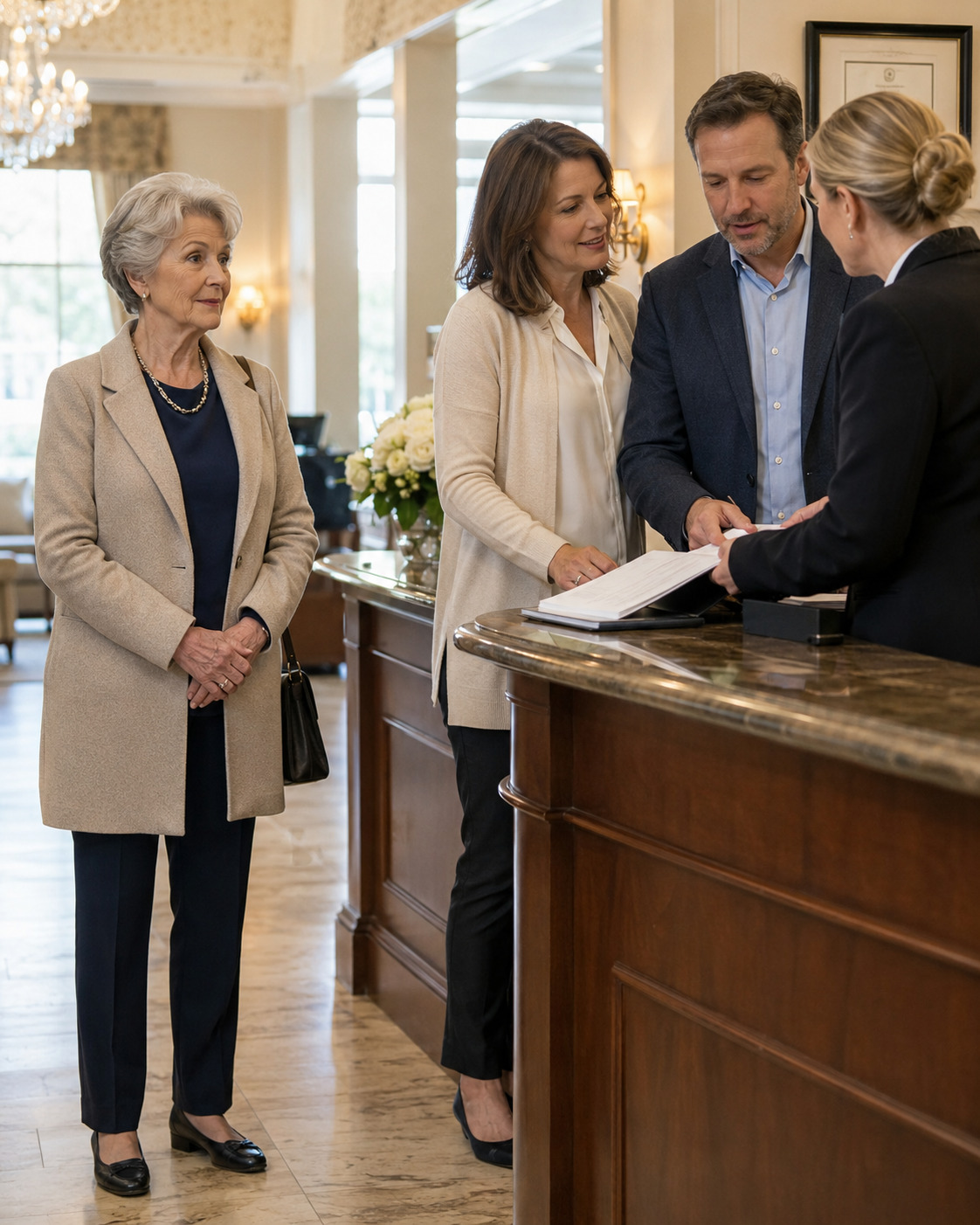
So I agreed to visit Cloverfield.
I let them show me around.
I watched my children admire the gardens I had chosen.
I watched Carol praise the dining room.
I watched Dennis inspect the rooms as if he were evaluating a property.
And I said nothing.
CHAPTER FOUR: THE TITLE SEARCH
The plan might have continued quietly if Carol had not decided to sell my house.
She hired a real estate agent named Priscilla Moss to look into the property.
That was when things began to unravel.
The title search came back with a name nobody in the family expected.
Win Heritage Trust.
Carol called Dennis.
Dennis called Kevin.
Kevin already knew.
A few weeks earlier, during the family tour of Cloverfield, he had noticed a small framed history display in one of the hallways.
It mentioned the Win Heritage Trust.
He had recognized the name.
He had not said anything.
Instead, he had texted me.
“Mom, what is Win Heritage Trust?”
I told him.
There was a long pause.
Then he asked, “Does Dennis know?”
“No.”
“What are you planning to do?”
I replied, “I’m planning to cooperate with their timeline.”
Kevin understood immediately.
He wrote back, “Dad would have loved this.”
Then he kept my secret.
For three weeks.
The formal meeting was scheduled for a Friday morning at my attorney’s office.
I knew exactly what was going to happen.
My children did not.
Dennis arrived with the confidence of a man who believed he had spent months solving a problem.
Carol wore what she called her “good coat,” a gray wool coat she saved for serious occasions.
Patty looked nervous.
Kevin was quiet.
My attorney, James Hobart, had represented me for twenty years.
He had been there when I created the trust.
He had helped purchase the property.
He had reviewed the documents that allowed Cloverfield to grow into the facility it was.
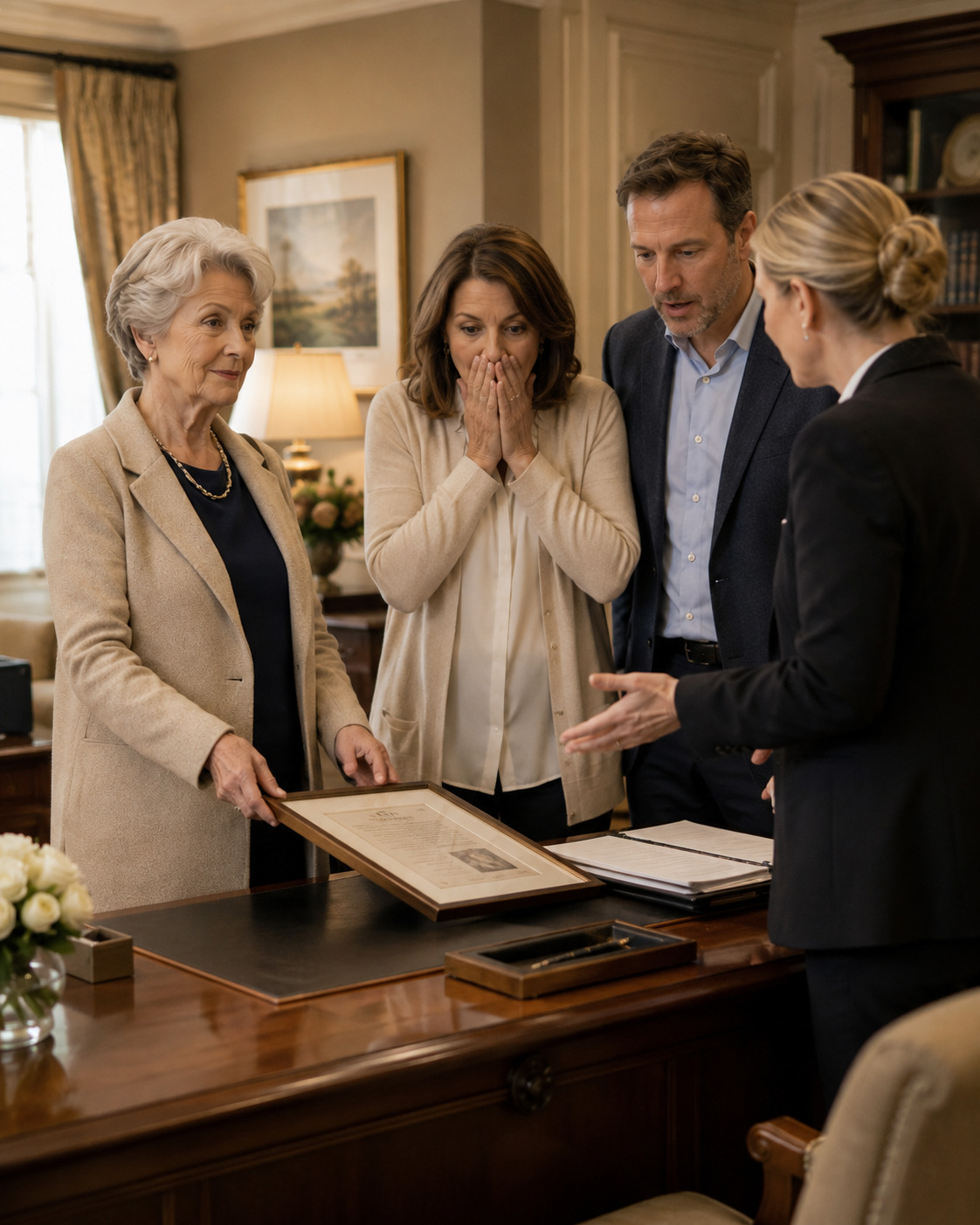
That morning, he placed several folders on the table.
Then he began.
CHAPTER FIVE: THE FIRST DOCUMENT
The first document was the deed to my house.
James explained that the property was held by the Win Heritage Trust.
I was the trustee.
The house was mine.
There was a silence around the table.
Dennis looked at me.
“How long has this been the arrangement?”
“Years.”
He looked at the papers again.
Then James placed another document in front of him.
It showed the ownership structure of Cloverfield Senior Living LLC.
I owned seventy-eight percent.
For a moment, nobody spoke.
Carol looked at the document.
Then she looked at me.
“You’re the owner?”
“I am.”
Patty started crying.
I reached for a glass of water and handed it to her.
Dennis seemed unable to decide whether he was angry, embarrassed, or simply confused.
“How long have you known?”
I looked at him.
“From the beginning.”
He shook his head.
“Why didn’t you tell us?”
I thought about that question for a long time.
The answer was not complicated.
“Because you never asked.”
No one had a response to that.
I was not saying it to be cruel.
It was simply true.
I had mentioned the trust.
I had mentioned investments.
I had mentioned that I was working on a project.
Dennis had said that sounded smart.
Kevin had asked whether it was complicated.
Patty had told me she was glad I had something to keep me busy.
Then they had gone on with their lives.
I had gone on with mine.
The difference was that I had continued building.
CHAPTER SIX: WHY I BUILT CLOVERFIELD
Dennis eventually asked me why I had done it.
That question was easier to answer.
“It started with Patty’s ankle.”
Everyone looked at my daughter.
She had broken her ankle years earlier and spent time in a rehabilitation facility.
I had visited her there.
The care had been fine.
But fine was not enough for me.
“I kept thinking about the people who lived there,” I said. “They deserved more than a place that was simply adequate.”
I explained that I had not wanted to build a facility that felt like a machine.
I wanted people to be treated like people.
That meant windows that brought in morning light.
It meant meals that residents actually wanted to eat.
It meant gardens that someone could walk through without feeling as though they were being supervised.
It meant staff who understood that the person sitting in front of them had lived a full life before arriving there.
“I spent thirty years teaching children,” I told them. “I knew that managing people and caring for people were not the same thing.”
I looked around the table.
“Residents know the difference too.”
Dennis looked down.
He had come to the meeting believing he was helping his mother find a place to live.
He was learning that his mother had spent two decades creating one.
Then he said something I had not expected.
“I’m sorry.”
I looked at him.
He continued.
“We were trying to take care of you.”
“I know,” I said.
And I did know.
That was the difficult part.
I knew my children loved me.
I also knew that love did not always stop people from making assumptions.
Sometimes it made them more confident in those assumptions.
CHAPTER SEVEN: WHAT CHANGED AFTER THAT DAY
The family did not suddenly become perfect.
There was no dramatic reconciliation.
No one hugged and cried for an hour.
Real families rarely work that way.
Instead, things changed slowly.
Carol stopped trying to sell the house.
She began visiting Cloverfield more often.
The first time she admitted that the facility was “excellent,” I almost laughed.
That was Carol’s highest compliment.
Patty started coming on Thursdays.
She brought a small pot of rosemary and placed it near my window.
Kevin called on Sundays.
Dennis began asking questions.
That was the biggest change.
He no longer said, “You should do this.”
He began saying, “What do you think?”
It may sound like a small difference.
It was not.
For years, I had felt that my children saw me as someone who had already finished becoming a person.
They remembered me as their mother.
They remembered the woman who packed lunches, attended school events, and kept the house running.
They had not thought much about who I became after they grew up.
Now they were beginning to find out.
I continued living at Cloverfield.
I had chosen an east-facing room years earlier.
The morning light came through the windows exactly as I had hoped.
Every morning, I walked outside and stopped beneath the red oak.
It had been there when I first stood on the property.
It was there when the facility opened.
It was still there now.
I liked the fact that it did not care about family arguments.
It simply continued growing.
CHAPTER EIGHT: THE THING MY CHILDREN FINALLY UNDERSTOOD
For a long time, my children believed I had been lucky.
They believed I had made good investments.
They believed I had been fortunate after Chester died.
They had never understood how much work had gone into my life.
The truth is, most people only see the finished result.
They do not see the years of planning.
They do not see the small decisions.
They do not see the mornings when nobody is watching.
They do not see the paperwork.
The conversations.
The mistakes.
The patience.
They see the building.
They do not see the foundation.
That was what my children finally began to understand.
I had not suddenly become capable at seventy-four.
I had been capable all along.
They had simply stopped looking.
One afternoon, Patty stood beside me near the east window.
“I used to think you were lonely,” she said.
I looked at her.
“I was,” I replied.
She looked surprised.
I smiled.
“Then I was busy. And then I was happy.”
She nodded.
“Good,” she said. “I’m glad.”
That was all.
But it was enough.
CHAPTER NINE: I DIDN’T WANT REVENGE
People later asked whether I had planned the entire reveal as revenge.
I hadn’t.
I was not angry that my children had discussed moving me.
I was not even angry that they had assumed they knew what was best.
The truth was, their decision had given me something.
It had shown me that I had arranged my life correctly.
It had created the perfect moment to explain what I had built.
I did not need to punish my children.
I needed them to understand.
There is a difference.
I had spent twenty years preparing for a future that I hoped would never come.
I had planned my finances.
I had planned my care.
I had planned my home.
I had planned what would happen to the property after I was gone.
I had done all of that because I did not want my children to be forced to make difficult decisions for me.
Ironically, they had tried to make those decisions anyway.
But I could not be angry forever.
They had been afraid.
They had been trying to help.
They had simply forgotten one important thing.
I was still capable of helping myself.
CHAPTER TEN: THE LIFE I BUILT FROM THE INSIDE
By May, the family had found a new rhythm.
The flowers along the entrance were blooming.
Chester had loved that pale yellow color.
I had chosen those flowers a few years earlier because they reminded me of him.
The wrench he had been holding when he died sat on a shelf in my room beside a photograph from our first summer together.
I had moved it recently.
For a long time, I had kept it in a drawer.
Then one morning, I realized I was ready to see it every day.
The house on Birwood Lane still stood.
I had not decided what to do with it.
I was not going to be rushed.
My children had finally learned that.
Dennis called on a Sunday.
He asked how I was.
I said I was fine.
He told me Carol thought I should keep the house.
Then he added that she also thought Cloverfield was very well run.
I smiled.
“She called it excellent?”
“Yes.”
“Then she must mean it.”
He laughed.
It was the first time in a long time that we had laughed together without something difficult sitting between us.
CHAPTER ELEVEN: WHAT I WISH THEY HAD ASKED
If I could change one thing, I would not change the trust.
I would not change the business.
I would not change the years I spent planning quietly.
I would change one thing.
I wish my children had asked more questions.
Not because they needed to know every detail of my finances.
Not because I believed I was entitled to their constant attention.
I simply wish they had occasionally wondered who I was when they were not around.
What did I do in the mornings?
What did I care about?
What had I built?
What had I learned?
What had I become?
Those questions might have changed everything.
Because the truth is, parents do not stop having lives when their children grow up.
We simply become less visible to them.
Children get jobs.
They marry.
They raise their own families.
They become busy.
And slowly, without meaning to, they begin remembering their parents as people from the past.
But we continue living.
We continue changing.
We continue making plans.
We continue becoming someone our children may not recognize.
That is not necessarily a tragedy.
But it can become one if they begin making decisions about us without first asking who we are now.
CHAPTER TWELVE: THE RED OAK
I still walk to the red oak every morning.
Sometimes I sit on the bench beneath it.
Sometimes I simply stand there.
The tree was already old when I first saw the property.
It had survived storms.
It had survived winters.
It had survived changes that nobody had bothered to record.
One day, it will be gone.
So will I.
That does not make me sad.
It is simply accurate.
Everything has a season.
The important thing is what we build while we are here.
I built Cloverfield because I wanted older people to have a place that felt like a home rather than a waiting room.
I built the trust because I wanted my affairs to remain in my hands.
I built a life that did not depend on my children understanding every part of me.
But I am grateful that they are finally trying to understand.
Dennis is still learning to ask instead of assume.
Patty still brings rosemary.
Kevin still calls on Sundays.
Carol still has strong opinions about almost everything.
And I still live in the place my children once decided was the best place for me to move into.
The difference is that now they know why.
I did not end up at Cloverfield because my children chose it for me.
I live there because I built it.
And perhaps that is the part I want people to understand most.
Getting older does not mean your life becomes someone else’s property.
It does not mean your children automatically know what is best.
It does not mean you stop making decisions.
Sometimes the strongest thing an older person can do is quietly prepare.
Not to prove anything.
Not to win an argument.
Simply because life is easier when the foundation is solid.
My husband used to say that the only thing worth building was something you understood from the inside.
I think he was right.
I built Cloverfield from the inside.
I built my life from the inside.
And now I am living in it.
That is the whole story.