Julian Sinclair’s voice sliced through the 85th-floor lounge like a cold razor, turning every head toward my oil-stained shirt. I stood there—Elias Thorne, a 60-year-old master electrician who had wired half the skyscrapers in Chicago—feeling like a grit-stained ghost in a palace of glass. “Do you have any idea what this night represents? ” Julian asked, adjusting his $10,000 watch with a smirk.
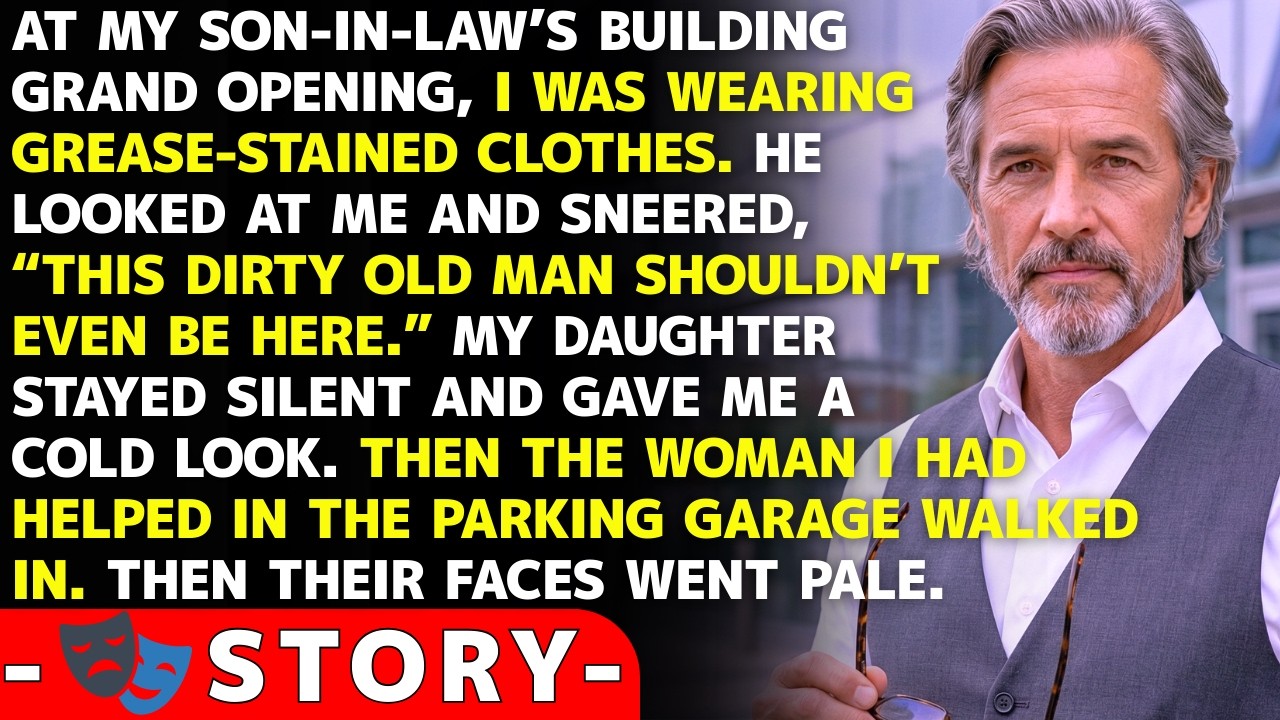
“Look at you. You look like you crawled out of a sewer. ”
The Apex Lounge was a blinding sea of white marble and recessed LEDs. Investors and the city’s elite stared at the grease on my sleeves.
I tried to explain—there had been an accident in the garage, a woman trapped in her Tesla, I’d pulled the manual release with my bare hands. Julian cut me off. “You’re a liability, Elias. ” He stepped closer.
“Beatrice deserves a father who adds value to her brand, not one who drips grease on a five-figure rug. ”
I looked at my daughter. Beatatrice stood in designer silk, her eyes darting away from mine. When she finally spoke, her voice was a sharp, clinical instrument.
“Take the service elevator in the back. Now. ”
She had told Julian I was a retired consultant. She was ashamed to admit her father was an electrician.
As the heavy doors slid shut, I saw Julian lean in to whisper victory in my daughter’s ear. She nodded. Five years earlier, I had held Margaret’s hand in a hospital room while the heart monitor flatlined. “Make it bright for her,” my wife had whispered.
“Promise me she will be more than us. ”
I promised. I worked double shifts until my hands went numb, paying for Beatatrice’s degree, her wedding, her new life. At the wedding, I was seated at Table 14, hidden behind a marble pillar near the kitchen doors.
The program didn’t mention the father of the bride. My handmade hope chest was found discarded near a dumpster because it didn’t match the minimalist theme. Then the phone calls became texts, and the texts became silence. She dropped Thorn from her name entirely.
I built a dollhouse for my granddaughter Clara—sixty nights of hand-carved joinery, tiny copper circuits, every room wired to glow with warm golden light. Beatatrice rejected it. “It’s just too Bridgeport, Dad. It doesn’t fit the aesthetic.
”
Then she came to me crying about Julian’s partners pressuring him, about a pre-IPO opportunity that would change everything. I signed over my retirement fund. Every cent of it. Fifty thousand dollars.
Three weeks later, Julian posted a photo of a Porsche in front of a private club with an initiation fee of exactly fifty thousand dollars. When I called Beatatrice to ask for two thousand just to keep my lights on, she accused me of holding a family loan over her head like a debt collector. She hung up. The invitation arrived six weeks later.
Cream-colored cardstock, a VIP pass to the grand opening of the Apex. “It’s time to move past the misunderstandings,” the note said. Formal attire non-negotiable. I spent my last dollars on a haircut and dry cleaning for my best white shirt.
Margaret’s silk tie. Her note—I am so proud of your working hands, Elias—tucked in my pocket like a talisman. The snow was falling hard when I pulled into the parking garage of the Apex. But before I could turn off the engine, I heard it: the rhythmic, desperate thud of a hand against glass.
A Tesla Model X sat under flickering fluorescent lights, doors frozen shut. Inside, a silver-haired woman clawed at the window, panic in her eyes. “Stay calm,” I shouted through the glass. “I’m an electrician.
I’m going to get you out. ”
The electronic locks were dead. I dropped to my knees in a puddle of hydraulic fluid, my clean white shirt soaking up the oily grime as I crawled beneath the chassis. My fingers found the emergency release cable—jammed, locked by a localized power surge.
And there, blinking faintly in the wheel well: a signal jammer. This wasn’t a malfunction. It was deliberate. I gave the cable a final desperate tug.
The doors disengaged with a heavy metallic click. The woman collapsed out, gasping the stale garage air like it was pure oxygen. I helped her to a concrete pillar. “I have to go,” I said, checking my watch.
“My daughter—she’s waiting on the 85th floor. ”
She pressed a business card into my greasy palm. Heavy textured velvet, a gold embossed phoenix, no name. I shoved it in my pocket without looking.
Twenty minutes late and covered in filth, I stepped into the lounge. Guests recoiled. Whispers cut through the clinking glasses. Beatatrice rushed over, her face drained of color.
“Dad, what have you done? You look like you crawled out of a sewer. ”
“I helped a woman. She was trapped in her car—”
“I don’t care about the garage.
” She grabbed my arm, her nails digging in. “You’re ruining everything. Go to the mechanical room. Now.
”
She shoved me through a service door, straight into Julian and the board of directors. Julian’s eyes swept over my oil-stained sleeves with clinical disgust. He was mid-performance for the board, pointing at me like a specimen. “This is the human interest prop I was telling you about—the before picture for our Southside charity initiative.
” Meredith Sinclair clutched her pearls. “Does he need a handout? I have some change in my clutch. ”
I’d had enough.
“Julian,” I said, my voice steady. “You’re wearing my retirement on your wrist and driving it in your garage. Julian’s face turned livid. Before he could respond, every light in the building went out.
The darkness didn’t just fall. It slammed into the room like a physical weight. Panic ripped through the elite crowd. Emergency LEDs flickered on, casting an eerie red glow over the panicked faces.
And Julian, blinded and cornered, launched into a vicious rant—not realizing his lapel mic was still live on the emergency channel. “You did this, didn’t you? You pulled a wire to make me look bad, you manual trash. I skipped the final stress test to get this launch under budget—”
“Julian, stop,” Beatatrice sobbed.
“Everyone can still hear you. ”
Too late. James Sterling, the CEO of Sterling Tech, stood in the red light, his face ashen. I inspected the dark panels and felt the cold vibration beneath my boots.
“It’s a firmware hardware mismatch,” I said. “You overshot the backup relays by thirty percent. You’re trying to run a smart building on a dumb foundation. ”
Then the emergency elevator doors groaned open.
Leonora Vance stepped into the red light. The woman I’d saved in the garage was the titan of Vance Holdings, the building’s true owner. She bypassed security using a physical key no one knew existed, and she walked straight past the board, past Julian, straight to me. She had heard Julian’s “liability” speech through the building’s emergency comm system from the elevator.
She described the suffocating darkness of P3, the vacuum-sealed tomb her car had become—and the man with oil on his sleeves who had dropped to his knees in the dark to save her. “You called him a liability? ” She turned to the board. “This man is the only reason I’m standing here instead of being wheeled out of this building.
”
She announced her foundation’s $200 million investment was contingent on sterling character—a quality she found entirely absent in Julian Sinclair. She had already drafted a fraud complaint covering the $50,000 he’d stolen from me. Julian had 72 hours to return every cent or face her legal team. James Sterling didn’t hesitate.
“Julian is no longer part of this firm. Effective immediately. ”
Then Leonora turned to me. “Mr.
Thorne, these visionaries have left my building in the dark. Would you be so kind as to show them how a real master works? ”
The server room smelled of scorched silicon. Young IT staff were frantically rebooting software while the real problem—a hidden backdoor script Julian had installed to fake a recovery later—cascaded into a catastrophic loop.
I opened my toolkit, pulled out a simple copper jumper wire, and performed a manual override on the primary power bus, bypassing the corrupted AI layer. Contactors engaged with a deep, rhythmic clack. The lights came back on, flooding the building from the bottom up. When I emerged, Leonora was waiting.
She offered me a position as chief technical adviser for Vance Holdings, overseeing 47 properties across North America—with legal authority to audit every project Julian Sinclair ever touched. I found Beatatrice on the observation deck hours later, silhouetted against the skyline, mascara streaked down her face. “Dad, I don’t know how to apologize. ”
I pulled out my phone and showed her the call history.
“Thirty-seven attempted calls in the last three months, Beatrice. Thirty-seven times I reached out to my only child. And thirty-seven times the phone rang into a void. ” I read them aloud—her birthday, Mother’s Day, the hardest days without her mom.
“You didn’t just lose me,” I said. “You lost yourself. ”
She sank to her knees on the cold concrete. “I’m so sorry, Daddy.
I let them convince me you were something to be ashamed of. ”
I pulled her to her feet. “I forgive you, Beatrice. But trust takes time to rebuild.
”
One month later, I stood in a training facility Leonora had built on the 82nd floor, teaching young engineers the manual bypass techniques that had saved the Apex. My first paycheck had cleared. Attached to it: $63,000, marked as debt repayment from Julian Sinclair. Beatatrice took a position as community outreach director for Vance Holdings, connecting projects with neighborhoods like Bridgeport.
She brought Clara to see my workshop. I had rebuilt the dollhouse from the shattered pieces the Sinclairs had thrown away—stronger this time, with the photo of Margaret and baby Beatatrice hidden in the secret attic. “Grandpa Elias! ” Clara ran into my arms with fearless trust.
I guided her small finger to the brass switch, and every window blazed with warm golden light. On Thanksgiving, Meredith and Richard Sinclair sat at my table. Meredith brought a store-bought pie and tears. “I destroyed my family with my arrogance.
If we’re at your table, we live by Thorn rules. We speak the truth. We respect each other. ” After dinner, she handed me an envelope.
She and Richard wanted to fund a trade school scholarship in Margaret’s name. On the first morning of the new year, I stood in my quiet workshop, the mortgage paid off, the house finally mine. Clara’s drawing—me with a red cape and a massive wrench—was taped to the wall. Leonora’s legal team had finalized new maintenance protocols for the entire Apex complex: manual-first standards, so no digital ghost could ever leave a tenant in the dark again.
They called it the Thorn Standard. I turned off the workshop light. The darkness no longer felt like a tomb. Upstairs, the furnace hummed with steady warmth.
The grid inside these walls was finally sound. The legacy wasn’t a name in gold on a lobby wall. It lived in the light I’d kept burning, so the people I loved could always find their way home.