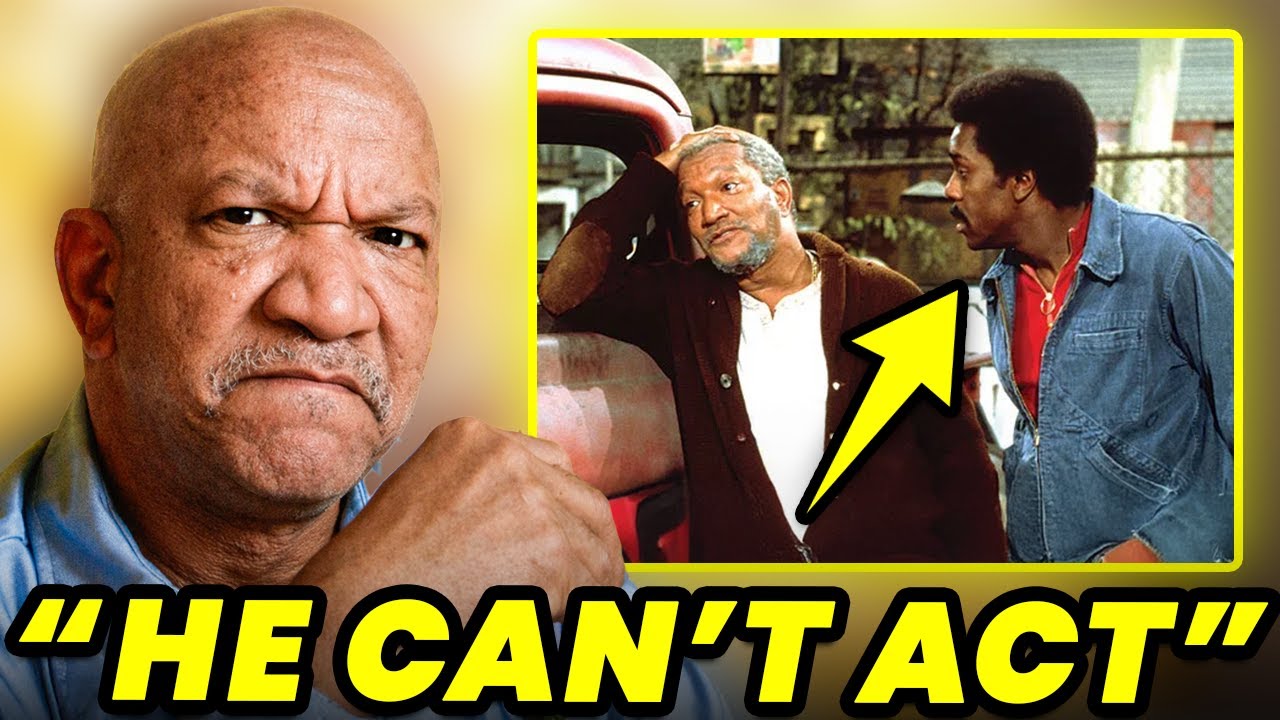
For years, millions of Americans knew exactly what Fred Sanford was about to do.
He would stop in the middle of an argument.
His hand would move toward his chest.
His face would tighten.
Then he would call out to his late wife, Elizabeth, as though the end had finally arrived.
It became one of the most recognizable running jokes on Sanford and Son.

Fred was not really dying, of course.
That was the joke.
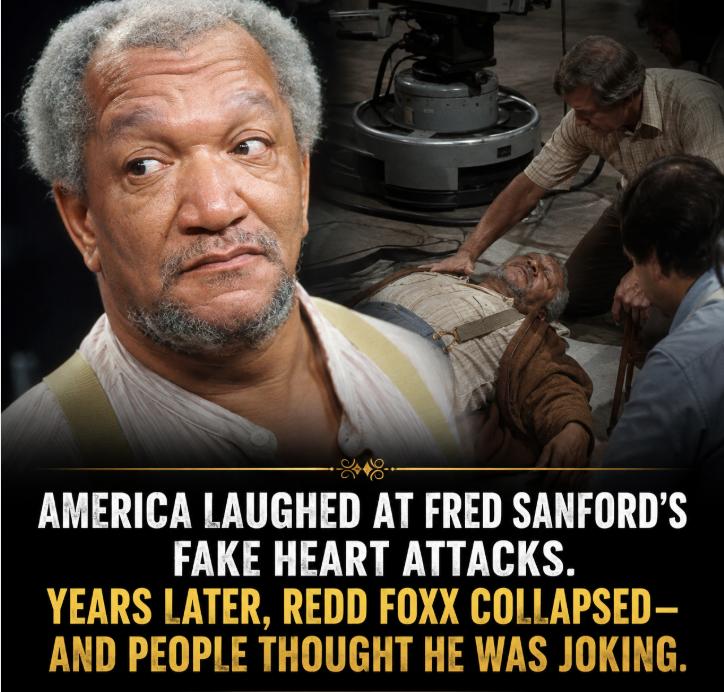
Then, nearly two decades later, on a television soundstage in Hollywood, Redd Foxx suddenly collapsed during rehearsal.
At first, people around him thought he was joking again.
This time, he wasn’t.
The moment became one of the strangest and saddest coincidences in television history. But reducing Redd Foxx’s life to the way it ended misses the larger story.
Long before America knew Fred Sanford, Foxx had spent decades building a reputation in clubs where his comedy could be far sharper than anything NBC would allow on television.
Then Sanford and Son made him a national star.
It also put him in the middle of battles over money, creative control and how Black life should appear on American television.
Foxx once walked away from the hit show while it was still near the top of the ratings.
Years later, after making enormous sums of money, he watched the IRS seize his home, cars and personal belongings.
And then, in his late 60s, he was given one more chance at a television comeback.
That was where the story came full circle.
Before Fred Sanford, America Barely Knew Redd Foxx
Redd Foxx was born John Elroy Sanford in St. Louis in 1922.
By the time television made him famous, he had already been performing comedy for decades.
Foxx developed his reputation in nightclubs and on the Black entertainment circuit, where he could perform material that was far too risqué for network television of the era. His comedy records became popular even though much of the material could not be played on mainstream radio.
To much of Black America, Redd Foxx was hardly a discovery.
To mainstream television audiences, however, he seemed to arrive almost overnight.
When Foxx died in 1991, the Los Angeles Times noted that before Sanford and Son debuted in 1972, he was far better known among nightclub audiences and buyers of his adult-oriented comedy albums than among the broader American public.
That changed because of Norman Lear and Bud Yorkin.
Lear and Yorkin had already seen what could happen when television comedy dealt directly with subjects that other sitcoms avoided. Their All in the Family had become a phenomenon.
For their next project, they looked across the Atlantic.
The basic idea behind Sanford and Son came from the British comedy Steptoe and Son, about a father and son operating a rag-and-bone business.
But Lear and Yorkin did not simply copy the British show.
Their version moved the story to Watts in Los Angeles and centered on Fred Sanford, an irritable, scheming junk dealer, and his son Lamont, the younger man forever caught between loving his father and desperately wanting a life of his own.
NBC bought the series.
Redd Foxx became Fred.
Demond Wilson became Lamont.
And American television changed.
The Junkyard Was Funny Because the People Felt Real
Sanford and Son premiered on NBC on January 14, 1972.
The setting was hardly glamorous.
Fred and Lamont lived and worked around a salvage business surrounded by furniture, appliances, old parts and objects other people had thrown away.
But the junkyard quickly became one of television’s most recognizable places.
The show was loud, argumentative and sometimes uncomfortable.
Fred could be selfish.
Lamont could be impatient.
They insulted each other.
They fought over money.
They complained about being trapped together.
Yet underneath the arguments was something the audience understood immediately.
They were family.
That distinction mattered.
Norman Lear later explained that audiences might laugh at jokes on the surface, but deeper laughter came when viewers first cared about the people telling them.
That philosophy was particularly important on Sanford and Son. The show could deal with race, money, frustration and working-class life without becoming a lecture because the audience was already invested in Fred and Lamont.
Foxx also brought something to Fred Sanford that could not simply be written into a script.
He knew the rhythms of the world the show was trying to portray.
Writers and producers later recalled that Foxx would challenge material when a line or situation did not feel authentic. Television Academy accounts describe moments when Foxx and other Black cast members told writers that something they had written simply did not sound like something the characters would really say or do.
That could make Foxx difficult.
It could also make the show better.
Fred Sanford was not designed merely as a polite television version of somebody else’s idea of a Black working-class father.
Foxx put himself into the character.
Even the name Sanford carried a connection to his own family: Foxx’s real surname was Sanford, and accounts of his life identify his older brother as Fred G. Sanford.
The character was becoming personal.
And soon, so was Foxx’s fight over the show.
Then Came the Joke America Never Forgot
Fred Sanford had many weapons.
Insults.
Schemes.
Guilt.
And whenever Lamont pushed him too far, Fred had one final move.
The heart attack.
He would clutch his chest and behave as though death were seconds away, invoking his late wife Elizabeth as if he were preparing to join her.
It became shorthand for the character.
You did not need an explanation.
The moment Foxx put his hand to his chest, audiences knew what was coming.
The bit worked partly because Fred was such an accomplished manipulator. Everybody knew he was using guilt to get what he wanted.
But there was also something unexpectedly human beneath the joke.
Elizabeth was dead.
For all Fred’s outrageous behavior, the repeated references reminded viewers that there had once been a woman at the center of his life who was no longer there.
That mixture of humor and loss was typical of the show.
Fred could make poverty funny without pretending money did not matter.
He could make old age funny without pretending getting older was easy.
And he could make death funny because, every week, the audience knew he was going to get back up.
Foxx had found the character that would define him.
But success soon created another problem.
How much was the man at the center of that success actually worth to the people making the show?
When Redd Foxx Walked Away
By its early seasons, Sanford and Son was not a struggling experiment.
It was a major television hit.
Foxx knew it.
So did NBC and Tandem Productions.
During the 1973–74 season, the relationship between the star and the people producing the show broke down badly enough that Foxx stopped appearing.
The dispute involved compensation and Foxx’s stake in the success of the series.
Production could not simply stop, so the writers had to explain Fred Sanford’s disappearance.
The show continued without its central character, leaning more heavily on Lamont and Fred’s friend Grady, played by Whitman Mayo.
Six episodes at the end of the third season were made without Foxx.
Behind the scenes, the argument became serious enough that Tandem Productions pursued legal action. Contemporary trade reporting described a dispute over Foxx’s demands for a greater ownership position in the series.
Eventually, an agreement was reached.
Accounts of the settlement say Foxx returned with compensation of $25,000 per episode and participation in the producers’ net profits.
Then something revealing happened.
He came back.
And so did the show’s momentum.
Sanford and Son rose to No. 2 in the Nielsen rankings for the 1974–75 season.
For anyone who wondered how important Redd Foxx was to the series, the answer had become difficult to miss.
The junkyard could remain.
The supporting cast could remain.
The scripts could remain.
But without Fred Sanford standing in the middle of it, something essential was gone.
Foxx had leverage because Foxx was the show.
And yet winning that battle did not mean all of his battles were over.
The People Around Fred Became Family to Viewers
Foxx may have been the engine, but Sanford and Son became richer as its supporting characters grew.
There was Lamont, forever dreaming of something beyond the junk business but rarely able to escape his father’s schemes.
There was Grady Wilson, played by Whitman Mayo, whose slower, sweeter presence provided a different kind of comedy.
And then there was Aunt Esther.
LaWanda Page’s battles with Fred became some of the show’s most memorable confrontations.
Fred insulted her appearance.
Esther attacked his morals.
Neither seemed capable of allowing the other to enter a room peacefully.
For viewers, the arguments became almost ritualistic.
The people around Fred were not merely there to deliver lines.
They created a world.
And even before a single actor spoke, audiences heard another piece of that world.
Quincy Jones’ instrumental theme, “The Streetbeater,” became inseparable from the series. Jones composed the unmistakable funk-driven music that opened the show and was released on record in 1973.
For longtime viewers, only a few seconds of it can still bring back the junkyard.
That is the power of television nostalgia.
Sometimes memory does not begin with a plot.
It begins with a sound.
Why the Show Mattered Beyond the Laughs
Looking back, it is easy to focus on Fred’s insults, Aunt Esther’s comebacks or the fake heart attacks.
But Sanford and Son arrived at an important moment.
American network television had featured Black performers before, but Black working-class family life was still far from ordinary in prime-time sitcoms.
Sanford and Son placed that world at the center of the screen.
The Television Academy has described the series as groundbreaking, noting both its popularity and its significance in expanding what mainstream television could show.
The series did not present Fred Sanford as a flawless symbol.
That was part of its strength.
Fred was stubborn.
Cheap.
Jealous.
Clever.
Sometimes foolish.
Sometimes unexpectedly tender.
In other words, he was allowed to be a full comic character rather than a lesson.
And because millions of viewers watched him every week, the success of the series helped prove something that should never have needed proving:
A television comedy centered on Black characters could become a mainstream American hit.
That legacy would extend far beyond Fred’s junkyard.
But Foxx himself would soon leave it.
The Junkyard Closed Without a Grand Goodbye
Sanford and Son lasted six seasons, from 1972 through 1977.
There was no giant sentimental finale designed to make America cry.
The show simply ended as Foxx moved on to a deal with ABC and his own variety program.
Attempts were made to continue the Sanford world afterward, but nothing duplicated what Foxx and Wilson had created together.
That should have been the beginning of a comfortable second act for Foxx.
He had become one of America’s most recognizable comedians.
He had earned significant money.
His character was already part of television history.
But fame and financial security are not the same thing.
And years later, Foxx’s private finances became very public.
He Had Made Millions. Then the IRS Came to His House.
By the end of the 1980s, Redd Foxx’s life looked very different from his years near the top of network television.
He was still working.
He performed in Las Vegas.
He appeared alongside Eddie Murphy and Richard Pryor in the 1989 film Harlem Nights.
But behind the performances was a serious tax problem.
On November 28, 1989, Internal Revenue Service agents seized Foxx’s Las Vegas home and seven vehicles over unpaid taxes.
Contemporary reporting said federal liens connected to the seizure totaled more than $755,000, with penalties and interest potentially increasing the amount.
Foxx had also previously filed for Chapter 11 bankruptcy protection.
The image was difficult to reconcile with the television star who had once been among the country’s highly paid entertainers.
Some later retellings reduce Foxx’s financial collapse to one simple explanation, often gambling.
The public record is more complicated.
Bankruptcy records and tax disputes involved unpaid taxes, creditors, lawsuits and financial decisions accumulated over years. IRS attorneys did publicly raise Foxx’s spending, including gambling, while arguing over his ability to repay the government.
But the important part of the story is not that a television star spent too much money.
It is the contrast.
Redd Foxx had once stood at the center of one of NBC’s biggest comedies.
Now government agents were carrying his possessions out of his house.
In April 1990, Foxx and the IRS eventually reached a payment arrangement. Some seized property was returned, although cars and jewelry were still expected to be sold to reduce the debt.
Foxx was not finished.
He kept working.
And then, unexpectedly, television offered him another chance.
At 68, Redd Foxx Was Starting Over
In 1991, CBS introduced The Royal Family.
Foxx starred opposite Della Reese.
The pairing made sense.
Both performers had enormous personalities, and the project gave Foxx something he had not enjoyed in years:
a real shot at another network television success.
The series represented more than another paycheck.
For Foxx, it was a comeback.
The Los Angeles Times reported shortly before the show’s premiere that some of Foxx’s earnings would likely go toward resolving his continuing tax obligations. Foxx himself was still looking for ways to straighten out his finances.
But he was working.
He was back on a soundstage.
He was making people laugh again.
After all the battles, the cancelled programs, the financial trouble and the years away from his greatest role, the man America remembered as Fred Sanford had another chance to introduce himself to viewers.
Then came October 11, 1991.
This Time, It Wasn’t Fred Sanford
Foxx was at Paramount Studios rehearsing The Royal Family.
There was no studio audience watching.
According to a spokeswoman for the production, Foxx had been clowning around and making people laugh.
Then he collapsed.
For a moment, the people around him did not understand what they were seeing.
They thought he was joking.
Why wouldn’t they?
For years, Redd Foxx had made millions of people laugh by pretending that Fred Sanford’s heart was giving out.
He had trained America to see a hand on his chest and expect comedy.
But Foxx did not get back up.
Paramedics were called.
He was taken to Queen of Angels-Hollywood Presbyterian Medical Center.
Redd Foxx died later that day after suffering a heart attack.
He was 68.
The coincidence was almost too cruel.
A performer spends years pretending to have heart attacks.
Then when the real one comes, people initially think they are watching another performance.
But there is an important difference between remembering the irony and turning Foxx’s death into another punch line.
The people on that set were not watching Fred Sanford anymore.
They were watching a friend and colleague in trouble.
And the man who had built a career around making audiences laugh was suddenly gone.
The Joke Was Never the Whole Story
For many viewers, Redd Foxx will always be frozen in a familiar pose.
Hat on his head.
Suspenders over his shirt.
An insult ready for Lamont.
A complaint ready for Esther.
One hand moving toward his chest whenever he needed to win an argument.
But the man behind Fred Sanford had already lived a long professional life before NBC made him famous.
He had spent decades performing in clubs where Black comedians built careers largely outside mainstream television.
Then he carried that experience into American living rooms.
He challenged writers when something felt wrong.
He fought producers when he believed his contribution was worth more.
He walked away from a hit series and eventually returned on better terms.
He made enormous amounts of money.
He also experienced bankruptcy and a humiliating public battle with the IRS.
And at an age when many entertainers would have accepted that their biggest years were behind them, he returned to network television and tried again.
That is a more interesting story than any collection of “weird facts.”
It is a story about what happens after success arrives.
And what happens when success leaves.
The Junkyard Outlived Everyone
Sanford and Son ended in 1977.
Redd Foxx died in 1991.
Norman Lear, Quincy Jones and many of the people who built that television era have since passed as well.
But the junkyard remains.
Not physically in Watts exactly as viewers saw it.
In memory.
A few notes from “The Streetbeater” are enough.
A clip of Fred and Esther trading insults is enough.
Fred’s hand moving toward his chest is certainly enough.
The show has survived because audiences did more than laugh at its jokes.
They knew the people.
They knew the rhythm of that house.
They knew Lamont would complain about his father and still stay.
They knew Fred would announce some impossible plan as though he had just discovered the secret to becoming rich.
They knew Aunt Esther could walk through the door and start a fight before she was fully inside.
That familiarity is what turns a television program into nostalgia.
And for viewers who were there in the 1970s, Sanford and Son is not simply an old sitcom.
It is a reminder of where they were when television sounded different, looked different and was beginning to tell stories it had not told often enough before.
The Television Academy’s retrospective on the series makes the same larger point: Sanford and Son broke significant ground while remaining, above all, a comedy audiences wanted to watch.
Redd Foxx was the reason it worked.
He could be difficult.
He could be unpredictable.
His life away from the cameras could be messy.
But Fred Sanford never felt manufactured.
Foxx gave him too much of himself for that.
And perhaps that is why the final coincidence still hits so hard.
For years, America laughed because everyone knew Fred Sanford’s heart attack wasn’t real.
Then one afternoon in 1991, Redd Foxx collapsed on a television set.
The people around him waited for the joke.
It never came.
Yet more than three decades later, audiences are still laughing at everything that came before it.
That may be the clearest measure of what Redd Foxx left behind.
The man is gone. The junkyard closed long ago. But Fred Sanford still walks into America’s living rooms, grabs his chest, calls for Elizabeth — and somehow makes another generation laugh.