Part 1: The Night My Daughter Finally Stopped Apologizing
The first time I saw my daughter ask her husband for permission to order dessert, I knew something inside her marriage was already broken.
It happened at The Copper Table, an upscale restaurant on the east side of Columbus, Ohio, the kind of place where wineglasses caught the chandelier light and waiters spoke softly enough to make every insult sound louder.
My daughter, Claire, sat across from me in a navy dress I had never seen before. Her auburn hair was curled neatly over one shoulder, but the skin beneath her eyes looked tired, as if sleep had become something she borrowed and gave back too soon.
Beside her sat her husband, Grant Holloway.
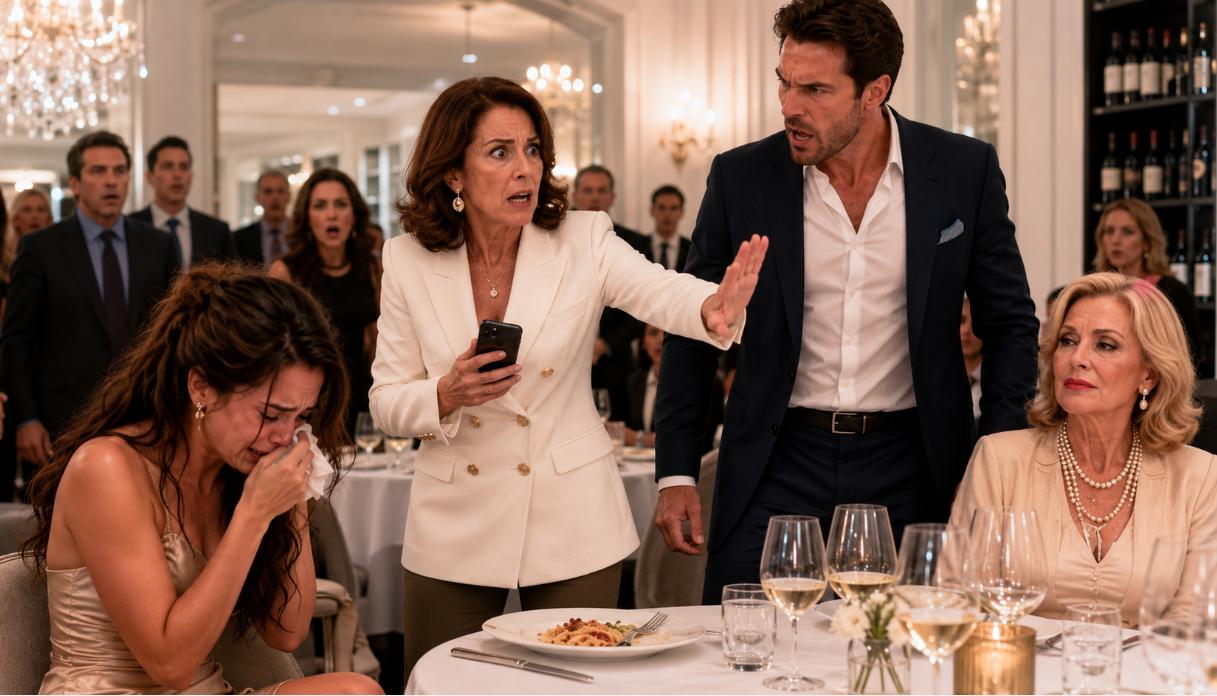
Grant was thirty-five, broad-shouldered, clean-shaven, and handsome in the way men become when they know people forgive them too quickly. He wore a dark blazer, a silver watch, and the expression of someone who believed every room owed him attention.
Next to him was his mother, Patricia.
Patricia Holloway had pearls around her neck, wine-red lipstick, and a smile that never reached her eyes. She had spent most of dinner watching Claire the way a woman watches a stain on a white tablecloth.
I had not wanted to come.
Claire had called me that morning.
“Mom,” she had whispered, “please just come tonight. Grant says it would mean a lot if both families could sit down and move forward.”
“Move forward from what?” I asked.
There was a pause.
Too long.
“You know how he is,” she said softly.
Yes.
I knew exactly how he was.
Grant corrected her in front of people.
He spoke over her.
He laughed when she offered an opinion, then called it teasing.
He checked her phone “as a joke.”
He once told her that teaching second grade was “cute little work” compared to his job in commercial real estate.
For three years, I had watched my daughter become smaller at her own dinner table.
Still, I came.
Because mothers do foolish things when their daughters say please.
Dinner began politely enough.
That was the part people outside families never understand. Cruelty does not always enter the room shouting. Sometimes it arrives in a pressed shirt, holds the door open, and orders wine for everyone.
Grant lifted his glass.
“To family,” he said.
Patricia smiled.
“To loyalty,” she added.
Claire looked down at her plate.
I saw it.
That tiny flinch.
The first warning.
For the next forty minutes, Grant performed.
He told the waiter Claire would have sparkling water instead of wine because “she gets emotional.”
He corrected her when she said a movie came out in 1998.
He interrupted when she tried to tell Patricia about a student who had finally learned to read.
“Claire loves making everything sentimental,” he said, chuckling. “That’s why I handle the important things.”
Patricia placed one manicured hand over her son’s wrist.
“You’ve always been the practical one.”
Claire smiled weakly.
I folded my napkin in my lap.
Hard.
“Claire handles plenty,” I said.
Grant turned toward me.
His smile stayed in place, but his eyes cooled.
“I’m sure she tells you that.”
Claire’s hand tightened around her fork.
“Grant,” she said quietly.
“What?” he asked, still smiling. “We’re just talking.”
But we were not just talking.
We were watching a man test how much humiliation he could pour over my daughter before anyone called it by name.
The waiter arrived with dinner.
For a few minutes, silverware replaced conversation.
Then Patricia looked at Claire’s plate and sighed.
“Pasta again?”
Claire blinked.
“I wanted pasta.”
Patricia tilted her head.
“Sweetheart, you always say that. Then you complain your dresses don’t fit.”
My daughter’s face went red.
I put my fork down.
Grant laughed under his breath.
“Mom’s not wrong.”
Claire stared at him.
It was not a dramatic stare.
It was worse.
It was the exhausted look of someone realizing the person beside her had never once planned to protect her.
“I’m not doing this tonight,” Claire said.
Grant’s smile vanished.
The table seemed to shrink.
“What did you say?”
Claire swallowed.
“I said I’m not doing this tonight. I came because you said you wanted peace. But this isn’t peace. This is just another performance.”
For one perfect second, I saw my daughter again.
Not Grant’s wife.
Not Patricia’s disappointment.
My Claire.
The girl who once stood on a kitchen chair at six years old and announced she was going to be a lawyer, a singer, and president of the moon.
Grant leaned back slowly.
The restaurant hummed around us. A couple at the next table laughed over wine. Somewhere near the bar, ice dropped into a shaker.
Then Grant said, very softly, “Apologize.”
Claire’s face changed.
“No.”
Patricia’s eyes widened.
Grant placed both hands on the table.
“Claire.”
“No,” she repeated, her voice shaking now. “I’m tired of apologizing for being embarrassed by the way you treat me.”
The nearby tables grew quieter.
Grant noticed.
Men like Grant always notice an audience.
His jaw tightened.
“If you won’t show respect in private,” he said, “maybe you need to learn it in public.”
Before I could stand, he reached toward her.
He grabbed her arm hard enough to make her gasp and pulled her toward him, forcing her down in her chair like she was a misbehaving child.
The sound that left my daughter’s mouth was not loud.
That made it worse.
It was small.
Humiliated.
Broken.
The restaurant went silent.
A waiter froze beside a table with two plates in his hands. A woman across the room covered her mouth. Someone whispered, “Oh my God.”
Claire’s eyes filled with tears.
“Grant, stop,” she said.
Patricia did not move.
She did not look shocked.
She did not reach for Claire.
She simply sat back, lifted her wineglass, and said, “Sometimes a wife needs to understand boundaries.”
That was when something inside me went very still.
Not angry.
Not yet.
Anger is loud.
This was colder than anger.
I rose from my chair.
Grant looked at me.
“Sit down, Linda.”
My name is Linda Mercer.
I am sixty-one years old.
I have buried a husband, raised two daughters, worked thirty-four years as a nurse, and seen enough bruises explained away as accidents to know when a woman is in danger.
I did not yell.
I did not throw my drink.
I did not call him names.
I took my phone from my purse and placed it on the table.
“Let go of my daughter,” I said.
Grant laughed once.
“This is a family matter.”
“No,” I said. “It became a public matter when you put your hands on her in a room full of witnesses.”
Claire looked at me through tears.
I could see the shame on her face.
Not because of what she had done.
Because women like my daughter are trained to feel responsible for the cruelty done to them.
Grant’s fingers loosened slightly, but he did not let go.
Patricia leaned forward.
“Linda, don’t embarrass yourself.”
I looked at her.
“You watched your son hurt my child and called it boundaries. Nothing I do tonight will embarrass me.”
A murmur moved across the restaurant.
Grant’s face flushed.
“You’re making this bigger than it is.”
I unlocked my phone.
“Then the police can decide that.”
His smile faltered.
“You wouldn’t.”
I tapped the screen.
“911. What is your emergency?”
The color drained from Grant’s face.
I kept my eyes on him as I spoke.
“My name is Linda Mercer. I’m at The Copper Table on Eastview Avenue. My son-in-law has grabbed my daughter and is refusing to let her go. There are witnesses. Please send officers.”
Grant released Claire instantly.
She folded into herself, one hand covering the place where his fingers had been.
I wanted to run to her.
I wanted to hold her.
But I knew something more important.
If I moved too quickly, Grant would turn the story into chaos.
So I stayed standing.
Steady.
Clear.
The manager hurried over, pale and sweating.
“Ma’am, is everything all right?”
“No,” I said. “Please preserve any security footage from the dining room.”
Grant stood so abruptly his chair scraped backward.
“This is ridiculous.”
A man at the next table said, “I saw what happened.”
Grant turned on him.
“Stay out of it.”
The man did not look away.
“I saw what happened,” he repeated.
Then a woman near the window lifted her phone.
“I recorded part of it.”
Patricia finally set down her wineglass.
Her hand was shaking.
For the first time that night, she looked less like a queen and more like a woman realizing the throne had been built on sand.
Claire whispered, “Mom…”
I stepped to her side then.
Only then.
I put one hand on her shoulder.
“You’re not in trouble,” I said.
She broke.
Not dramatically.
Not loudly.
Her face crumpled, and she leaned into me like she had been holding herself upright for years.
Grant stared at us.
“You have no idea what you’ve done,” he said.
I looked at him.
“Yes,” I said. “I do.”
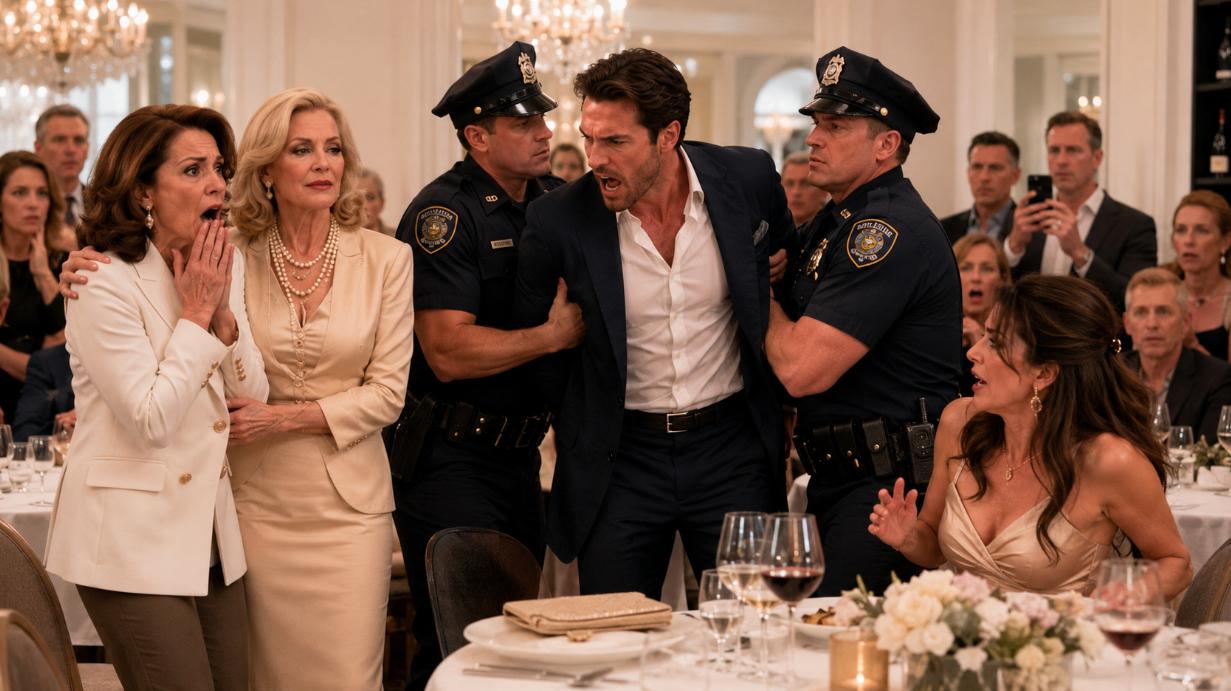
Outside, red and blue lights began to wash across the restaurant windows.
Grant turned toward the glass.
His mouth opened slightly.
And for the first time since I had met him, he looked afraid.
But what he did not know was that the police report would only be the beginning.
Because three days earlier, Claire had left a voicemail on my phone.
One I had not listened to until that morning.
And in that voicemail, she had said six words that changed everything:
“Mom, if something happens to me…”
The restaurant doors opened.
Two officers walked in.
Grant straightened his jacket as if dignity could still save him.
But my daughter had finally stopped apologizing.
And I had finally stopped staying quiet.
Part 2: The Voicemail Claire Was Afraid to Leave
The first officer who approached our table was a woman in her forties with tired eyes and a calm voice.
Her name tag read Officer Reyes.
She did not rush.
She did not dramatize.
She looked at Claire first.
“Ma’am, are you safe right now?”
Claire opened her mouth.
No sound came out.
Grant answered for her.
“She’s fine. This is a misunderstanding.”
Officer Reyes did not even look at him.
“Sir, I asked her.”
That single sentence shifted the room.
Claire blinked.
Her lips trembled.
Then she whispered, “No.”
Grant’s head snapped toward her.
“What?”
Officer Reyes stepped slightly between them.
“No, you’re not safe? Or no, this wasn’t a misunderstanding?”
Claire looked down at her lap.
“Both.”
Patricia made a sharp sound.
“Claire, don’t be foolish.”
The second officer, a younger man with a square jaw, turned to Patricia.
“Ma’am, please remain seated.”
Patricia’s face tightened as if no one had ever spoken to her that way.
Grant spread his hands.
“My wife is upset. Her mother has always interfered. They both enjoy making me the villain.”
Claire flinched at the word wife.
I saw it.
So did Officer Reyes.
She crouched slightly beside Claire’s chair, bringing her voice lower.
“Would you like to step outside with me?”
Claire looked at me.
A question.
A plea.
A child again and not a child at all.
I nodded.
“I’ll be right behind you.”
Grant moved to stand.
The younger officer blocked him.
“Sir, you need to stay here.”
“I’m her husband.”
“Then you can cooperate from that chair.”
The whole restaurant watched as Claire stood.
Her knees nearly buckled.
I reached for her elbow, but she shook her head.
Not because she did not want me.
Because she wanted to prove she could stand.
That nearly broke me.
Officer Reyes led her toward the lobby.
I followed.
Behind us, Grant’s voice rose.
“This is insane. Mom, call Daniel.”
Daniel Holloway was Grant’s older brother, a local attorney who had made a career out of cleaning up family messes before they reached daylight.
Patricia fumbled in her purse.
I turned.
“Call anyone you want,” I said. “The cameras are already running.”
Patricia’s eyes met mine.
For a moment, I saw hatred.
Then fear.
In the lobby, away from the dining room, Claire sat on a leather bench beneath a framed photograph of downtown Columbus at night.
The restaurant’s warmth did not reach that corner.
She was shaking.
Officer Reyes knelt in front of her.
“Claire, I need to ask you a few questions. You can take your time.”
Claire stared at the floor.
“He didn’t mean to do it here.”
The sentence slipped out automatically.
My heart sank.
Not because I believed it.
Because I had heard women say versions of that sentence my entire nursing career.
He was tired.
He was stressed.
He didn’t mean it.
He’s not usually like that.
Officer Reyes’s voice remained gentle.
“Has he put his hands on you before?”
Claire closed her eyes.
I stopped breathing.
Her answer was barely audible.
“Yes.”
The lobby blurred around me.
I gripped the back of a chair.
“How many times?” Officer Reyes asked.
Claire shook her head.
“I don’t know.”
That was the answer of someone who had stopped counting because counting made it real.
Officer Reyes looked at me.
“Ma’am, are you her mother?”
“Yes.”
“Did you witness what happened tonight?”
“Yes.”
“Did anyone record it?”
“A woman in the dining room said she did. The manager was asked to preserve security footage.”
Officer Reyes nodded.
Claire looked up sharply.
“You asked for footage?”
I knelt beside her.
“Yes.”
Her eyes filled with fresh tears.
“He’ll be so angry.”
“Claire,” I said softly, “he already was.”
She covered her mouth.
A sound came from her that I had no name for.
Not crying.
Not exactly.
More like a locked door opening after years of pressure.
“I didn’t know how to leave,” she whispered.
I reached for her hand.
This time, she let me take it.
“I know.”
“No, Mom.” Her grip tightened. “I really didn’t. He checks the accounts. He knows where I am. He tells me I’m unstable when I disagree. He said if I left, he’d make sure everyone knew I was unfit to teach.”
Officer Reyes’s expression did not change, but I saw her jaw tighten.
Claire wiped her cheek.
“And Patricia helps him.”
I looked toward the dining room.
Patricia sat upright at the table, phone pressed to her ear, pearls glowing under the chandelier.
“She always says I provoke him,” Claire continued. “That I embarrass him. That a good wife knows when to stop talking.”
I thought of all the times Claire had gone quiet mid-sentence.
All the times she changed the subject when I asked about bruises in her voice.
All the times I mistook survival for distance.
“I should have pushed harder,” I said.
Claire shook her head.
“You tried. I lied.”
The honesty hit both of us.
Officer Reyes gave us a moment.
Then she asked, “Claire, do you have somewhere safe to stay tonight?”
Claire looked at me.
“With me,” I said immediately.
Grant’s voice cut across the lobby.
“She is not going anywhere with her mother.”
He had gotten past the younger officer somehow, Patricia right behind him.
Officer Reyes stood.
“Sir, return to the dining room.”
Grant pointed at Claire.
“She needs to stop this before it ruins our life.”
Our life.
Even then.
Even there.
He made her pain a shared inconvenience.
Claire stood slowly.
Her face was wet.
Her hands shook.
But when she spoke, the whole lobby heard her.
“No, Grant.”
He stared at her.
“What did you say?”
She swallowed.
“I’m not going home with you.”
Patricia stepped forward.
“Claire, don’t be dramatic. Couples fight.”
I turned on her.
“Couples fight over bills. Over dishes. Over in-laws. They do not humiliate and control each other in public while their mothers applaud.”
Patricia’s lips parted.
No answer came.
Officer Reyes addressed Grant.
“Sir, you are being detained while we investigate tonight’s incident.”
Grant’s face hardened.
“You’re making a mistake.”
The younger officer appeared behind him.
“Hands where I can see them.”
The dining room had gone completely silent again.
Grant looked around.
At the waiters.
At the diners.
At the woman near the window still holding her phone.
At the manager standing beside the host stand, pale and rigid.
His life, the one he had curated so carefully, was staring back at him without admiration.
He did not look at Claire.
Not once.
That told me everything.
As the officers led him toward the entrance, Patricia followed, hissing into her phone.
“This is a family emergency. Daniel, get here now.”
Claire sagged against me.
“I’m scared.”
“I know.”
“What if he comes after me?”
I looked at Officer Reyes.
The officer’s voice was steady.
“We’ll talk through options. Emergency protection order. Safe housing if needed. Documentation. But tonight, you won’t leave with him.”
Claire pressed both hands over her face.
For the first time that evening, she cried like someone who knew she might live.
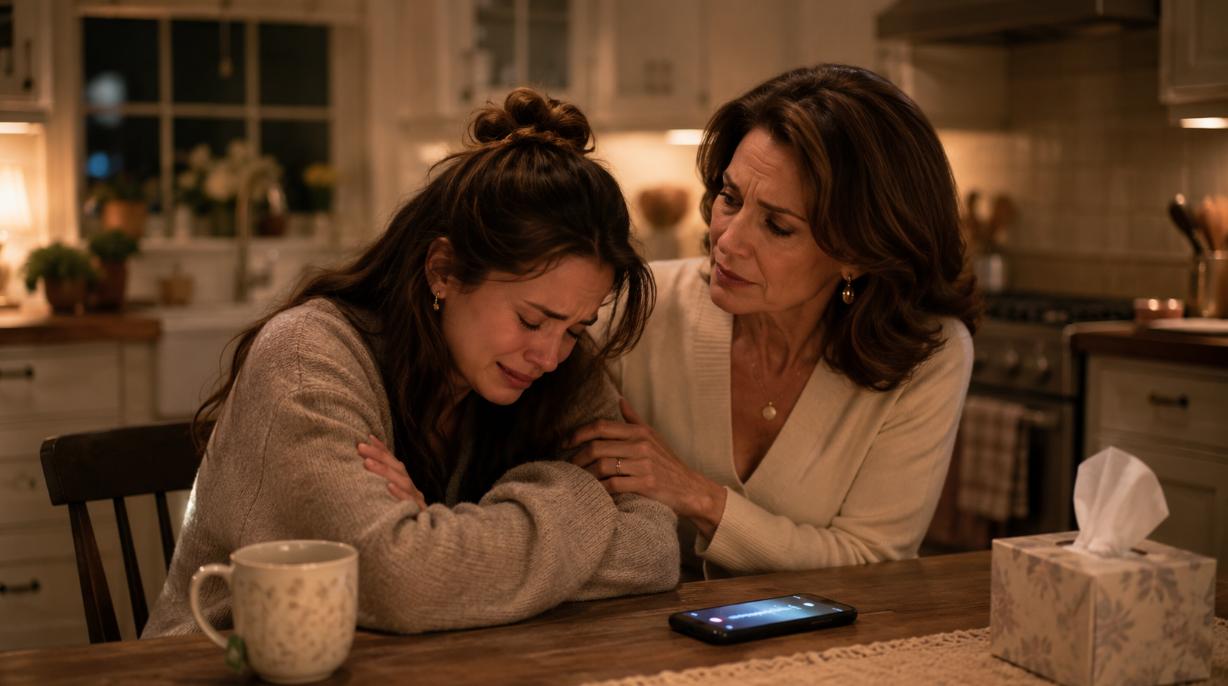
At my house, Claire slept in my guest room with the lamp on.
She was thirty-two years old, but I stood in the hallway for almost an hour listening for movement, the way I had when she was a baby and feverish.
At 2:13 a.m., I finally went downstairs.
The house was dark except for the kitchen light above the stove.
I sat at the table with my phone in front of me.
The voicemail waited.
Three days old.
I had missed it because I had been at a dental appointment, then grocery shopping, then convincing myself Claire would call again if it was important.
My thumb hovered over the screen.
Then I pressed play.
Static.
A breath.
Then Claire’s voice.
“Mom…”
I closed my eyes.
She sounded small.
Not sleepy.
Terrified.
“If something happens to me, I need you to know I tried to leave.”
My hand flew to my mouth.
The voicemail continued.
“I put copies of everything in the blue folder in my classroom cabinet. The one labeled Winter Reading. Bank statements. Photos. Screenshots. The insurance policy Grant took out on me. The emails from Patricia.”
My skin went cold.
“I know this sounds crazy. Maybe I am crazy. He keeps saying I am. But if I disappear, or if there’s an accident, please don’t let them say I was unstable.”
A chair scraped above me.
Claire was awake.
The voicemail kept playing.
“I’m sorry I lied to you. I was embarrassed. I thought if I loved him better, he’d become the man he was when we met.”
A sob broke through the recording.
Then she whispered:
“I don’t think that man was real.”
The voicemail ended.
I sat frozen in my kitchen, the phone still glowing in my hand.
Behind me, Claire said, “You heard it.”
I turned.
She stood at the bottom of the stairs in one of my old sweatshirts, her hair loose, face pale.
I wanted to run to her.
Instead, I stayed seated.
Because she looked like a woman who needed the room to choose her next step.
“When did you leave that message?” I asked.
“Wednesday.”
“Why didn’t you tell me after?”
She wrapped her arms around herself.
“Because the next morning he brought me coffee and cried. He said he was scared of losing me. He said he’d change. And Patricia called and said I was destroying him.”
I said nothing.
Claire looked at the floor.
“So I deleted the folder from my mind and went to dinner.”
“The folder is still at school?”
She nodded.
“In my classroom.”
“What’s in it, Claire?”
Her eyes met mine.
“Enough.”
That one word changed the air.
At 6:30 that morning, I drove her to Meadowbrook Elementary.
The school was quiet, the parking lot half-empty, the sunrise pale behind the flagpole.
Claire had taught there for nine years. Her classroom smelled like crayons, dry-erase markers, and the peppermint tea she kept in a thermos. Paper snowflakes hung from the ceiling though it was only November because, as she said, children deserved beauty early.
She unlocked the cabinet behind her desk.
Her hands trembled so badly the keys jingled.
Behind a stack of phonics workbooks was a blue folder.
Winter Reading.
She pulled it out.
It was thick.
Too thick.
Inside were printed emails from Patricia.
Text messages from Grant.
Photos of holes punched in walls.
Bank transfers from Claire’s account to Grant’s business.
A copy of a life insurance policy naming Grant as beneficiary.
And a handwritten note from Patricia on cream stationery.
Claire,
A wife who threatens divorce should not be surprised when her husband protects his future.
I read the sentence three times.
Each time, it became worse.
Claire whispered, “She gave me that after I told her I wanted to separate.”
I looked at my daughter.
Not broken.
Not weak.
A woman who had built a record while pretending to survive quietly.
“You knew,” I said.
She nodded.
“I was scared. But I wasn’t stupid.”
Before I could answer, someone knocked on the classroom door.
We both froze.
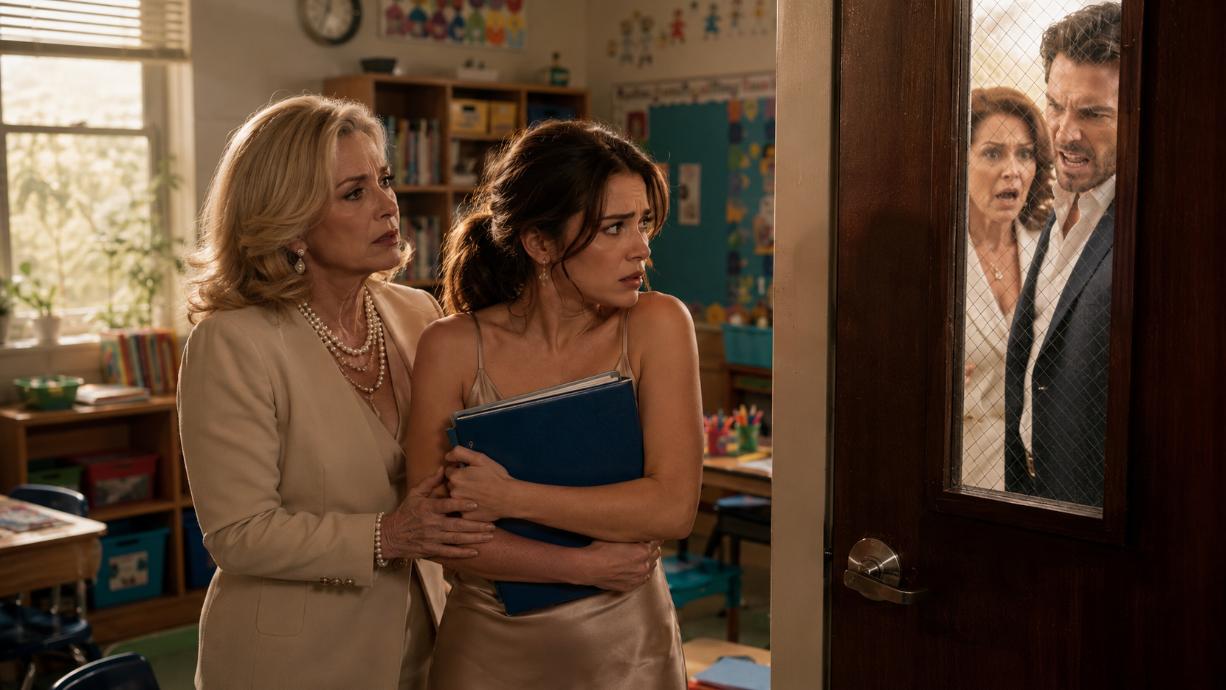
Through the narrow window, Patricia Holloway looked in.
Pearls.
Red lipstick.
Perfect hair.
And behind her stood Grant’s brother, Daniel.
Patricia smiled.
Not warmly.
Not kindly.
Like a woman who had come to collect something she still believed belonged to her.
Claire clutched the blue folder to her chest.
Daniel tried the door handle.
Locked.
Patricia leaned close to the glass and spoke clearly enough for us to hear.
“Claire, open the door. We need to talk before this gets worse.”
My daughter looked at me.
For the first time in years, she did not ask what she should do.
She reached into her pocket.
Took out her phone.
And dialed 911 herself.