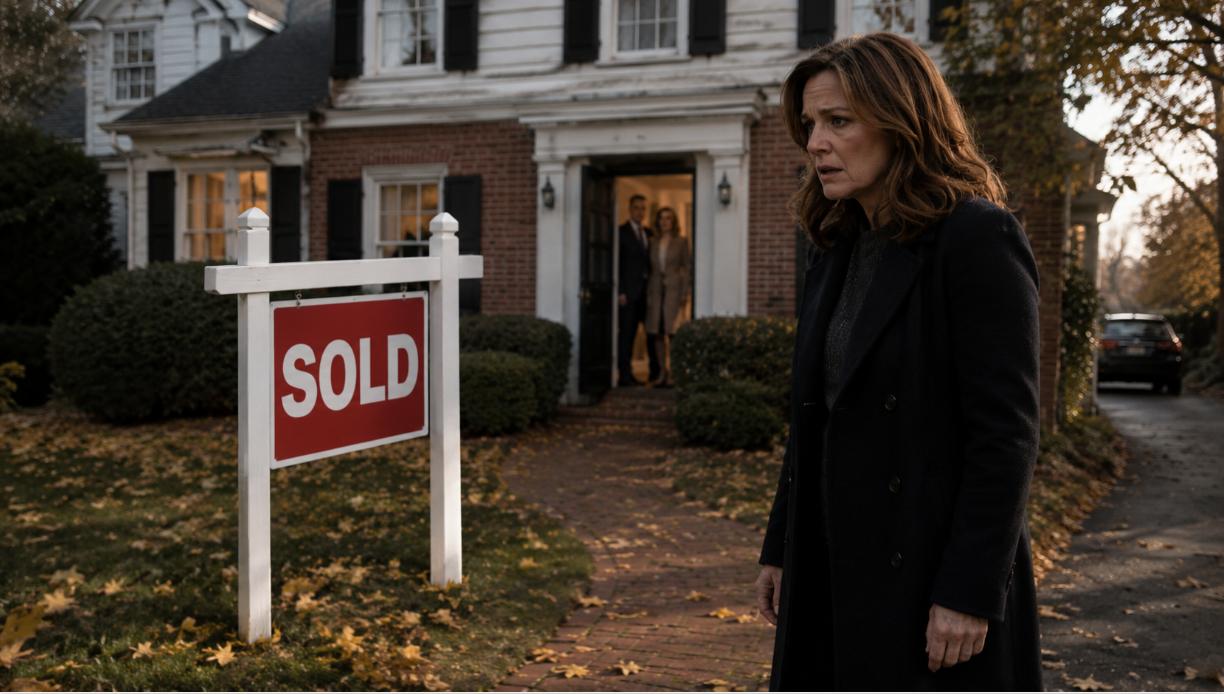
The “SOLD” sign was already hammered into the lawn when I pulled into my mother’s driveway.
Not leaning.
Not waiting.
Hammered.
The red letters swung in the late October wind, bright as a slap against the pale grass. A few yellow maple leaves skated across the front walk, scraping over the brick steps my father had laid by hand thirty-seven years ago.
For a moment, I sat with both hands on the steering wheel and stared at the sign as if it might apologize.
Inside my purse, my phone buzzed again.
The hospital.
I answered without looking away from the house.
“Ms. Reeves?” the nurse said. “Your mother is asking for you.”
My throat closed.
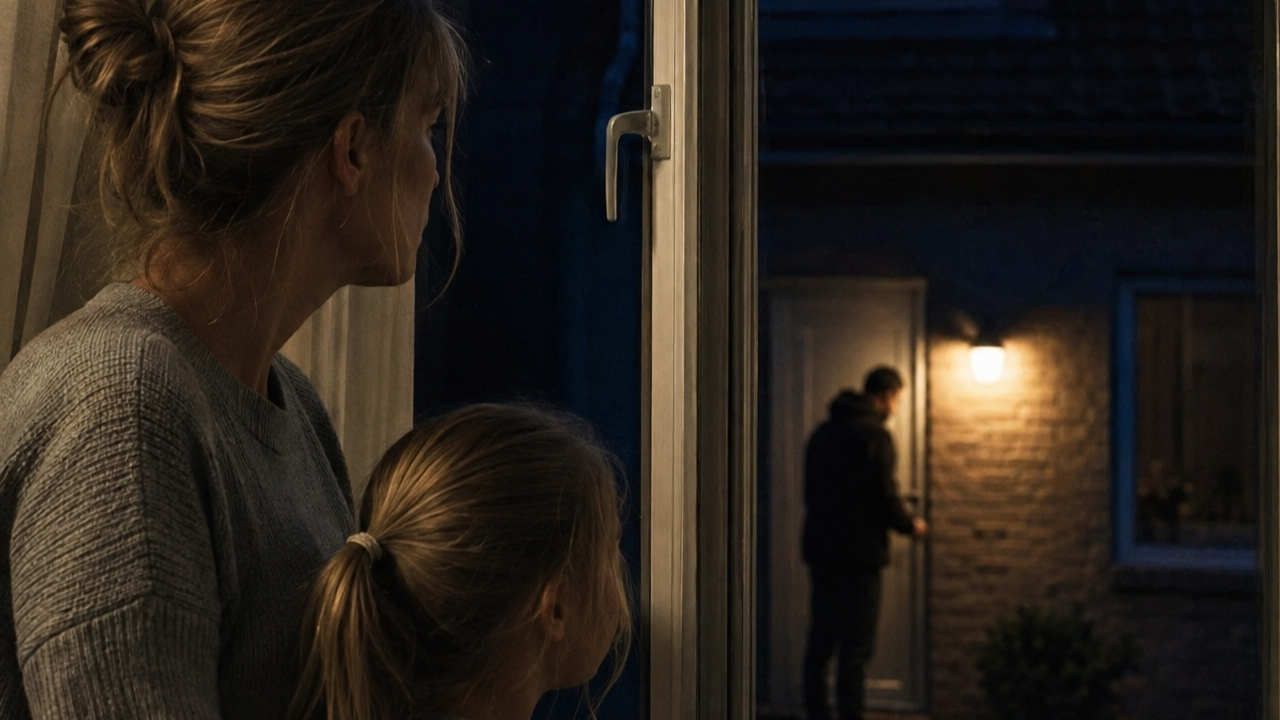
Across the street, Mrs. Calloway stood behind her lace curtains. She had been watching our family since the Carter administration and never once pretended not to.
The upstairs bedroom curtain shifted.
Someone was inside.
My mother’s bedroom.
My hand went cold around the phone.
“I’m on my way,” I told the nurse.
But I didn’t drive away.
I got out.
The air smelled like damp leaves, chimney smoke, and the faint sweetness of cut grass. The kind of suburban autumn smell my mother used to call “God’s way of making goodbye look pretty.”
I walked past the SOLD sign and up the front steps.
The brass door knocker was gone.
So was the wreath.
The key my mother kept under the loose porch brick still fit.
That should have comforted me.
Instead, it frightened me.
The foyer opened into silence.
Not the peaceful silence of an empty house.
The stripped silence of a house that had been searched.
The runner rug was rolled against the wall. The family photos that once climbed the staircase were stacked face-down in a cardboard box. My father’s Navy portrait leaned against a trash bag.
A laugh came from the kitchen.
My brother Calvin’s laugh.
Low. Dry. Certain.
Then my sister Marlene spoke.
“Diana always makes everything dramatic. She’ll cry, accuse us, act like she’s the only one who cares.”
My fingers tightened around the doorframe.
Calvin said, “Let her. Papers are signed.”
A third voice answered.
A man’s voice I didn’t know.
“Possession transfers Friday. As long as the seller’s authority holds, there’s nothing she can do.”
Seller’s authority.
My mother lay in a hospital bed eight miles away, her silver hair spread over a pillow, her left hand still curled from the stroke.
And my siblings had sold her house.
While she was still alive.
I stepped into the kitchen.
Three faces turned.
Calvin stood by the sink in his charcoal suit, polished shoes planted apart as if he owned the floor. At fifty-five, he still carried himself like the oldest son in every room, even rooms where nobody had crowned him. His hair had gone iron gray at the temples, and he wore his success like armor—expensive, tight, and always on display.
Marlene sat at the breakfast table with a paper coffee cup and a folder in front of her. She was fifty-two, a realtor with perfect nails, frosted hair, and a smile she could turn on faster than a porch light. Her eyes, though, always gave her away. They darted first to what could be lost.
The stranger wore a navy blazer and a buyer’s-agent smile. He closed his leather portfolio slowly.
Marlene recovered first.
“Diana,” she said. “You scared us.”
I looked at the folder.
Then at the empty wall where Mom’s ceramic rooster clock used to hang.
“Funny,” I said. “I was about to say the same thing.”
Calvin exhaled through his nose.
“Not now.”
“Not now?” I stepped farther in. “When exactly is the right time to ask why there’s a SOLD sign in Mom’s yard while she’s in cardiac rehab?”
Marlene pressed her palms flat on the table.
“It’s not cardiac rehab. It’s post-stroke care. And don’t make this ugly in front of Mr. Pritchard.”
Mr. Pritchard lifted both hands. “I can step outside.”
“No,” I said. “Stay. I’d love a witness.”
Calvin’s jaw moved once.
There it was—the old warning. The same look he used when we were kids and he wanted me to remember he was bigger, louder, and closer to Dad’s temper.
But Dad had been gone nine years.
And Mom had been fighting to speak for three weeks.
I was no longer twelve.
I reached for the folder.
Marlene slapped her hand over it.
The sound cracked through the kitchen.
A glass trembled in the drying rack.
For one second, none of us moved.
Then Calvin said quietly, “You don’t have the authority to touch that.”
I looked at him.
“Neither do you.”
His mouth thinned.
“That’s where you’re wrong.”
He slid a document from the folder and laid it on the table with two fingers.
Durable Power of Attorney.
My mother’s name at the top.
Calvin’s name below.
And at the bottom, a signature that looked almost like hers.
Almost.
But my mother had never made the loop in her M that way.
Not once in seventy-eight years.
I felt something sharp and clean move through me.
Not grief.
Not yet.
Recognition.
“You forged this.”
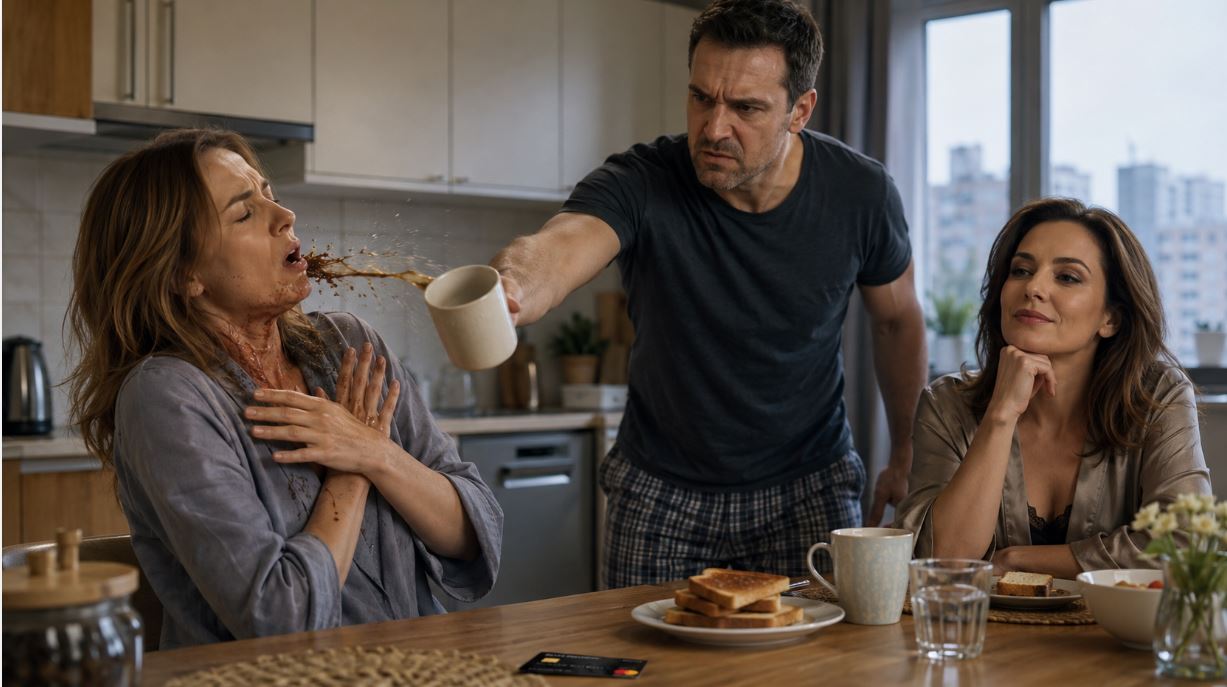
Marlene stood so fast her coffee tipped over. Brown liquid spread across the table, swallowing the corner of another document.
“Watch your mouth.”
Calvin didn’t raise his voice. That was always his trick. He made calm sound like a verdict.
“Mom signed it last year.”
“No, she didn’t.”
“You wouldn’t know. You were too busy playing martyr.”
The word landed exactly where he aimed it.
For six years, I had taken Mom to her appointments, filled her pill case every Sunday, argued with insurance, trimmed her roses, sat through cataract surgery, slept on her couch when her blood pressure spiked. Calvin visited on holidays. Marlene came when she needed listings in Mom’s neighborhood.
But somehow, caregiving always looked like martyrdom to the people who refused to do it.
I picked up the paper.
Marlene’s hand twitched, but she didn’t stop me.
The signature at the bottom shimmered in the fluorescent kitchen light.
I could hear Mom’s voice in my head.
Never sign anything when someone is rushing you, Di. A rushed pen is a thief’s best friend.
“Where is the notary?” I asked.
Calvin blinked.
“What?”
“The notary. If Mom signed this, where is the notary?”
Mr. Pritchard cleared his throat and took one step back.
Marlene looked at Calvin.
Just once.
Barely a glance.
But enough.
Calvin took the document from my hand.
“You need to leave.”
I laughed then.
It came out small and strange.
“This is Mom’s house.”
“It was,” he said.
Outside, a gust of wind pushed the SOLD sign hard enough to make it squeal on its metal frame.
I looked from my brother to my sister.
For the first time in my life, they looked less like family and more like people standing over something they had killed, waiting for it to stop moving.
My phone buzzed again.
The hospital.
This time, I answered with trembling fingers.
“Ms. Reeves?” the nurse said. “Your mother is upset. She keeps trying to say something.”
“What?”
There was a pause.
“She keeps saying… blue book.”
Marlene’s face drained of color.
Calvin went still.
And that was when I knew.
Mom had hidden something.
And they knew exactly what it was.
By the time I reached the hospital, rain had begun to fall in thin silver threads.
St. Agnes Medical Center sat on the edge of town, all glass, brick, and tired fluorescent light. The lobby smelled of disinfectant, burnt coffee, and lilies from the gift shop. A television mounted near the ceiling played a weather report no one watched.
I found Mom in Room 417.
She looked smaller than the woman who had raised three children, buried one husband, refinished two dressers, and once chased a raccoon off the back porch with a broom and church shoes.
Her left cheek sagged slightly. Her hair, usually pinned into a soft roll, lay loose against the pillow. But her eyes were awake.
Sharp.
Waiting.
“Mom,” I whispered.
Her right hand lifted an inch.
I took it.
Her fingers squeezed mine with surprising force.
The nurse, a broad-shouldered woman named Keisha, adjusted the IV line. “She’s been trying to talk since four. Gets frustrated when we can’t understand.”
Mom made a sound.
Not quite a word.
Her eyes flicked toward the bedside table.
A yellow legal pad sat there. Beside it, a thick black marker.
Keisha handed it to me. “She can write a little with her right hand.”
I placed the pad on Mom’s lap.
Her hand shook as she gripped the marker. Each letter came slowly, scraped onto the page like it cost her blood.
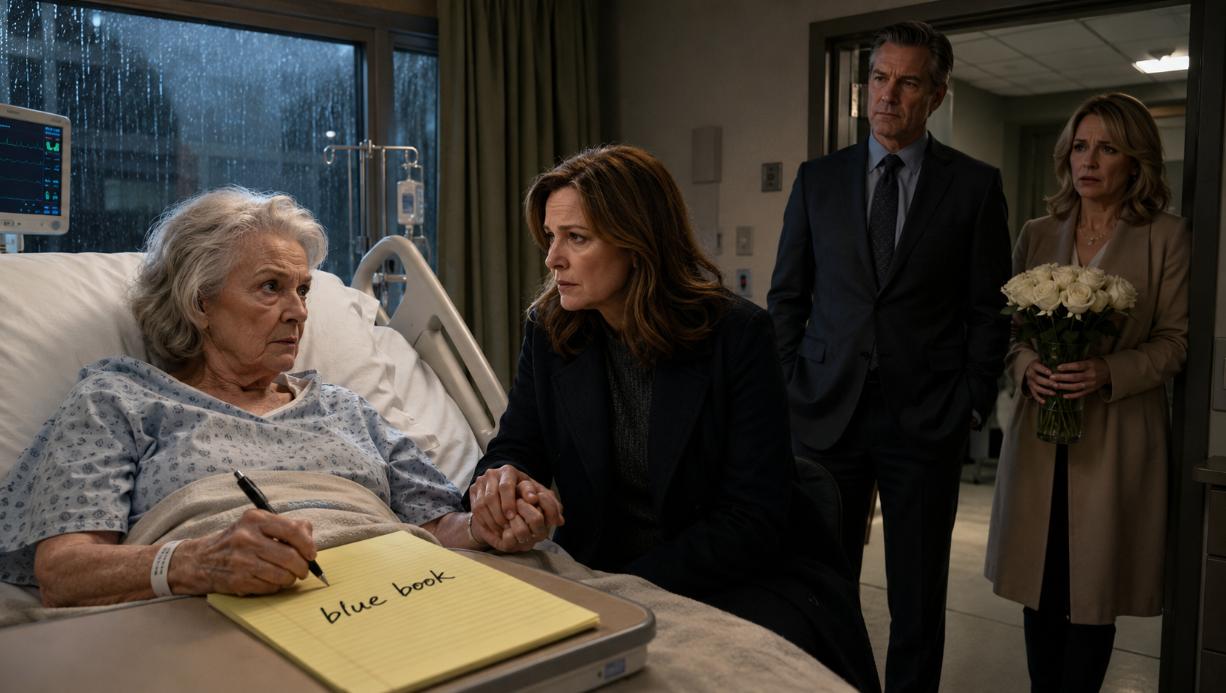
B L U E
She stopped, breathing hard.
“I know,” I said. “Blue book.”
Her eyes filled.
Not with fear.
With anger.
She tapped the pad.
Again.
I waited.
B A S E M E N T
Then another word.
F R E E Z E R
My stomach tightened.
“The blue book is in the basement freezer?”
Mom closed her eyes once.
Yes.
I leaned closer.
“Calvin and Marlene know about it?”
Her face changed.
A shadow moved across it.
Not surprise.
Pain.
She wrote again.
T H E Y L O O K E D
The room seemed to shrink.
I could hear the rain ticking against the window. A monitor beeped softly beside the bed. Down the hall, someone laughed too loudly, then stopped.
Mom tugged my hand.
She wanted me closer.
Her mouth worked.
“D… Di…”
“I’m here.”
“Don’t…”
Her lips trembled.
“Trust…”
The word faded.
I thought she meant Calvin.
Or Marlene.
But then her eyes shifted to the doorway.
I turned.
My brother stood there, rain on the shoulders of his suit.
Marlene was behind him.
She carried flowers.
White roses in a glass vase.
The kind you bring when you want the nurses to think you’re decent.
Calvin’s eyes moved from Mom’s face to the legal pad.
Then to me.
“You shouldn’t upset her,” he said.
Mom’s hand tightened around mine.
I stood slowly.
“She was upset before I got here.”
Marlene stepped in with her realtor smile turned soft around the edges.
“Mama, look what we brought.”
Mom stared at the flowers as if they were insects.
Marlene set them on the windowsill.
Her perfume filled the room—vanilla, powder, and something expensive trying to cover fear.
“Diana,” she said, “can we talk outside?”
“No.”
Calvin’s gaze sharpened.
“This is not the place.”
“You sold her house.”
Marlene flinched.
Keisha looked up from the IV pole.
Calvin’s voice dropped. “Lower your voice.”
“Why? Afraid she’ll hear? Or afraid the nurses will?”
A red flush crept up Marlene’s neck.
“We did what had to be done,” she snapped. “That house is too much for her. The taxes, the stairs, the repairs—you think love pays for a roof?”
Mom made a sound in the bed.
A broken, furious sound.
Marlene’s face twisted.
“Mama, don’t look at me like that. We were protecting you.”
Mom reached for the marker.
Calvin stepped forward.
“Let her rest.”
Keisha moved between him and the bed without drama. She didn’t raise her voice. She didn’t need to.
“Family can visit,” she said, “but patients decide when they’re done.”
Calvin stared at her.
Keisha stared back.
He lost.
Mom wrote one word.
L I A R
Marlene’s eyes shone.
For one second, she looked like a child who had been slapped.
Then the child vanished.
“You always take her side,” she said to me.
I looked at my sister—the woman who used to crawl into my bed during thunderstorms, who once cried for three days after our father forgot her school play, who spent her adult life staging homes because she had never felt safe in one.
“Marlene,” I said quietly, “there are no sides when someone steals from a sick woman.”
Her mouth opened.
Nothing came out.
Calvin took her elbow.
“We’re leaving.”
At the doorway, he turned.
“You go digging in places you don’t understand, Diana, you’re going to find out Mom had secrets too.”
Mom’s eyes closed.
A tear slid into her hair.
Calvin smiled without warmth.
“Ask her about the second mortgage.”
Then he left.
I drove back to the house in a rainstorm so hard the road disappeared in front of me.
Calvin’s last words rode beside me.
Second mortgage.
I told myself he was lying.
But lies usually ran fast.
That one sat down and made itself comfortable.
The house was dark when I arrived. The SOLD sign still leaned in the yard, slick with rain. I parked around back, under the old maple tree, and used the kitchen door.
The smell hit me first.
Cardboard.
Dust.
Lemon cleaner.
And underneath, the faint mineral cold of the basement rising through the floorboards.
I turned on the kitchen light.
The room looked worse than before.
Cabinet doors hung open. Drawers had been pulled out and shoved back crooked. The ceramic rooster clock was gone. So were Mom’s recipe tins.
Not packed.
Taken.
I found the basement door half-open.
The stairs groaned under my shoes.
Downstairs, the air was cooler and smelled of concrete, laundry soap, and old Christmas decorations. A single bulb swung from a chain, casting the room into moving pieces.
The freezer stood against the far wall.
White. Humming. Dented near the bottom from the year Dad tried to move it by himself.
I opened it.
Cold vapor rolled out.
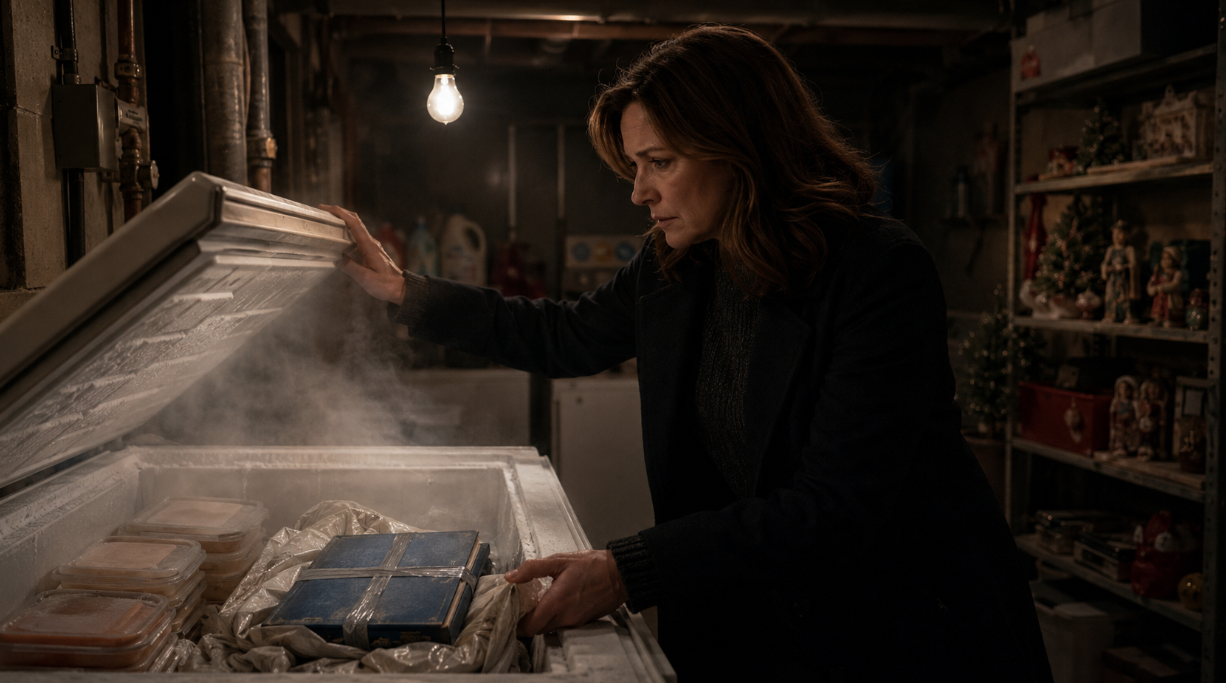
Inside were neat stacks of frozen soup, labeled in Mom’s handwriting.
TURKEY BARLEY.
HAM BONE.
CHICKEN AND RICE FOR DI.
Behind the soup, wrapped in two grocery bags and sealed with duct tape, was a blue ledger book.
My hands were shaking before I touched it.
I carried it upstairs and sat at the kitchen table.
For a while, I just looked at it.
The cover was cloth, faded navy, the corners soft from use. On the first page, Mom had written:
For Diana, when the house starts talking.
I pressed my fingers over the words.
Then I turned the page.
It was not a diary.
It was a map.
Dates. Payments. Names. Copies of checks taped to pages. Notes in Mom’s small, upright handwriting.
The second mortgage was real.
But not for Mom.
Twenty-two years earlier, Calvin’s construction business had nearly collapsed after a lawsuit. Mom and Dad had taken out a second mortgage to save him from bankruptcy.
He had promised to pay it back.
He paid six months.
Then stopped.
Marlene had borrowed against Mom’s line of credit twice—once after her divorce, once to “bridge a commission gap.” She had promised repayment after closing two big listings.
She never repaid either.
Page after page, Mom had documented it all.
Not with bitterness.
With precision.
And then, near the back, I found a sealed envelope taped to the inside cover.
My name was on it.
Diana Rose Reeves.
Not Di.
Not honey.
Her serious handwriting.
Inside was a letter.
My darling girl,
If you are reading this, then your brother and sister have done what I feared they would do.
I have loved all three of you in different ways because you needed different things. Calvin needed someone to believe he could stand. Marlene needed someone to notice when she was falling. You needed someone to tell you that being dependable was not the same as being disposable.
I failed you there.
I let you carry too much because you carried it quietly.
The house is not just a house. It is the last honest thing your father and I built together. I changed my will three years ago. The house goes to you, not because you loved me more, but because you did not love me for what could be taken from me.
If Calvin or Marlene try to sell it, call Samuel Harris. Do not argue. Do not beg. Do not explain morality to people who already spent it.
There is a copy of the deed in the blue book.
There is also a recording.
Forgive me for waiting so long to become brave.
Love,
Mom
The room blurred.
I covered my mouth with the letter and made no sound.
Outside, rain beat against the windows.
The house creaked around me, old wood shifting in old joints.
Then something thudded upstairs.
I froze.
Another sound.
A footstep.
Not from the basement.
Above me.
In Mom’s bedroom.
I closed the ledger.
The kitchen light flickered once.
A voice called softly from the hallway.
“Diana?”
Marlene.
She stood at the bottom of the stairs holding Mom’s jewelry box.
The sight of it broke something open in me.
It was cherrywood with a tiny brass latch, worn smooth where Mom’s thumb had touched it for decades. Dad had given it to her on their twenty-fifth anniversary. Inside were not diamonds or pearls, but things only a family could price incorrectly: a lock of baby hair, Dad’s tie clip, a silver thimble, three tiny hospital bracelets.
Marlene held it against her chest like a child caught with stolen candy.
Behind her, Calvin came down the stairs carrying a banker’s box.
He stopped when he saw the blue book on the table.
The air changed.
Marlene whispered, “You found it.”
I stood between them and the ledger.
“You searched the freezer.”
Calvin set the box down carefully.
“Mom has dementia.”
“No, she had a stroke.”
“She’s confused.”
“She called you a liar in perfect handwriting.”
Marlene’s face crumpled for half a second.
Calvin’s didn’t.
He looked at the envelope beside the book. “What did she tell you?”
“The truth.”
A muscle jumped in his cheek.
“The truth is that house was drowning her. The truth is I have creditors. Marlene’s one bad month away from losing her license. You think keeping that house helps anyone?”
“There it is,” I said.
“What?”
“The real reason.”
He leaned forward, palms on the table.
“You always do this. You make yourself the saint and the rest of us the villains.”
“No. You did that when you sold a house you didn’t own.”
Marlene stepped between us.
Her mascara had started to run.
“Diana, please. The buyer already put money down. If this falls apart, Calvin could be sued. I could be sued. I handled the listing.”
“You handled the listing?”
She looked away.
My laugh came out like a cough.
“You listed Mom’s house?”
“I had to keep it quiet. If people knew she was sick, they’d lowball.”
The logic was so clean in her mouth it almost sounded sane.
Almost.
I looked at Calvin.
“And the power of attorney?”
He said nothing.
Marlene’s eyes flashed toward him.
There it was again.
The tiny crack.
“You told me she signed it,” she said.
Calvin didn’t look at her.
“Marlene,” I said, “where was it notarized?”
She swallowed.
“Calvin said his attorney—”
“Where?”
Her lower lip trembled.
Calvin slammed his hand on the table.
“Enough.”
The old sound.
The old command.
For a moment, I was nine again, standing in the hallway while Dad shouted at bills and Mom stared into a sink full of dishes. Calvin had learned early that volume could rearrange a room.
But age had done something strange to us.
His anger no longer made him bigger.
It made him visible.
“You forged it,” Marlene whispered.
Calvin turned on her.
“You wanted the commission.”
She recoiled as if he had shoved her.
“You said Mom agreed.”
“I said Mom would agree if she were thinking clearly.”
“That is not the same thing.”
“It is when nobody else has the guts to make decisions.”
I reached into my purse and took out my phone.
Calvin saw.
His eyes narrowed.
“Who are you calling?”
“The lawyer.”
He moved faster than I expected.
His hand shot across the table and knocked the phone from mine. It skidded across the floor and hit the cabinet.
Marlene gasped.
The kitchen went silent except for the freezer humming below.
I looked at my brother.
He looked at his hand.
For the first time that night, fear crossed his face.
Not fear of me.
Fear of himself.
I bent slowly, picked up the phone, and checked the screen.
Cracked.
Still working.
I dialed Samuel Harris.
Calvin did not stop me.
An older man answered on the third ring, his voice dry and alert.
“Harris.”
“My name is Diana Reeves. My mother is Evelyn Reeves.”
There was a pause.
Then the sound of a chair moving.
“I wondered when you’d call.”
Across the table, Calvin closed his eyes.
Samuel Harris said, “Do you have the blue book?”
“Yes.”
“Good. Don’t let anyone leave with it.”
Marlene started crying quietly.
Mr. Harris continued, “And Diana?”
“Yes?”
“Is your brother there?”
I looked at Calvin.
He looked like a man standing on ice, listening for the crack.
“Yes.”
“Tell him the recording your mother made with me is time-stamped, witnessed, and already filed.”
Calvin opened his eyes.
Mr. Harris said, “Tell him I’m on my way.”
Samuel Harris arrived in a black sedan just after midnight.
He was seventy-two, tall and narrow, with silver hair combed back from a long forehead and a face that had spent forty years listening to people lie. He wore a camel overcoat darkened at the shoulders by rain and carried a leather folder that looked older than some attorneys.
Mrs. Calloway’s porch light clicked on across the street.
Of course it did.
Mr. Harris stepped into the kitchen, removed his wet gloves, and looked at each of us in turn.
Calvin tried first.
“Samuel, this is a family matter.”
Mr. Harris hung his coat over a chair.
“Fraud often is.”
Marlene made a small sound.
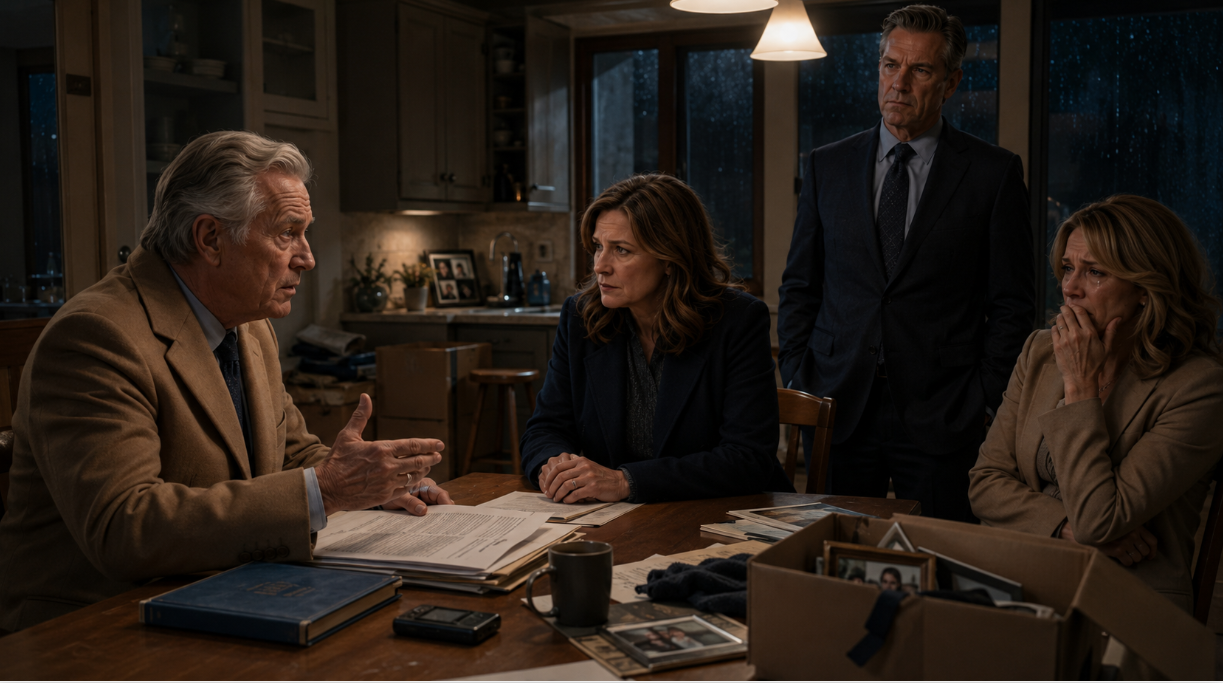
He sat at the table, opened his folder, and slid out three documents.
“Evelyn Reeves changed her estate plan three years ago. I drafted it. I witnessed her sign it. Her physician provided a competency letter. The house was placed in a transfer-on-death deed naming Diana Reeves as beneficiary.”
Calvin’s face hardened.
“Transfer-on-death means nothing while she’s alive.”
“Correct,” Mr. Harris said. “Which is why she still owns the house.”
“The power of attorney—”
“Was revoked.”
The words landed with a quiet finality.
Marlene lifted her head.
“What?”
Mr. Harris tapped the second document.
“Evelyn executed a limited power of attorney years ago for convenience after her knee surgery. She revoked it fifteen months later. Calvin was notified by certified mail.”
I looked at my brother.
He stared at the table.
Marlene whispered, “You knew?”
Calvin said nothing.
Mr. Harris opened the third document.
“This morning, the title company contacted my office because Evelyn’s signature on the sales authorization did not match their archived records. I was already reviewing the matter when Diana called.”
The rain slowed outside.
No one breathed.
Then Mr. Harris placed a small digital recorder in the center of the table.
“Marlene,” he said gently, “you should sit down.”
She sat.
Calvin remained standing.
Mr. Harris pressed play.
Mom’s voice filled the kitchen.
Weak but clear.
“If my children are hearing this, then I have waited too long to say what should have been said at my own table.”
Marlene covered her mouth.
Calvin looked toward the dark window.
Mom continued.
“Calvin, I loved you before you became so afraid of failing that you started calling other people’s sacrifices your rights.”
His face tightened.
“Marlene, I loved you before you believed being overlooked gave you permission to take what was not yours.”
My sister began to sob.
“And Diana…”
My knees softened.
I gripped the chair.
“You were the child who stayed. I let staying become your job. I am sorry. The house is yours when I’m gone. Until then, it is mine. No one is to sell it. No one is to empty it. No one is to turn my life into an early inheritance.”
The recorder clicked faintly.
Then Mom’s voice changed.
Softer.
“I know about the offer. I know about the pressure. I know Calvin said the market would drop and Marlene said I wouldn’t come home anyway.”
Marlene shook her head, crying harder.
“I know both of you are scared. Debt is a wolf at the door. Shame is worse. But fear does not make theft holy.”
Calvin flinched.
For once, it was not anger.
It was pain.
Mom’s voice filled the room one last time.
“If you sell my house while I am alive, you will not be saving me. You will be burying me early. And I am not dead yet.”
The recorder stopped.
The silence afterward was enormous.
Marlene folded over herself, shoulders shaking.
Calvin stood rigid, eyes wet but refusing to fall.
Mr. Harris closed the folder.
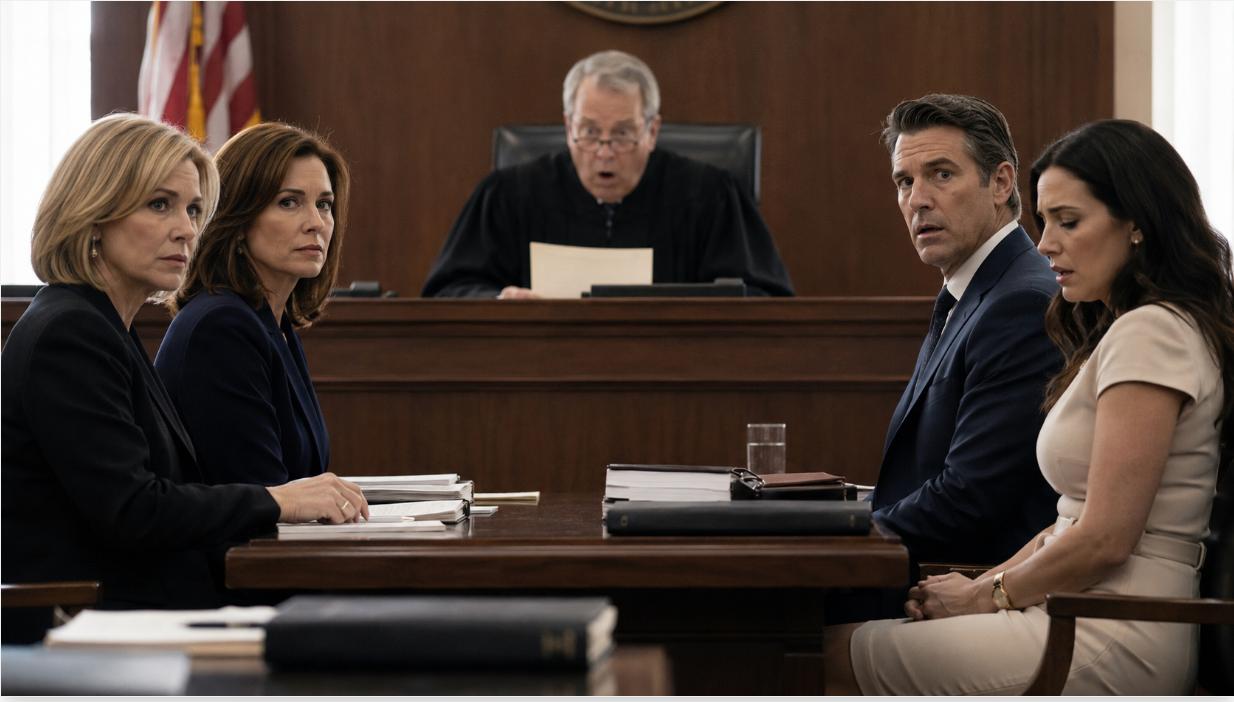
“The sale will be challenged and stopped. The title company has been notified. If the buyer pursues damages, that is a separate issue. If law enforcement becomes involved, that is another.”
Calvin laughed once.
Bitter. Hollow.
“So that’s it? Diana wins?”
I looked at him then.
Really looked.
At the expensive suit.
The gray skin.
The shaking hand he had hidden in his pocket.
“You think this is winning?”
His eyes met mine.
For a second, I saw the boy who had heard Dad call him useless after losing a Little League game. The boy who grew into a man terrified every room was still keeping score.
Then he disappeared.
“You always got her forgiveness,” he said.
“No,” I said. “I got her appointments.”
That shut him up.
Marlene lifted her face.
“What happens now?”
Mr. Harris answered.
“You return what you took. You cooperate with stopping the sale. You pray your mother is kinder than the law.”
Marlene looked at the jewelry box in her lap as if she had just realized what it was.
She placed it on the table and pushed it toward me.
“I didn’t take the bracelets,” she whispered. “I couldn’t.”
I opened the box.
Inside, the three tiny hospital bracelets lay curled like old paper rings.
Calvin’s.
Marlene’s.
Mine.
Mom had kept all of us.
Even after everything.
The sale collapsed by noon the next day.
By three, the buyer’s agent threatened legal action.
By five, Marlene’s broker called.
By six, Calvin’s wife left him a voicemail he played twice in his truck and never answered.
I know because he told me later.
Not that day.
That day, he disappeared.
Marlene stayed.
She spent the afternoon putting Mom’s things back where they belonged. Not perfectly. Not tenderly at first. But carefully.
The rooster clock returned to the kitchen wall.
Dad’s Navy portrait went back beside the stairs.
The recipe tins appeared one by one from the trunk of Marlene’s Lexus.
At sunset, the house glowed gold through the front windows.
For the first time since the stroke, it looked inhabited again.
I found Marlene in Mom’s bedroom, sitting on the edge of the bed with a framed photo in her hands.
It was the three of us in 1984.
Calvin with a missing tooth.
Marlene in pigtails.
Me holding Mom’s skirt.
“She never came to my eighth-grade play,” Marlene said.
I stood in the doorway.
Outside, wind dragged leaves along the gutter.
“She was in the ER with Grandma that night.”
“I know that now.”
Her thumb moved over the glass.
“I didn’t then.”
I came into the room and sat beside her.
The mattress dipped between us.
Marlene’s voice became small.
“I spent my whole life thinking Mom saw you as good and me as extra.”
“She saw you.”
“No.” She shook her head. “She watched me. That’s different.”
There was no easy answer.
The old house creaked around us. Pipes clicked in the walls. Somewhere downstairs, the refrigerator kicked on with a tired hum.
Marlene wiped her face with the heel of her hand.
“I wanted the commission. I wanted Calvin to stop saying I was one bad quarter from being broke. I wanted…” She laughed without humor. “I wanted to be the smart one for once.”
“And Mom?”
Her face collapsed.
“I told myself she wouldn’t know.”
There it was.
Not evil.
Worse.
Convenience.
I looked at the photograph.
“We all tell ourselves something before we do the thing we know is wrong.”
Marlene glanced at me.
“What did you tell yourself?”
“That if I stayed useful, no one would leave me.”
She stared.
Then she reached for my hand.
I almost pulled away.
Almost.
But her fingers closed around mine, cold and damp.
“I’m sorry,” she said.
The words were not polished.
Not theatrical.
They had no defense attached.
So I believed them.
Not enough to trust her.
Enough to let them exist.
Mom came home nine days later.
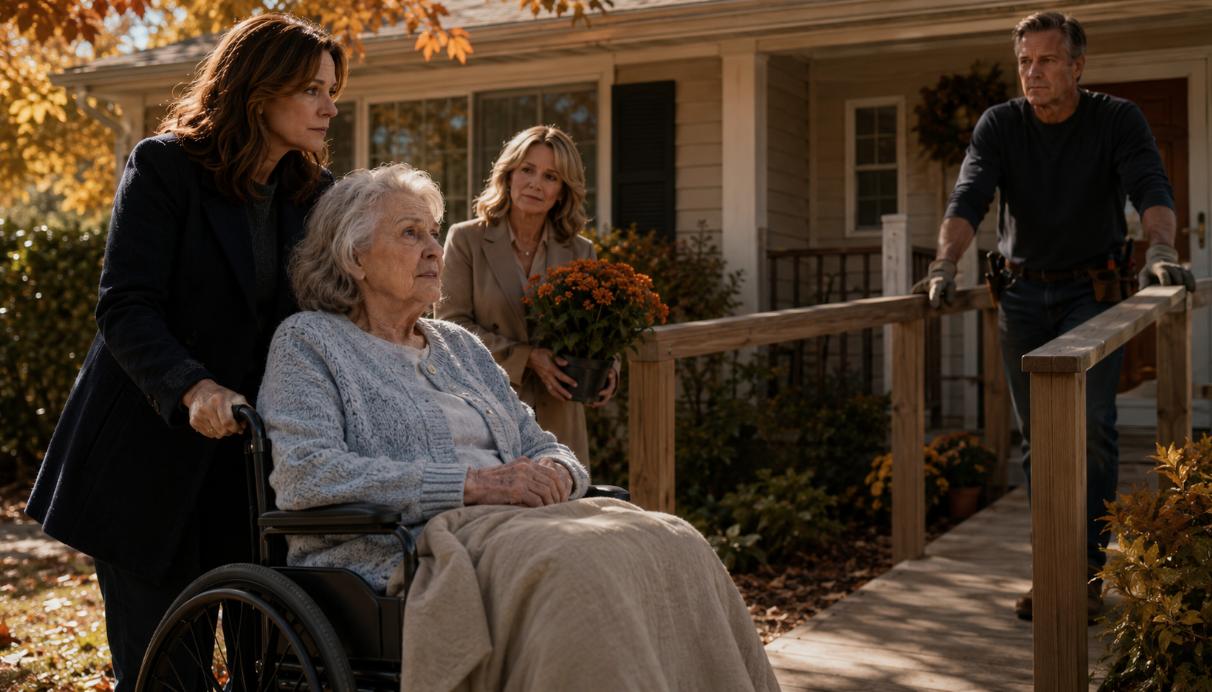
The ramp was temporary. The wheelchair was borrowed. The speech therapist said progress would be slow, which meant no one was allowed to call it impossible.
The morning she returned, the sky was a hard, clean blue. The maple tree in the front yard had dropped half its leaves overnight, leaving the lawn scattered with gold.
I had the porch swept.
Marlene had brought mums for the steps.
Calvin had not answered my calls.
Then, five minutes before the medical transport van arrived, his truck pulled up.
He got out wearing jeans and an old brown jacket instead of a suit. He looked ten years older.
In his hands was a toolbox.
Marlene stiffened beside me.
I stepped down from the porch.
“What are you doing here?”
Calvin looked past me at the front steps.
“Ramp railing’s loose.”
“You came to fix a railing?”
His mouth twitched.
“Don’t make it poetic.”
He walked past me, knelt by the ramp, and began tightening bolts.
The van arrived as he was working.
Mom watched him through the windshield.
Her face gave nothing away.
When the attendants lowered her onto the driveway, the whole world seemed to slow.
The van lift hummed.
Leaves scraped along the concrete.
Marlene cried silently behind me.
Calvin stood with the wrench in his hand.
Mom’s eyes moved over the house.
The porch.
The windows.
The maple tree.
The empty space where the SOLD sign had been.
Then she looked at us.
Her right hand lifted from the wheelchair.
Not much.
Just enough.
Home.
Inside, the house smelled of chicken soup, furniture polish, and the lavender sachets Mom kept in every drawer. Sunlight fell across the foyer in bright rectangles. Dad’s portrait watched from the wall.
We settled her in the living room, in the blue recliner she loved and claimed to hate.
For a while, no one spoke.
Then Mom pointed at the coffee table.
The blue book sat there.
Mr. Harris had told me to keep it safe.
Mom wanted it visible.
Calvin stared at it.
Finally, he crossed the room and stood in front of her.
His shoulders rose and fell.
“Mom.”
Her eyes stayed on him.
He swallowed.
“I was scared.”
She blinked slowly.
Not forgiveness.
Permission to continue.
“My business is worse than I said. I thought if I could get ahead of it, fix it before anyone knew…” He looked at the floor. “I told myself you wouldn’t need the house anymore.”
Mom’s mouth moved.
No sound came.
She reached for the pad.
I placed it on her lap.
She wrote with slow, hard strokes.
I N E E D E D T H E T R U T H
Calvin read it.
His face broke.
Just slightly.
Enough.
Marlene stepped forward.
“I’m sorry, Mama.”
Mom looked at her daughter for a long time.
Then she wrote:
B E S O R R Y W I T H Y O U R H A N D S
Marlene nodded through tears.
“I will.”
Mom pointed to Calvin.
Then to the porch.
The railing.
His mouth twisted.
“Already started.”
For the first time in weeks, Mom almost smiled.
Almost.
Thanksgiving came cold that year.
Not postcard cold.
Real cold.
The kind that slipped under doors and made old bones complain.
Mom insisted on dinner at her house.
“Small,” I told everyone.
Mom wrote back:
N O
So we did not make it small.
Marlene came early with pies and no makeup. She had put her house on the market before her creditors could. Not because anyone forced her. Because, as she said while peeling apples at Mom’s counter, “I’m tired of staging rooms I can’t afford to stand in.”
Calvin arrived with his wife, Linda, and a casserole that looked suspiciously store-bought. He had filed paperwork to restructure his business. He did not discuss it unless asked. Nobody asked.
Samuel Harris came because Mom invited him with a note that read:
You started the fight. Eat turkey.
Mrs. Calloway brought cranberry relish and pretended she hadn’t known everything.
By four, the windows fogged from the heat of the kitchen. The house filled with the sounds Mom had missed—silverware, oven doors, low voices, the football game murmuring from the living room, Marlene laughing once without checking who approved.
Mom sat at the head of the table.
Her speech had improved. Not enough for speeches. Enough for verdicts.
Before we ate, Calvin stood.
His chair scraped softly against the floor.
He held a folded paper in his hand.
“I need to say something.”
Marlene stopped passing the rolls.
I felt my stomach tighten.
Calvin looked at Mom.
Then at me.
“I paid six months on that mortgage and let Dad carry the rest.”
The room went still.
He placed the paper beside Mom’s plate.
“This is the first repayment. It’s not enough. It’s a start.”
Mom looked at the check.
Then at her son.
He continued, voice rough.
“I thought needing help made me weak. So I turned help into something I was owed.”
He glanced at Marlene.
“I dragged you into it.”
Marlene lowered her eyes.
Then Calvin looked at me.
“And I hated you for doing what I didn’t.”
The words had no shine on them.
No performance.
They were ugly, plain, and therefore real.
I did not forgive him in that moment.
That would make a cleaner story.
A cheaper one.
Instead, I looked at my brother across the table and saw a man standing at the beginning of a long road he should have taken years ago.
Mom reached for her fork.
Tapped her water glass once.
All eyes turned to her.
She worked her mouth carefully.
“Eat,” she said.
The room exhaled.
We ate.
Not healed.
Not whole.
But present.
And sometimes, in families like ours, present is the first miracle.
In spring, the house began to bloom.
The roses Mom thought had died sent up new red shoots by the porch. Calvin repaired the back fence without being asked. Marlene took Mom to speech therapy on Tuesdays and learned to sit in waiting rooms without checking her phone every two minutes.
I still came on Sundays.
I still filled the pill case.
But I no longer did it quietly.
If I was tired, I said so.
If I needed help, I asked.
The first time I did, both Calvin and Marlene looked startled, as if I had spoken a foreign language at dinner.
Then they came.
Not always gracefully.
Not always on time.
But they came.
One afternoon in May, Mom and I sat on the porch while sunlight moved through the maple leaves. The air smelled of cut grass and warm soil. Across the street, Mrs. Calloway watered one petunia for eleven suspicious minutes.
Mom held a glass of iced tea in her right hand.
Her left rested under a crocheted blanket.
The SOLD sign was long gone, but sometimes I still saw it in my mind.
Red letters.
Wet grass.
A house almost stolen before its owner stopped breathing.
Mom followed my gaze to the yard.
“You… still… mad?”
Her words came slowly now, but they came.
I considered lying.
Then I remembered the blue book.
“Yes.”
She nodded.
“Good.”
I looked at her.
She smiled with one corner of her mouth.
“Mad… means… you know… worth.”
The porch blurred.
I looked away.
A robin hopped along the walk, cocking its head like it had overheard enough family history for one day.
Mom reached over and tapped my hand.
“House… not prize.”
“I know.”
“No.” She squeezed my fingers. “Proof.”
The word settled between us.
The house was not proof that I was better.
Not proof that Calvin and Marlene were worse.
It was proof that love without boundaries becomes a place where selfish people learn to shop.
It was proof that silence can be mistaken for consent.
It was proof that a woman in a hospital bed, half her body failing her, could still raise one working hand and stop her own erasure.
That evening, after Mom went inside to rest, I walked to the edge of the lawn.
The grass had grown back where the signpost had scarred it.
Not perfectly.
You could still see the two small holes if you knew where to look.
I knelt and pressed my palm over them.
The ground was warm.
Behind me, the house stood in the amber light—white columns, black shutters, brick steps, upstairs windows catching fire from the sunset.
A beautiful house.
A wounded house.
Still standing.
From the porch, Mom’s voice carried through the screen door.
“Di?”
I rose.
“Coming.”
And for the first time in years, that word did not feel like a duty.
It felt like a choice.