The funeral flowers arrived before Grandpa died.
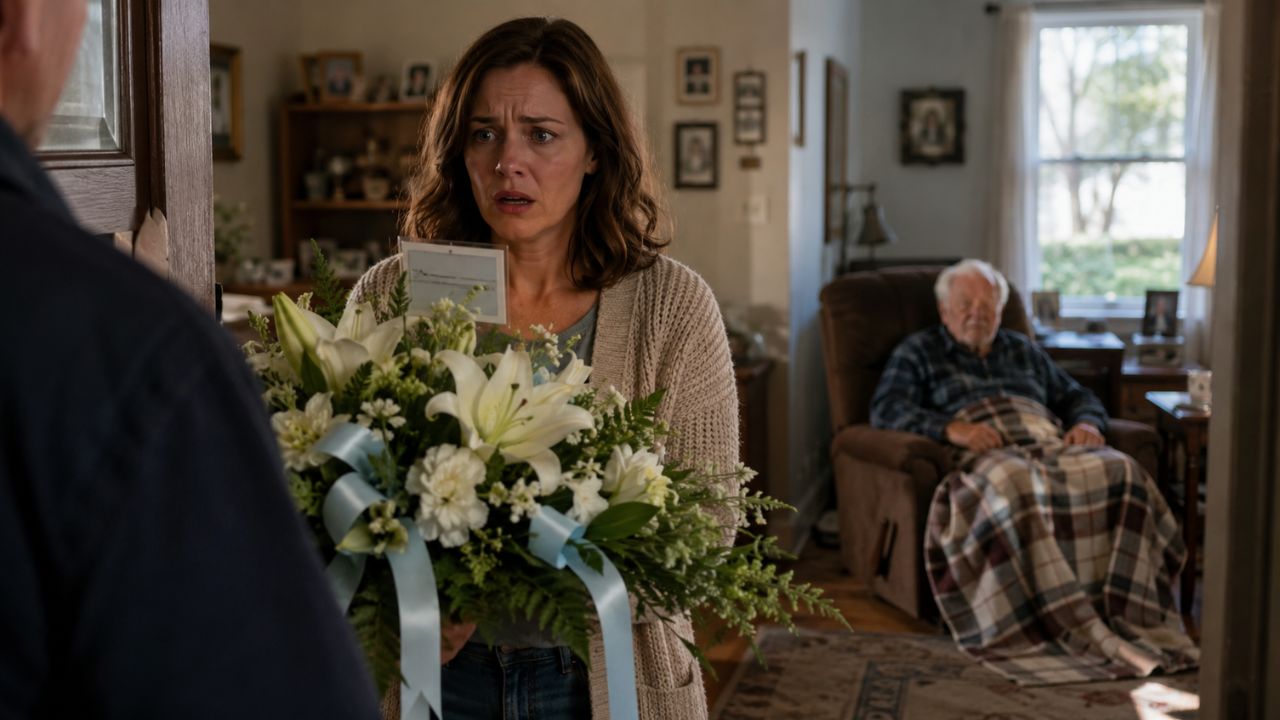
White lilies. Pale blue ribbons. A silver card tucked carefully between the stems.
The delivery man stood on the porch with both hands around the vase, looking confused.
“I’m sorry,” he said, glancing from the flowers to the house number beside the door. “This says funeral arrangement.”
For a moment, I thought he had the wrong address.
Then I saw the name printed on the paper clipped to the vase.
Richard Whitmore.
My grandfather.
My hand tightened around the doorframe.
Behind me, in the living room, Grandpa was still alive.
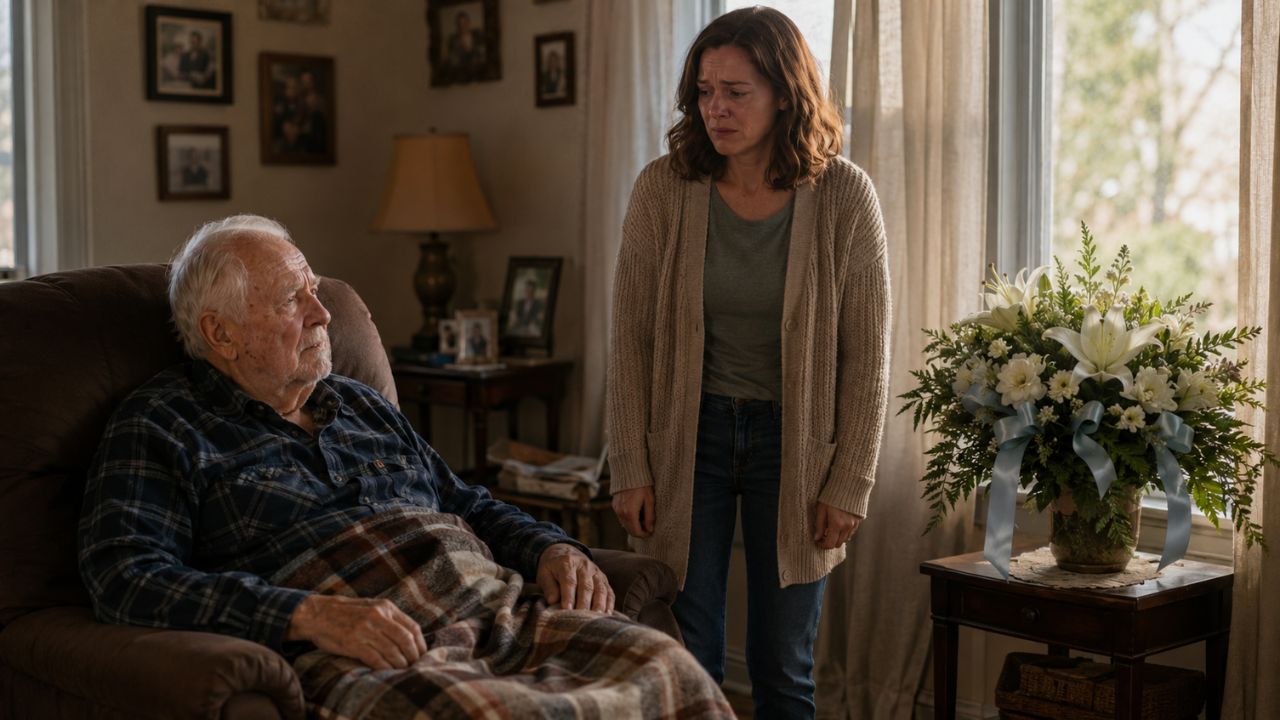
He was sitting in his old brown recliner by the window, wrapped in the plaid blanket my grandmother had sewn forty years earlier. His eyes were closed. His chest rose and fell slowly. The television was on low, though he had stopped watching it an hour ago.
He was weak, yes.
He was tired.
But he was not gone.
Not yet.
I looked back at the delivery man.
“There must be a mistake,” I said.
He shifted awkwardly.
“I just deliver what’s on the order, ma’am.”
I signed for the flowers with a hand that did not feel like mine.
After he left, I stood in the entryway, staring at the arrangement.
The lilies were fresh. Expensive. Too perfect.
Someone had not just made a small mistake.
Someone had chosen them.
Paid for them.
Written the card.
I pulled it out slowly.
The front was silver with raised white letters. The kind you see beside a casket or resting against a church wall.
Inside, in neat printed words, it said:
“With love from the family. Rest peacefully, Dad.”
Dad.
Not Grandpa.
Dad.
That meant the flowers had not come from a confused cousin or a distant relative.
They had come from his children.
My mother, Elaine.
My uncle Robert.
My aunt Diane.
His own children had sent funeral flowers to his house while he was still breathing.
I heard a soft movement behind me.
Grandpa had opened his eyes.
“What’s that, Annie?” he asked.
I turned too quickly, trying to hide the card.
“Nothing, Grandpa. Just a delivery.”
He looked at the vase. His eyes lingered on the lilies.
For most people, flowers brighten a room.
Those flowers made the whole house colder.
Grandpa stared at them for a long time.
Then he said quietly, “Are those for me?”
I wanted to lie.
Every part of me wanted to protect him.
But Grandpa had raised me after my father left. He had taught me to tell the truth even when my voice shook.
So I walked over and placed the vase on the small table beside his chair.
“Yes,” I whispered. “They’re for you.”
He did not cry.
That almost made it worse.
He simply nodded, as if one more piece of a puzzle had finally slid into place.
“Put them by the window,” he said. “I’d like to see what they bought.”
I hated the calm in his voice.
I hated that he sounded less surprised than I felt.
I set the flowers where he could see them.
The lilies faced the afternoon light. Their white petals looked almost too clean for that old living room, with its faded family photos, worn carpet, and the wooden clock that had not kept the right time since Grandma passed.
Grandpa watched the flowers.
Then he closed his eyes again.
I stepped into the kitchen and called my mother.
She answered on the fourth ring.
“Annie, I’m at work. Is he worse?”
“No,” I said. “He’s alive. Which is why I’m calling.”
There was a pause.
“What does that mean?”
“The funeral flowers came.”
Silence.
Then a sigh.
“Oh, for heaven’s sake. They delivered them early?”
I gripped the counter.
“So you knew about them.”
“Annie, don’t start.”
“You sent funeral flowers to his house while he’s still alive.”
“We were preparing,” she said. “Your grandfather is ninety-two. The doctors said it could be any day.”
“Any day is not today.”
“You don’t understand how much there is to arrange.”
I looked through the kitchen doorway.
Grandpa was still facing the window.
He was not watching television anymore.
He was watching the flowers.
My mother kept talking.
“Robert said the funeral home needed decisions. Diane handled the flowers. I handled the obituary draft. Nobody is trying to hurt anyone.”
“You wrote an obituary?”
“It’s just a draft.”
I swallowed hard.
“Does Grandpa know?”
Another pause.
Then my mother’s voice changed.
“Annie, do not upset him.”
I almost laughed.
They had sent funeral flowers to a living man, but I was the one who might upset him.
I hung up without saying goodbye.
For the next hour, the house was strangely quiet.
Grandpa did not ask for the television to be turned up.
He did not ask for tea.
He just sat there, looking at the lilies.
When I finally brought him a glass of water, he touched my wrist.
“Read me the card.”
My throat closed.
“You don’t need to hear it.”
“Yes,” he said. “I do.”
I sat on the edge of the coffee table and opened the card.
My voice cracked before I finished the first line.
“With love from the family. Rest peacefully, Dad.”
Grandpa leaned back and looked at the ceiling.
For a moment, I thought he had fallen asleep.
Then he said, “Your grandmother hated lilies.”
I looked at him.
“She did?”
“Oh, yes. Said they smelled like sadness and church basements.”
A small smile touched his mouth, but it disappeared quickly.
“I told the kids that more than once.”
I looked at the flowers again.
So they had not even remembered that.
Not his favorite song.
Not his favorite flower.
Not even the kind of arrangement he would have wanted.
They had not sent flowers for him.
They had sent flowers for themselves.
To feel organized.
To look dutiful.
To be ready.
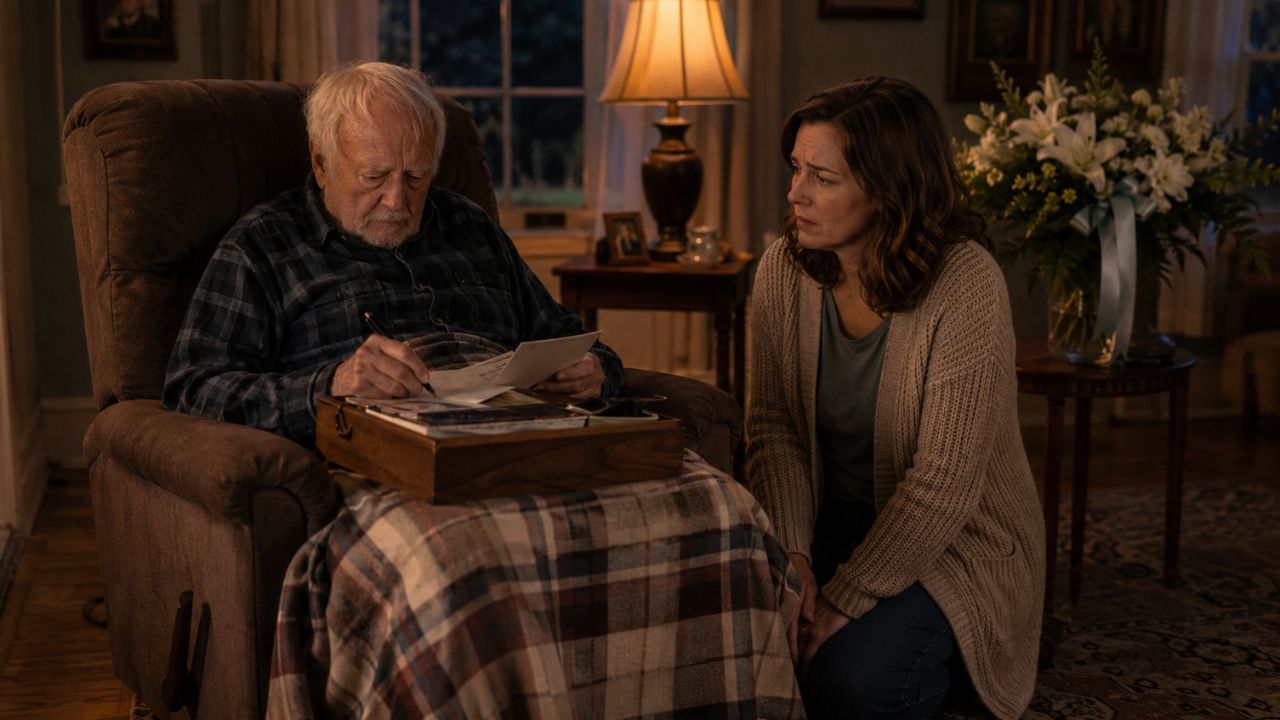
That evening, Grandpa asked me to bring him the old wooden writing box from his bedroom.
It had sat on his dresser for as long as I could remember. Inside were stamps, envelopes, a fountain pen, Grandma’s old recipe cards, and a bundle of letters tied with blue ribbon.
“Do you want to write something?” I asked.
He nodded.
“My hand’s not what it used to be,” he said. “But it’ll do.”
I placed a pillow behind his back and set the box on his lap.
He picked up the funeral card first.
He turned it over slowly.
Then, with a shaking hand, he wrote something on the back.
I did not look.
After that, he asked for paper.
He wrote for nearly an hour.
Sometimes he stopped to rest.
Sometimes he closed his eyes and whispered a name before writing it down.
Elaine.
Robert.
Diane.
Annie.
Grandma Ruth.
The old house creaked around us as the sun went down. The lilies sat by the window like witnesses.
At one point, he looked at them and said, “You know what hurts most?”
I knelt beside his chair.
“What?”
“Not that they’re thinking about what comes after. Everybody has to. That’s life.”
He touched the blanket on his lap.
“What hurts is that they stopped seeing what was still here.”
I could not answer.
Because I knew exactly what he meant.
Over the past year, Grandpa’s children had slowly changed around him.
At first, they called to check on his medication.
Then they called to ask where he kept insurance papers.
They used to ask how he slept.
Then they asked whether the house had been appraised recently.
They used to bring soup.
Then they brought folders.
My uncle Robert had spent one Sunday afternoon walking through the garage, opening drawers and tool cabinets, while Grandpa slept in the recliner.
My aunt Diane had asked me whether Grandma’s wedding ring was “still somewhere in the house.”
My mother had started using the phrase “when the time comes” so often that Grandpa stopped looking at her when she said it.
He was not a father to them anymore.
He was a date.
A document.
An estate.
But to me, he was the man who taught me how to ride a bicycle in the church parking lot.
The man who put extra sugar in my oatmeal and told Grandma it was an accident.
The man who drove across town at midnight when I was seventeen because I had cried on the phone and could not explain why.
He had been steady when everyone else was not.
And now, while he was still sitting in his own living room, his children had sent flowers for his death.
The next morning, a black sedan pulled into the driveway.
I recognized Mr. Harris immediately.
He had been Grandpa’s lawyer for years. Tall, gray-haired, polite in a way that made people sit straighter.
I opened the door before he knocked.
His eyes moved to the flowers by the window.
Then to Grandpa.
“Richard,” he said gently.
Grandpa lifted one hand.
“Thomas. Thanks for coming.”
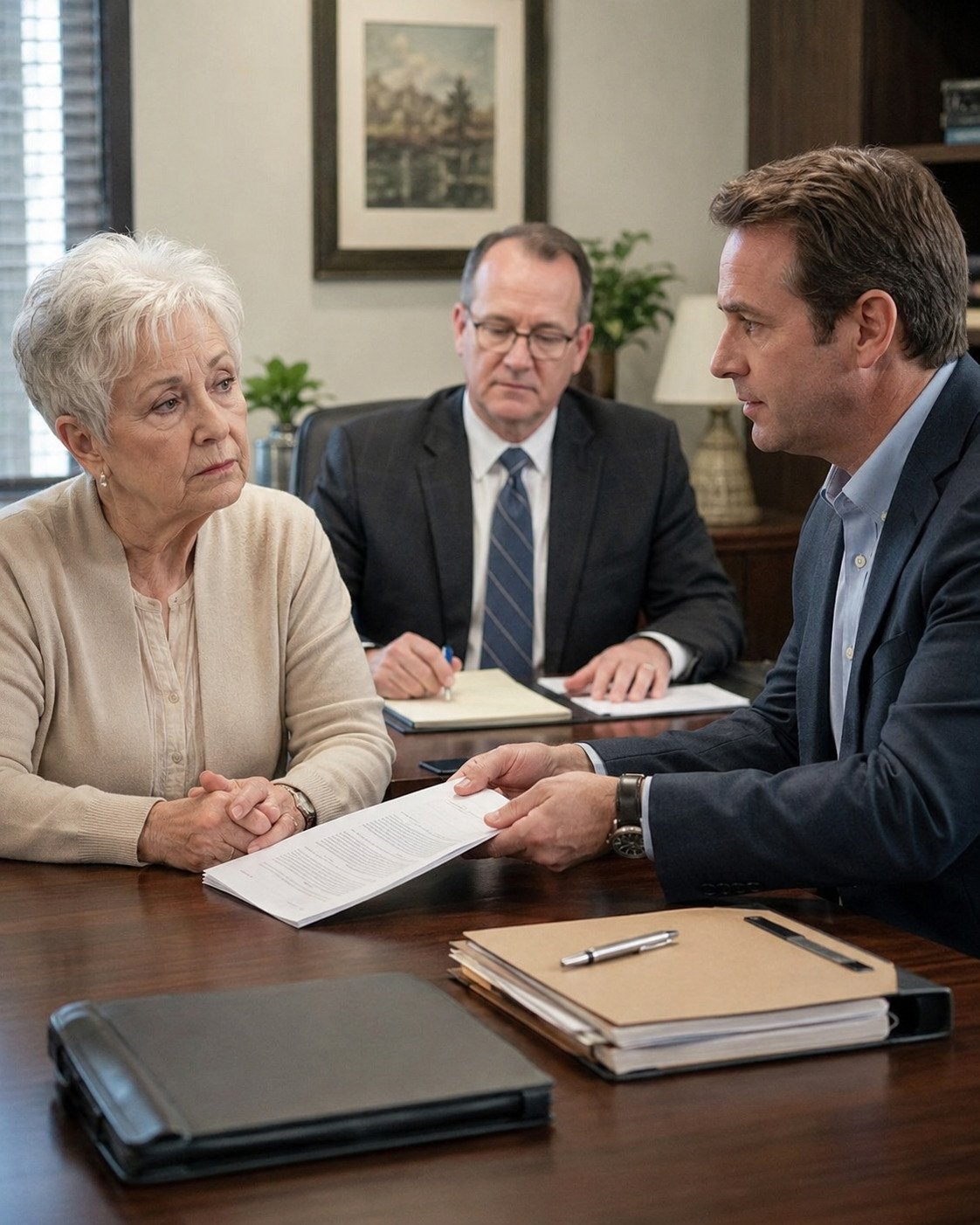
Mr. Harris carried a leather folder under his arm.
I started to leave the room, but Grandpa stopped me.
“No. Stay.”
So I sat on the couch while they talked.
There were legal words I did not fully understand. Trust. Codicil. Executor. Beneficiary. Community use.
But I understood enough.
Grandpa was changing his will.
Not because he was confused.
Not because I asked him to.
Not because anyone pressured him.
He was doing it because the lilies had told him the truth.
At one point, Mr. Harris asked, “Are you certain?”
Grandpa looked at the flowers.
“Yes,” he said. “I am.”
Three days later, Grandpa died just before dawn.
It was quiet.
No dramatic last words.
No thunderstorm.
No warning.
I had fallen asleep in the chair beside his bed, and when I woke, the room felt different.
Still.
Too still.
His hand was cool in mine.
For a long time, I did not move.
I just sat there, holding the hand that had held mine through half my life.
The funeral was held the following Saturday.
My mother wore black and greeted guests at the church door as if she had carried the whole burden alone.
Robert stood near the casket, accepting condolences with one hand while checking his phone with the other.
Diane cried loudly when people were watching.
The lilies were there.
The same arrangement.
Someone had moved them from Grandpa’s house to the church, as if that made sense.
My mother told Mrs. Wilson from next door, “Dad loved lilies.”
I nearly turned around.
But then I remembered Grandpa’s face when he wrote on the back of that card.
So I said nothing.
After the burial, the family gathered at Grandpa’s house.
The living room was full of people who had not sat there when he was sick.
Cousins leaned against the wall.
My mother opened drawers “looking for serving spoons.”
Robert asked if anyone knew where the safe deposit key was.
Diane whispered that the house would sell quickly if they painted the kitchen.
I stood near the window, beside the table where the flowers had been.
The table looked strangely empty now.
At three o’clock, Mr. Harris arrived.
The room settled immediately.
People always become respectful when money is about to be discussed.
My mother sat on the couch.
Robert took Grandpa’s recliner.
I wanted to tell him to move.
I did not.
Diane sat forward, hands folded, eyes sharp.
Mr. Harris opened his folder.
“Before I read Mr. Whitmore’s final instructions,” he said, “he asked that this be returned to the family.”
He placed the silver funeral card on the coffee table.
My mother stared at it.
Diane’s face went pale.
Robert looked away.
Nobody reached for it.
Mr. Harris continued.
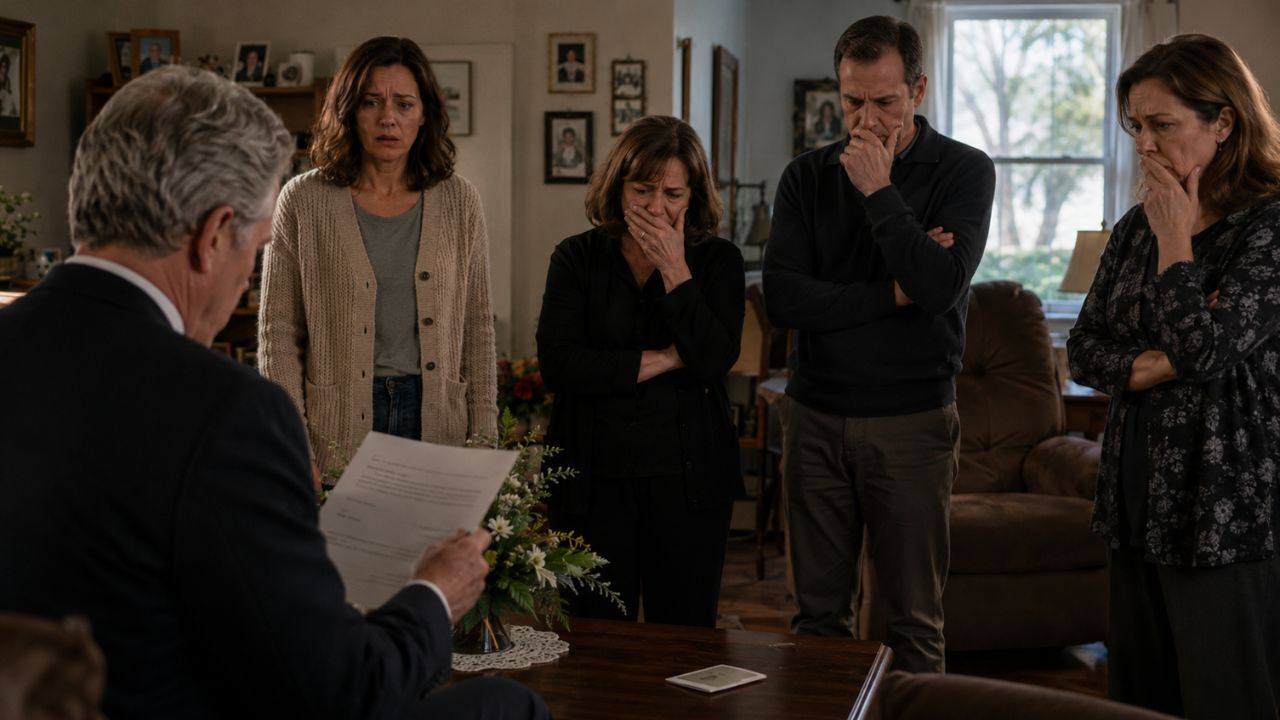
“Richard kept this card beside him during his final days. He asked me to read what he wrote on the back.”
He turned the card over.
His voice was calm.
“To my children, who sent flowers before sending forgiveness…”
The room went silent.
My mother whispered, “Oh my God.”
Mr. Harris kept reading.
“I received your lilies while I was still breathing. Thank you for letting me know where I stood.”
Diane began to cry.
This time, no one watched her.
“I do not blame you for preparing for my death. Death comes for every house sooner or later. But I do blame you for forgetting that I was still in mine.”
Robert shifted in the recliner.
The wooden frame creaked.
Mr. Harris read on.
“You asked about the house before asking about my pain. You asked about the bank before asking if I was afraid. You planned the service before sitting beside my chair.”
My mother covered her mouth.
“I loved you all. I still do. But love does not mean leaving the fruit of my life to the hands that were already reaching past me.”
No one breathed.
Then Mr. Harris set the card down and took out the will.
Grandpa left small personal items to each of his children.
To my mother, he left Grandma’s old Bible, the one with family births written inside the cover.
To Robert, he left the watch he had worn every Sunday for thirty years.
To Diane, he left Grandma’s recipe box.
At first, they seemed relieved.
Then Mr. Harris turned the page.
“The residence at 428 Maple Street shall not be sold by my children, grandchildren, or any private buyer. It shall be transferred into the Whitmore House Trust.”
Robert sat up.
“What trust?”
Mr. Harris did not look at him.
“The home will be converted into a small community residence for widowers and elderly men without nearby family support.”
Diane blinked.
“That’s not possible.”
“It is already in process,” Mr. Harris said.
My mother’s voice shook.
“He gave away the house?”
“No,” Mr. Harris replied. “He gave it a purpose.”
That sentence landed harder than any accusation.
Mr. Harris continued.
“The savings account will provide maintenance for the property. The garage tools will be donated to the county vocational program. The remaining funds will be used for meals, transportation, and basic care for residents of the trust.”
Robert stood.
“He was sick. He didn’t understand what he was signing.”
Mr. Harris closed the folder halfway.
“Your father was evaluated by his physician the same week. He was legally competent. I also met with him privately. More than once.”
Robert looked at me.
“You did this.”
I shook my head.
“No. The flowers did.”
His face hardened.
But he had no answer.
My mother finally picked up the silver card.
Her hand trembled as she turned it over and read Grandpa’s handwriting for herself.
Then she sat back as if someone had taken the air from her lungs.
For the first time all day, she looked like a daughter instead of an heir.
Diane whispered, “We were just trying to be ready.”
Mr. Harris nodded once.
“Richard understood that. But he believed there is a difference between preparing for someone’s death and treating them as if they are already gone.”
Nobody argued after that.
What could they say?
The proof was sitting on the coffee table in silver paper and blue ink.
A week later, a locksmith came to change the locks.
Not to keep family out.
To prepare the house for its next life.
The church men helped clear the upstairs rooms. Mrs. Wilson brought casseroles for the volunteers. The old garage was emptied, and Grandpa’s tools went to young students who wanted to learn a trade.
My mother came by once.
She stood in the doorway of the living room and looked at Grandpa’s recliner.
For a moment, I thought she might apologize.
Instead, she said, “He really hated lilies?”
I nodded.
“With a passion.”
She laughed once, but it broke halfway through.
“I should have known that.”
I did not say what we both understood.
Yes.
She should have.
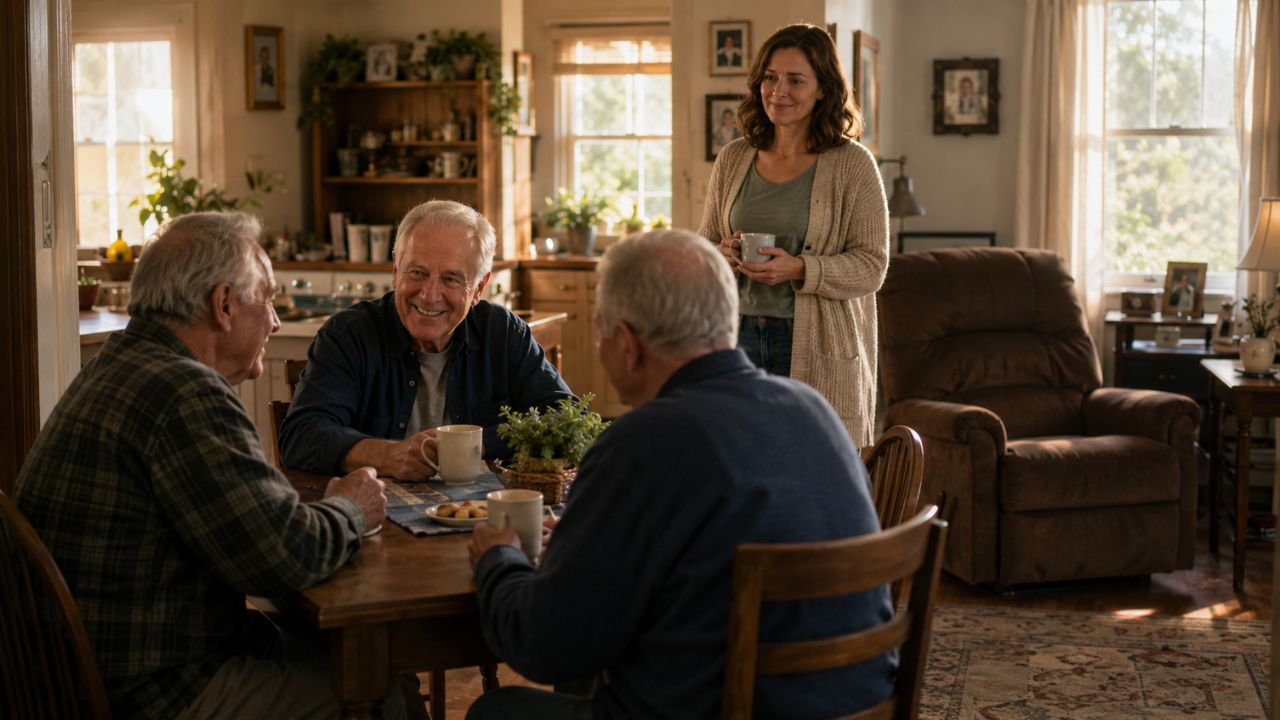
Months later, the house opened as Whitmore House.
Three elderly widowers moved in first.
One had lost his wife the year before.
One had no children.
One had two sons who lived three states away and rarely called.
Every morning, sunlight fell through the same window where Grandpa had watched those funeral flowers.
But now there were fresh coffee cups on the table.
A newspaper folded beside the recliner.
Soft voices in the kitchen.
Life.
Still here.
On opening day, Mr. Harris handed me a small envelope.
“Richard asked me to give this to you last.”
Inside was a note written in Grandpa’s shaky hand.
“Annie, don’t let bitterness be the last thing this house remembers. Let it remember chairs being filled, coffee being poured, and somebody asking, ‘How did you sleep?’ That is how a house stays alive.”
I stood by the window and read it twice.
Then I looked at the place where the lilies had once sat.
For a long time, I had thought those flowers were the cruelest thing my family ever did.
Maybe they were.
But in the end, they became something else.
They became the reason Grandpa stopped waiting to be loved properly.
They became the proof he needed.
They became the moment he took his life, his home, and his dignity back from people who had already started dividing them.
My family sent him flowers before goodbye.
So Grandpa sent his goodbye before inheritance.
And somehow, the house they were so eager to claim became the one place where lonely old men were no longer treated as if they were already gone.