After Years Of Silence, Nadia Comaneci Confirms What We Knew All Along
For 50 years, one number has followed Nadia Comăneci everywhere.
10.
But when the 14-year-old Romanian gymnast looked toward the scoreboard in Montreal on July 18, 1976, that was not the number she saw.
The board flashed:
1.00
For a moment, even Nadia thought something had gone wrong.
One was not a good gymnastics score.
Then the arena understood.
The scoreboard had not malfunctioned.
It had simply been built for a world in which Olympic perfection was not expected to happen.
There was no way for the equipment to display 10.00.
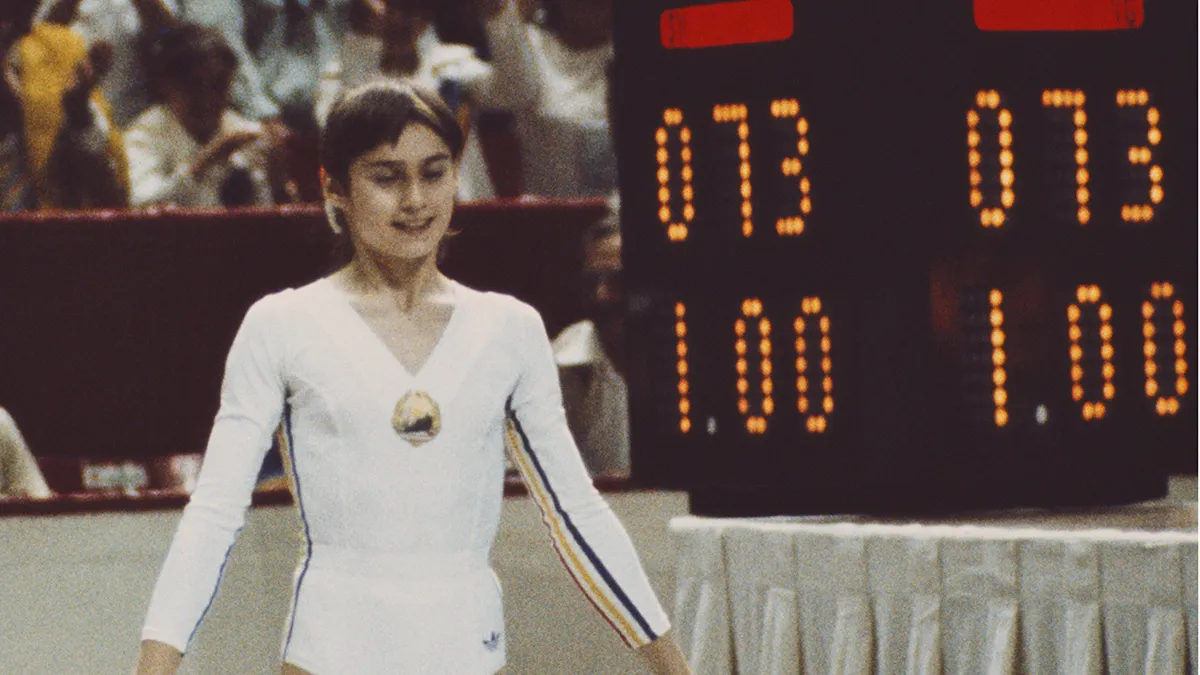
Nadia Comăneci had just become the first gymnast in Olympic history to receive a perfect 10.
The machine was less prepared for her than the judges were.
That image became one of the defining moments of the 1976 Olympics.
A tiny Romanian teenager.
A white leotard.
Uneven bars.
A confused scoreboard.
And a performance so extraordinary that technology itself appeared to fall behind.
The world quickly found a word for Nadia.
Perfect.
It appeared on magazine covers.
In headlines.
In television reports.
For millions of Americans who watched Montreal that summer, Nadia became something close to a fairy-tale figure—a child from behind the Iron Curtain who seemed to float through the air without fear.
But perfection is a dangerous identity to give a 14-year-old.
Because what happened after Montreal was much harder to fit into a single number.
Nadia grew.
She lost.
She came back.
She competed with an infected hand.
Her longtime coaches defected.
Her government restricted her movements.
She eventually fled Romania in darkness, leaving behind her family, her medals and almost everything familiar.
Then, after reaching the West, she later said the man who had helped her escape became another person controlling her life.
Freedom did not arrive all at once.
It had to be learned.
And fifty years after the scoreboard flashed 1.00, the woman who once seemed almost superhuman returned to Montreal and looked back at the girl she had been.
What impressed Nadia most was no longer the perfection.
It was the courage.

Before the 10, There Was a Child Who Could Barely Sit Still
Nadia Elena Comăneci was born on November 12, 1961, in Onești, Romania.
Long before she became known for extraordinary control, she was remembered as a child with extraordinary energy.
Gymnastics gave that energy somewhere to go.
Béla and Márta Károlyi were building a new gymnastics program in Romania, searching for young children who could be developed into elite competitors.
Nadia became one of their most extraordinary discoveries.
The training was intense.
So was Nadia.
That distinction matters.

Later accounts have sometimes reduced the relationship to a simple story of a brutal coach manufacturing an obedient child.
Nadia’s own telling has been more complicated.
In her 2003 memoir Letters to a Young Gymnast, she defended Károlyi against some accusations that he had simply abused and overworked her, while describing both the demanding system around her and her own powerful desire to succeed.
She was not merely pushed toward excellence.
She chased it.
By the middle of the 1970s, the rest of Europe could see what Romania had produced.
In 1975, Nadia Announced Herself to Europe
At the 1975 European Championships, Nadia won the all-around title and established herself as one of the most dangerous competitors in international gymnastics.
She was still barely a teenager.
Then came New York.
At the inaugural American Cup in 1976, Nadia won the women’s all-around with 39.750.
The male winner that year was an American gymnast named Bart Conner.
At the time, they were simply two young champions posing in the same gymnastics world.
Twenty years later, they would marry.
But none of that could have been imagined yet.
Montreal was coming.
And Montreal would change almost everything.
July 18, 1976: The Scoreboard Wasn’t Ready
Nadia’s first Olympic perfect 10 came on the uneven bars during the team competition.
That detail is important because the story is often misremembered as beginning on the balance beam.
It did not.
It began on the bars.
The equipment supplier had been told that a gymnastics score would not need four digits.
A perfect 10 was considered effectively unreachable.
So when the judges awarded Nadia 10.00, the scoreboard displayed 1.00 instead.

Nadia herself has remembered being confused.
Fifty years later, she joked that a one clearly did not make sense because it was a terrible score.
Then everyone realized what had happened.
And Nadia did not stop at one.
She earned seven perfect 10s during the Montreal Games.
By the time the Olympics ended, she had won:
- gold in the all-around,
- gold on uneven bars,
- gold on balance beam,
- silver with the Romanian team,
- bronze on floor exercise.
Seven 10s.
Five medals.
Three gold.
At 14.
America was fascinated.
So was the rest of the world.
But almost immediately, Nadia faced a problem no gymnast had ever faced in quite the same way.
She had not merely become champion.
She had become the girl who was perfect.
What Do You Do After Perfection?
There is nowhere obvious to go from a 10.
That is one of the traps hidden inside the number.
If Nadia won again, people expected it.
If she scored less than 10, people wondered what had gone wrong.
If her appearance changed, it became news.
If she grew taller or heavier—as teenage girls naturally do—it became a public issue.
The 14-year-old frozen in photographs from Montreal could not remain 14.
Her body changed.
Gymnastics changed.
Expectations did not.
That tension shaped the years that followed.
Nadia did not simply dominate every competition forever.
There were falls.
Losses.
Coaching tensions.
Changes in weight and technique.
And endless comparisons with the tiny gymnast the world had first met in Montreal.
Yet the idea that Nadia simply collapsed after 1976 is also false.
She kept winning.
The “Perfect Girl” Grew Up — and Won Again
Nadia remained one of the best gymnasts in the world.
She won another European all-around championship in 1977.
Then, after a difficult period, she produced another major comeback.
In 1979, she won her third consecutive European all-around title, becoming the first gymnast—male or female—to accomplish that feat.
That year brought another performance every bit as revealing as the famous perfect 10.
Only this time, Nadia was not perfect.
She was hurt.
In Fort Worth, Her Left Hand Became Dangerously Infected
At the 1979 World Championships in Fort Worth, Texas, Nadia developed a serious infection in her left hand.
Her wrist became badly swollen.
She was hospitalized.
Doctors treated the infection.
Her participation in the championships was in serious doubt.
The Romanian team was fighting for the team title.
And Nadia returned to compete on the balance beam.
According to contemporary accounts, her hand was so compromised that she had to protect it during the routine.
She still scored 9.95.
The performance helped Romania secure its first women’s world team championship.

Then Nadia went back to the hospital.
The infection required surgery.
This moment never became as globally famous as 1.00.
Perhaps because it lacked the simple fairy-tale symbolism.
But it revealed something equally important.
Montreal had shown Nadia’s precision.
Fort Worth showed her toughness.
The girl who had once looked almost untouched by difficulty was now older, injured and still expected to deliver.
She did.
Moscow Proved Montreal Had Not Been a Fluke
At the 1980 Olympics in Moscow, Nadia was 18.
She no longer looked exactly like the tiny child from Montreal.
But she was still elite.
She won gold on balance beam.
Gold on floor exercise.
Silver in the individual all-around.
Silver with the Romanian team.
Across two Olympic Games, Nadia finished with nine Olympic medals, five of them gold.
If her story had ended there, it would already have been extraordinary.
But gymnastics was only one part of Nadia Comăneci’s life.
Romania was still under Nicolae Ceaușescu.
And in 1981, something happened that changed Nadia’s relationship with her own country.
Her coaches left.
Béla and Márta Károlyi Did What Nadia Wasn’t Ready to Do
In 1981, the Romanian gymnastics delegation toured the United States.
At the end of that trip, Béla and Márta Károlyi and choreographer Géza Pozsár did not return to Romania.
They defected.
The Károlyis left behind their young daughter.
The decision was enormous.
The coaches who had helped turn Romanian women’s gymnastics into a world power were now seeking asylum in America.
Nadia did not leave with them.
She later explained that she simply was not ready.
Romania was home.
Her family was there.
The idea of abandoning everything was still unimaginable.
But according to Nadia, the Károlyis’ defection changed the way Romanian officials looked at her.
If the famous coach could leave—
perhaps the famous gymnast could too.
Nadia Said Her World Became Smaller
After the Károlyis defected, Nadia later wrote that her opportunities to travel outside Romania became severely restricted.
She felt watched.
Trips disappeared.
Her name would be removed from travel lists.
A woman who had spent her teenage years crossing borders as one of Romania’s most famous citizens suddenly found herself unable to move freely.
Years later, she summarized the feeling bluntly:
she began to feel like a prisoner.
This is where the political side of the Nadia story becomes impossible to separate from the sporting side.
Romania had celebrated her as proof of national greatness.
Her image had enormous value.
That same fame also made her difficult for the state to ignore.
Nadia officially retired from competition in 1984.
But retirement did not automatically mean freedom.
The Darkest Rumor About Nadia Is More Complicated Than It Looks
For years, one story has circulated as proof that the pressure after Montreal nearly destroyed her.
The claim was that Nadia attempted suicide by drinking bleach as a teenager.
The problem is that Nadia’s own accounts have changed.
In 1990, Life magazine was reported as quoting her confirming that she had drunk bleach at age 15 and been hospitalized.
But in a 1992 Los Angeles Times interview, Nadia gave a different version of the episode, describing it as an act she staged rather than a genuine attempt to die.
Later, in Letters to a Young Gymnast, she denied the bleach story altogether.
That does not mean Nadia experienced no psychological pressure.
Clearly, she did.
It means responsible storytelling should not turn a disputed episode into a clean, confirmed “dark secret.”
Her documented reality was already complicated enough.
By the late 1980s, she wanted out.
And this time, she was ready to risk everything.
In November 1989, Nadia Left Her Medals Behind
Nadia was 28 when she fled Romania.
Not 14.
Not a child champion.
A grown woman making a decision with consequences she understood could be severe.
The escape began in darkness.
She later described moving for hours through rough countryside, mud, icy water and cold terrain near the Romanian-Hungarian border.
There were no spotlights.
No judges.
No crowd.
No scoreboard.
She could not carry her Olympic medals.
She could not properly say goodbye to her parents.
She even had to mislead members of her own family because secrecy was essential.
She knew being caught could mean prison.
Nadia later described the journey as terrifying.
Think about the contrast.
At 14, she had become one of Romania’s greatest international symbols.
Thirteen years later, she was crawling through darkness to leave the country that had once carried her home as a national treasure.
This was not another gymnastics routine.
There would be no second attempt.
She Reached the West — and the Story Immediately Became a Scandal
The man who helped organize Nadia’s escape was Constantin Panait, a Romanian émigré living in the United States.
When Nadia arrived in America, the press quickly focused on their relationship.
Panait was married and had children.
Early press conferences created the impression that Nadia and Panait were romantically involved.
Nadia received harsh coverage.
A woman who had once been presented to Americans as the innocent, disciplined “perfect 10” was suddenly being portrayed as a home-wrecker.
One careless answer—“So what?” when asked about Panait’s wife and children—became part of the public narrative.
To audiences watching from outside, it looked like Nadia had escaped communism and immediately created a celebrity scandal.
Months later, she told a radically different story.
Nadia Said the Man Who Helped Her Escape Became Her Captor
In 1990, Nadia began speaking publicly about what she said had actually happened with Panait.
She denied that the relationship was the love story many newspapers had imagined.
She said Panait had controlled her.
According to Nadia, he decided what she could say.
He kept other people away from her.
She said she was frightened and unfamiliar with her rights in the West.
She also accused him of taking approximately $150,000 she had earned through appearances after her defection.
Later that year, reporting on Nadia’s account became even darker.
She said Panait had locked her inside hotel rooms and an apartment, physically abused her and kept her effectively captive for roughly three months.
These were Nadia’s allegations, and they should be described as such.
But they completely change the emotional shape of her escape story.
Crossing the Romanian border had not automatically made her free.
She had escaped one system in which other people controlled access to her life—
only to say that she found herself under another person’s control after reaching the West.
Freedom Wasn’t a Border. It Was Something Nadia Had to Learn.
One of Nadia’s most revealing later comments was not about gymnastics at all.
In a 1992 interview, she talked about how difficult it was to trust people after growing up in communist Romania.
She had been conditioned to ask:
Why is this person talking to me?
What do they want?
What happens if I say the wrong thing?
Life in the West required another kind of adjustment.
Freedom came with choices.
It also came with people asking questions Nadia had never learned how to answer publicly.
She later said it had taken time to tell her story.
That sentence explains much of the chaos of her first months in America.
The public wanted an instant narrative.
Nadia’s life did not fit into one.
Then gymnastics brought an old acquaintance back into her life.
His name was Bart Conner.
Bart Conner Had Been There at the Beginning
Nadia and Bart had first crossed paths as young gymnasts.
At the 1976 American Cup in New York, both won their respective competitions.
There is a famous photograph from that era of Bart giving Nadia a playful congratulatory kiss.
They were teenagers.
There was no great romance.
No prediction that their lives would eventually join.
Bart became an Olympic champion himself, winning gold with the U.S. team and on parallel bars at the 1984 Los Angeles Games.
Years passed.
When Nadia’s life in the West became chaotic after her defection, people from the gymnastics community began reaching out.
Bart was among those who reconnected with her.
Friendship gradually became something more.
This part of Nadia’s life had almost nothing in common with her arrival in America.
There was no frantic press conference.
No dramatic border.
No instant scandal.
It developed slowly.
In 1996, Nadia Went Back to Romania as a Bride
Seven years after fleeing Romania through the darkness, Nadia returned for an entirely different kind of journey.
In April 1996, she married Bart Conner in Bucharest.
The ceremonies became a major Romanian event.
Large crowds gathered.
Romanian officials attended.
Nadia—the woman who once felt she had to escape her country secretly—was now back publicly, wearing a wedding dress, being celebrated rather than watched as a potential defector.
It would be too easy to call that a perfect ending.
Nadia’s life had already demonstrated the danger of that word.
It was something better.
A new beginning.
She and Bart eventually built their life largely around gymnastics, business, charitable work and promoting the sport.
Their son, Dylan, was born in 2006.
The girl whose whole life had once been defined by gymnastics found a way to remain inside the sport without being trapped by competition.
Nadia Never Really Left Gymnastics
Retirement meant Nadia stopped competing.
It did not mean she stopped belonging to the sport.
Together with Bart Conner and their longtime business partners, she became involved with gymnastics academies, media projects, equipment businesses and international sporting organizations.
She also developed charitable work in Romania through the Nadia Comăneci Foundation, including programs connected with children and community health.
That may be one of the quieter triumphs of her story.
The apparatuses that once represented pressure did not have to remain symbols of pressure forever.
She could return to gymnastics on her own terms.
Coach.
Promote.
Encourage.
Remember.
And eventually, return to the place where the mythology began.
Fifty Years Later, Nadia Walked Back Into Montreal
In July 2026, Montreal marked the 50th anniversary of the Games that transformed Nadia Comăneci into an international icon.
Nadia returned.
She was 64.
Three generations had passed since 1976.
The city was different.
Gymnastics was different.
The scoring system itself was different.
The teenage girl on the old footage seemed almost impossibly distant.
But the memory was still alive.
On July 18, 1976, she had looked at a scoreboard and seen 1.00.
Half a century later, people were still asking her about those few seconds.
Nadia admitted that when it happened, she did not immediately understand that she had made history.
It happened too quickly.
Nobody had stopped the competition to explain that the sport had just changed.
Then she said something much more revealing.
Looking at her younger self now, Nadia said:
“I’m impressed, as an adult right now, about the courage that that 14-year-old had.”
Not the score.
Not the medals.
Not the fame.
The courage.
That May Be the Best Way to Understand Nadia Now
When America first met Nadia, adults struggled to describe what they were watching.
So they called her perfect.
The word was easy.
The life underneath it was not.
At 14, Nadia could not explain the politics around Romanian sport.
She could not know how fame would affect her relationship with her government.
She could not know that her coaches would defect.
She could not know that she would one day be forbidden from traveling freely.
She could not imagine walking across an icy border at night.
She could not predict the humiliation and confusion that would greet her arrival in America.
She could not know she would eventually return to Romania as Bart Conner’s bride.
She knew only the next routine.
That was enough.
The Scoreboard Told the Simplest Version of Nadia’s Story
1.00 became 10.00.
Wrong number.
Correct meaning.
For decades, Nadia’s public story often worked the same way.
A simple image stood in for something much more complicated.
Perfect gymnast.
Communist heroine.
Troubled teenager.
Defector.
Scandal.
Survivor.
Wife.
Mother.
Ambassador.
None of those labels is entirely false.
None is enough.
The great irony is that the woman forever associated with perfection spent much of her life navigating things that were profoundly imperfect.
An imperfect political system.
Imperfect relationships.
Imperfect public assumptions.
Imperfect attempts to explain herself.
And perhaps that is why her story has aged better than the perfect 10 itself.
The Perfect 10 Eventually Disappeared From Gymnastics
Even the sport outgrew the number that made Nadia famous.
Elite gymnastics eventually abandoned the traditional 10-point scoring system.
Modern routines are judged under an open-ended structure combining difficulty and execution.
A gymnast can still perform beautifully.
But the scoreboard no longer promises a simple, absolute definition of perfection.
In a strange way, that change feels appropriate.
Nadia’s life demonstrated something the old scoreboard could not.
Human beings do not fit comfortably inside perfect numbers.
She was brilliant in Montreal.
That does not mean every moment surrounding her career was healthy.
Her coaches could demand enormously from her without every accusation later made about them automatically being true.
Romania could celebrate her and restrict her.
The man who helped her leave Romania could, according to Nadia, later control and mistreat her.
America could welcome her and simultaneously misunderstand her.
Contradictions are not flaws in the story.
They are the story.
Montreal Was Only the First Escape
The famous Nadia on the bars appeared to escape gravity.
For a few seconds at a time, that was the illusion.
She released.
Turned.
Caught.
Landed.
Everything controlled.
But the escapes that came later were much less elegant.
Escaping the expectation that she would remain the same 14-year-old forever.
Escaping the idea that anything below 10 represented failure.
Escaping a government that restricted her freedom.
Escaping, according to her later account, another man’s control after reaching America.
Escaping the world’s need to tell her story more quickly than she was ready to tell it.
Those escapes did not receive scores.
No judges raised cards.
No arena erupted.
But they required their own kind of balance.
Bart Did Not Rescue the “Perfect Girl”
It would be tempting to turn Bart Conner into the savior at the end of Nadia’s story.
That would make another simple fairy tale.
It would also miss the point.
Bart became a partner in the life Nadia built after the chaotic first chapter of her defection.
But Nadia had already done the most dangerous thing herself.
She had decided to leave.
She had walked through the cold.
She had survived being misunderstood.
She had begun speaking publicly about what she said Panait had done to her.
She had started learning how to live without a government, coach, manager or press corps defining every decision.
The marriage was not the moment another person finally gave Nadia freedom.
It was part of a life in which Nadia increasingly decided what freedom meant for herself.
That is a stronger ending than rescue.
Even Béla Károlyi Doesn’t Fit Neatly Into the Villain Role
The same complexity applies to the coach who helped produce her greatness.
Modern gymnastics has undergone a profound reckoning over coaching culture, athlete welfare and abuse.
Béla and Márta Károlyi’s broader legacy has become deeply controversial.
But Nadia’s own account of her childhood training should not simply be overwritten to fit a cleaner modern narrative.
She has acknowledged the severity of elite training.
She has also defended Béla against some of the harshest characterizations of what happened to her personally.
The relationship contained pressure, authority, ambition and enormous success.
It should be examined critically.
It should not be rewritten for dramatic convenience.
That principle applies to Nadia’s whole life.
The real version is complicated enough.
The Girl From 1976 Never Actually Needed a Dark Secret
This is why stories claiming Nadia has “finally confirmed what we knew all along” undersell her.
There was no need for a secret revelation.
She has been telling parts of this story for decades.
She wrote a memoir.
She spoke about Romania.
She described her escape.
She publicly accused Panait of controlling and abusing her.
She discussed the controversies surrounding her teenage years.
She built a new public life.
And in 2026, she returned to Montreal to talk about the perfect 10 again.
The revelation is not that Nadia finally broke her silence.
It is that the meaning of the same story changes when the person telling it grows older.
At 14, Nadia thought about the routine.
At 64, she can see the courage required simply to be that child.
The World Saw Perfection. Nadia Remembers Courage.
That distinction may be the most meaningful thing Nadia Comăneci has given the perfect 10 fifty years later.
The world looked at a flawless performance and decided perfection was the story.
Nadia lived long enough to know better.
The scoreboard could measure execution.
It could not measure childhood.
Pressure.
Fear.
Politics.
Isolation.
Trust.
Freedom.
Or what it takes to rebuild a life after becoming globally famous before you are old enough to drive.
There is no score for those things.
Maybe there never should have been.
Fifty Years Later, the Number Matters Less Than the Woman
On July 18, 1976, Olympic technology failed to display Nadia Comăneci’s achievement correctly.
The machine showed 1.00.
Everyone eventually understood it meant 10.00.
For half a century, that number has represented Nadia to the world.
But if her life proves anything, it is that one perfect score can tell only a tiny part of a human story.
She won seven perfect 10s in Montreal.
She won five Olympic gold medals across two Games.
She grew out of the body the world first celebrated.
She competed through pain.
She lived under a government that increasingly restricted her movement.
She left Romania in darkness.
She arrived in the West only to discover that freedom could be complicated too.
She rebuilt.
She married.
She became a mother.
She stayed connected to the sport that made her famous.
And fifty years later, she returned to Montreal.
Not as the perfect child on the scoreboard.
As the woman who survived everything that came after it.
Perhaps that is why her words in 2026 land so differently.
Looking at that 14-year-old now, Nadia is impressed by her courage.
The rest of us spent fifty years staring at the 10.
Maybe we were watching the wrong number all along.