When You Can No Longer Care for Yourself — Don’t Go to a Nursing Home, Do THIS Instead
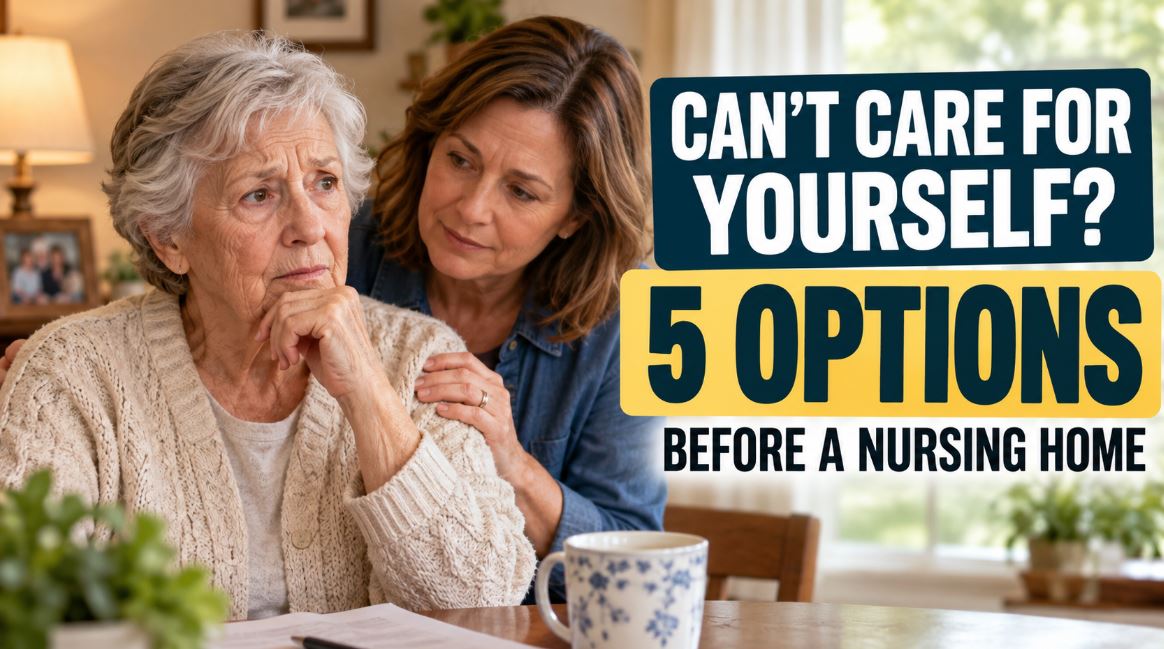
There is a fear many older adults rarely say out loud.
It is not always the fear of dying.
It is the fear of waking up one day and realizing:
**“I can’t take care of myself anymore.”**
Maybe bathing becomes difficult.
Maybe you no longer feel safe cooking alone.
Maybe medications become confusing.
Maybe a fall makes your family nervous about leaving you by yourself.
And suddenly, one frightening thought enters the conversation:
**“Does this mean I have to go to a nursing home?”**
For many families, that question comes during a crisis.

A fall.
A hospitalization.
A new diagnosis.
A sudden decline in strength.
Everyone is exhausted, worried, and trying to make a major decision quickly.
That is exactly when it can feel as though there is only one choice.
But needing more help does **not automatically mean you need a nursing home**.
Long-term care is not one single destination.
It is a range of options, from a few hours of help at home to round-the-clock skilled nursing care.
The goal is not to avoid nursing homes at all costs.
For some people, skilled nursing care is necessary and appropriate.
The goal is to understand your choices **before a crisis makes the decision for you**.
Here are five possibilities worth knowing.
1. Stay in Your Own Home — But Change How You Live There
For many older adults, the first question is simple:
**“Can I stay in my own home?”**
Often, the answer may be yes — with the right support.
This is commonly called **aging in place**.
It does not mean pretending you can still do everything alone.
It means adapting your home and your routine so that you can safely keep as much independence as possible.
Think about where problems usually begin.
The bathtub becomes difficult to step into.
A loose rug becomes a tripping hazard.
The hallway is too dark at night.
Carrying laundry downstairs becomes exhausting.
Remembering medications becomes harder.
Meals become simpler because cooking takes too much energy.
Individually, none of those things necessarily means someone needs to move.
Sometimes they mean the environment needs to change.
### Small home changes can make daily life easier
Depending on the person, useful changes may include:
– removing loose rugs and clutter from walkways
– improving lighting
– installing grab bars where appropriate
– adding handrails
– using a shower chair
– placing frequently used items where they are easier to reach
– adding a raised toilet seat if needed
– rearranging a bedroom so fewer stairs are necessary
– using mobility aids recommended for the individual
The point is not to turn the house into a hospital.
It is to make ordinary life safer.
### Help can come to you
Home support can also be added gradually.
You might need someone to help with cleaning once a week.

Later, perhaps someone helps with meals, bathing, transportation, or medication reminders.
Some people need only a few hours of assistance.
Others need much more.
What matters is whether the level of help available at home matches the person’s actual needs.
A useful question is:
**“What can I still do safely, and what tasks are becoming difficult?”**
That question is far more helpful than:
**“Am I too old to live alone?”**
Age alone does not answer that.
Ability does.
2. Live With an Adult Child — But Talk About the Hard Things First
For some families, living together can work extremely well.
An older parent gets companionship and practical support.
Adult children feel reassured knowing Mom or Dad is nearby.
Expenses may be shared.
Grandparents may become more involved in family life.
But moving in with family is not automatically simple.
Love does not eliminate the need for boundaries.
Before anyone packs a suitcase, families should discuss what everyday life will actually look like.
Not vaguely.
Specifically.
### Talk about questions such as:
Who pays for what?
Will the older parent contribute to groceries or household expenses?
How much privacy will everyone have?
Who helps with transportation?
What happens if bathing or toileting assistance eventually becomes necessary?
Can the adult child realistically provide that care?
Will outside caregivers be hired?
What happens when the caregiver needs a vacation?
How will disagreements be handled?
And perhaps most importantly:
**What happens if the arrangement stops working?**
These conversations can feel uncomfortable.
But avoiding them does not protect the relationship.
It often creates resentment later.
A good opening might be:
**“Before we decide anything, can we talk about what living together would actually look like day to day?”**
That changes the conversation from:
“Mom has nowhere else to go.”
to:
“Can we build an arrangement that works for everyone?”
Those are very different situations.
3. Share a Home With Other Older Adults
There is another option that receives much less attention:
**senior home-sharing.**
Imagine two or three older adults sharing a home.
Each has private space.
Expenses are divided.
Meals may sometimes be shared.
Someone else is around if something feels wrong.
Yet nobody is automatically placed in the role of caregiver.
For the right people, this arrangement can provide something many older adults want badly:
**company without giving up autonomy.**
Perhaps you are widowed and the house feels too quiet.
A longtime friend is also living alone.
Neither of you needs nursing care.
But both would feel safer and less lonely having another person nearby.
That can be worth exploring.
### But friendship alone is not enough
Before sharing a home, discuss:
– finances
– household responsibilities
– pets
– guests
– privacy
– quiet hours
– transportation
– food
– what happens if one person eventually needs much more care
Written agreements may also be useful.
Home-sharing is not appropriate for everyone.
But it demonstrates an important point:
There are more ways to age than simply **living completely alone** or **moving into an institution**.
4. Consider Assisted Living When You Need Help — But Not Constant Nursing Care
This distinction is important.
**Assisted living and nursing homes are not the same thing.**
An assisted living community generally focuses on helping residents with everyday life while allowing them to maintain substantial independence.
Depending on the community and the individual’s needs, help may include things such as:
– meals
– housekeeping
– transportation
– medication assistance
– bathing
– dressing
– organized activities
– emergency support
Residents usually have their own room or apartment and continue making many of their own daily choices.
For someone who no longer feels comfortable living alone but does not require continuous skilled nursing care, assisted living may be worth considering.
### Don’t choose based on the lobby
A beautiful entrance tells you very little about what daily life will feel like.
When evaluating a community, pay attention to the people.
Do staff members seem rushed?
Do they know residents by name?
Do residents appear engaged?
What happens at mealtimes?
How are emergencies handled?
How much help is actually included in the quoted monthly price?
What costs extra?
What happens if care needs increase?
How often does staffing change?
Ask questions about the things that will matter on an ordinary Tuesday morning — not just the things shown during a tour.
Fancy furniture is easy to buy.
Reliable care and respectful relationships are much harder to create.
5. Consider a Continuing Care Community If You Want to Plan Several Steps Ahead
Some older adults want something different.
They do not want to wait until each new health change forces another move.
A **Continuing Care Retirement Community**, often called a CCRC or life-plan community, may offer several levels of care within the same broader community.
Depending on the specific organization, a resident may begin in independent living and later have access to assisted living or nursing care as needs change.
The appeal is easy to understand.
Instead of asking:
**“Where will I go if I need more help?”**
you already know what the next step may look like.
You may also be able to remain close to familiar people and surroundings as your needs change.
However, these communities vary considerably.
Costs, contracts, healthcare services, admission requirements, and financial structures can be complicated.
Anyone considering one should carefully review the agreement, understand what services are guaranteed, and know what happens if their financial or medical situation changes.
This is not a decision to make from a brochure.
It is a long-term commitment that deserves careful review.
## So How Do You Know How Much Help You Actually Need?
This is often the most important question.
Instead of starting with:
**“Where should I live?”**
start with:
**“What am I having trouble doing?”**
Look at ordinary life.
Can you bathe safely?
Can you dress yourself?
Can you get on and off the toilet safely?
Can you get in and out of bed or a chair?
Can you prepare enough food?
Can you manage your medications correctly?
Can you move around your home without frequent falls or near-falls?
Can you manage appointments?
Can you call for help in an emergency?
Can you safely spend significant periods of time alone?
You do not need perfect independence in every category.
Many people live successfully at home while receiving help with some of these tasks.
What matters is the combination.
For example:
Someone who needs help cleaning and shopping may still live very independently.
Someone who frequently falls, becomes confused about medications, cannot safely use the bathroom alone, and needs assistance throughout the night may need a much higher level of support.
That is why the right decision should be based on actual needs — not embarrassment, fear, or age alone.
## The Question Many Older Adults Are Really Asking
Underneath all the practical decisions is often another fear:
**“Will I become a burden to my children?”**
That fear can cause people to hide problems.
They do not mention the fall.
They pretend they are eating well.
They say they took their medication when they are not sure.
They insist:
“I’m fine.”
The intention may be loving.
They do not want their children to worry.
But hidden problems often become family crises.
Needing help does not automatically make you a burden.
A crisis with no plan is what makes everything harder.
There is a big difference between saying:
“Dad fell again. We have to decide what to do tonight.”
and saying:
“If Dad eventually needs help bathing and cooking, here are the three options he prefers.”
Planning creates choices.
Waiting can remove them.
## Have the Conversation Before You Need It
You do not need to be sick to talk about future care.
In fact, the best time to have the conversation is often when everyone is still calm.
A parent might say:
**“If I ever need more help, I want you to know what I would prefer.”**
An adult child might say:
**“I’m not trying to change anything now. I just want to understand what you would want if your needs changed later.”**
Then discuss the possibilities.
Would staying at home be the first choice?
Would you accept a caregiver coming into the home?
Would living with family be acceptable?
Would you consider assisted living?
How important is staying in the same town?
Who should help make decisions if you cannot?
What financial resources are available?
You do not need every answer today.
The goal is simply to stop the subject from being forbidden.
## Technology Can Help — But It Is Not a Caregiver
Modern tools can support independence.
Depending on someone’s situation, useful technologies might include:
– emergency alert systems
– fall-detection devices
– medication reminders
– automatic lights
– smart doorbells
– voice assistants
– video calling
– remote monitoring devices when appropriate and consented to
These can add another layer of safety.
But technology has limits.
A sensor cannot help someone bathe.
A smartwatch cannot replace companionship.
A camera cannot provide hands-on care after a fall.
Use technology as support, not as a substitute for the human help someone genuinely needs.
## What About the Cost?
This is where many families become overwhelmed.
Home care costs money.
Assisted living costs money.
Nursing care costs money.
And the rules surrounding Medicare, Medicaid, veterans’ programs, state programs, insurance, and long-term care benefits can be confusing.
Do not assume you know what is or is not affordable before investigating.
Depending on where someone lives and their eligibility, there may be local or government-supported programs that help older adults remain in the community.
Families can also consider speaking with appropriate professionals such as:
– a social worker
– an aging-services organization
– a geriatric care professional
– a benefits counselor
– an elder-law attorney for relevant legal and financial planning
The earlier financial planning begins, the more options a family may have.
A crisis is a terrible time to discover how the system works.
## When a Nursing Home May Actually Be the Right Choice
It is equally important not to turn nursing homes into the villain.
Some people eventually need skilled nursing care that cannot safely or realistically be provided at home.
That may include people with very complex medical needs, extensive mobility limitations, significant cognitive impairment, or a need for continuous supervision and nursing support.
In those situations, skilled nursing care may provide something extremely important:
**safety and appropriate medical support.**
Choosing it is not failure.
And moving into a nursing facility does not mean a family has abandoned someone.
The right question is never:
**“How do we avoid a nursing home no matter what?”**
It is:
**“What is the least restrictive setting that can safely provide the care this person actually needs?”**
Sometimes the answer is home.
Sometimes it is family.
Sometimes assisted living.
Sometimes skilled nursing.
The correct answer can also change over time.
## Don’t Wait for the First Crisis
Imagine two families.
In the first family, nobody talks about aging.
Then Mom falls.
She breaks her hip.
The hospital is preparing for discharge.
Her children have 48 hours to figure out what happens next.
Everyone is scared.
Nobody knows what Mom wants.
Nobody knows what they can afford.
Nobody knows whether her house can be made safe.
Now imagine another family.
Years earlier, Mom had said:
“If I need help someday, I want to stay home as long as it’s safe. I’m comfortable hiring help. If that stops working, I’d prefer assisted living near you.”
The fall is still frightening.
But the family has direction.
That is the difference planning can make.
You cannot control every part of aging.
But you can reduce the number of decisions that have to be made in panic.
## The Goal Is Not to Prove You Can Do Everything Alone
Independence is often misunderstood.
People think independence means:
“I never need anyone.”
But almost nobody lives that way at any age.
Real independence is closer to:
**“I still have a meaningful say in how I live.”**
Maybe someone helps clean your house.
You still choose your routine.
Maybe your daughter drives you at night.
You still decide where you want to go.
Maybe a caregiver helps you shower.
You still choose what you wear and what you do afterward.
Accepting assistance does not automatically erase autonomy.
Sometimes accepting the right amount of help is exactly what allows you to keep more independence for longer.
## Five Options Worth Remembering
If you eventually need more help, your choices may include:
**1. Aging in place with home modifications and support**
**2. Living with adult children or other family members**
**3. Sharing a home with other older adults**
**4. Moving to assisted living**
**5. Choosing a continuing-care community that can provide increasing levels of support**
And if your medical needs eventually require skilled nursing care, that remains another legitimate option.
There is no single answer that fits everyone.
The best choice depends on your health, finances, relationships, home environment, personal preferences, and how much assistance you actually need.
## The Most Important Step Is the One You Can Take Before You Need Help
You do not need to move tomorrow.
You do not need to hire anyone tomorrow.
You do not need to make a final decision about where you will spend the rest of your life.
But you can begin asking questions.
What would I want?
What would I never want?
What help would I be willing to accept?
Is my current home realistic if my mobility changes?
Who would help me make decisions?
What can I afford?
What options exist near my family?
Those questions are not pessimistic.
They are practical.
Because aging does not automatically take away your choices.
But waiting until a crisis can.
The goal is not to control every detail of the future.
It is to give your future self more than one door to walk through.
And perhaps the most important thing to remember is this:
**Needing help is not the same as losing your life.**
The right support can allow you to keep making decisions, maintain relationships, enjoy familiar routines, and preserve the parts of independence that matter most.
Do not wait until someone else has to choose for you.
Learn your options while they are still yours to choose.