Part One: The Woman Who Fired the Wrong Man
Logline
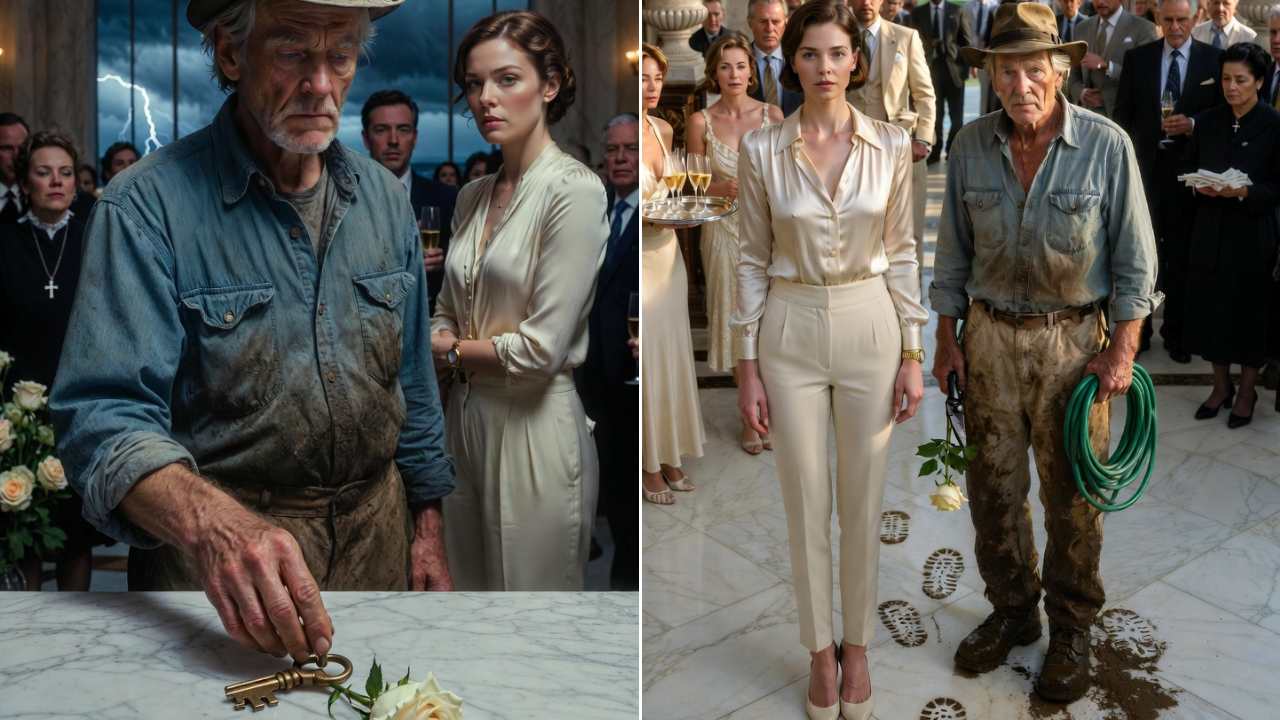
At a luxury estate in the Hamptons, a young socialite fires an old gardener in front of wealthy guests to prove she belongs among the elite—only to discover the man she humiliated is the true owner of the mansion, and the entire evening was his final test.
Main Characters
Eleanor Whitmore
Age: 36
Occupation: Event curator for luxury estates and private charity galas
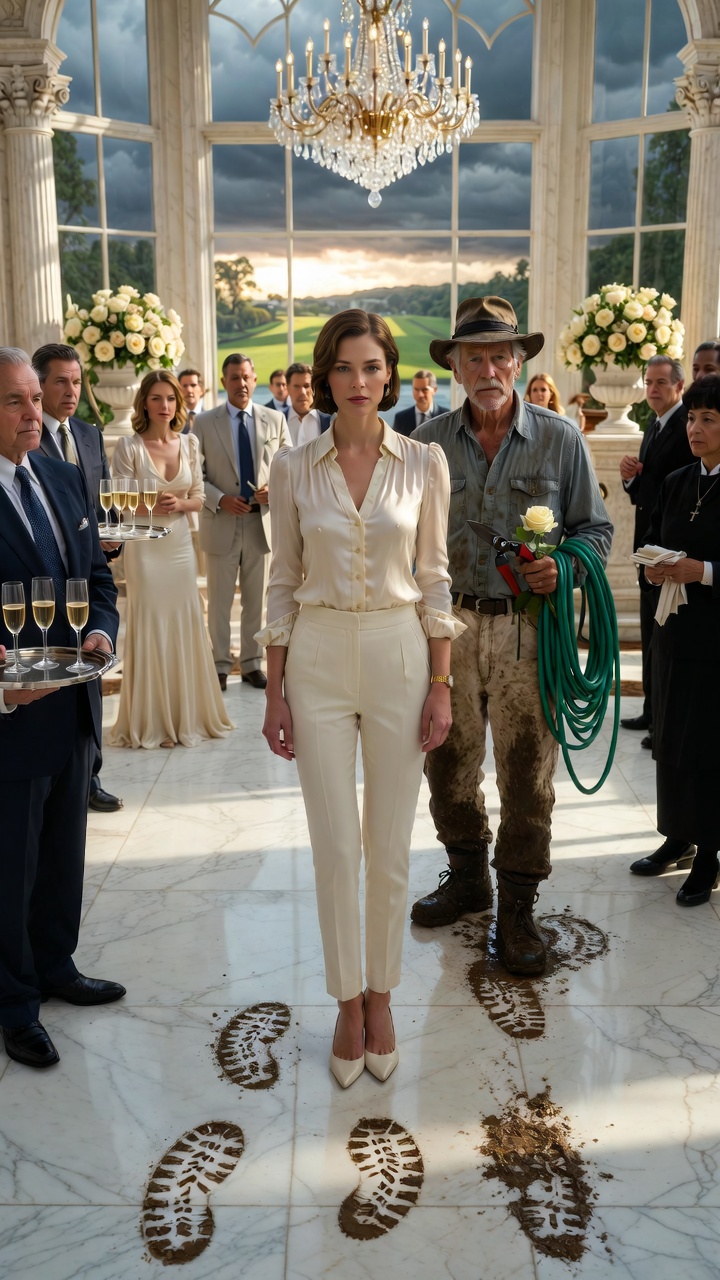
Appearance: Tall, polished, elegant, chestnut-brown hair pulled into a smooth low bun, green eyes, ivory silk blouse, tailored cream trousers, gold watch
Personality: Controlled, ambitious, sharp, terrified of looking weak
Emotional Scar: Grew up poor beside wealthy neighborhoods and was humiliated by rich families her mother worked for
Greatest Fear: Being mistaken for “staff” again
Secret Desire: To become untouchable
Moral Belief: Respect must be earned through discipline, image, and control
Greatest Weakness: She treats vulnerability like a disease
Greatest Strength: She sees details others miss
Walter Hayes
Age: 72
Occupation: Publicly appears as the estate gardener
Hidden Identity: Billionaire real estate investor and true owner of the Whitestone Estate
Appearance: Weathered face, silver-white hair under an old canvas hat, broad shoulders despite age, rough hands, faded denim shirt, khaki work pants, muddy boots
Personality: Patient, observant, quiet, emotionally guarded
Emotional Scar: His daughter died after marrying into a family that valued status over kindness
Greatest Fear: Leaving his fortune to people who worship property but not people
Secret Desire: To find someone worthy of protecting the estate’s legacy
Moral Belief: How people treat workers reveals who they are when power is removed
Greatest Weakness: He tests people instead of trusting them
Greatest Strength: He can see character beneath performance
Miles Harrington
Age: 44
Occupation: Private wealth consultant
Appearance: Silver-blue suit, tan skin, perfect smile, expensive watch
Personality: Charming, opportunistic, always watching the richest person in the room
Role: Encourages Eleanor’s worst instincts because he wants access to the estate deal
Rosa Martinez
Age: 58
Occupation: Housekeeper at Whitestone Estate
Appearance: Warm brown eyes, dark hair streaked with gray, black uniform, silver cross necklace
Personality: Kind, direct, tired of rich people pretending not to see her
Role: Knows Walter’s true identity but keeps his secret
Chapter One
The Mud on the Marble
Eleanor Whitmore saw the mud before she saw the old man.
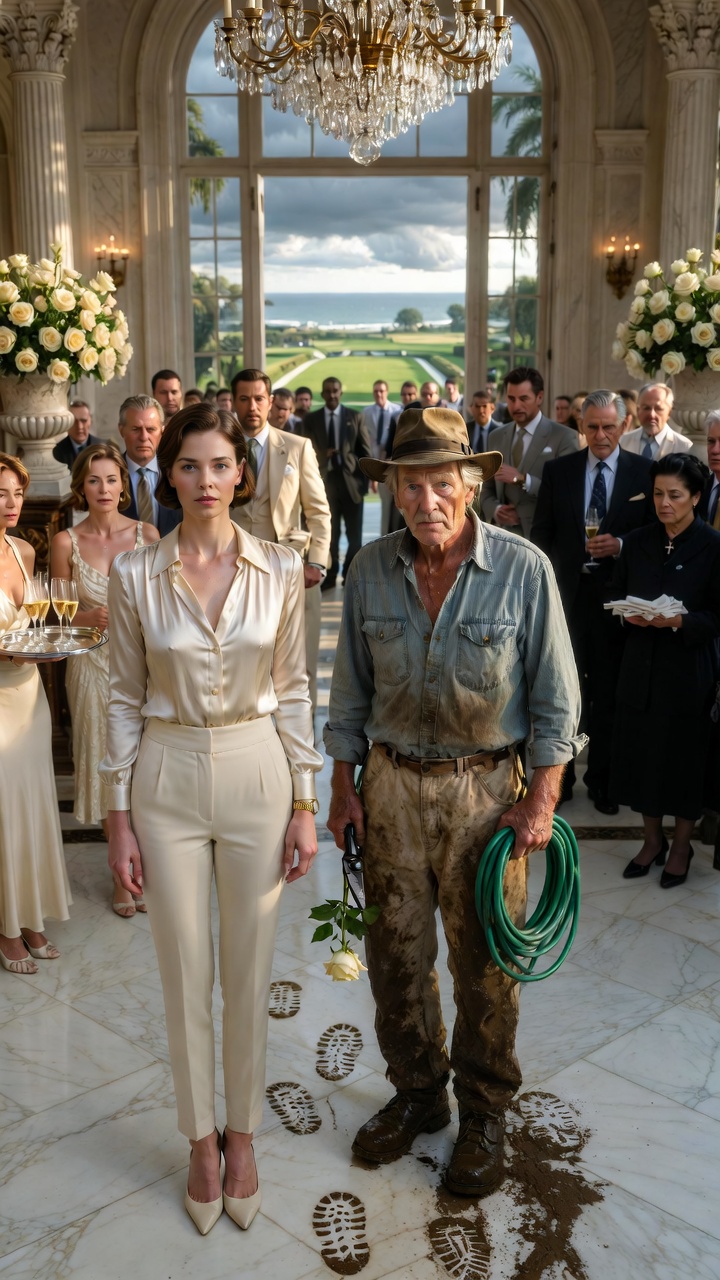
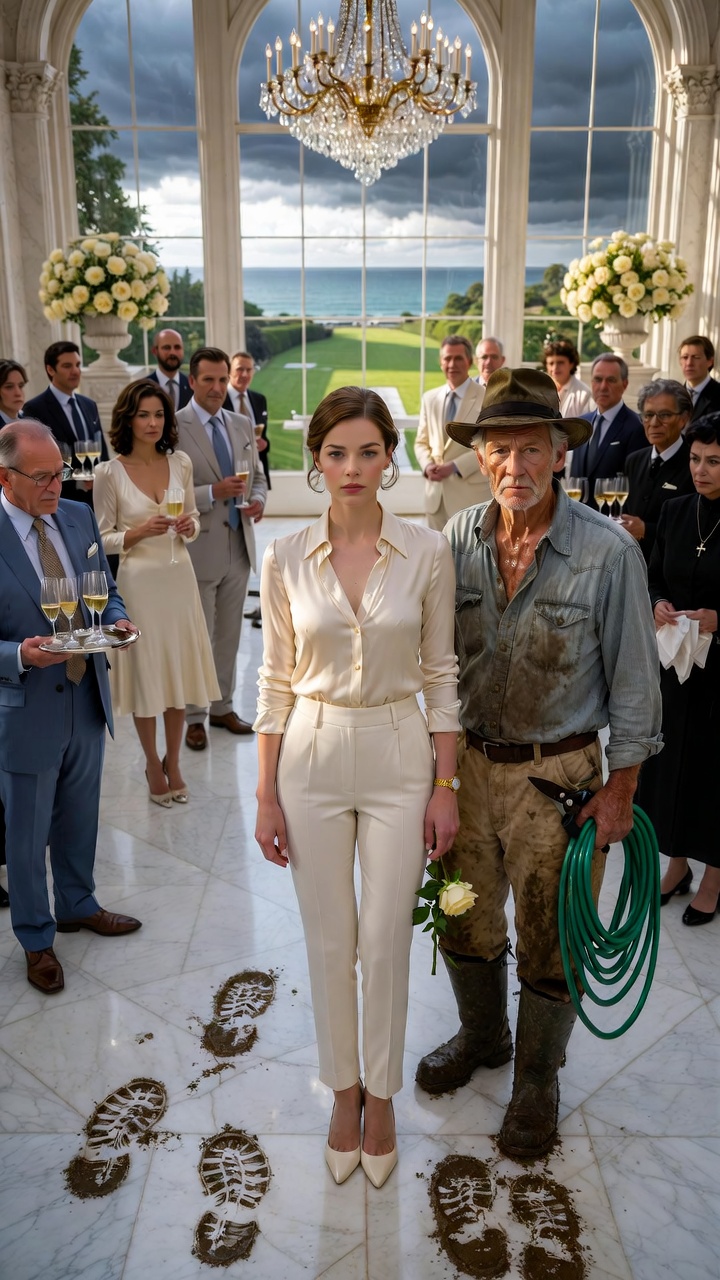
Three brown footprints crossed the white Carrara marble foyer of Whitestone Estate, each one shaped by the deep tread of a work boot.
The first print lay beneath the crystal chandelier.
The second cut across the reflection of a $400,000 floral installation she had approved that morning.
The third stopped two inches from the hem of her cream trousers.
Eleanor did not move.
Around her, the house breathed money.
Floor-to-ceiling windows opened toward a green lawn rolling down to the Atlantic. The late afternoon sun poured through the glass in sheets of gold, catching on champagne flutes, silver trays, polished stone, and the pale roses arranged in enormous ceramic urns. Outside, violinists tuned near the reflecting pool. Inside, caterers moved like shadows around guests in linen suits and silk dresses.
Tonight was not just another charity reception.
Tonight was her audition.
Three hundred guests. Four senators. Two museum trustees. One former ambassador. And somewhere among them, representatives from the private foundation rumored to be choosing a new director for Whitestone’s cultural program.
Eleanor wanted that position so badly she could taste metal at the back of her throat.
Then she saw him.
An old gardener stood at the open side entrance, holding a pair of pruning shears and a coil of green hose. His canvas hat was wet with sweat. His denim shirt clung to his shoulders. Mud darkened the cuffs of his khaki pants.
In one rough hand, he held a single white rose.
Not a bouquet.
Not an arrangement.
One rose.
Freshly cut.
The sight of it made Eleanor’s jaw tighten.
“Excuse me,” she said.
Her voice did not rise.
It sharpened.
The old man looked up.
His face was deeply lined, sun-browned, and calm in a way that irritated her immediately. He did not jump. He did not apologize. He simply stood there, as if a man with dirt on his boots had every right to occupy a room built to impress billionaires.
“Yes, ma’am?”
Eleanor glanced at the footprints.
Then at him.
“Do you see what you’ve done?”
The gardener followed her gaze to the marble.
For a moment, something moved across his face.
Not guilt.
Memory, perhaps.
“The sprinklers broke near the east hedge,” he said. “I came in to ask Rosa where the utility shutoff had been moved.”
“You came in?”
“Yes.”
“Through the foyer?”
“Side door was open.”
“It was open for catering staff.”
He looked at his muddy boots.
“I suppose I am staff.”
A few guests near the champagne table turned slightly.
Eleanor felt their attention before she saw it.
That was how rooms like this worked. Interest moved like perfume. Invisible at first, then everywhere.
She stepped closer.
“What is your name?”
“Walter.”
“Walter what?”
“Hayes.”
His voice remained even.
That made it worse.
“Mr. Hayes,” Eleanor said, each syllable dressed in professional courtesy, “this foyer was sealed and polished for tonight’s event. These guests are arriving for a donor reception, not a county fair.”
The old man glanced toward the lawn, where servers in white jackets crossed beneath strings of glass lights.
“I understand.”
“I don’t think you do.”
A server stopped behind the champagne table. Rosa Martinez, the housekeeper, stood in the hallway beyond the staircase, a tray of linen napkins in her hands. Her warm brown eyes met Walter’s for half a second.
Eleanor noticed.
She noticed everything.
That was why people hired her.
“Rosa,” Eleanor called.
Rosa stepped forward. “Yes, Ms. Whitmore?”
“Did you tell the grounds crew they could enter through the main house?”
“No.”
Walter looked at her.
Rosa’s mouth tightened, but she said nothing else.
Eleanor turned back to him.
“There are service paths for a reason.”
“I used the fastest path because water is flooding the hedge bed.”
“The hedge bed will survive.”
“Not if the line keeps running.”
“The hedge bed,” Eleanor said, “is not standing under a chandelier in front of donors.”
Walter looked at the chandelier.
Then at the guests.
Then at Eleanor.
“No,” he said quietly. “I suppose it isn’t.”
The answer should have ended it.
A warning. A cleanup. A staff correction.
But Miles Harrington chose that moment to appear at Eleanor’s shoulder with a glass of champagne in his hand and amusement in his smile.
“Trouble in paradise?” he asked.
Miles always smelled faintly of sandalwood and expensive risk. He had introduced Eleanor to three board members that afternoon, praised her “command of the estate,” and whispered that Whitestone needed someone who could protect its image from sentimental mismanagement.
He now looked at Walter as if the old man were a stain that had learned to speak.
Eleanor felt heat climb her neck.
Not embarrassment.
Fear wearing its clothes.
She had spent her whole life training herself never to look like the woman who once waited in kitchens while richer women thanked her mother without learning her name.
She had built polish like armor.
And here stood Walter Hayes, dragging the old world back across the marble in wet brown footprints.
“This is being handled,” she said.
Miles lifted his glass. “Of course.”
But he did not leave.
Neither did the watching guests.
Walter bent slightly, as if to set down the rose and hose.
“Don’t,” Eleanor said.
He stopped.
“Don’t put that on the floor.”
His eyes moved to the rose.
“I brought it for the blue room.”
“The blue room arrangements are complete.”
“This one blooms once a year.”
“Then it can bloom outside.”
A flicker crossed his face.
There.
Finally.
Not pain exactly.
Something close enough to satisfy the cruelest part of the room.
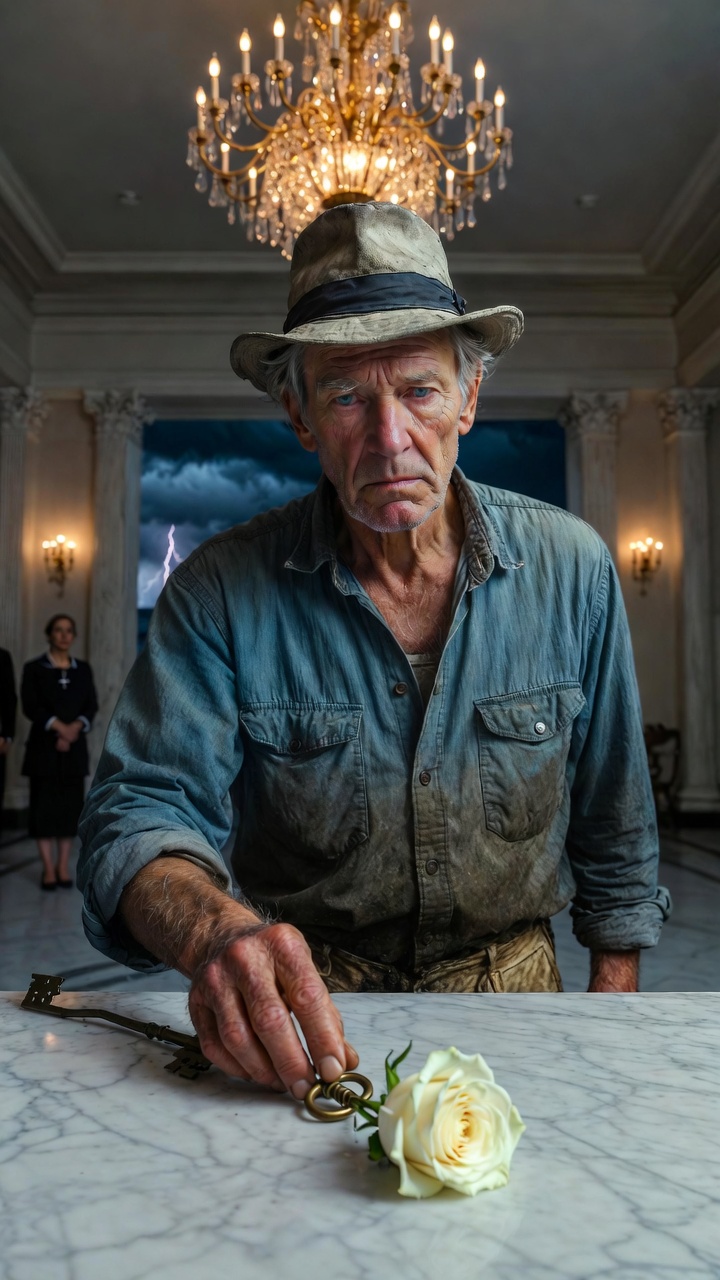
The rose trembled slightly between his fingers.
Rosa took one small step forward.
“Ms. Whitmore,” she said softly, “Mr. Hayes has worked with those roses for—”
“Rosa.” Eleanor did not look at her. “Please take a towel and clean the marble.”
Rosa went still.
Walter’s gaze dropped to the floor.
Not because he was ashamed.
Because Rosa was.
Eleanor saw it too late and hated herself for seeing it at all.
Miles leaned closer. “You’re doing the right thing,” he murmured. “Standards matter.”
Standards.
The word landed inside her like permission.
Eleanor straightened.
“Mr. Hayes, tonight’s event requires discipline. It requires discretion. It requires staff who understand where they should and should not be.”
“I understand more than you think.”
“I doubt that.”
The room heard it.
A woman near the floral installation lowered her champagne flute.
Walter’s fingers closed more tightly around the stem of the rose.
Eleanor should have stopped.
She knew it even then.
But ambition has a sound. It is not loud. It is the whisper that says one more sentence will prove you belong.
“You may collect your things from the grounds shed tomorrow,” she said. “As of this moment, your services are no longer required at Whitestone.”
Rosa inhaled sharply.
Walter looked at Eleanor.
For the first time, his calm shifted.
The old man did not look angry.
Anger would have been easier.
He looked disappointed.
Deeply.
Quietly.
As if she had failed an exam she did not know she was taking.
Miles smiled into his champagne.
Eleanor felt the room approve of her.
Or maybe she only needed it to.
Walter placed the white rose gently on the nearest marble console, careful not to let a drop of mud touch it.
Then he removed his canvas hat.
His silver-white hair was flattened beneath it. A thin scar cut across his left temple, disappearing into the weathered skin near his eye.
“I see,” he said.
“You’ll be paid through the end of the week,” Eleanor said.
He nodded once.
“That’s generous.”
The words were simple.
The tone was not.
Eleanor’s pulse tapped once in her throat.
Walter turned toward Rosa.
“I’m sorry about the floor.”
Rosa’s eyes shone.
“You don’t have to apologize to me.”
“No,” he said. “But I wanted to.”
Then he looked at Eleanor again.
Behind him, through the glass wall, the ocean moved in dark blue sheets under a sky bruised purple by incoming rain.
“Before I go,” Walter said, “may I ask one question?”
Eleanor folded her arms.
“One.”
“If the owner of this house were standing here in muddy boots, would you fire him too?”
A small laugh broke from Miles.
“Oh, that’s rich.”
A few guests smiled.
Eleanor did not.
Something about the question slid beneath her skin.
“The owner of this house,” she said, “would know better than to ruin his own foyer.”
Walter looked at the rose on the console.
Then back at her.
“Maybe.”
The first roll of thunder sounded beyond the windows.
Soft.
Far away.
But everyone heard it.
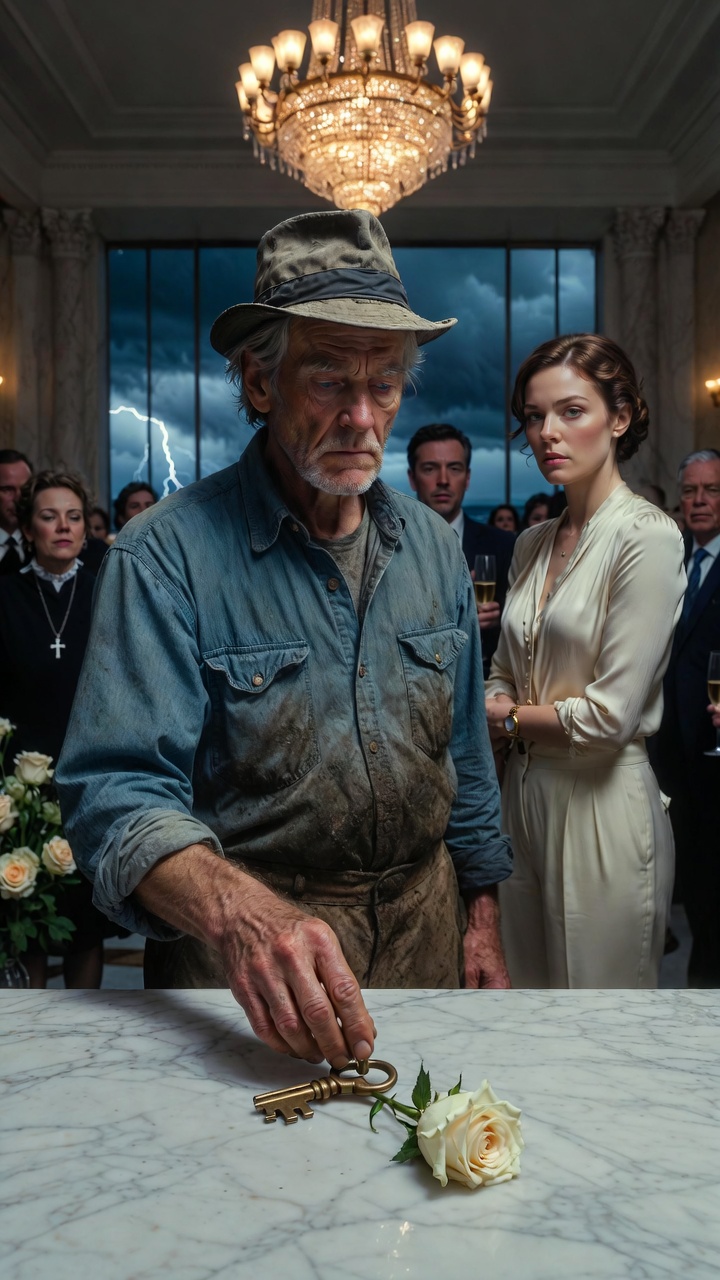
Walter reached into the pocket of his work pants and removed a small brass key.
Old.
Heavy.
Not the kind used for utility sheds or staff lockers.
He placed it beside the rose.
The metal touched marble with a quiet click.
Rosa closed her eyes.
Eleanor looked at the key.
Miles stopped smiling.
At the far end of the foyer, an elderly man in a navy suit turned sharply, recognizing it.
Walter put his hat back on.
“Keep the rose inside,” he said. “Storm will break the stem.”
Then he walked toward the side entrance.
No one stopped him.
No one spoke.
The mud remained on the marble behind him.
And for the first time that evening, Eleanor wondered whether the thing she had just ruined was not the floor.
Chapter Two
The Name on the Deed
The storm arrived ten minutes after Walter Hayes left the house.
It did not begin politely.
Rain struck the glass walls of Whitestone Estate like thrown gravel. Wind bent the white rose bushes along the east hedge until their pale heads whipped toward the ground. The violinists on the terrace abandoned their instruments and ran beneath the awning. Guests stepped back from the windows, laughing nervously, pretending weather was entertainment when they were safe behind expensive glass.
Eleanor stood in the foyer staring at the brass key.
It still lay beside the rose.
The flower had opened slightly in the warm air, releasing a soft green scent beneath the heavier perfume of lilies, champagne, and wet wool coats.
Rosa knelt on the marble with a white towel.
She wiped the mud slowly.
Too slowly.
“Rosa,” Eleanor said.
The housekeeper did not look up.
“Yes, Ms. Whitmore?”
“What is that key?”
Rosa pressed the towel against one footprint until the brown water spread.
“A key.”
“To what?”
Rosa finally looked at her.
“To a door you should have asked about before you fired the man who carried it.”
Eleanor’s mouth tightened.
“I don’t appreciate riddles.”
“No,” Rosa said, standing. “You prefer instructions.”
Miles laughed softly behind Eleanor, but it had lost some of its confidence.
“Come on,” he said. “It’s probably some old groundskeeper superstition. Big estates collect these characters.”
Rosa turned to him.
“Characters?”
Miles lifted both hands. “No offense.”
“People like you always say that after giving it.”
The color rose in his face.
Eleanor stepped between them. “Enough.”
But the word had no weight now.
Something had shifted.
The foyer no longer felt like a stage she controlled. It felt like a house listening.
From the far end of the hall, a man in a navy suit approached with careful steps. He was in his seventies, thin, with white eyebrows and the anxious posture of someone carrying information heavier than his bones.
“Ms. Whitmore,” he said.
Eleanor recognized him as Arthur Bell, one of the estate trustees.
“Yes, Mr. Bell?”
His eyes moved to the brass key.
“Where did you get that?”
“Mr. Hayes left it.”
Arthur’s face changed.
“How long ago?”
“Ten minutes.”
“You let him leave?”
“I dismissed a groundskeeper who walked mud through the main foyer during a donor reception.”
Arthur stared at her.
Not rudely.
Worse.
As if she had spoken nonsense in a language everyone else understood.
Miles stepped in smoothly. “Arthur, surely we’re not turning a staffing issue into a crisis.”
Arthur ignored him.
“Where is Walter now?”
Eleanor looked toward the side entrance.
“Outside, I assume.”
“In this storm?”
“He chose to leave.”
“No,” Rosa said. “She made him.”
The words cut cleanly through the foyer.
Guests nearby stopped pretending not to listen.
Eleanor felt her control slipping and reached for professionalism like a rail on a staircase.
“Mr. Bell, with respect, if Mr. Hayes is valuable to the estate, I am happy to revisit the decision tomorrow.”
Arthur’s voice dropped.
“Mr. Hayes is not valuable to the estate.”
Eleanor exhaled.
“Then—”
“He is the estate.”
The chandelier seemed to hum above her.
Miles lowered his glass.
“I’m sorry?”
Arthur looked at him once, then back to Eleanor.
“Walter Hayes owns Whitestone.”
The sentence moved through the room with no visible force, yet every person seemed struck by it.
A server froze.
A guest whispered, “What?”
Rosa looked down at the towel in her hands.
Eleanor did not speak.
For several seconds, her mind refused the shape of the truth.
Walter Hayes.
Muddy boots.
Old hat.
Pruning shears.
The white rose.
The brass key.
No.
No, because owners did not enter through side doors carrying hoses. Owners did not apologize to housekeepers. Owners did not let event curators fire them in front of guests.
Unless they wanted to know something.
Eleanor looked at Arthur.
“That’s impossible.”
Arthur’s face held no satisfaction.
“His grandfather built the first house on this land. Walter bought the surrounding properties one by one over forty years. He placed Whitestone under a private cultural trust after his daughter died.”
Miles recovered first.
“Well,” he said with a laugh too bright to be real, “that’s charmingly eccentric.”
Arthur turned to him.
“It is not eccentric to walk through your own home.”
Silence fell.
The rain hammered the windows harder.
Eleanor felt suddenly aware of her clothes, her posture, the gold watch on her wrist, the way she must have looked standing over an old man with mud on his boots and a rose in his hand.
The old shame she thought she had buried rose in her chest.
Not the shame of being poor.
The shame of becoming someone her younger self would have feared.
Rosa placed the muddy towel into a silver basin.
“He tests people sometimes,” she said quietly.
Eleanor turned.
“What?”
Rosa looked toward the storm-darkened windows.
“Not for fun. Not to humiliate them. He says beautiful houses attract people who love beauty, money attracts people who love power, and staff uniforms reveal who thinks kindness is optional.”
Miles scoffed. “This is absurd.”
Arthur’s eyes remained on Eleanor.
“Tonight’s reception was his final review for the new Whitestone cultural director.”
Eleanor’s breath caught.
The position.
The foundation.
The board members.
The careful introductions.
The entire evening.
Arthur continued, each word measured. “Mr. Hayes insisted the candidate be given full authority for one event. No interference. No warning. He wanted to see not only what she could build, but who she became while building it.”
Eleanor’s hand went cold.
Miles took a step back.
“Candidate?” he said.
Arthur did not look at him.
“Ms. Whitmore was the candidate.”
The room blurred slightly at the edges.
Eleanor reached for the console beside the rose.
Her fingers touched marble.
Cold.
Hard.
Real.
Outside, lightning flashed over the hedges.
For one white second, the whole lawn appeared: the reflecting pool trembling under rain, the terrace abandoned, the rose bushes bending violently, the east hedge flooding exactly as Walter had warned.
The sprinklers.
The broken line.
The thing she had dismissed.
Eleanor turned toward the windows.
“Where would he go?”
Rosa answered immediately.
“The rose garden.”
“In this weather?”
“He always goes there when he’s hurt.”
No one moved.
That was the part Eleanor would remember later.
Not Arthur’s revelation.
Not Miles’s cowardly silence.
The stillness.
A room full of elegant people waiting for someone else to become decent first.
Eleanor looked at the brass key.
Then at the rose.
Then at the footprints Rosa had not fully cleaned away.
She picked up the key.
Miles caught her arm.
“Eleanor,” he whispered, “be careful. If he’s angry, let Arthur handle it. You can still recover this. Apologize strategically. Don’t run into the rain like staff.”
She looked at his hand on her arm.
Then at his face.
He had said the wrong word.
Not because it was cruel.
Because it was honest.
She pulled away.
“I was staff.”
Miles blinked.
“What?”
“My mother cleaned houses in Southampton for women who smiled like you.”
His expression hardened.
“This is not the time for a childhood confession.”
“No,” Eleanor said. “It’s the first honest thing I’ve said tonight.”
She turned and walked toward the side entrance.
Rosa followed two steps behind and handed her a black raincoat from the service hook.
Eleanor looked at it.
Staff raincoat.
Plain.
Practical.
Invisible.
For a heartbeat, she almost refused it.
Then she put it on.
The rain hit her like judgment.
Chapter Three
The Rose Garden
The east lawn had become a sheet of black glass.
Eleanor’s shoes sank into wet grass with each step. Rain flattened her hair against her face and soaked through the collar of the borrowed raincoat. The gold watch on her wrist disappeared beneath a sleeve meant for someone who worked with their hands.
Behind her, the mansion blazed with light.
Ahead, the rose garden bent under the storm.
She found Walter Hayes near the hedge, kneeling in mud.
Not collapsed.
Working.
Of course he was working.
Water gushed from a broken irrigation line near the roots of the oldest rose bed. Walter had one hand pressed against the pipe and the other buried in wet soil, trying to redirect the flow away from the plants. His hat was gone. Rain ran through his silver hair and down the deep lines of his face.
The white roses around him thrashed in the wind.
Some had already broken.
Eleanor stopped at the edge of the garden.
For once, she did not know how to enter a room.
“Mr. Hayes.”
He did not turn.
“You’ll ruin those shoes.”
She looked down.
Her cream heels were brown with mud.
“I think the shoes deserved it.”
A faint sound came from him.
Not quite a laugh.
She stepped closer.
“I didn’t know.”
“No,” he said. “You didn’t ask.”
Rain struck her face.
She accepted it.
The words too.
“I’m sorry.”
Walter worked the soil around the pipe.
“For firing me?”
“For that. For the way I said it. For using the room against you.”
He looked up then.
His eyes were pale blue, almost gray in the storm.
“Rooms don’t do anything. People do.”
Eleanor nodded.
Water soaked the front of her blouse beneath the raincoat. Her hair had escaped its perfect bun. Mud clung to her calves.
She looked, finally, like a person weather could touch.
“Arthur told me who you are.”
Walter returned his attention to the pipe.
“I wondered how long it would take.”
“I failed your test.”
“Yes.”
The answer was so plain it hurt more than anger.
She swallowed.
“Is there any way to fix it?”
He pushed a stone against the rushing water.
“Which part?”
She had no answer.
The event? The job? His trust? Rosa’s humiliation? The years she had spent sanding down every soft part of herself until only polish remained?
Walter looked toward the mansion.
Through the rain, wealthy guests clustered behind the glass, watching.
Tiny faces.
Safe faces.
Curious faces.
“Do you know why I built the rose garden here?” he asked.
Eleanor shook her head.
“My daughter loved this part of the property. She said rich people always put beauty where guests could admire it. She wanted beauty where workers passed on their way home.”
Eleanor looked at the path behind the hedge.
Narrow.
Gravel.
The service path.
Her throat tightened.
Walter pressed his hand harder against the pipe.
“She married a man who smiled at donors and stepped over waiters. I thought he was ambitious. I mistook polish for character. By the time I saw the truth, she had learned to apologize for taking up space in her own life.”
His voice did not break.
That made it worse.
“She died at thirty-nine,” he said. “Not because of him. Not directly. But cruelty doesn’t need to kill you all at once. Sometimes it just teaches you not to call for help.”
Rain ran down Eleanor’s face.
She did not know which part was weather.
“I’m sorry,” she whispered.
Walter glanced at her.
“This house does not need another person who can impress a room. It has had plenty of those.”
Eleanor looked back at the mansion.
At Miles behind the glass.
At Arthur.
At the guests.
At Rosa standing near the terrace doors, watching with her arms wrapped tightly around herself.
“What does it need?” Eleanor asked.
Walter lifted his muddy hand from the pipe and pointed to the old brass valve half-hidden beneath a stone border.
“That turned a quarter turn clockwise will stop the flooding.”
Eleanor stared at him.
Then she laughed once.
Wet. Broken. Honest.
“You’re making me do garden work?”
“I’m giving you a chance not to make a speech.”
She stepped into the rose bed.
Mud swallowed one heel completely.
She pulled her foot free, kicked off both shoes, and knelt beside the valve. The brass was slick with rain. Her manicured fingers slipped once, twice. Mud pushed beneath her nails.
From the house, someone opened the terrace door.
Miles’s voice carried across the lawn.
“Eleanor! What are you doing?”
She did not look back.
She gripped the valve with both hands and turned.
Nothing happened.
She turned harder.
The brass cut into her palm.
Then the pipe shuddered.
The rush of water slowed.
Stopped.
The rose bushes still whipped in the storm, but the bed no longer flooded.
Walter sat back on his heels.
For several seconds, they listened to the rain.
Eleanor’s chest rose and fell.
Her hands were muddy.
Her trousers were ruined.
Her watch was scratched.
She had never looked less like the woman she had spent years becoming.
Walter looked at her hands.
“Your mother ever make you clean silver?”
Eleanor blinked.
“Yes.”
“Mine too.”
She looked at him.
He smiled faintly.
The mansion lights glowed behind him, turning the rain into falling gold.
“I don’t think I should be the director,” Eleanor said.
“No?”
“No. Not tonight.”
“Good.”
The word struck her strangely.
Walter stood slowly, his joints stiff, but his back still straight.
“The wrong person would have begged for the title first.”
Eleanor looked down at her muddy hands.
“What happens now?”
Walter picked up a broken white rose from the ground.
Its stem had snapped, but the bloom was intact.
“Now you go back inside.”
“And?”
“And you tell Rosa, in front of the same people, that you were wrong.”
Eleanor’s stomach tightened.
The room.
The guests.
Miles.
Her reputation.
Walter watched the thoughts cross her face.
“There it is,” he said.
“What?”
“The part of you still deciding whether dignity is worth more when rich people are watching.”
She closed her eyes.
Thunder rolled over the ocean.
When she opened them, she saw the mansion differently.
Not as a prize.
As a witness.
“Will you come with me?” she asked.
Walter held out the broken rose.
“No.”
She took it.
“Why?”
“Because if you only do it beside the owner, you still haven’t learned.”
Chapter Four
The Apology
When Eleanor walked back into Whitestone Estate, the foyer fell silent for the second time that night.
She was barefoot.
Her trousers were ruined.
Her hair had come undone completely, wet strands clinging to her cheeks and neck. Mud streaked one sleeve of the borrowed black raincoat. In her right hand, she held the broken white rose.
No one laughed.
Miles looked as though he wanted to.
Then he saw her face.
Rosa stood near the staircase with a dry towel in her hands.
Not moving.
Eleanor crossed the marble slowly, leaving new muddy footprints beside Walter’s old ones.
Arthur Bell watched from the console.
The brass key was gone.
Eleanor had it in her pocket.
She stopped in front of Rosa.
The room waited for a performance.
Eleanor had built a career on performances.
This time, she had none prepared.
“I was wrong,” she said.
Her voice shook.
She let it.
“I humiliated Mr. Hayes in front of this room. Then I ordered you to clean up the evidence of my arrogance.”
Rosa’s eyes did not soften.
Not yet.
Eleanor continued.
“I treated his work as if it mattered less because it happened outside. I treated your dignity as if it could be managed like part of the event.”
The rain beat against the windows.
No one touched a glass.
No one checked a phone.
Eleanor looked around the foyer.
At the donors.
The trustees.
The guests who had watched her become powerful in the smallest possible way.
“And I did it because I was afraid,” she said.
Miles shifted.
“Eleanor,” he warned quietly.
She ignored him.
“I was afraid that if I did not control every inch of this house, someone would realize I was once the girl carrying trays through rooms like this. I thought becoming polished meant I had escaped being looked down on.”
She turned back to Rosa.
“But tonight, I became the person doing the looking down.”
Rosa’s jaw trembled once.
Eleanor held out the broken rose.
“I’m sorry.”
Rosa looked at the flower.
Then at Eleanor.
“Don’t apologize because he owns the house.”
“I’m not.”
“Don’t apologize because the room changed sides.”
Eleanor swallowed.
“I know.”
Rosa studied her for a long moment.
Then she took the rose.
Not forgiveness.
Not yet.
But not refusal.
Behind them, Miles clapped once.
The sound cracked through the foyer.
“Well,” he said, smiling too broadly, “that was very moving. Very humble. I think we can all agree emotions ran high, but no permanent harm was done.”
Eleanor turned.
Miles was already recovering the room.
That was his gift.
He could make cruelty sound like weather.
“Mr. Harrington,” Arthur said.
But Eleanor lifted a hand.
“No. Let him finish.”
Miles’s smile flickered.
“I only mean,” he said, “Walter is obviously an eccentric man with a flair for theatrics. I’m sure once everyone calms down, we can return to the actual purpose of the evening.”
“And what is that?” Eleanor asked.
“The future of Whitestone.”
Rosa held the broken rose against her chest.
Arthur’s eyes narrowed.
Miles stepped closer, lowering his voice just enough to pretend intimacy while still allowing important people to hear.
“You have already damaged yourself tonight. Don’t make it worse by turning against the people who can still protect you.”
There it was.
The offer.
The old bargain.
Belong, and we will forgive you.
Tell the truth, and stand alone.
Eleanor looked at the muddy footprints on the marble.
Her own now mingled with Walter’s.
“No,” she said.
Miles stared.
“No?”
“No.”
The word was small.
But it entered the room like a door opening.
Eleanor reached into her pocket and removed the brass key.
Several guests reacted at once.
Arthur’s hand came to his mouth.
Miles’s eyes dropped to it.
Eleanor placed the key on the marble console beside the remaining clean roses.
“I don’t know whether Mr. Hayes will ever trust me with this house,” she said. “After tonight, maybe he shouldn’t.”
She looked at Rosa.
“But if Whitestone stands for anything, it cannot be the comfort of people who mistake kindness for weakness.”
The front door opened.
Wind pushed rain into the foyer.
Every head turned.
Walter Hayes stood in the doorway.
No hat.
Mud to his knees.
White hair wet against his forehead.
He looked less like a gardener now.
Not because he had changed.
Because the room had.
Eleanor felt the difference immediately.
The guests straightened.
Miles went still.
Arthur bowed his head slightly.
Walter stepped inside, leaving another footprint on the marble.
This time, nobody asked Rosa to clean it.
Walter looked at the brass key.
Then at the broken rose in Rosa’s hand.
Then at Eleanor.
For several seconds, he said nothing.
The silence stretched until it became unbearable.
Finally, Miles stepped forward with his expensive smile.
“Mr. Hayes, I think we all owe you—”
Walter raised one muddy hand.
Miles stopped.
Just like that.
Power did not need volume.
Walter looked past him.
“Rosa.”
“Yes, Mr. Hayes?”
“Would you bring towels for the staff first?”
Rosa’s eyes filled.
“Yes, sir.”
He turned to the room.
“Everyone else can wait.”
No one argued.
Walter stepped toward Eleanor.
She stood very still.
He reached into the pocket of his muddy work pants and removed a folded paper, sealed in a clear protective sleeve.
Arthur’s expression changed.
Eleanor saw it.
“What is that?” she asked.
Walter held it out.
“The director’s contract.”
Her throat tightened.
“I told you I don’t deserve it.”
“I heard you.”
“Then why—”
“I didn’t say it was for you.”
He placed the contract on the console beside the key.
Eleanor looked at it.
Then at Rosa.
Rosa froze halfway across the foyer, towels in her arms.
Walter’s eyes moved to her.
“Whitestone needs someone who already knows which doors people are forced to use.”
The room went utterly still.
Rosa’s lips parted.
Miles looked as if the floor had vanished under him.
Eleanor felt something break in her chest.
Not humiliation.
Relief.
The kind that comes when justice does not flatter you, but still lets you witness it.
Walter turned back to Eleanor.
“You may stay,” he said. “If Rosa wants you on her team.”
Rosa looked at Eleanor.
For the first time that night, Eleanor did not try to control what anyone saw on her face.
She simply waited.
Rosa held the towels against her chest.
Then she said, “We’ll start with the service entrance.”
Eleanor nodded.
“What about it?”
Rosa looked toward the side hall.
“We’re making it a front door.”
Walter smiled faintly.
Outside, the storm began to soften.
Inside, the mud remained on the marble a little longer.
Not as a stain.
As evidence.

