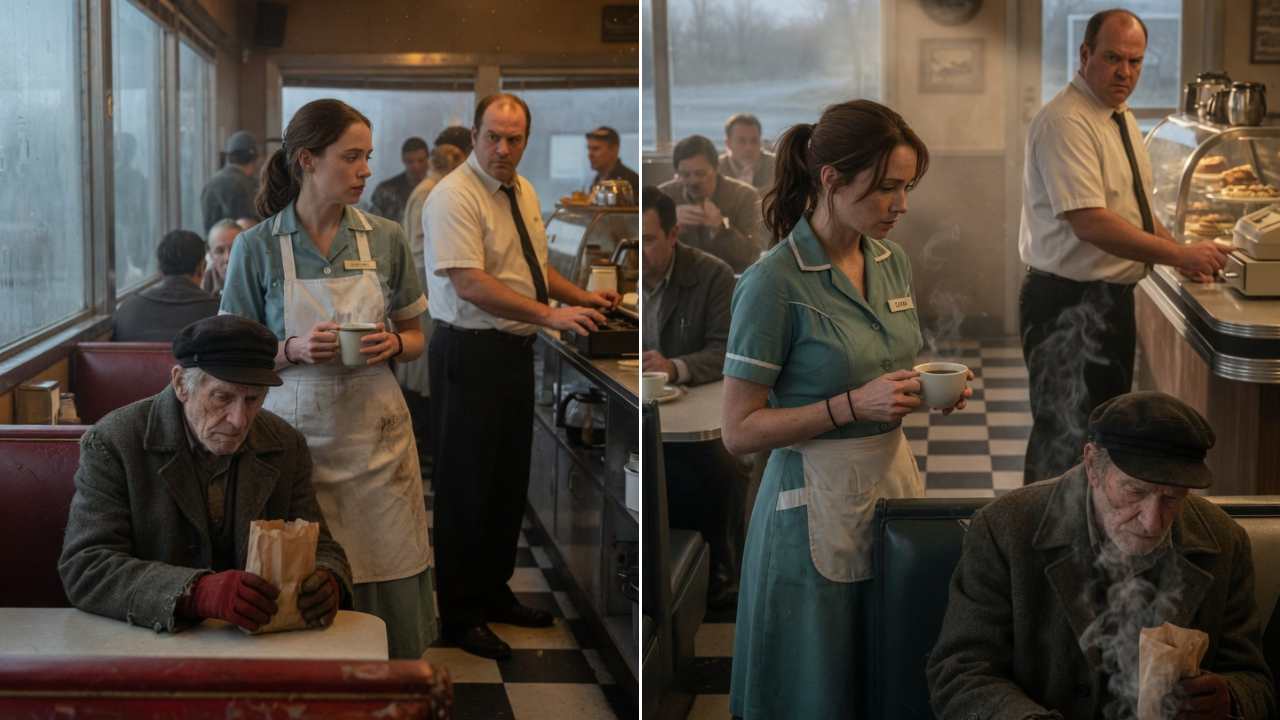
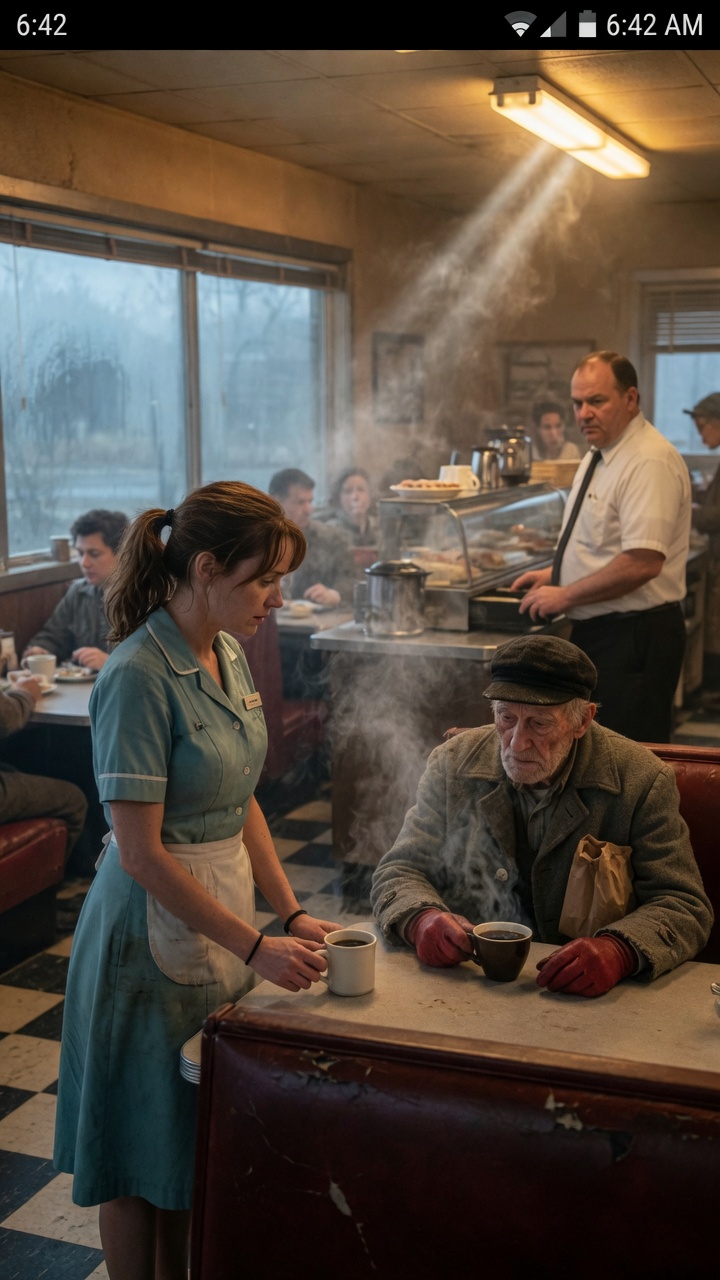
The bell above the diner door rang at 6:42 a.m., soft and tired, like it had been awake longer than everyone else.
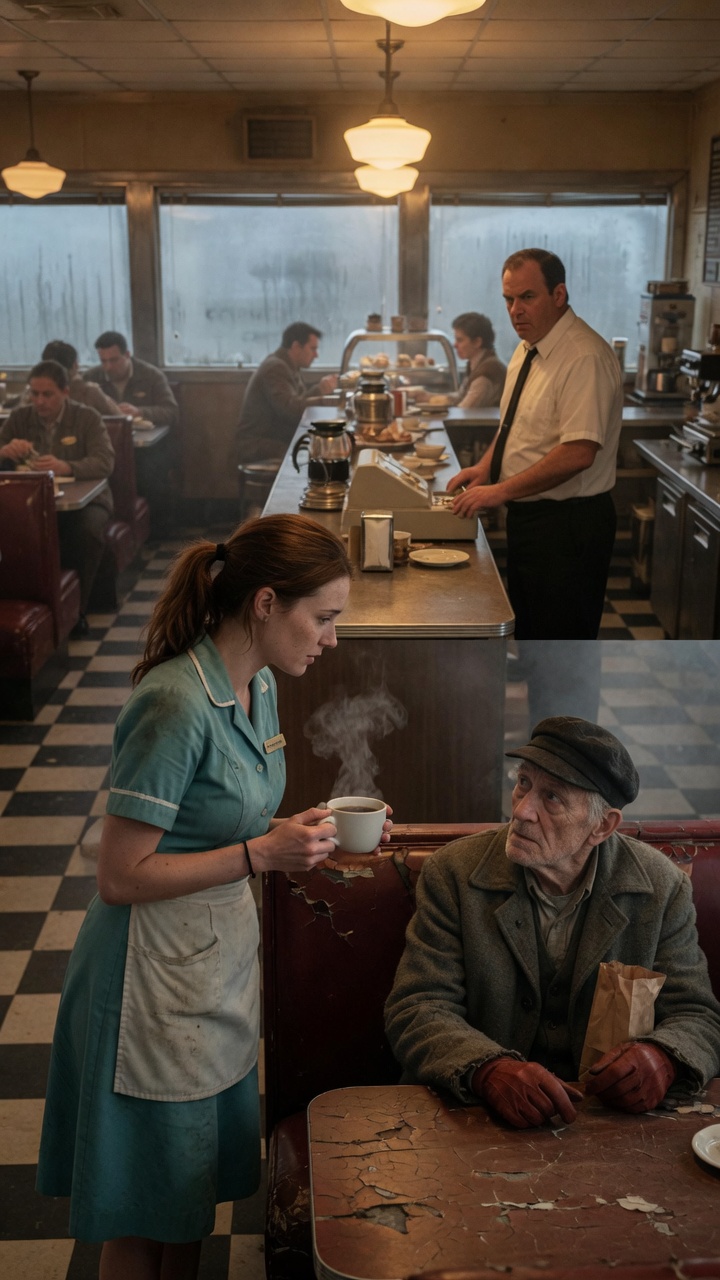
Clara Bennett looked up from refilling the napkin holders and smiled before she even saw his face.
“Morning, Mr. Abe.”
The old man stood in the doorway with his wool cap pulled low over his ears, his gray coat buttoned wrong, and a paper bag tucked carefully under one arm.
He looked frozen down to the bone.
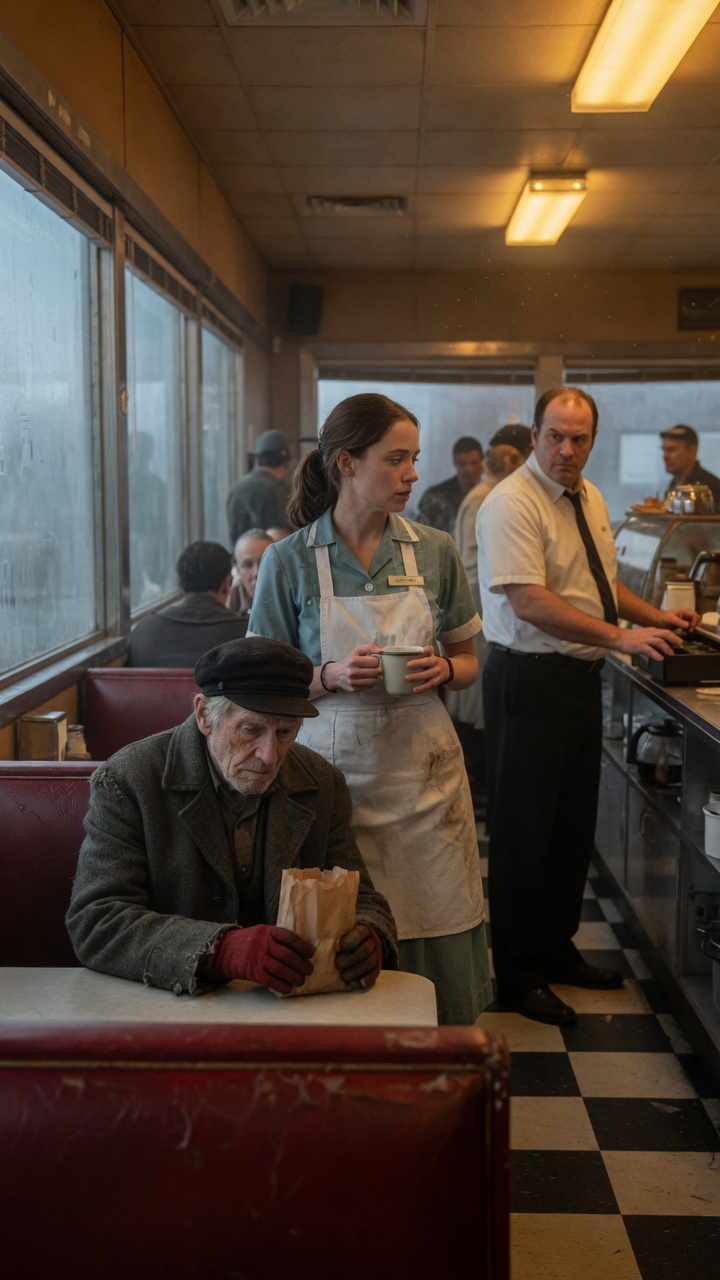
“There’s always coffee left for you.”
Behind the counter, Miles Crawford, the diner manager, looked up from counting the drawer.
“Clara,” he warned.
She ignored him.
She poured a mug, added two sugars and a splash of cream, then carried it to the booth by the window. The same booth Abe had sat in every Tuesday and Friday morning for almost two years.
He lowered himself slowly onto the cracked vinyl seat.
“You’re limping worse today,” Clara said.
“Old sidewalks and older knees,” he replied.
She tapped the order pad against her palm. “Let me guess. Two eggs over easy, wheat toast, hash browns extra crispy.”
Abe smiled. “You remember too much.”
“Only the important things.”
She turned toward the kitchen window. “Ray, one farmhouse plate. Extra crispy on the browns.”
Miles slammed the cash drawer shut.
“Is he paying this time?”
The diner went quiet enough for Clara to hear the grill hiss.
Abe’s eyes dropped to the table.
Clara forced a calm smile. “It’s on me.”
“No,” Miles said. “Not today.”
Clara turned slowly. “Miles.”
He stepped out from behind the counter, lowering his voice just enough to pretend he wasn’t making a scene.
“You already covered him twice this week.”
“He’s hungry.”
“So are half the people in this town. We are not a charity.”
Abe reached into his coat pocket with trembling fingers. “I have some change.”
Clara put her hand gently over his. “Keep it.”
Miles saw that. His jaw tightened.
“One more free meal,” he said, loud enough for the morning crowd to hear, “and you can find another place to wear that apron.”
A woman at table four stopped stirring her coffee.
Ray, the cook, looked through the pass window but said nothing.
Clara felt heat crawl up her neck.
Abe whispered, “Sweetheart, I can go.”
“No,” Clara said, sharper than she meant to. Then softer, “No. You’re staying.”
She walked to the kitchen window and picked up the plate when Ray slid it out.
Miles watched her carry it across the room.
When she set the food in front of Abe, the old man looked at it like it was something holy.
“You shouldn’t risk your job for me,” he said.
Clara sat across from him for just a second. Her feet were already aching, and her shift had barely begun.
“Mr. Abe, I’ve risked worse things for less deserving people.”
He looked at her with pale gray eyes that always seemed to know when she was lying.
“One day,” he said, “you’ll understand that kindness doesn’t disappear. It travels. It circles. It comes back.”
She smiled faintly. “You say that every week.”
“And every week you still need to hear it.”
By nine-thirty, the diner was full.
That was when the man in the camel coat walked in.
Everyone noticed him.
He wore polished shoes, a gold watch, and the expression of someone who believed the room should rearrange itself around him. His wife followed behind him, wrapped in a cream-colored scarf, her perfume reaching the counter before she did.
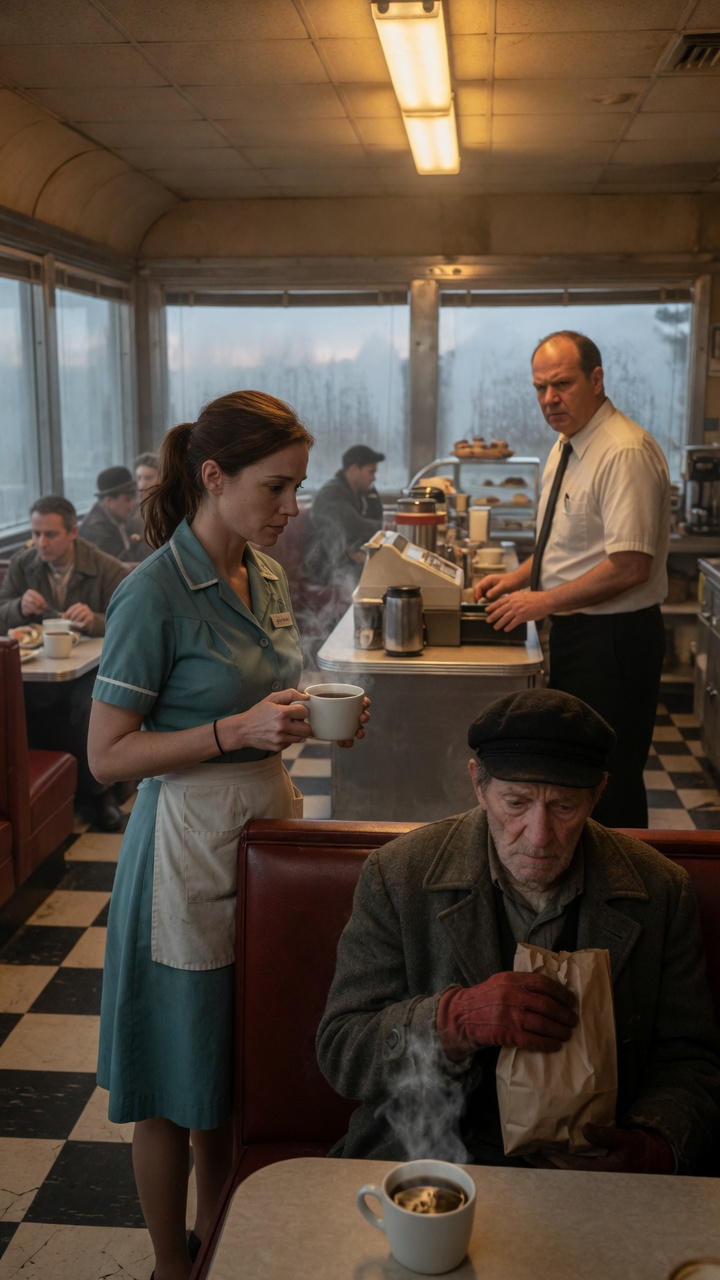
Miles rushed over.
“Mr. Whitcomb. Good morning. Your usual booth?”
The man glanced toward the window and frowned.
Abe was still there, slowly finishing his toast.
“That booth,” Mr. Whitcomb said, “is occupied.”
Miles stiffened. “I’m sorry, sir. We can seat you over here.”
“I don’t want over here.”
His eyes slid over Abe’s coat, his worn gloves, the paper bag beside him.
“Is this what you’re allowing in here now?”
Clara froze beside the coffee station.
Abe lowered his head.
Miles gave a nervous laugh. “He’s just finishing up.”
Mr. Whitcomb’s voice grew louder. “I bring clients here. My family has eaten here for twenty years. I shouldn’t have to sit next to a vagrant while I’m having breakfast.”
The word hit the room like a dropped plate.
Clara walked over before she could stop herself.
“His name is Abe,” she said.
Mr. Whitcomb turned to her slowly. “Excuse me?”
“His name is Abe. And he’s a customer.”
The man looked at Abe’s plate, then back at her.
“Did he pay?”
Clara didn’t answer.
He smiled coldly. “That’s what I thought.”
Miles grabbed Clara’s elbow and pulled her a few steps away.
“Back. Kitchen. Now.”
She yanked her arm free. “Don’t touch me.”
His face darkened. “You are on your last warning.”
Abe stood, unsteady, gathering his paper bag.
“Please,” he said quietly. “I’ve caused enough trouble.”
Clara turned toward him. “You didn’t cause anything.”
But he was already moving toward the door.
As he passed her, he stopped and placed something in her hand.
A butterscotch candy. Wrapped in gold paper.
“For later,” he said.
Then he stepped out into the cold.
Clara watched him through the window as he crossed the parking lot, his shoulders bent against the wind.
She didn’t know it would be the last time she would see him alive.
Three days passed.
Then five.
Abe didn’t come in Tuesday.
He didn’t come in Friday.
Clara checked the booth every time the bell rang.
Ray noticed first.
“You looking for your old man?”
“He always tells me if he’s going somewhere.”
Ray scraped the grill. “Clara, people like him don’t exactly keep a calendar.”
“He’s not ‘people like him.’ He’s Abe.”
On Monday morning, Clara found a yellow paper taped to the door of her apartment.
NOTICE TO VACATE.
Her landlord had underlined the amount due in red ink.
$1,175.
She stood in the hallway above the laundromat, holding the notice while the washing machines thudded beneath her feet.
Her rent was late. Again.
Her phone buzzed with a message from Miles.
Don’t be late. We need to talk.
She folded the eviction notice and put it in her purse next to her bus pass, three dollars in loose bills, and Abe’s butterscotch candy.
Then she walked to work because she couldn’t afford the gas.
The diner smelled like burnt coffee and bacon grease when she arrived.
Miles was waiting.
“Office,” he said.
“I’m already clocking in.”
“Office.”
She followed him past the kitchen, past Ray, past the storage shelves stacked with ketchup boxes and paper cups.
Miles closed the door.
“I checked the register records,” he said. “You’ve comped that old man thirty-seven meals.”
“I paid for most of them.”
“With tips that should be going toward your own life. Not my problem. But when regulars complain, it becomes my problem.”
“Mr. Whitcomb called?”
“He did. And he said he won’t bring his breakfast group back unless we clean up the atmosphere.”
Clara stared at him. “The atmosphere?”
“You know what I mean.”
“No, Miles. I really want to hear you say it.”
His mouth tightened. “You’re not paid to save every stray who walks through the door.”
She flinched.
He saw it and kept going.
“You think being soft makes you good? It makes you stupid. And stupid employees cost money.”
She pulled the eviction notice from her purse and laid it on the desk.
“Do you think I don’t know what money is?”
For one second, his expression shifted.
Then he looked away.
“That’s not my responsibility.”
“No. It isn’t.”
She picked up the notice.
He opened the office door.
“We’ll finish this after the breakfast rush.”
But they didn’t finish it after breakfast.
They finished it in front of everyone.
At 10:18 a.m., Mr. Whitcomb returned with two men in suits and sat at the booth by the window.
Abe’s booth.
Clara served them coffee without a word.
Mr. Whitcomb looked at her name tag.
“Clara, is it?”
“Yes.”
“I hope your friend found another doorway to haunt.”
One of the men laughed under his breath.
Clara’s hand tightened around the coffee pot.
“Sir, I’m going to pretend I didn’t hear that.”
His smile vanished. “Careful.”
Miles appeared behind her. “Is there a problem here?”
Mr. Whitcomb leaned back. “That depends. Do you still employ waitresses who insult customers?”
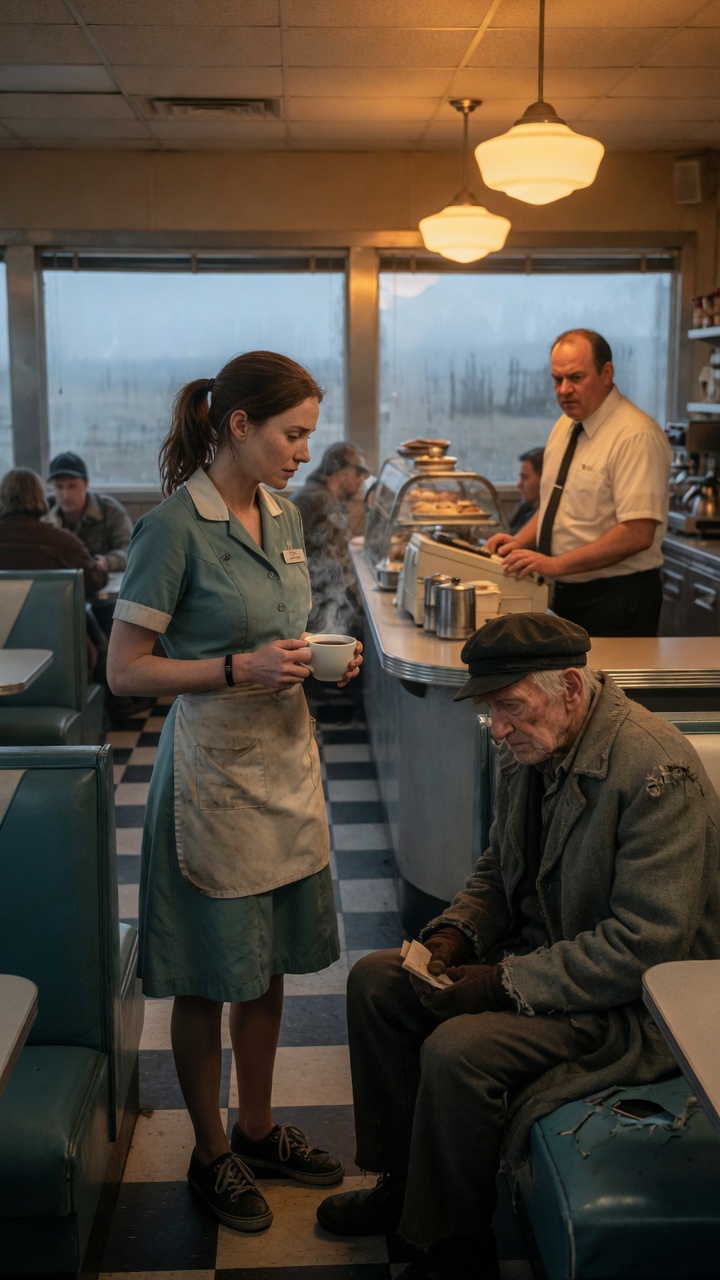
Miles turned to Clara, face red.
“Counter. Now.”
The diner went silent again.
Ray stopped cooking.
Clara walked to the counter and set the coffee pot down carefully, because if she didn’t, she might throw it.
Miles pointed toward the register.
“I warned you. I warned you more than once. You embarrassed this business, you disrespected a valued customer, and you’ve been giving away food like you own the place.”
Clara’s throat tightened.
“I never stole from you.”
“You stole control. You made decisions you had no right to make.”
“I fed a hungry old man.”
“You fed a problem.”
Something in her broke.
“No,” she said. “I fed a person.”
Miles’s face hardened.
“Take off the apron.”
The bell above the door rang.
No one turned at first.
Then the room shifted.
A man in a navy overcoat stepped inside, carrying a leather briefcase. He had silver hair, sharp eyes, and the quiet confidence of someone who didn’t need to raise his voice.
Behind him, parked outside the window, was a black town car.
The man scanned the diner.
“I’m looking for Clara Bennett.”
Clara’s hand froze on the knot of her apron.
“That’s me.”
The man walked toward her.
“My name is Jonathan Pierce. I’m an attorney with Pierce, Halden & Rowe. May I speak with you privately?”
Miles blinked. “She’s in the middle of being terminated.”
The attorney looked at Miles for the first time.
“Then I arrived just in time.”
Mr. Whitcomb frowned from the booth.
“Who is this?”
Jonathan Pierce ignored him.
Clara swallowed. “Is this about Abe?”
The attorney’s expression softened.
“Yes. Abraham Whitaker.”
Her knees nearly gave out.
“Is he okay?”
Jonathan removed his glasses slowly.
“I’m very sorry. Mr. Whitaker passed away last Wednesday morning. Peacefully, at home.”
“At home?” Clara whispered.
Miles looked confused. “Home?”
The attorney turned toward the room, then back to Clara.
“Miss Bennett, Mr. Whitaker asked that I deliver a letter to you in person. He was very specific that it be done here.”
He opened his briefcase and removed a cream envelope.
Her name was written across the front in thin, shaking handwriting.
Clara.
She took it with both hands.
The diner was so quiet she could hear the clock over the pie case.
She opened the envelope.
My dear Clara,
If Mr. Pierce is handing you this, then I have already taken my final walk home.
I am sorry I did not say goodbye. You would have tried to make me soup, and I would have had to pretend I could still eat it.
I owe you the truth.
My name is Abraham Whitaker. I was never homeless. The old coat was real enough, but the story people invented around it was not. Forty-eight years ago, I built Whitaker Industrial Supply from a single rented garage. I sold part of it when my wife Ruth became ill, kept the rest, and spent the last decade with more money than company.
Ruth and I had one son. We lost him when he was twenty-one. After Ruth died, the house became too large, the rooms too quiet, and every dollar I had felt like a locked door with no one behind it.
When the doctors told me my heart was failing, I decided to do one useful thing before I left.
I went searching for someone who could be kind without an audience.
I sat in diners, bus stations, hospital cafeterias, and coffee shops. I watched how people treated an old man they believed had nothing to offer.
Most looked away.
Some were cruel.
A few were polite.
But you, Clara, were kind when it cost you something.
You gave me coffee when your hands were shaking from exhaustion. You paid for my breakfast when your own rent was late. You defended my name when people tried to reduce me to a stain on the floor.
You once told me you were afraid your life would always be small.
Listen to me now.
A life is not small because the apartment is small. A person is not poor because the world refuses to see their wealth.
You were rich in the only currency that mattered to a lonely old man.
So I have left you what I no longer need.
The house on Ashbury Lane. My remaining shares in Whitaker Industrial. My personal accounts. The charitable trust Mr. Pierce will help you direct. After taxes and obligations, the estate is worth approximately eighteen million dollars.
Do not let that number frighten you.
Money is only a tool. Use it to protect what is gentle in you. Use it to feed people. Use it to build rooms where no one is made to feel invisible.
And remember what I told you.
Kindness travels in circles.
Send it out bravely.
It knows the way home.
With gratitude,
Abe
Clara was crying before she reached the end.
Not pretty crying. Not movie crying.
The kind that folded her in half and stole the air from her chest.
Ray came around from the kitchen and stood near her, wiping his hands on a towel he didn’t need.
Miles said nothing.
Mr. Whitcomb had gone pale.
The attorney waited until Clara could breathe again.
Then he spoke clearly, for the whole diner to hear.
“Miss Bennett, Mr. Whitaker also left instructions regarding this establishment.”
Clara looked up, confused.
Jonathan opened another folder.
“He purchased the building three months ago through a holding company. As of his passing, ownership transfers to you.”
Miles gripped the counter. “What?”
Jonathan continued, calm as winter.
“That includes the diner, the parking lot, and the upstairs office space.”
Mr. Whitcomb stood abruptly. “This is absurd.”
The attorney looked toward him.
“Mr. Whitaker also requested that I inform you personally that your company’s pending supply contract with Whitaker Industrial has been declined.”
The man’s mouth opened.
Nothing came out.
Clara stared at Jonathan. “He bought the diner?”
“Yes.”
“Why?”
The attorney’s voice softened again.
“He said this was where he remembered how to feel human.”
Miles stepped back as if the floor had moved under him.
Clara looked at him, at the apron still tied around her waist, at the counter she had wiped a thousand times, at the booth where Abe had sat with cold hands wrapped around warm coffee.
Then she untied the apron.
Miles exhaled like he was relieved.
She folded it once and placed it on the counter.
“I’m not quitting,” she said quietly.
Miles blinked.
Clara turned to Jonathan. “Can I fire him?”
Jonathan almost smiled.
“You own the building. The business transfer will take some paperwork, but yes, operational authority can be arranged immediately.”
Miles’s face drained.
“Clara, wait.”
She looked at him for a long moment.
For two years, he had watched Abe sit by the window and never once asked his last name.
For two years, he had watched her pay for meals and called it weakness.
For one second, anger rose hot and clean in her chest.
Then she thought of Abe.
Kindness travels in circles.
She breathed out.
“Miles,” she said, “you’re done for today. Go home. We’ll discuss your final paperwork tomorrow.”
“That’s it?”
“That’s more than you gave me.”
He didn’t argue.
When he left, the bell rang over his head.
No one clapped.
It was better that way.
Clara walked to Mr. Whitcomb’s table.
He avoided her eyes.
“Would you like more coffee?” she asked.
He looked startled. “I—no.”
She nodded.
“Then you can pay your check and leave. This diner won’t be the right atmosphere for you anymore.”
His wife stood first.
The men followed.
After they were gone, Ray let out a low whistle.
“Boss,” he said.
Clara laughed through her tears.
“Don’t call me that.”
“What should I call you?”
She looked at Abe’s booth.
For the first time all week, she smiled.
“Just Clara.”
Six months later, the diner had a new sign over the door.
ABE’S TABLE
Underneath, in smaller letters:
No One Leaves Hungry.
Clara kept the window booth exactly as it had been.
Every morning, she placed a cup of coffee there before opening. Two sugars. A splash of cream.
She paid off the back rent on her apartment building, then bought it from the landlord and lowered the rent for every tenant inside.
She gave Ray a raise and made him kitchen manager.
She turned the upstairs office into a small emergency fund for waitresses, cooks, dishwashers, single parents, widows, and anyone else who was one bad week away from losing everything.
And on the first cold Friday of November, a young woman came into the diner with a little boy asleep against her shoulder.
Her coat was too thin.
Her eyes were embarrassed.
She stood near the door and whispered, “I’m sorry. I don’t have any money. I just need something small for him.”
Clara felt Abe’s letter folded in her pocket, where she still carried it on hard days.
She picked up two menus.
“What’s your name?”
The young woman hesitated.
“Lena.”
Clara smiled.
“Well, Lena, breakfast is on the house.”
The woman’s eyes filled instantly.
“I can’t pay you back.”
Clara led her to the booth by the window.
“Yes, you can,” she said. “Someday, when life gives you the chance, be kind to someone who can’t pay you back.”
Outside, the wind lifted a handful of brown leaves from the sidewalk.
They spun once in the cold morning light and circled back toward the glass.
Clara watched them and thought of an old man with a paper bag, a gold-wrapped candy, and a heart big enough to hide eighteen million dollars behind a worn-out coat.
Kindness travels in circles, she thought.
And somehow, it always knows the way home.