The lawyer said my stepfather had left me a key.
Not money.
Not a house.
Not an apology.
Just a small brass key in a white envelope with my name written across the front.
Daniel Carter.
I stared at it on the lawyer’s desk and almost laughed.
Dale Mercer had not said my name out loud in thirty-one years.
The last time I saw him, I was nineteen years old, standing on the front porch with two cardboard boxes at my feet. My mother had been dead for twenty-six days. The house still smelled like her lavender lotion and the chicken soup she used to make when one of us was sick.
Dale stood in the doorway with his arms crossed.
“You need to start your own life now,” he said.
That was all.
No hug.
No explanation.
No “I’m sorry.”
Just the door closing behind him.
I carried those boxes to my car and drove away with everything I owned in the back seat.
After that, Dale became a name I tried not to think about.
Until the lawyer called.
“Mr. Carter?” the man asked.
“Yes.”
“My name is Walter Jennings. I handled Dale Mercer’s estate.”
I held the phone away from my ear for a second.
Dale Mercer.
I had not heard that name spoken by a stranger in decades.
“I think you have the wrong Daniel Carter,” I said.
“No, sir. I don’t.”
“Dale had children.”
“Yes. Brian and Stephanie.”
“Then call them.”
“I have. They received the majority of the estate.”
“That sounds right.”
“There was one item left specifically for you.”
I looked out my kitchen window at the bare maple tree in my backyard.
“What item?”
The lawyer paused.
“A storage unit.”
I said nothing.
“He paid it up for one year in advance,” Walter continued. “He left instructions that the key be given only to you.”
“His kids know about this?”
“No.”
“Why not?”
“Mr. Mercer was very clear on that point.”
I almost hung up.
There are some wounds that become part of your body after enough years. You stop noticing them, until someone presses a finger into the exact spot.
Dale Mercer was that wound.
He married my mother when I was eleven.
He did not hit me.
He did not shout much.
He was not cruel in the obvious way people recognize from movies.
That almost made it worse.
Dale’s dislike was quiet.
It lived in the spaces between words.
It lived in the way he bought Brian a new baseball glove and told me mine was “still good enough.”
It lived in the way Stephanie’s school picture was framed on the mantel while mine stayed in the envelope from the photographer.
It lived in Christmas mornings, when his children got gifts wrapped in bright paper with ribbons, and I got practical things.
Socks.
A jacket.
A calculator.
Mom tried to make up for it. She always did.
She would slip an extra book into my backpack. She would take me for ice cream after school. She would sit beside me at the kitchen table and ask about my day like every word mattered.
“You know Dale cares,” she used to say.
I never argued.
I just looked at her and nodded.
Because even as a boy, I understood something painful.
Sometimes mothers lie to protect the dream of a family.
Dale had two children before he married Mom.
Brian was three years older than me, loud and confident. Stephanie was a year younger, pretty and spoiled in the way only a child who has always been chosen can be.
They were not evil.
They were children.
But they knew the order of the house.
Dale first.
Then Brian.
Then Stephanie.
Then Mom.
Then me.
When I made the honor roll in eighth grade, Mom put the certificate on the refrigerator. The next morning, it was moved to the side so Stephanie’s cheerleading photo could be centered.
When I got a part-time job at a hardware store at sixteen, Dale said, “Good. Now you can start paying for your own things.”
When I got accepted to a state college, Mom cried so hard she had to sit down.
Dale read the letter and said, “Who’s covering tuition?”
That was Dale.
Practical.
Cold.
Always making sure I knew I was not his responsibility.
Then Mom got sick.
Ovarian cancer.
At first, everyone said the right things.
We’ll fight.
We’ll stay positive.
We’ll take it one day at a time.
But sickness changes a house.
It reveals the beams underneath.
Brian visited when it was convenient. Stephanie cried loudly, then disappeared for long stretches. Dale drove Mom to appointments in silence and came home looking older every time.
I was the one who learned her medication schedule.
I was the one who held the basin when the chemo made her sick.
I was the one who sat on the bathroom floor with her at two in the morning while she apologized for needing help.
“You don’t ever apologize to me,” I told her.
She touched my cheek.
“My sweet boy,” she whispered.
She died two weeks after my nineteenth birthday.
At the funeral, Dale stood beside Brian and Stephanie.
I stood on the other side of the casket.
I remember noticing that.
Even then.
After the burial, people came back to the house with casseroles and sad eyes. They told me my mother had been wonderful. They told me she was proud of me.
Dale barely looked at me.
Twenty-six days later, my boxes were on the porch.
For years, I hated him with a clean, simple hatred.
It was almost comforting.
I built a life around never needing him.
I finished school with loans and night shifts.
I married a woman named Ellen who had kind eyes and a laugh that could fill a room.
We had two daughters.
I worked for the post office for thirty-four years.
I buried Ellen after Alzheimer’s stole her slowly, piece by piece, until the woman I loved looked at me like a polite stranger.
By the time Dale’s lawyer called, I was sixty years old.
Old enough to know life is rarely simple.
Still young enough to be angry.
Three days after the phone call, I sat across from Walter Jennings in an office that smelled like coffee and old paper.
He was a thin man with silver hair and suspenders.
He slid the envelope across his desk.
The key inside was small, brass, and ordinary.
“There’s no letter?” I asked.
“Not with me.”
“What did Dale say was in the unit?”
“He wouldn’t tell me.”
“And he didn’t want Brian or Stephanie notified?”
“Correct.”
“That won’t make them happy.”
“No, sir.”
I picked up the key.
“Why would he leave anything to me?”
Walter looked down at the file.
“His exact words were, ‘Only Daniel opens it. Nobody else. If he throws the key away, that’s his choice.’”
I sat there for a long time.
Part of me wanted to leave the key on the desk.
Let the storage company auction off whatever was inside.
Let Dale’s last secret rot behind a metal door.
But curiosity is a stubborn thing.
So is grief.
The storage facility was on the edge of Wichita, past a tire shop and a closed-down diner. Rows of beige metal units sat behind a chain-link fence, all of them looking exactly the same.
Unit 118 was near the back.
The padlock was old but not rusted.
My hand trembled when I unlocked it.
I told myself I was being ridiculous.
It was probably furniture.
Maybe boxes of tax papers.
Maybe junk Dale didn’t want his real children fighting over.
I rolled the door up.
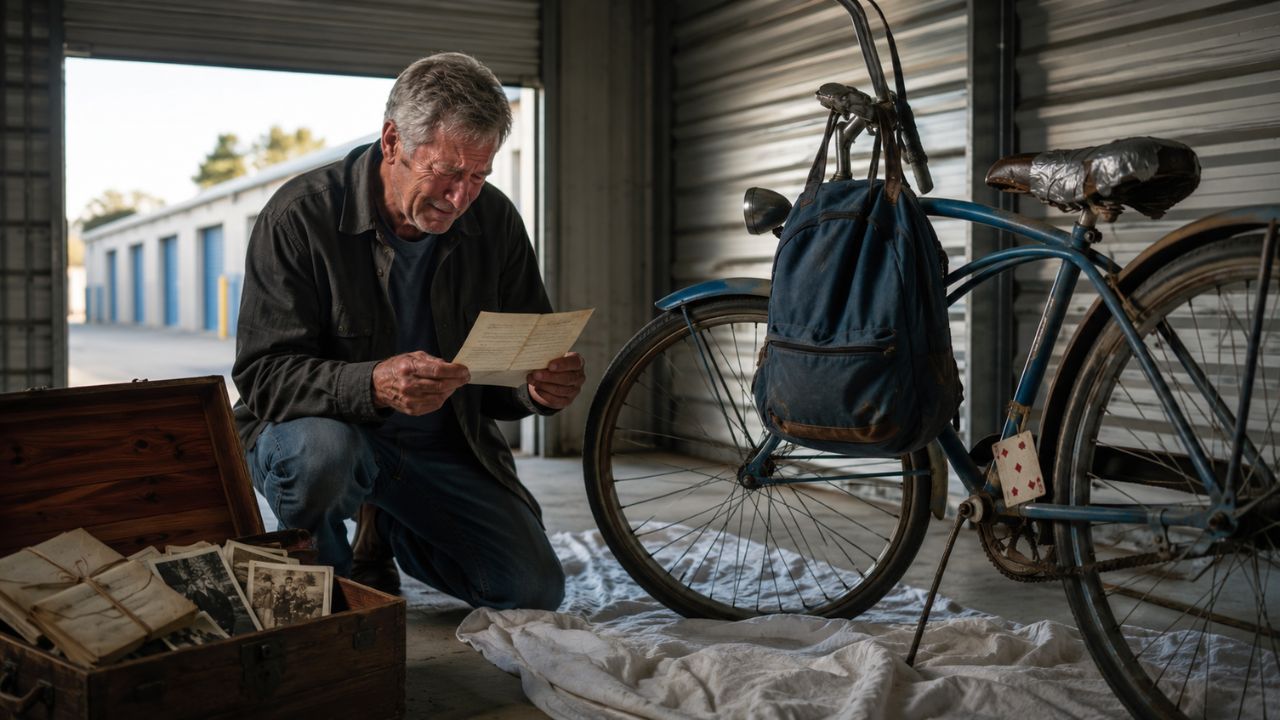
The unit was nearly empty.
One thing sat in the center of the concrete floor.
It was covered by a white sheet.
For a moment, I could not move.
There was something deeply unsettling about that sheet.
Something deliberate.
I stepped inside.
The air smelled like dust and cedar.
I pulled the sheet away.
And my knees nearly gave out.
It was my bicycle.
My blue Schwinn.
I had not seen it since I was fourteen years old.
The paint was faded. The front tire was flat. The black seat still had the split I’d covered with silver duct tape. One handlebar grip was worn smooth from my hand.
And clipped to the front wheel was an old playing card.
I remembered that card.
A nine of clubs.
I had fastened it there with a clothespin so the spokes would make a rattling sound when I rode fast down our street.
I used to pretend it was a motorcycle.
I used to pretend I was going somewhere far away.
I stood there with the white sheet gathered in my fist, and suddenly I was not sixty anymore.
I was fourteen.
I was flying down Maple Street with the summer wind in my face.
I was racing home because Mom had made lemonade.
I was still living in a world where I thought time was generous.
Hanging from the handlebars was my old backpack.
Blue canvas.
One strap repaired with black thread.
Mom had sewn that strap herself.
I reached for it slowly, as if touching it too quickly might make it disappear.
Inside was an envelope.
My name was written on the front.
Not in Mom’s handwriting.
In Dale’s.
Daniel.
I sat down on the concrete floor.
Then I opened it.
Daniel,
If you’re reading this, then I’m gone.
That may be for the best, because I was never good at saying important things while looking a man in the eye.
Especially you.
I know you probably hate me.
I earned that.
I was not a father to you.
I told myself a lot of lies over the years. I told myself you were almost grown when I married your mother. I told myself you didn’t want me around. I told myself your mother loved you enough for both of us.
That last one was the worst lie.
A child should never have to survive on one parent’s love while the other adult in the house keeps score.
I stopped reading.
The words blurred.
Dale Mercer had written that.
Dale, who once told me crying did not fix anything.
Dale, who could sit through an entire dinner without asking me a single question.
Dale, who had made me feel like a guest in my own mother’s home.
I wiped my eyes with the back of my hand and kept going.
When your mother got sick, I was afraid.
Not just of losing her.
Of being left with you.
That is an ugly thing to admit.
But it is true.
You reminded me that I had failed at something I did not know how to fix.
You looked at her with so much love, and I was jealous of my own stepson.
I hated myself for it.
So I made you pay for it.
There it was.
No excuse.
No soft version.
Just the truth.
I read the next line twice.
The day I put your boxes on the porch was the worst thing I ever did.
I told myself I was helping you become a man.
I was lying.
I wanted the house to stop reminding me of everything I had ruined.
I am sorry.
I know those words are too small.
But they are the only honest ones I have left.
Dale
I pressed the letter against my chest and cried in a storage unit on the edge of Wichita.
Not pretty tears.
Not quiet tears.
The kind of crying that comes from some deep place you thought had dried up years ago.
When I could breathe again, I looked back into the backpack.
There were photographs.
At first, I thought they were old family pictures.
Then I realized they were all of me.
My Little League team.
My high school graduation.
Me in my hardware store vest at sixteen, standing beside a display of paint cans.
A picture of me and Ellen on our wedding day.
My daughters as toddlers in matching yellow dresses.
A newspaper clipping from when I was promoted to supervisor at the post office.
A printout of a Facebook post my daughter had made after Ellen died.
A photo of my retirement party.
I stared at them one by one.
My hands grew cold.
Dale had followed my life.
Not openly.
Not kindly.
Not in any way that could have helped me when I was young and lonely and broke.
But he had watched.
For thirty years, he had known where I was.
There was another envelope in the backpack.
I hired people to find what I was too ashamed to ask you for.
I know that sounds wrong.
Maybe it was.
I never approached you because I believed you were better off without me. Then years passed, and pride turned into habit. Habit turned into fear. Fear turned into shame.
By the time I wanted to call, I did not know how to begin.
What does a man say after thirty years?
“Sorry I threw you out after your mother died”?
“Sorry I made you feel unwanted in the only home you had”?
There are some sins that do not fit inside a phone call.
So I stayed away.
But I watched from a distance.
I saw that you built a good life.
I saw that you loved your wife.
I saw that your daughters smiled in pictures.
I saw that you became the kind of man I should have helped you become.
Your mother would have been so proud.
I am proud too.
I know I have no right to say that.
But it is true.
Dale
I sat there until the light outside the storage unit shifted.
Then I noticed something behind the bicycle.
A cedar chest.
Small.
Polished.
With a brass latch.
It had been tucked against the back wall where the sheet had hidden it from view.
I knew that chest.
It had belonged to my mother.
She kept old letters in it.
Birthday cards.
Recipes.
A lock of my hair from my first haircut.
I crawled toward it and opened the latch.
The smell hit me first.
Cedar.
Paper.
Lavender.
My mother.
Inside were bundles tied with ribbon.
Letters.
Dozens of them.
All addressed to me.
Some from the year after I left home.
Some from the hospital.
Some written in shaky handwriting near the end.
I picked one up and turned it over.
There was no stamp.
No postmark.
My heart began to pound.
I had spent most of my adult life believing Mom stopped writing to me when her illness got worse.
She hadn’t.
She had written constantly.
She had just never mailed them.
A folded note sat on top of the first bundle.
Daniel,
These were your mother’s letters.
I found them in her sewing room after you left.
I should have mailed them.
I told myself it would only hurt you more.
That was another lie.
The truth is, I read one.
Then another.
Then I kept them because they were the only place where she still spoke about you.
I stole them from you.
There is no kinder way to say it.
I am sorry.
Dale
My grief changed shape in that moment.
It was not only sadness.
It was anger.
Real anger.
Hot and sharp.
He had kept my mother’s words from me.
All those years I thought she had let go.
All those nights I wished I could hear her voice again.
He had the letters.
He had them in a chest.
I wanted to hate him again.
It would have been easier.
But then I opened the first letter.
My dearest Daniel,
Dale says you are working too many hours. I told him that sounds exactly like you. Stubborn as a mule and twice as proud.
I wish I could make you soup.
I wish I could see your face.
I hope you know that leaving this house does not mean leaving me.
You are my heart walking around in the world.
Love,
Mom
I covered my mouth with my hand.
The next letter was shorter.
My sweet boy,
The nurse says I should rest. I told her mothers do not rest when they have sons to worry about.
I dreamed last night that you were small again and riding your blue bicycle down the street. You kept looking back to make sure I was watching.
I was.
I always was.
Mom
I read until my eyes hurt.
Some letters were full pages.
Others were only a few lines.
In one, she told me she was afraid.
In another, she told me not to let bitterness make a home in me.
In another, she wrote that Dale was “harder than he wanted to be.”
I almost laughed through my tears.
Even dying, Mom was trying to fix people.
At the very bottom of the cedar chest was one final envelope.
This one was sealed.
The paper had yellowed with age.
On the front, in my mother’s handwriting, were five words:
For my two stubborn boys.
I stared at it.
My two boys.
Not “my son and my husband.”
Not “Daniel and Dale.”
My two boys.
I opened it carefully.
My darling Daniel and Dale,
If you are reading this together, then I was right and you finally stopped being fools.
If you are reading it apart, then I was still right, but you are both taking too long.
Dale, listen to me.
Daniel is not a reminder of what you failed to build.
He is a boy who needs you, even when he pretends he does not.
And Daniel, listen to me.
Dale is not as cold as he looks.
He is frightened of loving what he might lose.
That does not excuse him.
But it may help you understand him someday.
I am not asking either of you to become perfect.
I am asking you to try.
After I am gone, take care of each other.
Promise me.
Love always,
Mom
I broke then.
Completely.
Because she had seen both of us more clearly than we had seen ourselves.
And because we had both failed her.
Dale had failed her by pushing me away.
I had failed her by turning pain into a locked door and never checking if someone was on the other side.
Maybe that sounds generous.
Maybe it is.
But grief makes strange rooms inside a person.
That storage unit was one of them.
A week later, I called Walter Jennings.
“I opened the unit,” I said.
He was quiet for a moment.
“I thought you might.”
“Did Dale leave anything else?”
“Yes.”
My chest tightened.
“There was one final instruction. He asked me not to give it to you unless you opened the unit first.”
I drove back to Walter’s office that afternoon.
He handed me a small envelope.
Inside was a single sheet of paper.
Daniel,
I bought the plot beside your mother years ago.
There is one beside mine.
I do not expect you to want it.
But I wanted you to have the choice.
You belonged with us more than I ever let you feel.
Dale
I sat in my truck outside the lawyer’s office until the sun went down.
Brian called two days later.
I almost did not answer.
When I did, his voice was tight.
“What did Dad leave you?”
“Nothing you would want.”
“That’s not an answer.”
“No,” I said. “It isn’t.”
Stephanie sent a message later.
Was there money?
I deleted it.
There are people who hear the word inheritance and think only of accounts, houses, jewelry, and checks.
Dale left me a bicycle with flat tires.
A backpack full of guilt.
A cedar chest full of my mother’s voice.
And a truth I was not sure I wanted.
For months, I did not know what to do with any of it.
The letters sat on my kitchen table in neat stacks.
Every morning, I read one with my coffee.
Sometimes I smiled.
Sometimes I got angry all over again.
Sometimes I spoke to Dale out loud, though he was not there to hear it.
“You coward,” I said once.
Another day, I said, “You should have called.”
And one morning, after reading a letter where Mom described Dale sitting beside her hospital bed, holding her hand while he thought she was asleep, I whispered, “You loved her.”
That was the hardest part.
Dale had loved my mother.
He had loved her badly sometimes.
Fearfully.
Possessively.
Imperfectly.
But he had loved her.
And somewhere inside all that fear, maybe he had loved me too.
Not enough to do the right thing when it mattered.
Not enough to save a nineteen-year-old boy from feeling abandoned.
But enough to keep a bicycle.
Enough to save letters.
Enough to follow my life from far away.
Enough to spend his last years arranging a goodbye he did not have the courage to say in person.
Six months after I opened the storage unit, I went to the cemetery.
It was a clear spring morning.
The kind my mother would have called “a blessing.”
Her grave was under an oak tree.
Dale’s new headstone stood beside hers.
I had not attended his funeral. I did not regret that. Funerals are for the living, and at the time, I did not know what I was yet.
A son?
A stepson?
A stranger?
A man carrying someone else’s apology?
I brought flowers for Mom.
White lilies.
Her favorite.
Then, after standing there for a long while, I placed one small yellow rose on Dale’s grave.
Not forgiveness.
Not exactly.
More like an acknowledgment.
You were here.
You failed me.
You tried too late.
I know now.
Beside Dale’s plot was an empty space.
No stone.
No name.
Just grass.
I stood looking at it longer than I expected.
Some people would think it was strange that he bought that place for me.
Maybe it was.
But I understood what he had been trying to say.
Not “you owe me.”
Not “forget what I did.”
Just this:
You belonged.
I wish I had told you.
I went home that afternoon and took the blue Schwinn out of the storage unit.
The tires were cracked. The chain was stiff. The paint was worn almost gray in places.
My oldest daughter laughed when she saw it in my garage.
“Dad,” she said, “what are you going to do with that?”
“I don’t know yet.”
But I did know.
A week later, I took it to a repair shop.
The young man behind the counter told me it would cost more to fix than the bike was worth.
I smiled.
“No,” I said. “It won’t.”
Three weeks later, I rode that bicycle down my street for the first time in forty-six years.
The repaired spokes clicked.
The old playing card fluttered against the wheel.
For a few seconds, I was fourteen again.
The wind was in my face.
My mother was somewhere behind me, watching from the porch.
And Dale was there too, maybe, standing in the doorway, too proud and too afraid to say what he meant.
I cannot change what happened.
Neither could he.
That is the cruel thing about regret.
It arrives with perfect clarity and no power.
But sometimes, if we are lucky, regret leaves a trail.
A key.
A letter.
A bicycle.
A storage unit.
A chance to put down a little of what we have carried.
I still do not know if I have forgiven Dale.
Maybe forgiveness is not a door you walk through once.
Maybe it is a road.
Maybe some days you move forward.
Some days you stop.
Some days you turn around and yell at the dead.
But I know this.
For thirty-one years, I believed Dale Mercer never thought of me again.
I was wrong.
He thought of me every birthday.
Every Christmas.
Every time he saw a blue bicycle.
Every time my mother’s letters sat unopened in that cedar chest.
He just never found the courage to say it while we were both alive.
So he left me a key.
And behind that metal door, he left the only apology he knew how to give.
Not perfect.
Not enough.
But real.
Sometimes love does not arrive the way we need it.
Sometimes it comes damaged.
Late.
Wrapped in shame.
Hidden under a white sheet in a storage unit.
And sometimes, after a lifetime of believing you were unwanted, you find out someone kept the proof that you belonged all along.
Next to an old bicycle.
Waiting for you to come back.