I used to be ashamed of my father.
That is the sentence I hate admitting now.
But it is the truth.
I was ashamed of the way he dressed.
Ashamed of the old brown jacket he wore every winter, even after the cuffs started to fray.
Ashamed of the rust on his pickup truck.
Ashamed of the smell of grease and coffee that seemed to follow him home after every shift.
My father worked four jobs.
Not because he loved working.
Not because he had no dreams of his own.
But because after my mother left us, there was no one else to keep the lights on.
During the day, he worked maintenance at a warehouse.
In the evenings, he stocked shelves at a grocery store.
On weekends, he fixed cars in a small repair shop behind Mr. Alvarez’s gas station.
And a few nights a week, he cleaned office buildings after everyone else had gone home.
I remember waking up sometimes at two in the morning and hearing the front door open softly.
Then the sound of his boots.
Heavy.
Slow.
Trying not to wake me.
He would stand in the kitchen under the dim yellow light, eat cold leftovers straight from the container, wash his hands twice because the smell of oil never fully came off, and then fall asleep in the recliner before he even made it to bed.
As a child, I thought he was tired because he was strong.
As a teenager, I thought he was tired because he had failed.
That was how cruel I became.
Not all at once.
Little by little.
The older I got, the more I noticed what other kids had.
Their parents wore suits.
Their mothers drove new SUVs.
Their houses had fresh paint, matching furniture, and refrigerators full of name-brand food.
Mine had a father who clipped coupons at the kitchen table and kept a jar of coins by the sink for emergencies.
I hated that jar.
I hated the sound it made when he dropped spare change into it.
Clink.
Clink.
Clink.
To him, it was saving.
To me, it was proof we were poor.
When I was fifteen, my mother came back.
Not fully.
Not in the way a mother should.
She appeared first through phone calls.
Then birthday cards.
Then weekend visits.
By then, she had remarried a man named Richard, who owned three car dealerships and lived in a house with white columns out front.
The first time she took me there, I remember stepping out of her car and staring.
The lawn looked like a golf course.
There was a fountain near the driveway.
Inside, the kitchen counters shined like glass.
She gave me my own room for the weekend.
It had a queen bed, a television mounted on the wall, and a closet bigger than the bathroom I shared with my dad.
“You could have a better life,” she told me one Sunday evening.
She said it gently, like she was offering me a gift.
But the words stayed with me.
A better life.
I started comparing everything after that.
My father’s house suddenly felt smaller.
His truck sounded louder.
His clothes looked older.
His hands looked rougher.
And every sacrifice he made began to embarrass me instead of humble me.
The worst moment happened during my senior year of high school.
It was a Friday afternoon.
I had stayed late for a college prep meeting, and my father came to pick me up straight from the warehouse.
He was wearing his work pants, steel-toed boots, and a faded blue shirt with his name stitched over the pocket.
Frank.
There was a dark stain near his sleeve.
His hair was flattened from his cap.
He looked exhausted.
When he pulled up in that old pickup, two kids from my class looked over and smirked.
One of them whispered something.
I do not even know what he said.
It probably was not as bad as I imagined.
But at seventeen, shame can feel louder than truth.
I climbed into the truck and slammed the door.
My father smiled.
“How’d the meeting go?”
I stared out the window.
“Fine.”
“You hungry? I thought maybe we could stop for burgers.”
I turned toward him.
And all the anger I had been carrying came out in one ugly sentence.
“Why do you always have to show up looking like that?”
His smile faded.
“What?”
“Like this,” I snapped. “Like some loser who can’t get his life together.”
The truck went quiet.
I can still see his hands on the steering wheel.
The cracked skin around his knuckles.
The small scar across his thumb from when he cut himself fixing the heater one winter.
He did not yell.
He did not defend himself.
He only looked forward and swallowed.
Then he said softly:
“I’m sorry I embarrassed you.”
That should have broken me.
It did not.
At the time, I thought I had won.
That is what shame does.
It makes you mistake cruelty for honesty.
Two months after graduation, my mother asked me to move in with her and Richard.
She said they could help with college.
She said I would have more opportunities.
She said my father loved me, but love did not pay tuition.
I repeated that line to myself because it made leaving easier.
When I told my father, he was sitting at the kitchen table repairing the strap on his lunch bag with duct tape.
He looked up slowly.
“You want to live with your mother?”
“I need a better future,” I said.
The words were not mine.
Not really.
But I used them anyway.
He nodded.
Only once.
Then he looked back down at the lunch bag.
“If that’s what you want, I won’t stop you.”
Something about how easily he said it made me angry.
Maybe I wanted him to fight.
Maybe I wanted him to prove I mattered.
But he just let me go.
So I told myself he did not care enough to stop me.
I packed that same week.
My mother arrived in Richard’s black SUV.
My father carried my suitcase to the driveway.
He looked smaller that day.
Older.
The sleeves of his shirt hung loose around his wrists.
Before I got in the car, he held out a small envelope.
“What’s this?” I asked.
“Just a little cash,” he said. “For gas. Food. Anything you need.”
I almost laughed.
He was handing me forty dollars.
Forty dollars from a man who worked four jobs.
I took it, but I did not thank him.
Then he hugged me.
I kept my arms stiff.
“I love you,” he said.
I looked toward the SUV, embarrassed that my mother might be watching.
“Yeah,” I muttered.
And then I left.
For a while, the richer life felt exactly like what I thought I wanted.
My mother bought me new clothes.
Richard let me drive one of his cars.
I went to restaurants where the menus had no prices.
People treated me differently.
Or maybe I acted differently because I finally felt like I belonged somewhere better.
My father called the first week.
I ignored it.
He called again the next day.
I let it ring.
Then less often.
Then hardly at all.
Sometimes he left voicemails.
“Hey, kiddo. Just checking in.”
“Hope school stuff is going okay.”
“I saw they’re hiring at the community college bookstore if you need something part-time.”
“I made your favorite chili. Froze some for you.”
I deleted most of them without listening all the way through.
I told myself I was busy.
I told myself he would make me feel guilty.
I told myself I had moved on.
But the truth was uglier.
I did not want the sound of his voice reminding me where I came from.
Years passed.
The life my mother promised did not last.
Richard left her less than a year after I moved in.
The house with the white columns was sold.
The cars disappeared.
My mother became bitter in a quiet, exhausted way.
She still loved me, I think.
But she had built her promises on someone else’s money, and once that money was gone, the promises collapsed too.
I bounced between jobs.
Dropped classes.
Started over more times than I liked to admit.
And every time life got harder, I thought about calling my father.
But pride stopped me.
Then embarrassment.
Then time.
Time is dangerous that way.
At first, you do not call because you are angry.
Then you do not call because too much time has passed.
Eventually, silence begins to feel like a wall you built with your own hands.
I was twenty-six when I finally drove back to my father’s house.
I did not plan it carefully.
There was no big speech prepared.
No brave moment.
I had been cleaning out an old box when I found the envelope he had given me years earlier.
The forty dollars were gone, of course.
But I had kept the envelope for some reason.
On the back, in his handwriting, he had written:
Call me if you ever need anything.
Dad.
I sat on the floor of my apartment staring at those words until something inside me gave way.
The next morning, I drove three hours back to the town where I grew up.
The streets looked smaller than I remembered.
The grocery store where he used to work had changed signs.
The gas station repair shop was closed.
A new coffee place stood where the old laundromat used to be.
But my father’s house was still there.
Small.
Gray.
Quiet.
The porch light was off.
The grass was overgrown.
His old pickup was not in the driveway.
I parked by the curb and sat there for a minute, hands on the steering wheel.
I told myself he might be at work.
Of course he might be at work.
My father was always at work.
I walked to the front door and knocked.
No answer.
I knocked again.
“Dad?”
Nothing.
I tried the spare key hidden under the loose brick near the porch.
It was still there.
That made my chest tighten for reasons I did not understand.
The door opened with a familiar creak.
Inside, the silence felt heavy.
Not peaceful.
Not normal.
Heavy.
“Dad?” I called.
My voice moved through the house and came back empty.
The living room looked almost exactly the same.
The old couch.
The worn coffee table.
The family photos on the wall.
A picture of me in my Little League uniform.
A school photo with my missing front tooth.
A framed certificate from eighth grade that I did not even remember giving him.
Everything seemed frozen.
But then I noticed the dust.
A thick layer on the coffee table.
On the television.
On the picture frames.
My stomach tightened.
I walked into the kitchen.
There were unopened letters scattered across the counter.
Electric bill.
Pharmacy notice.
A hospital envelope.
My hands began to shake before I even picked it up.
The logo in the corner read:
St. Mary’s Medical Center
The date was nearly two months old.
I opened it.
I do not remember every word.
Only fragments.
Cardiology.
Follow-up appointment.
Urgent.
Missed call.
Please contact our office.
A terrible feeling settled in my chest.
I backed away from the counter.
“No,” I whispered.
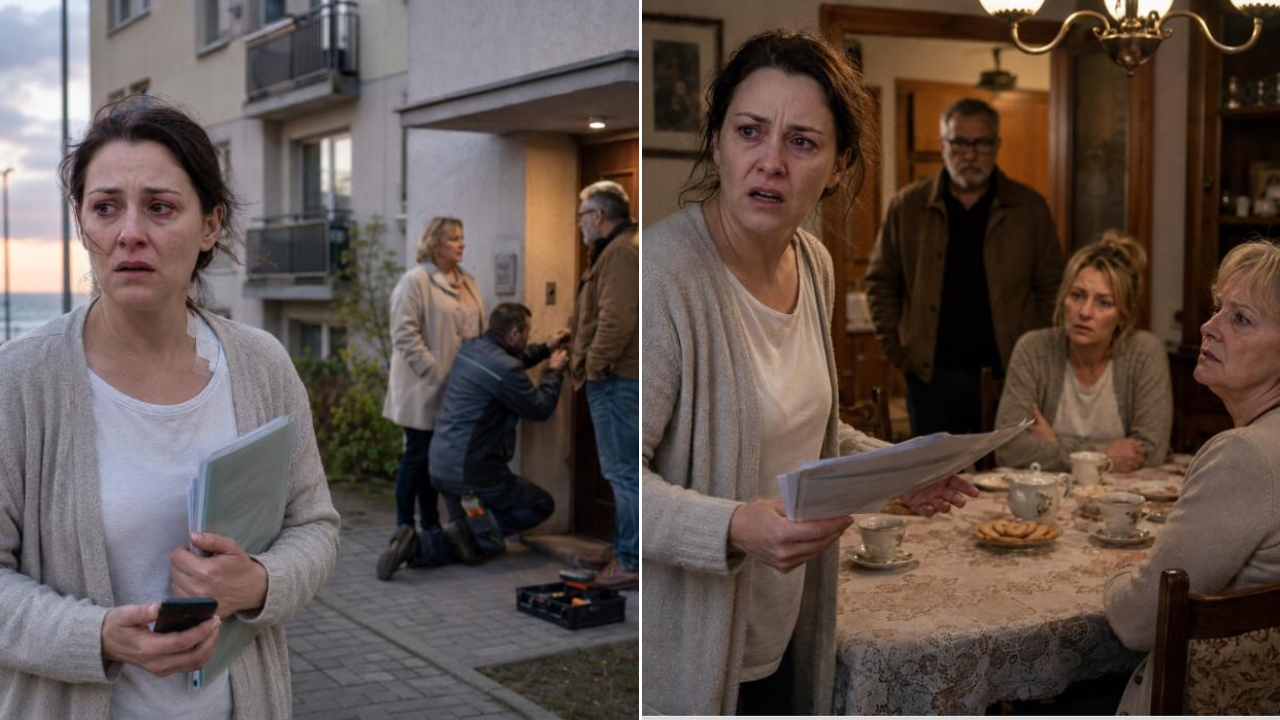
I rushed next door and knocked on Mrs. Henderson’s house.
She had lived beside us since I was a child.
She used to bring over casseroles when my father worked late.
For a long moment, no one answered.
Then the door opened.
Mrs. Henderson stood there, smaller than I remembered, her white hair pinned back, one hand still on the doorframe.
When she saw me, her face changed.
“Oh my God,” she whispered. “You finally came.”
The words hit me before I understood them.
“What happened to my dad?”
Her eyes filled immediately.
“Oh, honey.”
“No,” I said. “Please don’t say it like that.”
She stepped onto the porch.
“He passed away six weeks ago.”
The world seemed to tilt.
“What?”
“He had a heart condition,” she said gently. “He collapsed during his shift at the office building. They took him to St. Mary’s. The doctors tried.”
I stared at her.
“No. That’s impossible. I just… I just came to see him.”
Her mouth trembled.
“I’m so sorry.”
My legs weakened.
I grabbed the porch railing.
“He died alone?”
“No,” she said quickly. “I was there at the hospital when I could be. Mr. Alvarez came. A few people from the warehouse. Some church folks.”
I lowered my head.
“But not me.”
She did not answer.
She did not have to.
Then she said something that destroyed me.
“He asked about you.”
I looked up.
Her eyes were wet.
“Every day he was awake, he asked if anyone had called you.”
I could barely breathe.
“But he had my number.”
“I know.”
“Why didn’t he call?”
Mrs. Henderson wiped her cheek.
“He said he didn’t want to make you feel guilty.”
That was when I broke.
Not loudly at first.
Just a sound from somewhere deep in my chest.
The kind of sound grief makes when it has nowhere else to go.
Mrs. Henderson brought me inside and sat me at her kitchen table.
It smelled like tea and lemon cleaner, just as it had when I was a boy.
She placed a box in front of me.
“He left a few things with me,” she said.
Inside were small pieces of a life I had abandoned.
My old baseball glove.
A stack of birthday cards he had bought but never sent.
A photo of us at the county fair when I was nine, both of us holding paper cups of lemonade.
And one envelope with my name on it.
My father’s handwriting.
My dear child
I held it for a long time before opening it.
My fingers trembled so badly that Mrs. Henderson reached across the table and covered my hand with hers.
When I finally unfolded the letter, the first line nearly stopped my heart.
My dear child,
If you are reading this, it means I was not strong enough to wait for you.
I pressed my fist to my mouth.
First, I want you to know something important.
I never blamed you for leaving.
You were young.
You wanted a better life.
And every parent wants their child to have chances they never had.
I know I could not give you everything.
I know there were days you were embarrassed of me.
I had to stop.
The room blurred.
But I was never embarrassed of you.
Not once.
From the day you were born, you were the greatest gift my life ever gave me.
I bent over the letter as tears fell onto the page.
When your mother came back, I knew I could not compete with nice cars, a big house, or promises that sounded easier than anything I could offer.
So I let you go.
Not because I did not care.
Because I loved you.
Love means wanting your child to be happy, even when it breaks something inside you.
I remembered him standing in the driveway with my suitcase.
The forty-dollar envelope.
The hug I refused to return.
I called your phone many times after you left.
Most times, I hung up before it connected.
I did not want you to feel trapped by my loneliness.
I wanted you to live.
I wanted you to become more than tired hands and overdue bills.
I made mistakes too.
I should have told you more often that I was proud of you.
I should have let you see that I was scared.
I should have admitted that being your father was the only thing I ever felt I truly did right.
I could not see the page clearly anymore.
Then I reached the part that made my chest cave in.
I remember the day you called me a loser.
I know you were angry.
I know you were ashamed.
I won’t lie and say it did not hurt.
It hurt more than any long shift ever did.
But I want you to understand something.
If working four jobs made me a loser, then I was the happiest loser in the world.
Because every hour I worked was for you.
Not for a bigger house.
Not for nicer clothes.
Not so people would respect me.
For you.
I covered my face and sobbed.
Mrs. Henderson sat silently beside me.
There is only one thing I ask.
Do not spend your life punishing yourself for being young and wrong.
Learn from it.
Forgive yourself if you can.
And if you ever become a parent, remember this:
Children may forget what you bought them.
They may forget what you wore.
They may even forget how hard you worked.
But they will never forget whether they felt loved.
No matter where you go, no matter how long it has been, you will always be my child.
I love you.
Dad.
By the time I finished reading, I could hardly breathe.
I pressed the letter to my chest.
All the years I had spent thinking my father had nothing to give me.
And there, in my hands, was more love than I had known what to do with.
Mrs. Henderson waited until I calmed down.
Then she reached into the box again.
“There is one more envelope,” she said softly. “This came from his lawyer.”
I looked at her, confused.
“His lawyer?”
She nodded.
“He asked me to make sure you got it if you ever came back.”
Inside was a letter from a local attorney and several documents.
At first, I did not understand what I was looking at.
There were account statements.
Bank records.
A college savings plan in my name.
My name.
I read the amount twice because I thought my eyes were playing tricks on me.
More than two hundred fifty thousand dollars.
I shook my head.
“No. This can’t be right.”
Mrs. Henderson nodded through tears.
“He started it when you were little.”
I stared at the papers.
“How?”
“He saved everything he could,” she said. “Overtime. Tax refunds. Holiday bonuses. Money from fixing cars. He never bought himself much.”
I thought of the old jacket.
The worn boots.
The pickup he kept repairing instead of replacing.
The coin jar by the sink.
Clink.
Clink.
Clink.
“He also had a small life insurance policy,” she continued. “He wanted it added to the fund.”
I could not speak.
At the bottom of the attorney’s letter, there was a note written in my father’s hand.
I know you wanted a better life.
I am sorry I could not make it look better while I was here.
But I hope this helps you build one.
Use it well.
And when you walk across that stage someday, know that I will be with you.
I folded over the table and wept like a child.
Not because of the money.
The money was not what broke me.
It was the old jacket.
The skipped meals.
The double shifts.
The duct-taped lunch bag.
The forty dollars he gave me when I left, knowing he had been quietly saving a future for me the entire time.
I had looked at my father and seen poverty.
I had seen failure.
I had seen everything I wanted to escape.
But I had never seen the truth.
My father was not poor.
Not in the way that mattered.
He was rich in the kind of love that gives without applause.
The kind of love that works until its body gives out.
The kind of love that lets a child walk away and still leaves the porch light on.
I stayed in town for three days.
Mrs. Henderson took me to his grave.
It was simple.
Just his name.
Frank Miller.
Beloved Father.
I knelt in the grass and tried to say everything I should have said years earlier.
I told him I was sorry.
I told him I had been ashamed for the wrong reasons.
I told him I finally understood.
The wind moved through the trees above me.
For a second, I imagined I heard his old boots on the porch.
Heavy.
Slow.
Coming home after another long shift.
I used the money the way he asked.
I went back to school.
Not all at once.
Nothing about rebuilding a life happens all at once.
I took classes.
Worked part-time.
Failed one course.
Passed it the second time.
There were days I wanted to quit.
On those days, I opened his letter.
I kept it folded in a plastic sleeve because the paper had softened from how many times I had read it.
Years later, when I walked across the stage at graduation, I carried a photo of my father in my pocket.
It was the county fair photo.
The one where I was nine and he was smiling like the whole world was standing beside him.
When they called my name, people clapped.
I shook the dean’s hand.
I smiled for the camera.
Then I looked up toward the ceiling and whispered:
“We did it, Dad.”
Not I did it.
We.
Because every step I took across that stage had been paid for long before I understood the price.
After the ceremony, I drove to the cemetery in my cap and gown.
I placed my diploma against his headstone.
The sun was setting.
For a long time, I just sat there.
Then I said the words I had spent years being too proud to say.
“You were never a loser.”
My voice broke.
“You were the best man I ever knew.”
Some people leave behind money.
Some leave behind memories.
My father left me both.
But the greatest thing he left was the truth I had been too blind to see.
A parent’s love is not always loud.
Sometimes it looks like old clothes.
A tired smile.
A truck that barely starts.
A man eating cold leftovers at two in the morning so his child can have something better one day.
I once abandoned my father because I thought he had nothing.
Now I know he gave me everything.