CHAPTER 1 — THE MESSAGE AT THE FUNERAL
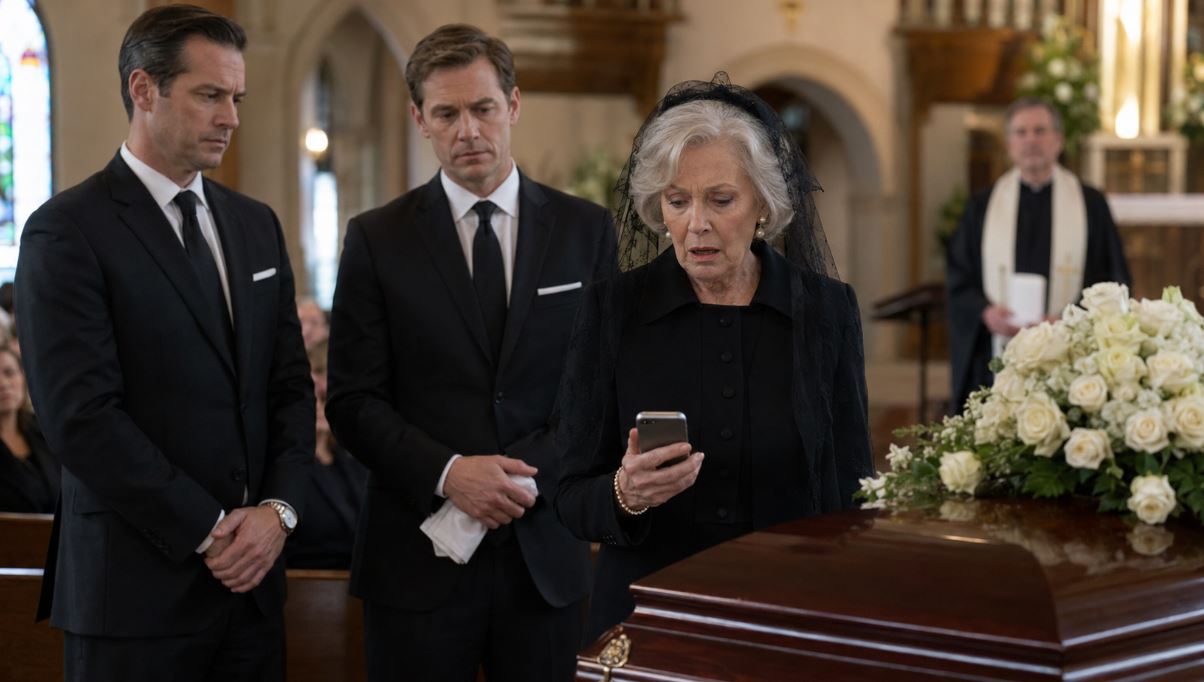
My phone vibrated in my hand just as the pastor began the final prayer over my husband’s casket.
I should not have looked.
A widow is not supposed to check her phone while standing three feet away from the polished mahogany box that supposedly holds the man she loved for forty-six years.
But grief does strange things to the body.
It makes your hands shake.
It makes your ears ring.
It makes you desperate for anything that is not the sound of people whispering, “Poor Eleanor.”
So I looked.
The message came from an unknown number.
Eleanor, don’t cry over that body. I’m not in there.
For a moment, I thought the church floor had moved beneath my feet.
I stared at the words until they blurred.
Then I looked at the casket.
Closed.
Locked.
Covered with white roses.
Charles had always hated white roses.
“They look like flowers people send when they don’t know what else to say,” he used to tell me.
My sons had chosen them anyway.
Preston stood to my right in a perfect black suit, one hand resting on the back of the pew in front of him. His face was solemn, his eyes dry.
Grant stood beside him, dabbing the corner of one eye with a folded handkerchief.
Too neat.
Too practiced.
Too calm.
I told myself that was cruel.
People grieve differently.
That is what everyone says.
But after raising two boys into men, a mother knows the difference between quiet sorrow and controlled impatience.
My fingers trembled as I typed back.
Who is this?
The reply came before the pastor finished saying “Amen.”
It’s Charles. Don’t trust our sons.
I almost dropped the phone.
Preston turned his head.
“Mom?” he whispered. “Are you all right?”
I pressed the phone against my chest.
“I’m dizzy.”
He smiled.
Not the soft smile of a worried son.
The careful smile of a man checking whether a lock had held.
Grant stepped closer and touched my elbow.
“We’ll take you home after this,” he said.
Not “Would you like us to?”
Not “Do you need anything?”
Just:
“We’ll take you.”
The service ended in a blur.
People came toward me with damp eyes and heavy perfume.
They hugged me.
They told me Charles was in a better place.
They told me I was strong.
They told me I was lucky to have sons who would “handle everything.”
I nodded.
I thanked them.
I did everything a widow is expected to do.
But inside my head, one sentence kept knocking against my skull.
Don’t trust our sons.
Charles Whitaker had been declared dead two nights earlier.
A heart attack, Preston said.
Sudden, Grant said.
Merciful, everyone said.
I had not been there.
That was the part I could not stop returning to.
I had gone to bed early with a headache. Charles stayed in his study, as he often did, pretending to read financial reports while really listening to old jazz records and sipping tea he never finished.
At 11:37 p.m., Preston called me from downstairs.
“Mom, don’t panic.”
Those are the worst words a person can hear.
By the time I reached the study, Charles was already on the floor.
Or at least, that is what I had been told.
I never saw him there.
Grant blocked the doorway.
Preston held both my shoulders and said, “The paramedics are working on him.”
Then everything moved too fast.
The ambulance.
The doctor.
The funeral home.
The papers.
The closed casket.
I had been married to Charles for forty-six years, and somehow, between one night and the next, my husband had become something everyone else handled.
At the cemetery, Preston placed a hand on my back.
“Mom, we should go.”
I looked at the coffin being lowered into the ground.
If the message was a lie, then someone was cruel beyond imagination.
If the message was true, then my whole family was standing around an empty grave.
Or worse.
A grave that belonged to someone else.
Grant leaned close.
“You shouldn’t be alone tonight.”
Again.
Shouldn’t.
Not mustn’t.
Not don’t want to be.
Shouldn’t.
The word wrapped around me like a leash.
I looked at my sons.
Preston, fifty-one, successful, polished, always speaking as if he had just left a boardroom.
Grant, forty-eight, charming, restless, forever in need of money but never in need of advice.
My boys.
My babies once.
The children whose fevers I had cooled with washcloths.
The teenagers I had defended when Charles was too strict.
The men who now looked at me like I was a problem to be managed.
“I want to go home,” I said.
Preston nodded too quickly.
“Of course.”
“To my home,” I added.
His face shifted.
Just a little.
Then it smoothed again.
“Of course, Mom.”
Our house in Westport looked exactly the same when we arrived.
That was what made it unbearable.
The porch light Charles always forgot to turn off.
The brass umbrella stand by the door.
His reading glasses on the side table.
The half-finished crossword beside his chair.
Everything insisted he had only stepped into another room.
Preston and Grant came inside without asking.
Grant opened the bar cabinet.
Preston went straight to Charles’s study.
I followed him.
He turned around in the doorway.
“You should rest.”
“I want to sit in here.”
His jaw tightened.
“Mom, not tonight.”
“Why not?”
His eyes flickered toward the desk.
Charles’s desk.
A heavy walnut thing with carved legs, old-fashioned and stubborn, just like him.
Preston forced a smile.
“Because it will upset you.”
“I’m already upset.”
He did not like that answer.
Grant appeared behind me with a glass in his hand.
“Mom, Preston is right. You’ve had a terrible shock.”
I looked at them both.
For the first time in my life, I was afraid of my sons.
Not because they shouted.
Not because they threatened.
Because they were being too gentle.
“We’ll stay tonight,” Preston said.
“No,” I said.
Both men went still.
I had surprised them.
I had surprised myself.
“I want to be alone.”
Grant laughed softly.
“That isn’t a good idea.”
“I did not ask whether it was a good idea.”
Preston’s smile disappeared.
“Mother, you are grieving. This is not the time to become difficult.”
Mother.
He only called me Mother when he wanted distance.
Charles had noticed that years ago.
“When Preston says Mother,” he once told me, “he’s either about to ask for money or forgive himself for something.”
I almost smiled at the memory.
Then my phone vibrated again.
I did not look down.
Not in front of them.
Preston’s eyes dropped to my purse.
“Who keeps texting you?”
“No one.”
“Mom.”
The way he said it made my skin tighten.
I lifted my chin.
“Leave the house, Preston.”
Grant set his drink down.
“Let’s all calm down.”
“I am calm.”
Preston stared at me for several seconds.
Then he took a breath and adjusted his cufflinks.
“Fine. We’ll come in the morning.”
“No need.”
“We’re bringing Dr. Mercer.”
I blinked.
“Who?”
“Dr. Elaine Mercer. She specializes in cognitive health and grief response.”
I stared at him.
“You arranged a doctor?”
Grant stepped forward.
“Just to check on you.”
“I have my own doctor.”
Preston’s voice softened, which somehow made it worse.
“Mom, after what happened to Dad, we all need to make sure you’re not overwhelmed.”
Overwhelmed.
There it was.
A word polite people use when they do not want to say unstable.
I felt my husband’s message like a hand around my wrist.
Don’t trust our sons.
“I don’t need a mental evaluation,” I said.
Preston’s face hardened.
“No one said mental evaluation.”
“You didn’t have to.”
Grant looked away.
Preston moved closer.
“Mother, we are trying to protect you.”
“From what?”
Neither of them answered.
Finally, Preston smiled again.
“From decisions you may not be ready to make.”
After they left, I locked the front door.
Then the side door.
Then the kitchen door.
Then I stood in the quiet house, one hand pressed to my chest, and listened to my own breathing.
I waited until I saw their headlights disappear down the drive.
Only then did I open my phone.
The new message was a photograph.
Charles’s desk.
The image was close, focused on the lower left corner, where a piece of carved molding met the side panel.
A red circle marked the spot.
Beneath the photograph was a message.
Press the left corner. Do not open anything in front of Preston or Grant.
My legs nearly failed me.
I went to the study.
The room still smelled like Charles.
Cedar.
Old paper.
A faint trace of the pipe tobacco he had given up ten years ago but kept in a jar because he liked the memory.
I knelt beside the desk, awkwardly, painfully. My knees were not young anymore.
My hands moved over the polished wood until I found the corner from the photograph.
I pressed.
Nothing happened.
I pressed again, harder.
A soft click broke the silence.
A narrow compartment slid open.
I sat back on my heels and covered my mouth.
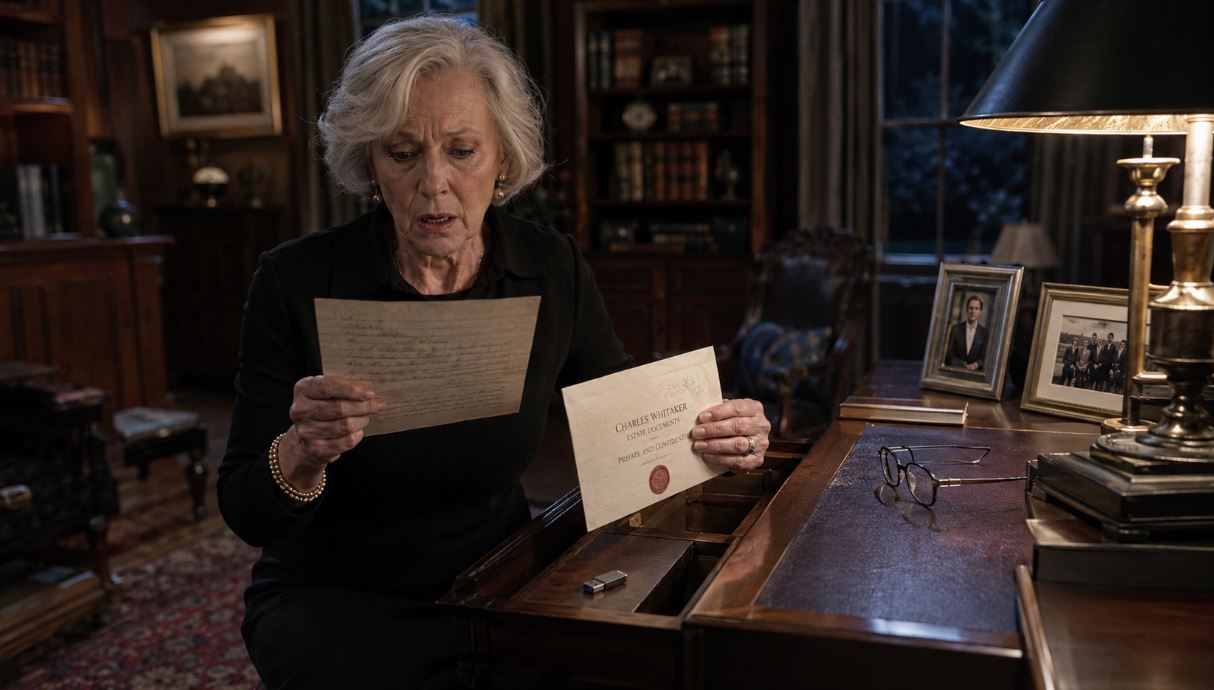
Inside was a cream envelope with my name written across it.
Eleanor.
Charles’s handwriting.
I knew the slope of every letter.
The little hook at the end of the r.
The way he made capital E’s too large.
There was also a USB drive and a folded document sealed in a clear plastic sleeve.
My fingers shook as I opened the envelope.
My dearest Ellie,
If you are reading this, then I was right to be afraid.
I need you to stay calm. I know that is a cruel thing to ask, but your safety depends on it.
Preston and Grant have been pressing me for months about the house, the investment accounts, and the trust. I did not tell you because I was ashamed.
A tear fell onto the paper.
I wiped it quickly, terrified of smearing the ink.
Charles continued:
They believe I changed my will in their favor. I let them believe that.
I did not.
The real will is with this letter. It leaves you full control of everything for the rest of your life. After you are gone, what remains will go partly to the grandchildren, partly to the Whitaker Foundation, and only under strict conditions to our sons.
Do not sign any document they put in front of you.
Do not allow any doctor they bring to examine you without your own attorney present.
If they suggest you are confused, grieving, forgetful, unstable, or unable to manage your affairs, understand what they are doing.
They are not worried about your health.
They are trying to take your voice.
My hand closed around the paper.
Take your voice.
I thought of Preston’s smooth tone.
Grant’s careful sadness.
Dr. Mercer arriving in the morning.
Decisions you may not be ready to make.
I kept reading.
Samuel Price knows part of the truth. I had to let him go publicly to keep him safe, but he has remained loyal. If anything happens, call him from the old kitchen phone, not your cell. The number is taped beneath the third drawer.
There is more, Ellie.
What happened to me may not have been natural.
I stopped breathing.
The house made a small settling sound around me.
For a moment, I was certain someone was standing behind me.
No one was.
I read the last line of the page.
Trust what I prepared, not what they perform.
I love you.
Charles.
I held the letter against my chest and wept.
Not loudly.
The grief was too frightened to be loud.
My husband might be dead.
Or he might not.
My sons might have lied.
Or worse.
And somewhere inside this house, my life had become something people were preparing to take from me.
I looked at the plastic sleeve.
Inside was a notarized will dated only three weeks earlier.
I knew enough to understand what that meant.
It was newer than the version Preston had mentioned after the funeral.
Newer than anything my sons expected me to see.
The USB drive sat beside it like a small black secret.
Before I could touch it, headlights swept across the study windows.
I turned off the lamp.
A car door closed.
Then another.
My phone vibrated.
They came back sooner than I expected. Do not let them in.
I moved to the window.
Preston’s car sat in the driveway.
Grant climbed out of the passenger seat.
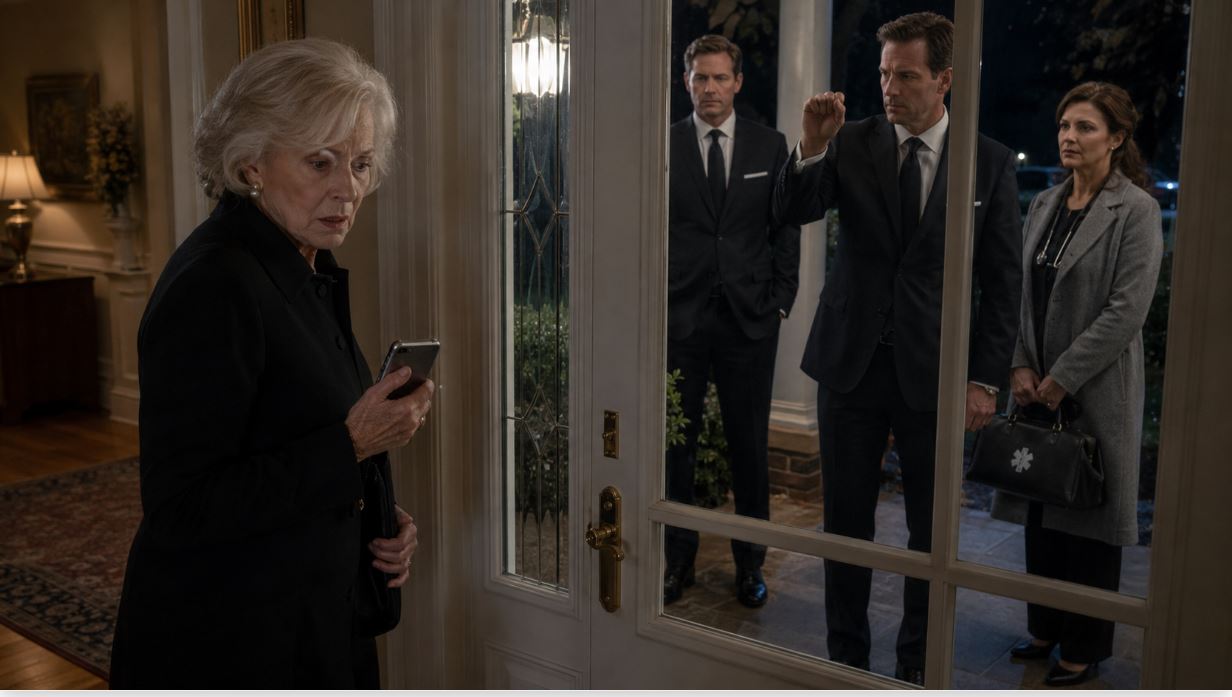
Behind them, a woman in a gray coat stepped carefully onto the gravel.
She carried a leather medical bag.
Dr. Elaine Mercer.
My sons had not waited until morning.
The doorbell rang.
Once.
Twice.
Then Preston’s voice came through the front door.
“Mom? Open up. We’re worried about you.”
I stood in the dark study, clutching Charles’s letter.
Grant knocked next.
“Mom, please. Don’t make this harder than it needs to be.”
Then Dr. Mercer spoke.
Her voice was calm.
Professional.
Practiced.
“Mrs. Whitaker, your sons are concerned you may be experiencing acute grief confusion. We only want to make sure you’re safe.”
Safe.
I almost laughed.
Behind me, Charles’s desk remained open, its hidden compartment exposed like a wound.
My phone vibrated one more time.
Call Samuel. Now.
I looked toward the kitchen.
For the first time since the funeral, I understood something clearly.
This was no longer about whether Charles was alive.
It was about whether I would be allowed to remain Eleanor Whitaker.
Wife.
Mother.
Owner of my home.
Keeper of my own mind.
I slipped the will, the USB drive, and Charles’s letter into my purse.
Then I walked quietly toward the kitchen while my sons kept knocking at the front door.
And beneath the third drawer, exactly where Charles said it would be, I found a phone number written in his hand.
I picked up the old kitchen phone.
My finger trembled over the buttons.
Then I called the only man my husband still trusted.
CHAPTER 2 — THE REAL WILL
Samuel Price answered on the second ring.
“Mrs. Whitaker?”
The sound of his voice nearly broke me.
Samuel had driven for Charles for more than twenty years. He had taken me to doctor’s appointments, picked up our grandchildren from school, carried groceries through snowstorms, and once driven three hours back to a restaurant because I had left my wedding ring in the ladies’ room.
Preston fired him two months before Charles died.
He said Samuel had become careless.
Charles said nothing at the time.
That silence had hurt me.
Now I understood it differently.
“Samuel,” I whispered. “They’re here.”
His voice changed.
“Are you alone?”
“Yes.”
“Do not open the door.”
“They brought a doctor.”
“I know.”
“How do you know?”
A pause.
Then he said, “Because Mr. Whitaker thought they might.”
At the front of the house, Preston knocked harder.
“Mother, this is becoming concerning.”
Mother again.
I pressed the phone tighter to my ear.
“What do I do?”
“Is the back kitchen door locked?”
“Yes.”
“Good. Keep it that way. I’m ten minutes away. Until then, call your attorney.”
“My attorney?”
“Not the family attorney. Yours.”
I closed my eyes.
Charles and I had used the same law firm for decades. But three years ago, after a disagreement about a property sale, Charles insisted I have separate counsel for personal documents.
At the time, I teased him.
“Planning to divorce me at seventy-four?”
He kissed my forehead and said, “No, Ellie. Planning to make sure no one can speak over you when I’m not in the room.”
I found the number in my contacts.
Marianne Bell.
Estate attorney.
Sharp as winter sunlight.
I called her.
She answered after five rings, her voice sleepy but alert.
“Eleanor?”
“Marianne, I need help.”
That was all I managed before my voice failed.
She listened.
Unlike my sons, she did not interrupt.
When I told her about the message, the hidden will, the doctor at the door, and Charles’s letter warning me not to submit to an examination without counsel, Marianne became very quiet.
Then she said, “Eleanor, put me on speaker.”
I did.
“Now walk to the front door, but do not open it.”
My heart hammered as I crossed the hallway.
Through the frosted glass, I could see their shapes.
Preston closest.
Grant behind him.
Dr. Mercer standing slightly aside.
Marianne’s voice came through the phone, clear and cold.
“Who is at the door?”
Preston stopped knocking.
“Who is that?”
“This is Marianne Bell, counsel for Eleanor Whitaker.”
A silence followed.
Not long.
But long enough.
Preston recovered first.
“We’re concerned about our mother.”
“I understand. Mrs. Whitaker is represented. Any medical evaluation, legal discussion, or paperwork concerning her capacity, estate, residence, or finances will go through my office.”
Dr. Mercer stepped closer to the glass.
“Ms. Bell, I was asked to perform a wellness check.”
“By whom?”
“Her sons.”
“Mrs. Whitaker has not consented.”
Preston’s voice sharpened.
“She is clearly confused. She’s refusing to open the door.”
Marianne replied, “Refusing to open a door at midnight to people pressuring her is not confusion. It is judgment.”
I almost sobbed with relief.
Grant spoke then.
“Mom, this is ridiculous. We’re your sons.”
I finally answered.
My voice shook, but it held.
“Then you should have called before bringing a doctor to my door in the middle of the night.”
Preston leaned closer.
“Mother, you don’t understand what you’re doing.”
Marianne said, “Mr. Whitaker, that is the last time you will suggest my client lacks understanding without evidence. Leave the property.”
“This is our family home.”
“No,” Marianne said. “It is Eleanor Whitaker’s legal residence. Leave the property or I will advise her to call the police.”
Another silence.
Then Preston said something I had never heard from him before.
Nothing.
No correction.
No instruction.
No smooth argument.
Just silence.
A car pulled into the driveway behind them.
Samuel.
I knew the way he drove, slow and steady even in crisis.
Preston turned.
“What is he doing here?”
I opened the curtain just enough to see Samuel step out of an old dark sedan. He wore a wool coat over his pajamas and held a folder under one arm.
Grant looked furious.
“You were told not to come near this house.”
Samuel did not raise his voice.
“I was told many things, Mr. Whitaker.”
Marianne said through the speaker, “Mrs. Whitaker, keep the door locked. Mr. Price can remain outside as witness.”
Preston stepped toward Samuel.
“You need to leave.”
Samuel looked past him, toward the door.
“Mrs. Whitaker, Mr. Charles asked me to give you something if your sons brought Dr. Mercer before you had time to call counsel.”
My stomach turned.
Preston lunged for the folder.
Samuel stepped back.
“Don’t,” Samuel said.
One word.
Not loud.
But it stopped Preston.
Maybe because Samuel had seen him as a boy.
Maybe because men like Preston are only brave when they believe no one is recording.
Grant noticed the porch camera then.
Charles had installed it after a delivery theft the year before.
His eyes lifted toward it.
Samuel followed his gaze.
“Yes,” he said. “It’s on.”
Dr. Mercer took a step back.
“I think perhaps this should be rescheduled.”
Preston turned on her.
“You’re being paid to evaluate her.”
Marianne’s voice cut in.
“Thank you, Mr. Whitaker. That statement has been heard and recorded.”
Preston’s face went pale.
For the first time, I understood the power of witnesses.
My sons had expected grief, darkness, and a frightened old woman alone in a big house.
Instead, there was an attorney on the phone.
A former employee in the driveway.
A camera above the porch.
And a hidden will in my purse.
Dr. Mercer left first.
She murmured something about professional boundaries and returned to her car.
Grant tried once more.
“Mom, please. You’re making a mistake.”
I leaned my forehead against the door.
My boys.
My beautiful boys.
How did a mother measure the distance between a cradle and this moment?
“I hope I am,” I said quietly.
Grant looked confused.
I continued, “Because if I’m wrong, then all I’ve done is hurt your feelings. But if I’m right, you came here tonight to help take away my choices.”
His face changed.
Not guilt.
Not enough.
But something.
Preston heard it too and grabbed his arm.
“We’re leaving.”
They left without saying goodbye.
When their car disappeared, Samuel remained in the driveway until Marianne told me it was safe to let him in.
The moment I opened the door, he removed his hat.
His eyes were wet.
“I am sorry, Mrs. Whitaker.”
“Is Charles alive?” I asked.
Samuel looked down.
The answer was there before he said it.
“No, ma’am.”
I gripped the doorframe.
For one terrible, foolish hour, I had allowed myself to believe.
The messages.
The desk.
The warnings.
Some part of me had imagined Charles in hiding, alive somewhere, waiting for me to reach him.
Samuel stepped closer.
“But he wrote those messages before he died.”
I stared at him.
“What?”
“He prepared them. Scheduled some. Gave instructions for others.”
“That’s impossible.”
“Mr. Charles believed your sons were watching his calls and email. He set up a private account and asked me to send certain messages if specific things happened.”
My voice broke.
“The funeral?”
Samuel nodded.
“He said if they chose a closed casket, white roses, and kept you away from the arrangements, I was to send the first message.”
I covered my mouth.
Charles.
Even in fear, even near death, he had known the shape of his sons’ performance.
“The message said he wasn’t in there.”
Samuel looked pained.
“He told me to write it exactly that way.”
“Why?”
“To make sure you paid attention.”
I wanted to be angry.
For one second, I was.
It was a cruel message.
A devastating message.
But Charles knew me.
If the text had simply said, “Check the desk,” I might have assumed it was spam.
If it had said, “Your sons are lying,” I might have shown Preston.
But “I’m not in there” had shocked me awake.
My husband had reached through death and frightened me on purpose.
To save me.
I stepped aside and let Samuel in.
He placed the folder on the kitchen table.
Inside were copies of emails, bank records, and handwritten notes from Charles.
Marianne stayed on the phone while we reviewed them.
The truth came together slowly.
Not like thunder.
Like poison entering water drop by drop.
Preston and Grant had borrowed against expectations they had no legal right to count on.
Preston’s investment firm was under pressure after several failed deals.
Grant had gambling debts disguised as business losses.
Both had assumed Charles would leave them immediate control of the trust.
When he refused, they changed tactics.
First, they tried guilt.
Then pressure.
Then legal language.
Then concern.
Grant had emailed Dr. Mercer three weeks earlier.
The subject line read:
Potential Capacity Evaluation — Elderly Parent Following Spousal Death
Following.
Spousal.
Death.
But Charles had still been alive when the email was sent.
I read the date three times.
My hands went numb.
Marianne inhaled sharply over the speaker.
“Eleanor, preserve that.”
Samuel opened another page.
A note from Charles.
Ellie,
This is where I stopped hoping I had misunderstood them.
I asked Grant why he had contacted a capacity doctor before I was dead.
He said he was being prepared.
Prepared.
That word should never come from a son’s mouth like that.
I pressed my palm to my chest.
Preston and Grant had not simply reacted badly to their father’s death.
They had prepared for it.
Marianne’s voice grew careful.
“Eleanor, did Charles express suspicion that his death might be caused intentionally?”
I looked at Samuel.
He nodded once.
I opened the second page of the letter.
Charles had written:
I cannot prove they intend to harm me. I want to be clear about that.
But I have become careful about what I drink when they visit.
If something happens suddenly, insist on an independent review before cremation.
They will push for speed.
Do not allow speed.
A coldness spread through me.
I thought of the closed casket.
The quick arrangements.
Preston telling me, “Dad wanted simplicity.”
Grant saying, “There’s no need to drag this out.”
I had believed them because grief makes obedience feel like rest.
“Marianne,” I whispered, “what do I do?”
“You do nothing alone,” she said. “That is the first rule.”
By morning, Marianne had filed emergency notices with the probate court.
She also contacted a private investigator she trusted and advised me to request a formal review of Charles’s medical records.
The funeral home was instructed not to proceed with any cremation or transfer without my written consent.
When Preston found out, he called twenty-two times.
I did not answer.
Grant sent a message.
Mom, you’re letting strangers turn you against your family.
I stared at it.
Then I typed:
No. I’m finally letting witnesses into the room.
I did not send it.
Marianne told me not to engage.
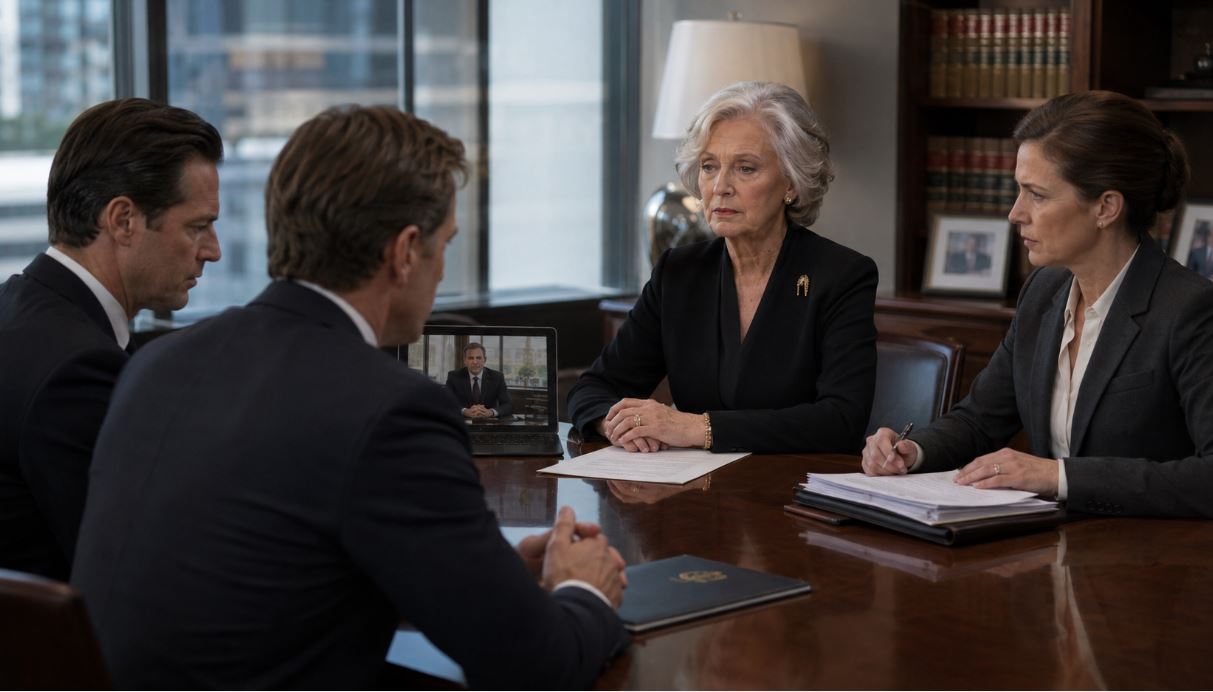
Two days later, Preston and Grant arrived at my attorney’s office with their own lawyer.
I had never seen my sons so angry while trying to look calm.
Preston kissed my cheek in the waiting room.
I let him.
That was the last motherly thing I could give him that day.
Grant squeezed my hand.
“Mom, we love you.”
I looked at him.
“I hope that’s true.”
He blinked.
In the conference room, their attorney presented a will.
The false one.
Not forged badly.
Not obvious.
It left me a lifetime residence in the Westport house, but control of the trust passed immediately to Preston and Grant “for the protection and comfort of their mother.”
Comfort.
Protection.
Words can wear nice suits while doing ugly work.
Marianne laid Charles’s real will on the table.
Newer.
Signed.
Witnessed.
Notarized.
Stored with proof.
Preston’s face drained of color.
Grant whispered, “Where did you get that?”
I answered before Marianne could.
“Your father left it for me.”
Preston recovered quickly.
“Our father was under stress. That document may not reflect his true wishes.”
Marianne opened the folder.
“Then perhaps his video statement will help.”
I stopped breathing.
“Video?” Grant said.
Marianne inserted the USB drive into her laptop.
Charles appeared on the screen.
Alive.
Sitting at his desk.
Wearing the brown cardigan I had always told him made him look like a retired professor.
His face was thinner than I remembered.
His eyes were tired.
But his voice was clear.
“My name is Charles Henry Whitaker. Today is March 8. I am making this recording because I believe my wife, Eleanor, may be pressured after my death.”
I covered my mouth.
On the screen, Charles looked directly into the camera.
“Ellie, if you are watching this, I am sorry. I hoped I would never need this.”
Preston looked away.
Grant stared at the table.
Charles continued.
“To my sons, Preston and Grant: if you are in this room challenging your mother’s authority, then you have become exactly what I feared. You will say you are protecting her. You are not. You are protecting your access.”
Preston stood.
His attorney pulled him back down.
Charles’s voice remained steady.
“Your mother is not confused. She is not incapable. She is not a child to be managed. She is the woman who built this life beside me, and no man in this family has the right to take it from her.”
I began to cry.
Quietly.
Not because I was weak.
Because for days, everyone had spoken around me.
About me.
For me.
And there was Charles, dead but still making room for my voice.
The video continued.
“I leave Eleanor full control of my estate. If she chooses to help our sons, that is her choice. If she chooses not to, that is also her choice. Any attempt to declare her incompetent without independent medical evidence and counsel present should be treated as financial coercion.”
Grant whispered, “Dad…”
Charles’s eyes seemed to harden, as if he had heard him.
“I loved my sons. That is why this hurts. But love does not require blindness.”
Then the video ended.
No one spoke.
Marianne closed the laptop.
Preston’s attorney cleared his throat.
“I believe we need time to review these materials.”
Marianne smiled politely.
“You may take all the time the court allows.”
The investigation into Charles’s death took longer than people online would have liked.
Real life does not move at the speed of outrage.
There was no dramatic confession.
No one dragged from a courtroom in handcuffs.
No secret body in the casket.
Charles had died.
That much was true.
His heart had failed.
But the review found troubling details.
Medication discrepancies.
Unexplained changes in dosage.
A prescription refill Charles had not picked up himself.
A sedative in his system that had not appeared on his active medication list.
Not enough, at least at first, to prove murder.
Enough to open questions.
Enough to stop my sons from controlling the narrative.
Enough for probate court to examine their actions closely.
Preston lost his temporary role in the family company.
Grant’s creditors suddenly became less patient when they learned the trust was not his rescue plan.
Dr. Mercer submitted a statement saying she had been misled about the urgency of my condition and had never personally agreed I lacked capacity.
Of course she did.
Everyone protects themselves when the light comes on.
My sons tried apologies after that.
Preston sent a letter.
Six pages.
Elegant.
Regretful.
Full of phrases like “stress,” “miscommunication,” and “wanting what was best.”
He never once wrote:
I tried to take control of your life.
Grant called from a blocked number and cried.
His voice sounded like the boy who used to climb into my lap after nightmares.
“Mom, I got scared,” he said. “I owed people money. Preston said Dad was being unfair. We thought if we controlled the trust, we could fix everything.”
I closed my eyes.
“You tried to fix your life by stealing mine.”
He sobbed.
“I’m sorry.”
I wanted to comfort him.
That is the curse of motherhood.
Even when the child is grown.
Even when the child has harmed you.
Some part of your body still responds to their pain.
But Charles’s words stayed with me.
Love does not require blindness.
“I hope you get help,” I said.
“Can I come see you?”
“Not now.”
“Mom, please.”
I held the phone with both hands.
“Grant, I love you. But I do not feel safe with you.”
There was a silence on the line.
A terrible one.
Then he whispered, “Okay.”
That was the first honest thing he had said in months.
Six months later, I still live in the Westport house.
My house.
Charles’s desk remains in the study, the hidden compartment still empty now, because secrets no longer need to live in wood.
Marianne handles all legal communication.
Samuel drives me when I need him, though I pay him properly now and refuse to let him call it loyalty instead of work.
The trust is protected.
The foundation is active.
My grandchildren visit sometimes, carefully, with their mothers.
I never speak badly about their fathers in front of them.
Children deserve truth at the right age, not poison before they can name it.
Preston and Grant are not cut off forever.
I do not know what forever means anymore.
But they are cut off from control.
That is different.
There are days I miss them so fiercely I have to sit down.
Not the men at my door with a doctor.
The boys.
Preston with jam on his fingers.
Grant asleep on the stairs with a blanket around his shoulders.
I grieve them too.
That is something people do not understand about betrayal.
You do not only grieve what someone did.
You grieve who you thought they were.
And sometimes, you grieve the version of yourself who did not see it sooner.
Charles’s video sits in a secure file now.
I have watched it four times.
Only four.
The first time, I wept.
The second, I took notes.
The third, I got angry.
The fourth, I laughed at the end because Charles cleared his throat and muttered, “I hope I did this blasted thing correctly,” before the recording stopped.
That was my husband.
Careful.
Stubborn.
Terrible with technology.
Still trying to protect me after he was gone.
One evening, I sat in his study with a cup of tea and opened the last envelope Samuel had given me.
It was marked:
For Ellie, after the lawyers are done talking.
Inside was one page.
My dearest girl,
If you are safe enough to read this calmly, then the worst part is over.
I am sorry for the fear.
I am sorry for the message at the funeral.
I knew it would hurt you.
But I also knew our sons had learned how to use your tenderness against you.
You would have opened the door.
You would have signed something to keep peace.
You would have let them call it love because you are a mother.
So I had to make you afraid enough to listen to yourself.
Forgive me for that.
But do not forgive anyone else too quickly.
Forgiveness is holy.
Access is not.
You may love our sons from a distance until they become men you can trust near you again.
And if that day never comes, you are still allowed to live.
Not as my widow.
Not as their mother.
As Eleanor.
The woman I loved first.
Charles.
I held the letter for a long time.
Outside the study window, the evening light moved across the lawn.
For the first time since the funeral, the house did not feel haunted.
It felt guarded.
Not by cameras.
Not by lawyers.
Not even by Charles.
By me.
The next Sunday, I went to the cemetery alone.
The white roses were gone.
Good.
I brought yellow tulips instead.
Charles liked those.
“They look like they expect good news,” he used to say.
I stood by his grave and told him everything.
About Marianne.
About Samuel.
About Preston’s letter.
About Grant’s call.
About the foundation.
About the fact that I had finally learned how to change every password myself.
Then I told him the truth.
“I was angry with you,” I said. “For making me believe, even for a minute, that you might still be alive.”
The wind moved softly through the trees.
“But I understand why you did it.”
I placed the tulips against the stone.
“You were right. I would have opened the door.”
That was the hardest part to admit.
Not that my sons had betrayed me.
That I might have helped them do it just to keep from believing it was betrayal.
I touched his name on the stone.
“Not anymore.”
When I walked back to the car, my phone buzzed.
For half a second, my heart stopped.
Unknown number.
I opened it.
This time, it was not Charles.
It was Grant.
Mom, I started treatment. I know that doesn’t fix anything. I just wanted you to know.
I stood there beside the cemetery road, reading the message twice.
Then I typed:
I’m glad. Keep going.
I did not write love.
Not yet.
I did not write come home.
Not yet.
But I wrote back.
That was enough for that day.
People think inheritance is about money.
It is not.
Money is only the object people point to while they reveal themselves.
The real inheritance is trust.
The real will is what love leaves behind when control is stripped away.
Charles left me documents.
Evidence.
A warning.
But more than that, he left me permission.
Permission to doubt the people I had loved blindly.
Permission to protect myself without apology.
Permission to be a mother without being a victim.
My sons came to my door with a doctor and a plan.
My husband left me a hidden compartment and the truth.
But in the end, the thing that saved me was not the desk.
It was not the will.
It was not the video.
It was the moment I finally understood that being old does not mean being helpless.
Being grieving does not mean being confused.
And being a mother does not mean opening the door to sons who have forgotten how to love you without wanting something.
My name is Eleanor Whitaker.
I am seventy-two years old.
I am a widow.
I am a mother.
I am the owner of my home, my mind, my signature, and my life.
And the next time someone says they are only trying to protect me, I will ask one simple question.
“From danger…
or from my own power?”