The morning after my mother’s will was read, my stepfather folded his newspaper, looked at me across the kitchen table, and said, “I think it’s cleaner if you’re gone before the realtor comes.”
For a few seconds, I thought grief had damaged my hearing.
The kitchen was still full of my mother.
Her blue mug sat beside the sink, the rim stained from the cinnamon tea she drank every night. Her reading glasses rested on the windowsill above the basil plant she had kept alive through three Michigan winters. On the refrigerator, a yellow sticky note in her handwriting said:
Hannah — soup in freezer. Don’t forget to eat.
She had written it before the hospital.
Before the final infection.
Before the funeral home zipped her into silence.
I stared at the note because it was easier than staring at Richard Cole.
He sat in my mother’s chair.
Not beside it.
Not near it.
In it.
He wore a pale gray sweater and pressed khakis, his silver hair combed carefully back from his forehead. At sixty-four, Richard had the polished look of a retired bank manager, though he had never managed anything more complicated than other people’s patience. He did not raise his voice. He did not slam doors. He did not curse.
Richard’s cruelty came wrapped in folded napkins and calm sentences.
“The realtor?” I repeated.
He lifted his coffee cup. “Yes.”
“This is Mom’s house.”
His eyes moved to me slowly. Almost lazily.
“It was your mother’s house.”
The word was.
One syllable.
A grave closing.
From the hallway came the squeak of sneakers on hardwood.
Brent appeared with an apple in one hand and my mother’s car keys in the other.
Richard’s son was thirty-eight, old enough to know better and young enough to keep pretending he didn’t. He had the soft face of a man who had been rescued too often, sandy hair, expensive sweatpants, and a smile that showed up whenever someone else was cornered.
He tossed the apple once and caught it.
“Dad’s just trying to keep things simple,” Brent said.
I looked at the keys.
“Why do you have Mom’s car keys?”
He glanced down like he had forgotten they were there.
“Car’s part of the estate.”
“My mother’s body has barely been in the ground for forty-eight hours.”
Richard set his cup down with a soft click.
“Don’t make this emotional.”
I almost laughed.
The sound rose in my throat, sharp and wild, then died there.
Don’t make this emotional.
As if my mother’s funeral had been a business meeting.
As if grief were an inconvenience that needed better manners.
I gripped the back of the chair in front of me. My knuckles looked pale against the dark wood.
“I lived here too, Richard.”
“For a while.”
“For eight years.”
He gave the smallest nod, as though confirming a line item.
“And you were never charged rent.”
There it was.
The quiet accounting.
The hidden ledger he had kept in his head all along.
I had moved back after my divorce when Mom’s arthritis worsened. At first, I told myself it was temporary. A few months to help her recover from knee surgery. A little time to figure out my next step.
Then the appointments multiplied.
Cardiology. Orthopedics. Bloodwork. Pharmacy runs. Insurance calls. Late-night falls. Early-morning worry.
Temporary became Tuesday pill boxes and Sunday laundry.
Temporary became knowing which floorboard creaked outside Mom’s room.
Temporary became home.
Richard never complained about the help. He simply acted as if care had appeared in the house naturally, like sunlight through the windows.
Brent leaned against the counter and took a bite of the apple.
“She left everything to Dad, Hannah. That’s not personal. That’s legal.”
I turned to him.
He was smiling.
Not big.
Not obvious.
Just enough.
“You should be careful,” I said.
His eyebrows rose. “With what?”
“With enjoying this.”
For the first time, his smile flickered.
Richard stood.
He was not a tall man, but he had spent decades learning how to occupy a room with stillness. He walked to the small drawer beside the pantry, opened it, and took out a white envelope.
My name was written across the front in his blocky handwriting.
Not my mother’s.
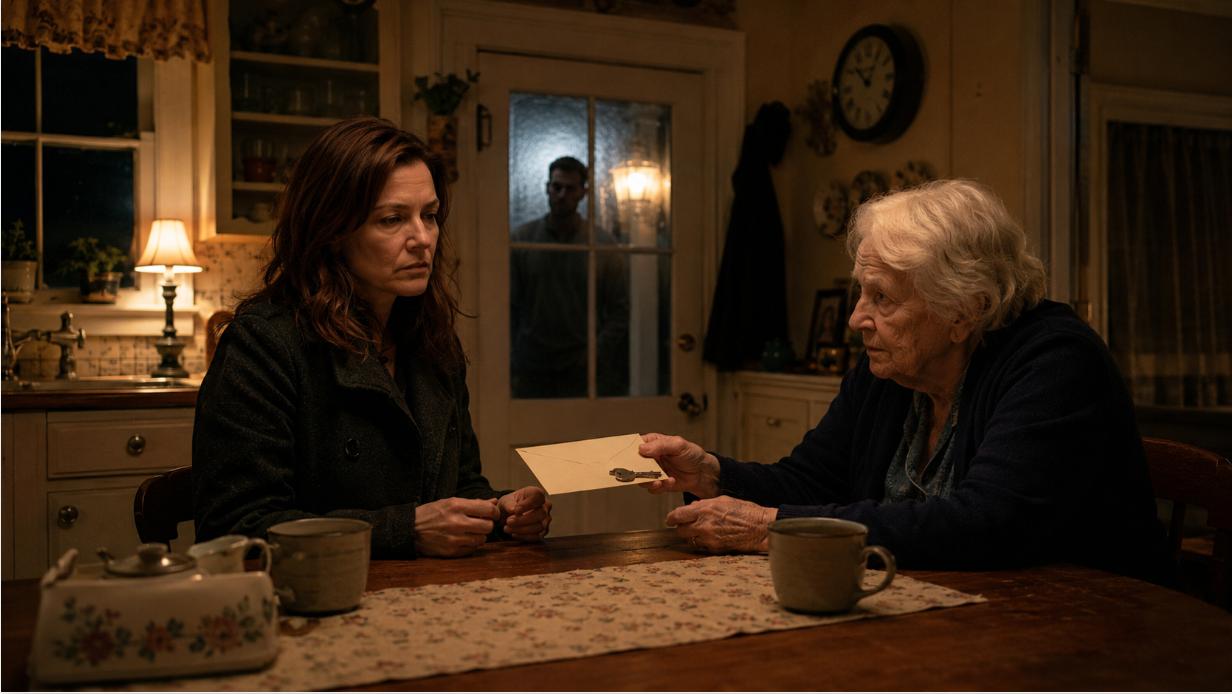
“This is for a motel,” he said. “Three nights should be enough time to make arrangements.”
He placed the envelope on the table.
I did not touch it.
Outside, a lawn mower started somewhere down the street. The sound was absurdly normal. A neighbor cutting grass. A dog barking once. A delivery truck slowing at the curb.
The world had no idea that my life was being removed from a kitchen.
“You’re kicking me out,” I said.
Richard’s mouth tightened.
“I’m preventing confusion.”
“Is that what you call it?”
“I call it respecting your mother’s wishes.”
That struck harder than anything Brent had said.
My mother’s wishes.
Eleanor Whitmore had been gentle, but she had never been weak. She remembered birthdays for people who had forgotten hers. She tipped waitresses in cash because, as she said, “The world is too quick to make kindness taxable.” She kept a flashlight in every room and spare batteries in an old cookie tin. She cried during old movies, cursed softly at hospital bills, and believed family meant showing up even when you were tired.
She had not been perfect.
But she had loved me.
I knew that the way I knew the sound of her footsteps.
So why had her will erased me?
The lawyer’s office came back to me in fragments.
The polished conference table.
The smell of lemon oil and printer paper.
Richard sitting upright, hands folded.
Brent slouched beside him, one ankle on his knee.
Attorney Miriam Keller reading in a careful voice while I waited for the sentence where my name would appear.
It never did.
The house to Richard.
The savings to Richard.
The furniture, the car, the lake property, the contents of all accounts to Richard.
My mother had left me nothing.
Not a necklace.
Not a letter.
Not even the blue mug by the sink.
I had sat very still, because if I moved, I thought I might break in front of them.
Now Richard slid the envelope closer.
“Take it.”
I looked at the envelope.
Then at him.
“You must have been waiting for this.”
His face changed.
Just slightly.
A shadow behind the eyes.
“Be careful, Hannah.”
There was the first crack.
Not guilt.
Fear.
For one second, I saw something in him that did not fit the calm performance.
Then Brent laughed.
“Come on. Don’t act shocked. Your mom remarried. People move on. Maybe she wanted Dad taken care of.”
I turned slowly.
“My mother took care of everyone.”
Brent shrugged. “Guess she had favorites at the end.”
The apple hit the counter before I realized I had slapped it out of his hand.
It rolled across the tile and stopped under the breakfast nook.
Brent stared at me, stunned.
Richard’s voice sharpened.
“Enough.”
My palm stung.
I was breathing hard.
Brent straightened, anger flushing his cheeks.
“You’re lucky I don’t call the police.”
I looked at the two of them.
My stepfather in my mother’s chair.
His son holding my mother’s keys.
The envelope on the table like a tip left for a servant.
Something inside me wanted to explode.
But grief is strange.
Sometimes it burns.
Sometimes it empties the room inside your chest.
That morning, it left me hollow.
I walked upstairs.
Neither of them followed.
My bedroom looked exactly as it had for years: cream walls, iron bedframe, quilt folded at the end, a stack of paperback mysteries on the nightstand. Mom had painted that room herself the summer I came home after my marriage failed.
“Fresh walls,” she had said, rolling paint over old scuffs. “Fresh lungs.”
I opened the closet and pulled down my suitcase.
I packed like someone fleeing a fire.
Jeans. Sweaters. Medication. Phone charger.
Then I went to Mom’s room.
The door was half-open.
Her bed was made. Richard had done that. Too neatly. The pillows stood upright like strangers at attention. Her perfume still lingered near the dresser, soft rose and powder.
I took every photograph I could find.
Mom at twenty-two on the hood of a red car.
Mom holding me in a hospital blanket.
Mom laughing in the backyard with flour on her cheek.
Mom and Richard on their wedding day, his hand resting lightly on her waist, her smile careful but hopeful.
I almost left that one behind.
Then I took it too.
Because truth is rarely polite enough to come in one piece.
In the bottom drawer of her nightstand, I found her old prayer book.
The leather cover was cracked. A grocery receipt marked a page near the middle.
I opened it.
No letter.
No note.
No hidden message.
Just her handwriting in the margin beside a Psalm:
Lord, help me know when peacekeeping becomes cowardice.
I sat on the edge of her bed and pressed the book to my chest.
That was the moment I cried.
Not loudly.
Not the way people cry in movies.
I folded forward, one hand over my mouth, trying not to let Richard and Brent hear me through the floorboards.
Because they had taken enough.
I would not give them the sound of me breaking.
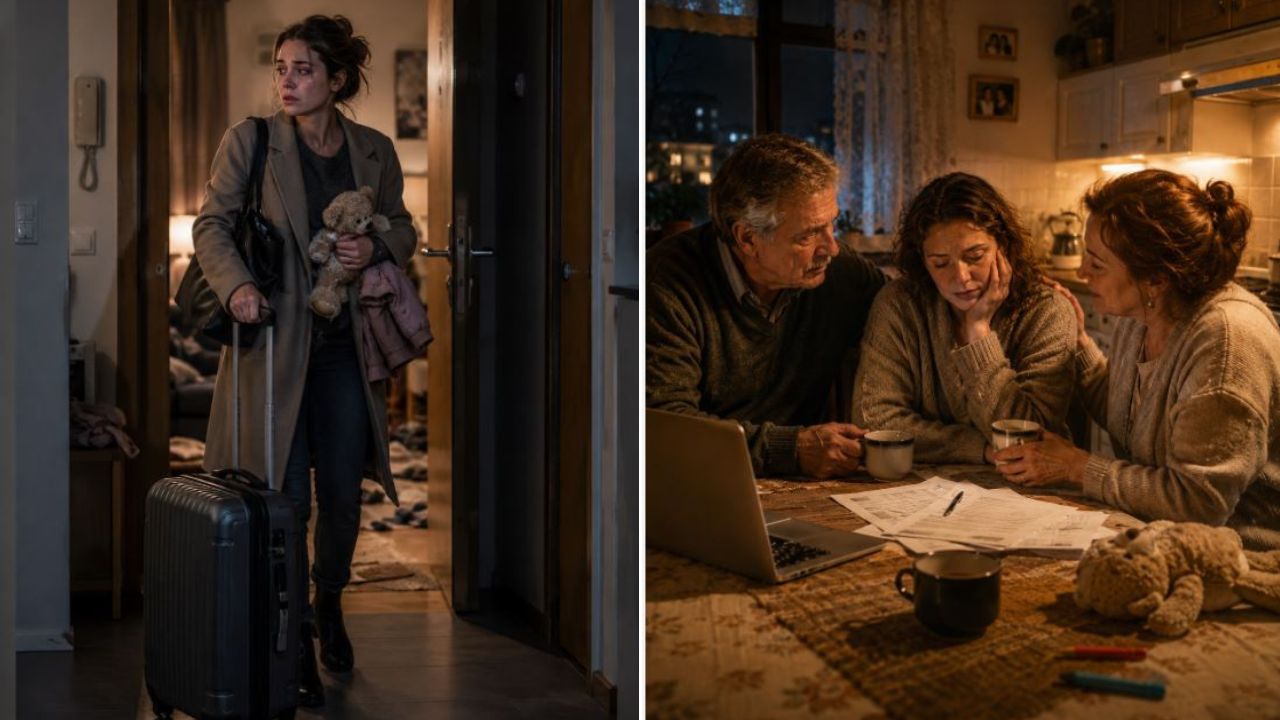
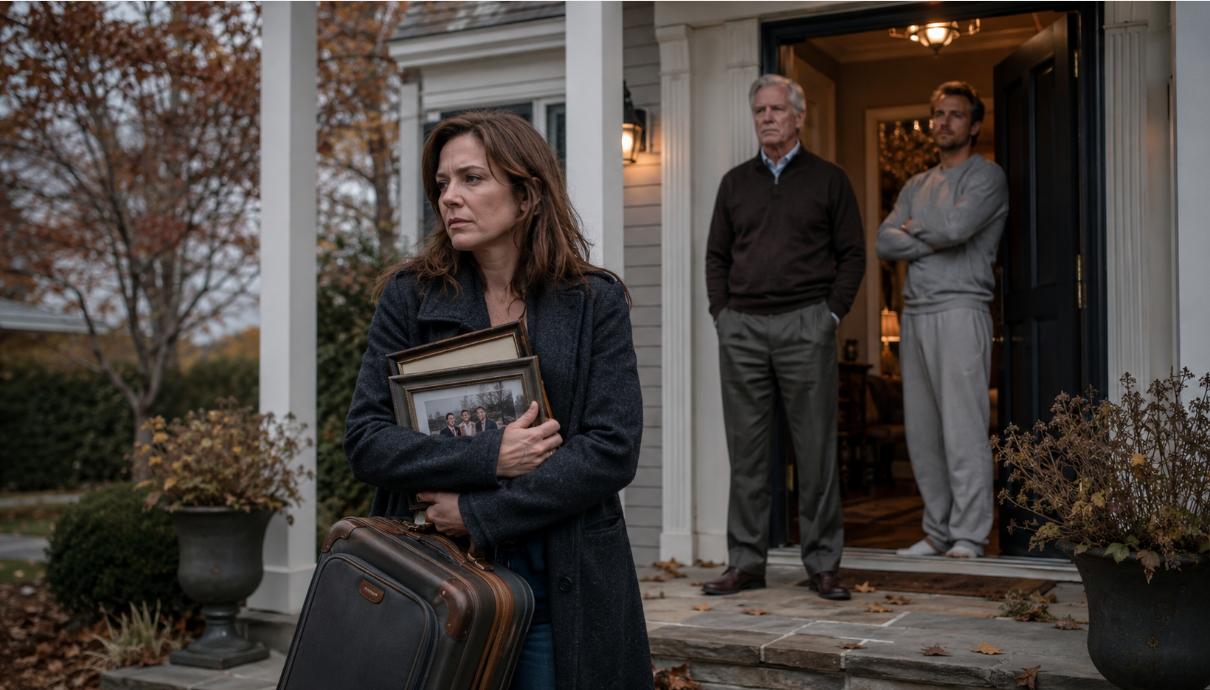
At noon, I carried my suitcase downstairs.
Richard was in the living room speaking to someone on the phone.
“Yes,” he said. “Sooner is better. I’d like it listed before the weekend.”
Brent stood near the fireplace, looking at Mom’s framed watercolor painting above the mantel.
“You taking that too?” I asked.
He smirked.
“Relax. Nobody wants your little sad souvenirs.”
I walked past him.
At the front door, I turned once.
The house stood around me in afternoon light.
White trim.
Warm oak floors.
The faint smell of lemon polish.
My mother’s house.
My home.
Richard covered the phone and looked at me.
“You’ll thank me someday,” he said.
I stared at him.
“No,” I said. “I won’t.”
Then I stepped outside.
The lock clicked behind me.
It was such a small sound.
But it felt like being erased.
For six days, I lived in Room 14 at the Pine Hollow Motor Lodge.
The sign out front flickered after dark, so the word MOTOR became M TOR every three seconds. The carpet smelled like cigarette smoke and old rain. The heater rattled like coins in a dryer. At night, headlights swept across the curtains whenever a car turned into the lot.
I ate canned soup with a plastic spoon.
I drank vending machine coffee that tasted like burnt cardboard.
I kept my mother’s photographs lined up on the dresser.
Every morning, I woke expecting to hear her call from the hallway.
Hannah, honey, are you up?
Every morning, the motel ceiling answered instead.
On the fifth night, I almost called Richard.
Not to beg.
That’s what I told myself.
Just to ask if there had been a mistake.
Just to ask if Mom had left a letter somewhere.
Just to ask if he had seen the sticky note on the refrigerator and felt anything at all.
But I didn’t call.
Pride stopped me first.
Then fear.
Because what if he said no?
What if there was no mistake?
What if the woman who had been my safe place had chosen, in the end, to leave me outside?
By the sixth night, I had begun to hate myself for wondering.
At 11:42 p.m., my phone rang.
Richard Cole.
His name lit the screen in the dark room.
I let it ring four times.
Five.
Then I answered.
“What do you want?”
At first, I heard only breathing.
Wet.
Shaking.
Then Richard said my name.
Not Hannah.
Not in that clipped, formal way.
He said, “Hannie.”
No one called me that except my mother.
My skin went cold.
“Don’t call me that.”
He sobbed.
Richard Cole, who had not cried at my mother’s funeral, was sobbing into the phone like a man with his hands over an open wound.
“Come to the house,” he choked.
I sat up.
“What happened?”
“Please.”
“Where’s Brent?”
Another ragged breath.
Then a sound in the background.
A crash.
Glass, maybe.
My heart started beating hard.
“Richard, where is Brent?”
“He opened it,” Richard whispered.
“Opened what?”
The line crackled.
Then his voice dropped so low I could barely hear it.
“The wall.”
I stood.
“What wall?”
“The one in Eleanor’s sewing room.”
The room tilted around me.
Mom’s sewing room had been locked for years except when she was inside it. A small room at the back of the house with pale blue curtains, baskets of thread, and a cedar chest under the window.
“What are you talking about?” I said.
Richard sobbed once.
“She knew,” he whispered. “Your mother knew everything.”
Then the call went dead.
For three seconds, I stood barefoot on the motel carpet, phone pressed to my ear.
Then I grabbed my coat and keys.
Chapter 2
What Was Hidden Behind the Sewing Room Wall
The front door was wide open when I arrived.
That was the first wrong thing.
My mother had locked doors the way some people crossed themselves. Front door, back door, basement door. She checked them every night in the same order. Even in summer, even when the neighborhood was quiet, even when Richard told her she was being dramatic.
“A locked door,” she used to say, “is not fear. It’s self-respect.”
Now the door stood open to the dark.
The porch light flickered above me.
Inside, the house smelled wrong.
Not like lemon polish.
Not like cinnamon tea.
Dust hung in the air.
Sharp.
Dry.
Freshly disturbed.
“Hannah?”
Richard’s voice came from somewhere inside.
Thin and cracked.
I stepped into the foyer.
The house looked as if someone had searched it with anger.
Cabinet drawers lay open in the hallway built-ins. The umbrella stand was tipped over. A lamp near the staircase had fallen sideways, its shade bent against the floor. One of Mom’s framed photos had shattered, glass glittering across the entry rug.
A smear of blood marked the wall near the stairs.
My breath caught.
“Richard?”
“In here.”
The voice came from the back of the house.
I moved slowly, every nerve awake.
The living room was half-packed. Realtor boxes sat against the wall. Mom’s books had been pulled from the shelves and stacked carelessly on the sofa. Her blue mug was gone from the kitchen sink.
I hated that I noticed.
I hated that it hurt.
Past the kitchen, down the narrow hallway, light spilled from the sewing room.
The door was open.
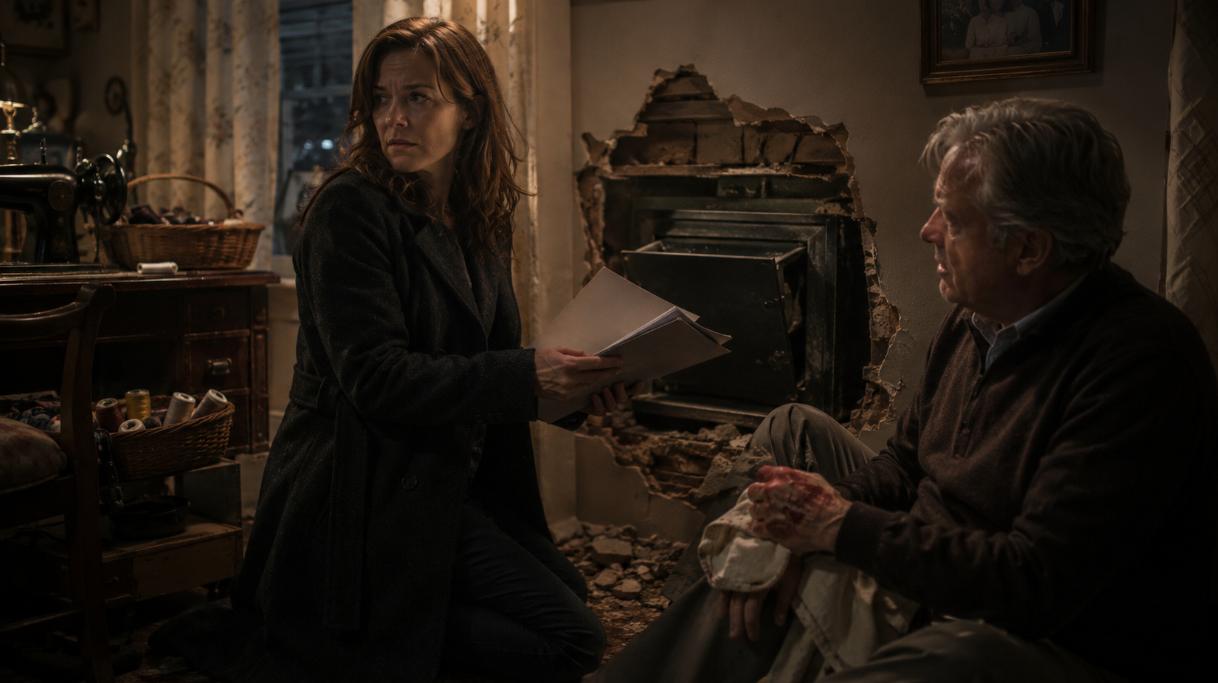
Richard sat on the floor beside the cedar chest, his back against the wall, one hand wrapped in a dish towel darkened with blood. His face was gray.
He looked smaller than he had six days ago.
Older too.
Like the house had finally taken off his mask.
“What happened to your hand?” I asked.
He looked at it, confused, as if he had forgotten he had a body.
“Glass.”
“Where’s Brent?”
Richard’s eyes moved to the wall.
Or what used to be the wall.
The plaster behind Mom’s sewing table had been smashed open. A jagged hole gaped between two studs. Chunks of drywall covered the floor. A hammer lay near Richard’s foot.
Inside the wall was a narrow metal box.
Open.
Empty.
My stomach tightened.
“What was in there?”
Richard swallowed.
“I don’t know.”
I stared at him.
“Don’t lie to me tonight.”
His eyes filled.
“I don’t know what was in the box. Brent found it.”
“Where is he?”
Richard looked toward the window.
“He ran.”
I almost laughed.
Of course he did.
“What did he take?”
Richard lifted his shaking hand and pointed to the sewing table.
On the table lay three things.
A stack of old envelopes tied with blue ribbon.
A small cassette recorder.
And a legal folder.
My name was written across the folder in my mother’s handwriting.
Hannah Grace Whitmore.
Not Cole.
Not my married name.
Whitmore.
My mother’s name.
My knees weakened.
I reached for the folder, but Richard spoke.
“She didn’t leave you nothing.”
His voice broke on the last word.
I looked at him.
He pressed the bloody towel harder around his hand.
“I thought she did.”
“What does that mean?”
He closed his eyes.
“I thought the will was everything.”
“You were happy to let me think that too.”
He flinched.
The old Richard would have corrected my tone.
This one just sat there bleeding on the floor.
“I was angry,” he said.
“At me?”
“At her.”
The answer stopped me.
Outside, wind moved through the bare branches near the window, scratching lightly against the glass.
Richard looked around the sewing room.
At the spools of thread.
The framed sampler on the wall.
The small lamp with the shade Mom had repaired twice.
“She was leaving,” he said.
My fingers tightened around the folder.
“What?”
“Your mother. Before she got sick. She was going to leave me.”
The room went very quiet.
For years, I had believed Mom stayed with Richard because she saw something good in him no one else did. Or because she feared being alone. Or because peace had become easier than truth.
But leaving?
My mother had been planning to leave?
Richard gave a laugh that collapsed almost immediately.
“She didn’t say it outright. Eleanor never threw knives when a spoon would do. But I knew. Separate bank account. Copies of records. Phone calls with Miriam Keller.” He looked at the broken wall. “And this room. She started locking this room.”
I glanced at the legal folder.
“Why didn’t you say anything after the will?”
His mouth twisted.
“Because I won.”
The honesty was uglier than a lie.
He looked at me then, and for the first time since I had known him, Richard Cole did not seem proud of his own control.
“I saw your face in that lawyer’s office,” he said. “I saw you waiting for your name. And I said nothing.”
“No,” I said. “You did worse. You kicked me out.”
His eyes closed.
“Yes.”
I opened the folder.
The first page was not a will.
It was a letter.
My mother’s handwriting moved across the paper in clean, careful lines.
My dearest Hannah,
If you are reading this, then Richard has shown you the will and nothing else.
I am so sorry.
I know how it looks.
I know how it must feel.
But please believe this before you believe your pain:
I did not forget you.
I did not choose him over you.
I did not leave you unprotected.
The room blurred.
I sat down slowly on Mom’s sewing chair.
The cushion sighed under me.
Richard watched without speaking.
I kept reading.
Years ago, before I married Richard, I put the house into a private trust. Your grandfather helped me do it after your divorce, when you moved home and I saw how tired you were from pretending you were fine.
The will Richard heard today does not control the house.
It does not control the lake property.
It does not control the account I created for you.
It controls only what I allowed Richard to see.
My hand shook.
I turned the page.
If I told Richard while I was alive, he would have fought me, charmed me, punished me with silence, and made the last months of my life smaller.
So I let him believe he had won.
Forgive me for that.
I thought I would have time to tell you myself.
A sound escaped me.
Not crying.
Not yet.
Something deeper.
A piece of my heart turning toward air.
Richard whispered, “What does it say?”
I looked at him.
“You don’t know?”
He shook his head.
“Brent opened the box. He read something. Then he started yelling.”
“What did he yell?”
Richard’s face tightened.
“He said you got the house.”
The words filled the sewing room.
I looked back at the papers.
There it was.
The Eleanor Whitmore Family Trust.
Dated four years earlier.
Trustee: Miriam Keller.
Primary beneficiary: Hannah Grace Whitmore.
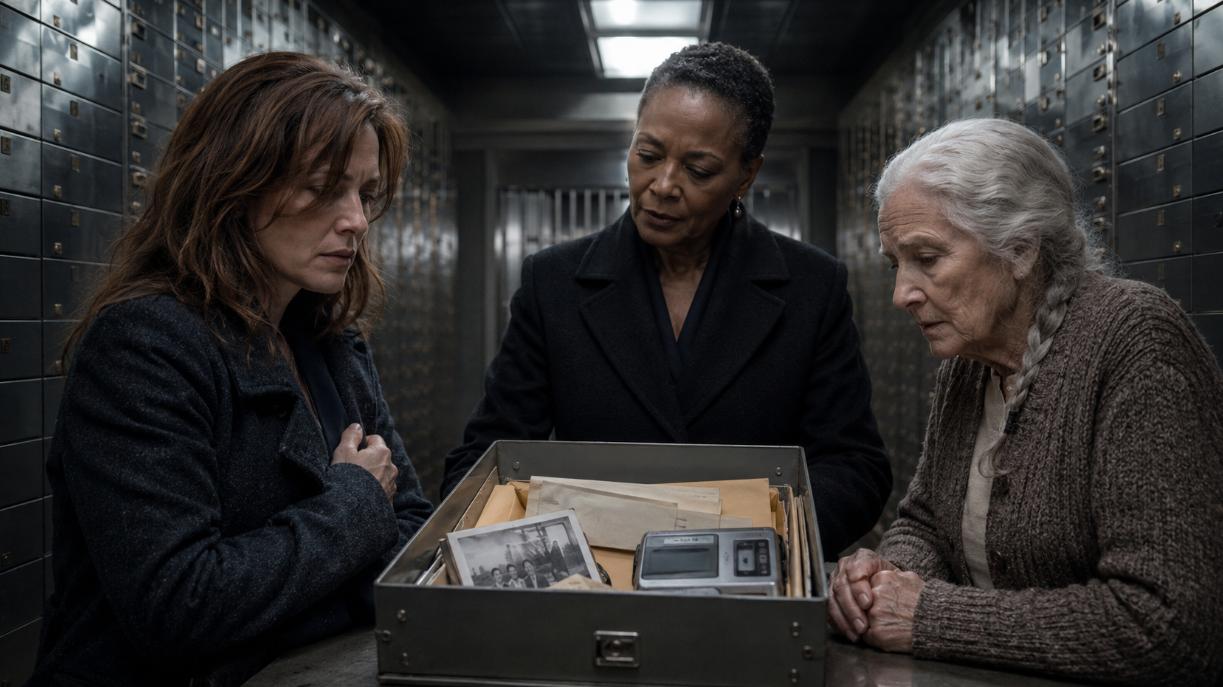
Assets: the house, the lake property, three investment accounts, and the contents of Eleanor Whitmore’s private safe deposit box.
My breath caught on the last line.
Safe deposit box.
Richard saw my face change.
“What?”
I kept reading.
Beside the trust document was a handwritten note.
Hannah, if anything happens before I can explain, call Miriam before sunrise. Do not let Richard or Brent into the bank. The key is not in this house.
The key is with someone Richard would never ask for help.
I stared at the sentence.
Someone Richard would never ask for help.
Richard tried to stand, then sank back down with a groan.
“Brent took something,” he said.
I looked at the empty metal box in the wall.
“What?”
“A photograph. Maybe two. And a small envelope.”
My pulse sharpened.
“What kind of envelope?”
“Cream-colored. Sealed. Your mother’s handwriting.”
“To who?”
He hesitated.
“To Brent.”
That made no sense.
Mom had never trusted Brent.
She was kind to him. Fed him. Remembered his birthday. But trust him? No.
I looked at the cassette recorder on the table.
“Did you play this?”
Richard shook his head.
“Brent tried. It didn’t work.”
I picked it up.
It was old, silver, scratched near the speaker. Inside was a cassette labeled in Mom’s handwriting:
For Hannah — play with Miriam.
I set it down carefully.
Not yet.
Some instructions deserve to be obeyed.
My phone buzzed in my pocket.
Unknown number.
I answered.
“Hannah Whitmore?”
The woman’s voice was older. Calm. Familiar in a way I couldn’t place.
“Yes.”
“My name is Ruth Bellamy. I lived next door to your mother when you were little.”
Ruth Bellamy.
Mrs. Bellamy.
Gray braids. Peppermint candies. A porch swing. A black cat named President.
Memory opened like a drawer.
“I remember you,” I said.
Her breath trembled softly.
“Your mother told me you might call someday. But I think we’re out of time.”
I stood.
“What do you mean?”
“A young man came here tonight,” she said. “Blond. Nervous. Angry.”
Brent.
My eyes went to Richard.
“He asked if Eleanor left anything with me. I told him no.”
My mouth went dry.
“Did she?”
Mrs. Bellamy was silent for one beat too long.
Then she said, “Yes.”
Richard pushed himself upright.
I turned away from him.
“What did Mom leave?”
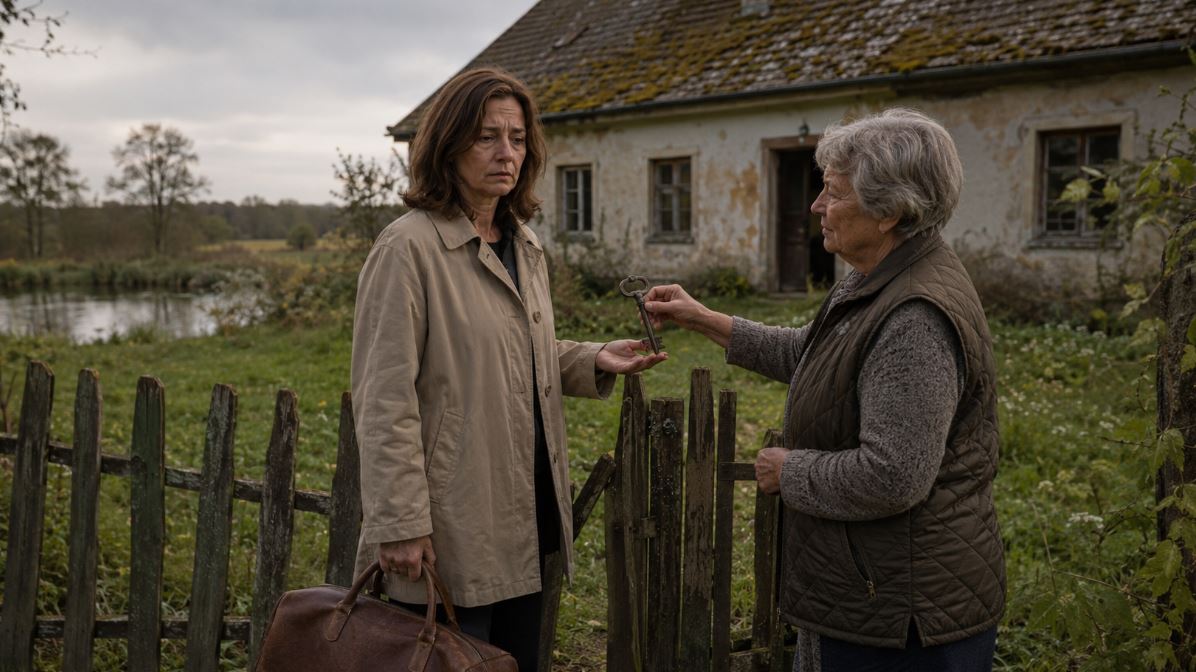
“A key,” Mrs. Bellamy said. “And a letter she made me promise not to give anyone but you.”
Behind me, Richard whispered, “Hannah…”
I ignored him.
Mrs. Bellamy’s voice lowered.
“Come now. Before he comes back.”
The line clicked dead.
I stood in the middle of my mother’s ruined sewing room, holding proof that she had not abandoned me.
Richard sat bleeding beneath the broken wall.
Brent was out there somewhere with an envelope my mother had written to him.
And the one person who had the key to everything was an eighty-one-year-old woman two streets away.
I grabbed the legal folder.
Richard looked up.
“Where are you going?”
I met his eyes.
“To find out what my mother was afraid to say while she was alive.”
Then I walked out of the room.
And this time, no one locked the door behind me.