Robert Miller had lived in the same white house on Maple Street for forty-three years.
It was not a fancy house. The porch sagged a little on the left side. The kitchen floor had a small crack near the sink. The old oak tree in the front yard dropped leaves every fall faster than Robert could rake them.
But to Robert, that house was everything.
It was where he had raised three children.
It was where his wife, Helen, had baked apple pies every Thanksgiving.
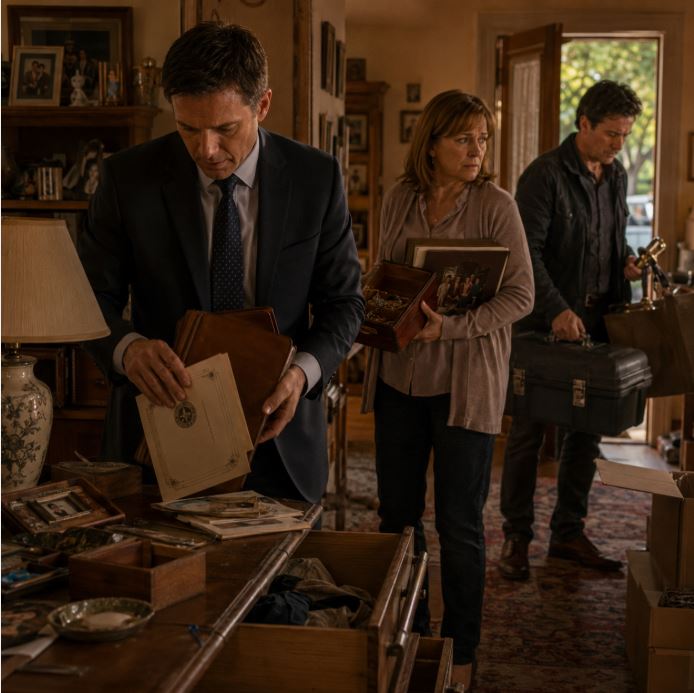
It was where birthday candles had been blown out, Christmas stockings had been hung, and family photographs had slowly filled the hallway wall.
After Helen passed away, the house became quieter.
Too quiet sometimes.
Robert was seventy-eight now. His hands shook a little when he buttoned his shirt. His knees hurt when the weather turned cold. Some mornings, he had to sit on the edge of the bed for a minute before standing up.
But his mind was clear.
He remembered every name, every bill, every promise.
Most of all, he remembered who showed up.
And who did not.
His oldest son, Mark, lived only twenty minutes away, but he rarely visited unless something needed to be signed.
His daughter, Linda, called once every few weeks, usually while driving somewhere, always in a hurry.
His youngest son, Kevin, came by when he needed money.
Robert never said that out loud.
Fathers from his generation did not complain much. They swallowed hurt like medicine and told themselves the children were busy.
But he knew.
He always knew.
One Thursday afternoon in October, the three of them arrived at his house together.
That alone made Robert suspicious.
Mark wore his work suit. Linda carried a folder. Kevin stood near the door, avoiding eye contact.
Robert was sitting at the kitchen table with a cup of black coffee when they came in.
“Well,” he said, forcing a smile, “this must be serious. All three of you in one room.”
Linda gave him a soft look.
Too soft.
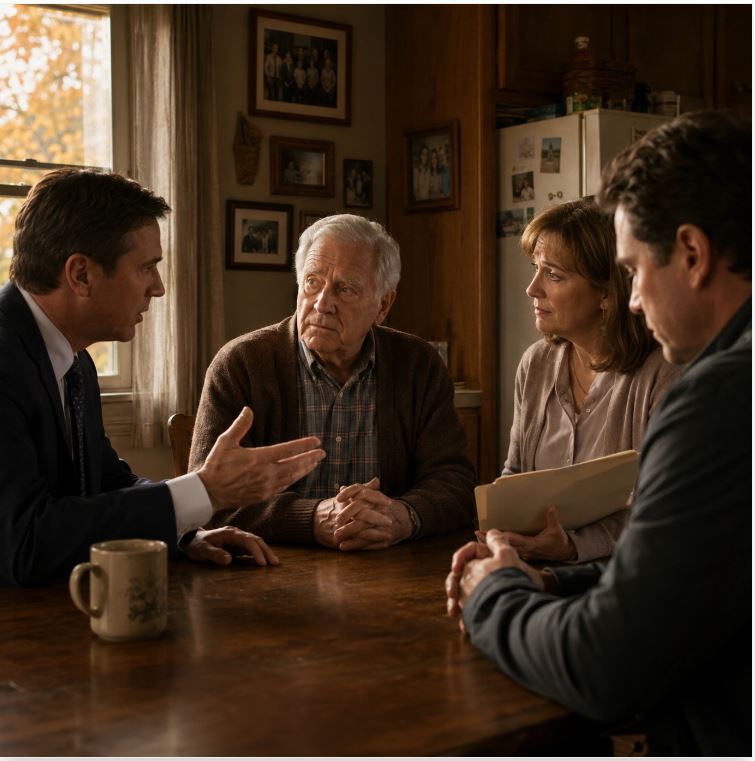
“Dad,” she said, sitting across from him, “we need to talk.”
Robert looked at the folder in her hand.
“I figured.”
Mark cleared his throat. “We’ve been worried about you.”
Robert took a slow sip of coffee. “Is that right?”
“You’re alone in this house,” Linda said. “You fell last month.”
“I slipped on the back step,” Robert replied. “I got up fine.”
“But what if you hadn’t?” Mark asked. “What if no one found you?”
Robert looked from one child to the next.
Kevin finally spoke. “There’s a very nice place about fifteen minutes from here. Green Meadows. Assisted living. Clean rooms. Nurses. Meals.”
Robert’s face did not change, but his heart sank.
“So that’s what this is.”
Linda reached for his hand, but Robert gently moved his fingers away.
“It’s for your own good, Dad,” she said.
There it was.
The phrase people used when they wanted to make a decision for someone else and feel kind about it.
For your own good.
Robert looked toward the hallway, where Helen’s picture hung beside their wedding portrait. She was twenty-two in that photo, laughing at something outside the frame.
He wondered what she would have said.
Probably something sharp.
Helen had never let the children push her around.
“I’m not ready to leave my home,” Robert said.
Mark sighed. “Dad, nobody is saying forever. Just until we figure things out.”
“What things?”
“The house,” Kevin said too quickly.
Linda shot him a look.
Robert noticed.
He noticed everything.
“The house?” Robert asked.
Mark leaned forward. “It’s too much for you. The taxes, repairs, yard work. We could help manage it.”
Robert almost smiled.
Manage it.
Another soft word covering a hard truth.
“You mean sell it.”
No one answered right away.
Then Linda said, “Eventually, maybe. It might be best.”
“For who?” Robert asked.
The kitchen went silent.
Mark looked irritated now. “Dad, don’t make this harder than it needs to be.”
Robert stared at his oldest son. For one second, he saw the boy Mark used to be, running through the yard with scraped knees and grass-stained jeans.
Then he saw the man in front of him.
Impatient. Polished. Already calculating.
Robert set his coffee cup down.
“If I say no?”
Linda’s eyes filled with tears, but Robert could tell they were not tears of sadness. They were tears of frustration.
“Then we’ll have to speak with your doctor,” she said.
That was the moment Robert understood.
This had already been planned.
Not discussed.
Planned.
The next morning, they drove him to Green Meadows.
They packed two suitcases for him. Not his favorite brown coat. Not Helen’s framed photograph from the bedroom. Not his old radio.
Just clothes, medication, slippers, and a few books.
Robert stood in the doorway before leaving and looked back at his living room.
The blue recliner where Helen used to sit.
The cabinet with her china.
The wall of family photos.
Mark jingled the car keys. “Come on, Dad. We’re already late.”
Robert stepped outside.
At Green Meadows, a cheerful woman named Nancy showed him to Room 214.
It was clean. Small. Beige.
There was one bed, one dresser, one window, and a chair that squeaked when he sat in it.
Linda arranged his shirts in the closet like she was doing something loving.
Kevin checked his phone.
Mark filled out paperwork.
Before they left, Linda kissed Robert on the cheek.
“We’ll come visit this weekend,” she promised.
Robert looked at her.
“You said that after your mother’s funeral too.”
Linda froze.
Mark said, “Dad.”
But Robert only turned toward the window.
They left ten minutes later.
That night, Robert did not sleep.
He sat in the squeaky chair and watched headlights move across the ceiling.
At 2:17 a.m., he reached into the side pocket of his small suitcase and pulled out an old flip phone.
Mark had tried to convince him to get rid of it for years.
Robert had refused.
He opened it slowly and called one number.
A man answered on the third ring.
“Robert?”
“Evening, Alan.”
Alan Brooks had been Robert’s attorney for almost twenty years. Before that, they had been friends through the Rotary Club. Alan was seventy-one, sharp as a tack, and one of the few people Robert still trusted completely.
“Are you all right?” Alan asked.
“I’m at Green Meadows.”
There was a pause.
“They moved you?”
“This morning.”
“Did you agree to that?”
Robert looked around the small room.
“I got tired of arguing.”
Alan’s voice changed. “What do you need?”
Robert closed his eyes.
“I need you to check the camera system at the house.”
Another pause.
“Robert…”
“I have a feeling,” Robert said quietly.
Alan did not ask him to explain.
He knew Robert well enough.
Years earlier, after a series of break-ins around the neighborhood, Robert had installed cameras inside and outside the house. Mark had laughed at him then.
“Dad, nobody wants your old furniture.”
But Robert had not installed them for the furniture.
He had installed them because he had spent thirty-five years working as an insurance investigator.
He knew people rarely showed their true faces when they thought someone was watching.
They showed them when they believed no one was.
The cameras covered the front porch, living room, hallway, kitchen, garage, and study.
They recorded automatically.
Robert had never told his children the system still worked.
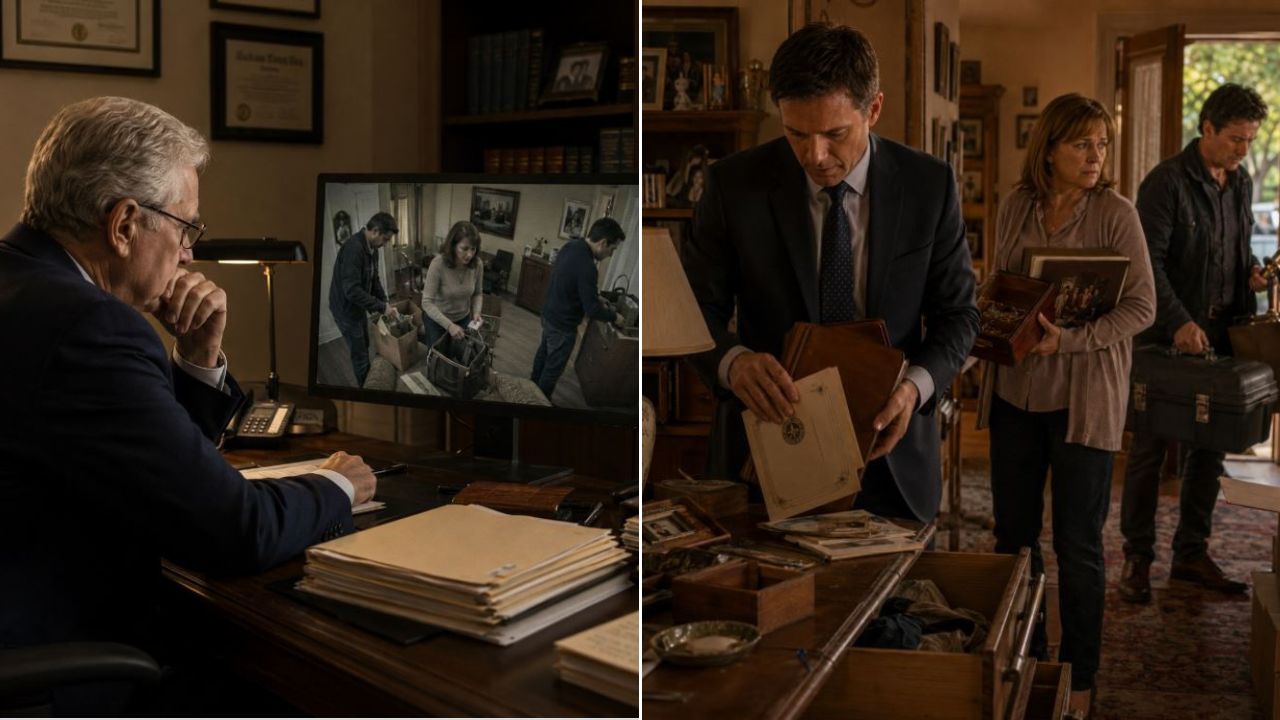
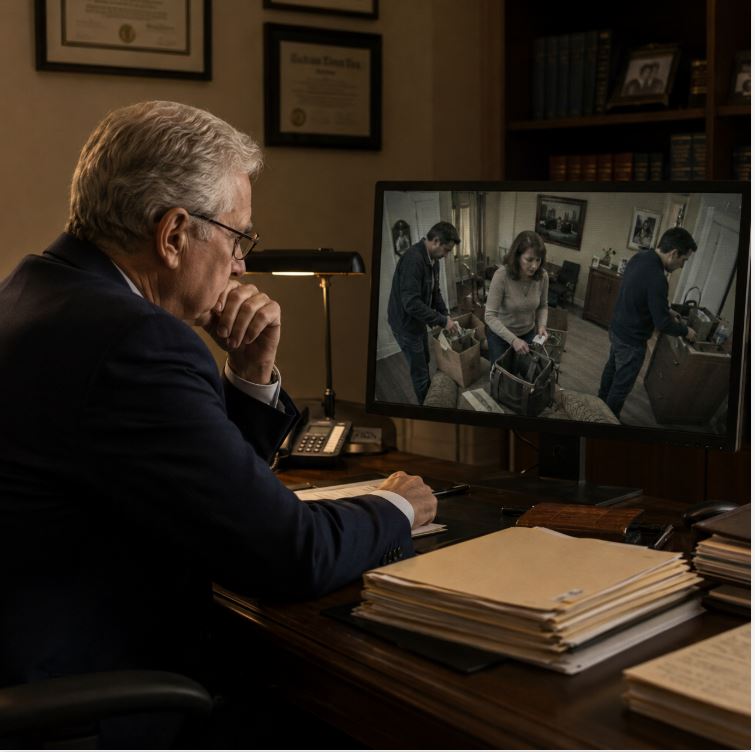
By eight o’clock the next morning, Alan Brooks was sitting in his office, logging into the camera account Robert had given him years earlier.
At 9:14 a.m., Mark’s SUV pulled into Robert’s driveway.
At 9:22, Linda arrived.
At 9:31, Kevin showed up in a rented van.
Alan watched in silence.
The three siblings walked into the house using the spare key under the flowerpot.
The same spare key Helen had hidden there twenty years ago.
At first, they moved slowly.
They opened cabinets. Checked drawers. Looked through closets.
Then Kevin found the box in the study.
Robert’s document box.
He carried it to the kitchen table.
Mark opened it.
Linda said something Alan could not hear at first, so he turned up the volume.
“Don’t take everything,” she said. “It’ll look bad.”
Kevin laughed. “To who? He’s in a home now.”
Mark pulled out folders.
Bank statements.
Insurance papers.
The deed to the house.
Robert’s hands would have trembled if he had been watching. But Alan was glad he was not there.
Then Linda went upstairs.
She came back twenty minutes later holding Helen’s jewelry case.
Alan leaned closer to the screen.
Linda opened the small velvet box inside.
Helen’s wedding ring.
The diamond was tiny. Robert had bought it in 1968 after saving for almost a year. Helen used to joke that the stone was small enough to lose in a sugar bowl, but she never took it off until the day she went into the hospital.
Linda held it up.
“I should have this,” she said. “I’m the daughter.”
Kevin snorted. “You barely called Mom when she was sick.”
Linda turned on him. “And you were borrowing money from Dad while she was dying.”
Mark slammed his palm on the table.
“Enough. We’re not doing this now.”
Kevin gestured around the kitchen. “Then when, Mark? You want to act like you’re in charge because you wore a tie? We all know why you’re here.”
Mark’s face hardened.
“I’m here because Dad can’t manage anything anymore.”
“No,” Kevin said. “You’re here because your business is failing.”
Linda’s mouth opened.
Mark stepped toward Kevin.
Alan kept watching.
He watched them argue in the kitchen where Robert had once carved Thanksgiving turkey.
He watched them divide their parents’ life into piles.
Things to keep.
Things to sell.
Things to throw away.
At 11:03 a.m., Kevin carried Robert’s tools from the garage to the van.
At 11:47, Linda packed Helen’s china.
At 12:15, Mark took the small safe from the study closet.
By 1:30, the house looked wounded.
Drawers open.
Cabinet doors hanging wide.
Photo albums stacked on the floor.
Then came the moment Alan would later replay in his mind again and again.
Linda stood in the living room holding one of the old albums.
It was the Christmas album from 1989.
The year Kevin got the red bicycle.
The year Mark broke his wrist trying to jump off the porch.
The year Linda wore a green dress Helen had sewn by hand.
Linda looked at the album for a moment.
Then she tossed it onto a trash pile.
Kevin said, “You’re throwing those away?”
Linda shrugged. “What are we supposed to do with a hundred old pictures?”
Mark said, “Just take anything valuable. We need this done before Dad starts asking questions.”
Kevin laughed again.
“What’s he going to do? Walk out of the nursing home and stop us?”
That was when Alan stopped the recording.
He removed his glasses.
For a full minute, he sat completely still.
Then he picked up the phone.
When Robert answered, Alan said only, “You were right.”
Robert closed his eyes.
He had expected it.
But expecting pain did not make it hurt less.
For the next two days, Robert said nothing to his children.
When Linda called, he let it go to voicemail.
When Mark texted, he did not reply.
Kevin did not call at all.
On Saturday morning, the three of them came to Green Meadows together, acting as if nothing had happened.
Linda brought muffins from a grocery store bakery.
Mark brought forms.
Kevin brought his usual nervous energy.
Robert was sitting by the window when they walked in.
“Dad,” Linda said brightly, “how are you settling in?”
Robert looked at the muffins.
“Fine.”
Mark placed the folder on the small table. “We need to go over a few things.”
Robert did not look at it.
“What things?”
“Just practical matters,” Mark said. “Power of attorney. House maintenance. Bank access in case of emergencies.”
Robert nodded slowly.
“In case of emergencies.”
Linda sat on the edge of his bed. “Dad, we’re trying to help.”
Robert looked at his daughter’s hands.
Helen’s wedding ring was not on them.
Not yet.
But he knew she had taken it.
He felt a sadness so deep it almost became calm.
“Where are the photo albums?” he asked.
The room changed.
Only slightly.
But enough.
Kevin looked at Linda.
Linda looked at Mark.
Mark said, “What photo albums?”
“The ones from the hallway cabinet.”
Linda swallowed. “We moved some things around. The house was cluttered.”
Robert looked at her. “Cluttered.”
She smiled too quickly. “We’re organizing, Dad.”
Robert nodded.
Then he said, “And your mother’s ring?”
Linda’s face turned pale.
Mark stepped in. “Dad, maybe we should talk about this another time.”
Robert reached into the drawer beside his chair and pulled out a single sheet of paper.
He handed it to Mark.
Mark frowned. “What is this?”
“A meeting notice,” Robert said. “Monday morning. Ten o’clock. Alan Brooks’ office.”
Linda stood. “Your lawyer?”
“Yes.”
Kevin muttered, “Here we go.”
Robert turned to him.
“No, Kevin. Here you go.”
No one spoke.
Robert’s voice stayed quiet.
“I want all three of you there.”
Mark’s jaw tightened. “Dad, if this is about the house—”
“It’s about the truth,” Robert said.
The meeting room at Alan Brooks’ office had a long wooden table and framed certificates on the wall.
Robert arrived early with Nancy from Green Meadows, who had kindly offered to drive him.
He wore his navy suit.
The one Helen always said made him look handsome.
Alan greeted him at the door and squeezed his shoulder.
“You sure about this?”
Robert looked at the empty chairs.
“No,” he said. “But I’m doing it anyway.”
At exactly 10:00, Mark entered first.
Linda came in behind him, wearing pearls.
Kevin arrived last, looking like he had not slept well.
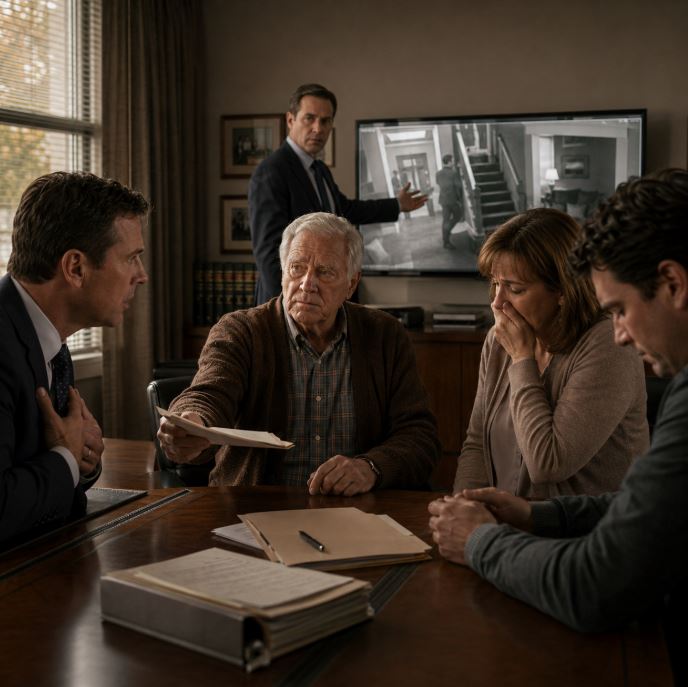
They all seemed surprised to see a large television screen at the end of the room.
Alan closed the door.
“Thank you for coming,” he said.
Mark leaned back in his chair. “Can we make this quick? I have a client call.”
Robert looked at his son.
“You’ll want to stay for this.”
Alan opened a folder.
“As you know, your father has asked me to review certain matters regarding his estate, his home, and his care.”
Linda clasped her hands. “We only want what’s best for Dad.”
Robert almost laughed.
Alan clicked a remote.
The screen turned on.
The first video showed Mark’s SUV pulling into the driveway.
Nobody moved.
The next clip showed Linda carrying Helen’s jewelry case down the stairs.
Linda gasped softly.
Kevin whispered, “Oh, no.”
Alan played the kitchen argument.
Every word filled the room.
“Don’t take everything. It’ll look bad.”
“He’s in a home now.”
“You’re here because your business is failing.”
“Just take anything valuable.”
Robert sat still.
He did not look angry.
That somehow made it worse.
Then Alan played the final clip.
Linda tossing the family photo album onto the trash pile.
Mark saying, “We need this done before Dad starts asking questions.”
Kevin laughing.
“What’s he going to do? Walk out of the nursing home and stop us?”
Alan paused the video.
The room was silent.
Linda was crying now, but Robert could not tell if it was shame or fear.
Mark’s face had gone red.
Kevin stared at the table.
Robert finally spoke.
“I may be old,” he said, “but I am not dead.”
No one answered.
He turned to Linda.
“Your mother wore that ring for fifty-four years. She asked me to keep it safe until I was ready to part with it. Not until you were ready to take it.”
Linda covered her mouth.
He turned to Kevin.
“My tools were not worth much. But every one of them fed you.”
Kevin wiped his eyes.
Then Robert looked at Mark.
“And the house,” he said, “was never just a house. Your mother and I built a life there. You treated it like a store closing sale.”
Mark leaned forward. “Dad, we made mistakes. But you have to understand—”
Robert raised one hand.
Mark stopped.
“No. I don’t have to understand greed.”
Alan placed another document on the table.
“Before today,” Alan said, “Robert had an existing will dividing his estate equally among his three children.”
Linda looked up.
Kevin’s face changed.
Mark sat very still.
Alan continued.
“As of yesterday afternoon, that will has been legally revoked and replaced.”
Linda whispered, “Dad…”
Robert did not look away.
“My house will not be sold by any of you.”
Mark said, “What does that mean?”
“It means,” Robert said, “the house will be transferred into a trust.”
Alan nodded. “The trust will allow Robert to live in the home with paid care for as long as he chooses. After his passing, the property will be sold, and the proceeds will fund the Helen Miller Care Fund.”
Kevin blinked. “What is that?”
Robert’s voice softened when he said Helen’s name.
“A small fund for elderly people whose families forget them.”
Linda began to sob.
Mark looked furious. “You’re giving our inheritance away?”
Robert looked at him for a long moment.
“No, Mark. You gave it away when you emptied my house.”
The words landed like a door closing.
Alan continued.
“Robert has also removed all three of you from financial decision-making authority. His medical and legal representatives have been updated.”
Mark pushed back his chair. “This is ridiculous. He’s being manipulated.”
Robert smiled sadly.
“There it is.”
Mark froze.
“The moment you don’t get what you want,” Robert said, “I become confused.”
Kevin whispered, “Dad, I’m sorry.”
Robert looked at him.
“I believe you’re sorry you got caught.”
Kevin lowered his head.
Linda stood and walked around the table, but Robert gently held up a hand.
“Not now.”
She stopped.
He could see the little girl she had been.
The one who used to climb into his lap after bad dreams.
But he could also see the woman carrying Helen’s jewelry box down the stairs.
Both were true.
That was the hardest part of growing old.
You remembered every version of the people you loved.
Even the ones that broke your heart.
The legal process took weeks.
There were angry calls.
There were apologies.
There were accusations.
Mark threatened to challenge everything, but Alan had been careful. Robert had doctors confirm his mental clarity. The video evidence spoke for itself. Every document was clean.
Linda returned Helen’s ring in a small envelope.
Robert held it for a long time after she left.
Kevin brought back the tools, though two were missing.
Mark never returned the safe, but Alan made sure its contents were accounted for.
By Thanksgiving, Robert was back home.
Not alone this time.
Nancy from Green Meadows helped him find a part-time caregiver named Grace, a widow in her sixties with kind eyes and a habit of humming old church songs while making tea.
Robert kept his blue recliner.
He rehung the family photos.
Even the Christmas album from 1989 was saved.
Grace found it in a donation box before it disappeared forever.
On Thanksgiving morning, Robert sat at the kitchen table while rain tapped against the windows.
For the first time in months, the house smelled like food again.
Grace had made turkey breast, mashed potatoes, green beans, and a small apple pie using Helen’s old recipe card.
Around noon, the doorbell rang.
Robert knew who it was before Grace opened the door.
Linda stood on the porch holding a covered dish.
Her eyes were red.
“I know I don’t deserve to come in,” she said.
Robert looked at her for a long time.
Then he said, “No. You don’t.”
Linda nodded, tears slipping down her face.
“I just wanted to say I’m sorry. Not because of the will. Not because of the cameras. Because I forgot you were still my father.”
Robert’s expression changed.
Just a little.
Grace stepped back quietly.
Linda placed the dish on the porch rail.
“It’s sweet potatoes,” she said. “Mom’s way. Probably not as good.”
Robert looked past her at the yard, at the oak tree, at the porch Helen had decorated every fall.
Then he looked at his daughter.
“You can come in for one hour,” he said.
Linda cried harder.
“One hour,” Robert repeated. “And we don’t talk about the house.”
She nodded quickly.
“Yes. Of course.”
That afternoon, Linda sat at the kitchen table and ate from a paper plate because Robert had not yet unpacked all the dishes.
She did not ask about money.
She did not ask about the will.
She asked about Helen.
For the first time in years, she listened when Robert talked.
A week later, Kevin came by with a repaired porch step and two new tools to replace the missing ones.
Robert let him fix the step.
He did not invite him to stay for dinner.
Not yet.
Mark sent a letter through Alan.
Robert read the first paragraph, then folded it and placed it in a drawer.
Some apologies were written to repair relationships.
Some were written to reopen access.
Robert had spent seventy-eight years learning the difference.
By Christmas, the house on Maple Street had changed.
There was a caregiver schedule on the refrigerator.
A new lock on the study door.
A small sign by the front entrance that read:
Helen Miller Care Fund
Dignity Begins at Home
Robert spent Christmas Eve in his blue recliner with Helen’s ring in his palm.
He looked at the tree Grace had helped him decorate.
It was smaller than the trees Helen used to choose, but it glowed warmly in the corner.
The cameras were still there.
But Robert did not think of them as traps anymore.
He thought of them as witnesses.
They had witnessed betrayal.
But they had also witnessed something else.
An old man choosing himself.
Not out of bitterness.
Not out of revenge.
Out of dignity.
Because being old did not mean being invisible.
Being quiet did not mean being foolish.
And being a father did not mean letting your children bury you before you were gone.
That night, before turning off the lamp, Robert placed Helen’s ring back into its velvet box.
Then he wrote a note and tucked it underneath.
Someday, Linda might receive it.
Maybe.
But not because she was entitled to it.
Only if she earned back the kind of love that did not come with keys, deeds, or bank papers attached.
Robert looked around his home one last time before bed.
The old floorboards creaked.
The oak tree scratched softly at the window.
The hallway photographs watched over him like memories refusing to fade.
For the first time since his children had driven him away, Robert felt something close to peace.
They had sent him to a nursing home.
They had emptied his house.
They had forgotten about the cameras.
But their biggest mistake was thinking the house was the inheritance.
It wasn’t.
The real inheritance had always been the lesson Helen and Robert tried to teach them:
You do not measure family by what they take when you are weak.
You measure it by who protects your dignity when you have nothing left to give.
And Robert Miller, old as he was, had finally protected his own.