Ruth Bellamy lived two streets over in a yellow house with green shutters and a porch swing that had been complaining in the wind for as long as I could remember.
When I was a child, my mother used to send me there with a casserole dish wrapped in foil or a jar of blackberry jam. Mrs. Bellamy always answered the door in slippers, always smelled faintly of peppermint and lavender soap, and always sent me home with something I had not come for.
A cookie.
A book.
A warning about men who smiled too quickly.
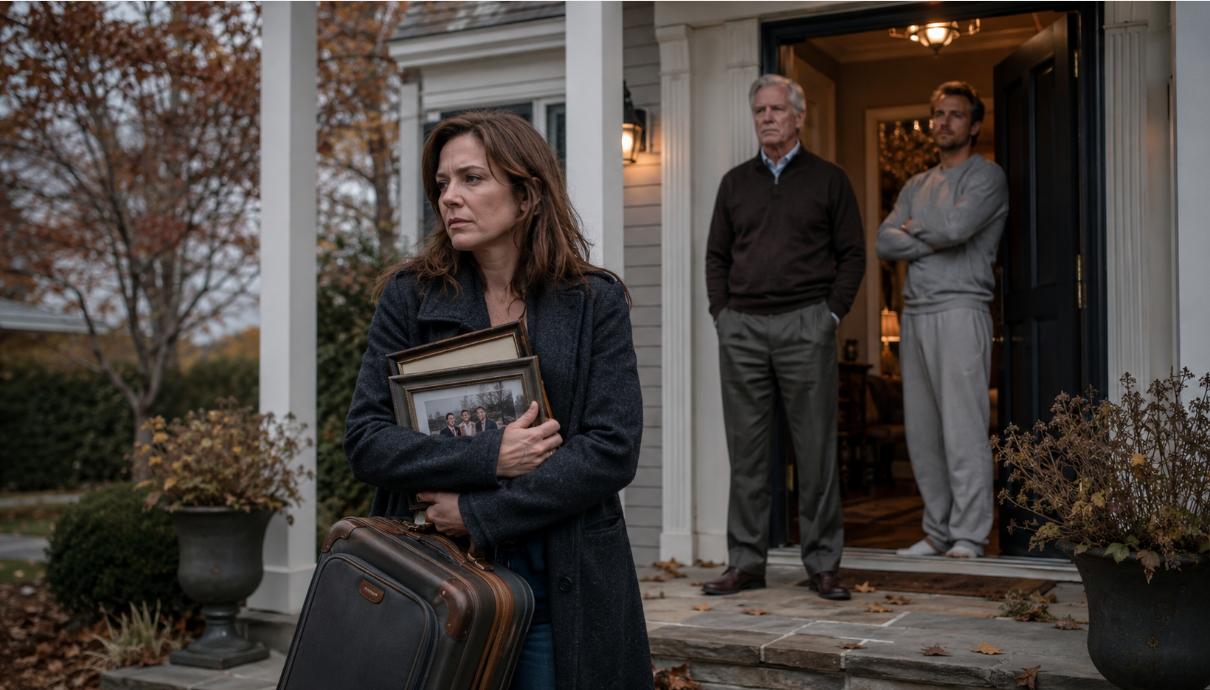
That night, her porch light was on.
So was every lamp in the front room.
I parked half a block away without knowing why. Maybe fear has instincts before the mind catches up. Maybe my mother’s voice was already inside me, telling me to be careful.
The street was quiet except for wind moving through bare branches. Halloween decorations still sagged in a few yards though October had passed. A plastic skeleton on the Lawsons’ mailbox twisted slowly, tapping one bony hand against the post.
Tap.
Tap.
Tap.
I held the legal folder tight against my chest and walked fast.
Before I reached Ruth’s steps, her front door opened.
She stood in the doorway wearing a navy housecoat, white socks, and a cardigan buttoned wrong. Her hair, once iron gray, was now nearly white and braided over one shoulder. She looked smaller than I remembered, but her eyes were exactly the same.
Sharp.
Unfooled.
“Hannah Whitmore,” she said.
The sound of my mother’s name on the end of mine nearly broke me.
I climbed the steps.
“Mrs. Bellamy.”
“Ruth,” she said. “At my age, formality is just furniture you trip over.”
Then she looked past me.
Down the street.
Her hand tightened on the door.
“Come in.”
I stepped inside.
She locked the door behind me.
Not just the knob.
The deadbolt.
Then the chain.
The house smelled like cinnamon, old books, and furniture polish. The front room was crowded with framed photographs, crocheted blankets, porcelain birds, and stacks of newspapers tied neatly with twine. A grandfather clock ticked in the corner with the heavy patience of something that had watched people ruin their lives before.
Ruth led me to the kitchen.
A kettle trembled on the stove. Two mugs waited on the table, though I knew she had not had time to make tea after calling me.
“You expected me,” I said.
She turned off the burner.
“I expected this night for four years.”
My fingers went cold around the folder.
“Four years?”
Ruth did not answer right away.
She opened a drawer, took out a small tin of peppermint candies, and placed one in front of me like I was still seven years old.
“Your mother came here the first Tuesday of every month,” she said. “After Richard went to his veterans’ breakfast. Same time. Same coat. Same brave face.”
I sat down slowly.
“She never told me.”
“She didn’t want you to carry more than you already did.”
The words struck me with a dull ache.
That was my mother.
Loving badly by loving secretly.
Ruth lowered herself into the chair across from me.
“Eleanor was afraid of Richard.”
I wanted to deny it.
Not because it wasn’t true.
Because saying it out loud made the years rearrange themselves.
The careful dinners.
The way Mom apologized when he went silent.
The way she would touch my wrist under the table when I challenged him, a silent plea to let it go.
Peacekeeping becomes cowardice.
I swallowed.
“Did he hurt her?”
Ruth’s face hardened.
“Not with fists.”
That was almost worse.
“She said he could turn a room into a courtroom without raising his voice,” Ruth continued. “Everything became evidence. Every dollar she spent. Every person she called. Every hour she was not where he expected.”
I looked down at my mother’s folder.
“She was leaving him?”
“Yes.”
“When?”
Ruth’s mouth trembled.
“After Thanksgiving.”
The words entered the room quietly.
Thanksgiving was two months away when Mom went into the hospital.
Two months.
She had been that close.
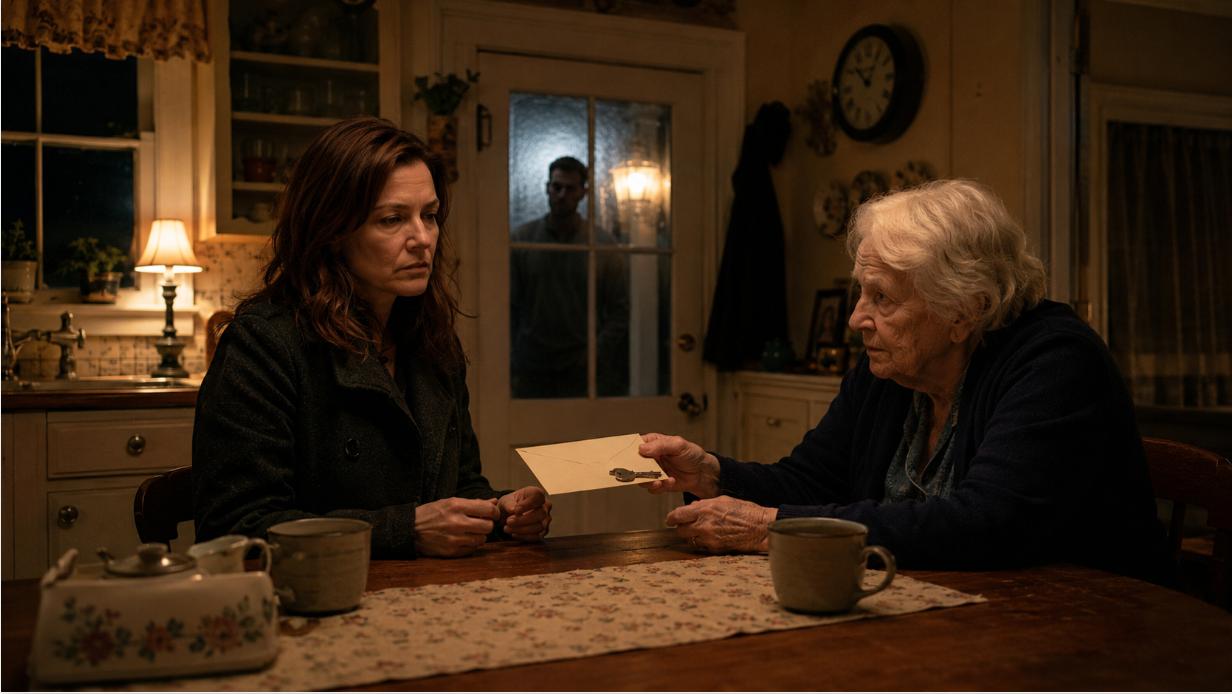
Ruth reached into the pocket of her cardigan and pulled out a small envelope. Cream-colored. Yellowed at the edges. My name was written across it in my mother’s handwriting.
Hannah Grace.
My breath caught.
Not Hannah Grace Whitmore.
Not formal.
Not legal.
Just Hannah Grace.
A mother calling her child home.
Ruth pushed it across the table.
“She told me to give this to you only if Richard tried to make you believe she left you with nothing.”
I stared at it.
“Why not give it to me right after the funeral?”
“Because she made me promise to wait until the house showed its teeth.”
“The house?”
Ruth’s eyes softened.
“That’s what she called it. Not Richard. Not the will. The house. She said once Richard thought he owned it, he would reveal what he really wanted.”
A chill moved over my arms.
I opened the envelope.
Inside was a brass key taped to a folded note.
The key was small, square-headed, and stamped with a bank number.
Beneath it, my mother had written:
Safe deposit box 318.
Miriam has the second key.
Do not go alone if Brent is missing.
I looked up.
“Brent came here.”
Ruth nodded once.
“Twenty minutes before I called you.”
“What did he say?”
“He was polite at first. That worried me.”
I almost smiled despite everything.
“He asked if Eleanor had ever left anything in my care. I said she left me friendship, common sense, and a recipe for peach cobbler. He did not enjoy that.”
“What did he do?”
Ruth’s gaze moved toward the back door.
“He went around the house after he left. I heard him near the kitchen window.”
My stomach tightened.
“You should have called the police.”
“I called you.”
“That is not the same thing.”
“No,” she said. “But it is what Eleanor asked me to do.”
Outside, a car rolled slowly past the house.
Too slowly.
Ruth and I both turned toward the dark kitchen window.
Headlights slid across the wall, touched the porcelain birds on the shelf, then vanished.
The grandfather clock ticked.
Once.
Twice.
Ruth stood.
“Kitchen light off,” she said.
I reached for the switch.
The room dropped into darkness except for the dim glow from the front room.
Ruth moved to the side of the window and lifted the curtain a quarter inch.
Her face did not change.
But her voice did.
“He’s across the street.”
My mouth went dry.
Brent.
“What is he doing?”
“Sitting in his car.”
I stepped toward the window, but Ruth snapped, “Don’t.”
I froze.
She let the curtain fall.
“You have your mother’s heart,” she said. “Try to borrow her brain for the next hour.”
Under different circumstances, I might have laughed.
Instead, I gripped the key until its teeth bit my palm.
“We need to call Miriam.”
“Already did.”
I stared at her.
Ruth lifted her chin.
“At my age, people assume slow means stupid. It does not.”
The phone on the wall rang.
Once.
Twice.
Ruth answered.
“Yes?”
She listened.
Then she looked at me.
“We’re coming now.”
She hung up.
“Miriam will meet us at First County Bank. They have a night manager for estate access. Apparently your mother arranged that too.”
“My mother arranged a bank opening at night?”
“Your mother arranged everything except the timing of her own death.”
The sentence sat between us.
Heavy.
True.
Then the back porch creaked.
Ruth’s hand went to the edge of the table.
Another creak.
Closer.
Someone was outside the kitchen door.
A shadow crossed the frosted glass.
My heart slammed against my ribs.
Ruth pointed silently toward the hallway.
I shook my head.
She pointed again.
This time like a woman who had survived eighty-one years and would not be argued with in her own kitchen.
We moved into the hall.
The doorknob rattled once.
Then a man’s voice came through the door.
“Hannah?”
Brent.
Not loud.
Not angry.
Almost friendly.
That made it worse.
“I know you’re in there.”
Ruth’s face turned to stone.
Brent knocked softly.
“Mrs. Bellamy, I’m sorry if I scared you earlier. I just need to talk to Hannah.”
I held my breath.
He knocked again.
“Hannah, this has gone too far. My dad’s hurt. You ran out with legal documents. That could be considered theft.”
Ruth rolled her eyes so hard I almost loved her.
Brent’s voice lowered.
“You don’t know what your mother did. She lied to everyone. She lied to you too.”
My fingers tightened around the folder.
That was the hook.
He knew exactly where to place it.
“You want to know why she left me a letter?” he continued. “You want to know why she wrote my name on that envelope?”
The hallway seemed to narrow.
Ruth touched my arm.
Do not answer.
Brent kept going.
“She wasn’t protecting you, Hannah. She was protecting herself.”
A hard thud hit the door.
Ruth flinched.
Then another.
The chain trembled.
I pulled out my phone and dialed 911.
Brent must have heard the keypad.
His voice changed.
“Hannah, don’t be stupid.”
The operator answered.
I whispered Ruth’s address.
Brent hit the door again.
Wood cracked near the frame.
Ruth reached into the umbrella stand and pulled out a black cane with a silver handle.
I stared at her.
She whispered, “My second husband was meaner than Richard and bigger than Brent.”
The door buckled once.
Then headlights swept across the kitchen from outside.
A car pulled into Ruth’s driveway.
Brent stopped.
The grandfather clock ticked.
From outside, a woman’s voice called, sharp and commanding.
“Brent Cole, step away from that door.”
Miriam Keller.
I had never been so relieved to hear a lawyer in my life.
Brent swore under his breath.
Footsteps moved off the porch.
A car door slammed.
Tires shrieked.
By the time the police arrived, Brent was gone.
But he had left muddy footprints on Ruth’s back steps.
And one smear of blood on the cracked doorframe.
Not his.
Richard’s, maybe.
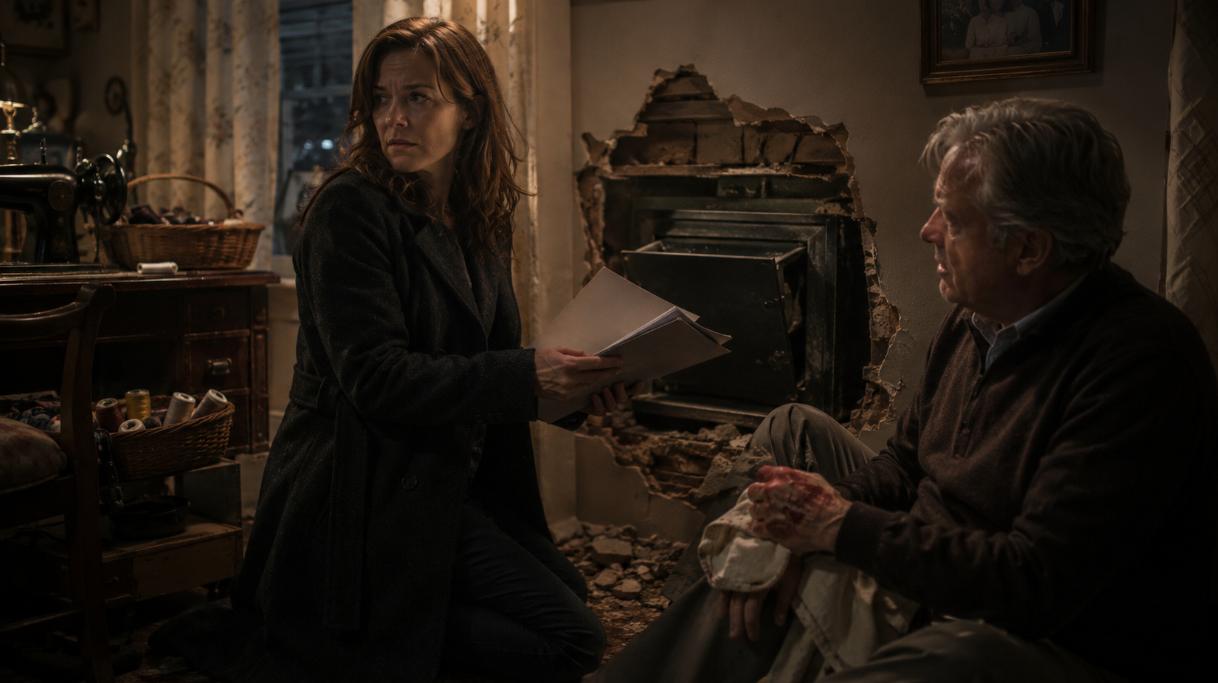
Or something he had taken from the sewing room.
Miriam stood in the kitchen while an officer took Ruth’s statement. She was in her late fifties, tall, Black, and elegant in a dark wool coat, with close-cropped hair and eyes that missed nothing. She had been my mother’s attorney for years, though I had only met her at the will reading.
That day, she had seemed professional.
Tonight, she looked personal.
“I should have told you,” I said.
She turned to me.
“No. Eleanor should have. But she was running out of courage and time.”
It was the kindest harsh thing anyone had ever said.
Ruth refused to go to the hospital to have her blood pressure checked.
“I have had high blood pressure since Nixon,” she told the officer. “It can wait.”
Twenty minutes later, we were in Miriam’s car.
Ruth sat in the back seat with her cane across her lap like a sword.
I sat in the passenger seat, clutching the folder and key.
Miriam drove without music.
The town was almost empty at that hour. Storefronts slept behind dark glass. Streetlights reflected in puddles. The bank clock glowed 12:37 a.m.
First County Bank stood on the corner of Main and Ash, a squat brick building with white columns and brass doors. A night manager let us in through a side entrance, his tie loose, his expression carefully neutral.
He did not ask questions.
People who manage bank vaults after midnight learn not to.
Downstairs, the air turned cool and dry.
The safe deposit room smelled like metal, carpet glue, and old secrets.
Miriam produced her key.
I produced mine.
The manager slid box 318 from the wall and carried it to a private room with a small table and two chairs.
Then he left us alone.
For a moment, none of us touched it.
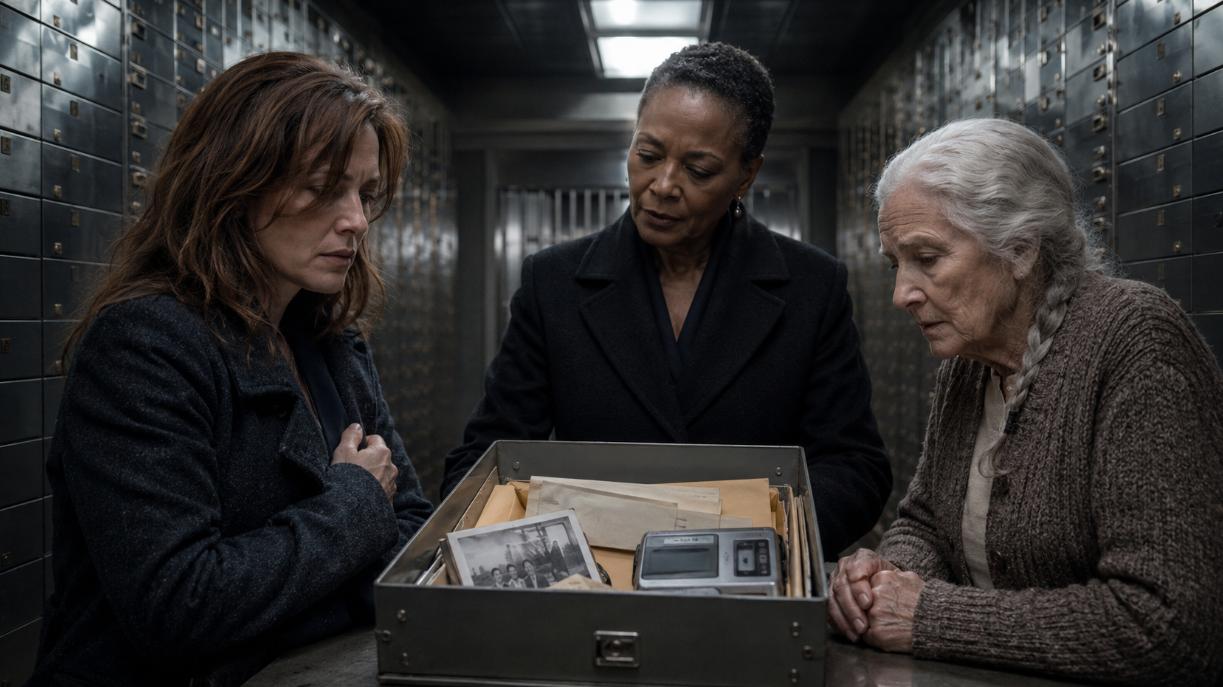
The metal box sat in front of me, long and gray, ordinary enough to hold tax papers or jewelry.
Instead, it felt like my mother’s last breath.
Miriam nodded.
“You should open it.”
My hands shook as I lifted the lid.
Inside were four things.
A cassette player wrapped in a scarf I recognized.
A thick envelope labeled TRUST DOCUMENTS — HANNAH.
A smaller envelope labeled BRENT.
And a photograph.
I picked up the photograph first.
It showed my mother standing in the backyard, younger by maybe ten years, wearing gardening gloves and laughing at something outside the frame. Beside her stood Richard.
But not the Richard I knew.
This Richard’s face was twisted in anger.
One hand gripped my mother’s upper arm hard enough to press the skin white.
The photo had been taken from across the yard.
Through a window, maybe.
On the back, in Ruth’s handwriting, was a date.
June 14.
Four years ago.
Ruth looked away.
“I took it,” she said quietly. “Not because I was nosy. Because Eleanor asked me to document things if I ever saw them.”
Miriam placed a hand on the table.
“That photograph is part of why she created the trust.”
I set it down carefully.
“What’s in Brent’s envelope?”
Miriam’s expression changed.
“Eleanor insisted it remain sealed unless Brent tried to claim part of the trust or interfere with your access.”
“He broke into Ruth’s porch tonight.”
“That qualifies.”
She opened the smaller envelope.
Inside was a single sheet of paper and a copy of a police report.
Miriam read first.
Her jaw tightened.
Then she handed it to me.
The police report was from twelve years ago.
A financial exploitation complaint.
Victim: Eleanor Whitmore.
Suspect: Brent Cole.
My eyes moved over the details.
Unauthorized credit card charges.
A forged check.
A missing debit card.
Complaint withdrawn.
No charges filed.
I looked up.
“Mom withdrew it?”
Miriam nodded.
“Richard begged her. Said Brent had a gambling problem. Said an arrest would ruin him.”
Ruth made a disgusted sound.
“Men always say ruin when they mean consequence.”
The letter to Brent was short.
Brent,
I forgave you once because I believed shame might teach you.
It did not.
If you are reading this, you have tried to take from Hannah what was never yours.
The contents of this envelope have been given to my attorney. If you attempt to challenge the trust, harass Hannah, enter my home without permission, or remove property, these records will be released to the proper authorities.
I am sorry no one loved you well enough to teach you boundaries.
But my daughter will not pay for that failure.
Eleanor
I sat back.
The room felt colder.
My mother had known.
About Brent.
About Richard.
About all of it.
And she had been building a wall around me while I thought she was simply enduring.
Miriam reached for the cassette player.
“This,” she said softly, “is the part Eleanor wanted you to hear with me.”
She pressed play.
For a second there was only static.
Then my mother’s voice filled the little bank room.
Frail.
Tired.
But unmistakably hers.
“Hannah Grace, if you are hearing this, I need you to breathe first.”
I covered my mouth.
Ruth looked down at her hands.
Mom continued.
“I know you are hurt. I know the will felt like abandonment. I let it happen that way because Richard needed to believe there was nothing left to fight for.”
The tape clicked softly as it turned.
“If I had left you the house in the will, Richard would have contested it. He would have delayed everything. He would have dragged you through court while you were grieving. He would have made you feel greedy for accepting what I wanted you to have.”
My eyes burned.
“So I gave him a will he could win.”
Miriam closed her eyes.
“But the will was never the real inheritance.”
The old air conditioner hummed above us.
“The house was already in trust. The lake property too. The accounts are protected. Miriam has the documents. Ruth has the key. I chose women Richard underestimated because underestimated women survive longer than proud men expect.”
Ruth gave one sharp nod.
Mom’s voice softened.
“I am sorry I could not tell you sooner. Every time I tried, I saw how tired you were. You had already lost your marriage. You had already come home with your heart in your hands. I did not want to hand you my fear too.”
A tear slipped down my face.
“I thought I was protecting you by staying quiet. Maybe I was wrong. Mothers can be wrong, even when we are trying to be brave.”
The tape crackled.
Then her voice changed.
There was strength in it now.
A final instruction.
“Do not give Richard the house. Do not give Brent mercy just because he calls his need love. Do not confuse peace with surrender. I did that for too long.”
I pressed my fist against my mouth.
“And Hannah…”
The pause nearly broke me.
“You were never a burden. You were the only person in that house who made it feel like home.”
The tape kept moving.
No one spoke.
“I left you the house not because you stayed. I left it to you because one day I hope you will learn you are allowed to stay somewhere without earning your place.”
The sound that came out of me was small.
Almost childlike.
Miriam placed a hand over mine.
Mom’s voice returned one last time.
“There is one more thing. Richard does not know about the lake account. Brent suspects something, but he does not know enough. If they come after you, let them. The records in this box will show who took what, who lied, and who mistook my silence for permission.”
Static rose.
Then, softer:
“I love you, my girl. I did not leave you. I was trying to leave a door open.”
The tape clicked off.
For a long time, the three of us sat in the bank’s private room without moving.
A lawyer.
An old neighbor.
A daughter with her mother’s voice still hanging in the air.
Finally, Miriam closed the cassette player.
“We need to secure the house,” she said.
I nodded, wiping my face.
“And Brent?”
Miriam gathered the papers.
“Brent has forced our hand.”
Ruth tapped her cane once against the floor.
“Good.”
We put everything back except the trust folder, the police report, and the cassette. Miriam signed the bank log. The night manager locked the box away again.
When we stepped outside, dawn had begun to thin the sky.
The first gray light touched the bank columns and the wet street beyond.
My phone rang as Miriam opened the car door.
Unknown number.
I answered.
No one spoke at first.
Then Brent’s voice came through.
Low.
Angry.
“You should’ve left it alone.”
I looked down Main Street.
Empty sidewalks.
Closed storefronts.
A delivery truck turning at the far intersection.
“Where are you?” I asked.
He laughed once.
“You think that trust makes you safe?”
Miriam reached for the phone, but I held up my hand.
Brent’s breathing filled the line.
“You don’t know what was in the envelope I took.”
My stomach tightened.
“What envelope?”
“The one your mother wrote to my father.”
The street seemed to tilt.
Richard.
Mom had written Richard a letter too.
Brent’s voice dropped.
“She didn’t just leave you the house, Hannah.”
A car engine started somewhere nearby.
“She left you the truth about how your father really died.”
The line went dead.
I stood there in the cold morning light, the cassette still warm in my coat pocket.
For the first time since my mother’s funeral, I understood something with perfect clarity.
The inheritance had never been about money.
It had always been about what my mother was too afraid to say while everyone was still alive.