The water looked perfectly clear.
The filter had been changed on schedule. The fountain was still running quietly, and from the outside, nothing seemed dirty enough to worry about.
Then the machine was taken apart.
Beneath the drinking tray, around the pump, and inside the narrow spaces most cat owners rarely inspect, a slippery layer had already begun to form.
That discovery changed the way four of the most popular cat water fountains of 2026 were judged.
Because the real question was no longer:
Which fountain has the most filters, the smartest app, or the most attractive design?
It became:
Which one does the best job of keeping used water away from the fresh water your cat drinks next?
The answer was not as obvious as expected.
One stylish fountain began developing buildup sooner than anticipated. Another could identify individual cats, but only if they agreed to wear a collar. One model was remarkably easy to clean, yet its health-tracking system did not always inspire confidence.
And the most expensive fountain handled used water in a completely different way.
But before revealing which model ranked first, there is something every cat owner should understand:
A fountain can look clean from above while hiding buildup in the exact places your cat’s water passes through every day.
That matters more than most owners realize.
The Problem Hiding Under the Tray

Most people buy a fountain because they want to improve their cat’s hydration.
Flowing water can be more appealing to some cats than water sitting in an ordinary bowl. Filters can help catch fur, dust, food particles, and other debris. Smart features may even record how often a pet drinks.
On paper, it sounds like a simple upgrade.
But a filter does not make a fountain maintenance-free.
Any device that constantly holds and circulates water can eventually develop biofilm. This is the thin, slippery layer that forms when microorganisms attach to a wet surface and begin building a protective community.
In a cat fountain, it may collect around the pump, beneath the tray, inside tubing, or along seams that are difficult to reach.
The most uncomfortable part is that the water may still look clean.
There may be no obvious smell. There may be no visible dirt floating in the bowl. Your cat may continue drinking as usual.
That is why many owners assume everything is fine until they fully disassemble the fountain.
The issue is not that every trace of buildup will automatically harm a cat. The issue is that clear-looking water can create a false sense of security.
Changing the filter is important, but it is only one part of the job.
If water continues passing through a pump, reservoir, or channel that has not been cleaned properly, a new filter cannot solve every problem inside the machine.
This became one of the most important criteria in the Cat Butler’s comparison.
Why Cat Hydration Is Easy to Misread

Cats are not always obvious when they are drinking too little.
Many domestic cats retain the low thirst drive of their desert-dwelling ancestors. Cats eating wet food receive much of their moisture from meals, while cats eating mostly dry food may need to drink more from bowls or fountains.
Even then, owners may not know how much water their cat is actually consuming.
In a multi-cat household, the problem becomes even harder.
You may see the water level dropping, but which cat is drinking? Is one pet visiting the fountain frequently while another barely approaches it? Has an older cat’s routine changed gradually over several weeks?
These questions matter because changes in drinking behavior can sometimes be worth discussing with a veterinarian.
A fountain cannot diagnose disease. A camera, app, or sensor should never replace professional veterinary care.
But reliable monitoring can give owners a clue.
It can show that a cat suddenly visited the fountain more often, stopped drinking at its usual time, or changed its routine in a way that would otherwise go unnoticed.
That means the best fountain should do more than circulate water.
It should be easy to clean, practical to maintain, and—if it claims to monitor health—accurate enough to be useful.
With those standards in mind, four models were tested and ranked.
The Four Contenders

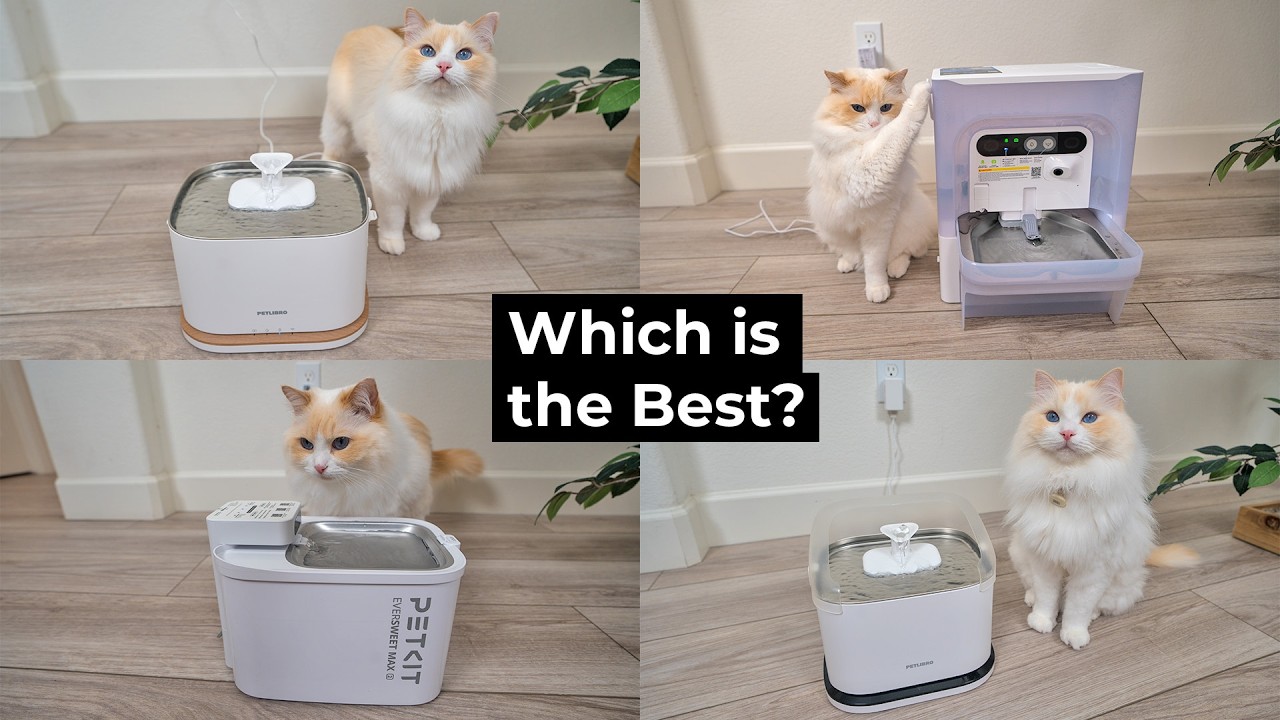
The comparison included:
- Petlibro Dockstream 2
- Petkit Eversweet Max 2 UVC
- Petlibro Dockstream RFID
- Petkit Eversweet Ultra
The Cat Butler tested the fountains with his two Ragdoll cats, Timo and Arya.
The video was sponsored by Petkit, a fact that should not be ignored when evaluating the result. However, the Cat Butler stated that the rankings were based on his personal experience using, cleaning, and comparing the products.
The fairest way to interpret the test is not to accept the winner blindly.
It is to look at the actual reasons each product gained or lost points.
And the first fountain revealed how quickly a polished design can lose its appeal once maintenance becomes part of the equation.
Fourth Place: Petlibro Dockstream 2
The Petlibro Dockstream 2 looks like the kind of fountain many cat owners would immediately consider buying.
It has a modern, minimal design. It does not look bulky or overly complicated. It also uses a four-layer filtration system designed to reduce hair, debris, odors, and impurities.
For an owner shopping on appearance and basic specifications, it seems like a strong option.
But after roughly two weeks, slippery buildup reportedly began forming inside the fountain.
That did not make the product unusable. Every fountain needs regular cleaning, and the rate of buildup can vary depending on the number of cats, room temperature, food placement, water quality, and cleaning schedule.
Still, it raised a concern.
If a fountain requires more frequent disassembly than the owner expects, maintenance can quickly become the product’s biggest weakness.
A fountain may be inexpensive to buy, but if it is frustrating to clean, owners may delay washing it. Once that happens, the benefit of the filtration system becomes less meaningful.
The Dockstream 2 may still suit a household that wants an affordable fountain and is prepared to clean it carefully.
But compared with the other models, it offered fewer advantages in monitoring, water management, and long-term maintenance.
Its fourth-place finish came with an important lesson:
The number of filter layers matters less if the areas around the pump are difficult to keep clean.
Third Place: Petkit Eversweet Max 2 UVC
The Petkit Eversweet Max 2 UVC performed better in one of the most practical categories: cleaning.
The model combines a four-stage filtration system with a UVC-equipped pump intended to help control bacterial growth.
UVC technology can be a useful addition, but it should not be mistaken for a complete cleaning solution. Pumps, trays, tanks, and wet surfaces still need to be washed.
Where the Max 2 became more appealing was its maintenance-friendly design.
Several components are dishwasher-safe, which can reduce the amount of scrubbing required by hand. This may sound like a minor convenience, but it can have a major effect on long-term hygiene.
A fountain that is easy to clean is more likely to be cleaned on time.
A fountain that is complicated to dismantle may remain dirty longer, no matter how advanced its technology appears.
The Max 2 also offered relatively manageable ongoing filter costs, making it a practical option for owners who do not want to pay premium prices year after year.
However, it lost points in health monitoring.
Its system could track drinking activity, but the Cat Butler found its monitoring less reliable than the strongest alternatives in the comparison.
In a home with one healthy cat, that may not matter much.
In a multi-cat household, or when one cat’s drinking pattern needs closer attention, unreliable identification can reduce the value of the feature.
The Max 2 did not win the test, but it may still be the most sensible choice for many owners.
It was not the smartest fountain.
It was not the most advanced.
But it was one of the easiest to live with.
Second Place: Petlibro Dockstream RFID
The Petlibro Dockstream RFID solved a problem that many multi-cat owners know well.
Traditional fountains may record that a pet approached or drank, but they can struggle to determine which cat was responsible.
This model uses an RFID tag attached to a collar.
When a tagged cat visits the fountain, the system can connect the drinking activity to that individual animal.
For owners with two, three, or more cats, this is a meaningful advantage.
Instead of seeing only that the fountain was used, they can monitor each cat separately.
That feature helped the Dockstream RFID climb to second place.
But it also introduced a new problem.
The system depends on the cat wearing a collar.
Not every cat tolerates one. Some remove collars repeatedly. Others become irritated, uncomfortable, or unusually cautious when something is placed around their neck.
For cats already comfortable with a properly fitted, cat-safe collar, RFID tracking may work extremely well.
For collar-free households, the fountain’s best feature may be impossible to use.
The model also shared some of the maintenance concerns seen in the standard Dockstream 2. Slippery buildup reportedly developed sooner than hoped, meaning regular disassembly and cleaning remained necessary.
The Dockstream RFID therefore became a highly specific recommendation.
It may be the best option in the group for owners who need individual monitoring and whose cats already wear collars.
But it is not automatically the best choice for every multi-cat home.
And this is where the ranking became more interesting.
The top fountain did not rely on a collar to tell cats apart.
It used a different system entirely.
The Question That Changed the Ranking
Before revealing the winner, the Cat Butler focused on a detail that rarely appears in ordinary product comparisons:
What happens to the water after a cat drinks from it?
Each time a cat drinks, saliva enters the water.
Small pieces of food may fall from the mouth, especially if the fountain is placed close to the feeding area. Hair, dust, and household debris may also collect in the tray.
In many fountains, that water returns to the main reservoir, passes through the filter, and circulates back into the drinking area.
The filter may catch part of the contamination.
But the system is still recirculating water that has already been used.
Three fountains in the comparison attempted to clean that water as it returned through the system.
The winner took a different approach.
It was designed to stop used water from returning to the fresh-water supply in the first place.
First Place: Petkit Eversweet Ultra
The Petkit Eversweet Ultra earned first place because of its one-way water-flow design.
Instead of relying only on a traditional recirculating reservoir, it separates fresh water from used or dirty water.
After water enters the drinking area and is used, the system can drain it away and replace it with fresh water.
This directly addresses the concern that shaped the entire test.
The winning feature was not simply an extra filter.
It was the decision to prevent old water from continuously mixing with the clean supply.
For owners worried about saliva, food particles, fur, or buildup being recirculated, this design offers an obvious advantage.
The Ultra also includes an AI-powered camera system that can reportedly identify and monitor up to 15 pets.
Unlike the RFID model, cats do not need to wear a collar.
The camera uses visual identification to connect each drinking session with an individual pet.
In a multi-cat household, this may allow an owner to see which cat drank, how frequently it visited the fountain, and whether its pattern changed over time.
That information cannot tell you whether a cat is healthy.
But it may reveal that something is different.
If one cat suddenly drinks much more often, visits less frequently, or changes its routine, the data may give the owner a reason to observe more carefully or speak with a veterinarian.
The health-monitoring tools are also presented without an additional subscription charge, increasing the long-term value for owners who dislike monthly fees.
However, there is a major limitation.
The Eversweet Ultra is expensive.
At approximately $249.99 in the comparison, it costs far more than a basic fountain and considerably more than some of the other smart models.
For many cat owners, that price will be difficult to justify.
A cat does not need artificial intelligence to drink safely. A well-maintained conventional fountain can work perfectly well. Multiple clean bowls placed around the home may also be effective, especially for cats that dislike moving water.
The Ultra makes the most sense for a specific kind of owner:
Someone with multiple pets, a strong interest in hydration monitoring, a desire to reduce water recirculation, and enough budget to pay for automation.
It is not essential for every home.
But based on the tested features, it offered the most complete solution.
The Final Ranking
The final order was:
- Petkit Eversweet Ultra
- Petlibro Dockstream RFID
- Petkit Eversweet Max 2 UVC
- Petlibro Dockstream 2
But the ranking should not be treated as a universal shopping list.
The best product depends on what problem you need to solve.
Choose the Petkit Eversweet Ultra if you prioritize fresh-and-used water separation, collar-free pet identification, and detailed monitoring.
Choose the Petlibro Dockstream RFID if individual tracking is essential and your cats already tolerate collars.
Choose the Petkit Eversweet Max 2 UVC if easy cleaning and manageable running costs matter more than perfect pet identification.
Choose the Petlibro Dockstream 2 if price and simple design are your main priorities—and you are prepared to clean it regularly.
The most expensive fountain is not automatically the best fountain for your cat.
The best one is the model your cat will actually use and you will realistically maintain.
What to Check Before Buying Any Fountain
Before buying, look beyond the headline features.
Ask whether the pump can be opened and cleaned properly. Check whether the fountain has narrow channels or hidden corners where residue may collect.
Find out which parts are dishwasher-safe.
Calculate the annual cost of replacement filters.
Check whether health tracking requires a paid subscription.
Consider whether your cat will tolerate a collar.
And most importantly, ask how often you are genuinely willing to dismantle and wash the machine.
No cat fountain is completely self-cleaning.
Filters help.
UVC systems may help.
Separate water tanks may help.
Cameras, sensors, and apps may help.
But every fountain still depends on a human being lifting the lid and cleaning what is underneath.
A simple fountain washed thoroughly and often may be more hygienic than an expensive smart device ignored for several weeks.
The Real Winner Is Not a Brand
The most important lesson from this comparison is not that Petkit finished first.
It is that water can look clean while the machine around it is not.
Most cat owners are not careless.
They buy fountains because they care. They replace filters because they want to do the right thing. They trust that clear water and a moving stream mean the system is working.
But filters cannot clean every hidden surface.
Once owners understand how water circulates, where biofilm forms, and how difficult the pump is to wash, they can make better choices.
For one household, the Eversweet Ultra’s one-way flow may be worth the cost.
For another, the Max 2’s easy maintenance may matter more.
For someone else, a basic fountain combined with a strict cleaning routine may be completely sufficient.
The real winner is the fountain that encourages your cat to drink while making it realistic for you to keep the entire system clean.
Tonight, take a closer look at the fountain already sitting in your home.
Do not only check the water in the tray.
Lift the lid.
Open the pump.
Run a finger around the hidden edges.
Look inside the narrow spaces where water remains after the machine is turned off.
You may find nothing unusual.
But if you discover a slippery layer where the water has been circulating, you will understand why this ranking changed—and why the cleanest-looking fountain is not always the one serving the cleanest water.